
When a news screen quotes the price of silver, the number often follows trading on a futures exchange in New York, not a coin shop or a vault. Miners, refiners, banks and funds all trade there, and their buying and selling through the day feeds the prices many traders watch.
That makes futures hard to ignore, even if you never plan to trade one. The contracts come in different sizes, end on fixed dates and ask for a cash deposit that the exchange can raise overnight. Margin increases in particular have arrived during some of silver's sharpest falls.
A futures contract is a promise to buy or sell a set amount of silver in a set month, at a price agreed today. Gains and losses are paid every day against one official settlement price. Each contract then ends in one of two ways: bars of metal change hands, or one side pays the other in cash. Knowing which applies, and when, is most of what separates a planned trade from a surprise.
On BloFin, you can trade the price of silver through the XAGUSDT Perpetual, which pays out in USDT and has no metal to deliver. Its mark price tracks an index price for silver.
What are COMEX silver futures?
COMEX silver futures are exchange-traded contracts to buy or sell silver for delivery in a set month, listed by COMEX, part of CME Group. The main contract covers 5,000 troy ounces. It is settled each day at an official price and ends in physical delivery. Three smaller contracts follow its price (source: CME Group, Silver futures contract specs, CME Group, client systems wiki).
In 1980, COMEX was a New York exchange with its own board of governors (source: Fortune, 1980, republished 2011), and by 2011 reports named CME Group as its owner (source: InvestmentNews, May 12, 2011). Its contracts now trade on CME Group's markets under COMEX rules (source: Reuters via Kitco, August 11, 2026, CME Group, Silver futures contract specs). That matters when you read silver's history: in 1980 COMEX set its own margins, while in 2011 CME Group raised them (source: Fortune, 1980, republished 2011, InvestmentNews, May 12, 2011).
Trading is heavy. CME said average daily trading across its silver futures hit a record $50 billion of notional value between January and June 2026 (source: Reuters via Kitco, August 11, 2026). Notional value means the full worth of the silver the contracts cover, not the cash traders put down.
The four CME silver futures contracts
CME lists four main silver futures that share one price. The standard contract, code SI, covers 5,000 troy ounces (source: CME Group, Silver futures contract specs). E-mini Silver, code QI, covers 2,500 ounces (source: CME Group, E-mini Silver futures contract specs), and Micro Silver, code SIL, covers 1,000 (source: CME Group, Micro Silver futures contract specs). The 100-Ounce Silver contract, code SIC, covers 100 (source: CME Group, 100-Ounce Silver futures contract specs).
Each contract moves in small price steps called ticks. The SI contract's smallest step is $0.005 an ounce, which is $25 on one contract (source: CME Group, Silver futures contract specs). E-mini Silver trades in steps of $0.0125, or $31.25 a contract (source: CME Group, E-mini Silver futures contract specs). Micro Silver moves in the same $0.005 steps as SI, and each one is worth $5.00 a contract (source: CME Group, Micro Silver futures contract specs). The 100-ounce contract moves in $0.01 steps, worth $1.00 a contract (source: CME Group, 100-Ounce Silver futures contract specs). SI calendar spreads, which trade one month against another, move in finer $0.001 steps worth $5.00 (source: CME Group, Silver futures contract specs).
The gap in size is easier to feel in dollars, so take the December 2026 contract's close of $51.942 an ounce on November 6, 2026 (source: Yahoo Finance price data, December 2026 silver futures). At that price, one SI contract controlled $259,710 of silver, one E-mini Silver contract $129,855, one Micro Silver contract $51,942 and one 100-ounce contract $5,194.20. A $1 move in the price per ounce changes each one by $5,000, $2,500, $1,000 and $100.
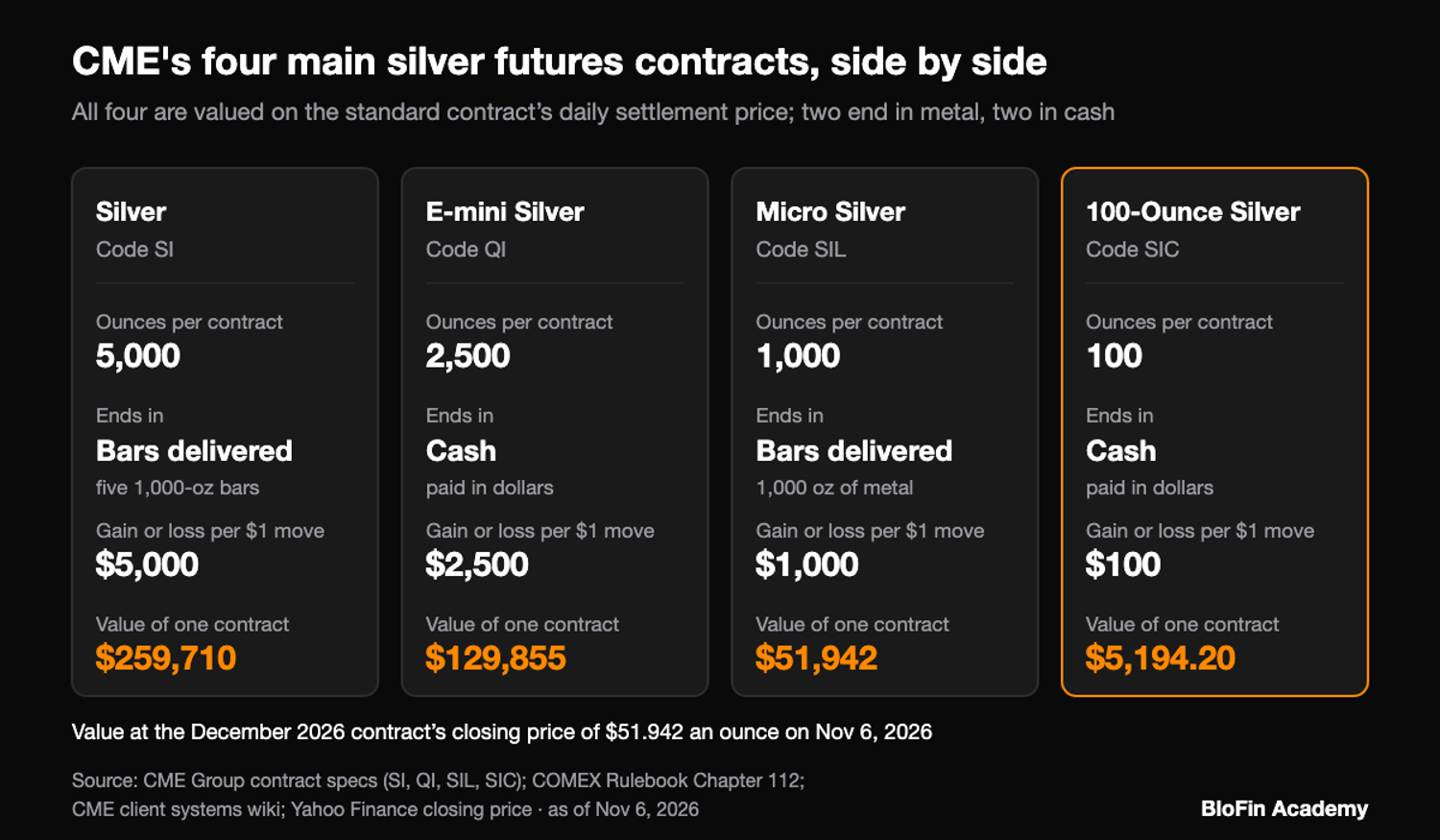
The newest and smallest contract, launched in February 2026, was built for retail traders. CME said its 1-Ounce Gold and 100-Ounce Silver contracts were both designed with a smaller notional size to appeal to them. In the first half of 2026, the 100-ounce contract traded an average of 17,800 contracts a day (source: Reuters via Kitco, August 11, 2026).
How the daily settlement price is set
Every CME silver contract is valued each day against one number: the settlement price of the standard SI contract. CME staff set it from trading in the month CME designates as active. They use the volume-weighted average price of trades between 12.24PM and 12.25PM CT, which is 6.24PM to 6.25PM UTC in winter (source: CME Group, client systems wiki).
The active month is the nearest of March, May, July, September and December that is not the spot month. Other months settle from calendar spreads, which are trades that buy one month and sell another at the same time (source: CME Group, client systems wiki). If no trades go through in the settlement minute, CME falls back to the last trade checked against the bids and offers, and then to the prior settlement, also checked against them (source: CME Group, client systems wiki). Both rules point at the same goal: one price, taken from the busiest part of the market.
The smaller contracts then copy the result, and Micro Silver takes the SI settlement exactly as it is. E-mini Silver and the 100-ounce contract round it to the nearest price step they trade in. In CME's own example, a December SI settlement of 78.821 becomes 78.82 on the 100-ounce contract (source: CME Group, client systems wiki).
That one minute is why COMEX matters beyond its own traders. A long position gains when the settlement rises and pays when it falls, and the cash moves between accounts every day. The same minute also fixes what the three smaller contracts pay, which is one reason COMEX sits at the center of how the silver price is determined, beside London and Shanghai.
Physical delivery and cash settlement
Two of the four contracts can end with metal changing hands, and two end in cash. SI is physically delivered in silver of at least 999 fineness (source: CME Group, Silver futures contract specs), as five bars of about 1,000 troy ounces each from a brand the exchange approves (source: COMEX Rulebook, Chapter 112). Micro Silver is also physically delivered (source: CME Group, Micro Silver futures contract specs).
E-mini Silver is cash settled at expiry (source: CME Group, E-mini Silver futures contract specs), and the 100-ounce contract is financially settled against the daily settlement price of the 5,000-ounce contract (source: Reuters via Kitco, August 11, 2026). Nobody who holds those two to the end receives metal, because the gain or loss is simply paid in dollars.
Delivery follows a fixed calendar. Trading in a month's SI contract ends at 12.25PM CT on the third-last business day of that month. Delivery can take place on any business day of the month (source: CME Group, Silver futures contract specs). For the December 2026 contract, trading ends at 12.25PM CT (6.25PM UTC) on Tuesday, December 29. A position still open after that has to be settled by delivery. The other way out is an exchange for related position (EFRP), a trade that swaps the futures for a matching position away from the exchange, such as physical silver (source: COMEX Rulebook, Chapter 112).
E-mini Silver and the 100-ounce contract stop earlier, on the third-last business day of the month before the contract month, so their December contracts end in November (source: CME Group, E-mini Silver futures contract specs, CME Group, 100-Ounce Silver futures contract specs). The December SI and Micro Silver contracts trade on into December itself (source: CME Group, Silver futures contract specs, CME Group, Micro Silver futures contract specs).
Expiry and rolling a silver futures position
Rolling means closing a contract before its delivery period and opening the same position in a later month, so you keep the exposure without handling metal. SI lists every month for the next 26 months, plus every July and December up to 60 months out (source: CME Group, Silver futures contract specs).
The smaller contracts list fewer months. E-mini Silver lists January, March, May, July, September and December over a 24-month period (source: CME Group, E-mini Silver futures contract specs). Micro Silver lists the next three months plus any January, March, May, July, September and December within 12 months (source: CME Group, Micro Silver futures contract specs). The 100-ounce contract lists March, May, July, September and December within 24 months, so a roll out of December goes straight to March (source: CME Group, 100-Ounce Silver futures contract specs).
Most trading crowds into the active month. CME moves that label to the next of those five months on the expiring month's First Position Date (source: CME Group, client systems wiki). If you want no metal, roll before that First Position Date, because delivery can start on the first business day of the delivery month (source: CME Group, Silver futures contract specs). For the December 2026 SI contract, CME's calendar gives the First Position Date as November 27, 2026, and first delivery as December 1 (source: CME Group, Silver futures calendar). A trader who holds December and wants to stay long sells December and buys March before November 27, and both legs can go through as one calendar spread trade. March's own First Position Date is February 25, 2027 (source: CME Group, Silver futures calendar).
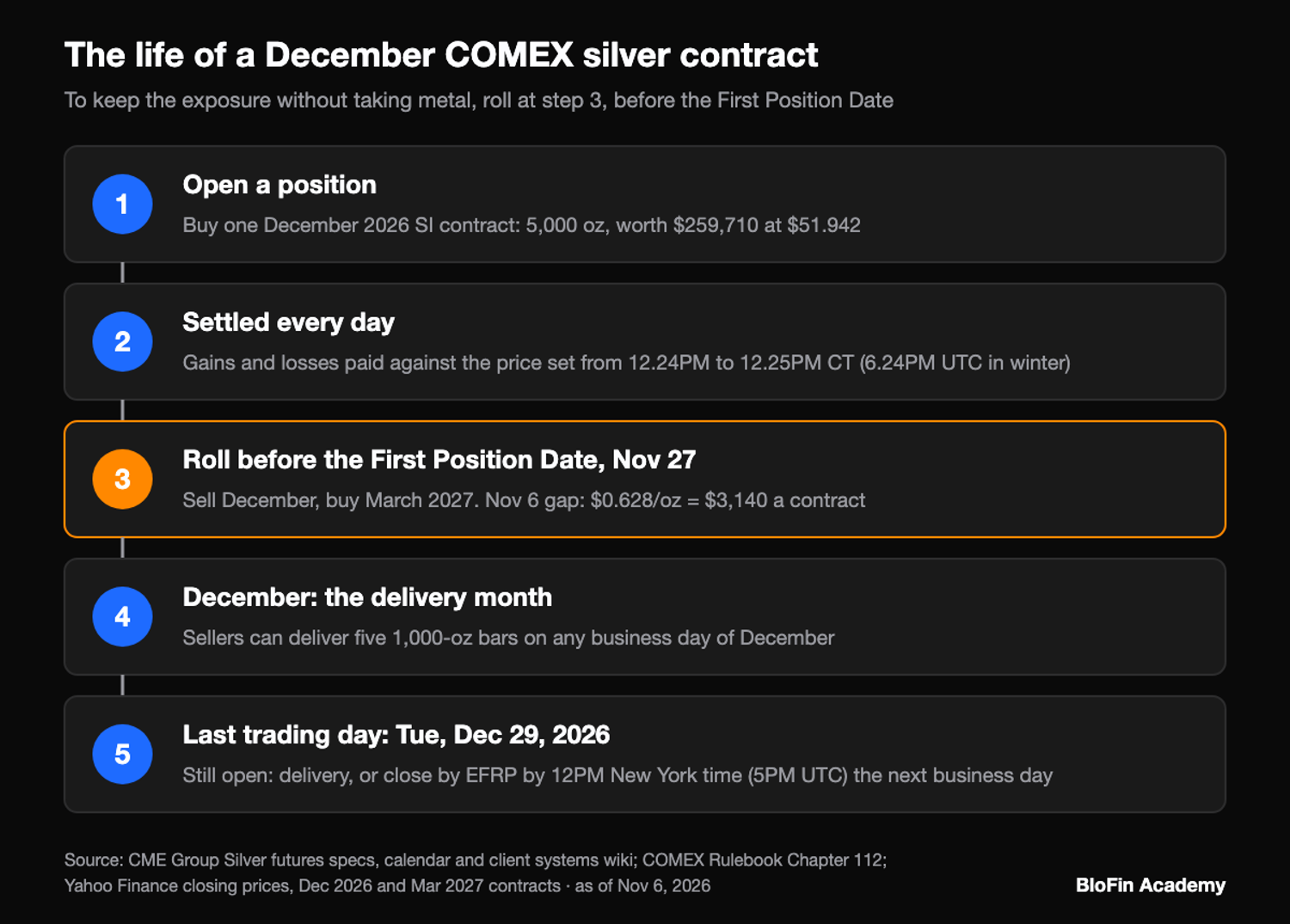
A roll moves you into a contract with a different price. On November 6, 2026, the March 2027 contract closed at $52.570 and December 2026 at $51.942 (source: Yahoo Finance price data, March 2027 silver futures). March sat $0.628 an ounce higher, a gap of 1.21%, which is $3,140 on one SI contract, or $62.80 for every 100 ounces. Nothing is charged for that gap on the day. But if both months later end at the same price, the March long gains $0.628 an ounce less than the December long would have.
When later months cost more than nearer ones, as they did here, the market is in contango. Each roll then moves a long into a higher-priced month, which has to rise by the gap before the position gains. When nearer months cost more, the market is in backwardation, and the roll works the other way.
Margin on COMEX silver futures
Margin is the cash deposit you must keep with your broker to hold a futures position, and the exchange sets the minimum. Initial margin is what you post to open the trade, and maintenance margin is the level your account must stay above. If losses take it below that level, the broker asks for more cash: a margin call.
Behind your broker sits the clearinghouse, and clearinghouses such as CME require brokers to post cash margins daily to cover their clients' positions (source: Finance Magnates, January 13, 2026). The same deposit idea runs through margin trading on crypto exchanges, where a small balance also holds a larger position.
Until January 2026, CME set silver margin as a fixed dollar amount per contract. After the close on January 13, 2026, it moved gold, silver, platinum and palladium to a percentage of notional value. Silver's maintenance margin started at 9% of notional for standard accounts and 9.9% for higher-risk accounts (source: Finance Magnates, January 13, 2026). The requirement now rises and falls with the price of silver, without a new notice each time.
Here is what that means in dollars. Say you hold one SI contract worth $259,710 at the December close of November 6. At a 9% maintenance rate, your account must keep at least $23,374 for it, and at 18%, the rate CME set in February (source: Reuters via Kitco, February 6, 2026), at least $46,748. A 5% fall in silver costs you $12,986 on that contract, more than half of that 9% level. A fall of that size can bring a margin call in a single day.
The rate itself moves. On November 10, 2026, CME listed maintenance margins of $21,078 for one SI contract and $4,216 for one Micro Silver contract, for the December 2026 contract period (source: CME Group, silver margins). That is about 8% of one SI contract's value of $259,710. It sits below the 9% maintenance rate CME started with in January. Those dollar figures change as CME updates them, so check the current requirement with your broker before you choose a size. If you would rather trade silver in hundredths of an ounce, open the XAGUSDT Perpetual trading page and check its live mark price and funding rate first.
Exchange margin changes from 1980 to 2026
Exchanges typically raise margins when price swings grow (source: Reuters via Kitco, February 6, 2026). Each contract's possible daily loss grows with the swings. Higher margins force some traders to add cash or cut positions, and in 1980 and 2011 silver fell hard after a run of increases. Prices have also risen after increases and fallen after cuts, though.
During the rally of 1979 and early 1980, Fortune reported, COMEX raised margins from $2,000 to $60,000 and sharply cut position limits. From January 21, 1980, it allowed only trades that closed positions. That rule caught the Hunt brothers' silver position, their Saudi partners and smaller traders alike: they could sell but could not buy. Fortune calls it the rule that undid the Hunts. The collapse came on March 27, the day later called Silver Thursday (source: Fortune, 1980, republished 2011).
In 2011, CME raised silver margin five times from April 25. The deposit for a new speculative position rose to $21,600 a contract after May 9, up from $11,745 two weeks earlier, an increase of 84%. Before the last increase took effect, silver had already fallen 27% from its three-decade high of $49.845 on April 25 (source: InvestmentNews, May 12, 2011). At the front-month close of $37.11 on May 9 (source: Yahoo Finance, silver front-month futures), the new deposit was about 11.6% of one contract's value, which sits inside the range CME used in 2026.
In 2026 the steps came faster. Reuters reported that CME had raised margins three times since the switch to percentages, on January 30, February 2 and Thursday, February 5. The last of those lifted COMEX 5000 Silver futures to 18% from 15%, effective after the close on February 6 (source: Reuters via Kitco, February 6, 2026). Newsquawk reported a cut to 14% from 18% on March 5 (source: Newsquawk, March 5, 2026). Börse Express reported that the standard initial rate fell to 10% from 11% from May 29, CME's second cut within two months (source: Börse Express, May 31, 2026). Whether CME's circuit breakers worked on January 30, the day of the first increase after the switch, is part of silver's volatility in a crash.
Set the price against each change and both directions show up. The front-month futures close is given for each date, with the move over the next 5 and 20 trading days (source: Yahoo Finance, silver front-month futures). Reports date every 2026 change shown here and the last of 2011's five increases. The earlier 2026 cut to 11%, any change since May 29, and the changes from mid-2011 to 2025, including at least three in late 2025, have no published date (source: Finance Magnates, January 13, 2026, Börse Express, May 31, 2026).
Date | Margin change | Date basis | Close that day | Next 5 days | Next 20 days |
|---|---|---|---|---|---|
May 9, 2011 | fifth rise since April 25 | effective after this day | $37.11 | -8.0% | -0.2% |
January 13, 2026 | switch to 9% of notional | effective after the close | $85.88 | +7.4% | -2.5% |
January 30, 2026 | rise | date as reported | $78.29 | -2.0% | +12.8% |
February 2, 2026 | rise | date as reported | $76.78 | +6.9% | +8.0% |
February 6, 2026 | rise to 18% | effective after the close | $76.74 | +1.5% | +9.5% |
March 5, 2026 | cut to 14% | date as reported | $81.69 | +3.7% | -11.0% |
May 29, 2026 | initial cut to 10% | effective | $75.62 | -8.8% | -23.1% |
The three 2026 increases came within one week, so their 20-day windows overlap and count as one episode. After that burst the price was higher 20 trading days later, a rebound from the January 30 close, which came on a day the front month fell 31.3%. The price was lower 20 days after both dated cuts, while the 5-day moves were mixed. A hike answers volatility that has already happened, so it can land near the end of a fall as easily as at its start. A margin change tells you that risk has been repriced, and silver has gone both ways afterwards.
Open interest and the Commitments of Traders report
Open interest is the number of futures contracts still open at the end of a day, each with a buyer and a seller. On November 3, 2026, COMEX silver futures-only open interest was 115,583 contracts, or about 577.9 million ounces. The figure comes from the weekly Commitments of Traders data of the Commodity Futures Trading Commission (CFTC) (source: CFTC, historical Commitments of Traders).
That level is low by recent standards. It is 66.9% of the weekly average from 2016 to 2025, which was 172,723 contracts. The 2026 low of 96,932 on May 5 was the smallest count since December 2011 in the CFTC's weekly history files (source: CFTC, historical Commitments of Traders). At the December close of November 6, the November 3 total was worth about $30.0 billion.
The report splits the large positions into groups, and producers, merchants, processors and users are the miners, refiners and manufacturers who hedge. On November 3 they held 18,212 contracts short against 5,067 long, while swap dealers held 22,636 long and 44,247 short, a net short of 21,611. Managed money, the group that covers hedge funds and other money managers, held 17,522 long and 13,487 short, a net long of 4,035. Other reportable traders held 19,480 long and 2,264 short (source: CFTC, historical Commitments of Traders).
That net long is small for managed money. Across 1,065 weekly reports since June 2006, its net position was at or below this level in only 14.8% of weeks, and since January 2024 in only 4.7% of 149 weeks. Its largest net long was 98,564 contracts in April 2017, and the group was last net short in February 2024 (source: CFTC, historical Commitments of Traders).
Traders often read a shift in fund positioning as a signal, so it is worth testing. On the weekly data since 2006, the change in managed money's net position and the same week's percentage change in the front-month price have a correlation of 0.45. That means they tend to move together. Against the next week's percentage price change, the correlation is about zero, and in 2026 alone it is -0.12, over only 43 weeks. These figures use Yahoo Finance front-month closes on each report's Tuesday. The report shows where funds stood after a move, and so far it has said little about the next one.
Position limits and the risk of a corner
A position limit caps how many contracts one trader can hold. Under a CFTC rule that took effect in March 2021, COMEX silver is one of five metals contracts with federal limits in the spot month. Those limits are set at or below 25% of the estimated deliverable supply, and traders have had to comply since January 1, 2022 (source: Federal Register, position limits final rule).
The spot month is the period that starts just before delivery notices can be issued and runs until the contract expires. Outside it, the rule leaves silver to limits and accountability levels set by the exchange. A trader whose position passes an accountability level must, if the exchange asks, explain the position and stop adding to it or reduce it in an orderly way. The rule cites the law's stated purposes, among them to deter and prevent market manipulation, squeezes and corners (source: Federal Register, position limits final rule).
The contrast with 1980 is timing. In Fortune's account, COMEX cut position limits only as the crisis grew, when the large positions were already built. A standing spot-month limit is in place before anyone builds a position, rather than imposed once the crisis has grown.
The JPMorgan spoofing case and manipulation claims
In September 2020, JPMorgan agreed to pay $920.2 million to settle CFTC charges of spoofing and manipulation in precious metals and US Treasury futures. It was then the largest monetary relief the CFTC had ever imposed (source: CFTC, release 8260-20). On the same day, the Justice Department announced a deferred prosecution agreement with the bank on wire fraud charges.
The CFTC found that from at least 2008 through 2016, traders on JPMorgan's precious metals and Treasuries desks placed hundreds of thousands of orders they meant to cancel before they filled. The orders covered gold, silver, platinum and palladium futures, as well as Treasury futures. They sent false signals of supply or demand so that the traders' other orders would fill, and in many instances they caused artificial prices (source: CFTC, release 8260-20).
The case shows that traders at a major bank broke the rules in silver futures for years, and that regulators caught and punished it. It concerns orders placed to move prices for the desk's own trades. That is a different claim from the idea that silver has been held below its value for decades, a claim the CFTC's release does not make. Test any manipulation claim the same way, by asking what conduct it names, in which market and which years, and what a regulator or court has found.
COMEX futures beside the XAGUSDT Perpetual
BloFin's XAGUSDT Perpetual covers 0.01 XAG per contract, and XAG is the code for one troy ounce of silver. That is one ten-thousandth of CME's 100-ounce contract, and the perpetual settles in USDT. Instead of a monthly roll, funding payments pass between long and short positions every four hours.
Leverage rests on the same deposit idea in both markets. A small margin holds a larger position, and losses that eat through the margin can lead to liquidation of a leveraged position.
The two markets also differ in size, costs and access, the trade-offs behind choosing between XAGUSDT and COMEX futures. CME's 100-ounce contract now trades at all hours every day, apart from maintenance windows of 4PM to 4.02PM CT on weekdays and 2AM to 4AM CT on Saturdays, one of several silver market trading schedules (source: CME Group, 100-Ounce Silver futures contract specs). In winter, those windows are 10PM to 10.02PM and 8AM to 10AM UTC.
Looking to trade silver? To get started, you'll need to first create a BloFin account, fund your account with cryptocurrency, and navigate to the XAGUSDT Perpetual trading page.

Frequently asked questions
When do the December 2026 E-mini and 100-ounce silver contracts stop trading?
Both stop trading on Wednesday, November 25, 2026, which is 34 days before the December SI contract does (source: CME Group, 100-Ounce Silver futures calendar, CME Group, Silver futures calendar). Trading in the 100-ounce contract ends at 12.25PM CT (6.25PM UTC) (source: CME Group, 100-Ounce Silver futures contract specs). E-mini Silver stops on the same day, under the same rule (source: CME Group, E-mini Silver futures contract specs). The March 2027 100-ounce contract stops on February 24, 2027 (source: CME Group, 100-Ounce Silver futures calendar).
How much can a silver bar delivered on COMEX weigh?
COMEX Rulebook Chapter 112 sets the weights. Each of the five bars in an SI delivery is cast at about 1,000 troy ounces, with a weight tolerance of 10% either way. The whole delivery may also vary by 10% from 5,000 ounces. A bar weighed in grams is converted by dividing by 31.1035 and rounding to the nearest tenth of an ounce (source: COMEX Rulebook, Chapter 112).
Can a silver futures position be closed after the last trading day?
An SI contract can, for a short time. COMEX Rulebook Chapter 112 allows an exchange for related position (EFRP) in an expired contract until 12PM New York time on the business day after trading ends. That is 5PM UTC in winter. After trading ends, an EFRP can only close a position, never open one. E-mini Silver and 100-ounce contracts still open at the end are settled in cash (source: COMEX Rulebook, Chapter 112, CME Group, E-mini Silver futures contract specs, CME Group, 100-Ounce Silver futures contract specs).
What does a COMEX silver futures code such as SIZ26 mean?
The code names the product, the month and the year. SI is the 5,000-ounce contract, and the month follows as a single code, such as H for March, K for May, N for July, U for September and Z for December (source: CME Group, client systems wiki). The digits give the year. CME's settlement examples use one digit, as in SIZ6. Its product calendar and Yahoo Finance use two, as in SIZ26. Both mean the December 2026 SI contract. The smaller contracts use the same month codes, and CME's settlement example uses SICZ6 for the December 2026 100-ounce contract (source: CME Group, client systems wiki, CME Group, Silver futures calendar, Yahoo Finance price data, December 2026 silver futures).
Why can the E-mini Silver settlement differ from the SI settlement?
E-mini Silver trades in $0.0125 steps, so CME rounds the SI settlement to the nearest of them, and the two can differ by a fraction of a cent. CME says that rounding is for display: the settlement on its Daily Bulletin, used to mark E-mini positions to market, matches the full-size contract's (source: CME Group, client systems wiki).
Researched and written by the BloFin Academy editorial team with AI-assisted drafting. All facts independently verified. Primary sources include CME Group's silver contract specifications, margins and settlement procedures, COMEX Rulebook Chapter 112 and CME's product calendars, the CFTC's Commitments of Traders reports, its 2020 JPMorgan release and its 2021 position-limits rule, Reuters, Kitco and Fortune, and BloFin's XAGUSDT Perpetual contract details, current as of November 10, 2026.
Nothing in this article constitutes financial advice, and nothing in it is a recommendation to buy, sell or hold silver futures or any other silver product. A futures position can lose more than its margin, an exchange can raise margin overnight, and a contract held into its delivery month can leave you owing metal or cash you did not plan for. On the XAGUSDT Perpetual, leverage can magnify losses and lead to liquidation, and funding can cost a position every four hours. Do your own research and consider your risk tolerance before you trade on BloFin.