
When a government decides that a raw material matters to its safety, it has three main tools. It can tax the material at the border, limit who may ship it abroad, or ration how much may come in. Silver has recently met all three kinds of decision: a US tariff review that ended with no tariff, Chinese export licensing, and Indian import duties and licenses. Traders read each new notice for what it could mean for supply.
Headlines and the rules often say different things. In early 2026, talk of silver critical mineral tariffs followed a US decision that set no tariff at all and reports of Chinese export restrictions. The Silver Institute, an industry group, calls those reports of Chinese limits wrong, using the word erroneous (source: Silver Institute, World Silver Survey 2026).
Each of these rules rests on a document anyone can read. There is a US government list, a decision by the President under US trade law, a notice from China's trade ministry and a set of Indian customs and trade orders. Set next to the prices from the days they landed, those papers show what each rule does to silver and what it leaves alone.
On BloFin, silver's price trades through the XAGUSDT Perpetual, a contract on XAG, the market code for silver. It pays out in USDT and never delivers any metal. A trade-policy decision therefore reaches you as a price move rather than as a customs bill. That is why the timing of each decision, and how far the price swung around it, matters most to a trader.
What is silver's critical mineral status?
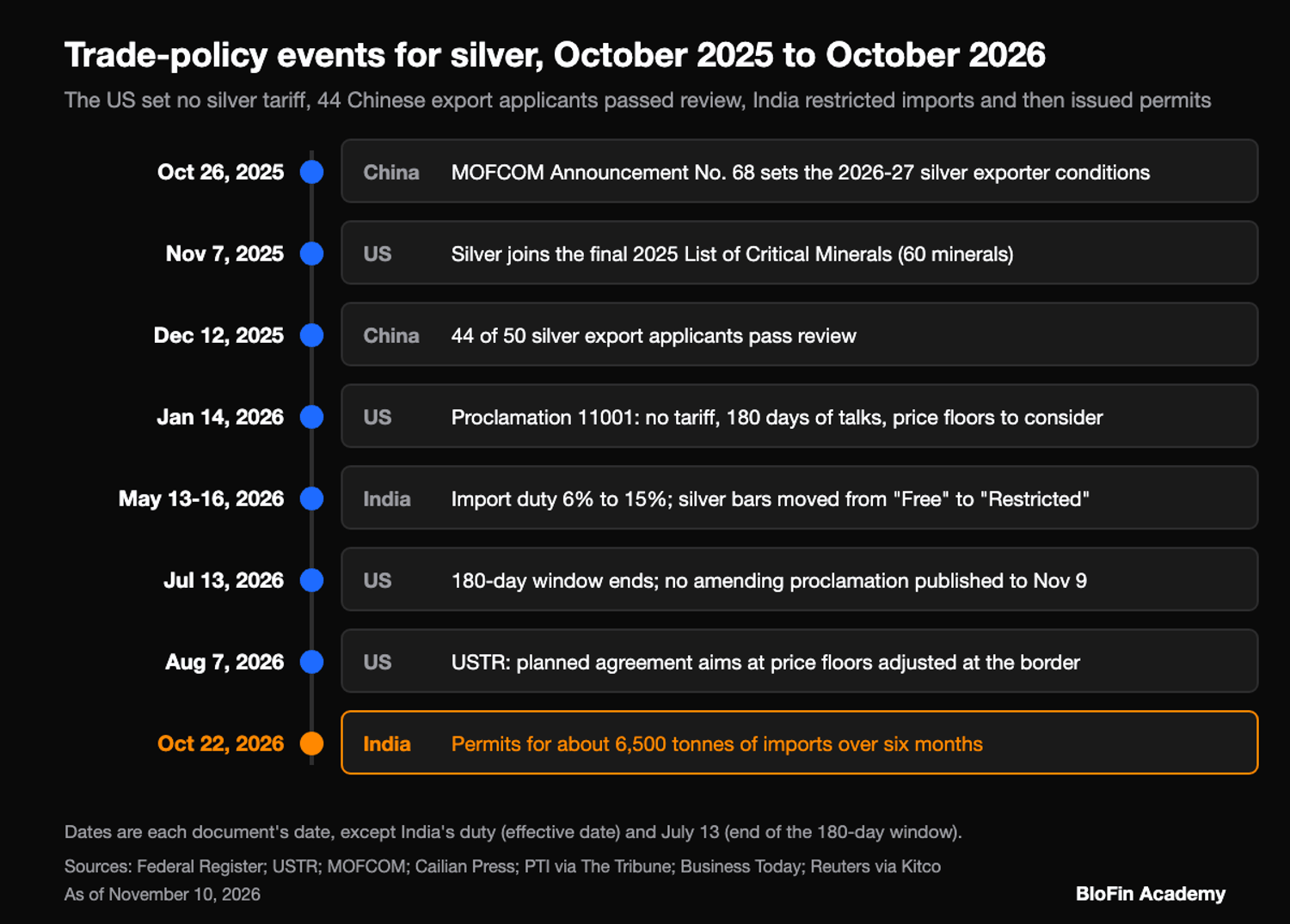
Silver's critical mineral status means it is one of 60 minerals on the US Geological Survey's final 2025 List of Critical Minerals, published on November 7, 2025 (source: Federal Register, Final 2025 List of Critical Minerals). Silver was not on the 2022 list. Being on the list puts no tax on the metal, because a tariff needs a separate trade decision.
The US Geological Survey (USGS) builds the list from data on supply, demand and how concentrated production is. It also revises the list as that data changes (source: Federal Register, Final 2025 List of Critical Minerals). Silver was one of six minerals that the August 2025 draft proposed to add, and the final notice kept it about ten weeks later.
The same notice lists silver as a by-product or co-product of other mining. It names zinc, lead, copper and gold as the main metals it comes with (source: Federal Register, Final 2025 List of Critical Minerals). Primary silver mines gave only 26% of mined silver in 2025, so about three-quarters came from mines run for other metals (source: Silver Institute, World Silver Survey 2026). More than half of the silver used each year goes into industrial uses such as electronics and solar panels rather than into bars and coins (source: Silver Institute, World Silver Survey 2026).
What did Proclamation 11001 decide?
Proclamation 11001, signed on January 14, 2026, put no tariff on processed critical minerals. It agreed with a Commerce Department finding that these imports threaten to harm US national security. It then told US negotiators to seek deals with trading partners and to consider price floors (source: Federal Register, Proclamation 11001).
The decision closed a probe under Section 232 of the Trade Expansion Act of 1962. That law lets the President limit imports that threaten national security. The Secretary of Commerce sent his report on October 24, 2025 (source: Federal Register, Proclamation 11001). The proclamation also notes that in 2024 the United States relied on imports for all of its supply of 12 critical minerals, and for at least half of 29 more.
The proclamation does not name silver, but it does spell out a fallback. Depending on how the talks go, the President says he may later consider other remedies, including minimum import prices for some critical minerals. Section 232 also lets him take other action if no deal is reached within 180 days. The Secretary of Commerce and the Trade Representative had to report on the talks within that window (source: Federal Register, Proclamation 11001).
For silver, the decision kept the duty at zero but left the threat of a later price floor or import limit alive. Kitco reported that the proclamations came out on the evening of Wednesday, January 14. It said silver came under heavy selling pressure overnight (source: Kitco, January 15, 2026).

How did silver trade after Proclamation 11001?
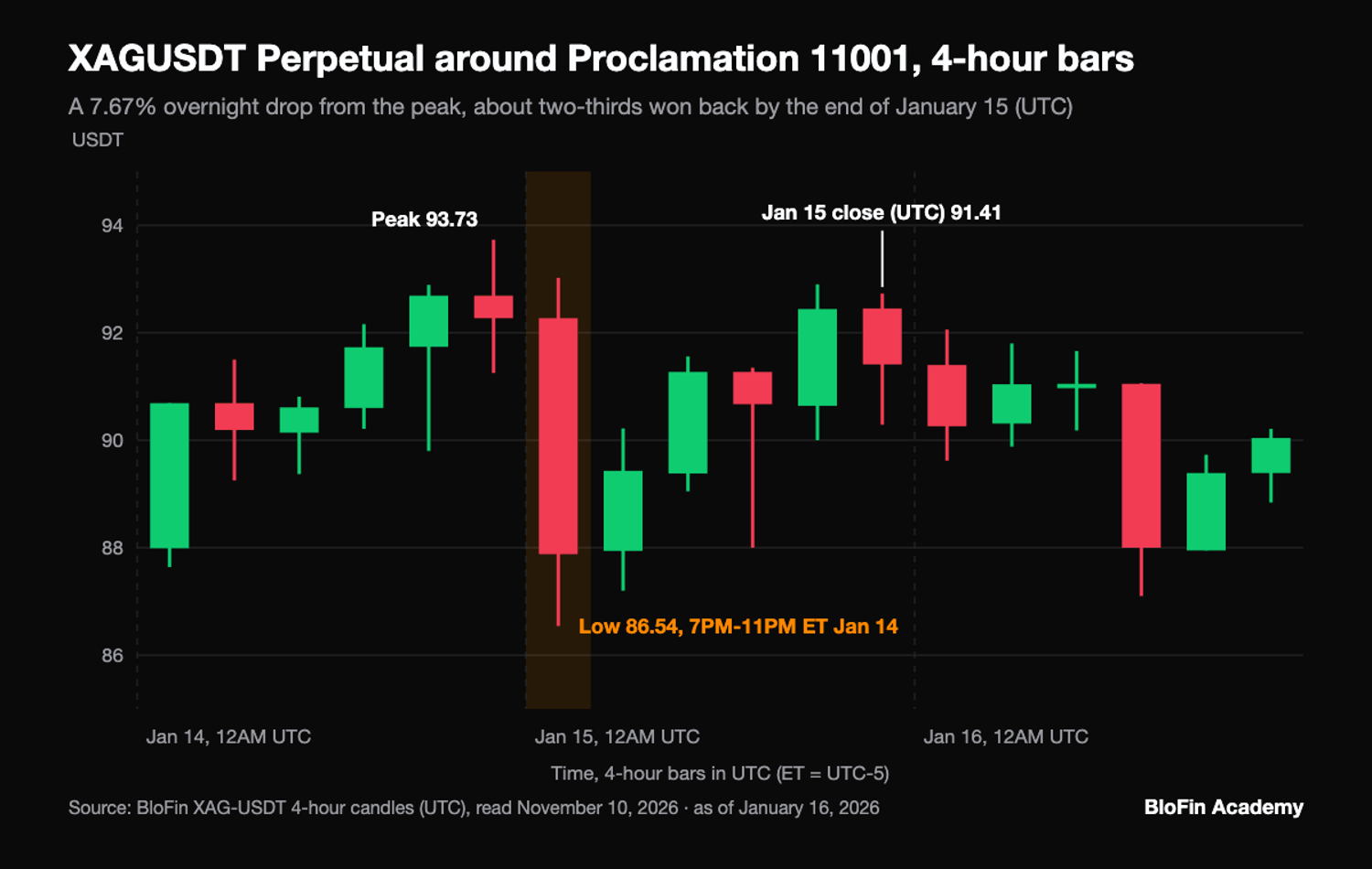
Silver fell sharply overnight after Proclamation 11001 and won back most of the drop within a day (source: Nasdaq, SLV historical prices). SLV, the iShares Silver Trust, which holds silver bars for its investors, closed 1.47% lower on January 15, 2026 than on January 14. Kitco reported a fall of more than 3% (source: Kitco, January 15, 2026), and ING reported one of more than 7% (source: ING THINK, January 15, 2026).
The figures differ because each one measures a different window. Kitco's figure was the change on the day when it reported on January 15. Spot silver was down more than 3% then, after a high of $93 and lows near $86 (source: Kitco, January 15, 2026). ING's Ewa Manthey measured the fall on Thursday from a record above $93, at more than 7%. She added that prices had since won back much of the drop (source: ING THINK, January 15, 2026).
BloFin's own 4-hour bars for the XAGUSDT Perpetual show the same shape in more detail. The price peaked at 93.73 in the bar from 8PM UTC on January 14 to 12AM UTC (3PM to 7PM ET). In the next bar, from 12AM to 4AM UTC (7PM to 11PM ET), it fell as low as 86.54. That low was 7.67% under the peak (source: BloFin XAGUSDT Perpetual 4-hour candles).
By the end of the UTC day on January 15, the perpetual stood at 91.41. That was only 0.93% under the previous UTC day's close of 92.27, so about two-thirds of the overnight drop had been won back (source: BloFin XAGUSDT Perpetual daily candles). The UTC day ends at 7PM ET (12AM UTC on January 16).
SLV's 1.47% close-to-close fall sits between the perpetual's 7.67% overnight drop and its 0.93% daily change. Its closes at 4PM ET (9PM UTC) on January 14 and 15, at $84.56 and then $83.32, fall on either side of the evening news (source: Nasdaq, SLV historical prices, Kitco, January 15, 2026).
Analysts linked the fall to the decision itself. BMO Capital Markets, quoted by Kitco, described a reactionary sell-off on the news. It expected the drop to be transient, because the President had not fully ruled out tariffs (source: Kitco, January 15, 2026). A 4-hour bar hides the path inside it. To follow the price on the next policy headline, open the XAGUSDT Perpetual page and watch the mark price used for liquidation beside the last traded price.
What happened after the 180-day deadline?
The 180-day window in Proclamation 11001 ran to July 13, 2026. It closed with no tariff under that proclamation. No later order from the President has changed it (source: Federal Register, Proclamation 11001). Silver therefore still faces no duty under Proclamation 11001.
A separate 10% import surcharge began on February 24, 2026, for 150 days, under Section 122 of the 1974 Trade Act. It left out metals used in currency and bullion. Its Annex II lists silver bullion and doré, code 7106.91.10, among the goods exempt from it (source: Federal Register, Proclamation 11012).
Talks on critical minerals run through the Office of the US Trade Representative (USTR). On August 7, 2026, USTR said its planned Agreement on Trade in Critical Minerals aims to set price floors for specific minerals, phased in and adjusted at the border. The plan also covers common standards across like-minded trading partners. USTR said the design draws on nearly 2,500 comments sent in after a notice of February 26, 2026 (source: USTR, August 7, 2026).
The same statement welcomed new S&P Global price benchmarks for critical minerals, including gallium, germanium, tungsten, antimony and two rare earths, neodymium and praseodymium. Silver is not among the minerals it names (source: USTR, August 7, 2026). A border price floor would hit silver only if a later deal or order from the President covers it.
Until a document names silver, the tariff question stays a risk rather than a rule. In 2025, before any decision existed, that risk showed up most clearly in the gap between silver prices in New York and in London.
What was the COMEX premium during the tariff debate?
The COMEX premium was the extra price that silver in New York carried over silver in London while traders feared a US tariff on imported metal. The Silver Institute says the exchange-for-physical (EFP) premium on the CME jumped to around $0.80 an ounce in 2025. That was higher than during COVID (source: Silver Institute, World Silver Survey 2026).
An EFP trades a futures contract for an equal quantity of physical silver, so its price shows the gap between a COMEX future and metal held in London. When that gap is wide, flying or shipping bars across the Atlantic to New York turns a profit. The Silver Institute counts about 225 million ounces added to CME vaults between December 2024 and early October 2025, while London stocks fell (source: Silver Institute, World Silver Survey 2026).
The fear lasted even though silver bars stayed free of tariffs after the April 2, 2025 tariff announcement. That tariff-free status was repeated in late August, yet CME stocks kept rising to a record in early October 2025. They ended 2025 at 449.4 million ounces, 41% more than the 318.6 million of a year earlier (source: Silver Institute, World Silver Survey 2026).
London paid for that flow. Outflows tied to tariffs, heavy investment buying and years of deficits cut the metal in London held outside exchange-traded funds to 136 million ounces at the close of September 2025, a record reported low. The squeeze that broke out in October was then set off by strong demand from India (source: Silver Institute, World Silver Survey 2026).
After that, the flow turned the other way. By the time the survey was written in 2026, 199 million ounces had left CME stocks from their peak. The Silver Institute notes that this happened even though silver had been named a critical mineral in late 2025 (source: Silver Institute, World Silver Survey 2026). The listing on its own did not keep the metal in New York.
How does China license silver exports?
China licenses silver exports by naming the companies allowed to ship the metal, under state trading rules set by its Ministry of Commerce (MOFCOM). MOFCOM Announcement No. 68 of 2025, dated October 26, 2025, set the conditions for firms that want to export tungsten, antimony and silver in 2026 and 2027 (source: MOFCOM, Announcement No. 68 of 2025).
The ministry gives two aims: to protect resources and the environment, and to tighten export management of rare metals. A firm that already holds the right must have exported silver in every year from 2022 to 2024. A new producer must have made at least 80 tonnes of silver in 2024, about 2.57 million ounces, or 40 tonnes in China's western regions (source: MOFCOM, Announcement No. 68 of 2025).
The notice sets rules for who may export, and it puts no cap on how much they may ship. Of the 50 firms that applied, 44 passed review: 32 of the 34 existing exporters and 12 of the 16 newcomers. Cailian Press reported that the list was on public notice from December 12 to 18, 2025 (source: Cailian Press, December 12, 2025).
Kitco itself wrote of China's new restrictions on exports in January 2026. The Metals Focus analysts it quoted saw it differently. They said that exporting silver from mainland China has always needed a license, and that the list of approved firms is reviewed every two years. In their view, the policy is not an export ban but a move toward stricter management of export licensing (source: Kitco, January 15, 2026).
Even so, the rule reached prices through the way it was reported. The Silver Institute lists silver's addition to the US critical list in November 2025 among the causes of the rally into January 2026. It lists the reports of Chinese export limits too, while calling them erroneous (source: Silver Institute, World Silver Survey 2026).
What are India's 2026 silver import rules?
India's 2026 silver import rules raised the import duty on gold and silver from 6% to 15%, effective May 13, 2026 (source: The Tribune, May 13, 2026). The Press Trust of India said the aim was to curb non-essential imports as the West Asia crisis strained India's foreign exchange reserves. Three days later, India put silver bar imports under licensing (source: BasisPoint Insight, June 17, 2026).
On May 16, the Directorate General of Foreign Trade (DGFT) moved bars of 99.9% silver or more and other semi-finished silver bars from "Free" to "Restricted", starting at once. Until then, those bars could be imported freely, subject to Reserve Bank of India rules (source: Business Today, May 16, 2026).
Imports dropped hard at first. The Global Trade Research Initiative (GTRI) says the restriction made import licenses mandatory. It says India's silver imports fell from $411 million in April to $76 million in May, a drop of 81.6% within a month. GTRI added that future imports were likely to depend on the licenses the DGFT issues (source: BasisPoint Insight, June 17, 2026).
The licenses then came in bulk. On October 22, 2026, Reuters reported that India had issued permits to import about 6,500 tonnes of silver over the next six months. Its source was four dealers who received the permits. The premium dealers charged above India's official domestic price shrank to $0.45 an ounce that day, from up to $2.50 the week before (source: Kitco, Reuters report of October 22, 2026).
Reuters added that India relies on imports for more than 80% of its silver demand. In June, India had also put silver grain and powder on the restricted list (source: Kitco, Reuters report of October 22, 2026).
Heraeus analysts, quoted by Kitco on November 2, put the new permits at about 209 million ounces. That is around 90% of the 232 million ounces India imported in all of 2025 (source: Kitco, November 2, 2026). In their account, imports fell to around 1 million ounces a month in May and June. They then recovered to 15.5 million in August and 11.0 million in September. The first nine months of 2026 came to roughly 87 million ounces, 32% less than a year earlier.
The same analysts expect the permits to boost India's silver use over the next two quarters. They also warn that much of the permitted amount is unlikely to be used if demand at home stays weak. They put the dealer premium at around $6.50 an ounce in July, before the licenses eased the shortage (source: Kitco, November 2, 2026).
The duty rise is easy to size in dollars. Take 53.34 USDT, the XAGUSDT Perpetual's last price in BloFin's 5.37AM UTC read on November 10, 2026, as a stand-in for an ounce of silver, with 1 USDT counted as $1. A 6% duty then comes to about $3.20 an ounce, and a 15% duty to about $8.00. The rise adds roughly $4.80 an ounce, or about $154 per kilogram. That is more than the premium of up to $2.50 in the week before October 22, but still less than July's $6.50.
Trading silver on trade-policy headlines on BloFin
Trading silver on trade-policy headlines means treating each new notice as a sudden price event. The documents can come out at any hour. Trade policy is only one force on the price. It also answers to interest rates, the dollar, industrial demand and investment flows, all feeding into how the silver price is determined.
Scheduled releases such as the consumer price index (CPI) and Federal Reserve meetings follow a calendar. That means trading silver around CPI and FOMC can be planned ahead in a way a trade notice cannot.
On BloFin, the XAGUSDT Perpetual lists its trading hours as 24/7. Each contract is 0.01 XAG, and 1 XAG represents one troy ounce. BloFin's listing notice also warns that when the primary market is outside its regular trading hours, you may be held to reduce-only trading. Then orders can only close or reduce a position. The price index freezes at its most recent value whenever outside price data is missing (source: BloFin, XAGUSDT listing notice).
The contract has no expiry date, unlike dated futures contracts. A funding payment between longs and shorts falls due every 4 hours while the trade remains open.
A sudden gap on a headline is the main danger once you use leverage. When the mark price touches the liquidation price of a leveraged position, BloFin closes the trade by force. The order panel shows an estimated level, marked Liq. Price, before you trade. Take a 10x long opened at the January 14 peak. As a rough estimate, the 7.67% fall to the overnight low would cost about 77% of its margin, before fees and funding. Your position size and leverage decide whether a night like that ends a trade.
Looking to trade silver? To get started, you'll need to first create a BloFin account, fund your account with cryptocurrency, and navigate to the XAGUSDT Perpetual trading page.

Frequently asked questions
Which minerals joined the US critical minerals list with silver?
The August 2025 draft proposed six additions to the 2022 list: potash, silicon, copper, silver, rhenium and lead. It also proposed dropping arsenic and tellurium. The final list kept those two after all, and it adds boron, metallurgical coal, phosphate and uranium. That took the total from the draft's 54 minerals to 60 (source: Federal Register, Final 2025 List of Critical Minerals).
How often does the US update its critical minerals list?
The Energy Act requires the USGS to update the list at least every 3 years, after public comment and a review across government. The final 2025 notice goes further. It calls the list dynamic rather than fixed. It says the list will be updated not less than biannually, and that each update will reflect current policy priorities (source: Federal Register, Final 2025 List of Critical Minerals).
Did the Commerce Department recommend tariffs on critical minerals?
It recommended talks first and kept tariffs as a possible next step. According to the proclamation, the Secretary of Commerce recommended deals with foreign nations to secure supplies. He also said tariffs or other import limits may be appropriate if good deals are not reached in time (source: Federal Register, Proclamation 11001).
Which other metals fall under China's export notice?
Tungsten and antimony fall under the same notice as silver. For 2026 and 2027, 16 firms applied to export tungsten and 15 qualified: 14 existing exporters and 1 newcomer. Of the 14 firms that applied for antimony, the 11 existing exporters qualified and all 3 new applicants failed (source: Cailian Press, December 12, 2025).
How does the UAE route affect India's silver imports?
India's trade deal with the United Arab Emirates (UAE) gives silver from the UAE a lower duty, so the size of that gap decides whether the route pays. When India cut its silver duty from 15% to 6% in July 2024, the India-UAE route became unprofitable overnight. In 2025 the UK and Hong Kong supplied 40% and 30% of India's imports instead (source: Silver Institute, World Silver Survey 2026). GTRI says the 2026 rise to 15% reopened an 8-percentage-point edge for silver from the UAE (source: BasisPoint Insight, June 17, 2026).
Researched and written by the BloFin Academy editorial team with AI-assisted drafting. All facts independently verified. Primary sources include the Federal Register's final 2025 List of Critical Minerals and Proclamation 11001, the Office of the US Trade Representative, China's Ministry of Commerce Announcement No. 68 of 2025, the Silver Institute's World Silver Survey 2026, Nasdaq's SLV price history and BloFin's XAGUSDT price data, with reporting from Kitco, Reuters, ING, Cailian Press, The Tribune, Business Today and BasisPoint Insight, current as of November 10, 2026.
Nothing in this article constitutes financial advice, and nothing in it is a recommendation to buy, sell or hold silver in any form. Trade-policy decisions on silver can come out at any hour and can move the price several percent overnight, as the night of January 14, 2026 showed. A later document can also change a rule without warning. On the XAGUSDT Perpetual, leverage can liquidate a position on a single overnight move, and funding can cost a position every four hours. Past performance does not indicate future results. Do your own research and consider your risk tolerance before you trade on BloFin.