
Copy trading is built around a simple premise: instead of analyzing the markets yourself, you follow someone who does. Their trades execute in your account automatically, proportional to your allocation. You participate in their outcomes (gains and losses included) without managing positions yourself.
BloFin offers copy trading across both futures and spot markets. No separate application is needed. But getting the most out of it involves more than picking a trader and hitting copy. The trader you choose and the settings you configure both matter, and neither compensates for the other.
This guide covers both: how to evaluate and select a lead trader, how to set up your copy trade correctly, and how to manage it once you're live.
Before you start: What you need
Copy trading on BloFin doesn't require a separate application. Any registered user can access it directly from the Copy Trading page. What you need before starting:
A funded BloFin account with assets ready to allocate
A lead trader you would like to follow
For Spot Copy Trading, you must first transfer the assets you wish to use from your Spot, Funding, or USDT-M Account into your dedicated Spot Copy Trading Account. However, for Futures Copy Trading, BloFin can automatically transfer assets from your Funding Account, Spot Account, or Futures Account into your Copy Trading Account in a single step when you set up a copy trade. You don’t need to manually transfer funds beforehand.
Do note that the minimum allocation is 100 USDT.
How to choose the right lead trader to copy on BloFin
With your account funded and ready, the first decision is who to copy.
The person you choose to copy determines your copy trading experience more than any other decision you make. Your position sizing, leverage settings, and copy mode all matter, but none of them compensate for following a trader whose strategy fundamentally doesn't match what you're looking for. Getting the selection right is where most of the work in copy trading actually lives.
Start with what you want, not what looks impressive
Before looking at any lead trader's profile, define what you're actually trying to get out of copy trading. The answer shapes everything you look for.
A trader with an 800% ROI over three months might look outstanding until you see they had an 85% max drawdown to get there. If you're comfortable with that level of volatility, great. If you need your Copy Trading Account to stay above a certain balance for other reasons, a calmer trader with 60% ROI and 12% drawdown may serve you better.
Some useful questions to answer before starting your search:
How much volatility can you tolerate in your Copy Trading Account?
Are you hoping to grow capital aggressively or generate steady returns?
How active do you want the strategy to be? (Frequent small trades vs. fewer larger positions)
How much leverage are you comfortable with in copied positions?
Do you want to follow a strategy through a rough patch, or cut quickly if results drop?
Your answers point you toward different trader profiles. High ROI and high drawdown suits aggressive growth seekers. Consistent performance and low drawdown suits capital-preservation-focused users. High frequency suits those who want constant activity. Low frequency suits those who prefer fewer, more deliberate positions.
The metrics that matter most
Return on Investment (ROI) measures return relative to the maximum capital deployed. BloFin shows this across multiple timeframes. The 7-day ROI gives a recent snapshot, but it's the least reliable indicator of consistent skill. It's easy to have one great week.
When evaluating ROI, look at it over longer periods where available. A trader who averages 10% monthly ROI across six months is more compelling than one who posted 300% in the last week. The point is: context matters.
Max drawdown is the largest peak-to-trough loss in the trader's account. It tells you the worst-case scenario they've actually experienced in real market conditions, not hypothetically. A low MDD indicates the strategy has stayed relatively contained even during losing stretches.
This is arguably the most important number for new copiers. It directly answers: how bad could things get based on what's actually happened before?
Don't treat high ROI without context. Always pair it with MDD. A 200% ROI with a 90% drawdown means the account nearly wiped out getting there. A 60% ROI with a 10% drawdown means strong returns with tight risk control.
Sharpe Ratio measures return relative to total volatility. A higher Sharpe Ratio means the trader is generating better returns per unit of risk taken. Two traders with the same ROI can have very different Sharpe Ratios if one achieves those returns smoothly and the other through erratic swings.
For copiers who want consistent performance rather than wild swings, the Sharpe Ratio is a better guide than raw ROI.
Sortino Ratio focuses specifically on downside volatility rather than total volatility. It penalizes strategies with large downside moves while treating normal upside volatility as neutral. A higher Sortino Ratio means the trader generates good returns without heavy downside risks.
If you're primarily worried about losing money rather than missing gains, the Sortino Ratio gives you the most relevant picture.
Win Rate is the percentage of trades (or days, depending on the display) that close profitably. It's a measure of how often the trader is right directionally.
A high win rate sounds good, but it needs context. A trader with a 90% win rate who loses 50% of their account on the 10% losing trades is still net negative. Win rate is most useful when paired with the average gain on winning trades versus the average loss on losing ones. Traders who win often but take large losses when wrong are more dangerous than their win rate suggests.
Assets Under Management (AUM) is the trader's own investment plus the total capital from all copiers following them. A high AUM suggests the trader has attracted meaningful interest from other users, though popularity alone doesn't make someone worth copying. Treat it as a soft social proof signal, not a primary indicator.
Using the lead trader’s profile page
When you click on a lead trader's profile, you get more detail than the summary card shows.
Current Positions shows their live exposure: direction (long or short), leverage, the specific futures pair, position size, entry price, and current unrealized P&L. This gives you an immediate sense of what you'd be inheriting if you enable Copy Immediately.
A profile with five large leveraged positions in a single pair during a volatile period tells you something different from a profile with diversified positions across multiple pairs at moderate leverage. Look at current positions as a real-time read on risk appetite.
Trade History shows their completed trades with entry and close prices, direction, and per-trade ROI. Scanning through trade history reveals whether the trader tends to close winners quickly and hold losers, or vice versa. Consistent patterns in how they manage exits matter more than individual trade outcomes.
Note that entry and close prices shown in trade history are the trader's actual prices. Your executed prices as a copier may differ slightly due to market conditions at the time your order fills.
Copiers shows the existing people following this trader, including how long they've been copying and their total returns. A group of long-term copiers with consistently positive returns is meaningful evidence. High turnover, with lots of copiers stopping after a short time, can signal inconsistency or strategy changes worth investigating.
Trader tags as a starting filter
BloFin assigns tags to lead traders based on recent behavior. They're a useful first filter but shouldn't be the final word.
Tag | What it means | What to watch |
Top ROI | Top 15 by ROI in last 30 days | Verify MDD and sustainability, not just the headline number |
Top Profit | Top 15 by actual returns for copiers | More copier-focused than Top ROI. Often the more practical pick. |
Low Risk | Lowest drawdown in last 30 days | May mean lower returns. Check if the ROI still meets your goals. |
Rising Star | New trader, high recent ROI | Limited track record. Higher uncertainty in both directions. |
High Frequency | Trades more than most | More executions means more fees. Check net returns, not gross. |
Low Frequency | Fewer trades than most | Fewer positions means more time out of the market. Suits patience. |
High Leverage | Average leverage above 20x in last 30 days | Amplified returns and losses. Check MDD carefully. |
Low Leverage | Average leverage below 10x | More conservative exposure. Better for risk-averse copiers. |
Red flags worth looking for
Short track record with very high ROI. A trader with 1,000% ROI over two weeks hasn't been tested through different market conditions. Impressive, but treat it with caution.
High win rate with high drawdown. As discussed, the combination suggests they win often but badly when they lose. The math often doesn't work in copiers' favor.
Currently in large, heavily leveraged positions. If the account has most of its capital tied up in a few high-leverage positions going in the wrong direction, you may be entering at the worst possible moment.
Copier turnover. If the Copiers section shows many followers stopping after short periods, something about the experience isn't matching expectations, whether that's performance, strategy consistency, or communication.
Significant recent performance divergence. If a trader's 7-day ROI is dramatically different from their longer-term average in either direction, something about their recent behavior has changed. Worth investigating whether it's a fluke or a shift in approach.
Matching trader style to your goals
Your profile | What to look for |
Want steady growth, low stress | Low drawdown, moderate ROI, high Sharpe/Sortino, Low Leverage tag |
Want aggressive returns | Higher ROI, accepting of higher drawdown. Check historical patterns. |
New to copy trading | Low Risk tag, longer track record, lower leverage, consistent win rate |
Want diversification | Multiple traders with different strategies (low correlation between approaches) |
Limited capital per trader | Check minimum position sizes in their trade history. Avoid traders whose positions scale too large for your allocation. |
How to start Spot Copy Trading
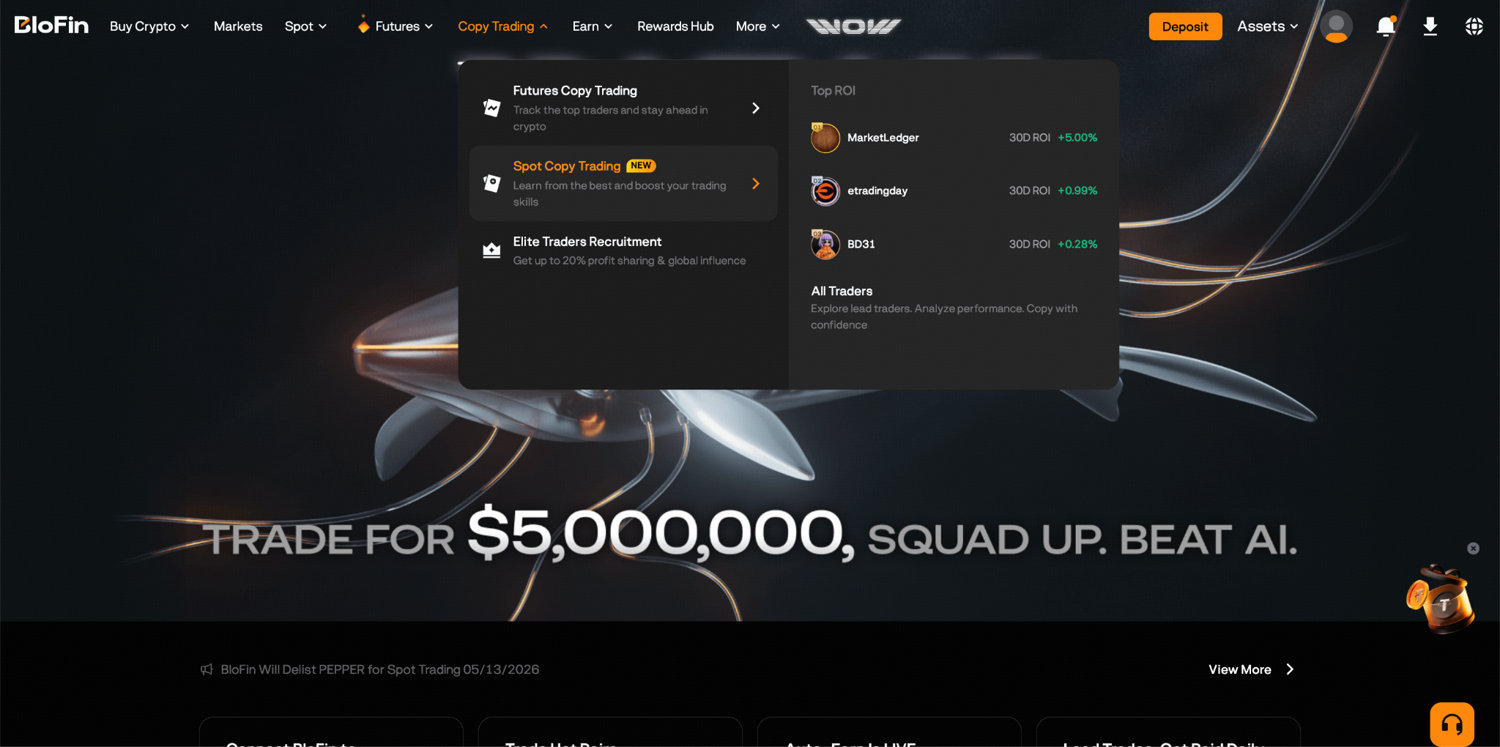
Step 1: Log in to your BloFin account and hover your cursor over the Copy Trading tab in the navigation bar. Then, select Spot Copy Trading.
Step 2: Browse traders in the All Traders section. Use filters and performance tags to narrow your search.
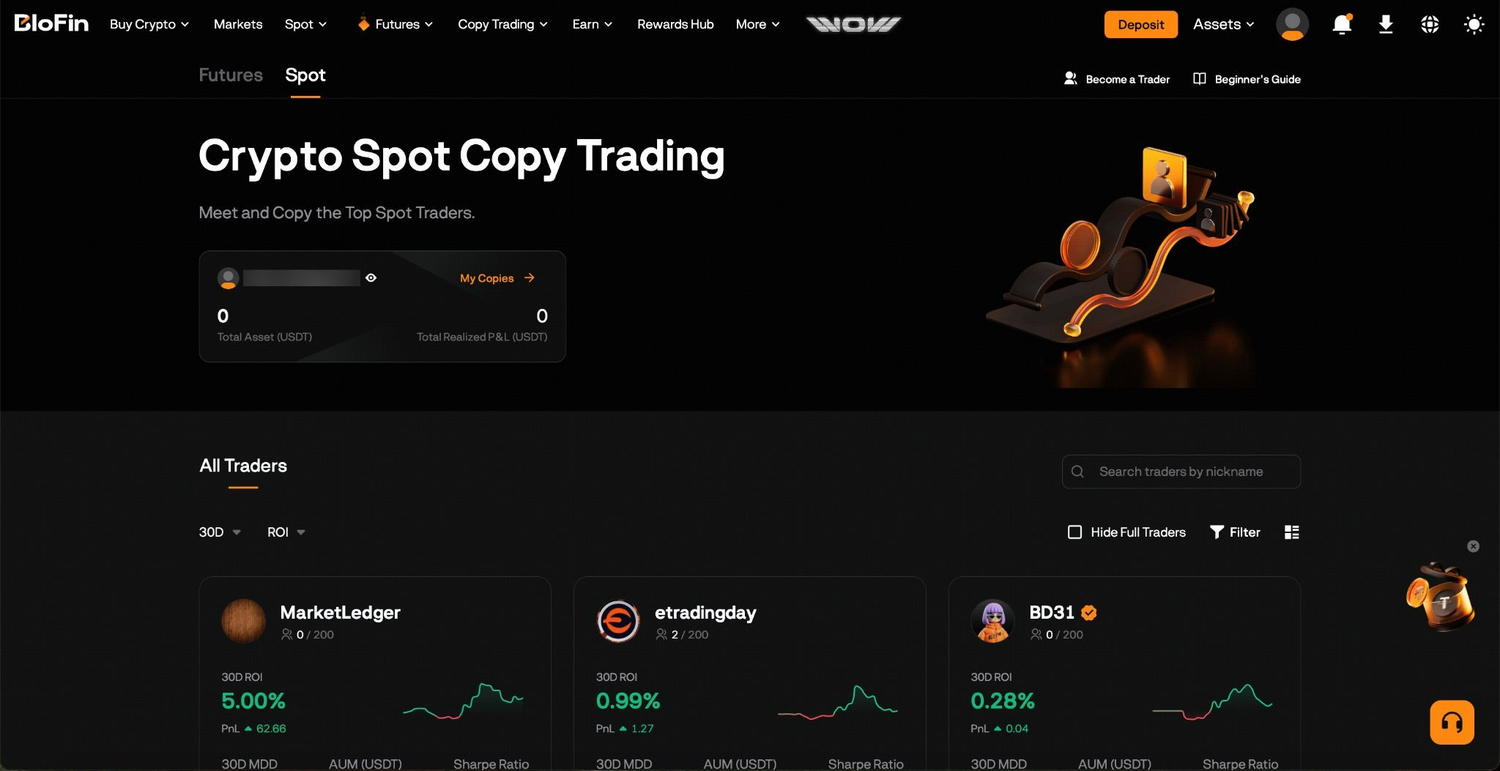
Step 3: Click the Copy button on your preferred lead trader's card to view their detailed performance page. Review their stats before proceeding.
Step 4: Click the Copy button on the performance page. Then, indicate your total investment value and choose your copy mode (Smart Copy, Fixed Amount, or Fixed Ratio). Once done, ensure you’ve read and agreed to the BloFin Copy Trading Service Agreement and click Submit.
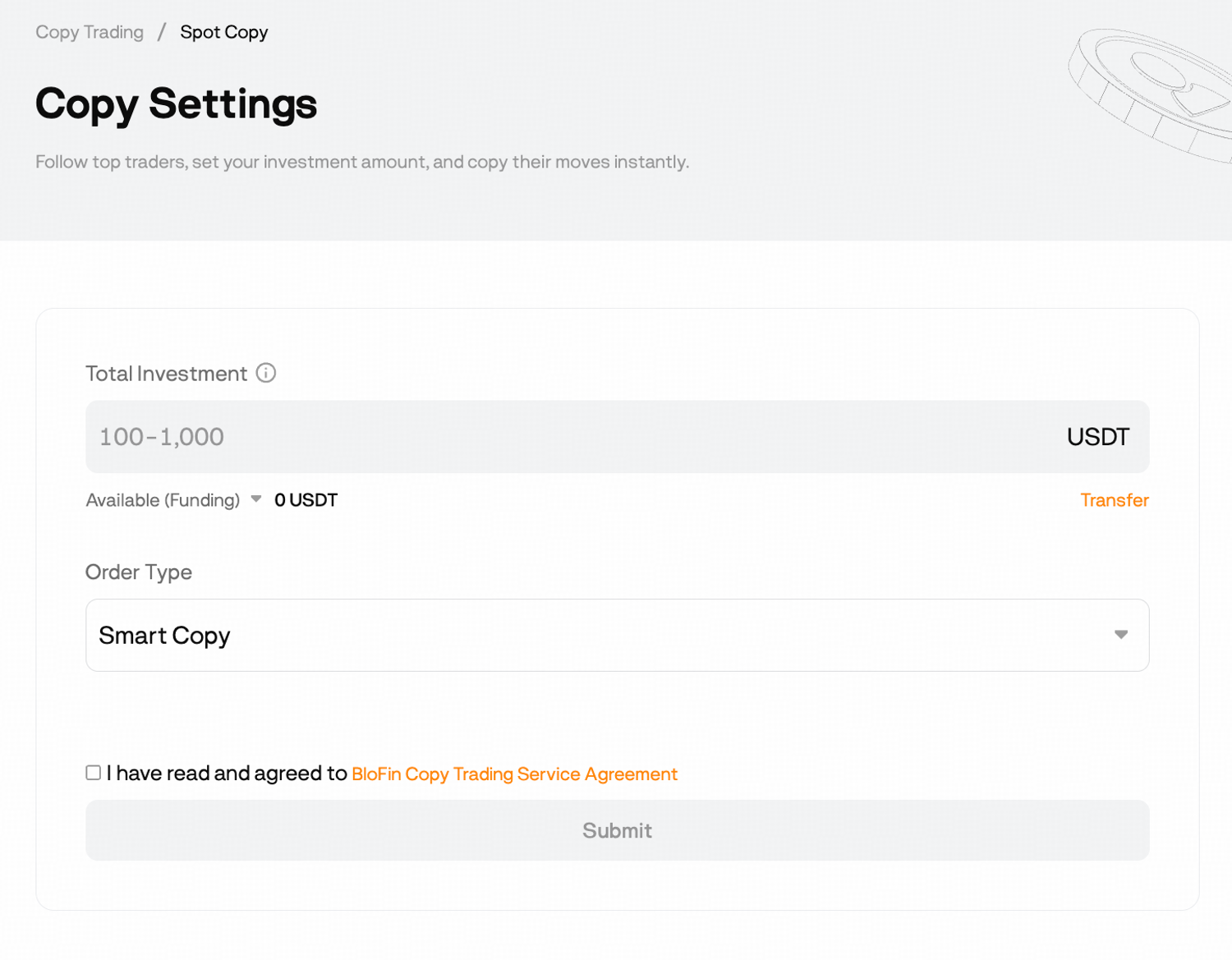
The copy mode you select determines how your allocation scales across each trade. Smart Copy is the recommended starting point: it automatically syncs your sizing with the trader's proportionally.
How to start Futures Copy Trading
Step 1: Log in to your BloFin account and hover your cursor over the Copy Trading tab in the navigation bar. Then, select Futures Copy Trading.
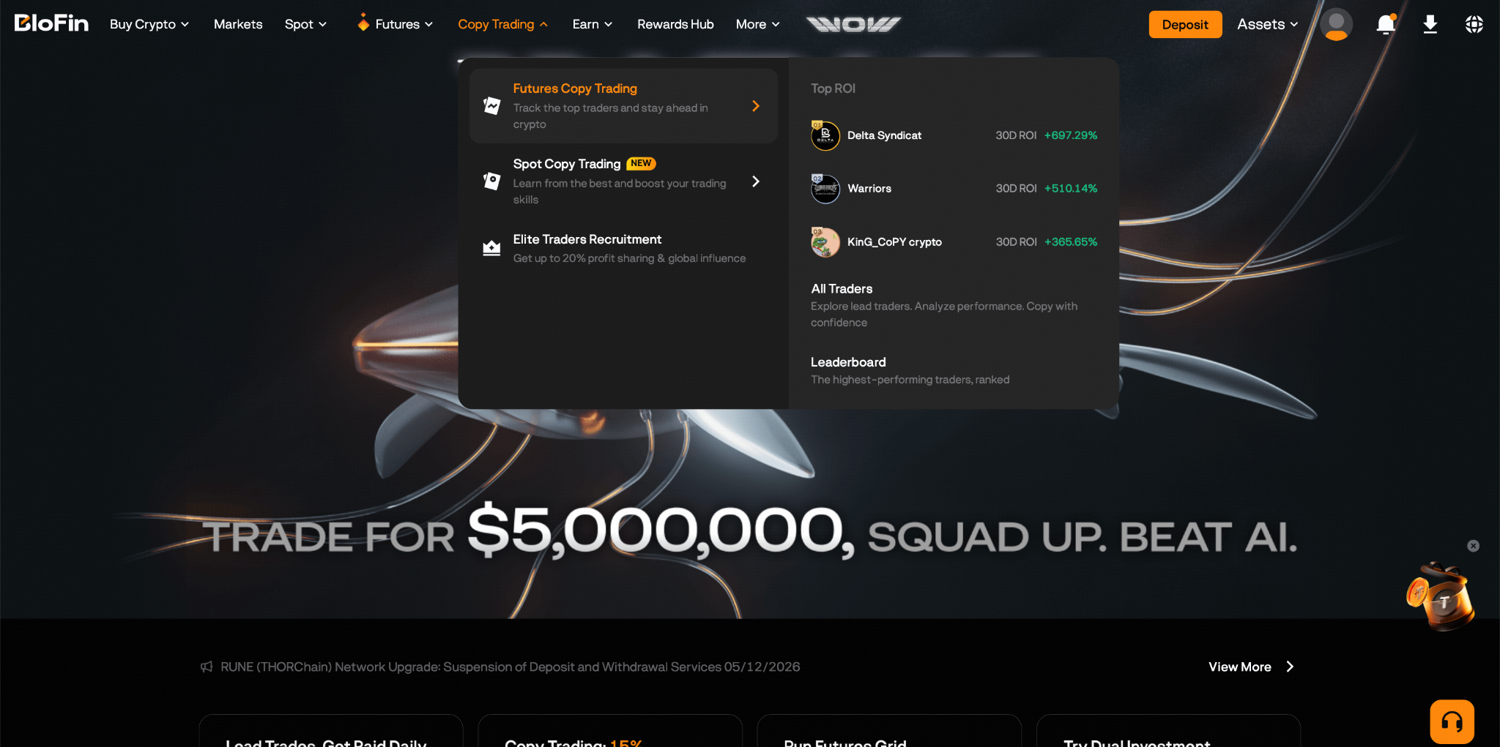
Step 2: Browse traders in the All Traders or Leaderboard section. Use filters and performance tags to narrow your search.
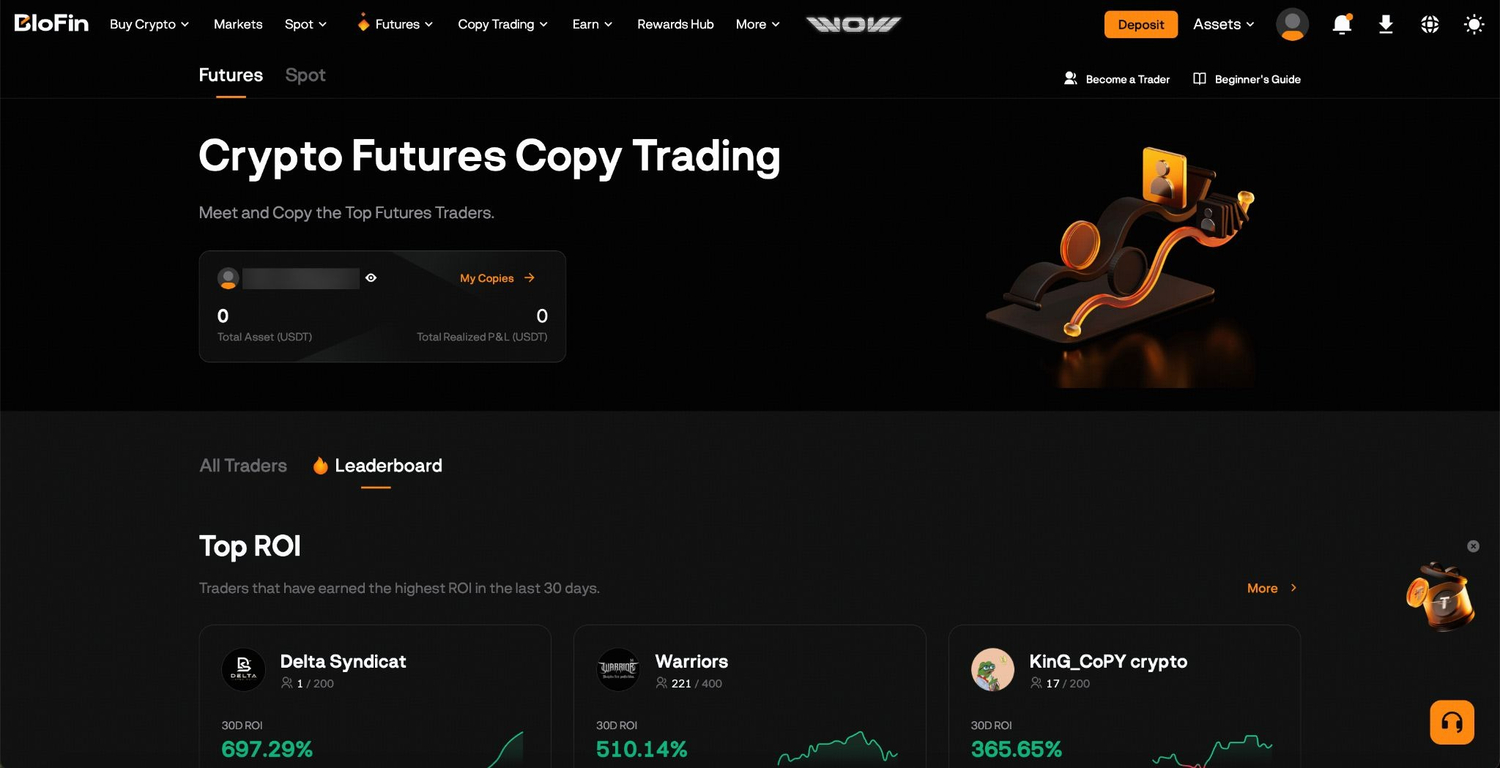
Step 3: Click the Copy button on your preferred lead trader's card to view their detailed performance page. Review their stats before proceeding.
Step 4: Click the Copy button on the performance page. There is a lot more to fill up than Spot Copy Trading. You’ll need to indicate your total investment value, select items to copy (USDT Perpetual Trades or Trading Bots), and choose whether to toggle Copy Stop Loss. There’s also a section for advanced settings and the option to choose whether you would like to copy immediately (more on this in the section below).
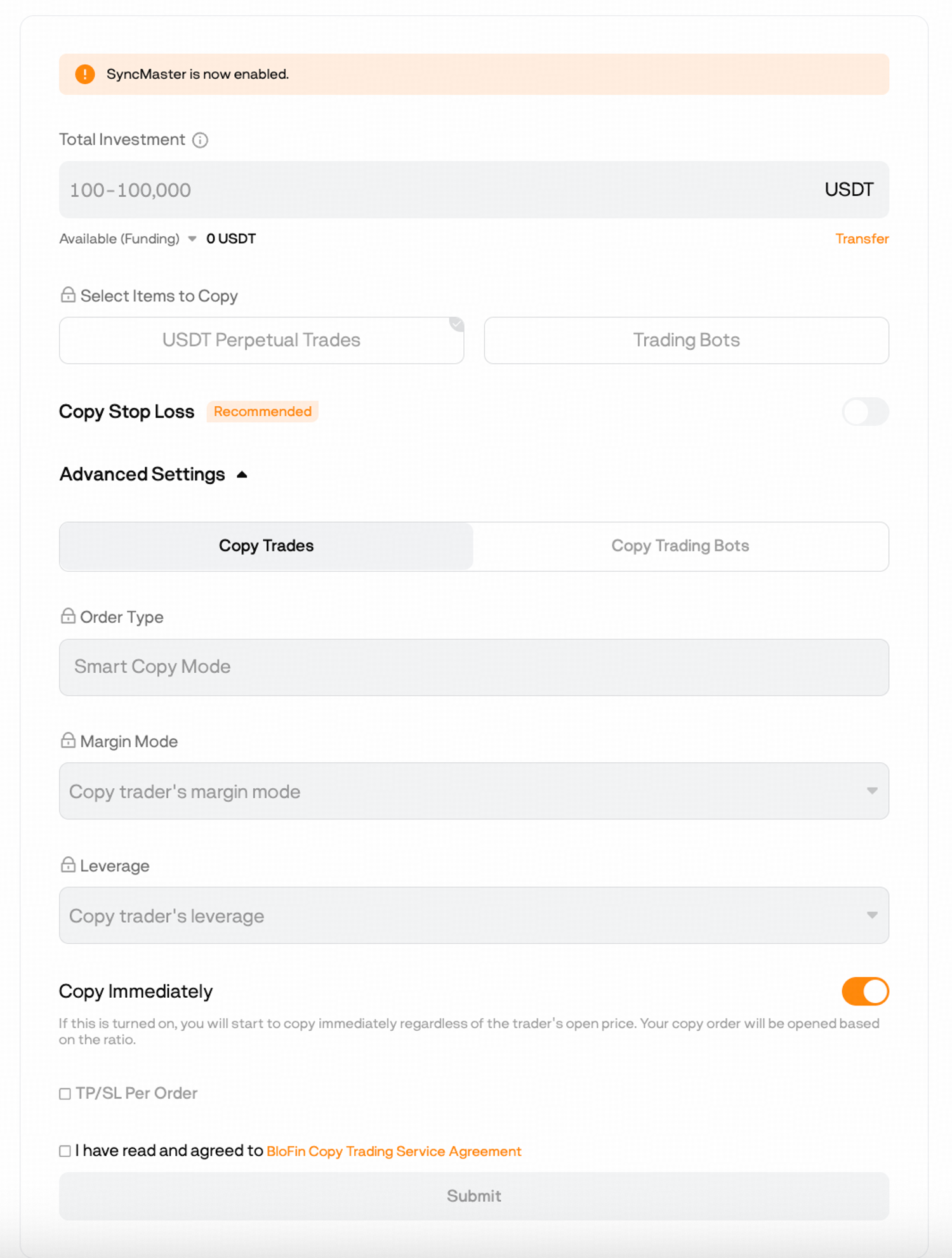
Step 5: Once you’re done inputting the details, ensure you’ve read and agreed to the BloFin Copy Trading Service Agreement and click Submit.
The Copy Immediately setting: One decision that matters more than most
This toggle appears in your futures copy setup and is easy to overlook, but it has a meaningful impact on how your copy trade begins.
Copy Immediately on: Your account immediately opens positions in any trades the lead trader currently has running, at the current market price. You're entering existing positions mid-stream at a different price than the trader's original entry, with different risk/reward dynamics.
Copy Immediately off: Your account only follows new positions the trader opens after you start. You start clean, with no inherited exposure.
Before enabling Copy Immediately, open the trader's profile and check what positions they currently hold. If they're already in a large, long-running position with a significant unrealized gain, joining it at market price means your entry point is much higher than theirs. Your exit trade will still track theirs, but your profitability on that trade is determined by your entry, not the trader's.
For most new copiers, starting with Copy Immediately off is the lower-risk approach. You begin fresh and build your copy trading history alongside the trader's new decisions rather than inheriting the risk profile of existing ones.
Can you copy multiple traders at once?
Yes. BloFin allows you to copy up to 10 lead traders simultaneously, each with separate allocations, copy modes, and settings. Each runs independently. Stops, adjustments, and failures on one trader don't affect the others.
Copying multiple traders at once can serve different purposes. Some users diversify across traders with different strategies, one conservative and one more active, so that performance isn't tied to a single approach. Others allocate most of their copy capital to one primary trader and a smaller amount to a secondary.
A few things to keep in mind if you're copying multiple traders:
Your total copy trading capital is spread across however many traders you're following. Make sure each allocation is large enough to actually execute trades. If an allocation is too small relative to the minimum trade size for a given pair, copy trades will fail.
Monitoring multiple traders adds complexity. The Copy Trading User Center shows all your active copy trades in one place, but reviewing performance across multiple traders takes more active attention.
Setting TP/SL on your copied positions
You can set take-profit and stop-loss levels on your copied positions independently of the lead trader's decisions. Your position closes at your specified level even if the trader is still holding.
This is particularly useful in Futures Copy Trading where positions can move quickly. Setting a stop-loss per order limits your downside without relying entirely on the trader's risk management. It also gives you control when you're comfortable with some of the trader's decisions but not all of them.
Does copy trading affect your regular trading?
No. Copy trading runs in a dedicated Copy Trading Account, completely isolated from your regular Futures and Spot accounts. You can continue placing manual trades in your regular accounts while copy trading runs in the background. The two don't interfere.
Managing active copy trades
You can view your copy trades by navigating to either the Futures Copy Trading page or Spot Copy Trading page and clicking My Copies.
From there, you’ll be able to view your total assets, total realized PNL, pending profit sharing. You can also click the different tabs available to view lead traders you’re currently following, ones you’ve unfollowed, and your copy history under the Traders tab, and your current positions and trade history under the Trades and Bots tabs.
Want to see your copy trades for other markets? Simply toggle between Futures Copy and Spot Copy.
How to know if your copy trade is working
Most users check their P&L and stop there. A more useful way to evaluate your copy trade is to compare your actual results with the lead trader's published performance.
If your ROI is tracking reasonably close to the trader's, your setup is working. If there's a significant gap and you're underperforming consistently, a few things could explain it: your Copy Immediately setting brought you into positions at worse entry prices, your fixed leverage is limiting your upside on winning trades, or your allocation is too small relative to the trader's position sizes, causing frequent execution failures.
Check your copy trade failure count in the position history. If you're seeing repeated failures, the most likely culprit is insufficient balance relative to the minimum trade size for the pairs being traded.
When to adjust vs when to stop
Adjusting typically makes sense when the setup is working structurally but something needs tuning: your allocation is too low and causing failures, you want to add a stop-loss level, or you want to change your leverage cap.
Stopping may make more sense when the trader's strategy has changed significantly in a way that no longer aligns with what you signed up for, or when their performance has deteriorated in a way that suggests the edge that drew you to them has been lost. A period of poor performance on its own isn't necessarily a reason to stop. Drawdowns are part of any trading strategy. What matters more is whether the drawdown looks consistent with the trader's historical risk profile or represents something new.
Stopping copy trading: What actually happens
When you stop copying a trader, you have two options. You can close all open copied positions immediately at market price, or let them run until the trader closes them naturally.
Choosing to close immediately means you exit at the current market price, which may be at a loss, at a gain, or near breakeven depending on where positions are sitting. Choosing to let them run means you remain exposed to the market until the trader decides to exit.
Once all positions are settled, your funds transfer automatically back to your Funding Account. You don't need to do anything manually.
Ready to start copying?
Now that you've got a better understanding of the framework for choosing a lead trader and setting up your copy trade the right way, the next step is putting it into practice. Sign up for a BloFin account, head to the Copy Trading page, and start browsing lead traders across futures and spot markets.
Frequently asked questions
Do I need to apply to start copy trading on BloFin?
No. Copy trading is available to all registered users. Go to the Copy Trading page and start following a trader directly.
What is the minimum to start copy trading?
The minimum allocation is 100 USDT.
Can I copy multiple traders at once?
Yes, up to 10 lead traders simultaneously, each with separate allocations and settings.
What is the most important metric when choosing a lead trader?
There's no single most important metric, but Max Drawdown gives you the most direct answer to "how bad could this get." Pair it with ROI across a longer timeframe to get the complete picture. A strong Sharpe or Sortino Ratio adds confidence that returns were generated consistently rather than through lucky outliers.
How do I know if a trader's recent performance is sustainable?
Look at consistency across multiple timeframes rather than peak performance. If a trader's 7-day ROI looks dramatically different from their longer-term average, check whether there's a change in leverage or strategy that explains it.
Should I follow traders with the most copiers?
AUM and follower count signal interest from other users but don't guarantee quality. Check whether existing copiers have been following for a long time with positive returns. That's more meaningful than sheer numbers.
What does the Copiers section on a trader profile tell me?
It shows how long existing copiers have followed the trader and their returns. Long-term copiers with consistent positive outcomes suggest the strategy translates reliably to other accounts.
Is a high win rate always good?
No. Win rate tells you how often they're right, not how much they make when right versus how much they lose when wrong. A 90% win rate can still be a losing strategy if the 10% of losses are large. Always check win rate alongside MDD and total P&L.
What is the difference between Top ROI and Top Profit tags?
Top ROI reflects the trader's own return percentage. Top Profit reflects the actual returns generated for their copiers. In some cases these differ because the trader's own allocation behaves differently from copiers' allocations. For most users focused on their own copy trading returns, Top Profit is the more directly relevant tag.
Does copy trading interfere with my regular trading?
No. Copy trading runs in a dedicated Copy Trading Account, completely separate from your regular Futures and Spot accounts. Manual trading and copy trading run independently.
What happens to my funds when I stop copying?
Once you stop copying and all positions are settled, your funds transfer automatically back to your Funding Account. You can choose to close all positions immediately or let existing positions run until the trader closes them.
What if a copy trade fails to execute?
Check your copy trading account balance first, since insufficient funds are the most common cause. Other reasons include hitting your total investment limit, the lead trader's limit order not being fully filled, or your proportional position size falling below the minimum trade requirement. If 20 consecutive copy trades fail, the system automatically stops following that trader.
What is the "Copy Immediately" setting?
When enabled, your account immediately opens positions in any trades the lead trader currently has running, at the current market price. When disabled, you only follow new trades the trader opens after you start. For most new copiers, starting with it disabled is the more cautious approach.
Disclaimer: This content is for educational purposes only and does not constitute financial, investment, legal, or tax advice. Crypto assets are highly volatile and carry significant risk of loss. Always verify local regulations and consult a qualified professional before making financial decisions.