
The price shown next to a stock or a token is the price of the last trade. It tells you where a buyer and a seller last agreed, but what you pay on your own order depends on who is waiting to sell right now, at which prices and in what amounts. In the largest markets so many orders wait close to the last price that the difference is too small to notice.
A smaller market can follow a famous company's price closely and still have far fewer orders waiting behind that price. A small purchase fills against the best offer on the list, while a large one uses up that offer and moves on to the next, and then the next, so its average price creeps upward. The extra cost appears only after the trade, in the price you were filled at.
An order book makes that queue visible. It lists the buy and sell orders waiting at each price, so you can add them up against the size of your order before you trade and work out roughly what the fill will cost. A limit order then lets you set the worst price you are willing to accept.
Tokenized Amazon (AMZNX) is one of those smaller markets. On BloFin it trades as the AMZNX/USDT Spot pair, with an order book of its own, and the AMZNUSDT Perpetual, a contract on Amazon's price, runs on a separate book. The orders waiting in both books at midday in New York on Monday, September 28, 2026, show what an order of each size would have cost at that point in the day.
What are AMZNX liquidity and slippage?
AMZNX liquidity is how much tokenized Amazon you can buy or sell on BloFin's AMZNX/USDT order book close to the current price. Slippage is the gap between the price you expected and the average price your order actually gets. A thinner book means more slippage on the same order, which is why the two are measured together.
Every order book has two sides. The bid is the highest price a buyer is offering, the ask is the lowest price a seller will take, and the difference between the two is called the spread (source: Investor.gov, Bid Price/Ask Price). The mid price is the point exactly between those two best prices, a common single figure for the market price at that moment. Depth is the amount of orders waiting on each side within a set distance of the mid, usually counted in USDT on a USDT pair.
AMZNX itself is a tracker certificate on Amazon shares, but on BloFin it is bought and sold like any spot pair, so slippage on market orders works on it as it does on any other token. Slippage can be measured from two starting points. Measured from the best ask, it counts only the extra you pay because your order runs past the first price on the list. Measured from the mid, it also counts the half of the spread you cross to reach the sellers. Nassim Nicholas Taleb defined slippage the second way in 1997, as the difference between your average fill and the mid at the moment you trade (source: Wikipedia, Slippage (finance)).
Say you had sent a 1,000 USDT market buy into the AMZNX/USDT book at 12.44PM ET. The best ask was 247.01 USDT with 1.78 AMZNX on offer, enough for about 440 USDT of your order, and the rest would have filled at the next ask, 247.05. You would have received 4.048 AMZNX at an average of 247.0324 USDT. That is only 0.009% above the best ask, yet 0.110% above the 246.76 mid, a difference of 1.10 USDT, and nearly all of it is the spread.
AMZNX/USDT spread and depth on BloFin
BloFin's AMZNX/USDT order book had a spread of 0.50 USDT at 12.44PM ET and 0.35 USDT at 12.56PM ET on Monday, September 28, 2026, or 0.203% and 0.142% of the mid price. At both times about 105,500 to 108,900 USDT of AMZNX was offered within 0.5% of the mid.
AMZNX/USDT trades on an order book, where each buy order is matched with a sell order at a price both sides accept, and both times fell inside Nasdaq's regular session. At both times the first 100 price levels on each side stretched about 1% above the mid and 0.9% below it, and they held between about 128,000 and 148,000 USDT a side. In the 24 hours before 12.44PM, 6,616 AMZNX changed hands on the pair, roughly 1.6 million USDT at that afternoon's price. A book holding that much near the mid fills an ordinary retail order within a few levels, while a large order has to reach further from the mid, and the depth of a market is what decides how far.
Each cell gives the USDT waiting within that distance of the mid, asks first and bids second, for the AMZNX/USDT book at both times and for the AMZNUSDT Perpetual's book at 12.44PM ET.
Market | Time of the book (ET, September 28, 2026) | Spread | USDT within 0.1% of mid (asks / bids) | USDT within 0.25% (asks / bids) | USDT within 0.5% (asks / bids) |
|---|---|---|---|---|---|
AMZNX/USDT Spot | 12.44PM | 0.50 USDT (0.203%) | 0 / 0 | 38,031 / 52,829 | 108,893 / 118,993 |
AMZNUSDT Perpetual | 12.44PM | 0.03 USDT (0.012%) | 235,955 / 220,890 | 866,674 / 1,137,518 | 2,335,812 / 1,890,047 |
AMZNX/USDT Spot | 12.56PM | 0.35 USDT (0.142%) | 4,252 / 1,012 | 49,284 / 45,345 | 105,546 / 108,550 |
The first 0.1% is the part to notice. At 12.44PM no AMZNX order sat within 0.1% of the mid on either side, because the spread itself was wider than 0.2%, so even the smallest market order had to pay at least half of it. About 12 minutes later the spread had narrowed to 0.35 USDT and a few thousand USDT appeared inside that band. The orders themselves were small: of the 200 levels in the 12.44PM book, the median held about 3.3 AMZNX, worth around 800 USDT, while 29 held less than one token and the largest held 28.13.
The AMZNUSDT Perpetual's book was far tighter and deeper in the same minute, even though only 498 AMZN traded on it in the 24 hours before 12.44PM. That depth comes with leverage, funding every eight hours and the risk of liquidation. Choosing between AMZNX and the perpetual is therefore a decision about the whole product, and trading Amazon with leverage adds costs of its own on top of the spread.
AMZNX slippage on 1,000, 10,000 and 50,000 USDT market orders
On the 12.44PM ET AMZNX/USDT book, market buys of 1,000, 10,000 and 50,000 USDT would have filled 0.110%, 0.137% and 0.205% above the mid price, before fees. Sells of the same sizes would have filled 0.101%, 0.116% and 0.168% below it.
Each figure is what an order of that size would have paid by filling against the AMZNX/USDT book one price level at a time. Its average fill is then compared with the best price on its side and with the mid.
Time of the book (ET, September 28, 2026) | Order size (USDT) | Market buy: average fill (USDT) | Buy: average above best ask | Buy: average above mid | Market sell: average fill (USDT) | Sell: average below best bid | Sell: average below mid |
|---|---|---|---|---|---|---|---|
12.44PM | 1,000 | 247.0324 | 0.009% | 0.110% | 246.5100 | 0.000% | 0.101% |
12.44PM | 10,000 | 247.0981 | 0.036% | 0.137% | 246.4733 | 0.015% | 0.116% |
12.44PM | 50,000 | 247.2665 | 0.104% | 0.205% | 246.3464 | 0.066% | 0.168% |
12.56PM | 1,000 | 247.0700 | 0.000% | 0.071% | 246.7200 | 0.000% | 0.071% |
12.56PM | 10,000 | 247.1747 | 0.042% | 0.113% | 246.5856 | 0.054% | 0.125% |
12.56PM | 50,000 | 247.3539 | 0.115% | 0.186% | 246.4099 | 0.126% | 0.196% |
Say you had sent 10,000 USDT as a market buy at 12.44PM. The order would have used up nine price levels, from 247.01 to 247.14 USDT, and bought 40.470 AMZNX at an average of 247.0981. Against the best ask that is only 3.57 USDT extra, but against the 246.76 mid it is 13.68 USDT, because crossing half the spread cost more than walking the book did. BloFin's Regular-tier spot fee of 0.1000% adds 10.00 USDT, so the purchase would have cost about 23.68 USDT more than 40.470 AMZNX valued at the mid, or 0.237% of the order.
Run the same arithmetic at the other two sizes and the mix changes. A 1,000 USDT buy cost about 2.10 USDT in all, almost entirely half the spread and the fee. A 50,000 USDT buy walked 30 levels to 247.51 and paid 102.42 USDT against the mid plus 50.00 USDT of fee, 152.42 USDT in all or 0.305%. Its cost split into roughly equal thirds: half the spread, the walk through the book and the fee. Selling works the same way in reverse, and a 50,000 USDT sale at 12.44PM would have returned 49,916.20 USDT before the fee, which is 83.80 below the value at the mid.
The narrower spread at 12.56PM helped small orders most, cutting the 1,000 USDT buy to 0.071% against the mid, while the 50,000 USDT buy still walked 28 levels. The fee is the one fixed part of these costs, and BloFin's spot trading fee schedule sets the Regular rate and the lower VIP rates that apply as your trading volume or balance grows.
Limit order vs market order on AMZNX/USDT
A market order buys or sells straight away, so the fill is certain and the price is open. A limit order executes only at your limit price or better (source: Investor.gov, Types of Orders). On AMZNX/USDT, a limit order the book cannot fill at once waits as an open order, and a large one may fill only in part.
The order panel on the AMZNX/USDT trading page offers Limit, Market and Trigger orders, the same three choices you meet when you buy tokenized Amazon on BloFin for the first time. They behave like every other market, limit and stop order, and the AMZNX book shows what the choice is worth in USDT.
Say you wanted 50,000 USDT of AMZNX at 12.44PM ET but would pay no more than 247.25 USDT, about 0.2% above the mid. A buy limit at 247.25 would have filled 109.130 AMZNX at once, worth 26,972.95 USDT at an average of 247.1635. The other 23,027.05 USDT would have stayed in the book as a bid at 247.25, waiting for sellers to come down to it. A limit set at the 246.76 mid would have filled nothing at first, because every seller was asking at least 247.01, and it would have become the new best bid.
At the Regular tier the fee is the same either way on BloFin's spot market. A maker order rests in the book before it fills and a taker order fills against orders already there, and at that tier both pay 0.1000%. A Regular-tier limit order on AMZNX therefore saves on price only. At VIP 1 the spot maker rate of 0.0350% is lower than the 0.0600% taker rate, so a limit order that rests in the book saves on the fee too. On BloFin's futures market the Regular maker rate of 0.0200% sits below the 0.0600% taker rate.
Splitting a large order into pieces helps when new sellers arrive between them. The two books about 12 minutes apart held a similar amount within 0.5% of the mid, about 108,900 and 105,500 USDT of asks, but the individual orders and prices had changed, so each piece meets a fresh book.
AMZNX liquidity at weekends, on holidays and at night
BloFin's daily AMZNX/USDT record shows weekend days trading about a third of a typical weekday. Across the complete UTC days from August 25 to September 27, 2026, the median weekday turnover was 1.68 million USDT and the median weekend day 571,141 USDT, and Labor Day, Monday, September 7, traded just 307,202 USDT.
Turnover counts trading and depth counts the orders waiting, so turnover is only a rough guide to depth. Nasdaq was closed on Labor Day (source: Nasdaq, 2026 holiday schedule). That Monday's AMZNX turnover sat beside the quietest weekend days, such as Saturday, September 5, at 323,413 USDT and Sunday, September 6, at 278,074. The busiest weekend over those five weeks was the last one, with 995,772 USDT on Saturday, September 26, and 1,409,617 on Sunday, September 27, so a weekend can still be active.
The perpetual follows the same pattern from a lower base. Its median weekday turnover over the same five weeks was 109,003 USDT against 27,914 on a weekend day, even though its book was the deeper of the two at midday on September 28.
Say you are choosing when to buy 10,000 USDT of AMZNX in a week like the one starting Saturday, September 19. That Saturday the pair turned over 374,279 USDT all day, so your order alone would have been about 2.7% of the day's trading. On Monday, September 21, turnover was 1,717,507 USDT and the same order would have been about 0.6%. A bigger share of a quieter day usually means fewer orders waiting to meet yours, which makes a busy weekday the likelier time for a cheap fill.
Nasdaq warns that its extended sessions before and after the regular day bring much higher volatility and less liquidity, with fewer people trading and prices moving more sharply (source: Nasdaq, trading hours). The token keeps trading after those sessions end, which is when AMZNX can drift away from Amazon's last close. Amazon's results nights add a burst of news to the same thin hours, and trading Amazon around earnings starts from sizing for that move.
Nasdaq has announced an overnight session running 9PM to 4AM ET, starting December 6, 2026 (source: Nasdaq, Equity Trader Alert 2026-46). Once it runs, Amazon's shares will trade through most of each weeknight, which is the window where AMZNX hours and Nasdaq's hours differ most today.
Who provides liquidity on the AMZNX/USDT order book
A market maker is a firm that keeps buy and sell orders on both sides of an order book and earns the spread between them. When an xStock such as AMZNX trades as an ordinary pair on an exchange's order book, its liquidity typically comes from a market maker (source: xStocks, Exchange Integration).
Supply and demand on that book set the token's price (source: xStocks, FAQ). An exchange can join the issuer directly or work with a market maker that already has, and in that second model the market maker manages issuance and redemption, creating new tokens or redeeming them (source: xStocks, Exchange Integration). In the cash route, which xStocks calls the Market Flow, an onboarded client sends stablecoins and the issuer has a broker buy the shares, or sends tokens back and the broker sells them. That route has a $5,000 minimum and settles in about 30 seconds up to $200,000 (source: xStocks, Market Flow). Tokens are issued and redeemed at the prevailing market price of Amazon's share, and that process helps keep AMZNX in line with Amazon's share price (source: xStocks, Issuance and Redemption).
Creation and redemption follow the stock market's calendar, and the calendar shows in the book. They run 24 hours a day on US business days and stop at weekends and on US market holidays (source: xStocks, FAQ). Over a weekend, then, the AMZNX on BloFin's book is the supply already in circulation. The issuer's instant swap route, xChange, quotes a spread that is tightest in market hours and wider in pre-market and after-hours trading, when the underlying market has less liquidity (source: xStocks, xChange). The trades on each market set its price, one reason the token and the perpetual can disagree on price. Each xStock is backed 1:1 by the underlying shares, held with regulated custodians, and AMZNX's proof of reserves is public (source: xStocks, FAQ).
How to check AMZNX depth before you place an order
Before a large AMZNX order, open the pair's order book and add up the orders on the other side until they cover your size. Note the price where they run out. If that price is further from the mid than you will accept, use a limit order or a smaller size.
Step 1: Open the AMZNX/USDT Spot trading page and under the Order Book tab on the right side of the page, you’ll see sell orders listed above the last price and buy orders below it, each with its Price(USDT) and Amount(AMZNX).
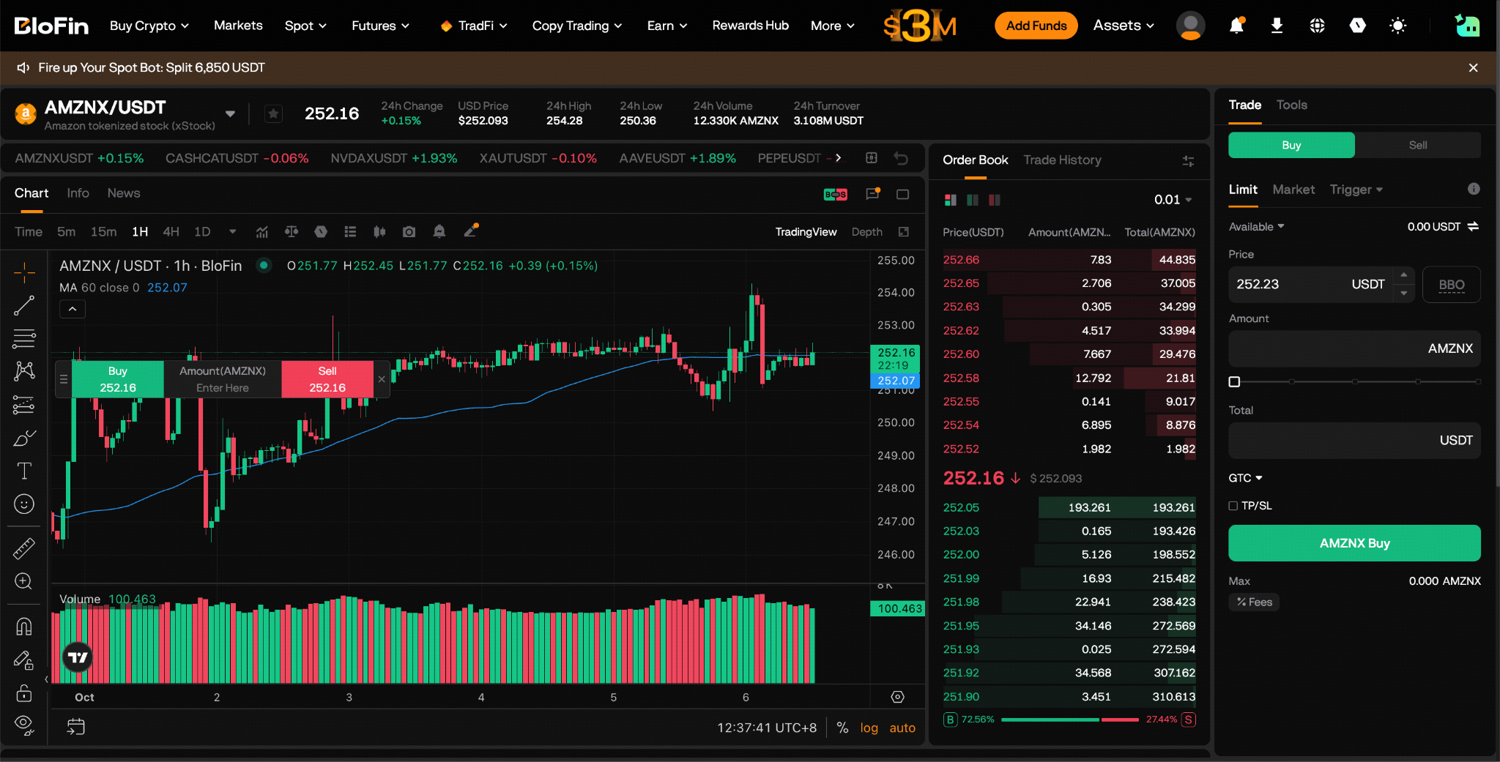
Step 2: In the Price(USDT) column, read the best ask and the best bid, the two prices closest to the last price, and work out the spread.
Step 3: For a buy, check the Total(AMZNX) column on the sell side, which adds up the amounts from the best ask outward, until it passes the number of tokens you want. A 10,000 USDT buy is about 39.7 AMZNX at 252 USDT.
Step 4: Open the Depth view for the same totals drawn as a chart, which shows at a glance where the book thins out on each side.
Step 5: On the order panel, choose Market if the price where your size runs out is acceptable, or choose Limit and enter that price as your worst price. Use Trigger only for an order that should wait until the pair reaches a set price.
Adding up the totals in Step 3 takes a few seconds. It is the same method behind the slippage figures above, so the cost you read off the book is what a market order would pay at that moment, before the fee.
Which order type suits each AMZNX order size
On the two midday books, a market order up to about 10,000 USDT paid little more than half the spread and the fee, while a 50,000 USDT order paid another 52 to 57 USDT to walk the book. Small orders that must fill now suit a market order, and large or patient ones suit a limit order.
These sizes and costs come from the AMZNX/USDT book at 12.44PM and 12.56PM ET, with the Regular-tier spot fee added.
Order size | What the two midday books showed | Order type that fits |
|---|---|---|
Up to about 1,000 USDT | Filled in one or two levels; total cost 1.71 to 2.10 USDT, mostly half the spread and the fee | Market, or a limit at the best ask |
About 10,000 USDT | Filled across nine to 12 levels; 21.32 to 23.68 USDT in all | Market during Nasdaq hours after checking the spread, or a limit a few cents above the best ask |
50,000 USDT or more | Walked 28 to 30 levels; 142.76 to 152.42 USDT in all | Limit order, or several smaller orders with a fresh look at the book each time |
Any size at a weekend or on a US holiday | Weekend days traded about a third of a weekday's turnover | Limit order, sized against the book at that moment |
Say you hold 40.5 AMZNX and want to sell during the Nasdaq session. On the 12.44PM book, a market sell of that size would have filled across seven bids at an average of 246.4734 USDT, about 11.61 USDT below its value at the mid, and the 0.1000% fee would have taken roughly 10 USDT more. That is close to the cost of the 10,000 USDT purchase, so in a book of this shape a round trip at this size costs about twice the one-way figure.
At a weekend the same order meets a market trading about a third as much, so a limit order set from the book at that moment is the safer choice at any size. The spread is the cost you can see before you trade, and the depth behind it decides how much more a large order adds. Reading both, and choosing the order type to match, keeps an AMZNX order close to the price you meant to pay.
Looking to gain exposure to Amazon? To get started, you'll need to first create a BloFin account, fund your account with cryptocurrency, and navigate to the AMZNX/USDT Spot trading page or AMZNUSDT Perpetual page.
Frequently asked questions
Can slippage work in your favor?
Yes, when the best available price moves your way while the order is being filled. IG calls this positive slippage, where the price changes during execution and the order fills at a better price than requested (source: IG, slippage definition). A limit order has the same possibility built in, because a buy limit can execute only at the limit price or lower (source: Investor.gov, Types of Orders). On AMZNX/USDT that happens when a buy limit set above the best ask meets sellers asking less: it fills at their lower asks, up to its limit.
What happens to an AMZNX limit order that only partly fills?
The part that fills is added to your AMZNX balance straight away, and the rest stays in the book at your price as an open order. On the AMZNX/USDT trading page it is listed under Open Orders until more sellers reach your price or you cancel it. A partial fill is common on a thin book, and if the price moves away from your limit, the unfilled part can wait for a long time.
Do larger traders pay lower AMZNX trading fees?
BloFin's spot fee falls as your VIP level rises: the Regular tier pays 0.1000% as maker and taker, and VIP 1 pays 0.0350% as maker and 0.0600% as taker. VIP 1 starts at 1,000,000 USDT of spot trading in 30 days, 10,000,000 USDT of futures trading, or 50,000 USDT of assets, and BloFin updates VIP levels daily at 1AM UTC. On a 10,000 USDT market buy, the VIP 1 taker fee is 6.00 USDT.
How big can a market order on the AMZNUSDT Perpetual be?
BloFin caps a single AMZNUSDT market order at 500 AMZN and a single limit order at 5,000 AMZN, and the smallest order is 0.01 AMZN. At the 12.44PM ET mid of 246.915 USDT on September 28, 2026, 500 AMZN was about 123,458 USDT, and a market buy that size would have filled 0.033% above the best ask across 15 levels.
Does a stop order on AMZNX fill at the stop price?
A stop order becomes a market order once the stop price is reached (source: Investor.gov, Types of Orders). It then fills at whatever the book holds at that moment. On the AMZNX/USDT panel the matching tool is the Trigger order, which places a market or limit order once the pair reaches your set price. A limit price on the triggered order caps the fill, at the risk that it waits unfilled if the price jumps past it.
Researched and written by the BloFin Academy editorial team with AI-assisted drafting. All facts independently verified. Primary sources include BloFin's AMZNX/USDT and AMZNUSDT order books, daily trading record and spot fee rates as last recorded on September 28, 2026, the AMZNUSDT contract details, futures fee rates and VIP thresholds as of October 2, 2026, the AMZNX/USDT trading page and BloFin's spot trading guide as of October 4, 2026, the xStocks documentation, Investor.gov, Nasdaq, Wikipedia and IG, current as of October 5, 2026.
Nothing in this article constitutes financial advice, and nothing in it is a recommendation to buy, sell or hold Amazon in any form. The spreads, depth and costs quoted here are past readings from two moments on September 28, 2026. The AMZNX/USDT book can be far thinner at night, at weekends, on US holidays and around Amazon's results, so a market order can fill well away from the last price. AMZNX is a certificate that carries the risk of its issuer and custodians, and a leveraged AMZNUSDT position can be liquidated by a fast move before you can act. Past performance does not indicate future results. Do your own research and consider your risk tolerance before you trade on BloFin.