
Owning a share costs you nothing once you have paid for it. You can keep it for a week or for twenty years, and the only money that moves while you wait is a dividend, if the company pays one. A futures contract on the same share works on a different footing, because it has a last day, and its price is pulled toward the share's price as that day comes closer.
Take that last day away and the pull disappears too. A contract with no end date could float far above the share in a buying rush, or sink far under it in a selling one, and no date on the calendar would close the gap. Traders would then be trading a price that tells them little about the company.
Perpetual futures solve this with funding, a small transfer between the two sides of the market made every few hours. When the contract trades above the share's price, buyers pay sellers, and when it trades below, sellers pay buyers. For anyone who holds a position for days or weeks, those payments add up to the running cost, or the running income, of keeping it open.
BloFin's perpetual on Microsoft is the MSFTUSDT Perpetual, and its funding settles three times a day, weekends included. Since it listed in April 2026, a long position worth 1,000 USDT has paid about 44.90 USDT in funding, most of it in the first three months. In October, up to the 30th, the same position paid about 3.23 USDT, and an equal short received it.
What is the MSFT perpetual funding rate?
The MSFT perpetual funding rate is the percentage BloFin uses to move money between long and short positions on the MSFTUSDT Perpetual, normally settled daily at 4PM, 12AM and 8AM UTC. With a positive rate, longs pay shorts; with a negative one, shorts pay longs. You pay or receive the rate multiplied by your position's full value.
The payment exists because a perpetual has no expiry date to tie it to the share. Songrun He, Asaf Manela, Omri Ross and Victor von Wachter point out that a perpetual has no guarantee of meeting the spot price. In the design they study, longs pay shorts, at set intervals, an amount in proportion to that gap (source: He et al., Fundamentals of Perpetual Futures). Ackerer, Hugonnier and Jermann define perpetual futures as contracts whose price is anchored to the spot price by periodic funding payments from long to short (source: Ackerer et al., Perpetual Futures Pricing). BloFin describes its own funding fee in the same terms, as the mechanism that draws a perpetual's market price toward the asset it tracks (source: BloFin funding rate guide).
Funding payment = position value × funding rate.
A rate of +0.0019%, for example, moves about 0.02 USDT from the long to the short on a 1,000 USDT position (source: BloFin MSFTUSDT funding history). A position closed before the settlement time pays and receives nothing for it (source: BloFin funding rate guide). The schedule is one of the contract's standing terms, listed with its leverage and fees in the guide to the MSFT perpetual on BloFin.
Who pays MSFT funding, longs or shorts?
Who pays MSFT funding depends on two things only: the sign of the rate at the settlement and the side of your position. At a positive rate every long pays and every short receives, and at a negative rate the flow reverses, while a zero rate moves nothing. Your entry price, profit and leverage play no part.
Three settlements from the contract's own record show each case, oldest first, on a position worth 1,000 USDT (source: BloFin MSFTUSDT funding history).
Settled rate | Long position | Short position | On 1,000 USDT of position value |
|---|---|---|---|
+0.3432% at 12AM UTC, May 4, 2026 | pays | receives | about 3.43 USDT moves to the short |
−0.0217% at 8AM UTC, August 12, 2026 | receives | pays | about 0.22 USDT moves to the long |
0.0000% at 12AM UTC, October 30, 2026 | nothing | nothing | no payment |
Because the payment is figured on the position's full value, leverage leaves it the same size. A 1,000 USDT long pays 3.43 USDT at +0.3432% whether you back it with 1,000 USDT of margin at 1x or 50 USDT at 20x. What changes is how heavy that payment is next to your margin: about 0.3% of it at 1x, and about 6.9% of it at 20x, in a single settlement.
In isolated margin, where each position carries its own margin, that weight shows up straight away. BloFin lists the settlement of funding, paid or collected, as one of the events that moves an isolated position's estimated liquidation price (source: BloFin forced liquidation rules). Each payment you make leaves less margin, so a smaller price move can then reach the liquidation level, and each payment you receive does the opposite. The guide to leverage and liquidation sets out that arithmetic in full.
A short through a week of positive rates is paid at every settlement, which is the income side of shorting Microsoft on BloFin. The rate for the next settlement and its countdown are live on the MSFTUSDT Perpetual page.
When MSFT funding settles, including weekends and holidays
MSFT funding settles at 4PM, 12AM and 8AM UTC every day of the week, including Saturdays, Sundays and US market holidays. Only the 4PM UTC settlement falls while Microsoft's shares are in their regular session. The other two land between the close and the next open, hours in which BloFin can restrict trading to orders that shrink or close positions.
The contract page gives an eight-hour cycle that starts at 4PM UTC (source: BloFin MSFTUSDT contract details). In BloFin's stock futures notice, the regular weekday session opens at 1.30PM UTC and closes at 8PM UTC during US daylight saving time, and each end moves one hour later in standard time, from early November to mid-March. Beyond that session, and through weekends and market holidays, stock futures can be held to reduce-only orders (source: BloFin stock futures notice).
The US time change on Sunday, November 1, 2026 moves the session but leaves the settlements where they are. US clocks go back an hour on the first Sunday in November, at 2AM local time (source: NIST, daylight saving time). Through Friday, October 30, sessions end at 8PM UTC. From Monday, November 2, trading runs from 2.30PM UTC to 9PM UTC, and the 4PM UTC settlement still falls within it. The guide to the MSFT perpetual's trading hours and reduce-only windows covers every hour and holiday on that schedule.
From Friday's close to Monday's open, an ordinary weekend has eight settlements. Across the weekend of October 23 to 26, 2026, the eight rates added up to +0.0524%, so a long worth 1,000 USDT paid about 0.52 USDT while Nasdaq was shut (source: BloFin MSFTUSDT funding history). Holidays follow the same pattern. On Labor Day, September 7, a day BloFin's notice lists as closed all day, MSFTUSDT still settled at +0.0013%, +0.0021% and +0.0024% (source: BloFin MSFTUSDT funding history). Thanksgiving, November 26, is on the same closed-all-day list, so all three of its settlements fall outside regular hours (source: BloFin stock futures notice). A weekend's funding is usually small next to its other risk, a jump in price when trading resumes, which is weekend gap risk on the MSFT perpetual.
When the funding interval changes
The eight-hour interval is the normal setting, and BloFin has shortened it on MSFTUSDT twice. From 2PM UTC on May 20, 2026 to 1PM UTC on May 21, the contract settled every hour, 24 times in one day, and those 24 rates added up to +0.3445%. On August 19, extra hourly settlements came at 8PM, 9PM, 10PM and 11PM UTC (source: BloFin MSFTUSDT funding history).
BloFin's funding guide sets out schedules for 8-hour, 4-hour, 2-hour and 1-hour intervals and warns that BloFin can move settlement times in real time as conditions change (source: BloFin funding rate guide). The contract page adds that parameters change with the market without a separate announcement (source: BloFin MSFTUSDT contract details). An hourly day matters for cost. At a typical October rate, one day of three settlements took about 0.01% of a position's value, while the hourly day in May took more than 0.34% (source: BloFin MSFTUSDT funding history).
How BloFin calculates the MSFT funding rate
BloFin builds the MSFT funding rate from two parts: a premium index, measuring the distance between the contract's tradable prices and Microsoft's price index, and an interest component of 0.03% a day (source: BloFin funding rate guide). Interest minus premium is capped at 0.05% either way, and the total must stay within the platform's outer limits.
Funding rate = average premium + (interest − average premium, limited to between −0.05% and +0.05%).
The premium reading compares two prices with the index. The impact bid is the average price you would get selling a set amount into the bids, and the impact ask is the average price you would pay buying the same amount from the offers. An impact bid over the index means buyers are paying up, and the reading turns positive. An impact ask lower than the index means sellers are giving way, and the reading turns negative; with the index between them, the reading is zero (source: BloFin funding rate guide).
BloFin averages those readings with more weight on the later ones, so the readings closest to a settlement count most. Taking the 0.03% a day as 0.01% for each eight-hour settlement, the formula gives these results.
Average premium | Interest minus premium | Capped at ±0.05% | Resulting funding rate |
|---|---|---|---|
−0.07% | +0.08% | +0.05% | −0.02% |
+0.02% | −0.01% | −0.01% | +0.01% |
+0.08% | −0.07% | −0.05% | +0.03% |
BloFin uses the formula across its perpetuals, and the MSFTUSDT record strays from a literal reading of it. Read literally, any premium between −0.04% and +0.06% would give +0.0100%. Yet only 31 of the contract's 603 settlements came to exactly that, all between May 13 and May 21, 2026, and the median rate since listing is +0.0016% (source: BloFin MSFTUSDT funding history). Treat the formula as the reason the rate moves and the history as the record of what it charges.
MSFTUSDT funding history since April 2026
MSFTUSDT funding history runs to 603 settlements, from 4PM UTC on April 20, 2026 to 12AM UTC on October 30. Their rates add up to +4.4902%: 378 were positive, 214 negative and 11 zero. A long held throughout at 1,000 USDT paid about 44.90 USDT, all of which went to shorts.
The payments were far from even across the months, and the first three carried nearly all of them (source: BloFin MSFTUSDT funding history).
Month (2026) | Settlements | Rates added up | Paid by a 1,000 USDT long |
|---|---|---|---|
April, from the 20th | 31 | +0.3169% | 3.17 USDT |
May | 114 | +2.6809% | 26.81 USDT |
June | 90 | +1.1216% | 11.22 USDT |
July | 93 | +0.6963% | 6.96 USDT |
August | 97 | −0.7859% | −7.86 USDT, received |
September | 90 | +0.1370% | 1.37 USDT |
October, to the 30th | 88 | +0.3234% | 3.23 USDT |
April to June produced 91.7% of the total. May carried 114 settlements, the most of any month, because of the hourly day on May 20 and 21. It also holds the longest run of positive rates: 57 in a row from 8AM UTC on May 11 to 12AM UTC on May 23, adding up to +1.1458%. The two highest rates of all came at a weekend, +0.2278% at 4PM UTC on Sunday, May 3 and +0.3432% at 12AM UTC on Monday, May 4, while Nasdaq was closed.
August went the other way. From 4PM UTC on August 3 to 8AM UTC on August 17, 42 settlements in a row were negative, adding up to −0.8285%, so longs were paid for two weeks and shorts paid them (source: BloFin MSFTUSDT funding history). The most negative rate on record, −0.0217% at 8AM UTC on August 12, came in that run.
Since September the rates have been small and the sign has changed often. In September and October, the 12AM UTC settlements added up to +0.2494%, the 8AM UTC ones to +0.1456% and the 4PM UTC ones to +0.0654%, and no 4PM UTC rate went above +0.0120% (source: BloFin MSFTUSDT funding history). Funding in that period mostly built up outside Nasdaq's regular session.
A run of one sign tells you which side has been crowded, which is how CryptoQuant reads the measure: a positive rate points to longs dominating and a negative one to shorts. It also warns that a high rate does not reliably signal a fall (source: CryptoQuant, funding rates). BloFin's guide to crypto funding rates shows how traders read funding beside open interest on any perpetual.
MSFT funding around Microsoft's earnings reports
MSFT funding barely moved around Microsoft's three earnings reports since the contract listed. Through the settlements on either side of the October 28, 2026 release, the rates were +0.0007%, −0.0024%, +0.0012% and +0.0019% (source: BloFin MSFTUSDT funding history). On a long worth 1,000 USDT, the four together came to about 0.01 USDT, against 10 USDT for a 1% move in the price.
On October 28, Microsoft released its results for its first quarter of fiscal 2027, which ran from July to September 2026, and held its results call at 5.30PM ET, 9.30PM UTC, that evening (source: Microsoft Q1 FY2027 results). The 4PM UTC settlement that day, hours before the results, came in at +0.0007%. The next settlement, the first after the release, came at 12AM UTC on October 29 at −0.0024%, so shorts paid longs. Say you held 1 MSFT long, worth 531.01 USDT at the October 28 close of $531.01 (source: Nasdaq, MSFT historical prices). That settlement paid you about 0.0127 USDT, against about 5.31 USDT for each 1% the price moved.
The July report shows the same gap at a larger scale. Microsoft reported its fourth quarter of fiscal 2026, April to June 2026, on July 29, 2026 (source: Microsoft Q4 FY2026 results), and the shares closed at $390.54 that day and $451.10 the next, a rise of 15.5% (source: Nasdaq, MSFT historical prices). The four settlements from 4PM UTC on July 29 to 4PM UTC on July 30 added up to just +0.0057% (source: BloFin MSFTUSDT funding history).
The April report came nine days after the contract listed, and this time the price fell. Microsoft reported its third quarter of fiscal 2026, January to March 2026, on April 29, 2026 (source: Microsoft Q3 FY2026 results), and the shares closed at $424.46 that day and $407.78 the next, a drop of 3.9% (source: Nasdaq, MSFT historical prices). The four settlements from 4PM UTC on April 29 to 4PM UTC on April 30 were +0.0067%, −0.0011%, −0.0020% and +0.0112%, for a total of +0.0148% (source: BloFin MSFTUSDT funding history).
The guide to trading Microsoft around earnings deals with the price side of a report night, including the reduce-only hours after the release.
A month of MSFT funding on a 1,000 USDT position
A month of MSFT funding on a 1,000 USDT position cost a long about 3.23 USDT in October 2026. From 12AM UTC on October 1 to 12AM UTC on October 30, the contract settled 88 times, and the rates added up to +0.3234%. An equal short collected it.
Funding over a period ≈ position value × the rates settled while the position was open, added together.
That shortcut keeps the position's value fixed. Holding a fixed number of contracts instead gives a slightly different answer, because each payment uses the value at that moment. Say you bought 1.95 MSFT, about 1,000.15 USDT, at the September 30 close of $512.90 (source: Nasdaq, MSFT historical prices). Paid at the latest close before each settlement, your October funding came to about 3.32 USDT, since Microsoft closed above $512.90 on 20 of the 21 trading days from October 1 to 29.
What 3.23 USDT means for you depends on the margin behind the position. The same payment is a small share of the margin at 1x and a large one at 20x.
Leverage | Margin for 1,000 USDT of position | October funding as a share of margin |
|---|---|---|
1x | 1,000 USDT | 0.32% |
5x | 200 USDT | 1.62% |
20x | 50 USDT | 6.47% |
Trading fees give a useful scale. BloFin charges 0.06% of the position's value when an order fills at once, as a taker, and 0.02% when it rests in the order book first, as a maker. Opening and closing 1,000 USDT therefore costs about 1.20 USDT at taker rates and 0.40 USDT at maker rates. BloFin's fee structure lists every tier. From October 1 to 30, funding cost a long nearly as much as three taker round trips.
Other months were very different at the same size. May would have cost a long 26.81 USDT, against 3.23 USDT in October up to the 30th, and August would have paid a long 7.86 USDT.
How to check the MSFT funding rate and your own payments
You can check the MSFT funding rate in three places on BloFin. The trading page shows a live estimate for the next settlement beside a countdown, the contract's funding history lists every settled rate, and your own payments appear in the Order Center. The estimate keeps changing until the settlement, so only the settled figure decides what you pay.
On the MSFTUSDT trading page the figure sits under the label "Funding Rate / Countdown", and it can switch sign shortly before a settlement when the rate is close to zero. The funding history shows each settled rate to four decimal places of a percent, so you can add up any stretch of days and multiply by your position's value. Check the time column against UTC before you match a rate to a day, since the page lists times in UTC+8 (source: BloFin MSFTUSDT funding history).
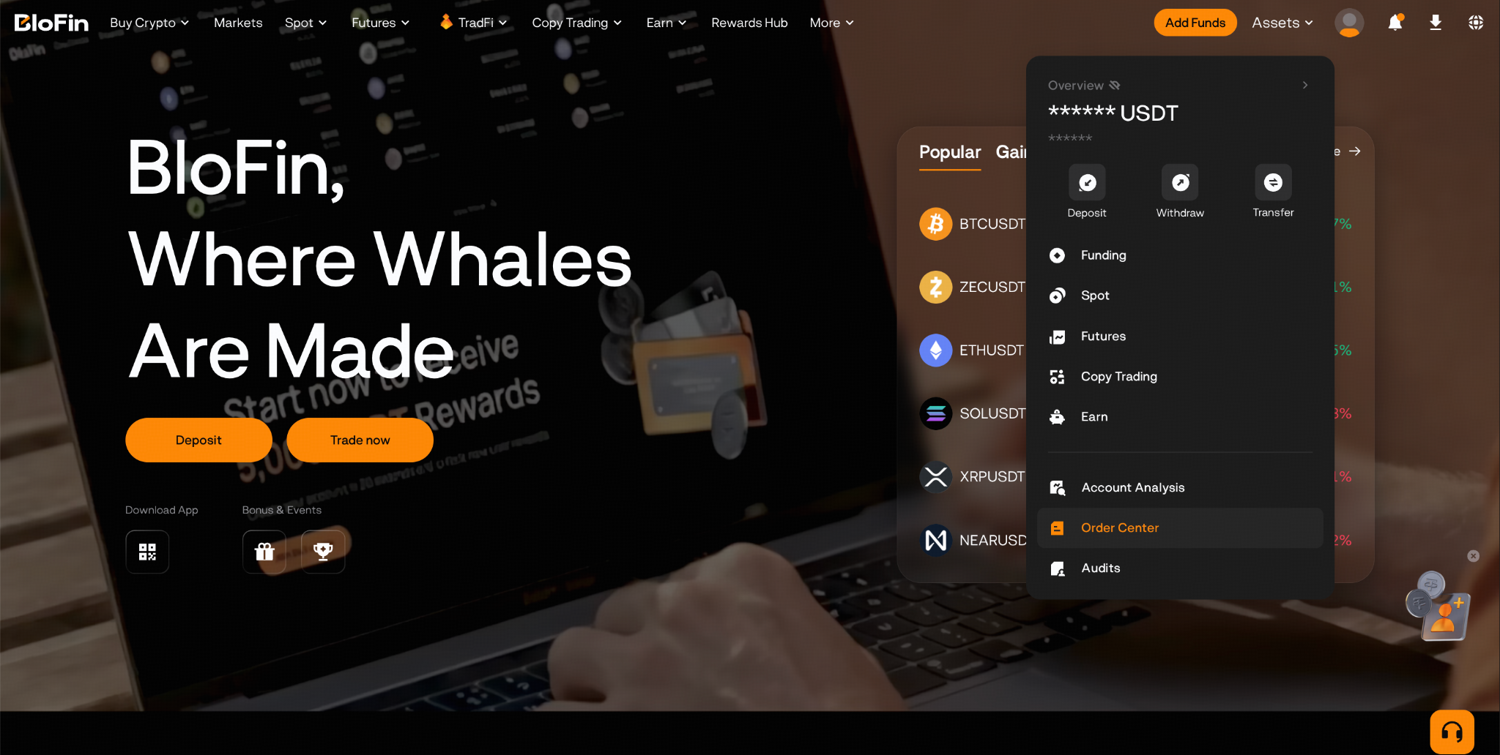
Your own records sit in your account. BloFin's help center gives the path on the website, using these labels (source: BloFin, checking funding fees).
Step 1: Log in to your BloFin account and hover your cursor over the Assets tab. Then, click Order Center.
Step 2: Select Trading History.
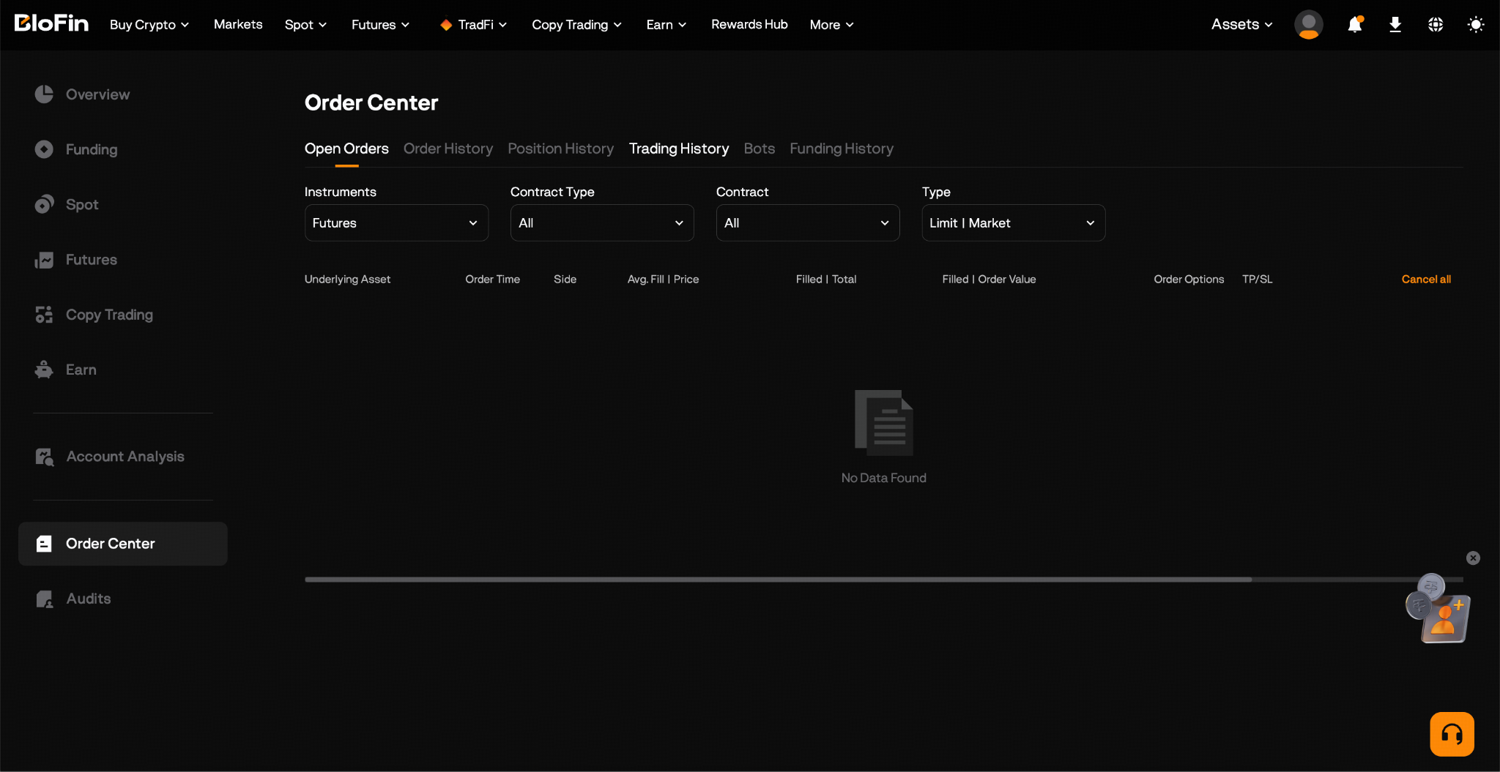
Step 3: Set Instruments to Funding Fee.
Step 4: Pick the Contract Type and the Contract, MSFTUSDT, then set a Time range that covers the days you held.
Step 5: Read the records. Each one shows the Time of the settlement, the Coin it was paid in, the Symbol, the Margin mode, isolated or cross, and the Funding Fee charged or received.
If a settlement you expected is missing, the usual reasons are that nothing was open when that settlement came, a filter for time or contract left it out, or the position closed before the fee was settled (source: BloFin, checking funding fees). One timing detail matters at the edges. BloFin's assessment of the fee can take about a minute, so a position you open a few seconds after the hour can still be caught by that settlement (source: BloFin funding rate guide).
Planning for funding before you hold an MSFT position
Planning for funding before you hold an MSFT position comes down to four checks. Look at the sign and size of the latest rates and count the settlements your plan crosses. Then work out the share of your margin those payments could take, and compare them with your trading fees.
Count the settlements first. A weekday trade from 3PM UTC to 7PM UTC meets just one, at 4PM UTC. Hold from 3PM UTC Friday to 3PM UTC Monday and you meet nine. Across October 23 to 26, 2026, those nine rates added up to +0.0644%, about 0.64 USDT on a 1,000 USDT long (source: BloFin MSFTUSDT funding history). Then read the sign: positive rates cost longs and pay shorts, negative rates the other way round.
Reduce-only hours limit how far you can dodge a payment. Closing ahead of a 12AM UTC settlement is allowed, since closing shrinks a position, but reopening may wait until the session starts again. Only at 4PM UTC can you close and reopen within trading hours.
Over many months, funding becomes the main running cost of keeping the position, and the perpetual pays no dividend to set against it (source: BloFin stock futures notice). The guide to holding the MSFT perpetual long term sets a year of that cost against owning the shares.
Looking to trade Microsoft with its funding costs in view? To get started, you'll need to first create a BloFin account, fund your account with cryptocurrency, and go to the MSFTUSDT Perpetual trading page.
Frequently asked questions
Is MSFT perpetual funding paid in USDT or in Microsoft shares?
Funding on the MSFTUSDT Perpetual is paid and received in USDT, the stablecoin the contract settles in (source: BloFin MSFTUSDT contract details). No shares change hands at any point. Your funding records show USDT in the coin field, and each payment goes straight into or out of your futures balance, beside your profit, loss and fees.
Does Microsoft's dividend change the MSFT perpetual funding rate?
The funding formula has two inputs only, the premium against the index and the interest component, so a dividend has no place in it (source: BloFin funding rate guide). That holds on November 19, 2026, the ex-dividend date for Microsoft's $0.98 quarterly payout (source: Microsoft dividend announcement). The contract carries no right to dividends either (source: BloFin stock futures notice), and Microsoft's dividend record covers the payout itself.
Can you avoid MSFT funding by closing before the settlement?
Closing before a settlement means you pay and receive nothing for it, since funding applies only to positions open at that time (source: BloFin funding rate guide). The round trip usually costs more than it saves. Closing and reopening 1,000 USDT costs about 0.40 USDT at maker rates, while the largest 4PM UTC rate since September, +0.0120%, came to about 0.12 USDT (source: BloFin MSFTUSDT funding history).
Does BloFin keep the funding payments?
Funding passes between traders, from the side that pays to the side that receives, and BloFin's help center says it is not charged as a BloFin trading fee (source: BloFin, checking funding fees). What one long pays at a positive rate goes to shorts. BloFin earns its trading fees separately, each time an order fills.
Can funding alone liquidate an MSFT perpetual position?
It can in principle, at high leverage. In isolated margin each payment comes out of the position's margin, so a long run of payments in one direction eats into it. The 42 negative settlements in a row in August added up to −0.8285% (source: BloFin MSFTUSDT funding history), which took about 8.29 USDT from a 1,000 USDT short, about 16.6% of its 50 USDT margin at 20x. Even that run cost less than a 1% price move, so price moves have been the real danger.
Researched and written by the BloFin Academy editorial team with AI-assisted drafting. All facts independently verified. Primary sources include BloFin's MSFTUSDT funding history and contract details, its stock futures notice, and its help center guides to funding rates, checking funding fees and forced liquidation. They also include the perpetual futures papers of He, Manela, Ross and von Wachter and of Ackerer, Hugonnier and Jermann, CryptoQuant's funding-rate guide, Microsoft's results releases of April 29, July 29 and October 28, 2026 and its September 15 dividend announcement, Nasdaq's MSFT price history and NIST's daylight saving time page, current as of October 30, 2026.
Nothing in this article constitutes financial advice, and nothing in it is a recommendation to buy, sell or hold Microsoft in any form. Funding on the MSFTUSDT Perpetual is charged or paid on a position's full value at every settlement, three times a day including weekends and holidays, and BloFin can shorten the interval without notice. Past rates do not set future ones, each payment in isolated margin moves your liquidation price, and outside US trading hours you may only be able to reduce a position. Past performance does not indicate future results. Do your own research and consider your risk tolerance before you trade on BloFin.