
A great company can still be a poor investment if you pay too much for it or have to sell at the wrong moment. What you earn depends on the price you pay and how long you can stay invested, as well as on how the business performs. That gap between a strong business and a strong investment is where most stock debates really sit.
Search for a verdict on a popular stock and you mostly find a rating, a price target or one writer's opinion. Those answers are quick to read and hard to test, because they rarely show which reported number the opinion rests on. So you have no way of telling when the opinion has stopped being true.
Tying the case for and the case against to figures in the company's own filings makes the debate testable. You can then hold both up against how long you plan to stay invested and how big a fall you can take. Two careful readers can finish with opposite answers, and each can be right for their own money.
Palantir, the data and AI software company, is one of the sharpest examples of this debate today. BloFin lists it as the PLTRUSDT Perpetual, a USDT-settled futures contract linked to Palantir stock, so crypto holders meet the same argument from a different starting point.
Is Palantir stock a good investment?
Whether Palantir stock is a good investment turns on how long its growth can last against a price near 57 times yearly revenue (source: Nasdaq PLTR historical data) (source: Palantir Q3 2026 Form 10-Q). It also rests on whether you could hold through falls like the recent 48.2% drop (source: Nasdaq PLTR historical data). The reported business figures are strong, and whether the price already reflects them stays open.
The bull and bear arguments mostly start from the same reported figures. They part over how long the growth can last and how much of it is already in the share price. No filing can make that call for you.
What a filing can do is give you a number to check for each side of that argument. The same few pages carry most of those numbers, so it helps to know where each one sits in an earnings report before you take a side. The answer still depends on your time frame, your budget and what else you own.
Palantir's third-quarter report and the fall in its stock
Palantir reported its third quarter of 2026 after the Nasdaq close on November 2, with revenue up 96% to $2.3 billion and its full-year forecast raised (source: Palantir Q3 2026 earnings release). Two sessions later, the share had closed 3.7% lower, at 17.9% below its October record close (source: Nasdaq PLTR historical data).
Palantir filed the results with the SEC at 4.06PM ET, which was 9.06PM UTC (source: SEC EDGAR filing index for the Q3 8-K). The share had already closed at $178.34 by then. The next two closes were $175.40 and then $171.70 on November 4, against the record close of $209.05 on October 9 (source: Nasdaq PLTR historical data).
Palantir lifted its 2026 revenue forecast from about $8.2 billion (source: Palantir Q2 2026 earnings release) to about $8.5 billion (source: Palantir Q3 2026 earnings release). The same report gives each side something. A bull can point to US commercial revenue passing US government revenue for the first time, and a bear to total contract value growing just 6%, far behind revenue (source: Palantir Q3 2026 earnings release).
Two sessions settle nothing about a stock you might hold for five years, so the reported figures matter more than the move. They are also the part you can check for yourself at the next report.
The bull case for Palantir stock
The bull case says Palantir's software has spread from government agencies into everyday company use, and that the growth now comes with very high margins. Third-quarter revenue from US companies jumped 148% to $984 million, and the operating margin under generally accepted accounting principles (GAAP) rose from about 33% to 47% in a year (source: Palantir Q3 2026 Form 10-Q).
Palantir's revenue, US commercial customers and margins all rose over the year (source: Palantir Q3 2026 Form 10-Q) (source: Palantir Q3 2026 Business Update).
Measure | Q3 2025 | Q3 2026 |
|---|---|---|
Total revenue | $1.2 billion (source: Palantir Q3 2026 earnings release) | $2.3 billion |
US commercial revenue | $397 million | $984 million |
US commercial customers, past 12 months | 530 | 686 |
GAAP operating margin | 33% | 47% |
Adjusted operating margin | 51% | 62% |
US commercial growth and customer spending
US commercial revenue is the center of the bull argument. It added $587 million in a year, about 52% of all the revenue Palantir added, even though it started at about a third of the total (source: Palantir Q3 2026 Form 10-Q). Palantir now expects more than $3.5 billion from this line in 2026, which it says is growth of at least 143% (source: Palantir Q3 2026 Business Update). One growth figure cannot show which customers and deals lie behind those sales.
Existing customers are also spending more. Net dollar retention, which compares what last year's customers pay now with what they paid then, was 165% (source: Palantir Q3 2026 Business Update). In plain terms, a group of customers paying $100 a year ago was paying $165 by this count.
Total revenue growth has also picked up at each report: 70% in the fourth quarter of 2025 (source: Palantir Q4 2025 earnings release), 85% in the first quarter of 2026 (source: Palantir Q1 2026 earnings release), 93% in the second (source: Palantir Q2 2026 earnings release) and 96% in the third (source: Palantir Q3 2026 earnings release). Palantir also beat its own forecast by a wide margin. Third-quarter revenue came in about 7.0% above the middle of its August range (source: Palantir Q2 2026 earnings release).
What AIP adds to the bull case
AIP, the Artificial Intelligence Platform, is Palantir's generative AI product, which it began deploying in 2023 (source: Palantir Q3 2026 Form 10-Q). The bull argument treats it as the reason commercial growth took off, and Palantir's results presentation says much the same: "AIP continues to drive US commercial momentum" (source: Palantir Q3 2026 Business Update).
You can only test that indirectly. Palantir's 10-Q splits revenue by customer type and by region, and AIP has no revenue line of its own, so the closest checkable evidence is US commercial revenue and customer count. AIP is one of four main software platforms in Palantir's business model (source: Palantir Q3 2026 Form 10-Q).
Margins and cash
A GAAP margin that climbs from 33% to 47% means costs grew far more slowly than revenue. The adjusted operating margin, which leaves out stock-based pay, reached 62%, and adjusted free cash flow, the cash the business generates after Palantir's own adjustments, was $1.2 billion, a 53% margin (source: Palantir Q3 2026 earnings release).
The balance sheet supports the same reading. Cash and US Treasury securities came to $10.4 billion at September 30 (source: Palantir Q3 2026 earnings release). A bull reads that as room to keep investing whatever the share price does.
The bear case for Palantir stock
The bear case says the business can stay excellent and the stock can still disappoint, because so much growth is already in the price. At the November 4 close, Palantir traded near 57 times its last four quarters of revenue, while governments supplied about half of sales and growth outside the US ran far slower (source: Nasdaq PLTR historical data) (source: Palantir Q3 2026 Form 10-Q).
Valuation at about 57 times revenue
The $171.70 Nasdaq close on November 4 (source: Nasdaq PLTR historical data), multiplied by all 2,409,497,474 shares across the three classes on the 10-Q cover, gives a market value of about $413.7 billion (source: Palantir Q3 2026 Form 10-Q). Divide that by $7.3 billion of revenue over the past four quarters (source: Palantir Q3 2026 Form 10-Q) (source: Palantir Q4 2025 earnings release) and you get about 56.8 times sales. Price-to-earnings and the other multiples need their own arithmetic.
Stock-based pay
Stock-based compensation, the shares and options a company pays its staff with, was $318.9 million in the third quarter, up 85.1% from $172.3 million a year before (source: Palantir Q3 2026 Form 10-Q). It is the main reason the adjusted operating margin of 62% sits well above the GAAP margin of 47%, since the adjusted figure leaves this cost out, along with related payroll taxes. If you count staff shares as a real cost, the lower figure is the one to watch.
More of that cost is on the way. Palantir still had about $2.0 billion of stock-based pay to expense on awards it has already granted. Its diluted share count, which adds the effect of outstanding awards, ran 7.0% above its basic count in the quarter (source: Palantir Q3 2026 Form 10-Q).
The same filing gives the bull side two figures here. The cost fell from 14.6% of revenue to 13.8% in a year, and shares outstanding grew 1.1% in the year to September 30, 2026 (source: Palantir Q3 2026 Form 10-Q). Read the two sides together and you learn more than either headline tells you.
Total government share of revenue
Government customers brought in $1.1 billion, or 49.5% of third-quarter revenue, and the US government alone supplied 41.2% (source: Palantir Q3 2026 Form 10-Q). So US commercial passing US government revenue changes the mix less than the headline suggests, because government work still makes up about half of the whole.
That matters because government spending follows a different logic from corporate spending. Palantir's own filing warns that large government customers face doubts over budgets, spending, timing and policy, which makes it hard to predict when or if a sale will happen (source: Palantir Q3 2026 Form 10-Q). The government share was 53.6% a year earlier, so it is falling, though from a high level and while government revenue itself rose 81%.
Growth outside the US
Revenue outside the US rose 26.0% to $376.2 million, against 119% growth inside it, and its share of the total fell from 25% to 16% (source: Palantir Q3 2026 Form 10-Q). The gap is wider in commercial sales. Taking US commercial revenue away from all commercial revenue leaves about $184 million outside the US, up about 21% from about $151 million, while US commercial grew 148%.
A bear case reads that as growth resting on one country. A bull case reads the same figure as a market Palantir has barely started on. Either way, it is one of the easiest numbers to track, because the 10-Q prints the regional split each quarter.
How long growth at this rate can last
Fast growth gets harder as the base gets bigger. Palantir added about $1.1 billion of quarterly revenue over the past year to reach 96% growth. Doing 96% again over the next year would take about $2.2 billion more, nearly the size of the whole third quarter (source: Palantir Q3 2026 Form 10-Q). That is arithmetic on a reported number, and it says nothing about what will happen.
Palantir's own forecast points to some slowing. It expects fourth-quarter revenue of about $2.7 billion (source: Palantir Q3 2026 Business Update). The middle of its range would be about 88% above the same quarter a year earlier (source: Palantir Q4 2025 earnings release), although its August range turned out to be well short of the result.
Contract figures are the other place to look, and they have grown more slowly than revenue lately. Total contract value, the full potential value of contracts closed in the quarter, rose 6% to $2.9 billion. US commercial remaining deal value, what is left on its US commercial contracts if every option is used and none ends early, rose 79% in a year but only 4% from June (source: Palantir Q3 2026 earnings release). Remaining performance obligations are the non-cancelable contracted revenue Palantir has not yet recognized. They rose about 88% from a year earlier to $4.9 billion, about level with June (source: Palantir Q3 2026 Business Update). Large contracts arrive unevenly, so one quarter proves little, and a run of flat quarters would give the bear case more weight.
Palantir analyst ratings
Analysts who cover Palantir disagree, with most of those polled on the buy side. Stock Analysis's November 2026 count, using data from S&P Global, shows 33 analysts split into 19 strong buy, 3 buy, 9 hold, 1 sell and 1 strong sell, for a consensus rating of Buy (source: Stock Analysis PLTR forecast data).
That is 66.7% on the buy side, 27.3% on hold and 6.1% on the sell side (source: Stock Analysis PLTR forecast data). The same provider says a consensus of Buy means analysts expect the stock to beat the market over the next twelve months. So a rating is a view on the coming year, and it says little about a five-year holding.
Ratings also move slowly. The June count was 20 buy-side ratings out of 32. The share rose 94.9% from its June 25 low close to its October record (source: Nasdaq PLTR historical data), yet by November the buy side had gained just two names (source: Stock Analysis PLTR forecast data). Treat the split as a reading of professional opinion on one date, and check it against the filings before you lean on it.
How far Palantir stock has fallen from its records
Palantir stock has dropped by a fifth or more from a peak close on five separate occasions since its 2020 listing. The two deepest were 84.6% from January 2021 to December 2022 and 48.2% from November 2025 to June 2026, and the share has closed at least 20% below its record on about 70% of trading days (source: Nasdaq PLTR historical data).
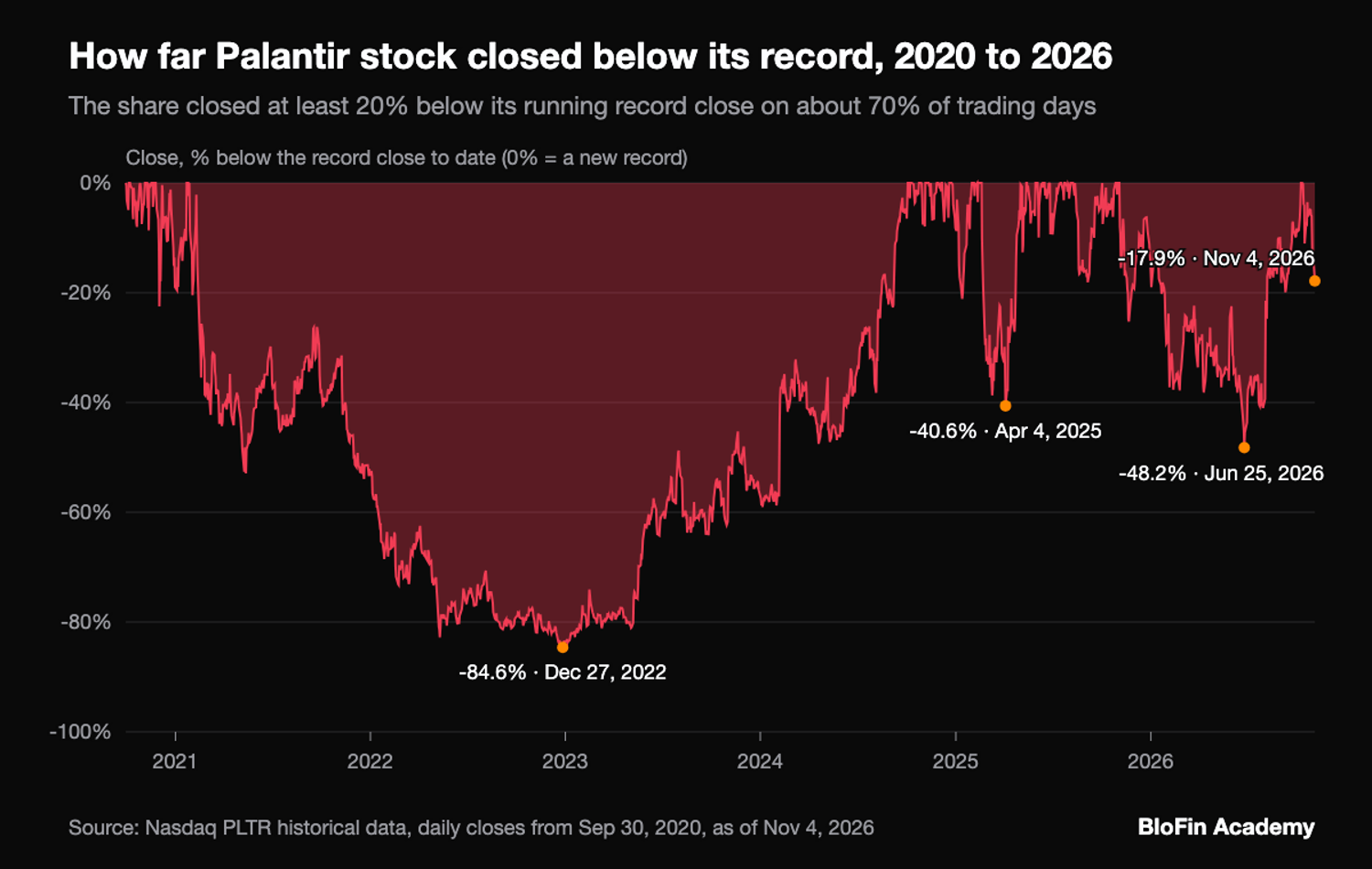
Fall | From record close | To low close | Drop | $1,000 became | Gain needed to recover | Days to a new record close |
|---|---|---|---|---|---|---|
2021 to 2022 | $39.00, January 27, 2021 | $6.00, December 27, 2022 | 84.6% | $154 | 550.0% | 1,345 |
2025 to 2026 | $207.18, November 3, 2025 | $107.27, June 25, 2026 | 48.2% | $518 | 93.1% | 340 |
Both falls ended with a new record close (source: Nasdaq PLTR historical data), and that ending is easy to see in hindsight. The harder part to imagine in advance is how they felt while they were happening. Anyone who bought at the January 2021 record close had to wait until October 2024 to see that price at a close again.
So the drawdown test is a personal one: picture $1,000 of your own money showing as $518, with no sign yet of when it will recover, and ask what you would do. If you know you would sell, that answer counts for as much as any figure in the filings, whatever you think of the company. The full Palantir price record has all five falls, and how much Palantir stock moves day to day measures the swings in between.
Palantir stock for long-term holders and traders
A long-term holder and a trader are asking different questions about the same stock. A holder needs the business to keep growing for years and can ride out most swings. A trader needs a view on the next move and has to survive those swings with the margin behind the position.
In this record, longer holds lost money less often, with a heavy caveat. Measured from every daily close since listing to the same date one, three and five years later, this is how often the holding lost money (source: Nasdaq PLTR historical data):
Holding period | Start dates measured | Share that ended lower |
|---|---|---|
1 year | 1,281 | 32.7% |
3 years | 780 | 15.4% |
5 years | 278 | 0.0% |
The five-year line looks better than it should. Every one of those start dates falls between September 2020 and November 2021, so they overlap heavily. They all end between September 2025 and November 2026, when even the $107.27 low sat well above the highest starting price of $39.00 (source: Nasdaq PLTR historical data). It is one stretch of one unusual stock, and past performance does not tell you how the next five years will go.
Traders meet the same stock through a different set of numbers. Palantir's largest one-day gain since listing is 30.8%, on February 6, 2024, and its largest one-day loss is 21.3%, on May 9, 2022 (source: Nasdaq PLTR historical data). Moves that size are a detail to a five-year holder and a serious event for anyone using leverage.
For crypto holders, the PLTRUSDT Perpetual is BloFin's only Palantir market. It gives no shares, votes or other shareholder rights (source: BloFin stock futures notice). Holding it means paying or receiving funding on a daily schedule of 12AM, 8AM and 4PM UTC (source: BloFin PLTRUSDT contract details), and liquidation runs on the mark price. At 2x your margin is half the position, so a fall near 50% can reduce or liquidate a long, closing part or all of it. The Palantir share's 48.2% fall sat close to that line (source: Nasdaq PLTR historical data). The choice between that contract and the share comes down to funding costs and shareholder rights. On BloFin, stock futures may be limited outside regular US market hours to reduce-only orders, which can only cut a position or close it (source: BloFin stock futures notice).
The PLTRUSDT Perpetual page shows the contract's mark price and funding rate if you want to compare it with the share before you commit any margin.
A checklist for judging Palantir stock yourself
A useful Palantir checklist pairs each argument with one reported figure and a reading you decide on in advance. Go through these figures after every quarterly report, and write down what would make you rethink before you look. Then check whether your time frame and budget still fit.
Figure | Latest reading | A bull case wants | A bear case expects | Where to find it |
|---|---|---|---|---|
US commercial revenue growth | 148% | Stays well above total growth | Slows toward total growth | Earnings release |
Adjusted and GAAP operating margin | 62% and 47% | The gap narrows | The gap widens as stock awards grow | Earnings release |
Stock-based pay as a share of revenue | 13.8% | Keeps falling | Turns back up | Form 10-Q |
Government share of revenue | 49.5% | Keeps falling as commercial grows | A budget cut hits a line worth about half of revenue | Form 10-Q |
Revenue growth outside the US | 26.0% | Catches up with the US | Stays far behind | Form 10-Q |
Remaining performance obligations | $4.9 billion | Grows again | Stays flat while revenue rises | Business Update appendix |
Price-to-sales multiple | About 57 times | Falls because revenue outruns the price | Falls because the price drops | Your own sum, using the 10-Q cover and a dated close |
Then turn the same questions on yourself, because the figures only answer half of them:
How long can you leave this money invested without needing it back?
Could you hold through a fall of 48.2%, the most recent deep one, without selling?
How much of your total savings would one volatile stock become?
Do you want to own shares, or take a leveraged position that has funding and a liquidation price?
Your answers may point somewhere different from the analysts' count, and that is fine: the count measures their expectations over a year, and the checklist measures whether the stock fits your own plan.
Looking to trade Palantir? To get started, you'll need to first create a BloFin account, fund your account with cryptocurrency, and go to the PLTRUSDT Perpetual trading page.
Frequently asked questions
Is Palantir a good stock to buy now?
That depends on your plan more than on the date, and only you can weigh it. As a dated reference point, the $171.70 close on November 4, 2026 sat 60.1% above the June 25 low close. It was also 17.9% below the October 9 record close and 10.0% below the close a year earlier (source: Nasdaq PLTR historical data). The report did not lift the share at either of the next two closes, and two closes say little about a longer holding.
Does Palantir pay taxes?
Palantir does record an income tax charge, but it is very low for now, at $13.6 million on $1.1 billion of third-quarter pre-tax income, or about 1.2% (source: Palantir Q3 2026 Form 10-Q). The filing ties the rate partly to an accounting reserve against its US and UK future tax savings, so net income runs close to pre-tax income.
Does Palantir have any debt?
Palantir had no outstanding balance on its $500 million credit facility at September 30, 2026, and that facility matures on March 31, 2027 (source: Palantir Q3 2026 Form 10-Q). It does have a large long-term spending promise: an amended cloud services agreement commits it to at least $5.6 billion through February 29, 2036, with yearly minimums of $268 million to $979 million. That is a contract commitment and a real future cost, even though it is separate from borrowing.
Does one customer make up most of Palantir's revenue?
No single customer provided more than 10% of Palantir's revenue through the first nine months of 2026, and its top three together provided 16%. Its 1,090 customers vary widely in size: the top twenty averaged $146 million of revenue over the past twelve months, up 76% from $83 million a year earlier. One unnamed customer also made up 27% of accounts receivable, the money customers still owe, at September 30 (source: Palantir Q3 2026 Form 10-Q).
Does Palantir's growth come from new or existing customers?
Most of it comes from customers Palantir already had. Revenue rose $1.1 billion in the third quarter from a year earlier. Of that increase, $891 million, about 79%, came from government and commercial customers that were already in place at December 31, 2025 (source: Palantir Q3 2026 Form 10-Q). Palantir says these increases generally reflect wider use of its products inside those organizations. Most of the increase therefore came from accounts in place by the end of 2025, some of which were themselves new that year.
Researched and written by the BloFin Academy editorial team with AI-assisted drafting. All facts independently verified. Primary sources include Palantir's third-quarter 2026 Form 10-Q, its earnings releases on SEC EDGAR and its Q3 2026 Business Update. Price data comes from Nasdaq's daily history for Palantir, and rating counts come from Stock Analysis, using S&P Global data. BloFin facts come from its stock futures notice and PLTRUSDT contract details, current as of November 5, 2026.
Nothing in this article constitutes financial advice, and nothing in it is a recommendation to buy, sell or hold Palantir in any form. Palantir stock has fallen 84.6% and 48.2% from record closes in the past six years, and a holder can wait years to see an old price again. A leveraged PLTRUSDT Perpetual position can be reduced or liquidated in a far smaller fall, and funding costs add up the longer you hold. Past performance does not indicate future results. Do your own research and consider your risk tolerance before you trade on BloFin.