
Most people who want silver's price in their portfolio would rather not keep bars in a cupboard, pay to insure them or haggle with a dealer when it is time to sell. For years now, stock exchanges have offered an easier way: you buy a share, and a fund takes care of the metal.
The share is simple to buy, but what you own through it varies more than the fund names suggest. One fund lets large holders swap units for bars, while most others will never hand a private investor any metal. Another holds no silver at all and resets its bet every day, and a third is a bank's promise to pay. Fees look small on every fact sheet, yet they are only part of what it costs, and the rules in your country may decide which funds you can buy.
Funds trade through a stock broker, mostly during US market hours. Crypto holders in places BloFin's terms allow may have another route to silver's price, one that skips the broker. On BloFin it is the XAGUSDT Perpetual, a USDT-margined contract with no expiry date and no metal behind it. Its holding cost arrives as funding every 4 hours, so it behaves very differently from a yearly fund fee.
What is a silver ETF?
A silver ETF is an exchange-traded fund that follows the silver price, usually by holding bars in a vault. You buy and sell its shares through a broker on a stock exchange, the costs come out of the fund's assets, and what you own is a slice of the fund, with no claim on any particular bar.
The name is looser than it sounds. The issuer says its iShares Silver Trust (SLV) is not a registered investment company, so it does not face the same rules as funds covered by the Investment Company Act of 1940 (source: iShares Silver Trust). Investors still call SLV and its peers silver ETFs, a bar-backed structure much like a gold ETF, and some products sold under the label are notes or swap-based funds with no bars at all.
Share prices stay close to the metal because large firms can create and redeem shares. For SLV, only authorized participants can do that, in Baskets of 50,000 shares, while everyone else trades on the exchange (source: SEC, SLV 10-Q). The match is close, though rarely exact. SLV closed about 1.4% above its net asset value (NAV) on November 3, 2026. The fund values the metal at each day's LBMA Silver Price, while the shares trade until the close, so the two numbers are taken at different moments (source: iShares Silver Trust).
A share is also a different amount of silver in each fund, including the Sprott Physical Silver Trust (PSLV) and the abrdn Physical Silver Shares ETF (SIVR), so its price tells you little by itself.
Fund | Silver per share | Date of ounce count | Close on November 4, 2026 | Close per ounce held |
|---|---|---|---|---|
PSLV | about 0.341 ounce | June 30, 2026 | $16.98 | about $49.76 |
SIVR | about 0.951 ounce | June 30, 2026 | $49.61 | about $52.19 |
SLV | about 0.903 ounce | November 4, 2026 | $47.16 | about $52.25 |
Those closes come from Nasdaq's price history (source: Nasdaq, SLV historical prices). The ounce counts are the funds' own and carry different dates, so the per-ounce figures are rough, with PSLV's and SIVR's the roughest. Even so, the roughly $50 for an ounce held in PSLV against about $52 in the other two fits the discount at which PSLV often trades.
SLV, PSLV and SIVR compared
SLV, PSLV and SIVR all hold silver, and they differ on where it sits, what they charge and who can turn shares into metal. SLV holds the most ounces, SIVR has the lowest current expense of the three, and PSLV is the one where a holder with enough units can ask for bars.
Their headline fees sit close together. SLV charges 0.50% (source: SEC, SLV 10-Q). PSLV charges 0.45% plus other costs that took its expense ratio to 0.56% in 2025 and 0.52% in its June 30, 2026 report (source: SEC, PSLV annual information form; SEC, PSLV 2025 annual report; SEC, PSLV June 30, 2026 interim report). SIVR charges 0.30% under a voluntary waiver of its 0.45% fee (source: SEC, SIVR 10-Q).
Fund | Structure | Silver held | Custodian | Who can swap shares for metal |
|---|---|---|---|---|
PSLV | Closed-end trust from Ontario, Canada | 215.6 million ounces, June 30, 2026 | Royal Canadian Mint | Unitholders, from ten Good Delivery bars |
SIVR | US trust on NYSE Arca | 67.2 million ounces, June 30, 2026 | ICBC Standard Bank | Authorized participants, 50,000 shares at a time |
SLV | US trust on NYSE Arca | 506.4 million ounces, November 4, 2026 | JPMorgan Chase Bank, London | Authorized participants, 50,000 shares at a time |
iShares Silver Trust (SLV)
SLV is the giant of the group, with about $26.3 billion in net assets on November 4, 2026, and, on November 3, a 30-day median bid/ask spread of 0.02% (source: iShares Silver Trust). JPMorgan's London branch keeps the metal. The trust account can hold no more than 1,100 ounces in unallocated form, so nearly all of it sits as physical bars (source: SEC, SLV 10-K).
The fee is paid by selling silver, so the metal behind each share shrinks over the life of the trust. iShares warns that shareholders lose money if silver does not rise enough to make up for that. You never receive a bill, because the cost shows up as a share that stands for slightly less metal every year (source: iShares Silver Trust).
Sprott Physical Silver Trust (PSLV)
PSLV is built differently. It is a closed-end trust, so its units can sit under or over the value of the metal for long periods. They traded at an average discount of about 3.5% on NYSE Arca in 2024, about 2.8% in 2025 and about 5.4% in the first half of 2026 (source: SEC, PSLV 2025 annual report; SEC, PSLV June 30, 2026 interim report). The $18.87 close on June 30, 2026, stood about 5.7% under the $20.01 NAV (source: SEC, PSLV June 30, 2026 interim report).
The discount changes your result. From the end of 2025 to June 30, 2026, PSLV's NAV fell 18.6% while its NYSE Arca close fell 20.2%, because the discount widened (source: SEC, PSLV June 30, 2026 interim report; Nasdaq, PSLV historical prices). So a wider gap can cost you on top of silver's own move, and a narrower one can help, with no promise of either.
Redemption is the feature that sets PSLV apart. You can ask for metal once a month, by the 15th, in amounts worth at least ten Good Delivery bars, and each bar is usually about 1,000 troy ounces (source: SEC, PSLV annual information form). That is about 10,000 ounces, or roughly $520,000 at the $51.99 an ounce implied by SLV's November 4 NAV. You also pay the Mint's handling, transfer and repackaging fees and the armored transport. The Mint can charge a standard fee of up to 2.5% of the silver's value, or about $13,000 on that amount, plus 0.25% for each later redemption in a calendar year (source: SEC, PSLV annual information form). Cash redemptions pay 95% of the lower of the five-day average market price and NAV, so they give up at least 5% (source: SEC, PSLV 2025 annual report).
abrdn Physical Silver Shares ETF (SIVR)
SIVR works like SLV on a smaller scale, with ICBC Standard Bank as custodian and individual investors barred from creating or redeeming shares directly. Because its 0.30% rests on a voluntary waiver, the fee can go back up toward 0.45% (source: SEC, SIVR 10-Q).
A gap of 0.20 percentage points a year is small beside silver's swings. SIVR rose 145.3% in 2025 and SLV rose 144.7%, and in 2026 to November 4 they fell 26.7% and 26.8%, on Nasdaq closes (source: Nasdaq, SIVR historical prices; Nasdaq, SLV historical prices).
Silver funds with no bars: Futures, swaps and notes
Some silver funds hold no silver. They use futures and swaps to target a multiple of the daily move, or they are notes from a bank that pay income from selling options. That brings costs and risks a bar in a vault does not have: daily resets, contract rolls and the credit of the issuer.
Futures expire, so a fund built on them keeps selling the nearest contract and buying a later one. When the later contract costs more, each roll is a small drag, and when it costs less, the roll adds a little. One plain version of this, Invesco DB Silver Fund, closed in 2023 (source: SEC, Invesco DB Silver Fund 10-K).
Leveraged silver ETFs such as AGQ
ProShares Ultra Silver (AGQ) aims for twice each day's move in the Bloomberg Silver Subindex, a rolling index of COMEX silver futures, and charges 0.95% a year. On November 3, 2026, its exposure was about 150% through swaps with three banks and about 50% through December futures (source: ProShares AGQ). Those positions are what hold it at twice the day's move. They reset every day, and over any longer period ProShares says your return may be higher or lower than twice the index.
On round illustrative numbers, say an index goes from 100 to 120 and back to 100. A 2x fund gains 40% and reaches 140, then loses 33.33% on the way back and ends at 93.33, down 6.67% while the index is flat.
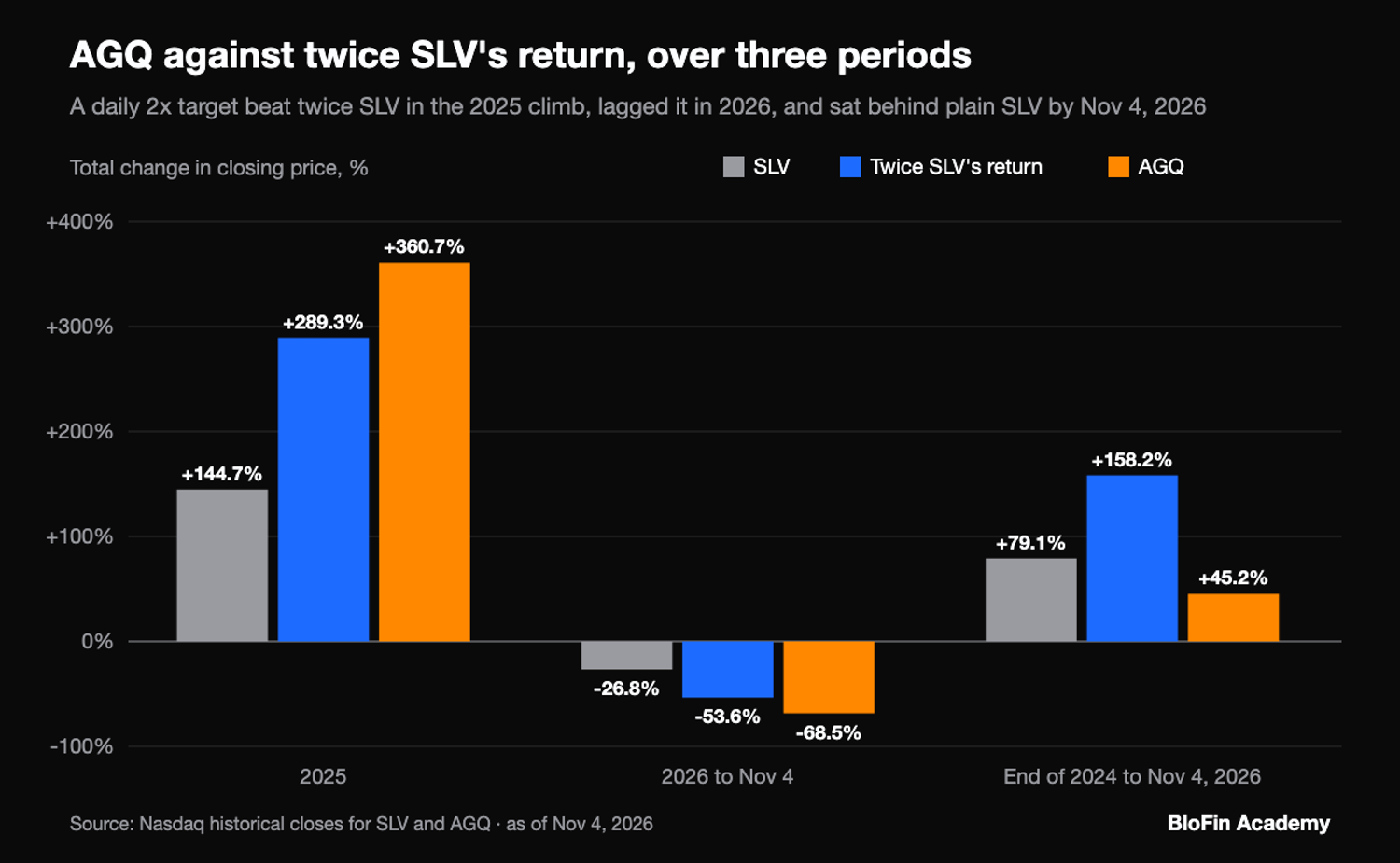
The real record shows the effect running both ways, with twice SLV's return as a rough yardstick, since AGQ follows futures and SLV holds bars. Over the 90-day windows in this record, AGQ beat twice SLV about a quarter of the time. In 2025 AGQ rose 360.7% against 289.3% for that yardstick, and in 2026 to November 4 it fell 68.5% against 53.6%. Across the whole period from the end of 2024, AGQ gained 45.2% and plain SLV gained 79.1%, so the 2x fund finished behind the 1x fund. That depends on the end date: at the January 28, 2026 close, AGQ was up 1,089% from the end of 2024 and SLV 301% (source: Nasdaq, AGQ historical prices; Nasdaq, SLV historical prices). AGQ also reports tax on a Schedule K-1, a form to check before you buy (source: ProShares AGQ).
Covered-call notes such as SLVO
The ETRACS Silver Shares Covered Call ETN (SLVO) is an exchange-traded note, which means it is senior unsecured debt of UBS AG, due April 21, 2033. It may pay a variable monthly coupon from notional call-option premiums, and that coupon can be zero. It charges 0.65% a year, on top of notional transaction costs that UBS puts at about 0.84% a year inside the index (source: UBS ETRACS, SLVO). The strategy gives up part of the gain when silver jumps, and every payment depends on UBS's ability to pay.
Silver ETF holdings as a demand signal
ETF holdings show how many ounces investors keep through funds, which makes them a useful public read on investment demand. Holdings rise when shares are created and fall when they are redeemed. They can also move against the price, so they tell you how much metal moved far better than where silver goes next.
The Silver Institute put global holdings at 1,317.6 million ounces at the end of 2025, after a rise of about 273 million ounces, with 80% of it in the second half (source: World Silver Survey 2026). Its demand table counts 278.1 million ounces of net investment in these products for the year, a slightly different measure. It links those inflows, along with seasonal demand in India and reduced supply from China during its October holidays, to the squeeze in London that October. So flows can matter a great deal for the physical market.
They are a poor timing signal, though. The same report says holdings fell by 35.8 million ounces to the end of February 2026 as prices soared, with investors in North America and Europe taking profits while Asia saw inflows (source: World Silver Survey 2026). SLV's own ounces and closing price show how loose the link is.
Period | Change in SLV's ounces | Change in SLV's closing price |
|---|---|---|
December 31, 2025 to March 31, 2026 | −7.1% | +5.8% |
March 31 to June 30, 2026 | −2.3% | −21.5% |
June 30 to November 4, 2026 | +5.6% | −11.8% |
In the first three months, ounces left the trust while the price rose. In the next three, ounces and price both fell. In the last period ounces rose and the price ended lower, yet SLV still closed above its June 30 level on September 30, so that fall came after September (source: SEC, SLV 10-Q for March 31; SEC, SLV 10-Q; Nasdaq, SLV historical prices). You can follow this yourself, since iShares posts "Ounces in Trust" on the fund's page, with a note that the daily figure can differ slightly from the bar list (source: iShares Silver Trust).
Who can buy a silver ETF?
Anyone with a US brokerage account can usually buy SLV, PSLV and SIVR on NYSE Arca, and PSLV also trades in Toronto. Retail investors elsewhere may need another product: the European Union (EU) requires a key information document (KID) for packaged products, and UK retail access is limited under rules that are changing.
The EU's PRIIPs Regulation obliges those who produce or sell packaged investment products to give investors a KID, and the rules are under revision (source: European Commission, PRIIPs). US-domiciled ETFs mostly serve the US market, and a 2018 justETF article said they did not comply, which is why many online brokers dropped them (source: justETF). Neither source names SLV, SIVR or PSLV, which is an Ontario trust, so ask your platform.
The UK is less settled. Its new framework for Consumer Composite Investments began its transition on April 6, 2026, and takes full effect on June 8, 2027. The Financial Conduct Authority (FCA) says its rules do not create a barrier to US ETFs. It adds that an overseas fund can be marketed to UK retail investors only if it is a recognized scheme, and that as of December 2025 no US funds were (source: FCA, PS25/20). IG, a UK platform, said on March 12, 2026, before that transition began, that most UK retail investors cannot buy US-domiciled ETFs directly (source: IG). Its page names no silver fund, and these sources speak of US funds while PSLV is an Ontario trust, so ask your own platform about SLV or PSLV before assuming either answer.
The local form in Europe is the exchange-traded commodity (ETC). The iShares Physical Silver ETC (SSLN), for example, is issued in Ireland, held about 51.6 million ounces with JPMorgan in London on November 4, 2026, charges 0.20% a year and posts a KID on its page (source: iShares Physical Silver ETC). SSLN is a debt security linked to silver the issuer holds, where SLV gives you a trust share. Its securities are limited-recourse bonds, payable only from the secured property behind them, so any shortfall stays unpaid (source: iShares Physical Silver ETC).
How a silver ETF compares with XAGUSDT
A bar-backed silver ETF gives you a share of a trust through a stock broker, at a small yearly fee taken inside the fund. The XAGUSDT Perpetual gives you a contract in a USDT-margined account, with leverage you choose and funding paid or received every 4 hours.
Point of comparison | Bar-backed silver ETF | XAGUSDT Perpetual |
|---|---|---|
What you hold | A share of a trust that holds silver | A contract sized in XAG and settled in USDT |
Where you hold it | Stock brokerage account | BloFin account |
Leverage in the product | 1x | 1x to 100x, your choice |
Ongoing cost | 0.30% to 0.56% a year, inside the fund | Funding every 4 hours on position value |
Cost to trade | 30-day median bid/ask spread (SLV 0.02% on November 3) for a round trip, plus any broker commission | 0.0200% maker fee, 0.0600% taker fee per side, plus any spread you cross |
Smallest purchase | One share ($47.16 for SLV on November 4, 2026), unless your broker sells fractions | 0.01 XAG (about 0.53 USDT at the 53.38 mark read November 5) |
Those contract terms and fees are BloFin's own (source: BloFin XAG contract details; BloFin fees), and the XAGUSDT contract carries further terms a fund holder never meets, such as price limits and position tiers. With the fund, your main question is the custodian and the trust. With the contract, it is the exchange that holds your margin, which is why BloFin's safety and reserves matter before any large balance moves over.
Access has limits on this side too. BloFin's platform may not be accessed or used by anyone who is resident or domiciled in a Restricted Location, a list that includes the United States, Canada, China, India and Singapore. BloFin says it may add to that list, and that in certain jurisdictions some products may be restricted (source: BloFin Terms of Use). So a US or Canadian reader who can buy SLV through a local broker cannot take the perpetual route, and anyone else should check the current list for their own country.
Trading hours and price gaps
NYSE Arca runs an early session from 4AM to 9.30AM ET, the core session from 9.30AM to 4PM ET and a late session until 8PM ET, on weekdays outside market holidays (source: NYSE, hours and calendars). Silver itself keeps moving elsewhere, so a fund can open far from its last close. SLV closed at $44.84 on November 3, 2026, and opened at $46.78 the next morning, up 4.32% (source: Nasdaq, SLV historical prices).
BloFin's hourly candles show the XAGUSDT Perpetual trading through the weekend of October 31 to November 1, 2026, with 48 hourly bars and 1,905,079 contracts, about 19,051 XAG at 0.01 XAG each. That is one observed weekend, and it says nothing about BloFin's rules for every weekend or holiday.
Silver ETF expense ratios and perpetual funding
So far funding has cost a long far more than a fund's fee, though the two are measured differently. An expense ratio is a yearly rate on the fund's value that builds up slowly inside the share price. Funding is a payment at each settlement, charged on your position's value, and it can reverse direction.
Settlements come every 4 hours, starting at 12AM UTC each day. A positive funding rate has longs paying shorts, and a negative one has shorts paying longs.
XAGUSDT has been listed only since January 8, 2026, so no 12-month record exists yet. Since listing, there have been 1,805 settlements, and they sum to 38.8750%, a total summed from BloFin's funding history (source: BloFin XAG funding history). Each trailing window ends at 12AM UTC on November 5. The dollar figures assume a fixed $10,000 position value, which a real position would not keep as the price moved.
Window | Settlements | Funding sum | On a $10,000 long | Negative settlements |
|---|---|---|---|---|
Last 7 days | 42 | 0.6587% | $65.87 | 0 |
Last 30 days | 180 | 2.5971% | $259.71 | 0 |
Last 90 days | 540 | 6.2823% | $628.23 | 85 |
Last 180 days | 1,080 | 15.0148% | $1,501.48 | 162 |
Since listing | 1,805 | 38.8750% | $3,887.50 | 271 |
On the same $10,000, a full year of fund fees comes to $30 for SIVR at its waived rate, $50 for SLV and $56 for PSLV at its 2025 expense ratio. Over the same 7, 30, 90 and 180 days and the 301 days since listing, SLV's fee comes to about $1, $4, $12, $25 and $41. Funding has cost far more than the fund in every one of those windows.
The first months explain why the since-listing total is so large. January to March account for 21.6582% of the 38.8750%, about 56%, at about 0.26% a day, against about 0.08% a day since April. That later rate is still about 58 times SLV's fee of about 0.0014% a day (source: BloFin XAG funding history).
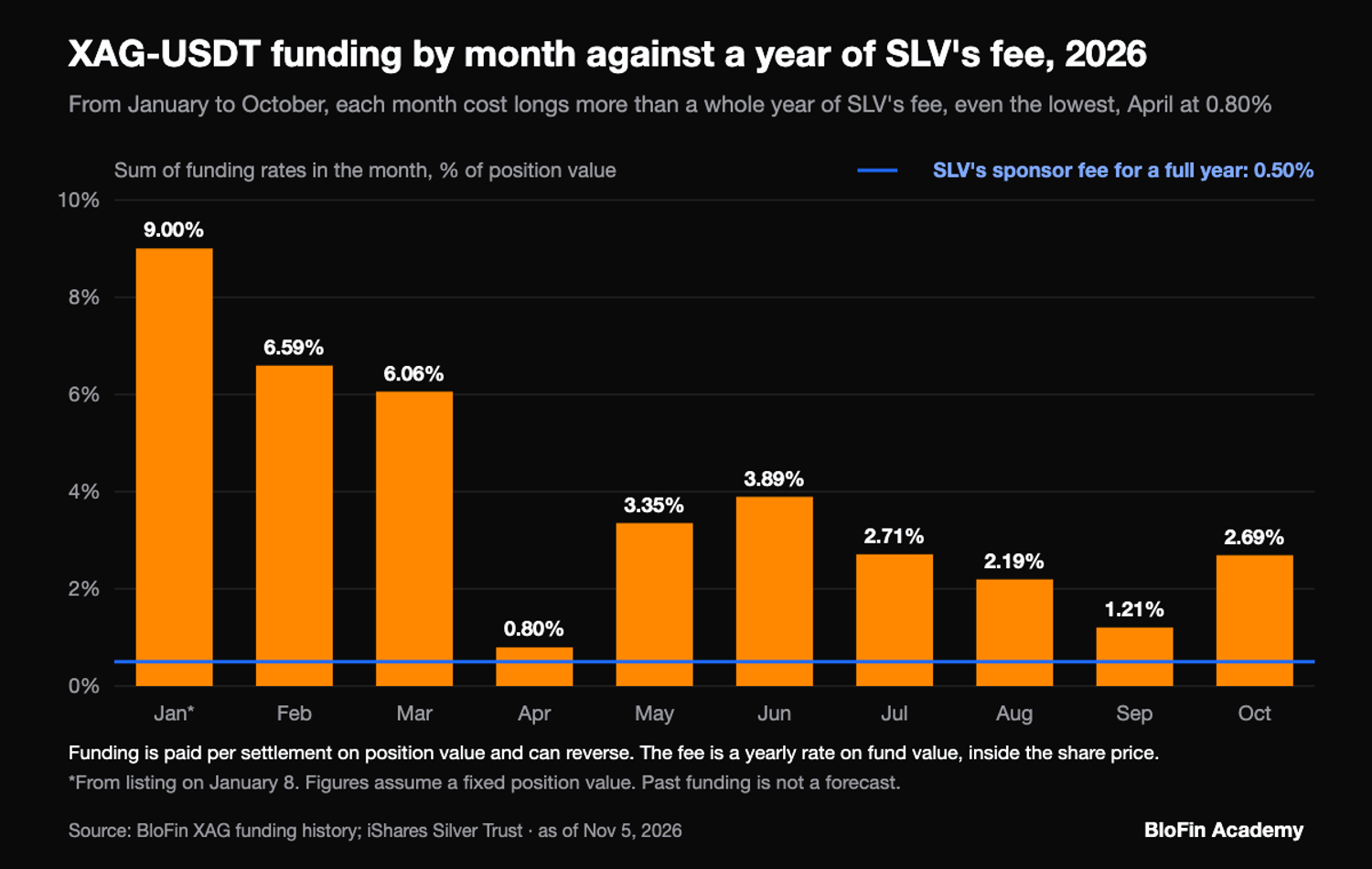
Funding can run in your favor over days. Longs received it at 271 of the 1,805 settlements, about 15%, including 58 of 180 in September alone (source: BloFin XAG funding history). And 145 of the 1,764 rolling seven-day windows since listing summed negative. No 30-day window did, though the lowest, 0.4729% ending April 26, sits under a full year of SLV's and PSLV's fees. Even so, every calendar month from January to October summed to a net cost for longs. The lowest was April at 0.7958%, or about $80 on $10,000, which still tops a full year of each of those three fund fees (source: BloFin XAG funding history).
Because silver perpetual funding can change at every settlement, none of this is a forecast. Before you open a position, look at the live rate and its settlement countdown on the XAGUSDT Perpetual trading page.
Holding XAGUSDT at 1x or 2x
XAGUSDT can sit at 1x, close to the exposure of a bar-backed fund, or at 2x, close to AGQ's exposure on its first day. Both positions keep a fixed size while a fund's shares simply rise and fall, and both can be liquidated, a risk that someone holding fund shares does not carry.
A 1x long in place of an ETF
A long at 1x uses margin of about the position's full value, so its liquidation price sits far below your entry. BloFin liquidates on the mark price, and the first position tier's maintenance rate is 0.50% (source: BloFin XAG position tiers). An estimated Liq. Price appears on the order panel for your trade, so read that field for your own size and margin mode, because leverage and liquidation depend on both.
A 1x long still differs from the fund in four ways. You keep paying funding for as long as the rate is positive, plus a trading fee each way. You hold a contract, so there is nothing to claim from a vault or redeem for bars. And the position lives inside BloFin's rules. BloFin can adjust contract parameters without a separate announcement (source: BloFin XAG contract details), and auto-deleveraging can close a profitable position at the mark price if the contract's insurance fund runs short or falls quickly (source: BloFin ADL FAQ). Your margin and your profit are in USDT, too, so you are also relying on that stablecoin.
AGQ and a 2x perpetual position
AGQ and a 2x perpetual long look alike and behave differently. AGQ resets to twice the daily move each day, while a perpetual position of a fixed size keeps its size, and its leverage drifts with the price. On the 100 to 120 and back to 100 path, the fixed position ends where it started before costs, while the fund loses 6.67%.
In a long, strong climb, the reset can work in AGQ's favor, as 2025 showed, and a fixed position gets no such boost. A long fall shows the trade-off, because at 2x your margin is about half of the position's value. As a rough estimate on isolated margin, a price fall of about 50% would equal your margin, and liquidation comes sooner than that. The Liq. Price field on the order panel gives the estimate for your own trade.
On BloFin's daily candles for the XAGUSDT Perpetual, the close went from 117.72 on January 28, 2026, to 57.73 on June 24, down 51.0%, and that day's 55.71 low sat 52.7% under the January close. January 28 was the highest SLV and AGQ close in this record, so this is the worst entry, not a typical one. On SLV's closes since the perpetual listed, only entries from January 23 to 29 were followed by a fall of 50% or more, though about half were followed by 30% or more. A 2x long opened at the January close would probably have faced liquidation on a fall of that size. AGQ lost 84.1% by that date and 87.8% by November 4, and stayed open (source: Nasdaq, AGQ historical prices). A fund holder cannot lose more than the shares cost.
Because funding is charged on position value, the same rate costs twice as much per dollar of starting margin at 2x. The 15.0148% over the last 180 days equals about 30% of a starting margin worth half the position. AGQ's 0.95% is only its stated fee, and the prospectus says the funds also bear trading spreads and embedded financing costs on swaps and futures (source: ProShares Trust II prospectus).
Choosing between a fund and a perpetual
The choice comes down to how long you plan to hold and what you want to end up owning. A bar-backed fund is built for holding in a stock account at a small yearly fee. A perpetual offers USDT margin, leverage and a small minimum order, at a funding cost that has added up quickly so far.
Time is the number to work out first. At the rate of the last 180 days, funding matched SLV's whole yearly fee in about 6 days, and at April's low rate it took about 19 days. Over a day or so, trading costs can matter more. Two taker fees come to 0.1200% of position value on the perpetual, against the fund's spread plus whatever your broker charges. Funding passed that 0.1200% in about a day and a half at the rate of the last 180 days, or about 4.5 days at April's rate. Over months, the yearly fee has so far been the far smaller cost, for anyone able to buy the fund.
A few questions narrow it down:
Do you want metal behind what you hold? A bar-backed fund has it, and the perpetual has none.
Can you open a brokerage account that offers the fund? If your country or platform blocks the fund you want, a local ETC may be the nearest alternative. BloFin's Terms of Use limit the other route, with the United States and Canada on its Restricted Locations list and some products that may be restricted elsewhere, so check them for your country.
Do you want to fund the position from crypto? The perpetual settles in USDT, and the fund needs a broker.
Do you want leverage? Compare AGQ's daily reset with a fixed position's liquidation risk and funding, and size either one on what you can afford to lose.
Tax can change the answer too. In the US, SLV's sponsor treats it as a grantor trust, and gains on silver held over a year can face a 28% maximum rate for collectibles (source: SEC, SLV 10-K). PSLV's trust expects to be treated as a passive foreign investment company (PFIC). A US holder who makes a timely qualified electing fund election on Form 8621 can face a 15% or 20% maximum on long-term gains under the form's terms. One who makes no election falls under a default regime the form warns may be adverse (source: SEC, PSLV annual information form). Bars you keep yourself raise different tax and storage questions, part of the choice between physical and paper silver, and a perpetual's tax treatment depends on your country.
Even the cheapest wrapper passes on silver's own swings in full, so whether silver is a good investment comes before any choice of fund or contract.
Looking to trade silver? To get started, you'll need to first create a BloFin account, fund your account with cryptocurrency, and navigate to the XAGUSDT Perpetual trading page.
Frequently asked questions
Is SLV backed by real silver?
SLV held about 15,752 tonnes of silver on November 4, 2026, according to iShares, and each share is a fractional interest in the trust's net assets. The fund's page posts a bar list and inspection letters, so you can see what the custodian holds. You still own a share, so you cannot walk into the vault and collect a bar (source: iShares Silver Trust).
Do silver ETFs pay dividends?
A trust that only holds bars has no interest or dividends coming in, so it sells a little silver to meet its fee. Returns come from the price alone. A note such as SLVO may pay a monthly coupon, and that coupon can be zero (source: UBS ETRACS, SLVO).
What is the cheapest silver ETF?
Among the three big US trusts, SIVR's 0.30% is the lowest current figure, though it depends on a voluntary waiver. Spreads, broker commissions and premiums or discounts also count. In Europe, physical silver ETCs start at 0.19% on justETF's list, read November 5, 2026, and SSLN lists 0.20% (source: justETF silver ETCs).
Can a silver ETF shut down?
Yes. When Invesco DB Silver Fund closed in 2023, it liquidated its remaining assets on March 10 and paid cash pro rata to shareholders who had not sold, less an amount kept for closing costs. The iShares page warns that its own trust could also be liquidated at a time that is bad for holders (source: SEC, Invesco DB Silver Fund 10-K; iShares Silver Trust).
Do silver ETFs trade on weekends or holidays?
On their exchange, US-listed silver funds trade only on weekdays outside market holidays, though some brokers offer an overnight session on other venues that can start on Sunday evening ET. NYSE lists its holidays each year, and some days close early: on the day after Thanksgiving and on December 24, 2026, each market closes at 1PM ET, with late trading at NYSE Arca ending at 5PM ET. Silver can move in that time, so the next open may gap (source: NYSE, hours and calendars; Blue Ocean).
Does BloFin list SLV or another silver ETF?
The XAGUSDT Perpetual is BloFin's only silver product, so you buy SLV, PSLV, SIVR or AGQ through a stock broker, or a local alternative in your own country. That perpetual tracks an index of silver's price, and it settles in USDT, so what you hold is a contract.
Researched and written by the BloFin Academy editorial team with AI-assisted drafting. All facts independently verified. Primary sources include iShares, the SEC filings of the iShares Silver Trust, Sprott Physical Silver Trust, abrdn Silver ETF Trust and Invesco DB Silver Fund, ProShares, UBS, the Silver Institute, the FCA, the European Commission, NYSE, Nasdaq and BloFin's XAGUSDT trading, contract, funding, position tier and fee pages and Terms of Use, current as of November 5, 2026.
Nothing in this article constitutes financial advice, and nothing in it is a recommendation to buy, sell or hold silver or any fund in any form. A silver fund can fall sharply with the metal and can trade away from its net asset value, a 2x fund can lose most of its value in a long decline, and a note depends on its issuer's ability to pay. A long perpetual can pay funding for as long as you hold it, can be liquidated, and gives you no metal. Past performance does not indicate future results. Do your own research and consider your risk tolerance before you trade on BloFin.