
Silver has always been awkward to own in small amounts. A bar has to be stored and insured, and a dealer buys it back below the price you paid. A fund share is easier, but it sits in a brokerage account that keeps stock-market hours. Putting silver on a blockchain promises to fix both problems, because an ounce, or a slice of one, becomes a token you can hold in a wallet and send at any hour.
The catch is that one label covers products that hold very different things. One silver token is a legal claim on bars in a named vault. Another follows a share in a silver fund that its issuer holds for you. Both look the same in a wallet, and the gap shows up only when you try to swap the token for metal, or when something goes wrong at the issuer. The range keeps growing, too, and in September 2026 a commodities hub in the UAE launched digital stakes in one record-sized silver bar.
Silver tokens come in two main designs, and newer products add a third. A metal-backed token stands for silver set aside for its holders, and its issuer will deliver that metal on request, subject to minimums and fees. A tokenized fund product follows a silver fund's shares instead, and Ondo's SLVon, one such product, is a debt note that pays out in stablecoins. Each design gives a different answer to three questions: what you own, who may buy it, and what you get back when you cash it in.
BloFin lists no silver token. On BloFin, silver trades through the XAGUSDT Perpetual, a contract that follows silver's price in USDT, with no metal to hold and nothing to redeem. Knowing how each kind of token is built, and how a perpetual compares, shows which one fits what you want from silver.
What is tokenized silver?
Tokenized silver is a blockchain token whose value follows the price of silver. Either each token is a claim on metal in a vault, or it tracks shares in a silver fund. The issuer decides who may buy it, what backs it, and whether you can swap it for bars or only for its cash value.
The two main designs run on the same basic steps. An issuer creates tokens when buyers pay in, records them on a blockchain and destroys them when holders redeem them, so the number of tokens should match what sits behind them. What differs is the legal claim. Kinesis's KAG is a claim on ounces in a vault, while Ondo's SLVon is a note that tracks a fund share. Gold tokens come in the same two kinds, and tokenized gold is minted and held in custody the same way.
How metal-backed silver tokens work
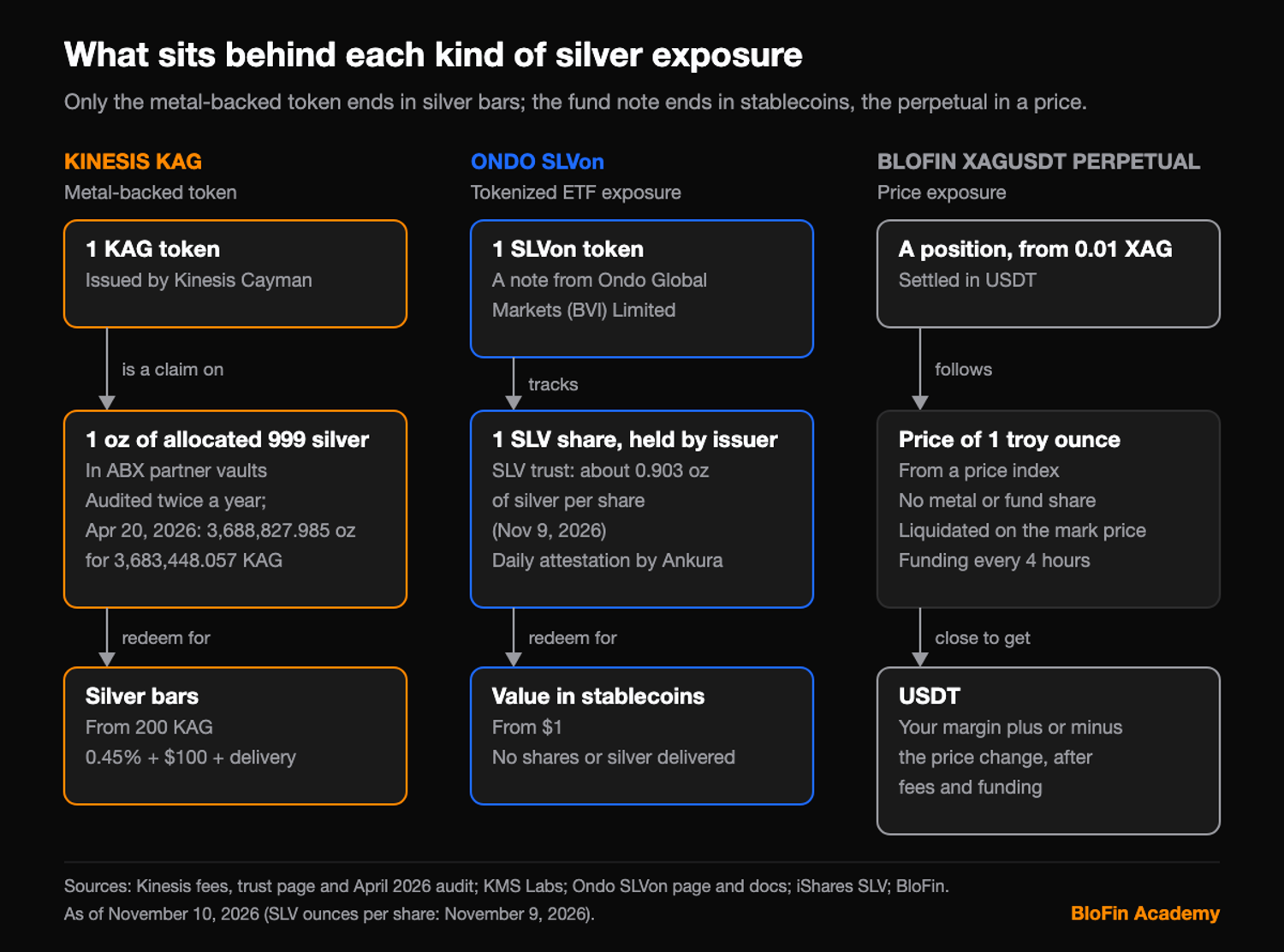
A metal-backed silver token stands for a fixed amount of physical silver that a vault holds for token holders. Kinesis's KAG works this way. Each KAG represents one ounce of fully allocated 999 silver, kept in vaults run by its partner Allocated Bullion Exchange (ABX), and Kinesis says the metal never appears on its own balance sheet (source: Kinesis, trust and security, KMS Labs).
"Allocated" means specific bars are set aside for the token holders, so the silver is theirs and stays off the issuer's books. Kinesis has its silver audited twice a year by Bureau Veritas, and its site lists 13 audits going back to March 2020 (source: Kinesis, trust and security). The newest listed is the April 2026 audit, and Kinesis also lists October audits for 2024 and 2025.
The audit letter for April 2026, dated June 3, shows how the check works. On April 20, 2026, there were 3,683,448.057 KAG in circulation on the Kinesis blockchain. A physical count by Inspectorate International, the firm the letter names, from April 21 to 24 found 3,688,827.985 troy ounces of silver, measured as 999 fine. That is 5,379.928 ounces more silver than tokens, or about 0.146%. The letter explains most of the gap, because Kinesis keeps five bars of about 1,000 ounces each as a reserve and counts them in the total (source: Kinesis, April 2026 audit).
Kinesis Cayman issues the tokens, and it is registered with the Cayman Islands Monetary Authority as a virtual asset service provider. Kinesis quotes one silver price across its 13 vault hubs, which include London, New York, Zurich, Dubai and Singapore. It showed $53.16 an ounce at 2.43AM UTC on November 10, 2026, a price it calls indicative (source: Kinesis, silver price, KMS Labs). At that price, April's token count would be worth about $195.8 million.
How the KAG yield works
KAG's yield is paid out of Kinesis's transaction fees. Sending KAG costs 0.45%, and so does minting new KAG, while trades on the Kinesis Exchange cost 0.22% and card payments carry a 0.22% conversion fee (source: Kinesis support, holder's yield, Kinesis, fees). Those fees go into a master fee pool, holders get 15% of it, and gold and silver have separate pools. Your share comes from a daily snapshot of your balance at 11.59PM UTC, added up over the month and paid in the same metal.
So the yield is a share of activity on the network, and it rises and falls with how much other people trade and send. The help article that sets out the 15% split has not been revised in years, so check the current terms in your account before you count on it. To qualify, your account must be fully verified through Kinesis's identity checks at KYC tier 3. KAG held in an outside wallet linked to that account counts toward your balance (source: Kinesis support, holder's yield).
Redeeming KAG for silver bars
Redeeming KAG means asking Kinesis to deliver the bars behind your tokens, which are destroyed on its blockchain as the metal leaves the system. You send the request through a redemption form in your account settings, where you pick a vault hub and an amount in steps of 200 KAG. Kinesis's operations team then replies with next steps within one to two working days (source: Kinesis support, redeeming bullion, Kinesis support, can I redeem).
The fee is 0.45% of the tokens redeemed plus $100, and delivery is priced by location (source: Kinesis, fees). At Kinesis's $53.16 price, the 200-ounce minimum is worth $10,632. The 0.45% comes to 0.9 KAG, or about $47.84, so the fixed cost is about $147.84, or 1.39% of the metal's value before any shipping (source: Kinesis, fees). Below 200 KAG, the way out is a sale on the Kinesis Exchange at 0.22%. Kinesis's website also says it is not meant for people based in the UK (source: Kinesis, fees).
How tokenized silver ETF exposure works
Tokenized ETF exposure is a token whose value follows a silver fund's share price, while the token's issuer holds the fund's shares. Ondo's SLVon tracks the iShares Silver Trust (SLV). Ondo's page sets one SLVon equal to 1.00 SLV share, and the tokens come from Ondo Global Markets (BVI) Limited, a business company formed under British Virgin Islands law (source: Ondo, SLVon).
In law, SLVon is a structured note, which is a kind of debt issued by that company. The amount it owes you moves with the value of the SLV share behind it. Your name never appears on the fund's share register, because the issuer holds the shares through a US broker, and the token gives you no right to receive them. What you do have is the right to redeem the token for what the shares are worth at the time, plus a claim on the assets that back it, under terms governed by Swiss law (source: Ondo docs, legal and regulatory, Ondo, SLVon).
Ondo's page names Alpaca Securities as the issuer's broker, and Ondo Finance Inc., a Delaware company, provides the tokenization services (source: Ondo, SLVon). The issuer is 90.01% owned by Flux Finance, part of the Ondo Foundation group, and 9.99% by Ondo Finance (source: Ondo docs, legal and regulatory). So a holder relies on three links in a chain: the trust's silver, the broker that holds the shares, and the issuer's promise to pay.
How much silver one SLVon tracks
One SLVon follows one SLV share, and one SLV share holds less than an ounce of silver. On November 9, 2026, the trust held 504,630,049.40 ounces for 559,050,000 shares, or about 0.903 ounce per share. Its net asset value was $47.50 a share, which works out to about $52.62 per ounce held (source: iShares, SLV). The trust also charges a 0.50% yearly sponsor fee. SLVon holders pay it too, because the token follows the share after that fee.
At 2.40AM UTC on November 10, Ondo's page showed SLVon at $47.89, a price Ondo calls illustrative. Divided by the November 9 figure of 0.903 ounce, that is about $53.05 per ounce of silver tracked. Kinesis showed $53.16 for one KAG at 2.43AM UTC, and the XAGUSDT Perpetual's mark price was 53.28 USDT at about 2.26AM UTC (source: Ondo, SLVon, Kinesis, silver price, BloFin, XAGUSDT Perpetual mark price). So per ounce, the three sat within about half a percent of each other, counting one USDT as one dollar, on readings taken within 17 minutes of each other.
Per ounce they cost about the same, and the difference that matters is the token count. If you hold 100 SLVon, you track about 90.3 ounces of silver, while 100 KAG is a claim on 100 ounces. Two balances that look equal in a wallet can hold different amounts of metal.
Who can buy SLVon
SLVon is sold only outside the United States, under the Regulation S exemption, and US persons may not buy or redeem it, with Canada on Ondo's banned list too. In places including the United Kingdom (UK), the European Economic Area, Singapore and Hong Kong, buyers must pass professional or qualified investor tests, such as owning a large portfolio. In Switzerland, the tokens are closed to individuals (source: Ondo docs, eligibility, Ondo docs, legal and regulatory).
For the European Economic Area, Ondo's own notices give two answers. Its short notice says qualified investors only. Its longer notice says a prospectus approved in Liechtenstein opens many Ondo tokens to retail buyers and keeps some for professionals, so a buyer there has to read SLVon's final terms (source: Ondo, SLVon). Anyone who buys from Ondo or redeems to it must first pass its KYC checks (source: Ondo docs, legal and regulatory). Before you buy, check Ondo's rules for the country you live in, because it bars banned persons from redeeming as well as buying (source: Ondo docs, eligibility).
The tokenized 1,971kg silver bar
On September 7, 2026, DMCC in Dubai launched digital stakes in a single 1,971kg silver bar. The bar holds a Guinness World Record and was made from 99.9% silver by SAM Precious Metals. It is the first tokenized commodity under DMCC's framework with the Virtual Assets Regulatory Authority (VARA) in Dubai (source: DMCC, silver bar launch).
The bar weighs about 63,369 troy ounces, or about $3.37 million of silver at Kinesis's November 10 price. Brink's holds the bar, and its ownership is recorded in DMCC Tradeflow, DMCC's register of who holds commodities stored in the UAE. A VARA-regulated platform in Dubai issues the stakes as an asset-referenced virtual asset on BNB Chain. Eligible buyers, retail investors included, could buy from September 7, and regulated trading between holders was set to open after the first sale, subject to regulatory and platform requirements (source: DMCC, silver bar launch).
This is a third design: a stake in one particular bar, where KAG gives ounces from a vault's allocated stock and SLVon gives a fund share. DMCC's announcement names no way to swap a stake for metal, so the date that trading between holders opens is the first thing a buyer would want to know.
Attestation, redemption and liquidity risks of tokenized silver
Every silver token adds three risks to silver's own price swings. The backing may fall short, and swapping the token for what backs it may cost more or take longer than expected. A quick sale may come at a poor price. Each issuer handles them differently, and gold tokens carry the same redemption and liquidity risks.
Attestation is the check that the backing exists, and the two issuers run it at very different speeds. Kinesis compares its vault count with the tokens on its blockchain every six months, so between audits a holder relies on the last count (source: Kinesis, trust and security). Ondo publishes daily attestations of its holdings, checked by Ankura Trust Company, plus monthly reports by the 20th of the next month (source: Ondo docs, trust and transparency). Its SLVon page lists physical silver as 100% of the underlying fund's holdings, as of November 9, 2026 (source: Ondo, SLVon).
Redemption risk is about what you get back and what it costs. KAG can be swapped for bars from 200 ounces, for 0.45% plus $100, about 1.39% of a 200-ounce redemption at Kinesis's $53.16 price on November 10, plus delivery (source: Kinesis, fees). SLVon redeems from $1 for its value in stablecoins, so only KAG is a route to metal. Liquidity risk shows up in Ondo's trade limits. During regular US trading, from 2.30PM UTC until 9PM UTC (9.30AM until 4PM ET), Ondo caps a single SLVon trade at $4,000,000, and the cap drops to $1,000,000 in the sessions before and after. The overnight session, from 1AM until 9AM UTC (8PM until 4AM ET), is back at $4,000,000 (source: Ondo, SLVon).
Tokenized silver and the XAGUSDT Perpetual
A token and a perpetual both follow silver's price, but only a token can stand for metal held for you. BloFin's XAGUSDT Perpetual is a contract settled in USDT. One XAG, the market code for silver, represents one troy ounce as a price reference, and the contract size is 0.01 XAG. A position has no metal, fund share or redemption behind it (source: BloFin, XAGUSDT listing notice).
KAG and SLVon, one token of each kind, compare with the XAGUSDT Perpetual as follows, on the terms each issuer publishes.
Kinesis KAG | Ondo SLVon | XAGUSDT Perpetual | |
|---|---|---|---|
What one unit follows | One ounce of allocated silver | One SLV share, about 0.903 ounce on November 9, 2026 | One troy ounce, as a price reference |
Who issues it | Kinesis Cayman | Ondo Global Markets (BVI) Limited | BloFin |
What you can redeem it for | Silver bars, from 200 KAG, at 0.45% plus $100 plus delivery | Its value in stablecoins, from $1 | Nothing; you close the position in USDT |
Who can use it | Website not meant for UK-based people | Non-US buyers only; professional or qualified investors in several countries | BloFin's Terms exclude restricted locations, including the US and Canada |
BloFin's Terms of Use name the restricted locations, and some BloFin products may be unavailable or limited in certain other places (source: BloFin, Terms of Use).
BloFin has listed the XAGUSDT Perpetual since 6AM UTC on January 8, 2026, and it trades 24/7 (source: BloFin, XAGUSDT listing notice). BloFin's only metal token on spot is Tether Gold (XAUT), so on BloFin, silver means the perpetual. When no outside silver price is available, BloFin holds the contract's index at its last value. Outside the main market's regular hours, BloFin says orders may be limited to reduce-only orders that close positions (source: BloFin, XAGUSDT listing notice).
The trade-off runs the other way from a token. A perpetual has no vault or fund share behind it, so there is no audit or redemption to check. It trades on margin, though, with up to 100x leverage on the first position tier of 0 to 400 XAG (source: BloFin, XAG position tiers). BloFin liquidates positions on the mark price, and higher leverage moves the liquidation price closer, so a fast swing in silver can force a leveraged position shut, while a token holder would simply sit through it.
Longs and shorts also swap funding payments every four hours on BloFin (source: BloFin, XAGUSDT listing notice), so holding a position costs or earns money depending on which side pays. If price exposure is all you need, you can open the XAGUSDT Perpetual on BloFin from 0.01 XAG, a position worth about 0.53 USDT at the 53.28 mark price at about 2.26AM UTC that morning (source: BloFin, XAGUSDT Perpetual mark price).
What to check before buying tokenized silver
Before buying tokenized silver, read three documents from its issuer: the latest audit or attestation, the redemption terms and the eligibility rules. They show what backs the token, whether it swaps for bars or only for stablecoins, and whether you may buy it where you live. Weigh whether silver is a good investment in your case first.
If you plan to pay with crypto, you can buy silver with crypto through a dealer, a token or the perpetual, and each route gets you something different. Whichever route you look at, those three documents decide what a token is worth when you want out.
Looking to trade silver? To get started, you'll need to first create a BloFin account, fund your account with cryptocurrency, and navigate to the XAGUSDT Perpetual trading page.
Frequently asked questions
Is there a cryptocurrency backed by silver?
Yes. Kinesis's KAG is backed by allocated silver, one ounce per token, and comes in two forms: the native token on the Kinesis blockchain and an ERC-20 version on Ethereum. The Ethereum version is issued by KMS Labs S.A., a company set up in Panama, and each one is a claim on a native KAG that KMS Labs holds in reserve. Turning it back into native KAG needs KMS Labs' own compliance checks first. The Bureau Veritas audits cover native KAG only, and KMS Labs says it will report checks on its own reserve separately (source: KMS Labs).
Does SLVon trade at weekends?
Yes. SLVon is on Ondo's Off-Hours list, which keeps it tradable over weekends and US market holidays, from Friday evening until trading reopens on Sunday evening (source: Ondo docs, off-hours trading). Ondo's SLVon page sets an Off-Hours limit for the token while US markets are closed. In that session the cap is a net position of $1,000,000, with buys and sells offsetting each other. Ondo also stops updating the page's 24-hour price data from Friday 8PM to Sunday 8PM ET, which is 1AM UTC on Saturday to 1AM UTC on Monday. So the 24-hour figures shown over a weekend are Friday's (source: Ondo, SLVon).
What happens to SLVon if its issuer fails?
The issuer is a separate company set up for this purpose, with an independent director, and Ondo says the issuer must keep extra collateral above full backing at all times. Ankura Trust Company acts as security agent and holds a first-priority claim on that collateral. In specified events of default, holders of the required share of tokens can direct Ankura to take the collateral, sell it and pay the money out to them. Flux Finance, the issuer's majority owner, has also guaranteed funds as an extra layer of cover (source: Ondo docs, trust and transparency).
Can you keep SLVon in your own crypto wallet?
SLVon is an ERC-20 token, so self-custody wallets such as MetaMask or Trust Wallet can hold it. Custodians including BitGo, Fireblocks and Ledger support it too, while most centralized exchange accounts do not yet. Buying from Ondo is done with its USDon stablecoin, and USDC is converted one-for-one in the same transaction. A bank wire is accepted only for buying USDon, and only from $500,000 (source: Ondo docs, investing and redeeming).
Does Kinesis charge a storage fee on silver?
Kinesis charges 0% for storing allocated KAG. It says the cost is covered by ABX's vaults and a share of the transaction fees charged across its system. Holders who use its segregated storage, where specific coins and bars are set aside for one owner, can redeem those exact items under a separate schedule of fees and minimums (source: Kinesis, fees).
Researched and written by the BloFin Academy editorial team with AI-assisted drafting. All facts independently verified. Primary sources include Kinesis's fee schedule, trust page, help articles and April 2026 audit letter, KMS Labs, Ondo's SLVon page and Ondo Stocks documentation, the iShares Silver Trust fund page, DMCC's September 7, 2026 announcement and BloFin's XAGUSDT Perpetual listing notice, Terms of Use and position tiers, current as of November 10, 2026.
Nothing in this article constitutes financial advice. A silver token is only as sound as its issuer, because someone else holds the metal or fund shares behind it. A redemption can cost more than 1% of the value or be closed to you by eligibility rules, and a token can trade away from silver's price when its market is thin. On the XAGUSDT Perpetual, leverage can cost your whole margin in a sharp move. Past performance does not indicate future results. Do your own research and consider your risk tolerance before you trade on BloFin.