
Plenty of people who hold crypto like the idea of owning some silver, and the obvious question is whether they can buy silver with crypto directly. They can, although that phrase covers products with little in common. A coin in a safe, a token in a wallet and a futures position all get called buying silver, and each one hands you something different.
The differences matter most when the price is moving fast, as it was in early November 2026. Spot silver was up 5.1% in the afternoon in New York on November 4, 2026, in the session after the US midterm elections (source: CNBC, November 4, 2026). The extra a dealer charges over spot can be larger than that whole move.
So the useful question is what you want to end up holding. Paying a dealer gets you metal you can touch, at a premium, and it can create a tax bill on the crypto you spend. A tokenized product gets you a balance in a wallet, on its issuer's terms. A perpetual futures contract gets you silver's price, with optional leverage and a running cost called funding, and no metal at all.
BloFin's route is the third one. The XAGUSDT Perpetual settles in USDT and takes orders from 0.01 XAG. It is how BloFin offers silver, because the exchange has no silver spot pair or token. BloFin's Terms of Use bar residents of Restricted Locations, including the US and Canada, from its platform, so this route is not open to them (source: BloFin Terms of Use).
Can you buy silver with crypto?
Yes, you can buy silver with crypto in three ways: pay a dealer for coins or bars, buy a tokenized silver product from another issuer, or trade a perpetual futures contract such as the XAGUSDT Perpetual. Only the dealer route ends with metal posted to you as part of the purchase, and the three differ on ownership, cost and size.
Where you live can settle this before anything else does. Beyond the US and Canada, BloFin's list of Restricted Locations names other countries and covers anyone resident or domiciled in them. BloFin may add to that list, and it says some products may be restricted in certain jurisdictions. So a country missing from the list is no promise of access, and the full Terms are worth reading (source: BloFin Terms of Use). Kitco and Hero Bullion, for their part, take crypto only from North American buyers. The Kitco payment page lists Bitcoin for US and Canadian customers (source: Kitco, payments and fees). Hero Bullion ships only to US addresses (source: Hero Bullion, FAQs). A reader elsewhere needs a dealer that both delivers to them and takes crypto.
Silver funds such as SLV are one more option, but you buy those through a brokerage account in dollars, so your crypto has to be sold first. The other routes that start from dollars, such as miners and futures on a regulated exchange, belong with how to invest in silver in general. A holder who wants to stay in crypto for as long as possible is choosing among these three. Dealers and the perpetual have figures you can set side by side, although the coin prices come from US and Canadian checkouts, whose residents BloFin's terms bar from the perpetual. A reader elsewhere can swap in their own dealer's price:
What you compare | Dealer coin paid in bitcoin | XAGUSDT Perpetual |
|---|---|---|
Who can use it | Delivery to US addresses at Hero Bullion; US and Canadian buyers at Kitco | Closed to residents of BloFin's Restricted Locations, including the US and Canada; check the Terms where you live |
What you hold | 1 troy ounce of silver, posted to you | A USDT-settled contract, with no metal |
Smallest order | 1 coin at Hero Bullion; $5,000 at Kitco | 0.01 XAG, about 0.53 USDT |
Price per ounce, before shipping, insurance and any sales tax | $57.83 at Kitco on orders of $5,000 or more; $61.13 at Hero Bullion from 1 coin | 53.38 USDT mark, plus a taker fee of about 0.03 USDT |
Running cost | Your own storage and insurance | Funding: 2.5971% of position value over the 30 days to November 5 |
Leverage | None | 1x to 100x |
Those prices were read at about 3AM UTC on November 5 (source: Kitco online store, silver; Hero Bullion, 2026 American Silver Eagle; BloFin XAG funding history). The Hero Bullion page is a cached copy that showed $61.88 in crypto by 3.21AM UTC, about 16.3% over the same asking price. A tokenized product has no single line to add beside them, because its terms depend on the issuer and on where you buy it.
Paying a dealer in bitcoin for coins or bars
Paying a dealer in bitcoin works much like any online checkout, with a payment processor such as BitPay turning a dollar order into a crypto invoice for a short window. You get real metal posted to you. You pay the dealer's premium, any shipping and insurance, any sales tax or import charge where you live, and whatever network fee your wallet charges (source: Kitco, payments and fees; Kitco, shipping and insurance).
Kitco and Hero Bullion both process crypto through BitPay, and their checkouts run like this, though labels differ between dealers. Outside the US and Canada, the Kitco payment page offers bank wire or funds on account instead (source: Hero Bullion, payment methods; Hero Bullion, FAQs; Kitco, payments and fees).
Check two Kitco rules before you start. Its page says payments must come directly from your own wallet and that transactions sent from exchanges are not supported, so you would withdraw the coins to a wallet before you open the invoice and its 15-minute window. The Kitco store also sets a $5,000 minimum on physical orders.
Step 1: Compare the crypto price with the wire or check price and the card price on the product page, since both dealers show all three. Then click Add to Cart (Pre Order on a coin not yet in stock).
Step 2: At checkout, choose Bitcoin at Kitco or Crypto via BitPay at Hero Bullion.
Step 3: Open the invoice, which at Kitco arrives as a secure payment link by email and shows a QR code to scan with a supported wallet.
Step 4: Check the amount, then send it before the invoice window closes. At Kitco that window is 15 minutes, and the amount must go in one payment. Kitco says that window guarantees the exchange rate BitPay locked in.
Step 5: Wait for the network to confirm the payment. Hero Bullion says confirmation can take from a few minutes to several hours, and that it then ships within 1 to 3 business days, though a pre-order waits for its listed ship date.
Stablecoin holders should read the coin list first, since the Kitco page describes Bitcoin only, while the Hero Bullion FAQ names GUSD, USDC, PAX, DAI and BUSD among its coins and does not name USDT. BitPay's own list, dated March 19, 2024, includes USDT (source: BitPay, supported cryptocurrencies), but what you can pay with depends on the dealer, so confirm it on the invoice screen before you count on it.
What a dealer's premium costs per ounce
A dealer's premium is the amount charged over the spot price. On one-ounce American Silver Eagle coins bought with crypto, it ran from about 8.7% at Kitco, on orders of at least $5,000, to about 14.9% at Hero Bullion on a single coin, on November 5, 2026 (source: Kitco online store, silver; Hero Bullion, 2026 American Silver Eagle). Hero Bullion's 20-coin tier came to about 12.8%. Those figures use the Kitco dollar asking price of $53.19 at 3.03AM UTC, and JM Bullion's $53.81 would make the 8.7% and 14.9% about 7.5% and 13.6% (source: Kitco, live silver price; JM Bullion, silver prices).
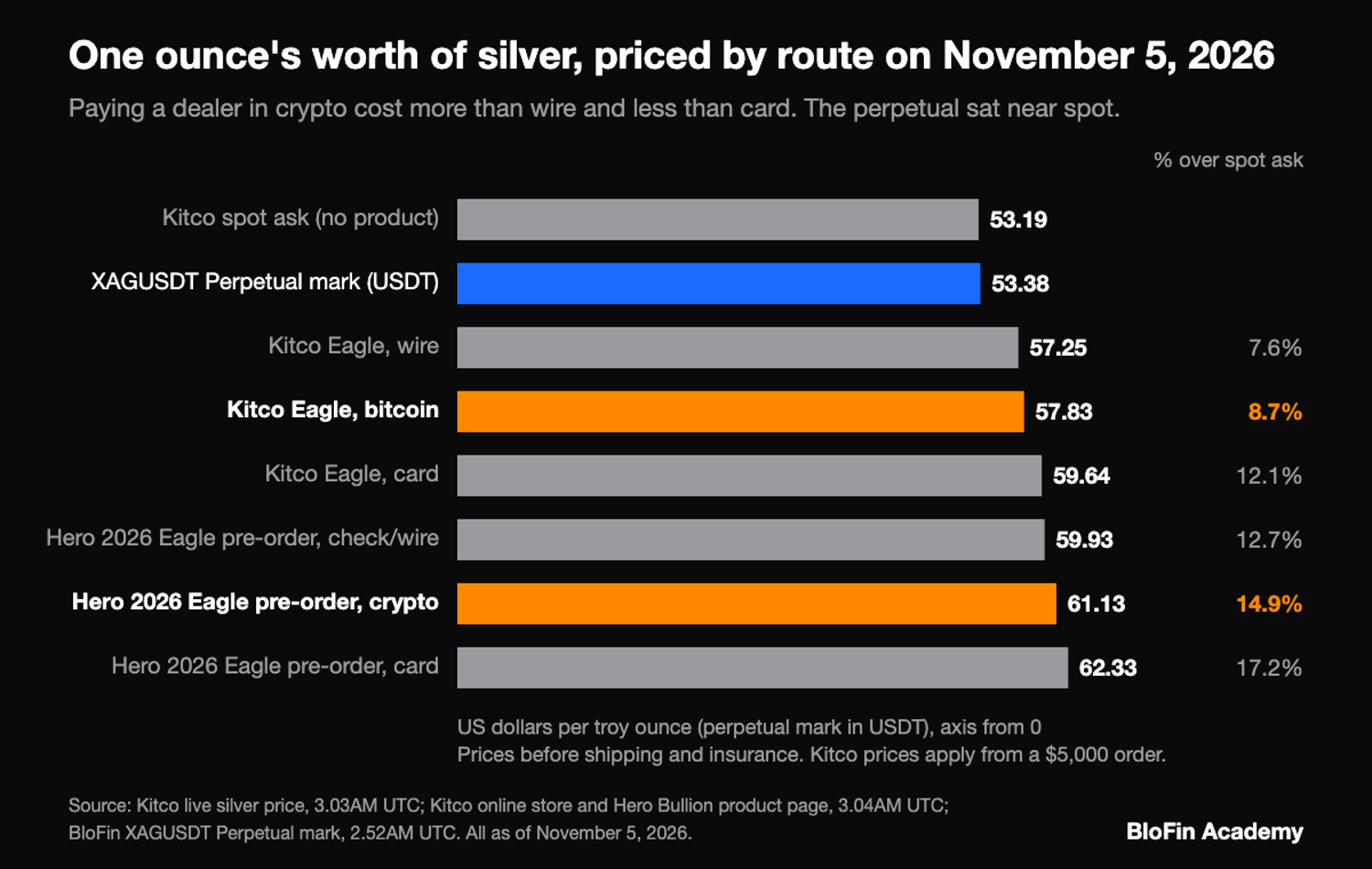
Those two coins are not quite the same product, because the Kitco listing gives no year, while the Hero Bullion price is for a new 2026 coin (source: Kitco online store, silver; Hero Bullion, 2026 American Silver Eagle). That 2026 coin was a pre-order on November 5, so its price was for later delivery (source: Hero Bullion, 2026 American Silver Eagle).
Paying in crypto sits between wire and card at both dealers. At Kitco the bitcoin price of $57.83 was about 1.0% over the $57.25 wire price, and the card price of $59.64 was about 4.2% over it. At Hero Bullion, crypto at $61.13 was about 2.0% over the $59.93 eCheck, check or wire price, and card at $62.33 was about 4.0% over it. Its checks start at $500 and its wires at $2,000.
Order size can matter more than the payment method. The Kitco store shows a $5,000 minimum on physical bullion orders, which is about 87 of those coins. Its payment page limits Bitcoin to US dollar orders of up to $10,000. Its standard shipping is free from $5,000, and insurance runs at 0.65% of the metal's value in most of the US and Canada (source: Kitco, shipping and insurance). The crypto section of the Hero Bullion payment page sets a minimum of $0.01 and a cap of $20,000, though its summary table shows $500,000. Hero Bullion ships US orders free from $149, which three of its 2026 Eagles would clear at $183.39.
Selling is the other half of the cost. The Hero Bullion sell page showed a bid of $50.21 on a random-year Silver Eagle in brilliant uncirculated condition, about $11 under its crypto price for a new coin. That page's server timestamp was about two hours older than the price it is compared with, and silver was rising in between (source: Hero Bullion, sell to us). Its product pages set a $1,000 minimum on buybacks and its sell page says $5,000, so a single coin cannot be sold back there either way (source: Hero Bullion, 2026 American Silver Eagle). A silver price that rises can cover that gap, and comparing physical silver and paper silver shows what else ownership costs.
Tax when you pay with crypto
Paying for silver with crypto usually counts as disposing of that crypto, whatever silver does next. The US treats swapping virtual currency for goods as creating a capital gain or loss, and the United Kingdom (UK) lists paying for goods with cryptoassets among the events that can bring Capital Gains Tax.
The Internal Revenue Service (IRS) says that exchanging virtual currency held as a capital asset for goods or other property creates a capital gain or loss. You measure it as the value of what you received less your basis in the crypto, meaning what it cost you (source: IRS, virtual currency FAQ). Say you spend bitcoin worth $1,000 on coins, and that bitcoin cost you $600. Your gain is $400, even though you never received a dollar.
In the UK, you may need to pay Capital Gains Tax if you make a gain when you sell cryptoassets, exchange them for a different type, or use them to pay for goods or services (source: GOV.UK, tax when you sell cryptoassets). Other countries have their own rules, so this is a starting point for a question to your tax adviser.
The UK wording also covers swapping bitcoin for USDT to fund a perpetual, because that is an exchange for a different type of cryptoasset. So a UK holder who starts in bitcoin makes a disposal whether they pay a dealer or swap into USDT, although a leveraged position may need only part of that bitcoin swapped. UK buyers of the metal also face value-added tax (VAT), because silver bullion is generally subject to it, and the standard rate is 20% (source: The Royal Mint, bullion; GOV.UK, VAT rates). Active trading adds its own records and events, as crypto taxes for traders explains.
Tokenized silver from other issuers
Tokenized silver is a token whose value follows silver or a silver fund, and you can hold it in a wallet. BloFin has no silver token or spot pair of its own, so this route runs through other issuers and venues, each with its own rules on who may buy and what can be redeemed.
Ondo's SLVon shows why those rules matter. Ondo lists one SLVon as equal to 1.00 share of the iShares Silver Trust, and says its tokens give economic exposure with no right to hold or receive the underlying asset. They may not be offered or sold in the US or to US persons unless registered or exempt, and in the UK they go only to qualified investors. For the European Economic Area (EEA), the page gives two answers. A short notice says qualified investors only, and its longer notice says many Ondo Stocks are open to retail investors while certain ones are for professionals (source: Ondo, SLVon). So retail buyers in the US and the UK are generally shut out of that token, and an EEA buyer has to read its final terms.
Metal-backed tokens are the other kind, where the issuer says each token stands for physical silver held in custody. The same mechanics apply to tokenized gold, and the checks carry over to silver. Ask who audits the metal, what minting or redemption costs, how small an amount the issuer will handle and who can buy the token back from you.
The XAGUSDT perpetual on BloFin
On BloFin, silver's price comes through the XAGUSDT Perpetual, held in USDT, with no coin to store and nothing to sell back to a dealer. Orders start at 0.01 XAG, or about 0.53 USDT at the November 5 mark price of 53.38, so you can take far less exposure than one coin carries.
The ISO 4217 list gives silver the code XAG (source: SIX, ISO 4217 list), and one XAG unit means a troy ounce (source: ISO 4217 on Wikipedia). The contract settles in USDT with leverage from 1x to 100x (source: BloFin XAG contract details). It gives you price exposure with no delivery date, no bar and no vault allocation, and BloFin Academy's guide to the XAGUSDT perpetual sets out the rest. Its last price rose about 8.1% in the 24 hours ending at 2.52AM UTC on November 5, from 49.41 to 53.41 USDT, and trades went through in every hour of the October 31 to November 1, 2026 weekend.
Getting there starts with USDT, because the contract settles in it. When you deposit crypto, the funds land in your Funding Account, and you go to Assets, select Transfer and move them to your trading account, which is instant and free. A bitcoin holder can sell it for USDT in a spot trade, at a flat 0.1000% fee on both sides of every trade, as the spot trading guide explains. BloFin Convert swaps supported tokens with zero trading fees, so check its supported assets for any other coin.
From there, choosing margin mode and leverage and placing the order follow BloFin Academy's guide to trading silver, and the first-trade guide walks through a futures order panel.
Trading costs are small next to a dealer's premium: BloFin charges 0.0200% to makers and 0.0600% to takers on regular futures (source: BloFin fees). On 1 XAG at the 53.38 mark, a taker order costs about 0.03 USDT each way. The larger risk is leverage, since forced liquidation runs on the mark price, which differs from the last price, and the panel displays an estimated Liq. Price ahead of the trade. As a rough estimate, at 10x a fall of 8.1%, the size of the 24-hour rise to November 5, would take about 81% of your margin before fees and funding.
Multi-Currency Margin Mode and the XAGUSDT contract
BloFin's Multi-Currency Margin Mode, part of the Unified Trading Account, lets supported assets count as collateral for perpetual contracts with no conversion first, and it needs at least 10,000 USDT of account equity. BloFin's guide names no contract, so check BloFin's collateral rules for this contract before you plan around it, because the contract itself settles in USDT.
The trade-off comes from what backs the position. In this mode your account can incur liabilities. If futures losses pass certain thresholds, the system may liquidate spot assets to cover them, so coins you meant to keep can be sold to pay for a futures loss. The account's default is Spot and Futures Mode, where positions sharing a settlement currency draw from one margin pool. The upgrade to a Unified Trading Account is irreversible, you request it through customer support, and the multi-currency mode may also ask you to complete a short quiz.
Funding compared with a coin's premium
Funding is the running cost that a long perpetual position pays when the rate is positive, so it can be set against a coin's one-time premium in days held. At the pace of the 30 days to November 5, about 0.087% a day on a fixed position would take about 100 days to equal an 8.7% premium. These premiums come from US and Canadian checkouts, so where BloFin's terms allow the perpetual, divide your own dealer's premium by the daily funding figure.
That pace is one choice among several, and the answer moves with the window you pick.
Window ending November 5, 12AM UTC | Funding sum | Average per day | Days to match 8.7% | Days to match 14.9% |
|---|---|---|---|---|
30 days | 2.5971% | 0.0866% | 100 | 172 |
90 days | 6.2823% | 0.0698% | 125 | 213 |
180 days | 15.0148% | 0.0834% | 104 | 179 |
Since listing on January 8, 2026 | 38.8750% | 0.1292% | 67 | 115 |
Those sums add up the rates BloFin publishes (source: BloFin XAG funding history).
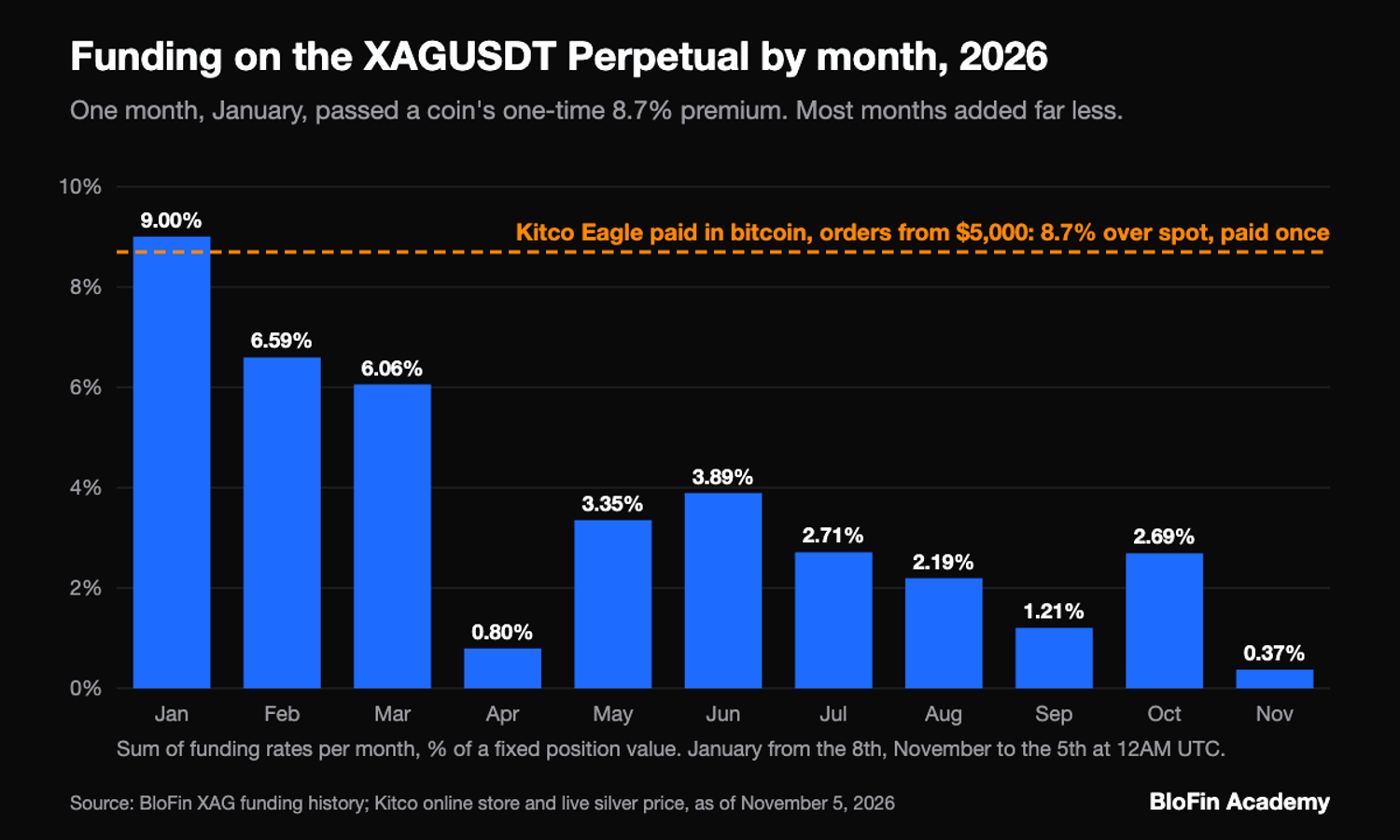
January shows how much those averages can hide: from the listing on January 8 to the end of that month, funding added up to about 9.00%, more than the whole Kitco premium. April came to about 0.80%. Over the contract's history, 271 of 1,805 settlements were negative, and on those longs were paid (source: BloFin XAG funding history). These sums apply to a fixed position value, and past funding says nothing about future rates. A positive rate means longs pay shorts, as the general guide to crypto funding rates explains. That guide mentions a typical 8-hour schedule, while the XAGUSDT Perpetual settles every four hours (source: BloFin XAG funding history).
Neither side of that sum is complete. A coin also has storage, insurance and the gap to a dealer's bid, while a perpetual carries liquidation risk that a coin in a safe never faces. Funding is charged on position value, so at 5x the same percentage falls on five times as much money as your margin. You can see the live rate on the XAGUSDT Perpetual page, along with a countdown to the next settlement.
Which silver route fits you
Your route depends on where you live and what you hope to have at the end: metal you can touch, a token you can hold, or a position on price that you plan to close. Three questions then settle most of it: how long you plan to hold, whether you want delivery, and whether you can accept liquidation.
You live in the US or Canada. Look at a dealer first, since BloFin's Terms of Use bar residents of both countries from its platform. Token rules such as the Ondo limit on US persons can close that route too. Between Kitco and Hero Bullion, only Kitco takes Canadian orders, from $5,000.
You want metal in your hands. A dealer is the direct route here, so check that it delivers to you, compare the crypto price with the check or wire price, and look at minimums and the gap to the bid.
You hold for many months and want no funding charge. A coin's premium is paid once, though storage and insurance continue. At the average funding pace of those windows, a perpetual long would need about 67 to 125 days to match the Kitco premium and 115 to 213 days to match the Hero Bullion premium. A long opened at the January 8 listing, though, passed 8.7% within that month.
You want to trade silver's moves for days or weeks. If BloFin's terms allow it where you live, the perpetual costs little to enter and exit and works in small sizes, and you accept funding and liquidation risk in exchange.
You want a token in your own wallet. Read the issuer's rules first, because eligibility and redemption decide whether this route is open to you at all.
You already hold USDT. Where BloFin is open to you, the perpetual needs no swap, while at a dealer it depends on the invoice screen.
Looking to trade silver? To get started, you'll need to first create a BloFin account, fund your account with cryptocurrency, and navigate to the XAGUSDT Perpetual trading page.
Frequently asked questions
Is a silver Bitcoin round the same as buying silver with Bitcoin?
A Bitcoin round is a silver product with a crypto design, and you can pay for it in dollars or crypto like anything else. Kitco listed a 1 oz silver Bitcoin round at $74.78 paid in Bitcoin on November 5, about $16.95 more than its 1 oz Eagle at $57.83, and a gold-plated one at $81.85 (source: Kitco online store, silver). Rounds come from private mints and carry no legal-tender status.
Is silver you bought with crypto taxed again when you sell it?
It can be. In the US, your basis in the silver is its fair market value when you exchanged the crypto for it (source: IRS, virtual currency FAQ), and any later gain counts from there. The IRS taxes long-term net gains on collectibles such as coins, generally on metal held for more than a year, at a maximum 28% rate, while net short-term gains are taxed as ordinary income (source: IRS, Topic 409). Rules differ elsewhere, so check where you live.
What happens if a bitcoin payment for silver goes wrong?
Kitco accepts one full payment per order, with no multiple or split payments. Once a Bitcoin payment has been submitted and is waiting for confirmation on the network, it cannot be canceled (source: Kitco, payments and fees). So check the amount, the wallet and the network fee before you press send.
Is a dealer's silver price the same as the XAGUSDT Perpetual's price?
No, they are separate quotes. At about 3.04AM UTC on November 5, JM Bullion showed a silver ask of $53.81 and Kitco $53.19, a gap of $0.62 (source: JM Bullion, silver prices) (source: Kitco, live silver price). The XAGUSDT Perpetual's mark price was 53.38 USDT at 2.52AM UTC, a separate reading in a different unit from a dollar quote.
Does a perpetual charge funding if you close before settlement?
BloFin says a position you close ahead of the charge owes no funding fee (source: BloFin funding FAQ). The XAGUSDT Perpetual settles six times a day, at 12AM UTC and then 4AM, 8AM, 12PM, 4PM and 8PM UTC, and the fee is your position's nominal value times the rate. BloFin adds that the timing may be adjusted according to market conditions.
Researched and written by the BloFin Academy editorial team with AI-assisted drafting. All facts independently verified. Primary sources include the IRS, GOV.UK, CNBC, the ISO 4217 list published by SIX, The Royal Mint, Ondo, BitPay, Kitco, Hero Bullion, JM Bullion and BloFin's XAGUSDT trading, contract, funding and fee pages and Terms of Use, current as of November 5, 2026.
Nothing in this article constitutes financial advice or tax advice, and nothing in it is a recommendation to buy, sell or hold silver in any form. Coins can sell for well under what you paid a dealer, a token's value depends on its issuer and its terms, and a leveraged perpetual position can be liquidated, with funding charged while it stays open. Spending crypto can create a tax bill even if silver falls afterward. Past performance does not indicate future results. Do your own research and consider your risk tolerance before you trade on BloFin.