
Pick up a bag of flour and a coin of the same printed weight, and you would expect them to weigh the same. They do not, because the ounce on a food label and the ounce on a precious-metal price are two different units that happen to share a name.
That mismatch causes real confusion the moment money is involved. A price quoted per ounce, a bar stamped in kilograms and a scale that reads in grams all describe the same metal. Mixing two of those units can move a valuation by close to a tenth without anyone noticing.
The fix is a small set of exact conversions. Silver is priced per troy ounce, a unit with a fixed weight in grams. Once you know that weight, you can turn any silver price into a price per gram, per kilogram or per bar, and check any figure you are quoted.
For silver on BloFin, the product is the XAGUSDT Perpetual, which tracks the price of one troy ounce of silver and settles in USDT, with no metal changing hands. Each contract covers a hundredth of an ounce, so the same unit arithmetic tells you what a position is worth.
What is a troy ounce?
A troy ounce is the unit used to weigh and price precious metals, including silver, and it equals exactly 31.1034768 grams. It is defined as 480 grains, and the grain is fixed at 64.79891 milligrams, so the gram figure is exact (source: NIST Handbook 44, Appendix C). One kilogram therefore holds about 32.1507 troy ounces.
America's measurement agency, the National Institute of Standards and Technology (NIST), publishes these definitions in Handbook 44, the reference that US weights-and-measures officials use. Its tables list the troy ounce as 480 grains exactly and the avoirdupois ounce, the everyday ounce, as 437.5 grains exactly (source: NIST Handbook 44, Appendix C). Because both units are counted in the same grain, the gap between them is fixed too.
UK law gives the same figure. The Weights and Measures Act 1985 defines the ounce troy as 0.0311034768 kilogram, which is 31.1034768 grams written in kilograms (source: Weights and Measures Act 1985, Schedule 1). NIST's tables note that Britain's troy units are identical with the US units of the same names, so a silver price per ounce means the same weight in London and New York (source: NIST Handbook 44, Appendix C).
Precision matters less in daily use than knowing which factor to reach for. For most silver sums, 31.1035 grams per ounce and 32.1507 ounces per kilogram are close enough, and rounding to them changes a result by under a thousandth of a percent.
How much heavier a troy ounce is than a regular ounce
A troy ounce is about 9.71% heavier than the avoirdupois ounce used for food and parcels, because it holds 480 grains against 437.5. In grams, that is 31.1035 against 28.3495, a difference of about 2.754 grams in every ounce (source: NIST Handbook 44, Appendix C). One avoirdupois ounce is about 0.9115 troy ounce.
The gap sounds small until it is multiplied. Ten avoirdupois ounces are about 9.11 troy ounces, so a price per troy ounce applied to them counts almost nine-tenths of an ounce that is missing.
The pound works the other way round. A troy pound is 12 troy ounces, while the everyday pound is 16 avoirdupois ounces, so the everyday pound ends up the heavier of the two (source: NIST Handbook 44, Appendix C). It matters for silver only when someone weighs the metal in pounds.
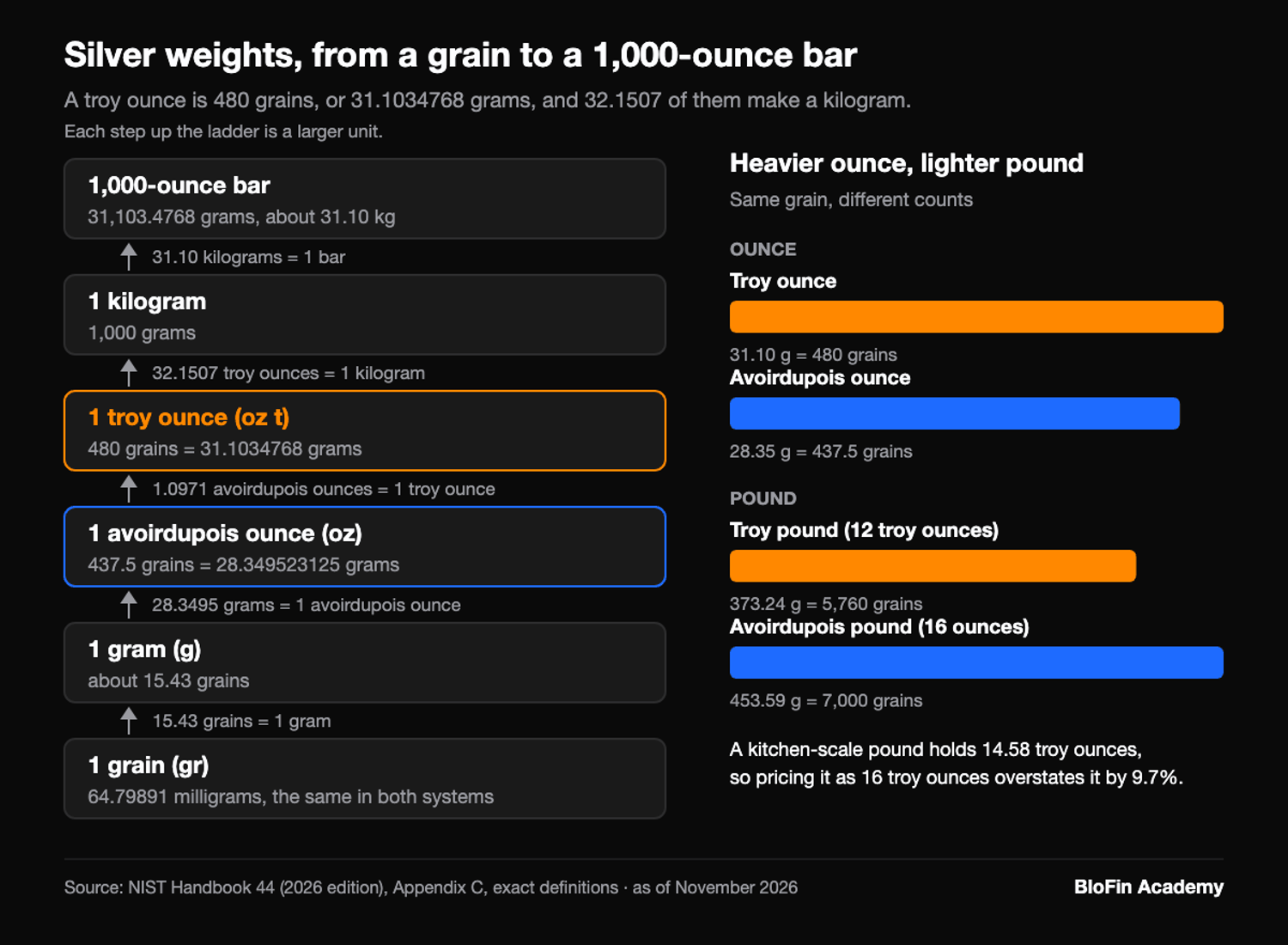
The Perth Mint notes that the precious-metals trade often writes plain "ounce" or "oz" and means the troy ounce (source: The Perth Mint, troy ounce guide). So a coin listed as "1 oz" holds a troy ounce, and the label often will not say so.

Why silver is weighed in troy ounces
Silver is weighed in troy ounces because precious metals have traded on troy weight for centuries, and UK and US rules still tie the unit to them. The Royal Mint says from around medieval times precious metals were weighed on the troy system rather than avoirdupois, and troy weight was brought in so everyone would use the same unit (source: The Royal Mint, Precious Metals Academy).
The name has a likely home. The Perth Mint says the system for weighing gold, silver and gemstones is said to take its name from Troyes, a French city that hosted one of the great medieval trade fairs (source: The Perth Mint, troy ounce guide). England's own coinage, by contrast, came to troy weight late. In the Middle Ages an English penny weighed 1/240 of a pound of sterling silver, but that pound was the Tower pound, and troy weights replaced Tower weights in England only in 1527 (source: LBMA, the pennyweight).
The Royal Mint also says that buyers and sellers usually value a precious-metal trade on the weight of metal it contains. A shared unit of weight is therefore a shared unit of value (source: The Royal Mint, Precious Metals Academy).
The law now writes that habit down. In the UK, the Weights and Measures Act 1985 allows the ounce troy for trade only in gold, silver or other precious metals and articles made from them (source: Weights and Measures Act 1985, section 8). In the US, NIST's model rule for states says precious metals sold by weight must be sold in troy weight or metric units. A seller using metric units must show a conversion chart to troy units (source: NIST, conversion factors for precious metal sales).
The effect is that a silver dealer, a vault and an exchange all speak in the same ounce, even in countries that otherwise use metric weights. A gram price and a kilogram price are both common, but they are conversions of the ounce price, and the ounce stays the unit the market quotes.
Converting silver prices to grams and kilograms
To convert a silver price per troy ounce into a price per gram, divide it by 31.1034768. For a price per kilogram, multiply it by about 32.1507. NIST's precious-metals sheet gives the per-gram rule for gold, and the arithmetic is identical for silver because only the unit is changing (source: NIST, conversion factors for precious metal sales).
The dollar price per ounce itself comes from the markets that set the silver price each day, and it moves from minute to minute. What stays fixed is the factor, so a worked conversion from one dated price shows the method you can repeat with any live quote.
Every value in the conversion uses one price, 53.34 USDT, which was the XAGUSDT Perpetual's last price at about 5.37AM UTC on November 10, 2026. BloFin describes the contract as silver priced in US dollars, with each XAG unit representing one troy ounce (source: BloFin, XAGUSDT listing notice). Each weight is converted into troy ounces with NIST's exact factor, multiplied by that price and rounded to two decimal places. USDT is a dollar stablecoin, so the figures read as dollars only as closely as USDT tracks the dollar.
Weight of silver | Troy ounces | Value at 53.34 USDT per troy ounce |
|---|---|---|
1 gram | 0.0322 | 1.71 USDT |
10 grams | 0.3215 | 17.15 USDT |
1 avoirdupois ounce (28.35 grams) | 0.9115 | 48.62 USDT |
1 troy ounce (31.10 grams) | 1 | 53.34 USDT |
100 grams | 3.2151 | 171.49 USDT |
1 kilogram | 32.1507 | 1,714.92 USDT |
A bar of exactly 1,000 troy ounces (31.10 kilograms) | 1,000 | 53,340.00 USDT |
Two figures carry most of the work. At that price, a gram came to about 1.71 USDT and a kilogram to about 1,714.92 USDT, so a quote for a kilo bar can be checked in one multiplication. Dealer premiums, storage fees and trading costs come on top of these metal values.
Pricing silver weighed in kitchen ounces, pounds or kilos
One easy conversion error is treating an everyday ounce as a troy ounce, which overstates the silver by about 9.7%. Pounds can go wrong in either direction, and a kilogram price is easy to convert with the wrong factor. Worked at the same 53.34 USDT price, each one moves a valuation by enough to matter on any sale.
Say a kitchen scale shows 10 ounces of silver scrap and you multiply by 53.34. You get 533.40 USDT, but 10 avoirdupois ounces are about 9.11 troy ounces, so the silver is worth about 486.17 USDT. The kitchen-scale figure is 47.23 USDT too high, or about 9.7% above the real value.
An everyday pound of silver holds about 14.5833 troy ounces, so it is worth about 777.88 USDT. Counting it as 16 troy ounces gives 853.44 USDT, again about 9.7% too much, while counting it as a troy pound of 12 ounces gives 640.08 USDT, about 17.7% too little.
Kilograms bring a subtler slip. A kilogram of silver at 53.34 USDT per ounce is worth about 1,714.92 USDT. Dividing that by 31.1035 looks as if it should give the ounce price back, because 31.1035 and 32.1507 are close. It gives about 55.14 USDT, which is about 3.4% too high. The right step is to multiply the kilogram price by 0.0311034768, the troy ounce's weight in kilograms, or to divide it by 32.1507.
A simple routine catches all three mistakes. Turn every weight into grams first, then divide by 31.1034768 to get troy ounces, and only then apply the price per ounce. A digital scale that reads in grams avoids the avoirdupois ounce entirely. NIST's model rule allows sale in metric units, as long as a conversion chart to troy units is prominently displayed (source: NIST, conversion factors for precious metal sales).
How silver contract sizes are stated in troy ounces
Silver futures and perpetual contracts state their size in troy ounces, so the unit tells you how much silver price exposure one contract carries. CME Group's standard Silver futures on COMEX, code SI, cover 5,000 troy ounces each and are quoted in US dollars and cents per troy ounce (source: CME Group, Silver futures contract specs).
Smaller COMEX contracts use the same unit, and E-mini Silver, code QI, covers 2,500 ounces (source: CME Group, E-mini Silver futures contract specs). Micro Silver, code SIL, covers 1,000 ounces, and 100-Ounce Silver, code SIC, covers 100 ounces and settles in cash, with no metal delivered (source: CME Group, Micro Silver futures contract specs, CME Group, 100-Ounce Silver futures contract specs). CME launched SIC in February 2026 for retail traders and opened it to 24/7 trading on September 11, 2026 (source: CME Group release via Mondo Visione, August 11, 2026, CME Group release via Mondo Visione, September 14, 2026), and silver trading hours sets out when each silver market is open.
In metric terms, SI covers about 155.52 kilograms of silver, QI about 77.76, SIL about 31.10 and SIC about 3.11. The December 2026 SI contract's delayed last price was $52.605 an ounce at 11.56AM CT (5.56PM UTC) on November 9, 2026, a futures price from the day before the 53.34 USDT perpetual price. At that price one SI contract was worth $263,025 and one SIC contract $5,260.50, a fiftieth of the size (source: CME Group, Silver futures contract specs).
The point for anyone reading a contract is that the size in ounces sets the value of each price step. A $1 move in silver changes one SIC contract by $100 and one SI contract by $5,000, the same per-ounce move scaled by the number of troy ounces in the contract.
The delivery rules show how the ounce and the gram meet. Under COMEX's rulebook, one standard contract is delivered as five bars that each weigh roughly 1,000 troy ounces, give or take 10%. When a bar's weight is recorded in grams, the paperwork turns it into ounces at 31.1035 grams per ounce, kept to one decimal place of an ounce (source: COMEX Rulebook, Chapter 112). A bar of exactly 1,000 troy ounces, 31,103.4768 grams, still reads 1,000.0 ounces under that rule.
The XAGUSDT Perpetual uses the same unit at a much smaller scale. BloFin's listing notice sets its contract size at 0.01 XAG, with each XAG representing one troy ounce of silver (source: BloFin, XAGUSDT listing notice). One contract therefore follows the price of a hundredth of an ounce, about 0.311 grams, and the minimum order is 0.01 XAG, one contract (source: BloFin, XAG contract details).
At the 53.34 USDT last price, one contract was worth about 0.5334 USDT of silver exposure, and 100 contracts made one troy ounce, worth 53.34 USDT. A kilogram works out to about 3,215.07 contracts, and one SIC contract's 100 ounces equal 10,000 of them. The margin you post on those contracts is a fraction of their value, set by the leverage you choose, as how the XAGUSDT Perpetual works sets out in full.
The price moves through the day, so for the current figure before you size a position in ounces, open the XAGUSDT Perpetual page.
Trading silver by the ounce on BloFin
Trading silver on BloFin means taking a position on the XAGUSDT Perpetual, a perpetual futures contract sized in hundredths of a troy ounce that settles in USDT. You gain or lose with the silver price per ounce, and you never take delivery of metal, so the unit sets your exposure rather than a weight you will hold.
On BloFin, funding on the XAGUSDT Perpetual settles every 4 hours (source: BloFin, XAGUSDT listing notice), and longs pay shorts whenever the rate is positive, as BloFin's guide to how funding rates work explains. Liquidation is decided by the mark price, which can sit apart from the 53.34 USDT last price, as BloFin's mark price and last price guide explains.
Leverage multiplies the ounces you control against the margin you put up. A position of 1,000 contracts follows 10 troy ounces, about 311 grams of silver, and with leverage the liquidation price of a leveraged position can sit close to your entry. Before you confirm, BloFin's order panel displays its estimated Liq. Price for the position. A stop-loss order on BloFin placed between your entry and that price can close the position before liquidation. BloFin's TP/SL lets you choose whether it triggers on the last price or the mark price, the price liquidation runs on. A stop that fills as a market order can also fill beyond its trigger in a fast move.
Looking to trade silver? To get started, you'll need to first create a BloFin account, fund your account with cryptocurrency, and navigate to the XAGUSDT Perpetual trading page.

Frequently asked questions
Which is heavier, 1 oz or 1 troy ounce?
A troy ounce is heavier. It weighs 31.1035 grams, against 28.3495 grams for the everyday avoirdupois ounce used for food, so each troy ounce carries about 2.754 grams more (source: NIST Handbook 44, Appendix C). A troy pound, by contrast, holds only 12 troy ounces, so it is lighter than the everyday pound of 16 avoirdupois ounces.
What is a pennyweight of silver?
A pennyweight is a troy unit of 24 grains, a twentieth of a troy ounce, or 1.55517384 grams (source: NIST Handbook 44, Appendix C). NIST's precious-metals sheet uses it for jewelry weighed on a gold buyer's balance, and works out the price per pennyweight as the price per troy ounce divided by 20. At 53.34 USDT an ounce, a pennyweight of pure silver is about 2.67 USDT (source: NIST, conversion factors for precious metal sales).
How is a troy ounce abbreviated?
NIST writes the troy ounce as "oz t" and the avoirdupois ounce as "oz", adding "avdp" where the two could be confused. An ounce with no system named is read as avoirdupois (source: NIST Handbook 44, Appendix C). The precious-metals trade does the reverse: it writes "ozt", or plain "oz" meaning troy (source: The Perth Mint, troy ounce guide).
How many grams are in a troy pound?
A troy pound of 12 troy ounces, or 5,760 grains, is 373.2417216 grams, against 453.59237 grams for the everyday avoirdupois pound of 7,000 grains, so the everyday pound is about 21.5% heavier (source: NIST Handbook 44, Appendix C). The troy pound lost its official status in the UK under the Weights and Measures Act of 1878, and only the troy ounce and its decimal subdivisions stayed official (source: LBMA, the pennyweight).
How many troy ounces are in a tonne of silver?
A metric tonne of 1,000 kilograms holds about 32,150.75 troy ounces, which is the factor to use when mine output or vault stocks are reported in tonnes. A US short ton of 2,000 avoirdupois pounds holds about 29,166.67 troy ounces, because it is defined from the avoirdupois pound of 453.59237 grams (source: NIST Handbook 44, Appendix C).
Does a silver bar's weight equal its silver content?
Only when the metal is pure, because value rests on the silver inside. COMEX requires silver delivered on its standard contract to assay at a minimum of 999 fineness, at least 99.9% silver (source: CME Group, Silver futures contract specs). A bar of 1,000.0 troy ounces at exactly 999 holds 999.0 ounces of silver, about 53,286.66 USDT at 53.34.
Researched and written by the BloFin Academy editorial team with AI-assisted drafting. All facts independently verified. Primary sources include NIST Handbook 44 (2026 edition) and NIST's conversion factors for precious metal sales, the UK Weights and Measures Act 1985, The Royal Mint, The Perth Mint, the LBMA, CME Group's silver contract specifications and its 100-Ounce Silver releases, the COMEX Rulebook, and BloFin's XAGUSDT listing notice and contract details, current as of November 10, 2026.
Nothing in this article constitutes financial advice, and nothing in it is a recommendation to buy, sell or hold silver in any form. A unit error can misprice silver by close to 10%, or more when pounds are mixed up, before any market move, and a dealer's premium or a buyback spread adds to that gap. On the XAGUSDT Perpetual, a position measured in ounces gains or loses with every change in the price per ounce, and leverage can liquidate it on a small move. Past performance does not indicate future results. Do your own research and consider your risk tolerance before you trade on BloFin.