
Look up the price of silver on two websites at the same moment and you will often get two different answers. A quote is one reading of a market that never stops moving, taken from one source, at one moment and on one side of a trade.
That gap matters as soon as you act on the number. A coin dealer sells to you at one price and buys back at a lower one. A futures screen prices metal that will not change hands for weeks, and a crypto exchange shows a contract priced in a stablecoin. Unless you know which number you are looking at, you cannot tell a cost from a timing gap or a warning sign.
Most of those numbers start from one reference point, the wholesale price of silver for delivery almost straight away. Coins, bars, futures and derivative contracts are all priced as a premium, a discount or a spread against it. That makes it the first number to understand.
BloFin offers silver exposure through the XAGUSDT Perpetual, which settles in USDT, follows a silver index and never hands over any metal. Knowing how the dollar quote is built tells you what the perpetual's price is measuring, and how far apart the two usually sit.
What is spot silver?
Spot silver (XAG/USD) is the price, in US dollars, of one troy ounce of silver bought or sold for prompt delivery. Banks and dealers trade it directly, mostly through London's clearing system, where a spot deal settles two business days later (source: LBMA, the price, LBMA, guide to the London market).
So "spot" means delivery within a couple of days, which is as close to now as a wholesale metal deal gets. Trading of this kind, between two parties with no exchange in the middle, is called over the counter. The London Bullion Market Association calls the loco London spot price "the standard for gold and silver" (source: LBMA, guide to the London market). Loco London means the metal changes owner across accounts held in London. Other delivery dates, bar sizes, purities and places are priced as a premium or a discount to that spot price (source: LBMA, guide to the London market).
The two-day rule has one more condition: a settlement date cannot fall on a UK or US holiday. When it would, the value date rolls forward to the next day that is a business day in both countries (source: ICE Benchmark Administration, silver holiday calendar 2026). Say you agree a spot trade on Wednesday, December 23, 2026. Thursday the 24th is the first London business day. Christmas Day and the Boxing Day holiday on Monday the 28th do not count, so the deal settles on Tuesday, December 29.
The spot price moves nearly around the clock as trading passes from New York to London, Zurich, Shanghai and Hong Kong. Kitco says it draws on the most active futures contract as well as over-the-counter dealing (source: Kitco, live silver price). London's daily benchmark, the LBMA Silver Price, is set instead in a single auction run by ICE Benchmark Administration, and that auction is one of the ways London and New York determine the silver price (source: ICE Benchmark Administration, silver auction specification).
How a spot silver quote works: bid, ask and spread
Every spot silver quote has two sides. The bid is what a dealer will pay you for an ounce, the ask is what it will sell one for, and the spread between them is the dealer's earnings. At 5.11PM UTC on November 9, 2026, Kitco quoted a bid of $52.57 and an ask of $52.82 (source: Kitco, live silver price).
That spread was $0.25, or 0.47% of the $52.695 midpoint. On 100 ounces, buying at that ask and selling straight back at that bid would cost $25 before any dealer premium. The big number at the top of a price page is a single figure, so it is one side of the quote or a midpoint, and the page does not always say which. On the Kitco page it was "52.57 per troy ounce", the bid, and the page says its price is based on the live global spot market bid price (source: Kitco, live silver price).
Other sites chose differently. Two minutes later, JM Bullion's chart page showed a "Silver Ask" of $53.40, which was $0.58, or 1.1%, above the Kitco ask (source: JM Bullion, silver spot price). CNBC's spot quote, which CNBC does not label as a bid or an ask, stood at $52.65 at the same minute (source: CNBC, silver spot quote). So three sites gave three "spot" prices within three minutes, spread across $0.83. None of them was wrong, because each one reports its own source, its own side of the quote and its own moment.
Three questions sort the numbers out: which side it is, whose market it comes from, and when it was read. The Kitco page adds a fourth clue, since its quotes for "silver futures" refer to the most active contract on COMEX, CME Group's metals futures exchange in New York, which is a different price again (source: Kitco, live silver price).
Why coins and bars cost more than spot
Coins and bars sell above spot because the premium pays for making and distributing them (source: Kitco, live silver price). On November 9, 2026, the Kitco store's one-ounce American Silver Eagle cost $56.81 by wire, a "Limited Time" price cut from $58.94. That was 7.6% over the $52.82 Kitco spot ask, against 11.6% at the regular price (source: Kitco online store, silver).
Kitco explains the size of the gap through the metal's low value per gram. Minting a one-ounce silver coin costs nearly as much as minting a gold one, but that cost is a far bigger share of what the silver is worth (source: Kitco, live silver price). The same coin cost $57.38 paid in bitcoin, 8.6% over the ask, and $59.18 by card, 12.0% over it. Kitco also sets a $5,000 minimum on physical bullion orders (source: Kitco online store, silver).
Bar size changes the premium, though not in a straight line. Kitco's .999 bars at 1, 10 and 100 ounces and its 1,000-ounce Good Delivery bar were read in the same fetch at about 5.13PM UTC (source: Kitco online store, silver). Each is priced by wire and set against the $52.82 spot ask.
Product, paid by wire | Price | Price per ounce | Premium over spot ask |
|---|---|---|---|
1 oz American Silver Eagle coin, sale price | $56.81 | $56.81 | 7.6% |
1 oz silver bar | $61.44 | $61.44 | 16.3% |
10 oz silver bar | $582.90 | $58.29 | 10.4% |
100 oz silver bar, sale price | $5,728.00 | $57.28 | 8.4% |
1,000 oz Good Delivery bar, call to order | from $56,790.00 | $56.79 | 7.5% |
The 100-ounce bar was marked down too, from a regular $6,259.00, or $62.59 an ounce. At regular prices, the one-ounce coin's $58.94 cost more per ounce than the 10-ounce bar, but less than the one-ounce and 100-ounce bars. A single snapshot can flatter one product that way, so compare several before reading too much into one price. Even the 1,000-ounce Good Delivery bar, a call-to-order item, was listed from $3.97 an ounce over the spot ask (source: Kitco online store, silver).
A second dealer's Eagle shows the same payment-method gap. Hero Bullion priced off-quality one-ounce Eagles, coins with cosmetic flaws only, at $57.47 by check or wire, $58.62 in crypto and $59.77 by card. Its card price is 4% above its check and wire price (source: Hero Bullion, off-quality American Silver Eagle). Against CNBC's spot quote of $52.63 at 4.55PM UTC, the time on that page's server copy, those prices sat 9.2%, 11.4% and 13.6% higher.
Premiums move with demand, and in the January 2026 rally, product shortages were common and premiums jumped, according to the Silver Institute. In the US they still stayed well below earlier highs (source: Silver Institute, World Silver Survey 2026). In India in 2025, strong local demand and a global supply squeeze pushed local premiums as high as 15% over the landing cost (source: Silver Institute, World Silver Survey 2026).
Spot silver and COMEX futures: The basis
The basis is the gap between a futures price and spot. At 5.02PM UTC on November 9, 2026, COMEX December silver traded at $52.765 against spot at $52.740, a basis of 2.5 cents, or 0.05%, taking spot as CNBC's XAG= quote (source: CNBC, COMEX silver futures quote, CNBC, silver spot quote).
Futures usually sit a little above spot, because holding metal until delivery costs storage, insurance and interest, and that normal state is called contango. The LBMA defines it as a market where the forward price, for delivery more than two business days ahead, is higher than the spot price. Backwardation is the opposite, with the forward price below spot (source: Kitco, live silver price, LBMA, guide to the London market).
The November 9 session sat firmly in contango. CNBC's one-minute closes give 1,077 minutes in which both prices printed, from 11PM UTC on November 8 to 5.13PM UTC on November 9 (source: CNBC, COMEX silver futures quote, CNBC, silver spot quote). The December contract closed above spot in 92.1% of those minutes. The basis ranged from 2 cents below spot to 14 cents above it. In the 76 minutes below zero, the gap was a cent or two.
The December contract expires on December 29, about seven weeks after that reading (source: CNBC, COMEX silver futures quote). Spread over a year, a 0.05% basis works out to roughly 0.35%. As the delivery month nears, less time is left to pay for storage and financing, so the gap to spot narrows. That pull toward spot links COMEX silver futures to the dollar spot price, whatever their contract sizes and margin rules.
What backwardation in silver signals
When silver slips into backwardation, it signals unusually strong demand for metal that can be delivered right now (source: Kitco, live silver price). In October 2025, analysts at the refiner Heraeus wrote that silver had slipped into a steep backwardation stretching out to 2027. The December 2025 contract traded more than 4% below spot, and implied one-month lease rates had spiked to around 8% early that month (source: Kitco, October 13, 2025).
A lease rate is the interest paid to borrow metal rather than money. The LBMA says its level is set by how much interest there is in borrowing or lending each metal (source: LBMA, guide to the London market). The Silver Institute links the October 2025 squeeze to strong Indian demand at a time when, by the end of September 2025, only 17% of London's silver was not held for exchange-traded products. Metal was flown from London to India, and the shortage left behind sent London lease rates to record highs. Lease rates fell back quickly, stayed historically high through the fourth quarter, and dropped to around 2% to 3% in mid-first-quarter 2026 (source: Silver Institute, World Silver Survey 2026).
London and New York prices can also pull apart. An exchange for physical, or EFP, switches a London position for a position on a futures exchange (source: LBMA, guide to the London market). In 2025, fear that US tariffs would split New York from London pushed the EFP premium on CME to around $0.80, past its COVID-era levels, and drew a surge of metal into CME vaults (source: Silver Institute, World Silver Survey 2026). Against those episodes, a basis of 2.5 cents is a calm market.
How spot silver compares with BloFin's silver perpetual
The XAGUSDT Perpetual is priced in USDT, a dollar stablecoin that trades close to $1, not in dollars. At 5.02PM UTC on November 9, 2026, its mark price was 52.84 USDT (source: XAGUSDT Perpetual). At CoinGecko's USDT price of $0.99929, that was about $52.80, or 0.12% above spot at $52.74 (source: CoinGecko, Tether price, CNBC, silver spot quote).
BloFin shows three prices on the contract. The index price is the silver reference the contract tracks. The mark price mixes the index with a funding basis and further inputs, while the last price is simply where the most recent BloFin trade printed (source: BloFin, index, mark and last price). BloFin works out unrealized profit and loss, the margin ratio and liquidation from the mark. A position is therefore liquidated on the mark price, not the last price, while orders fill at traded prices.
In that 5.02PM UTC read, the index stood at 52.81, the mark at 52.84 and the last trade at 52.84. The bid was 52.84 and the ask 52.85, a spread of one tick (source: XAGUSDT Perpetual). None of those three is the spot price. The perpetual tracks silver through its index, but its own price is set by trading on BloFin, so it can sit a little above or under the dollar market. One reading is only a sample. Over a longer record, 423 of BloFin's four-hour closes between August 3 and November 9, 2026 fell inside spot trading hours, so each can be set against a spot quote from the same moment (source: BloFin XAGUSDT Perpetual four-hour candles).
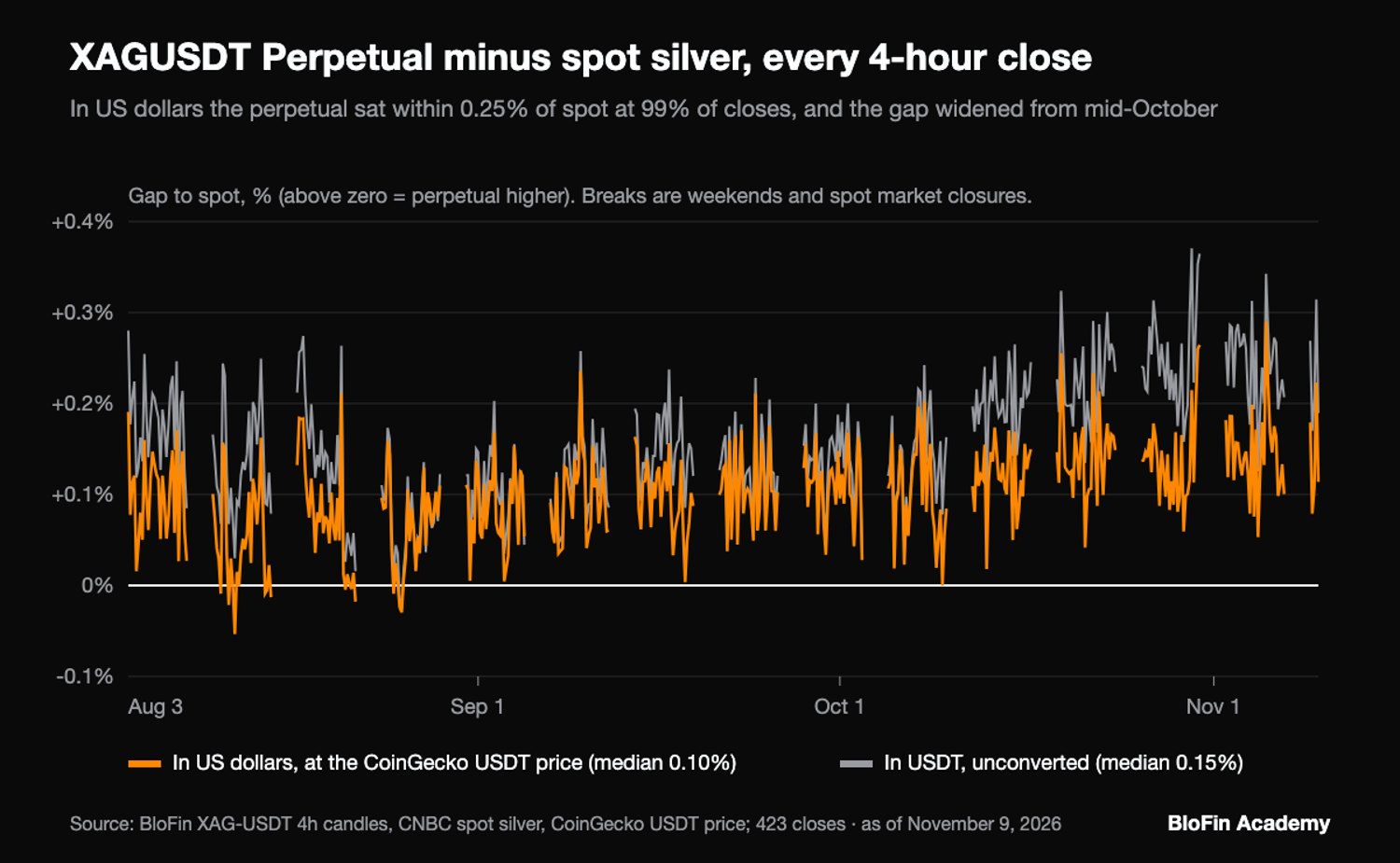
In USDT terms, the perpetual's last price closed above spot 99.5% of the time, by a median of 0.15%, on BloFin's four-hour candles and CNBC's five-minute spot prices (source: CNBC, silver spot quote). Part of the gap is the currency: converted to dollars at CoinGecko's hourly USDT price, the median gap fell to about 0.1%. In dollar terms, the perpetual sat within 0.25% of spot at 99.1% of closes, and above it at 96.5% (source: CoinGecko, Tether price, CNBC, silver spot quote). The gap has widened lately: across the 35 closes from November 1 to 9, the median was 0.25% in USDT and 0.14% in dollars.
Funding points the same way: all 180 four-hour settlements in the 30 days to November 9 were positive (source: BloFin, XAG funding rate history), which BloFin's funding guide reads as a premium, with longs paying shorts.
The smallest order is 0.01 XAG, and BloFin limits how far an order's price may stray from the index. Both are among the XAGUSDT Perpetual's contract terms that shape how it trades (source: BloFin, XAG contract details). The perpetual has no expiry date, so it never closes in on spot at delivery the way a COMEX contract does. That difference is the starting point for choosing between XAGUSDT and COMEX silver futures.
You can watch the live mark, index and last prices side by side on the XAGUSDT Perpetual page.
Reading a spot silver price before you trade
Before you act on a silver price, check five things. They are the side (bid, ask or midpoint), the market (spot, a futures month or a perpetual), the time of the reading, the currency (US dollars or USDT) and the unit, almost always the troy ounce. Most gaps between two screens close once those five match.
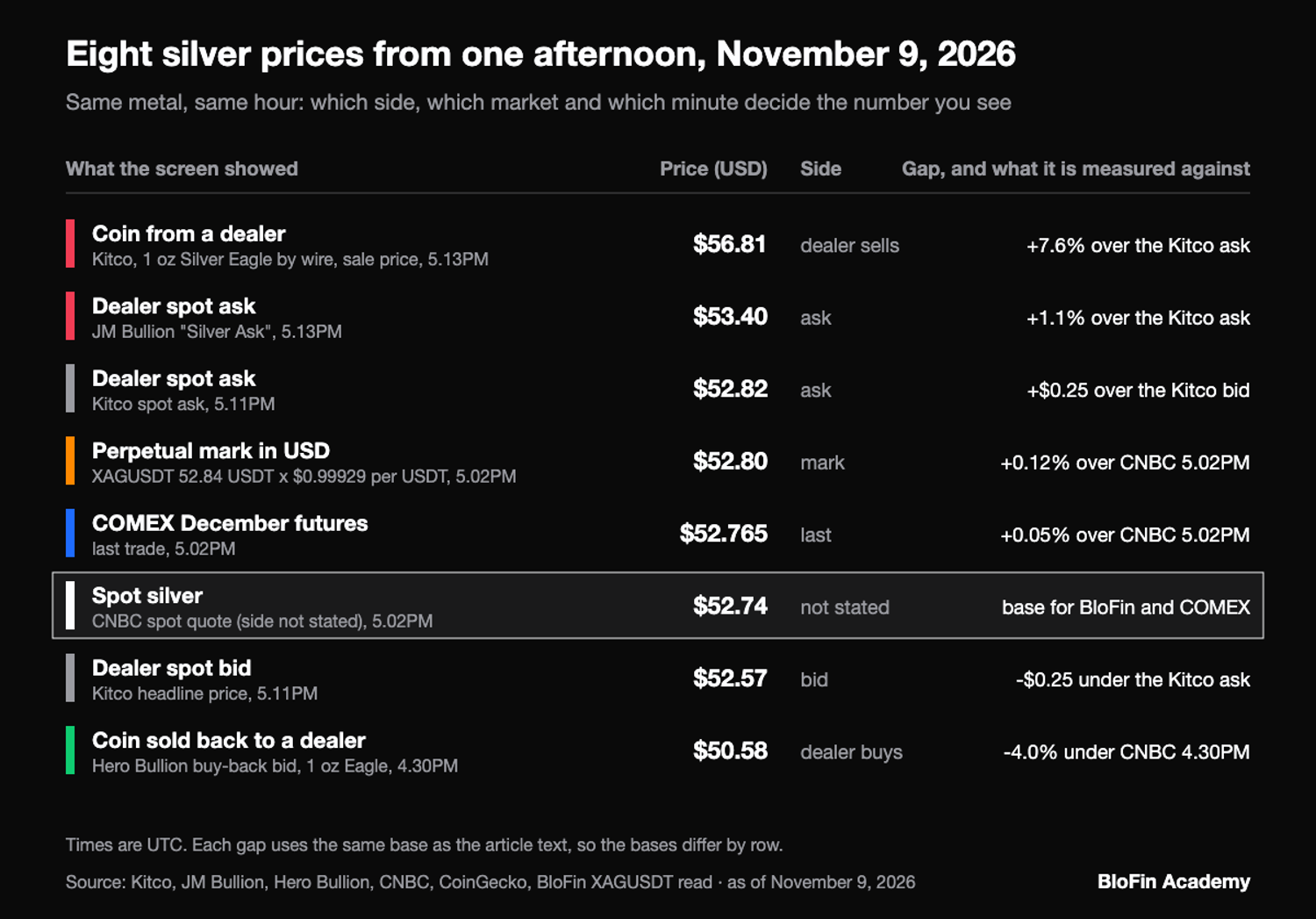
Take the November 9 readings and say you saw JM Bullion's $53.40 ask at 5.13PM UTC and the perpetual's 52.84 USDT mark from 5.02PM UTC. Silver seems about 1% cheaper on BloFin, and converting the mark to $52.80 barely changes that. Almost all of the gap comes from setting a dealer's ask beside a contract's mark, eleven minutes apart. Against spot at the same minute, the mark sat only 0.12% higher (source: JM Bullion, silver spot price, CoinGecko, Tether price, CNBC, silver spot quote).
The same habit helps when a gap is real. A basis that flips from a few cents above spot to several percent under it, as in October 2025, tells you physical metal is scarce. A dealer premium that climbs well above its usual level tells you retail demand is outrunning supply (source: Kitco, October 13, 2025, Silver Institute, World Silver Survey 2026). Those are the moments when silver prices drift furthest apart, and when the side, the market and the time of each reading matter most.
Looking to trade silver? To get started, you'll need to first create a BloFin account, fund your account with cryptocurrency, and navigate to the XAGUSDT Perpetual trading page.

Frequently asked questions
Can you buy silver at the spot price?
Not as a retail buyer. The LBMA says the prices quoted in the media normally represent the wholesale market, which trades London Good Delivery bars of 750 to 1,100 troy ounces at a minimum purity of 999 (source: LBMA, the price). Kitco's own melt-value calculator says it shows estimated metal value only and that retail premiums may apply to physical products (source: Kitco, live silver price).
Can you sell silver at the spot price?
Retail sellers usually get less than spot, because the dealer buying from you needs room to resell at a premium. Hero Bullion's buy-back page listed a bid of $50.58 for a one-ounce American Silver Eagle in brilliant uncirculated condition. That was about 4.0% under CNBC's spot quote of $52.67, at the page's server time of 4.30PM UTC on November 9, 2026. Its bid for a one-ounce round of any mint and condition was $44.53, about 15.5% under that quote (source: Hero Bullion, sell to us).
Is spot silver quoted the same way as spot gold?
Mostly, yes, but the ounce means something different. A gold price is per fine troy ounce, counting only the pure gold in a bar whatever its purity. A silver price covers one troy ounce of metal of which at least 999 parts in every 1,000 are silver, so it counts the whole ounce of material (source: LBMA, the price). Wholesale gold trades at a minimum purity of 995, or 99.5%, against 999 for silver (source: LBMA, the price).
How often does the spot silver price change?
Spot quotes update every few seconds while the market is open, and on a busy day the range is wide. At 5.11PM UTC on November 9, 2026, the Kitco quote showed a day's range from a low of $51.28 to a high of $53.58, about 4.5% (source: Kitco, live silver price). So a quote even a few minutes old can be out of date.
Does BloFin offer spot silver?
BloFin lists no silver pair in its spot trading market and no silver token. Its only silver product is the XAGUSDT Perpetual, which settles in USDT (source: BloFin, XAG contract details). Trading it gives you exposure to the silver price through a USDT contract, with no metal, bar or vault allocation behind your position. Tokens backed by silver exist elsewhere, and each carries its issuer's own terms for custody and redemption.
Researched and written by the BloFin Academy editorial team with AI-assisted drafting. All facts independently verified. Primary sources include ICE Benchmark Administration, the LBMA, the Silver Institute, Kitco, JM Bullion, Hero Bullion, CNBC's spot silver and COMEX silver quotes, CoinGecko and BloFin's XAG contract details, funding history and index, mark and last price pages, current as of November 10, 2026.
Nothing in this article constitutes financial advice, and nothing in it is a recommendation to buy, sell or hold silver in any form. Every price here is a dated reading, and silver can move several percent in a day, so a quote a few minutes old can already be out of date. Coins and bars cost well above spot and sell back below it. On the XAGUSDT Perpetual, leverage can magnify losses and lead to liquidation at the mark price, while funding can cost a long position every four hours. Past performance does not indicate future results. Do your own research and consider your risk tolerance before you trade on BloFin.