
Market Overview: Gold Soars, Dollar Under Pressure as Safe-Haven Landscape Shifts
In the first quarter of 2025, global financial markets underwent an unprecedented reshuffling of traditional safe-haven assets. The long-standing synergy among gold, the U.S. dollar, and U.S. Treasuries was decisively broken. Gold prices surged to new all-time highs, firmly establishing the metal as the world’s ultimate safe-haven asset. Meanwhile, the U.S. Dollar Index experienced a sharp decline, and U.S. Treasury yields rose, as both asset classes came under sustained selling pressure from overseas investors. The classic “dollar-Treasury safe-haven duo” has evidently lost its defensive appeal. This shift in risk-averse capital flows also fueled a rally in gold mining stocks, with the GDX index significantly outperforming spot gold prices, highlighting strong market expectations for continued gains in gold.
A deeper driver behind this trend is central bank activity, particularly aggressive gold purchases by the People’s Bank of China. According to estimates by Goldman Sachs, China’s central bank acquired as much as 570 tonnes of gold in 2024, far exceeding the figures disclosed to the International Monetary Fund (IMF) and more than five times the publicly reported numbers. Industry analysts widely believe that China’s actual gold reserves may have already surpassed 5,000 tonnes, accounting for a substantial share of total global central bank gold holdings. Simultaneously, China is advancing de-dollarisation in cross-border settlements through mechanisms such as mBridge, positioning gold as a core anchor asset in a new international reserve system.
All of these developments point to a fundamental transformation in the global safe-haven paradigm. The historical trio of safe-haven assets—U.S. dollar, U.S. Treasuries, and gold—no longer move in tandem, with gold now standing alone in investor preference. Where gold once moved in lockstep with the dollar, it has now become the primary destination for capital fleeing both the greenback and Treasuries. This is not merely a short-term shift in market sentiment, but a reflection of broader structural forces—including geopolitical realignment, the global debt cycle, and a recalibration of trust in fiat currencies.
Central Banks Lead, Investors Follow: Structural Bull Market Enters Deep Waters
Aggressive Central Bank Buying: The PBoC’s “Invisible Hand”
One of the core driving forces behind the current gold market rally is robust central bank demand, most notably the large-scale, covert gold purchases by the People’s Bank of China (PBoC) over the past two years. According to estimates by Goldman Sachs and other third-party research institutions, the PBoC purchased as much as 570 tonnes of gold in 2024, far exceeding the figures disclosed to the International Monetary Fund (IMF) and ranging from 5 to 10 times the official data. Since 2022, this divergence between reported and actual purchases has led to a growing gap between statistics from the World Gold Council (WGC) and the IMF. Most analysts attribute this discrepancy to the PBoC’s extensive hidden buying.
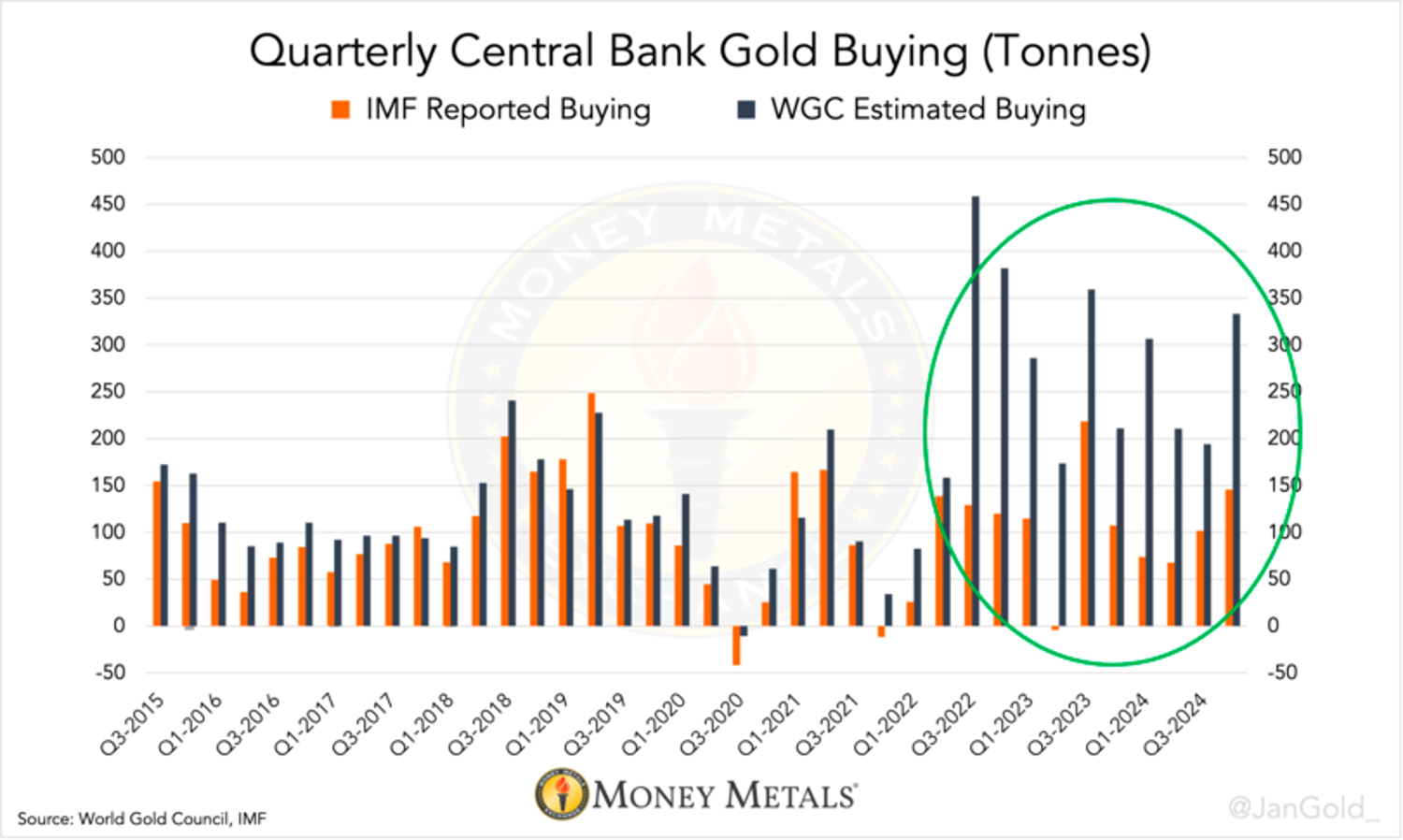
Using trade flow data, supply-demand imbalances at the Shanghai Gold Exchange, and evidence of direct bullion exports from London to China, market observers estimate that China’s actual gold reserves may now exceed 5,000 tonnes—roughly double its officially reported holdings. The scale of this accumulation is reshaping not only the geographic distribution of global official gold reserves but also the role of gold as a value anchor in the evolving international monetary system.
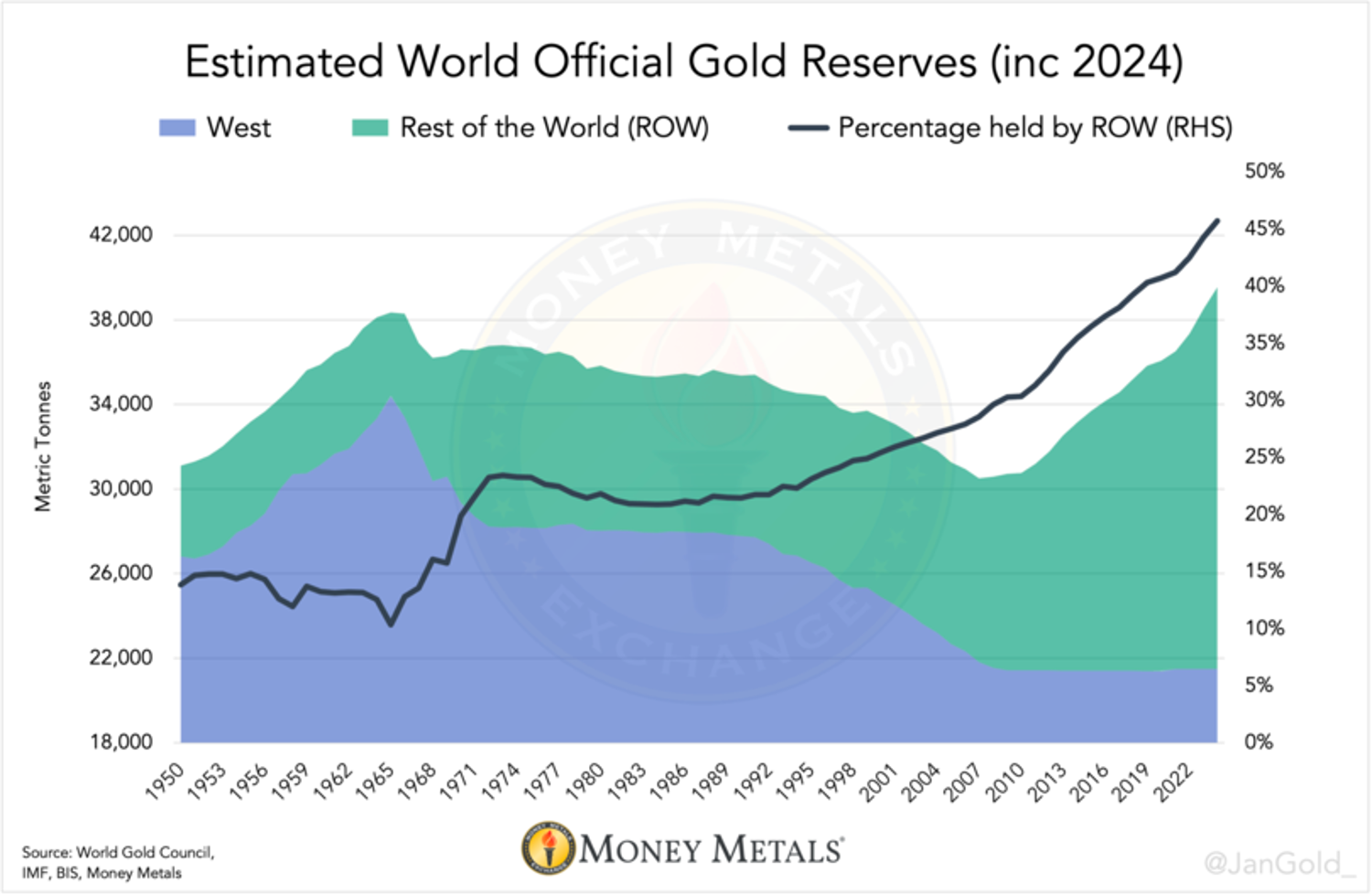
When accounting for undisclosed holdings by China and other central banks, such as Saudi Arabia, global official gold reserves reached a record 39,547 tonnes by the end of 2024. With nearly all new monetary gold buyers concentrated in the East, non-Western holdings now make up 45% of total global reserves, marking a dramatic and accelerating shift in reserve composition.
Geopolitical De-Dollarisation: Gold as a Strategic Replacement
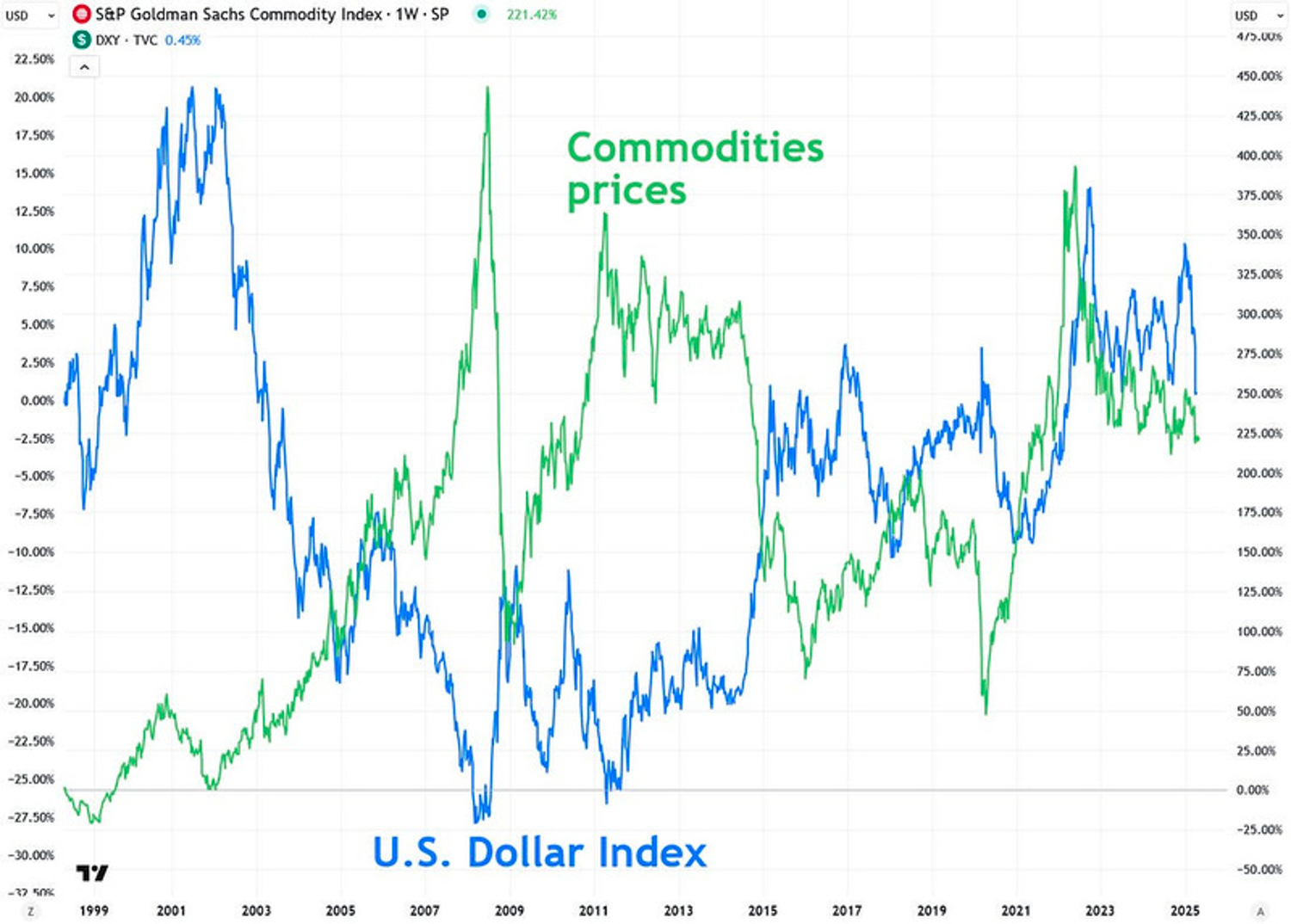
Since the beginning of the year, the U.S. dollar has weakened significantly. Given the inverse correlation between precious metals and the dollar, this decline has fueled broad gains in commodity prices, particularly for gold and silver. After three consecutive months of losses, the dollar now sits at a critical inflection point, with its next move likely to have meaningful implications for commodities and precious metals.
In parallel, the global trend toward “de-dollarisation” is gaining momentum, with gold increasingly positioned as a strategic reserve asset for emerging and developing economies. Countries such as China, members of ASEAN, and the BRICS bloc are actively promoting alternative settlement mechanisms, including the mBridge cross-border payment platform and gold-backed stablecoins, to reduce their reliance on the U.S. dollar. As a result, the share of gold in global foreign exchange reserves surged to 21% in 2024, the largest annual increase in four decades. The portion of global gold reserves held by non-Western nations also approached 45% for the first time, signalling a clear pivot away from the U.S. dollar dominance. In essence, gold is evolving from a simple store of value into a foundational pillar of a new global monetary order.
Liquidity and ETFs Amplify the Upside Momentum
On the market side, liquidity and investor sentiment are providing additional tailwinds to gold prices. Goldman Sachs recently raised its medium-term gold price target to $3,700 per ounce, with an expected trading range of $3,650 to $3,950, reflecting a dual thesis of strong demand from central banks and sustained inflows into ETFs. Amid growing concerns over a U.S. economic slowdown and mounting expectations of Federal Reserve rate cuts, institutional capital is returning to gold ETFs, helping drive prices higher.
Simultaneously, gold mining equities have gained favour among investors as high-beta plays on the precious metals rally. Indices such as GDX have significantly outperformed spot gold, underscoring investor enthusiasm and leveraged exposure to the broader trend. This convergence of macro, institutional, and retail forces is pushing gold deeper into a structural bull market phase, cementing its renewed centrality in the evolving global financial architecture.