
Introduction
A new breed of publicly traded company has emerged in 2025: the crypto treasury company. Much like MicroStrategy made headlines by accumulating billions in Bitcoin, these smaller firms are pivoting their core strategy to amass cryptocurrency reserves – but often in altcoins like Ethereum, Solana, or Tron.
The promise is enticing: transform a mundane small-cap stock into a proxy for crypto assets. Investors have responded with frenzied buying, sending share prices skyrocketing – only to later face the harsh realities of how these treasuries are funded.
This article examines what crypto treasury companies are, how they use PIPE (Private Investment in Public Equity) funding to build large crypto positions, and the significant risks this strategy poses for investors.
What Are Crypto Treasury Companies?
Crypto treasury companies are publicly traded firms whose primary corporate strategy is to accumulate cryptocurrency on their balance sheet (aside from Bitcoin, which has already been done by firms like MicroStrategy).
These companies often have unrelated legacy businesses (from consumer products to mining) but pivot to a treasury reserve strategy centered on a specific crypto asset. For example, Las Vegas-based BitMine Immersion Technologies (NYSE: BMNR) was a modest Bitcoin mining outfit until it announced in June 2025 that it would switch to an Ethereum treasury strategy. Similarly, Upexi, Inc. (NASDAQ: UPXI) – originally a consumer brands company – rebranded itself as a “Solana Treasury Company,” stockpiling Solana’s SOL token. The pitch is that by holding a large stash of a promising crypto, the company can gain from asset appreciation and even generate yield (via staking) to benefit shareholders. These announcements have had dramatic effects on share prices. Tiny firms suddenly saw their market caps balloon as they became de facto crypto ETFs.
We introduce several major altcoin treasury companies in the article: Altcoin Stocks Booming. Should Investors Join the Ride?
Clearly, the market is enthusiastic about the upside of these crypto treasuries. But behind the hype lies a financing mechanism that can severely dilute shareholders: the PIPE deal.
PIPE Financing: A Quick Explanation
Private Investment in Public Equity (PIPE) is a method for public companies to raise capital by selling stock directly to private investors, rather than through a public offering. In a PIPE deal, a company negotiates with one or several accredited investors – often hedge funds, family offices, or in some cases, strategic crypto investors – to inject cash (or sometimes crypto assets) into the company in exchange for newly issued shares.

Source: Investopedia
The PIPE shares are usually issued at a fixed price, which may be at a discount to the market price to entice investors, though in some high-demand cases they can be at a premium. Because these are restricted securities, the investor cannot sell the shares immediately. The company typically agrees to file a registration (S-1 or S-3) with the SEC to register those shares for resale after the deal closes.
Once the SEC declares the registration effective, the PIPE investors are free to sell their shares in the open market. PIPEs are popular with small-cap companies because they can raise large sums quickly and with relatively less regulatory hassle than a full public follow-on offering.
In summary, a PIPE is a fast-track funding tool: it brings in substantial capital to the company’s treasury, but at the cost of issuing a large block of new shares to private investors. Those new shares will eventually hit the market – and that’s where the risks to existing shareholders become apparent.
Investor Risks: Dilution and Delayed Selling Pressure
For ordinary investors, the PIPE funding model carries significant risks. Chief among them are dilution, overhang, and eventual selling pressure:
Massive Share Dilution
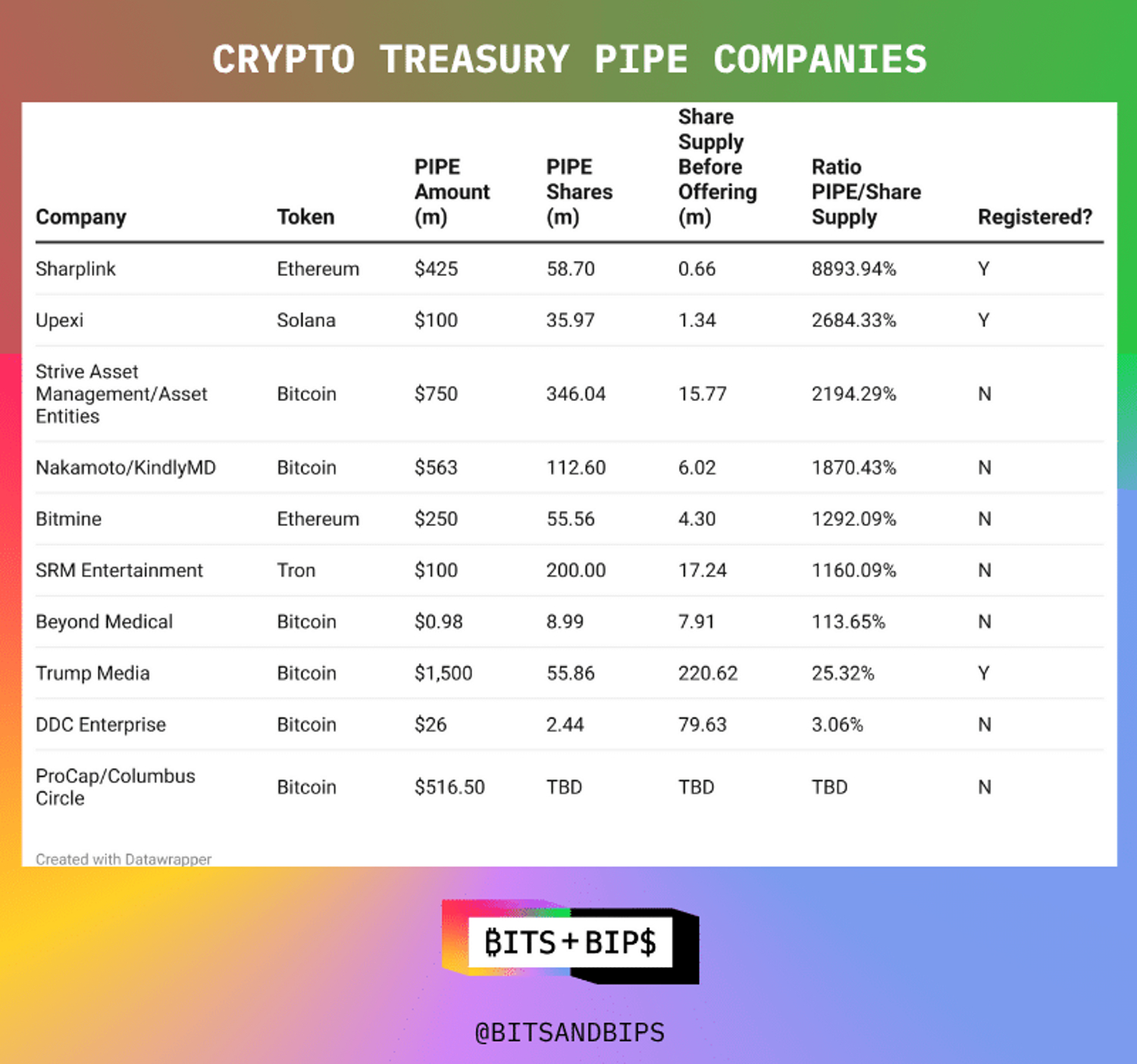
PIPE financings typically create a huge number of new shares (and warrants) that didn’t exist before, shrinking the ownership percentage of existing shareholders. SRM Entertainment’s TRON PIPE involved 100,000 preferred shares convertible into 200 million common shares, plus 220 million warrants at $0.50. If fully converted and exercised, those 420 million shares would dwarf the mere 17 million shares SRM had outstanding before, an explosive dilution that understandably spooked investors.
Below table summarizes the dilution in several cases:
Source: unchainedcrypto
Such dilution means that even if the crypto asset held doubles in value, shareholders might not see gains per share because the ownership is spread so thin. These companies must generate outsized crypto gains just to offset share dilution.
Selling Pressure Overhang
The PIPE investors usually agree to a lock-up until the company registers their shares for resale. This creates a time bomb of pent-up supply. When the required S-1 or S-3 registration statement is filed, the market knows those shares will soon be sellable. Often, that filing itself triggers a sell-off by other investors anticipating the dilution. For example, SharpLink’s stock plunged 70% in after-hours when it filed an S-3 to register 58.7 million PIPE shares for resale.
In Upexi’s case, the mere filing of a resale registration (covering 43.9M shares from its Solana funding) sent the stock down over 60% in a day, from around $10 to $4. The pattern has repeated: initial euphoria, then a sharp fall once the reality of impending share supply hits. Even if the PIPE investors haven’t sold yet, regular shareholders often rush for the exits.
Once the shares are registered and free trading, PIPE investors – who got in at favorable terms – have the opportunity to take profits. Many are happy to sell, especially if the stock is still above their entry price. This can create sustained sell pressure and volatility.
In summary, PIPE-funded crypto treasuries often create a boom-bust dynamic: huge upside on announcement and funding, followed by dilution-driven declines.
More Sustainable Funding Models
Crypto treasury companies have captured imaginations, but their funding tactics have raised concerns. Is there a better way to pursue a crypto accumulation strategy without burning existing shareholders?
Instead of one giant PIPE deal, companies could raise funds gradually through at-the-market equity programs or smaller placements over time. This can smooth out the dilution. By selling shares into the open market bit by bit (when volumes are high), a company might avoid the shock of a huge block hitting at once. The downside is that ATM sales are slower and dependent on market conditions.

Debt or Convertible Bonds: MicroStrategy famously used convertible bonds to buy Bitcoin, delaying dilution for years. Crypto treasury companies might consider issuing convertible notes to fund purchases, rather than pure equity. Debt avoids immediate dilution; if the crypto asset appreciates, they can pay off the debt or note conversions at higher equity prices later. Of course, this requires creditors willing to lend – which usually means the company must have some cash flow or assets to secure the loan. Many of these small firms don’t, which is why they resort to equity.
Conclusion
The rise of crypto treasury companies is a fascinating intersection of the equity and crypto markets. These firms provide a novel way for stock investors to get exposure to altcoins, and their meteoric stock rallies reflect genuine excitement about the future of crypto assets like Ethereum, Solana, Tron, and Bitcoin.
However, as we’ve detailed, the mechanism powering this trend – large PIPE financings – has significant downsides for investors. For investors, the key takeaway is caution. Understanding the fine print of PIPE deals, lock-up expirations, and basic share math is essential before jumping into these plays.