
Buying tokenized Alphabet on BloFin is straightforward: create and verify your account, deposit USDT into Spot, open the GOOGLX/USDT pair in the xStocks tab, and place a market or limit order for the amount you want. For active crypto traders and investors who want equity exposure without leaving their trading account, that means buying GOOGLX much like any other spot pair on BloFin, while meeting the platform’s eligibility rules for xStocks.
Buying a share in a large listed company has always required a specific kind of account. You open it with a broker licensed where you live, fund it in that country's currency, and place orders only while that country's exchange is open. The account exists because a share is a registered legal claim, and somebody has to keep the register.
None of that fits how a crypto trader already operates. The balance sits in stablecoins, the account was opened in minutes, and the position gets adjusted at whatever hour the idea arrives. Adding equity exposure to that setup has meant running two separate financial lives, moving money between them, and waiting for a market that is shut most of the week.
Tokenized equities exist to collapse that into one account. A tokenized stock is a blockchain token whose value is tied to a real share held in custody by a regulated issuer, so the price follows the share while the token settles on crypto rails against stablecoins. For traders comfortable with fractional tokenized stocks, that creates a practical way to add Alphabet exposure inside a crypto account without opening a separate brokerage account, while keeping in mind that tokenized exposure has different structure, access rules, and risks than direct stock ownership.
This guide walks through the full process on BloFin: account setup and verification, funding Spot with USDT, how market and limit orders work for GOOGLX, how to read the market data on the pair, fees, position management, when to exit, the main risks and eligibility limits, and how tokenized spot exposure differs from trading stock-linked futures.
What tokenized Alphabet (GOOGLX) is and what you are actually buying
GOOGLX is a tokenized version of Alphabet Inc. Class A stock, mapped to the underlying ticker GOOGL on Nasdaq. It trades as GOOGLX/USDT on BloFin's spot market alongside 13 other tokenized stocks and ETFs, and it was listed on September 2, 2025 in the second batch of xStocks BloFin brought to spot, a day after the first five (source: BloFin xStock Listing Announcement).
Each GOOGLX token is a tracker certificate issued by Backed Assets (JE) Limited, a special-purpose vehicle incorporated in Jersey, with Alphabet Class A shares held 1:1 as collateral for every token in circulation. Collateral is verified through Chainlink Proof of Reserve, which publishes an on-chain feed updated in near real time, with the underlying reserves checked by an external audit firm (source: Backed Finance). The token exists on-chain as an ERC-20 on Ethereum and EVM-compatible chains, or as an SPL token on Solana, meaning it can be transferred, held or traded away from BloFin.
What this structure means for you:
Price exposure, not ownership. Holding tokenized assets grants price exposure without direct shareholder status. You are a creditor of the issuer, not a registered owner of Alphabet shares.
No voting or governance rights. Tokenized stocks do not provide traditional corporate governance perks like voting rights at Alphabet's AGM or direct information rights from the company.
No direct dividends. Tokenized stocks do not pay cash dividends directly. During ex-dividend events the share price adjustment may be reflected in GOOGLX's trading price, but no cash payment routes through BloFin or the issuer to your account.
Tokenized stocks are backed by real shares held by custodians. The backing structure relies on an issuer and custodian arrangement rather than registering you on Alphabet's shareholder list.
For a fuller comparison against holding real equity, BloFin's overview of tokenized stocks sets out the trade-offs.
Before you start: Create a BloFin account and review robust security measures
Two of the three prerequisites are the same as for buying anything else on BloFin, so they are covered properly on their own pages instead of being restated here. The third one is specific to tokenized stocks and is the reason most people cannot find the pair.
A verified account. Sign up, complete identity verification and turn on two-factor authentication before you deposit anything. The walkthrough is in create a BloFin account. One detail matters here: tokenized stocks sit behind a higher verification tier than plain crypto trading, and below it the GOOGLX/USDT pair simply will not appear in your interface.
A funded Spot balance. You need USDT in your Spot account, not Funding, because an order placed against a Funding balance returns an insufficient-balance error. Choosing the right network and sending a test transfer first are covered in the BloFin deposit guide. Hold slightly more USDT than your intended order size, so the fee and any slippage do not push the order back.
The third is eligibility, and it is worth reading before you assume it. To trade xStocks on BloFin you must confirm that you are not a US Person as defined under the Securities Act of 1933, not domiciled in a Restricted Location under BloFin's Terms of Use, and not a United Kingdom Person, including Northern Ireland and British Nationals (source: BloFin). The issuer applies its own restrictions on top, and xStocks are not marketed or offered in the United States or any other prohibited jurisdiction. You must also be at least 18 with the legal capacity to trade financial products.
With a verified account, USDT in Spot and eligibility confirmed, everything below is the part that is specific to GOOGLX.
Navigating to the GOOGLX Spot trading market on BloFin
GOOGLX trades on BloFin as a Spot pair quoted against USDT under the ticker GOOGLX/USDT, alongside the other tokenized stocks and the crypto pairs. It is separate from the GOOGLUSDT perpetual contract, which lives in Futures. Follow the steps below to get there.
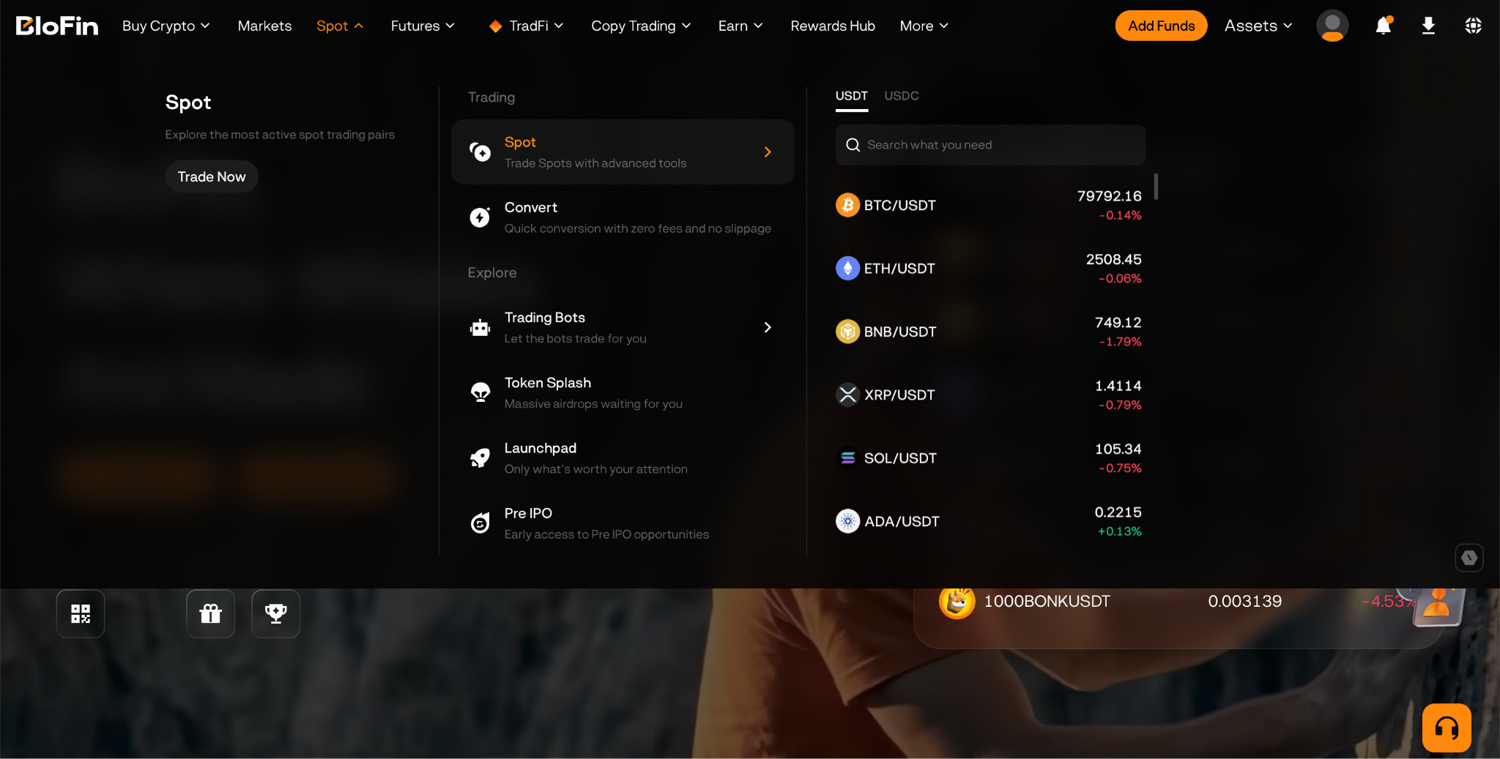
Step 1: Log in to your BloFin account and hover your cursor over the Spot tab. Then select Spot.
Step 2: Hover your cursor over the BTC/USDT Spot pair and a pop-up window will appear. Type GOOGLX in the search bar.
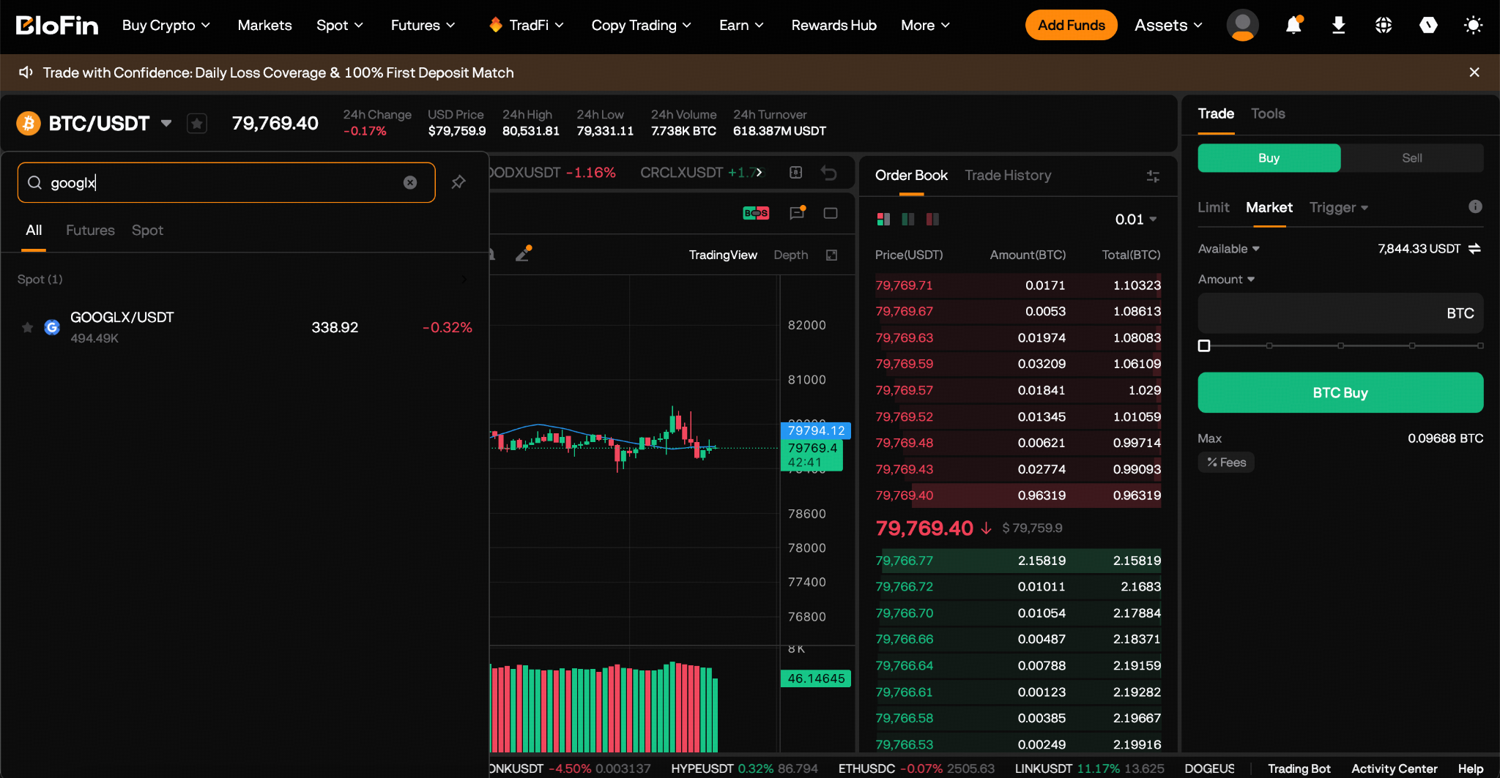
Step 3: Select the GOOGLX/USDT Spot pair from the results.
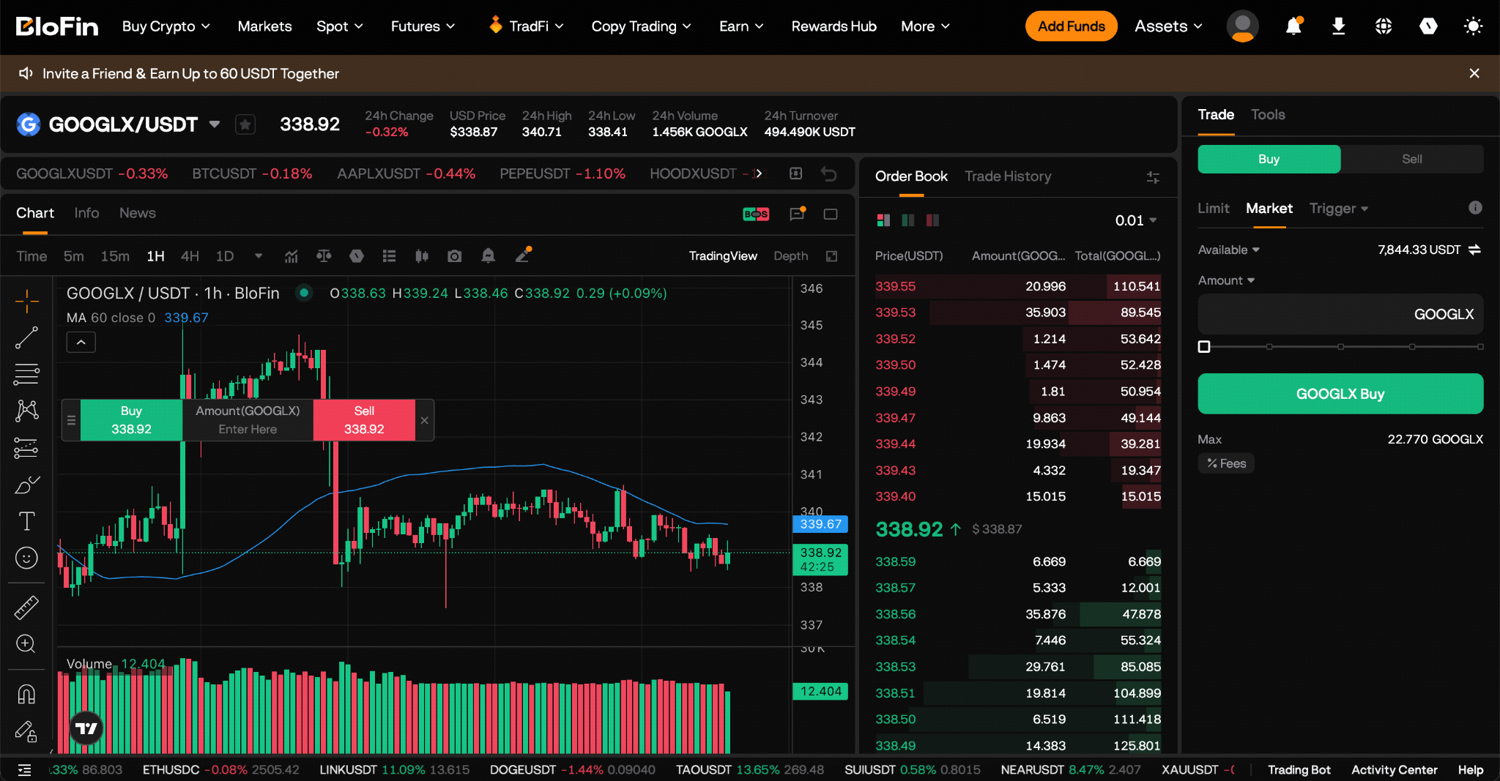
The trading interface shows a real-time candlestick chart of the tokenized Alphabet price, an order book with bids and asks, recent trades, and the order entry panel on the right, along with your available USDT and GOOGLX balances. Clicking the star icon next to the pair name adds it to your favorites so it sits at the top of the list next time.
Placing your first GOOGLX order: Market, limit, and order size
BloFin supports the common order types for GOOGLX, giving you control over price and execution speed. If this is your first trade on BloFin, start with a small amount to get familiar with the interface.
Market order: buys GOOGLX immediately at the best available price in the order book. This is the simplest option when you want instant execution and are comfortable with the current price, though a thin book means your average fill can land above the last traded price.
Limit order: you set an exact price, and the order fills only when the market reaches that level or better. This is the safer default on a tokenized stock, where liquidity is thinner than on the major crypto pairs, and it matters most around Alphabet's earnings and regulatory decisions.
Orders are fractional, so you are buying an amount of the token instead of whole shares, and a first position can be worth a few USDT instead of a few hundred. The minimum order size is shown on the order panel itself and is the figure to work to, since it is set per pair and can change.
Worked example (buying 100 USDT worth of GOOGLX):
Step 1: On the order panel, select Buy.
Step 2: Choose Market as the order type and enter 100 in the USDT amount field. If you only see GOOGLX, tap the Amount button and select Total.
Step 3: Review the estimated quantity and fees, then click GOOGLX Buy.
At the price on September 7, 2026, GOOGLX was trading at about 339 USDT (source: CoinGecko), so 100 USDT buys roughly 0.295 GOOGLX before fees, and the same arithmetic scales: 1,000 USDT buys about 2.95. Filled orders appear under Order History, and partial fills can happen on limit orders in quieter periods, so check Open Orders for anything still resting on the book. Your balance updates immediately under Assets > Spot.
GOOGLX trading fees and total cost
Knowing the all-in figure before you size a position is what keeps the result predictable. Spot xStocks charge a flat 0.1000% on both the maker and the taker side (source: BloFin).
Cost component | Rate | When it applies |
Spot taker fee | 0.1000% | Every market order, and every limit order that fills immediately |
Spot maker fee | 0.1000% | Every limit order that rests on the book before filling |
Network fee | Varies by chain | Moving USDT or GOOGLX on-chain |
Conversion cost | Market spread | Swapping another coin to USDT before buying |
On a 10,000 USDT purchase at the taker rate, the entry fee is 10 USDT and the exit fee another 10 USDT, for a round trip of 20 USDT, or 0.20% of notional (source: BloFin). Spot carries no funding cost, so holding the position adds nothing beyond that. The spread belongs in your estimate alongside the fee, because on a tokenized stock it is usually the larger of the two. Current tiers and VIP discounts sit on the BloFin fee structure.
How to read GOOGLX market data before ordering
The spot interface carries live market data for the pair, and a scan of it before trading tells you what you are about to trade into.
The last traded price and 24-hour change place GOOGLX against where it was a day ago, the 24-hour high and low give you the intraday range, and 24-hour volume in both GOOGLX and USDT shows how actively the pair is trading. Thin volume means wider spreads and more slippage on market orders. The order book beneath shows what is resting on each side near the current price, and how to size an order against that depth is worked through in GOOGLX liquidity and slippage.
Switching the chart interval between one minute, one hour and one day shows how closely GOOGLX has tracked Alphabet's Nasdaq price over different windows. Small deviations appear and arbitrage against the underlying collateral closes them. The data is most informative during the US session, when the reference price is updating continuously, and the schedule that governs that is covered in GOOGLX trading hours.
Reviewing and managing your GOOGLX position
After the fill, the position sits under Assets > Spot as a GOOGLX balance rather than as an open trade with a profit and loss line attached, because spot is ownership of the token rather than a contract against it. Your gain or loss is the difference between what you paid and what the token is worth now, and nothing about the position changes on its own while you hold it.
Holding spot costs you nothing while you hold it and asks nothing of you: the token simply sits in your account until you sell it, which is the practical difference between owning the asset and holding a contract against it. What does move is the price, and it moves on Alphabet's business, not on anything happening in crypto. Earnings, regulatory decisions and the advertising cycle are the drivers, and they are set out in what moves Alphabet stock price.
How to exit a GOOGLX position
Selling back to USDT on the same spot market is the primary exit, and the mechanics mirror the buy. Navigate to GOOGLX/USDT, switch to Sell, choose market or limit, enter either the amount of GOOGLX to sell or the USDT value you want back, and confirm. Partial exits work the same way, so you can cut exposure while keeping a residual balance, and proceeds land as USDT in your spot account ready to withdraw, convert or redeploy.
Timing matters more here than on a crypto pair. Selling during the Nasdaq session, 9:30 a.m. to 4:00 p.m. Eastern on weekdays, generally produces the tightest alignment between the token price and the underlying share, because the reference price is updating live. Outside those hours spreads tend to widen.
The other way out is not a sale at all: GOOGLX can be withdrawn to a wallet you control and held there, which changes what you own and what the issuer can still do. That route, and the controls that survive it, are covered in withdrawing GOOGLX to your own wallet.
Risk considerations when buying tokenized Alphabet
GOOGLX carries Alphabet's stock risk and token-specific risk on top, and both are worth understanding before committing real size.
On the market side, Alphabet's share price can move several percent in a single session, particularly around earnings and regulatory decisions, and the token moves with it. Gap risk sits alongside that, because the underlying share trades only during Nasdaq hours while news arrives at any time, so a weekend or an overnight event can produce a sharp adjustment when the market reopens. How those gaps form is set out in tokenized Alphabet price gaps.
On the structural side, you are a creditor of the issuer rather than a shareholder of Alphabet, so legal or financial difficulty at the issuer or its custodian could impair the backing. The token carries no vote and no direct claim on Alphabet's assets, and dividend value reaches you as a balance adjustment rather than cash, which is worked through in Alphabet dividends and GOOGLX. Where the product sits legally is covered in is tokenized Alphabet legal and safe.
On the venue side, outages, connectivity problems or a trading halt in either GOOGLX or its reference market can affect execution, and regulatory change could lead to delisting or restricted access in particular jurisdictions. Tokenized Alphabet suits someone comfortable with equity-style and crypto-style risk together, and it is not a risk-free substitute for a brokerage account.
How GOOGLX differs from the GOOGLUSDT perpetual
BloFin lists two Alphabet instruments and they are not interchangeable. GOOGLX/USDT is a spot market in a token backed by real shares: you own the token, there is no funding cost, and you can withdraw it. GOOGLUSDT is a perpetual futures contract that references the same price without any backing behind it, settles in USDT, pays or receives funding on a schedule, and exists only inside the exchange.
For buying and holding Alphabet exposure, spot is the simpler instrument and the one this guide covers. Which of the two suits a given intention is the subject of GOOGLX versus the GOOGL perpetual, and the mechanics of the contract itself are in how to trade Alphabet with leverage.
Checklist before you buy GOOGLX
Run through this before the first order goes in. Most of it takes a minute, and every line is something that costs more to discover afterwards.
Confirm you are eligible: not a US Person, not domiciled in a Restricted Location, and not a United Kingdom Person.
Complete identity verification to the tier tokenized stocks require, since the pair stays hidden below it.
Turn on two-factor authentication before you deposit anything.
Deposit USDT and confirm it has reached your Spot account rather than sitting in Funding.
Open GOOGLX/USDT and read the spread and the order book depth at the size you intend to trade.
Pick the order type on what you just read: a limit order whenever the spread looks wide.
Check the side, the amount and the price on the confirmation screen before you accept it.
Know what you are buying: a tracker certificate on Alphabet's price, carrying no vote and paying no cash dividend.
The two people skip most often are the eligibility check and the spread. The first decides whether the order can be placed at all, and the second decides what it costs you.
Frequently asked questions
How much does it cost to buy GOOGLX on BloFin?
Spot xStocks charge a flat 0.1000% on both sides, so a 10,000 USDT purchase costs 10 USDT to enter and 10 USDT to exit, a round trip of 20 USDT or 0.20% of notional (source: BloFin). On top of that you pay the spread between the best bid and ask, which is usually wider on tokenized stocks than on major crypto pairs, and any network fee if you move USDT or GOOGLX on-chain. There is no funding cost on spot, so holding the position costs nothing beyond those.
Do I need identity verification to buy GOOGLX?
Yes. Tokenized stocks are equity-linked products and typically sit behind a higher verification tier than plain crypto trading. Verification usually means a government-issued photo ID, a selfie or liveness check, and basic address details, and it processes in anywhere from minutes to hours. If your profile is incomplete the GOOGLX/USDT pair may not appear in your interface at all, which is the most common reason people cannot find it.
Which countries and residents can trade GOOGLX?
To trade xStocks you must confirm that you are not a US Person as defined under the Securities Act of 1933, not domiciled in a Restricted Location under BloFin's Terms of Use, and not a United Kingdom Person, including Northern Ireland and British Nationals (source: BloFin). The issuer applies its own restrictions in addition, and xStocks are not marketed or offered in the United States or any other prohibited jurisdiction. Eligibility otherwise follows the rules where you are trading.
What is the smallest amount of GOOGLX I can buy?
Orders are fractional, so you buy an amount of the token rather than whole shares, and a first position can be worth a few USDT. The exact minimum is set per pair and displayed on the order panel, so read it there instead of working from a figure quoted elsewhere. Fractional access is most of the appeal for a smaller account, because Alphabet trades in the hundreds of dollars a share and the token lets you hold a fraction of one.
Why is the GOOGLX spread wider than a pair like BTC/USDT?
Because far less money moves through it. GOOGLX turned over about $2.7 million across all venues in 24 hours on September 7, 2026, against roughly $21.2 billion for Bitcoin (source: CoinGecko). A thinner book means a wider gap between the best bid and the best ask, and more slippage on a market order that has to walk through several price levels. Use limit orders on anything but the smallest size, and read the depth at your intended size before you send the order, not after.
Is the GOOGLX on BloFin the same token as on other exchanges?
Yes. There is one GOOGLX, a tracker certificate issued by Backed Assets (JE) Limited under ISIN CH1436219237, and the same on-chain token trades on every venue that lists it. What differs between venues is the fee schedule, the depth of the order book and which chains you can withdraw to. You will also see the ticker written both ways, GOOGLX and GOOGLx, which is a branding difference rather than two products.
Does GOOGLX pay Alphabet's dividend?
The value passes through, but as a balance adjustment rather than a cash payment. The custodian receives the dividend, the issuer reinvests it into additional shares, and an on-chain multiplier is raised so holder balances rise proportionally, net of applicable withholding taxes. No cash routes through BloFin or the issuer to your account, so if income in cash is what you want, the tokenized route is the wrong vehicle for it.
Can I trade GOOGLX at the weekend?
The xStocks spot market runs 24 hours a day, five days a week, so GOOGLX closes for the weekend alongside Nasdaq (source: BloFin). You get the full day on weekdays, including the overnight window when Alphabet reports earnings, but a position held into Friday's close cannot be adjusted on that market until Monday.
Researched and written by the BloFin Academy editorial team with AI-assisted drafting. All facts independently verified. Primary sources include BloFin's September 2, 2025 xStocks spot listing announcement, its xStocks Risk Disclosure Statement for eligibility and trading hours, its published fee schedule, CoinGecko for the GOOGLX market price and trading volume, and BloFin's spot market listings, current as of September 2026.
Nothing in this article constitutes financial advice. GOOGLX carries the full price risk of Alphabet stock together with risks a share does not carry, including the solvency of the issuer and its custodian, thinner liquidity than the Nasdaq listing, and a redemption path closed to ordinary holders. Because the spot market closes for the weekend while Nasdaq is shut, a position held across a weekend can reopen at a materially different price. Prices, fees and volumes quoted here were read on September 7, 2026 and change. Past performance does not indicate future results. Do your own research and consider your risk tolerance before you trade on BloFin.