
Anyone who wants to take a view on a large listed company with more size than their cash allows has historically needed a specific kind of account: a margin account at a broker, an options approval level, or a spread-betting login in a country that permits it. Each comes with its own paperwork, its own funding currency, and its own set of hours.
That is an awkward fit for someone whose capital already sits in stablecoins on a crypto exchange. Moving money out to a broker to express a two-week view on a technology stock, then moving it back, costs time at both ends and leaves the position stranded whenever the equity market is shut. The view itself is often formed at exactly the hours a broker is closed.
Perpetual futures on individual stocks close that gap. A stock perpetual is a derivative that references the share price through an index, settles in a stablecoin, never expires, and lets you post a fraction of the position's value as margin. You get directional exposure with a multiplier attached, and the multiplier works on the way down as reliably as on the way up.
Alphabet Inc. is one of the largest companies in the world by market capitalization, and its share price reacts to everything from Google Cloud revenue to antitrust rulings to interest rate changes. On BloFin, the instrument that gives you leveraged exposure to it is the GOOGLUSDT Perpetual.
Answering the question: How do you trade Alphabet with leverage?
GOOGLUSDT is a perpetual futures contract settled in USDT that references Alphabet's underlying share price through an index built from third-party data vendors (source: BloFin). It tracks the stock price without granting share ownership, voting rights or dividends, and it lets you control a larger position than your deposit alone would allow, which amplifies losses exactly as it amplifies gains.
BloFin quotes size in GOOGL, with a minimum order of 0.01 GOOGL, a tick size of 0.01 USDT, and leverage up to 20x. The contract was listed on March 26, 2026 (source: BloFin), and the live specifications sit on its contract details page (source: BloFin GOOGL contract details).
BloFin also lists GOOGLX/USDT, a tokenized Spot pair that tracks Alphabet Class A stock. GOOGLX is itself a tracker certificate issued by Backed Assets (JE) Limited and backed 1:1 by real Alphabet shares held in custody, so the holder is a creditor of the issuer rather than an owner of the share. It gives economic price exposure with no leverage built in.
You can speculate on Alphabet stock price movements 24/7 on BloFin futures, even when Nasdaq is closed, but the index that drives the mark price depends on external data feeds. When those feeds are unavailable, the price index remains fixed at its most recently calculated value. For details on how trading hours and data gaps interact, see GOOGLX trading hours: 24/7 vs Nasdaq.
The rest of this article gives a practical, risk-focused playbook for opening, sizing, and managing a long leveraged Alphabet position.
Understanding leveraged Alphabet stock trading on a crypto exchange
Traditional routes to leveraged stock exposure include CFDs, margin accounts at brokerages, options, and leveraged ETFs. CFDs allow trading without owning the underlying asset, and the benefits include flexibility to go long or short with different order types for execution, so traders can profit from both rising and falling Alphabet prices using CFDs. Options can be used to gain leveraged exposure to price movements with defined risk profiles. Leveraged ETFs can provide exposure to a stock's performance, but daily compounding in those products can distort long-term returns, making them poor vehicles for multi-week holds.
GOOGLUSDT works differently from all of these. It is margined and settled in USDT, it references Alphabet's share price while ownership, dividends and voting rights stay with the shareholder, and it runs perpetually, so there is nothing to roll. Unlike a fixed 2x or 3x ETF, it lets you choose your own leverage up to 20x and change it by adjusting position size against your available margin. Your profit and loss are realized in USDT and can be redeployed straight into other markets on BloFin.Unlike a 2x or 3x ETF, GOOGLUSDT lets you choose your own leverage level up to 20x and adjust it by changing position size relative to your available margin. Alphabet shares were initially priced at $85 when Google went public in 2004; today the company is worth over $2 trillion. Your profit and loss on GOOGLUSDT are realized in USDT and can be redeployed into other markets on BloFin. CFD trading and perpetual futures both allow for long and short positions; for the short side of GOOGLUSDT, see how to short Alphabet on BloFin.
Leverage on this contract is for traders who understand liquidation. If you want Alphabet exposure without it, the tokenized spot pair GOOGLX/USDT is the simpler route, and the rest of this section assumes you have decided otherwise as an active trader choice.
Key contract specs and fee structure for GOOGLUSDT
Before you open a position, you need to know the numbers. Here are the core specs for the GOOGLUSDT perpetual:
Contract type: linear perpetual, USDT-settled
Base and quote: GOOGL / USDT
Minimum order size: 0.01 GOOGL
Maximum order size: 4,000 GOOGL on a limit order, 400 GOOGL on a market order
Tick size: 0.01 USDT
Maximum leverage: 20x, tiered downward as notional size increases
Maximum leverage on any derivative is set by a combination of regulatory guidelines and the venue's own risk controls, and BloFin publishes per-contract position tiers and price limit rules on GOOGLUSDT to contain extreme slippage. Those live on the same contract details page.
Your notional exposure is simply size in GOOGL multiplied by the index price. Buying 10 GOOGL with the index at 343 USDT gives you 3,430 USDT of exposure, against which your margin is a fraction determined by the leverage you selected.
The fee schedule for GOOGLUSDT follows BloFin's stock-perpetual tiers. Maker fees start around 0.0200% and taker fees around 0.0600%, varying by VIP level. For the latest tiers, see BloFin fees versus other exchanges. These fees apply per side of the trade; opening and closing each incur a fee.
Trading fees follow BloFin's maker and taker model, with standard rates for non-VIP users at 0.0200% maker and 0.0600% taker (source: BloFin). Full tiers and VIP discounts sit on the fee schedule, and a comparison with other venues is in BloFin fees versus other exchanges. These apply per side, so opening and closing each cost you.
Funding is the second running cost. Payments pass between longs and shorts every eight hours from 00:00 HKT by default. Since December 9, 2025 BloFin has shortened that interval automatically to four, two or one hour when volatility, funding-rate trends and liquidity warrant it, then restored it as conditions ease (source: BloFin). A position held through a volatile week can therefore pay funding far more often than three times a day. Realized and unrealized PnL, funding paid or received, and accumulated fees are all visible in the GOOGLUSDT position and funding tabs.
Preparing your BloFin trading account for leveraged Alphabet
To trade GOOGLUSDT you need three things ready:
A verified BloFin account. Opening any derivatives trading account requires identity verification, similar to opening a CFD trading account at a traditional broker. You may refer to our sign-up guide for reference in creating a BloFin account.
USDT in your BloFin account. Fund your wallet via crypto deposit or a supported on-ramp, then transfer funds to the futures or unified margin sub-account if required. Investors can use margin accounts to borrow funds for trading; on BloFin, your USDT balance serves as your margin.
Futures permissions enabled.
BloFin's unified account lets you use portfolio net assets, including USDT, GOOGLX and other tokens, as shared collateral, which is efficient and also means a concentrated GOOGLUSDT position can pull on assets you were not thinking of as margin. Enable two-factor authentication and withdrawal whitelists as well, because leveraged positions move quickly and losing access at the wrong moment is expensive.
If you are new to the platform, start with small position sizes or test-sized trades. For a walkthrough, you may also refer to how to place your first trade on BloFin.
How to open a long leveraged Alphabet position step by step
Once you've created your BloFin account and funded it with USDT, you may proceed to follow the steps below to open a long leveraged Alphabet position.
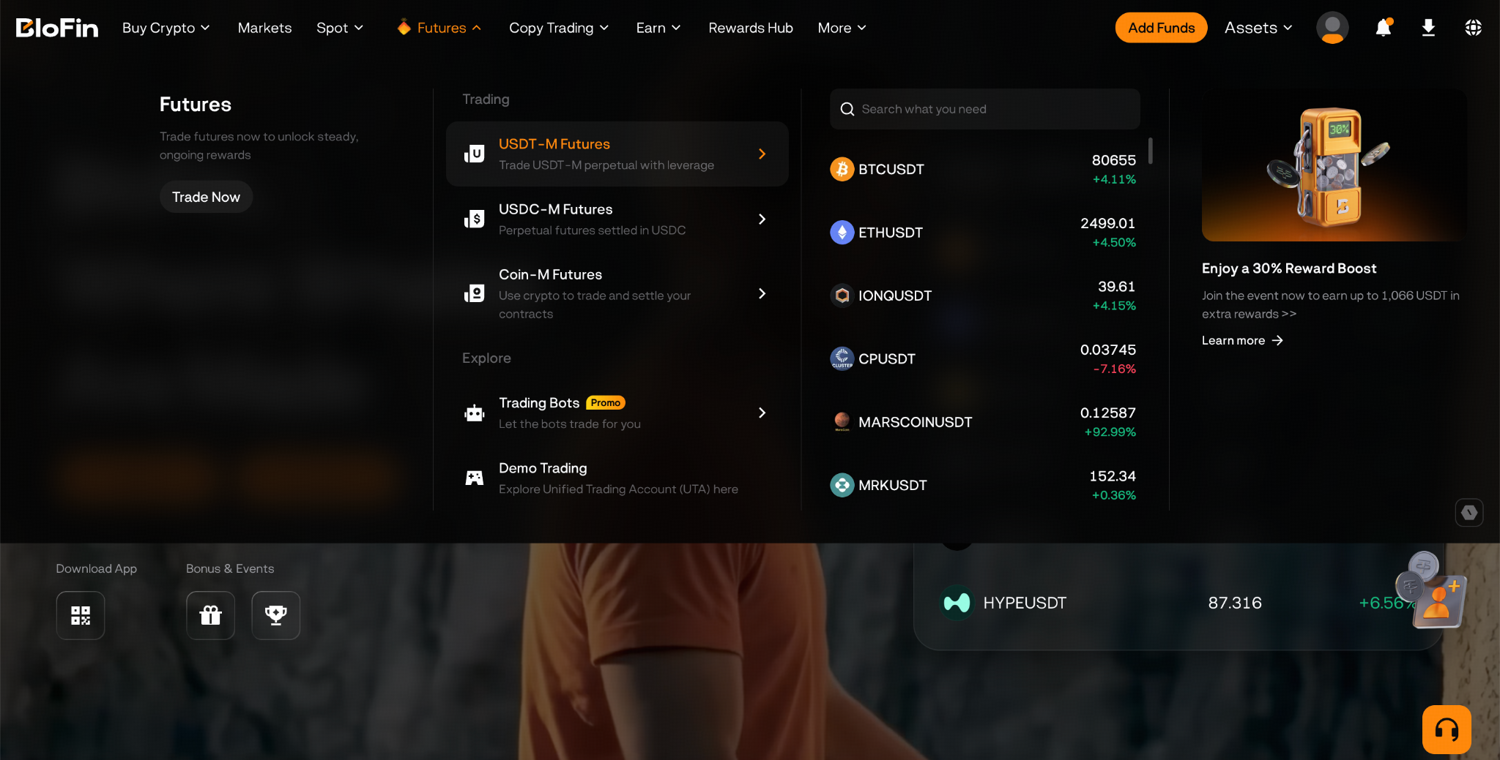
Step 1: Log in to your BloFin account and hover your cursor over the Futures tab. Then, click USDT-M Futures.
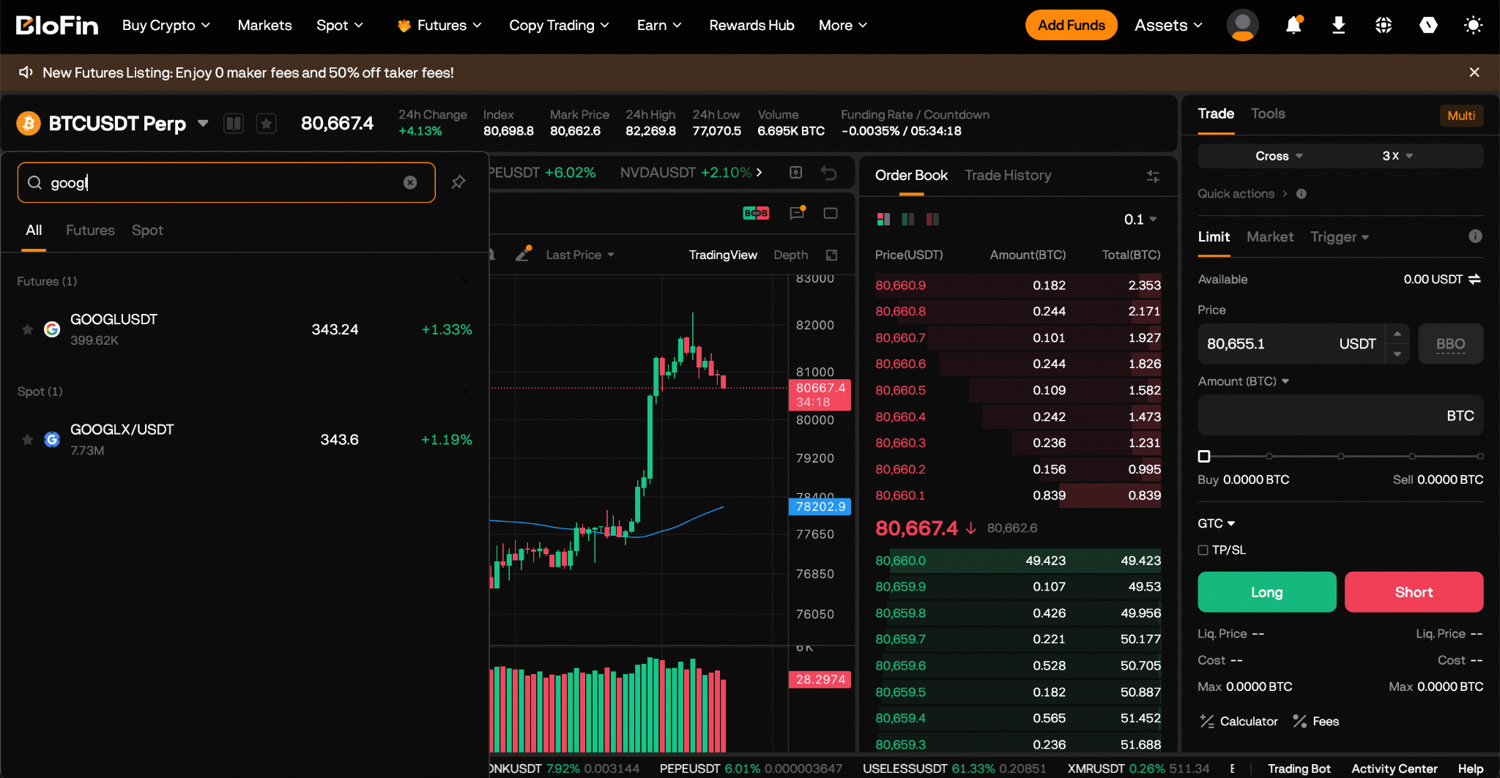
Step 2: Hover your cursor over the BTCUSDT trading pair and a pop-up window will appear. Type GOOGL and select the GOOGLUSDT Perpetual contract.
Step 3: Select your order type. A market order fills immediately at the best available price. A limit order lets you specify a maximum entry price. A stop-limit or stop-market order triggers a buy above the current price for breakout entries, or can be placed to sell later if momentum fades or to manage risk. For a deeper look at each type, see market versus limit versus stop orders.
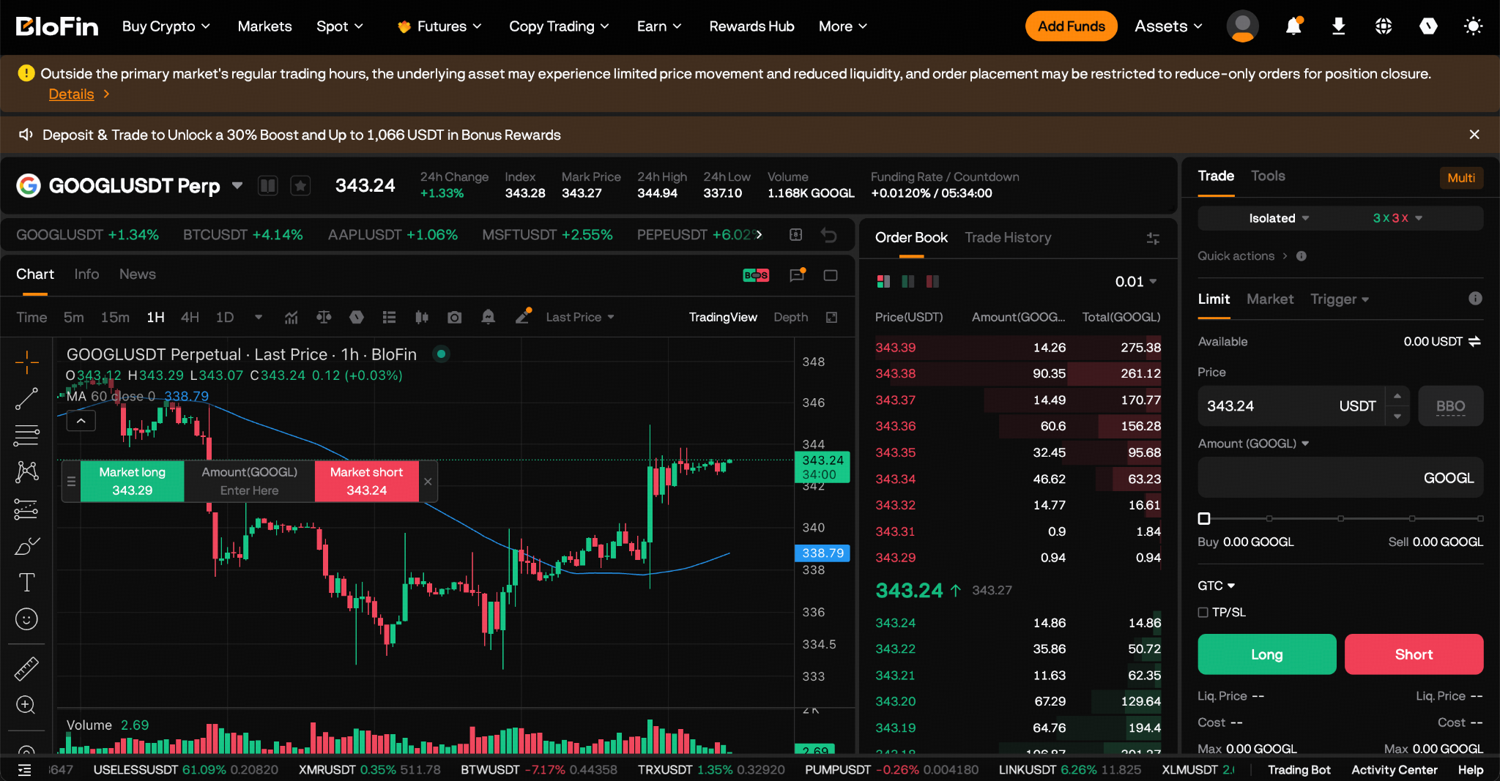
Step 4: Set your leverage on the order panel. The platform allows up to 20x, but that does not mean 20x is appropriate. Starting with 2x to 5x effective leverage is more forgiving for most traders. A 5:1 leverage means a 1,000 USDT deposit controls a 5,000 USDT position.
Step 5: Enter the contract quantity. With 2,000 USDT of equity at 5x, your target notional is 10,000 USDT, and at an index price of 343 USDT that works out to roughly 29.2 GOOGL, comfortably inside the 0.01 minimum and the 4,000 limit-order cap. Keep the size aligned with the expected price movement you are trading, not just the maximum leverage available.
Step 6: Attach a stop-loss before you submit, not afterwards, and set a take-profit at the same time if you are working to a target. Both controls sit on the GOOGLUSDT order ticket.
Once filled, your position appears in the Positions panel with entry price, liquidation price, unrealized PnL, and margin used. Monitor it.
Isolated vs cross margin on GOOGLUSDT
Margin is the USDT collateral you post to open and hold the position, and BloFin gives you two ways to manage it. The choice changes how much of your account a bad Alphabet trade can reach, so make it deliberately rather than accepting whichever mode the ticket defaults to.
In cross margin, your whole eligible futures balance backs the position, including unrealized profit on other trades. That keeps you in a position longer through a drawdown, and it also means one bad GOOGLUSDT trade can draw down funds you had earmarked elsewhere. In isolated margin, only the margin assigned to the GOOGLUSDT position is exposed: if Alphabet gaps against you and the position liquidates, you lose that allocation and the rest of the balance stays untouched. The trade-off is that isolated positions liquidate sooner, because there is no wider balance to absorb the move. The mechanics are set out in perpetual contracts and margin.
Position sizing, margin and liquidation when trading Alphabet with leverage
Position sizing is the single most important factor in capital preservation. Effective leverage equals position notional divided by account equity, and the higher it runs, the closer the liquidation price sits to your entry while increasing potential losses.
Traders often risk 1 to 2% of total account equity per trade. With 5,000 USDT of equity, that means risking 50 to 100 USDT on any one position, arrived at through a combination of size and stop-loss distance, and the method generalizes across markets in position sizing.
Worked example: you have 5,000 USDT of equity and you open a 10,000 USDT notional long in GOOGLUSDT, which is roughly 2x effective leverage. You set a stop-loss at a 10% decline in the underlying share price. If it triggers, you lose about 10% of 10,000, or 1,000 USDT, which is 20% of your account and ten times the budget described above. That kind of sizing mistake can turn a manageable drawdown into a total loss of the margin allocated to the position. To bring that trade inside a 1% risk budget with the same 10% stop, the notional has to come down to about 500 USDT, which at an index of 343 is roughly 1.5 GOOGL. That tension between the leverage you want and the stop distance you need is what position sizing actually resolves, and raising leverage without tightening the stop simply moves more of your account onto the table.
Alphabet shares can move 2 to 3% in a single session, which is enough to matter at any leverage above a few times. Margin calls occur when account equity falls below BloFin's maintenance margin requirement, and once your margin ratio crosses that threshold BloFin may auto-reduce or close the position to stop the account going negative. The full mechanism is in leverage and liquidation.
You can push the liquidation price further away by adding margin, reducing size, or moving to a lower leverage setting. A stop-loss caps the loss in most cases but not all: a large overnight gap, or a rapid move once a frozen index resumes updating, can carry price through your stop and into liquidation, having traded at none of the levels in between.
Managing a live leveraged Alphabet position: Orders, funding and frozen index
Once a long GOOGLUSDT trade is open, the work shifts to keeping the risk where you set it.
For exits, a stop-market order is the reliable choice during fast moves, while a stop-limit gives you price control at the cost of possibly not filling if price gaps through your limit. A take-profit closes at a level you chose in advance, and a trailing stop locks in gains while Alphabet trends higher, with the trailing distance set against the stock's typical daily range. Setting these before a move rather than during one is most of what separates a plan from a reaction. Reduce-only and post-only behavior is covered in post-only, reduce-only, IOC and FOK orders.
Funding passes between longs and shorts on each interval: when the rate is positive longs pay shorts, and when it is negative shorts pay longs. Held over days or weeks that becomes a real cost, and it is the difference between a trade that works on the chart and one that works in your account. The GOOGLUSDT funding history is published on BloFin's funding rate data page for the pair, and the general mechanics apply here exactly as they do on a crypto perpetual.
The frozen index is the case that catches people out. When external price data is unavailable, for instance outside Nasdaq's regular session of 9:30 a.m. to 4:00 p.m. ET or during a data vendor failure, the mark price stays fixed. Unrealized PnL stops moving while the risk stays exactly where it was, because when the index resumes, a large move can arrive in a single step with no intermediate prices to trade against. The same dynamic on the NVDA contract is worked through in weekend and overnight gap risk.
Special events: Dividends, corporate actions, suspensions and delistings
Alphabet Inc. initiated its first cash dividend in 2024 and continues to pay quarterly, currently yielding about 0.26% (source: Stock Analysis). On the ex-date, the underlying share price usually gaps down by approximately the dividend amount. BloFin handles ex dividend adjustments on GOOGLUSDT so that long and short positions are not mechanically advantaged or disadvantaged by the gap alone. Regulatory scrutiny, including antitrust scrutiny and data privacy issues, and earnings reports can also cause sudden volatility; Alphabet's stock can shift 2 to 3% after major announcements.
Corporate actions like stock splits also matter. Alphabet executed a 20-for-1 split in July 2022 (source: Alphabet Investor Relations). Open GOOGLUSDT positions would be adjusted proportionally in contract size and reference price to remain economically neutral.
If Nasdaq halts or suspends Alphabet stock while GOOGLUSDT is live, BloFin may freeze the index, switch to reduce-only, or temporarily pause trading. High-impact news events can cause extreme volatility in prices during and after such halts.
In the event of a contract delisting, BloFin would announce a GOOGLUSDT delisting date, stop opening new positions, and auto-close or cash-settle existing positions at a specified reference price per its delisting policy. For procedures around quarterly prints, see trading Alphabet around earnings. For legal catalysts, see trading Alphabet around court rulings.
Building a trading plan and technical analysis for leveraged Alphabet on BloFin
A repeatable plan beats improvisation. Start with fundamental analysis of Alphabet Inc.: revenue mix across Google Services, Google Cloud, and Other Bets; AI infrastructure spending; how cloud computing supports enterprise AI demand as a key driver for Alphabet; and the legal overhang from antitrust proceedings. Revenue and earnings growth can materially affect how traders frame the stock. Alphabet's share price is sensitive to interest rate changes and to shifts in the ad market, and these business and legal factors should shape any investment decision. For deeper driver analysis, see what moves Alphabet stock price.
Complement fundamentals with technical analysis on the GOOGLUSDT chart. Moving averages, the relative strength index, support and resistance zones, and higher volatility readings can help time entries and exit points. Market conditions and news, including analyst upgrades or downgrades, can cause rapid changes in asset prices, so market sentiment matters.
Successful leveraged trading often relies on defining risk tolerance and planning exits before entering. Document rules for maximum leverage, maximum drawdown per single day, and filters around events (for example, avoiding new positions right before an earnings report). Traders can also monitor investments in AI and other strategic areas when defining that plan. Earnings reports influence Alphabet's share price movements more than almost any other recurring catalyst.
Past performance in any market is not a guarantee of future results. A trading plan should fit your experience level; lower leverage, wider stops, and smaller fixed risk per trade are more forgiving.
Risk management and when leveraged Alphabet trading is not for you
A 2 to 3% adverse move in Alphabet's share price becomes a 20 to 30% loss on a 10x GOOGLUSDT position, and at 20x that same move can take the whole margin. Because leveraged products are securities-linked instruments, treat them with the same caution you would apply to other regulated market exposures. Leverage rewards discipline and punishes its absence, so the controls belong in place before the drawdown rather than after it:
Fix the maximum percentage of account equity you will put at risk on any one trade in advance. One to 2% is the common rule.
Treat maximum platform leverage as a ceiling you stay well under, not a default setting.
Cut exposure ahead of scheduled announcements and during thin-liquidity windows.
Spread risk across positions instead of concentrating an account in a single leveraged Alphabet trade.
If you cannot watch positions during US market hours, or you are uncomfortable holding through overnight and weekend gaps, lower leverage or unlevered GOOGLX/USDT spot will suit you better. The same applies with very small capital, no prior margin experience, or a low tolerance for large day-to-day swings in account equity.
BloFin provides the instruments and the data, and does not give personalized investment advice. Whether leveraged Alphabet exposure fits your knowledge, your money management rules and your risk tolerance is your decision, and sizing it to your account is your job. It is also not a substitute for deciding whether Alphabet exposure belongs in your broader investing plan.
Frequently asked questions
What leverage can I use on GOOGLUSDT?
Up to 20x, tiered downward as position size grows, with the live tiers published on BloFin's GOOGL contract details page (source: BloFin GOOGL contract details). The maximum is a ceiling rather than a recommendation: at 20x, a 5% adverse move in Alphabet's share price takes your entire margin, and Alphabet routinely moves 2 to 3% in a session. Most traders are better served by an effective 2x to 5x, which leaves room for a stop-loss to work before liquidation does.
How do I size a GOOGLUSDT position?
Work backwards from risk. Decide what percentage of equity you will lose if you are wrong, commonly 1 to 2%, then divide that figure by your stop distance to get the notional. Risking 50 USDT with a 5% stop gives 1,000 USDT of notional, which at an index of 343 is about 2.9 GOOGL. BloFin quotes size in GOOGL, with a minimum of 0.01 and a maximum of 4,000 on a limit order, so the arithmetic converts straight into an order quantity.
Can I trade GOOGLUSDT when Nasdaq is closed?
The perpetual keeps quoting and settling funding outside the Nasdaq session, but outside regular hours, and on weekends and public holidays, BloFin may limit stock futures to reduce-only orders (source: BloFin). That lets you close or reduce a position rather than open a new one. The mark price can also sit frozen while external data feeds are unavailable, so a position left open across those hours can meet a large single-step move when the index resumes.
Do I receive Alphabet's dividend if I hold GOOGLUSDT long?
No. The perpetual confers no ownership, no vote and no dividend. Alphabet pays a quarterly cash dividend, currently yielding about 0.26% (source: Stock Analysis), and on the ex-date the share price typically opens lower by roughly that amount. Because the contract tracks the share price index, a long position takes the price effect without receiving the payment behind it. If you want the dividend value passed through, the tokenized spot product handles it through a rebasing multiplier instead.
What does funding cost on GOOGLUSDT?
Funding passes between longs and shorts every eight hours from 00:00 HKT by default. Since December 9, 2025 BloFin has shortened that interval automatically to four, two or one hour when volatility, funding-rate trends and liquidity warrant it, then restored it (source: BloFin). The rate itself floats: when it is positive longs pay shorts, and when negative shorts pay longs. Check the published funding history for the pair before planning a multi-day hold, because the cumulative figure is what erodes a slow-moving trade.
Will a stop-loss always limit my loss on a leveraged Alphabet position?
No, and this is the most expensive assumption in leveraged trading. A stop-loss triggers an order at your level, and that order fills at the next available price. If Alphabet gaps overnight, or if a frozen index resumes with a large move already priced in, there may be no trading between your stop and a much worse level. Liquidation carries the same exposure. Position sizing, not stop placement, is what caps the damage in those cases.
Should I use isolated or cross margin?
Isolated margin caps the damage at the collateral you assigned to the GOOGLUSDT position, which suits a single directional trade you want ring-fenced from the rest of the account. Cross margin puts your whole eligible futures balance behind the position, which delays liquidation but lets one bad Alphabet trade reach funds allocated elsewhere. Traders running a single leveraged stock position usually want isolated; those running a hedged book across several markets more often want cross.
Researched and written by the BloFin Academy editorial team with AI-assisted drafting. All facts independently verified. Primary sources include BloFin's GOOGLUSDT contract details page for specifications and leverage, BloFin's published fee schedule, the "Updates to BloFin Stock Futures Trading" notice of April 21, 2026 for session restrictions, the funding-rate settlement frequency notice of December 9, 2025, BloFin's guide to TradFi assets for index construction, Stock Analysis for Alphabet's dividend, and Alphabet's investor relations disclosures for the 2022 stock split, current as of September 2026.
Nothing in this article constitutes financial advice. Leveraged positions in GOOGLUSDT can be liquidated in full by a price move far smaller than the leverage multiple suggests, and a stop-loss does not guarantee an exit at your chosen level, because a gap or a resuming index can carry price straight through it. The perpetual confers no ownership of Alphabet stock, no vote and no dividend. Contract parameters, fees and funding intervals are set by BloFin and can change without separate announcement, so read the live contract page before you size a position. Past performance does not indicate future results. Do your own research and consider your risk tolerance before you trade on BloFin.