
When a big technology stock surges on excitement over a new AI product and then starts to slip, some investors begin asking how they could gain from the slide. A trade that gains from a falling price is called a short: you make money when the price drops and lose it when the price rises, and a rise has no natural ceiling.
Shorting a share the traditional way goes through a stockbroker, who lends you shares from its own inventory, another client's margin account or an outside lender. You sell them now and buy them back later to repay the loan. You need a margin account, you pay interest for as long as the loan runs, and any dividend paid in the meantime goes from your pocket to the lender.
A perpetual futures contract gives you the same bet with nothing borrowed. It follows a share price, never expires and settles in a stablecoin, so selling it is an ordinary order. In place of loan interest you have funding, a small payment that passes between buyers and sellers several times a day and can land in your favor or against you.
For Meta Platforms, that contract on BloFin is the METAUSDT Perpetual, and a Meta short there is simply a sell order on it. The tokenized share trades beside it on the METAX/USDT Spot market, where a sell order is how you cash out tokens you own.
How do you short Meta on BloFin?
To short Meta on BloFin, place a sell order on the METAUSDT Perpetual, a USDT-margined contract that tracks Meta's share price. You gain as the price falls and lose as it rises. The smallest order is 0.01 META (source: BloFin METAUSDT contract details).
The spot token works only for selling what you own. A sell order on METAX/USDT Spot needs METAX in your account, so it ends a holding you already have and stops once your METAX is gone. The perpetual has no such limit, because selling first is a normal order there and nothing is borrowed.
That is the key difference from a broker short. When you short a share through a broker, the firm lends you the stock, charges interest on the loan and puts you under its margin rules. If the stock pays a dividend while you hold the short, you pay that dividend to the lender, and your possible loss has no upper limit (source: Investor.gov, An Introduction to Short Sales). On the perpetual, funding replaces the interest, and an isolated position can lose at most the margin you put behind it.
Brokers also offer put options and leveraged inverse funds as other ways to bet on a fall, each with its own costs and expiry rules. On BloFin, the contract route is the one that works from a USDT balance. Its index, mark price and contract terms are the same for a short as for a long, and the META perpetual sets each of them out.
Before you open your first Meta short
Before your first Meta short, you need a BloFin account with USDT in it and access to the futures page. To do this, you can first create an account and follow the steps in our deposit guide to fund your account. You should also read up on futures trading before proceeding so that you fully understand the mechanics of how it works.
Opening a Meta short, step by step
Opening a Meta short takes seven choices on the order panel of the METAUSDT Perpetual: margin mode, leverage, order type, price, amount, a take-profit and stop-loss, and the sell button itself. Each choice changes how much you can lose, so read the estimated liquidation price and cost before you send the order.
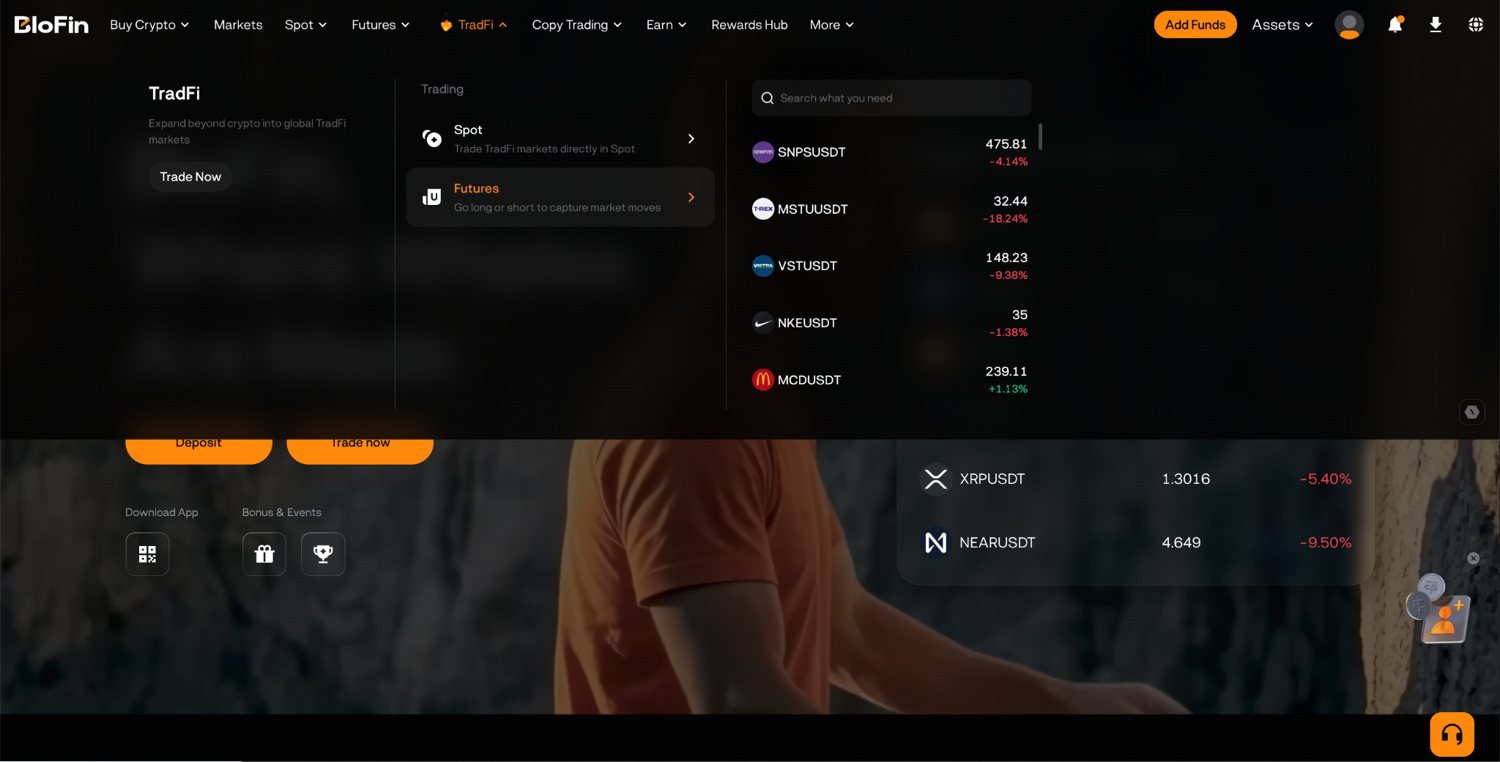
Step 1: From the BloFin homepage, hover your cursor over the TradFi tab and click on Futures.
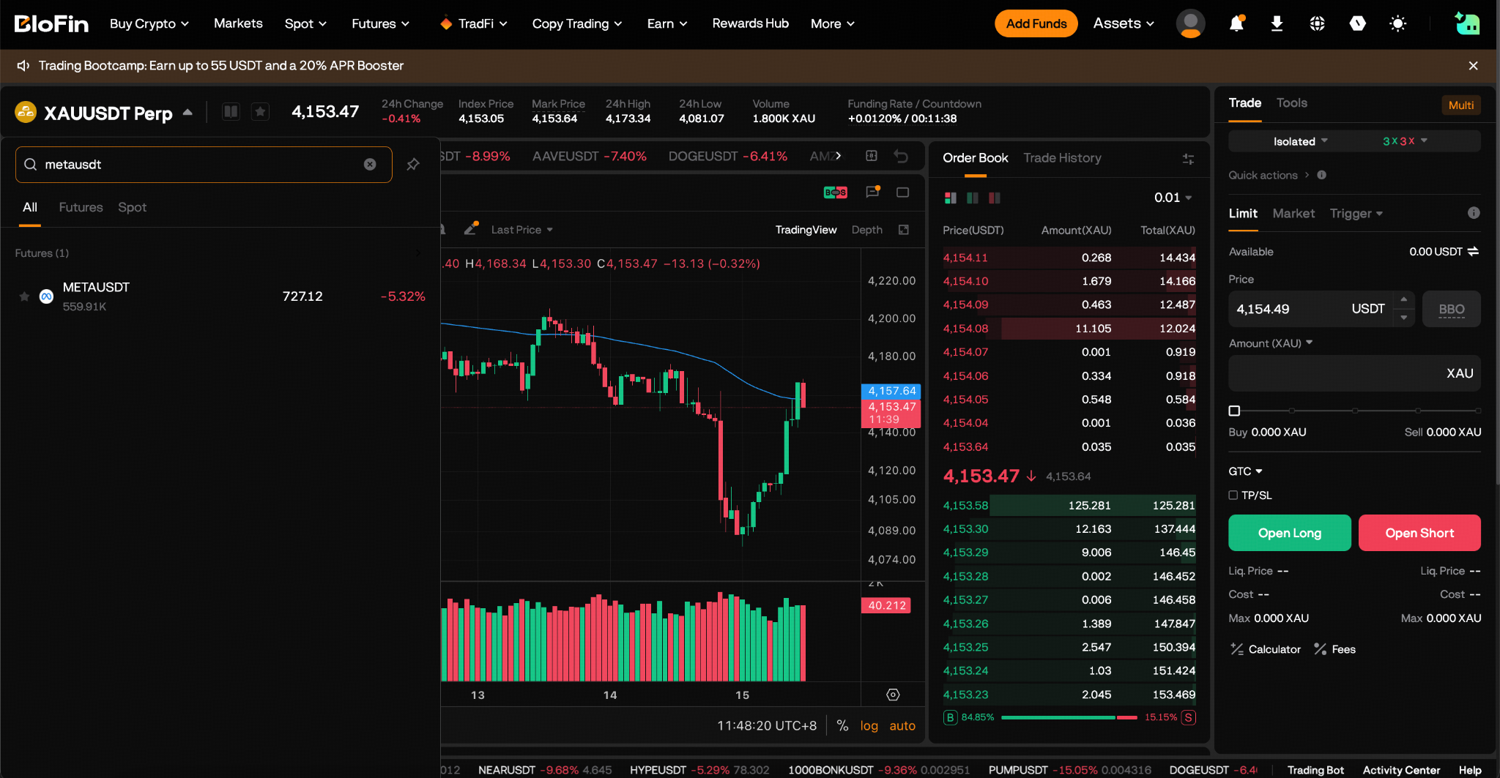
Step 2: Click on the XAUTUSDT pair on the top left corner of the page and a pop-up window will appear. Search for METAUSDT in the search field and select it.
Step 3: At the top of the order panel on the right side of the page, click Cross to open Margin Mode and choose Isolated. Isolated margin keeps the money behind this short separate, so the most it can lose is the margin you assign. Cross margin lets the position draw on your whole futures balance.
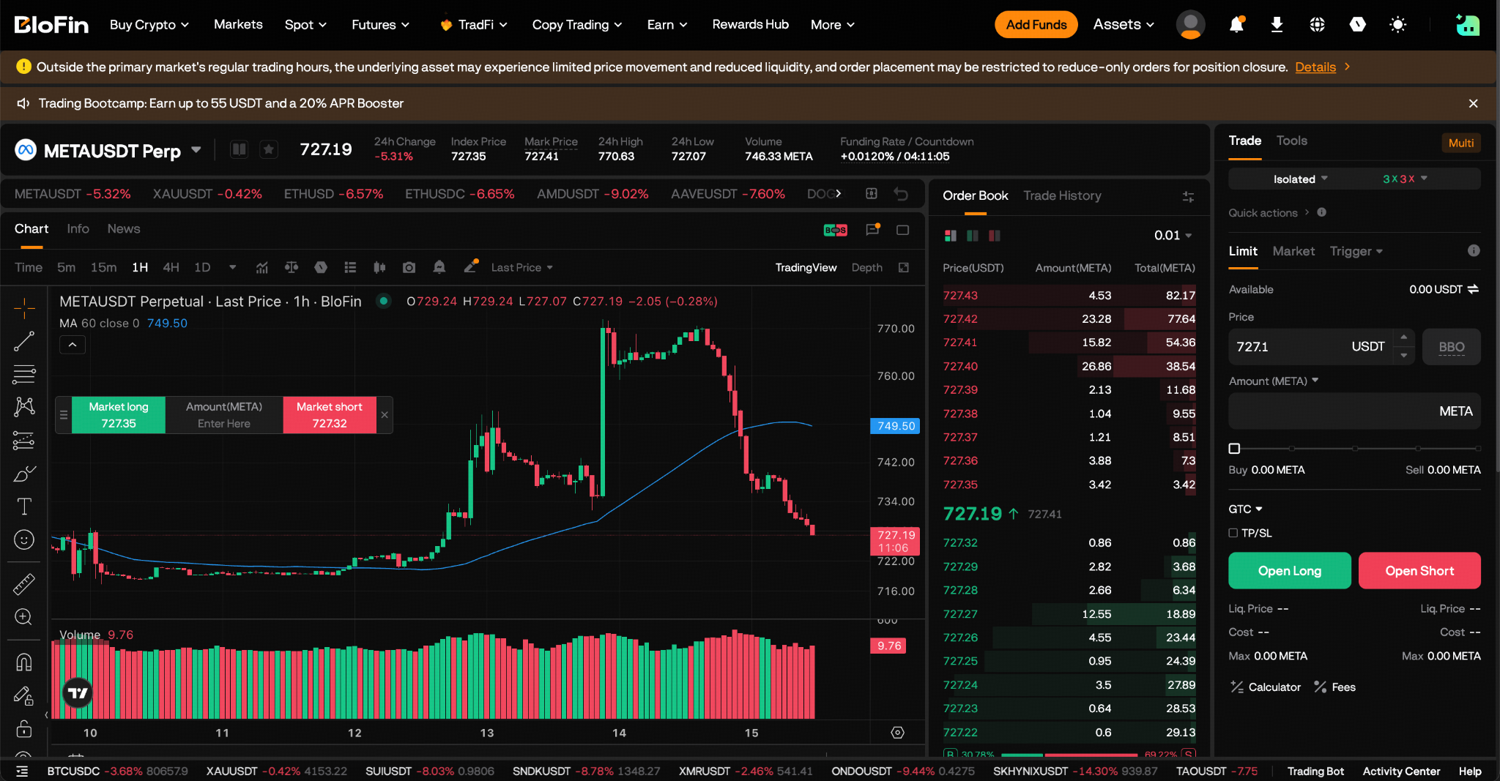
Step 4: Click the leverage figure beside it, such as 3x, and pick your leverage. The contract allows 1x to 20x, and the lower you go, the further above your entry the liquidation price sits (source: BloFin METAUSDT contract details).
Step 5: Choose the order type: Limit to name your own price, Market to fill at once at the best bid, or Trigger to send the order only when the price reaches a level you set. With Limit, type your selling price under Price, or press BBO to use the best price on the book.
Step 6: Enter the size under Amount (META). Each contract is 0.01 META, so a 1 META short is 100 contracts.
Step 7: Make sure Reduce-only is unticked, because a reduce-only order can shrink a position you hold but never opens a new short.
Step 8: With a Limit order, tick TP/SL to attach a take-profit and a stop-loss before you send it, so the exit plan is in place the moment the short opens. A Market order cannot carry them, so add them from the Positions tab as soon as it fills.
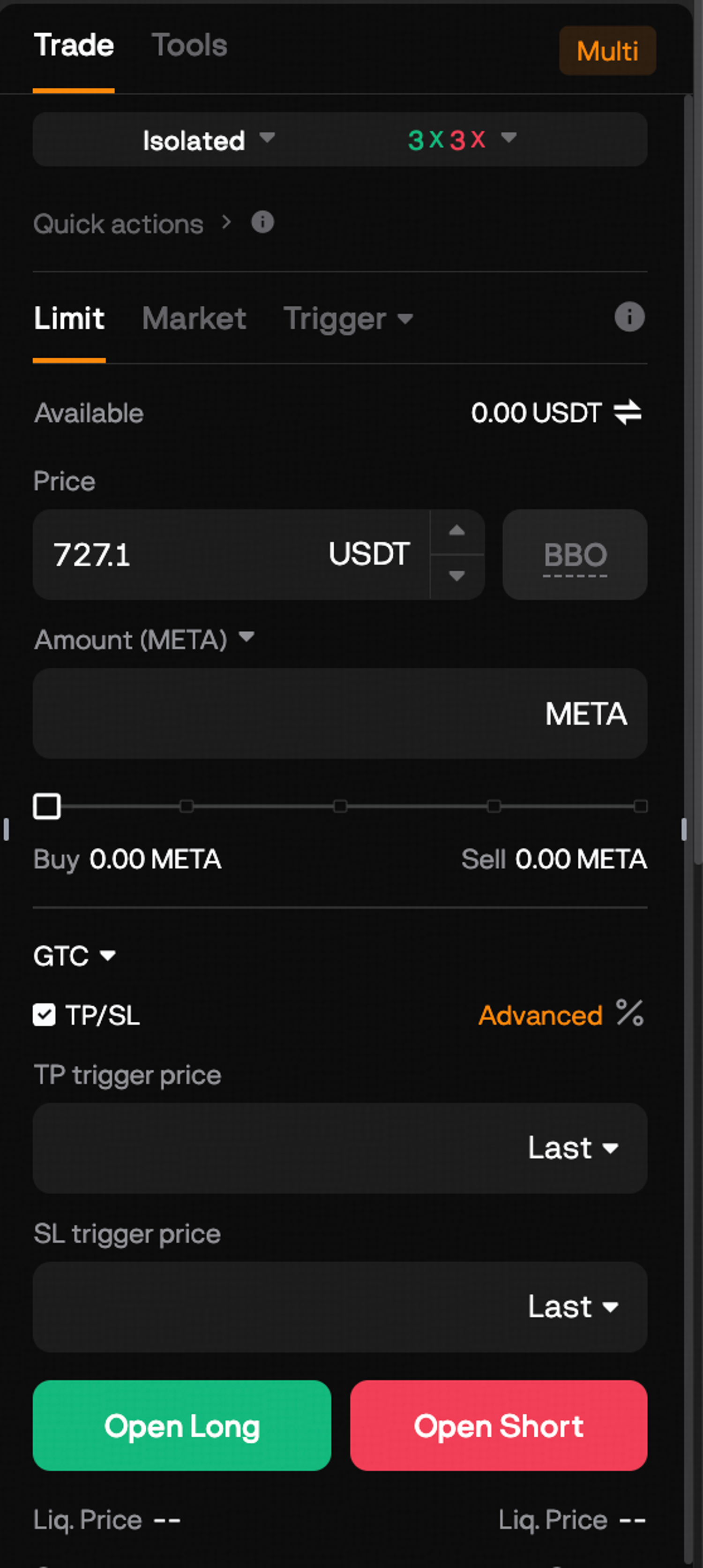
Step 9: Check Liq. Price and Cost under the buttons, then press the sell button to open the short. It appears in the Positions tab with its entry price, size, margin and estimated liquidation price.
Say you short 1 META at 731.09 USDT with 3x leverage in isolated margin. The position is worth 731.09 USDT, so the margin is about 243.70 USDT. BloFin's formula for an isolated short puts its liquidation near 950.46 USDT, a rise of about 30.0% (source: BloFin liquidation price FAQ). A market order pays the 0.06% taker fee, about 0.44 USDT to open, and a limit order that rests on the book first pays 0.02%, about 0.15 USDT.
Leverage only changes how much margin you post. The same 1 META short gains or loses the same USDT for every dollar Meta moves, at 2x or at 20x, and what changes is how small a rise it takes to close you out. Choosing that distance is the main decision in trading Meta with leverage.
The live mark price, funding rate and countdown to the next settlement are on the METAUSDT Perpetual trading page, beside the METAX/USDT Spot price of the token.
Take-profit and stop-loss on a Meta short
On a Meta short, the take-profit sits under your entry price and the stop-loss sits over it, the reverse of a long. Both are orders that wait for a trigger price. When the trigger is hit, BloFin closes the position with a market order unless you tick Limit, which sends a limit order at a price you choose.
Step 1: With TP/SL ticked on a limit order, enter the stop-loss trigger above your entry and the take-profit trigger below it. They become active once the entry order fills, and if one fires the other is canceled.
Step 2: Choose what the trigger watches: Last Price, the latest trade, or Mark Price, the smoother reference price BloFin uses for liquidation. A single large trade can jolt the last price for a moment while the mark price barely moves, which is the gap between mark price and last price.
Step 3: To add or move the orders on a short that is already open, go to the Positions tab and click TP/SL beside it. Choose Entire Position to close all of it at the trigger, or Partial Position to close part.
A stop on the mark price is the safer pairing for a leveraged short, because liquidation also runs on the mark price. Place it above your entry but below your estimated liquidation price, so the stop fires first and you choose the loss before BloFin's liquidation engine does. On the 3x example, a stop at 767.64 USDT, 5% over the 731.09 entry, would cost about 36.55 USDT before fees.
A stop is a trigger, and a trigger cannot promise a fill at its price. When Meta's price jumps past your level in one move, a market stop fills at the next price available, which can be well above the trigger. A limit stop caps the price you will pay but may never fill in that kind of move, the trade-off at the heart of setting a stop-loss on BloFin.
Funding on a Meta short
Funding settles between long and short positions every eight hours by default, at 12AM, 8AM and 4PM UTC, and more often when BloFin shortens the interval in a fast market. A positive rate means longs pay shorts, so a Meta short collects it, and a negative rate means the short pays. The rate stood at +0.0120% in mid-October 2026, so shorts were being paid.
You pay or receive the rate on the whole value of the position, so leverage leaves the amount unchanged. Close the short before a settlement and that settlement skips you (source: BloFin funding FAQ). At a mark price of 731.28 USDT, a 1 META short at +0.0120% receives about 0.088 USDT per settlement, or roughly 0.26 USDT a day.
That small credit is the one structural edge a short can have, and it can turn. Across the 45 settlements from 12AM UTC on September 25 to 4PM UTC on October 9, 2026, 32 rates were positive and 13 were negative (source: BloFin METAUSDT funding history). The first two in that run were −0.0120%, so a short opened on September 24 paid before it began to receive.
Funding also moves with the crowd. A high positive rate means the contract has been trading above its index, with buyers paying to stay long, and a negative rate means it has been trading below. That premium over the index is what crypto funding rates are built from, which is why the sign can flip within a day.
A Meta short through the post-Muse pullback
Meta's shares rose to $777.59 on September 24, 2026, weeks after the launch of its Muse AI agent. They then slipped to $718.67 by October 9, a fall of 7.58% worked out from the two closes (source: Stock Analysis price history). A 1 META short opened on BloFin at that September close would have earned about 59 USDT.
On BloFin, the METAUSDT Perpetual last traded at 777.91 USDT at 8PM UTC on September 24, the moment Nasdaq closed. At 8PM UTC on October 9 it traded at 719.40 USDT. Here is the short worked out with real fees and the 45 real funding settlements in between.
Part of the result | Calculation | USDT |
|---|---|---|
Price gain | (777.91 − 719.40) × 1 META | +58.51 |
Opening fee | 0.06% taker fee on 777.91 | −0.47 |
Closing fee | 0.06% taker fee on 719.40 | −0.43 |
Funding | 45 settlements adding up to +0.1999%, received by the short | about +1.45 |
Net result | price gain, minus fees, plus funding | about +59.06 |
The price did nearly all the work, and funding added about 1.45 USDT because most rates in that stretch were positive. Leverage changed only the percentage. At 5x the margin was 155.58 USDT, a return of about 38.0%, and at 2x it was 388.95 USDT, about 15.2%.
The short was nearly wrong at the start. On September 25 the last price touched 781.25 USDT, about 0.43% over the entry, before the slide began. At 20x, a rise of about 2.4% would have closed the position, so the trade survived only because the next move was down. Picking the top this closely is rare, and a short opened a week too early met a very different week.
Squeeze and gap risk on a Meta short
A short squeeze is a rapid climb that pushes short sellers to close by buying, and their buying lifts the price further. On a Meta perpetual, the forced buyer is the liquidation engine, which closes a short once the mark price reaches its liquidation price. Meta's jump of September 21, 2026 shows how fast that can happen.
Say you shorted 1 META at 666.10 USDT, the last price at 8PM UTC on Friday, September 18, in isolated margin. On Monday, September 21, Meta's stock jumped about 11.4% to close at $741.25, a rise The Next Web tied to investor bets on Muse (source: The Next Web). These estimates use tier 1's 2.50% maintenance margin and BloFin's hourly last prices (source: BloFin METAUSDT position tiers).
Leverage | Margin (USDT) | Estimated liquidation | Rise needed | When the last price reached it |
|---|---|---|---|---|
20x | 33.31 | 681.95 USDT | about 2.4% | about 5AM UTC on Monday, September 21, before Nasdaq opened |
10x | 66.61 | 714.42 USDT | about 7.3% | in the 2PM UTC hour on September 21, after the open |
5x | 133.22 | 779.37 USDT | about 17.0% | late in the US session on September 24, as the price neared 780 |
3x | 222.03 | 865.96 USDT | about 30.0% | never; the 781.25 peak took about 51.9% of the margin |
The 20x short ended before the US session even began, at about 1AM ET on a Monday. Its loss stopped at the 33.31 USDT of margin, because an isolated position cannot lose more than that. Mark and last prices differ slightly, so each crossing time is approximate to the hour.
Funding made it worse. From 12AM UTC on September 19 to 4PM UTC on September 21, the 13 settlements, including four hourly ones on the Sunday evening, added up to −0.1225%. A 1 META short still open at 4PM UTC on September 21 paid about 0.82 USDT for the privilege of being wrong.
Earnings bring the same risk in a single night. Meta reported its fourth-quarter 2023 results after the close on February 1, 2024, along with its first dividend and a $50 billion increase in its buyback plan (source: Meta Q4 2023 results). The next morning the stock opened at $459.60 against a $394.78 close, a gap of about 16.4% that no stop could trade through (source: Yahoo Finance).
Meta will release its third-quarter 2026 results after the 4PM ET close on Wednesday, October 21, 2026 (source: Meta third-quarter 2026 date notice) (source: Stock Analysis META overview). The biggest move can therefore come before the next session opens. A results night is worth planning hour by hour, as in trading Meta around earnings, and so is a weekend, when price gaps while Nasdaq is closed can open against a short.
Dividends and the ex-dividend date on a Meta short
A Meta short on BloFin owes no dividend, because BloFin's stock futures give no entitlement to dividends. A broker short is different: the borrower pays each dividend to the lender. Meta pays $0.525 a share every quarter, and its most recent ex-dividend date, September 21, 2026, fell on the day of the Muse jump.
Meta's board declared that dividend on September 10, 2026, payable on September 28 to holders of record on September 21 (source: Meta dividend announcement). BloFin's stock futures notice says the contracts do not entitle you to any dividends, interest or voting rights (source: BloFin stock futures notice). The perpetual short skips the payment that a broker short would have owed.
The amounts are small next to Meta's daily moves. The $0.525 dividend (source: Meta dividend announcement) was about 0.08% of the 666.10 USDT entry in the squeeze example, while the price rose about 11% the same day. A broker short of 100 shares would have owed the lender $52.50 on top of its loss from that rise.
Meta's ex-dividend dates in 2025 and 2026 fell in mid-March, mid-June, mid-to-late September and mid-December, always at $0.525 (source: Stock Analysis dividend history). Whether METAX pays Meta's dividend sets out how the tokenized share handles those same dates.
Meta short interest
Short interest counts the Meta shares that investors have sold short and still have to buy back: 33,572,792 at the September 30, 2026 settlement, with 1.25 days to cover (source: Nasdaq, META short interest). That works out to about 1.52% of the 2,205,128,509 Class A shares Meta reported outstanding on July 24, 2026 (source: Meta Form 10-Q, Q2 2026).
Short interest rose through the Muse rally and the pullback that followed, up about 16.5% from August 31 to September 30 (source: Nasdaq, META short interest).
Settlement date | Meta shares sold short | Days to cover |
|---|---|---|
July 31, 2026 | 31,458,758 | 1.84 |
August 14, 2026 | 28,048,106 | 1.94 |
August 31, 2026 | 28,807,174 | 1.71 |
September 15, 2026 | 30,990,107 | 1.57 |
September 30, 2026 | 33,572,792 | 1.25 |
Days to cover divides that total by Meta's average daily volume, which Nasdaq put at 26,851,312 shares for the late-September period (source: Nasdaq, META short interest). That ratio estimates how many average trading days it would take all short sellers to buy back their shares. The figure also arrives late. FINRA collects short positions from its member firms twice a month and publishes the data seven business days after each settlement date (source: FINRA, Equity Short Interest), so the September 30 reading came out on October 9.
The perpetual's funding sign is the faster read. Short interest counts shares sold short at brokers, while funding shows which side of the METAUSDT Perpetual has been paying in the last eight hours. Neither one tells you when a squeeze will start.
Closing a Meta short
Closing a Meta short means buying back what you sold. Use Close on the position in the Positions tab, or send a buy order of equal size with Reduce-only ticked. Your result is paid in USDT and funding ends with the position, and a closing order is accepted even in the hours when BloFin limits trading to reduce-only orders.
Step 1: Open the Positions tab under the chart and find your METAUSDT short.
Step 2: Click Close and choose Limit to set your buy-back price or Market to exit at once at the best offer.
Step 3: Enter the Price for a limit close and the Amount to close. A smaller amount leaves the rest of the short open at the same entry price.
Step 4: Press Confirm, then check that the position has left Positions and that the result shows in Position History.
A limit close that rests on the book pays the 0.02% maker fee, while a market close pays 0.06%, as the guide to closing a trade on BloFin shows. Close All shuts every open futures position at market prices in one action. After any close, look in Open Orders for a trigger or take-profit order that is still waiting, since a stray buy order there could later open a long you never meant to hold.
A short can also protect Meta shares or METAX you already own, sized to match the holding, and hedging Meta with the perpetual covers that use.
Looking to short Meta on BloFin, or to sell METAX you already hold? To get started, you'll need to first create a BloFin account, fund your account with cryptocurrency, and go to the METAX/USDT Spot trading page or the METAUSDT Perpetual trading page.
Frequently asked questions
Can a 1x Meta short on BloFin be liquidated?
A 1x Meta short on BloFin can still be liquidated, because a short's loss keeps growing as the price climbs. At 1x the margin equals the position's full value, so 1 META shorted at 731.09 USDT posts 731.09 USDT. BloFin's isolated-short formula puts liquidation near 1,425.68 USDT, a rise of about 95.0%, worked out with tier 1's 2.50% maintenance margin and the taker fee (source: BloFin liquidation price FAQ).
Can you open a Meta short on BloFin at the weekend?
BloFin may limit new positions to US regular hours, so weekend orders that would open or add to a short may be refused. The same applies on US market holidays: November 26 and December 25, 2026 have no session, while November 27 and December 24 end early at 6PM UTC (source: BloFin stock futures notice). A short opened on Friday stays open through the weekend and can be closed at any time.
What does Reverse do on a BloFin futures position?
Reverse closes your position and immediately opens one of the same size in the opposite direction, both as market orders. On a Meta short, it turns the short into a long in one step. If your balance cannot cover an equal long, BloFin opens a smaller one, and market order limits apply, so for METAUSDT the most a single market order can carry is 200 META (source: BloFin METAUSDT contract details).
Can a Meta short on BloFin lose more than its margin?
In isolated margin, the most a short can lose is the margin you assigned to it. In cross margin, a rise in Meta can pull in the whole available balance of your futures account, including money set aside for other trades. On an isolated short, Add Margin on the position puts more USDT behind it and moves the liquidation price further from your entry, which is the way to give a short more room without closing it.
How long can you hold a Meta short on BloFin?
A Meta short on BloFin can stay open for as long as you like, because the METAUSDT Perpetual has no expiry date. It closes when you close it, when a take-profit or stop-loss fires, or when it is liquidated. BloFin can change the contract's leverage and order limits without a separate announcement, so check the contract page again before adding to a short held for months (source: BloFin METAUSDT contract details).
Researched and written by the BloFin Academy editorial team with AI-assisted drafting. All facts independently verified. Primary sources include BloFin's METAUSDT contract details, position tiers and funding history, its stock futures notice of April 21, 2026, and its help center articles on hedge mode, funding and liquidation price. They also include Meta's dividend announcement of September 10, 2026, its third-quarter 2026 date notice, its fourth-quarter 2023 results release and its Form 10-Q for the second quarter of 2026; Nasdaq's META short-interest data; FINRA's equity short interest rules; the SEC's Investor.gov bulletin on short sales; Stock Analysis and Yahoo Finance price history; and The Next Web, current as of October 12, 2026.
Nothing in this article constitutes financial advice, and nothing in it is a recommendation to buy, sell or hold Meta in any form. A short on the METAUSDT Perpetual loses money when Meta rises, and on September 21, 2026 a rise of about 2.4% was enough to liquidate a 20x short before Nasdaq opened. Results and news can move the price by double digits in hours when BloFin may accept only orders that reduce a position, a stop can fill well past its trigger in a gap, and funding can cost a short money at every settlement. Past performance does not indicate future results. Do your own research and consider your risk tolerance before you trade on BloFin.