
Some exchange-traded funds aim for twice the daily move of a single stock. They build that exposure with swaps and rebuild it at every market close, so the target covers one trading day at a time. Held for weeks while the stock swings up and down, such a fund can end up well short of twice the stock's change.
That gap grows with the size of the swings, and it grows again when you add leverage of your own. A leveraged futures position on one of these funds stacks two kinds of leverage. The fund's resets every day, while yours stays at the size you opened until you change it.
Strategy (formerly MicroStrategy), the bitcoin-holding company that trades on Nasdaq as MSTR, is the stock behind several funds like this, issued by other companies. BloFin lists two perpetual futures around it: the MSTUUSDT Perpetual, which tracks a 2x MSTR fund, and the MSTRUSDT Perpetual, on the share price itself.
The weekend of November 14 to 15, 2026 showed how far apart the two can run. With US markets shut, the MSTUUSDT Perpetual traded as low as 14.10 USDT, 26.4% under the fund's $19.15 close on Friday, November 13. The MSTRUSDT Perpetual bottomed at 95.72 USDT, 14.2% under MSTR's $111.62 Friday close, so it fell about half as far (source: BloFin MSTUUSDT and MSTRUSDT market data, Nasdaq MSTU historical data, Nasdaq MSTR historical data).
What is the difference between the MSTU perpetual and the MSTR perpetual?
The MSTU perpetual, BloFin's MSTUUSDT Perpetual, follows the price of MSTU, a fund that resets to twice MSTR's daily move at each trading-day close. The MSTRUSDT Perpetual follows the share price of Strategy directly, and any leverage on it comes from the setting you choose. Both settle in USDT, carry funding payments and can be liquidated.
MSTU's full name, T-Rex 2X Long MSTR Daily Target ETF, comes from its sponsors, REX Shares and Tuttle Capital Management. It lists on Cboe BZX, while MSTR itself trades on Nasdaq. Each trading day the fund aims to return twice MSTR's percentage move, before its own fees and costs, and it sets that target for one day at a time only (source: REX Shares, MSTU).
BloFin added the MSTUUSDT Perpetual at 11.30AM UTC on October 12, 2026. Each contract is worth 0.1 MSTU, and leverage runs from 1x to 20x (source: BloFin MSTU listing notice).
Feature | MSTUUSDT Perpetual | MSTRUSDT Perpetual |
|---|---|---|
Price it follows | MSTU, a 2x daily MSTR fund on Cboe BZX | MSTR, Strategy's Class A shares on Nasdaq |
Contract size and smallest order | 0.1 MSTU | 0.01 MSTR |
Leverage you can set | 1x to 20x | 1x to 20x |
One-day MSTR exposure at 1x | About 2x, from the fund | 1x |
Daily reset | Inside the fund, at each US close | None |
Funding | Normally every eight hours, capped at 3% either way | Normally every eight hours, capped at 3% either way |
Largest limit and market order | 55,000 and 20,000 MSTU | 7,000 and 700 MSTR |
Outside regular US hours | May be limited to reduce-only orders | May be limited to reduce-only orders |
Only the fund inside MSTU resets. The MSTUUSDT Perpetual keeps the number of contracts you opened, and each MSTU behind them carries whatever MSTR exposure the fund rebuilt at the last close. Both perpetuals settle funding payments normally three times a day, at 8AM, 4PM and 12AM UTC. Each funding rate on the two contracts has a 3% limit, positive or negative, per period (source: BloFin MSTU contract details, BloFin MSTR contract details, BloFin MSTUUSDT and MSTRUSDT market data).
Liquidation works the same way on both contracts. BloFin starts to liquidate a position once its mark price reaches the liquidation level (source: BloFin forced liquidation rules). Funding and liquidation are what set either perpetual apart from the fund's own shares, which carry neither. Between the two contracts, the real difference is where the leverage lives and how often it is rebuilt. On BloFin, both are margined in USDT, so one balance can back a position on the MSTUUSDT Perpetual or the MSTRUSDT Perpetual.
How MSTU's daily 2x reset works
MSTU's daily reset means the fund rebuilds its exposure at every close, so each dollar in it carries about two dollars of MSTR exposure for the next trading day. On Monday, November 16, 2026, MSTR closed 7.70% below its Friday close. MSTU closed 15.46% lower, 2.01 times the stock's one-day move (source: Nasdaq MSTR historical data, REX Shares, MSTU).
FINRA describes most leveraged and inverse funds this way. Their stated multiple applies to a single trading day, generally from one close to the next. Holding them for a shorter or longer period can give results that differ a lot from that multiple (source: FINRA on leveraged and inverse ETPs). MSTU gets its exposure through total return swaps on MSTR, backed by cash, according to the holdings list REX published for November 16, 2026 (source: REX Shares, MSTU).
The reset is easiest to see with round numbers. Say the fund holds $100 and carries $200 of MSTR exposure. If MSTR rises 10% in a session, the exposure grows to $220 and the fund to $120. To get back to twice its value, the fund adds $20 of exposure. If MSTR falls 10% instead, the exposure drops to $180 and the fund to $80, so it cuts $20 of exposure and ends at $160. The fund buys after rises and sells after falls, every day.
Costs come on top, starting with the fund's yearly expense ratio. REX warns that each 1% daily fall in MSTR cuts the fund by 2% before the cost of financing its leverage, which lowers its value further (source: REX Shares, MSTU). On the MSTUUSDT Perpetual, the fund's costs reach you through the price the contract follows. Funding is a separate payment between longs and shorts.

Why a 2x fund decays in a choppy market
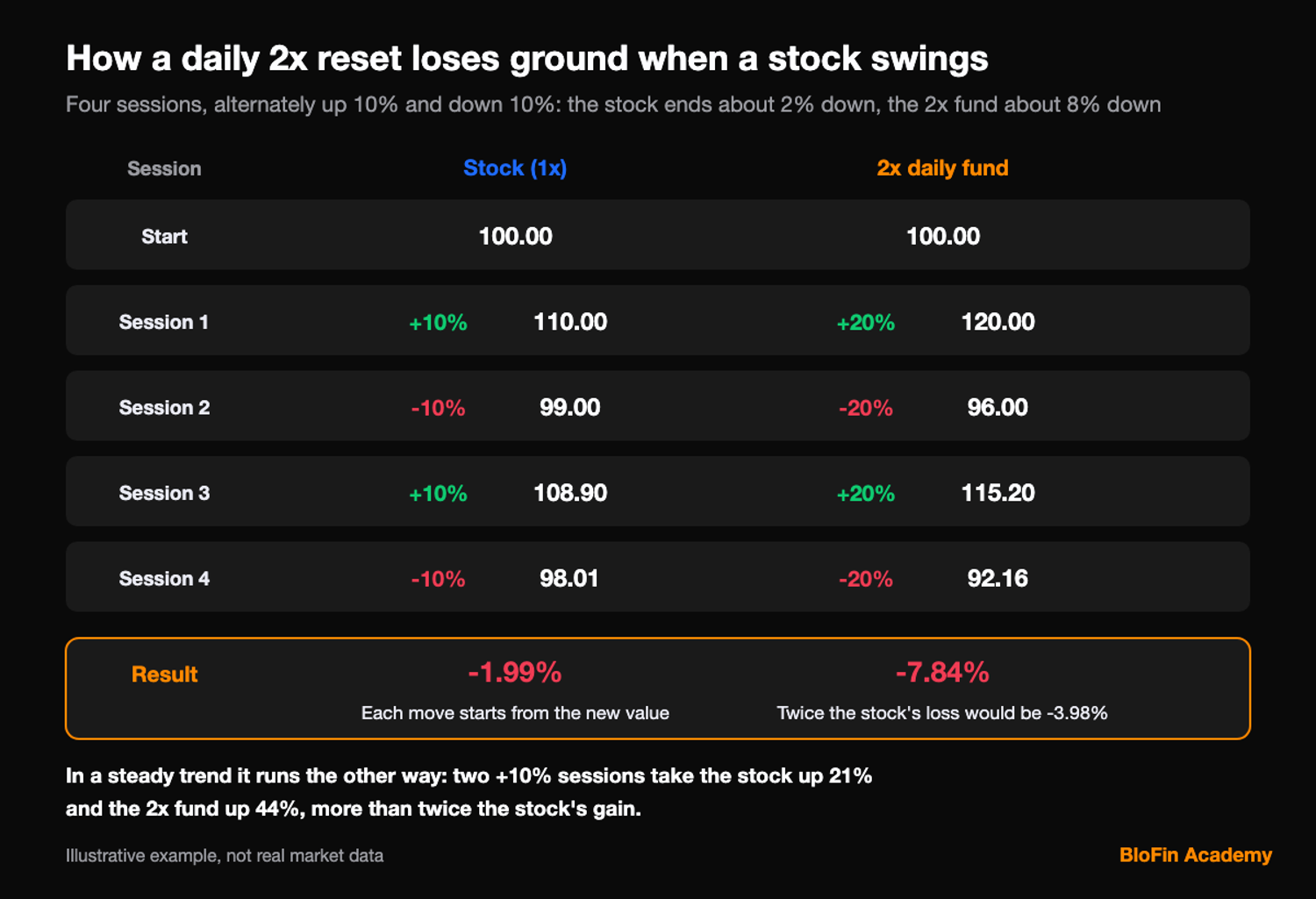
A daily 2x fund decays in a choppy market because each day's percentage move starts from a new value. If a stock rises 10% and then falls 10%, it ends 1% down. A fund that doubles each day's move ends 4% down, which is twice the loss you would get by simply doubling the stock's 1%.
Traders call this effect volatility decay. Over four sessions that alternate between rises and falls, the gap widens. The figures are an illustrative example, not real market data:
Session | Stock move | Stock value | 2x fund move | 2x fund value |
|---|---|---|---|---|
Start | 100.00 | 100.00 | ||
1 | +10% | 110.00 | +20% | 120.00 |
2 | −10% | 99.00 | −20% | 96.00 |
3 | +10% | 108.90 | +20% | 115.20 |
4 | −10% | 98.01 | −20% | 92.16 |
The stock finishes 1.99% down and the fund 7.84% down, nearly four times the stock's loss. Twice the stock's move would only be 3.98%. In a steady trend the effect runs the other way: two straight 10% rises lift the stock 21% and the fund 44%, more than twice the stock's gain. A 2x daily fund does best when its stock keeps moving one way and worst when it swings back and forth.
MSTU's record since its latest reverse split shows the same pattern with real prices. From August 24, 2026, the fund's prices were quoted after the split, so its closes from that day on compare directly with MSTR's (source: REX Shares, August 2026 reverse splits).
Nasdaq close | MSTR | MSTU |
|---|---|---|
August 24, 2026 | $122.63 | $28.86 |
November 13, 2026 | $111.62 | $19.15 |
November 16, 2026 | $103.03 | $16.19 |
From August 24 to November 16, MSTR fell 15.98%, and twice that is 31.97%. MSTU fell 43.90% over the same 59 sessions (source: Nasdaq MSTR historical data, Nasdaq MSTU historical data). A fund that had made exactly twice MSTR's move in every one of those sessions would have fallen 40.20%. Most of the gap therefore comes from compounding through a choppy run, in which MSTR climbed about 37% above its August 24 close by September 21 and then slid back. The last 3.7 points or so, the difference between MSTU and an exact 2x, include the fund's costs.
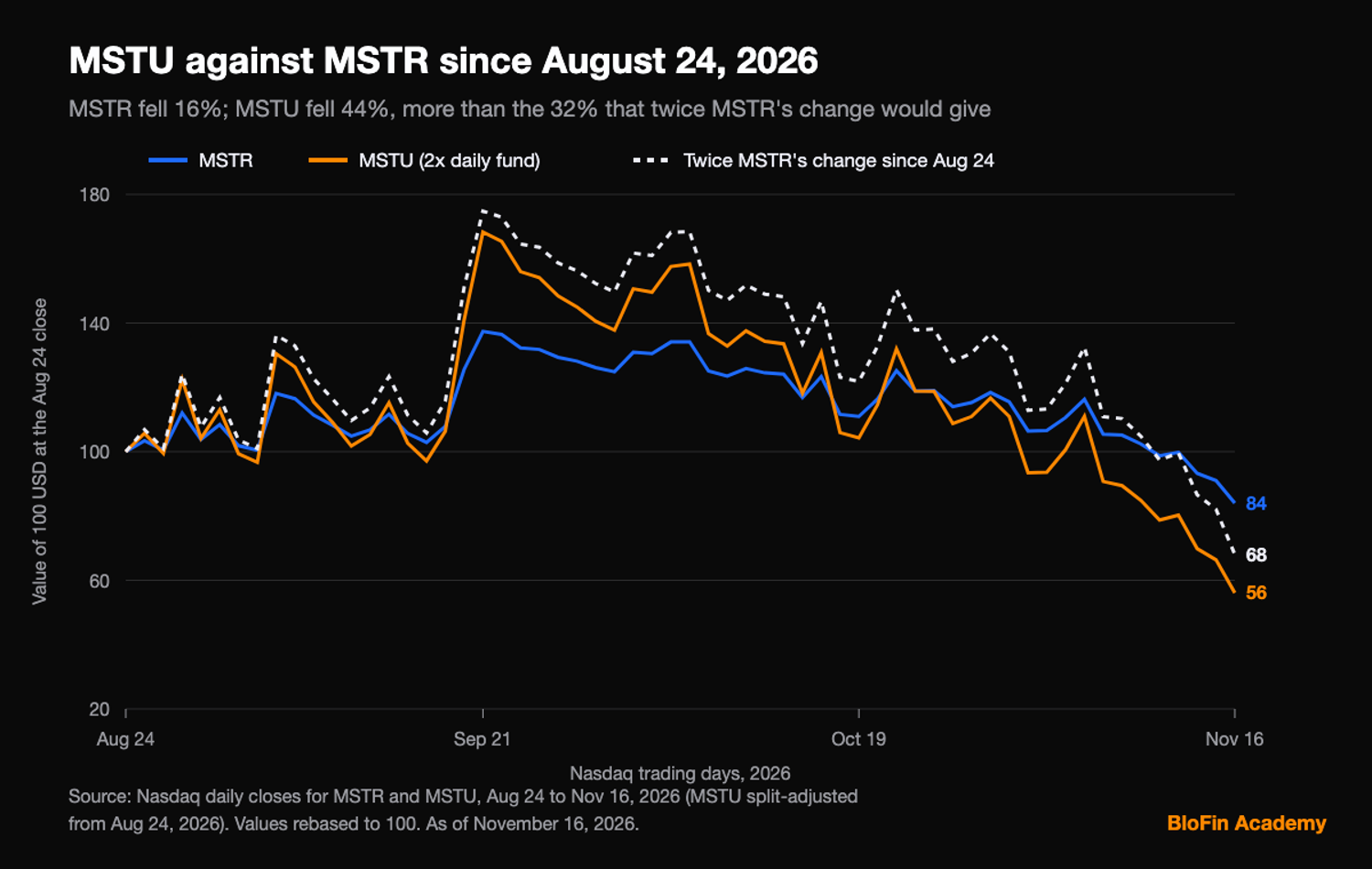
The MSTUUSDT Perpetual carries all of this with it, because the price it follows is MSTU's. A long held on it for weeks holds the fund's compounding as well as your own leverage, and that compounding is the main thing a position on MSTRUSDT leaves out.
Leverage on top of the fund's own 2x
Leverage on the MSTUUSDT Perpetual multiplies a fund that is already 2x, so 5x on MSTUUSDT carries about 10x one-day MSTR exposure and 10x carries about 20x. At 10x, a 5% MSTR fall in one session takes MSTU down about 10% and would wipe out the whole margin. In isolated margin, liquidation comes before that point.
Say you post 100 USDT. At 2x, 5x and 10x on MSTUUSDT, that opens MSTU positions worth 200, 500 and 1,000 USDT. Until the next close, they carry about 400, 1,000 and 2,000 USDT of MSTR exposure. If MSTR then falls 5% within the session, MSTU falls about 10%, and you lose about 20, 50 and 100 USDT. The same 100 USDT on MSTRUSDT at 4x, 10x and 20x opens positions of 400, 1,000 and 2,000 USDT, and the same 5% fall costs the same 20, 50 and 100 USDT.
Forced liquidation sets the real limit. In isolated margin, a long is liquidated once the margin left after its loss falls to the maintenance margin, the minimum a position must keep. For the first position tier of both contracts, that minimum is 2.50% of the position's value (source: BloFin MSTR position tiers, BloFin MSTU position tiers). From that rate you can estimate where an isolated long is closed. The estimate leaves out fees and funding.
Estimated liquidation price of an isolated long = entry price × (1 − 1 ÷ leverage) ÷ (1 − 0.025)
Leverage on MSTUUSDT | One-day MSTR exposure | MSTU fall to liquidation | MSTR one-day fall behind it | MSTRUSDT leverage for the same exposure | MSTR fall to liquidation on MSTRUSDT |
|---|---|---|---|---|---|
2x | About 4x | 48.72% | About 24.4% | 4x | 23.08% |
5x | About 10x | 17.95% | About 9.0% | 10x | 7.69% |
10x | About 20x | 7.69% | About 3.8% | 20x | 2.56% |
At equal one-day exposure, the MSTU route leaves a little more room. The 2.50% minimum applies to the MSTU position, which is half the size of the MSTR exposure it carries. That edge lasts only until the next close, when the fund resets, and it fades over several sessions of swings. The same multiplication also goes further than MSTRUSDT can: 20x on MSTUUSDT carries about 40x one-day MSTR exposure, and an isolated long there is closed after an MSTR fall of roughly 1.3%. A short is the mirror case, with a slightly shorter distance to liquidation.
Position tiers are much tighter on MSTUUSDT. Its 20x tier covers only the first 100 MSTU. Above that, the maximum drops to 10x with a 5.00% maintenance margin up to 200 MSTU, then to 5x with 10.00% up to 1,000 MSTU (source: BloFin MSTU position tiers). At the 14.89 USDT mark price at about 5.15PM UTC on November 17, 2026, the first tier ends near a 1,489 USDT position. MSTRUSDT's first tier runs to 600 MSTR, about 58,608 USDT at its 97.68 USDT mark around 3.50PM UTC that day (source: BloFin MSTU contract details, BloFin MSTR contract details).
In cross margin, the room changes with everything else you hold, because all of your futures balance stands behind each position.
Liquidity and order limits on the two perpetuals
The MSTRUSDT Perpetual is far busier than the MSTUUSDT Perpetual. On the afternoon of November 17, 2026, MSTRUSDT's open interest was worth about 2.59 million USDT. Its 24-hour volume was about 364,000 USDT, against about 75,600 USDT of open interest and 9,460 USDT of volume on MSTUUSDT, each valued at that contract's last price.
Measure | MSTUUSDT Perpetual | MSTRUSDT Perpetual |
|---|---|---|
Largest limit order | 55,000 MSTU, about 818,950 USDT | 7,000 MSTR, about 683,760 USDT |
Largest market order | 20,000 MSTU, about 297,800 USDT | 700 MSTR, about 68,376 USDT |
Smallest order | 0.1 MSTU, about 1.49 USDT | 0.01 MSTR, about 0.98 USDT |
Open interest | 5,086.2 MSTU, about 75,581 USDT | 26,510.44 MSTR, about 2,587,949 USDT |
24-hour volume | 636.6 MSTU, about 9,460 USDT | 3,732.39 MSTR, about 364,356 USDT |
Insurance fund | 5,145.50 USDT | 35,255.85 USDT |
The USDT values of the order limits use mark prices of 14.89 USDT for MSTUUSDT and 97.68 USDT for MSTRUSDT, and the insurance fund balances date from about 5.15PM UTC for MSTUUSDT and 3.50PM UTC for MSTRUSDT. Open interest and volume date from about 5.17PM UTC for MSTUUSDT and 3.55PM UTC for MSTRUSDT, at last prices of 14.86 and 97.62 USDT (source: BloFin MSTU contract details, BloFin MSTR contract details, BloFin MSTUUSDT and MSTRUSDT market data). In dollar terms, MSTUUSDT accepts the larger single market order, even though its open interest is about a thirty-fourth of MSTRUSDT's.
An order cap is the most BloFin accepts in one order. How much of that order fills near the last price depends on the order book at the time. On a contract trading about 9,460 USDT a day, a large market order can move the price a long way. BloFin says it may adjust these limits to market conditions without announcing each change, so the contract page is where to check the ones in force (source: BloFin MSTU contract details).
Before you size a position on MSTUUSDT, the MSTUUSDT trading page shows where it trades now against MSTU's last close.
MSTU and MSTR perpetuals over the weekend
Over a weekend, MSTU stays where Friday's close left it, because the fund resets only when a trading day ends. Any MSTR move between Friday and Monday reaches MSTU's Monday close at about twice the size. Outside regular US hours, BloFin warns that either contract may be limited to reduce-only orders.
Regular Nasdaq hours for MSTR run 9.30AM to 4PM ET. In UTC, the window is 2.30PM to 9PM in standard-time months and 1.30PM to 8PM in daylight-saving months. For evenings, weekends and public holidays, the notice BloFin published for its stock futures warns that order entry "may be limited to reduce-only orders" (source: BloFin stock futures notice). The MSTU listing notice gives the contract's hours as 24/7. It warns that when the fund's home market is closed, new orders can be held to reduce-only for closing positions, and that the price index freezes at its last value when no outside prices come in (source: BloFin MSTU listing notice).
The candles from November 14 to 15, 2026 show the 2x pattern with no reset. MSTUUSDT's low of 14.10 USDT came in the four-hour bar that opened at 12AM UTC on Sunday, November 15, 26.37% under the fund's $19.15 Friday close. MSTRUSDT's low of 95.72 USDT came in the bar that opened at 8PM UTC on Saturday, 14.24% under MSTR's $111.62 Friday close. MSTUUSDT fell 1.85 times as far (source: BloFin MSTUUSDT and MSTRUSDT market data, Nasdaq MSTU historical data, Nasdaq MSTR historical data).
By Monday's close, the fund had moved 2.01 times MSTR's one-day fall, 15.46% against 7.70%. Both weekend lows sat below where Monday ended, 12.9% under MSTU's $16.19 close and 7.1% under MSTR's $103.03 close. A 26.37% fall is larger than the estimated distance to liquidation of a 5x or a 10x isolated long on MSTUUSDT. MSTRUSDT's 14.24% fall is larger than the 10x distance and smaller than the 5x one.
The candles show that trades printed at those prices through the weekend gap. Whether new positions could be opened at the time the candles cannot show, because the notice says only that opening orders may be limited.
MSTU's swap limits and reverse splits
MSTU has twice cut its share count with a 1-for-10 reverse split, after the close on December 2, 2025 and again after the close on August 21, 2026. So 1,000 shares became 100, then 10. Each split raised the share price tenfold, and each holder's total stayed the same apart from fractions paid out in cash.
REX announced the first split on November 25, 2025, and the fund began trading on its new basis on December 3, 2025 (source: REX Shares, December 2025 reverse split). The second came on August 4, 2026, alongside splits in six other T-REX funds. Its release shows the effect with 10,000 shares at a hypothetical $1.00 turning into 1,000 shares at $10.00 (source: REX Shares, August 2026 reverse splits).
The MSTUUSDT Perpetual listed in October 2026, after both splits, so no position on it has yet been through one. BloFin's MSTU listing notice covers events that could move the underlying price sharply, naming stock splits, reverse splits, mergers and spinoffs. BloFin says each such event gets its own market notice explaining how the contract will treat it (source: BloFin MSTU listing notice). A future MSTU split would therefore come with its own notice for the contract.
The fund's leverage also depends on banks and brokers willing to write its swaps. In November 2024, two months after MSTU launched, Bloomberg reported that its manager needed about $100 million of swap exposure while prime brokers offered about $20 million. The manager turned to call options to keep the fund running. Defiance's rival 2x fund, MSTX, hit similar limits and also turned to options, TipRanks reported on November 22, 2024 (source: TipRanks, citing Bloomberg).
Who each perpetual fits
The MSTUUSDT Perpetual fits a view on MSTR that plays out within a session or two, because the fund's 2x holds for one trading day at a time and decays when the stock chops around. The MSTRUSDT Perpetual fits a view held across many sessions, because its exposure stays at the MSTR you opened, with leverage you set yourself.
Size points the same way. A position above about 1,489 USDT on MSTUUSDT leaves the 20x tier, while MSTRUSDT keeps its first tier to roughly 58,600 USDT and trades about 38 times the daily volume. Costs differ in kind. MSTUUSDT follows a price that already carries the fund's yearly expense ratio, its financing and its decay, and both contracts add funding while you hold.
The weekend cuts both ways. MSTUUSDT moved nearly twice as far as MSTRUSDT from November 14 to 15, 2026, which doubles both the gain and the loss for a position held over a Friday close. Whatever leverage you choose multiplies all of this, so know the distance to liquidation at that leverage and how to manage futures risk before you open a position on either contract.
Worried that a leveraged fund perpetual could wipe you out faster than you expect? Both contracts let you set leverage as low as 1x, and the smallest MSTUUSDT order is one contract, a tenth of an MSTU. To get started, you'll need to first create a BloFin account, fund your account with cryptocurrency, and go to the MSTUUSDT Perpetual trading page or the MSTRUSDT Perpetual trading page.

Frequently asked questions
Which other leveraged ETFs track MSTR?
Other US funds also target a daily multiple of MSTR. MSTZ, also from REX Shares, seeks twice the inverse of MSTR's daily move. Defiance runs MSTX, which seeks twice MSTR's daily move, and SMST, which seeks twice its inverse (source: REX Shares, MSTZ, Defiance, MSTX, Defiance, SMST). Of MSTU, MSTZ, MSTX and SMST, only MSTU is listed as a BloFin perpetual (source: BloFin market data).
What is the expense ratio of MSTU?
MSTU's total expense ratio is 1.05% a year, according to its issuer, REX Shares. On an illustrative $10,000 holding, that comes to about $105 a year, taken out of the fund's value with no separate bill (source: REX Shares, MSTU).
What does MSTU hold?
MSTU holds cash and total return swaps on MSTR, contracts that pay the fund MSTR's return on an agreed amount. On November 16, 2026, its holdings list showed cash and cash equivalents worth 216.03% of the fund's net assets, alongside its swap positions on MSTR (source: REX Shares, MSTU). It holds no bitcoin directly, so its link to bitcoin runs through MSTR's share price.
Can MSTU lose all of its value in one day?
REX warns that a move of more than 50% against the fund in one trading day would wipe out what MSTU's investors put in (source: REX Shares, MSTU). At twice the daily move, a 50% fall in MSTR is a 100% fall in the fund. Since MSTU launched in September 2024, MSTR's worst one-day fall from close to close was 17.12%, on February 5, 2026 (source: Nasdaq MSTR historical data). A leveraged long on the MSTUUSDT Perpetual is closed far sooner: at 10x in isolated margin, an MSTR fall of under 4% in one session is enough.
Does the MSTUUSDT Perpetual pay MSTU's distributions?
MSTU paid a distribution of $0.0279 per share in August 2026, according to REX's distribution calendar (source: REX Shares, MSTU). The MSTUUSDT Perpetual passes none of it on. BloFin's stock futures notice says these contracts give no right to dividends, interest, voting rights or any other shareholder right in the underlying. The same notice says the contracts are not securities and represent no ownership of the underlying shares (source: BloFin stock futures notice).
Researched and written by the BloFin Academy editorial team with AI-assisted drafting. All facts independently verified. Primary sources include BloFin's MSTU and MSTR contract details, position tiers, market data, forced liquidation rules, stock futures notice and MSTU listing notice, REX Shares' MSTU and MSTZ fund pages and its December 2025 and August 2026 reverse-split releases, Defiance's MSTX and SMST fund pages, FINRA's guide to leveraged and inverse exchange-traded products, Nasdaq's MSTR and MSTU historical data and TipRanks' report of Bloomberg's November 2024 story, current as of November 17, 2026.
Nothing in this article constitutes financial advice, and nothing in it is a recommendation to buy, sell or hold Strategy or MSTU in any form. Leverage on the MSTUUSDT Perpetual stacks on a fund that already doubles MSTR's daily move, so at 10x in isolated margin a one-day MSTR fall of about 4% can liquidate a long, and over weeks the fund can lose value through its daily reset even when MSTR ends flat. Both contracts carry funding payments, normally every eight hours, and outside regular US hours you may only be able to reduce a position. Past performance does not indicate future results. Do your own research and consider your risk tolerance before you trade on BloFin.