
When a company borrows to buy something that swings in price, a deep fall raises an obvious fear. A lender could step in, take the asset and sell it at the bottom. That is how a margin loan works for a single trader, and it is why "margin call" and "liquidation price" appear in the news so quickly whenever a big holder of a volatile asset is in trouble.
Whether that fear applies depends on the paperwork. It matters how the money was raised, whether anything was pledged, which payments are owed by law and which are only promised, and when each one falls due. Two companies with the same coins can fare very differently in the same crash, because one can be forced to sell and the other can wait.
Strategy (formerly MicroStrategy) is the Nasdaq-listed company behind MSTR, the stock that BloFin's MSTRUSDT Perpetual follows. It holds hundreds of thousands of bitcoin, and bitcoin closed below Strategy's average purchase price on 168 of the 320 days of 2026 through November 16 (source: BloFin BTC-USDT market data). The funding model behind those coins mixes convertible notes, preferred stock and share sales, and each part reacts in its own way when the price drops.
Can Strategy face a margin call or a liquidation price?
Strategy has no margin call and no liquidation price on its bitcoin. Its convertible notes are unsecured, and no bitcoin is pledged against them, so a price fall forces no sale by itself. What can still force cash out is a note falling due. Preferred dividends and share sales below mNAV 1 add pressure without being debts.
A liquidation price belongs to a leveraged position. It is the level at which the lender or exchange closes the trade because the collateral no longer covers the loan. For Strategy, a drop in bitcoin shrinks the value of the coins but sets off nothing by itself, because its 10-Q for the third quarter of 2026 calls the convertible notes senior unsecured obligations (source: Strategy Form 10-Q for the third quarter of 2026). A fall of 20% or 80% leaves their terms exactly where they were.
The only secured debt on the balance sheet is small: two loans with $39.9 million in principal between them, backed by assets other than bitcoin, according to the same filing. The notes rank behind those loans only up to the value of those assets.
The one exception is tied to single purchases, because the 10-Q says trade credit falls due once the buying is done. While that credit is outstanding, some of Strategy's bitcoin is pledged to the execution partner that extended it, and the 10-Q reports that none of that credit was owed on September 30, 2026 (source: Strategy Form 10-Q for the third quarter of 2026).
As far as the filings show, the coins are also unhedged. Strategy's 10-K for 2025 and its third-quarter 10-Q describe no hedge, derivative or option deal on the holdings. The 10-K also says the coins secured none of its debt on December 31, 2025 (source: Strategy Form 10-K for 2025, Strategy Form 10-Q for the third quarter of 2026). Their dollar value moves one for one with bitcoin, so nothing cushions a fall.
Being under water changes none of this. On November 15, 2026, Strategy owned 850,849 bitcoin, bought for $64.2 billion at an average of $75,452 a coin (source: Strategy Form 8-K filed November 16, 2026). At bitcoin's daily close of $64,865.40 on November 16, 2026, those coins were worth about $55.2 billion (source: BloFin BTC-USDT market data). That is 14.0% under their cost, and no clause in the notes turns the gap into a sale.
What can still force Strategy to pay cash
Three bills draw cash out of Strategy whatever bitcoin does: notes that reach a put date or maturity, interest on those notes, and dividends on its preferred stock. Only the first two are legal debts. Dividends are paid when the board declares them, so they press on the company without being something it can default on.
Each series of notes lets holders make Strategy buy the notes back for cash on a set date. The nearest is September 15, 2027, when holders of the $1.0 billion of 2028 notes can hand them back (source: Strategy Form 10-Q for the third quarter of 2026). If MSTR trades under a series' conversion price on that date, holders have little reason to take shares and good reason to ask for cash. Each series has its own put date, coupon and conversion price, and together they make up Strategy's debt and maturities.
This is where notes and preferred stock part ways. A note's principal falls due on a fixed date. A perpetual preferred share has no maturity date, and its principal never falls due at all. So a bitcoin fall can sharpen three cash calls: note interest, preferred dividends and notes coming back at a put date or maturity.
Dividends are by far the biggest of the three. On November 17, 2026, the Strategy dashboard put yearly interest and dividends at about $1.4 billion (source: Strategy dashboard). It set that against a USD Reserve of $4.8 billion and USD Cash of $151 million, which it reports as 3.4 years of cover (source: Strategy dashboard). That figure counts the reserve and the cash together. On the reserve alone, the same figures give about 3.3 years.
The reserve has a set purpose. Strategy announced a board-approved policy for it on June 29, 2026. The policy ties the money to preferred dividends and interest and sets a floor of a year's expected payments, and spending it elsewhere or going below that floor needs the board's approval (source: Strategy Form 8-K filed June 29, 2026). The reserve is money the board has earmarked for the bill, though no contract locks it there, which also makes it the first place a long slump would show (source: Strategy Form 10-Q for the third quarter of 2026).
The third link is quieter: Strategy raises most of its new money by selling MSTR shares. That adds bitcoin per share only while the stock trades above the value of the coins behind it, a ratio Strategy calls mNAV. When bitcoin falls and MSTR falls further, mNAV can slip under 1. From then on, Strategy's own notes say a share sale would be expected to dilute the holders who stay, so the bill still gets paid but costs more of the company (source: Strategy dashboard notes).

What happens if Strategy skips a preferred dividend?
If Strategy's board skips a preferred dividend, the company is in no default, because these dividends are paid only when declared. What follows depends on the series. Unpaid dividends on four series keep building up, the fifth simply loses them, and two series let holders put directors on the board after a run of missed payments.
Strategy has five preferred stocks, traded under the tickers STRF, STRK, STRE, STRC and STRD. Its 10-K sets out the split (source: Strategy Form 10-K for 2025). STRF, STRK and STRE pay every quarter and STRC pays for every calendar day, though STRF, STRK and STRD move to daily dividends from January 1, 2027 (source: Strategy Form 8-K filed November 16, 2026). STRF, STRK, STRE and STRC are all cumulative, which means an unpaid dividend stays owed and must be made up later.
STRK's Certificate of Designations goes further and adds interest to unpaid amounts every quarter at its 8.00% rate, so a skipped STRK dividend grows while it waits (source: STRK Certificate of Designations). The same document lets Strategy pay STRK dividends in cash, in MSTR shares or in a mix of the two.
STRD is the exception. Its dividends are non-cumulative, so a dividend the board does not declare is gone for good. In return, while the latest STRD dividend is unpaid, Strategy may pay no dividend on its common stock and is generally barred from buying back MSTR shares (source: STRD Certificate of Designations).
Missed payments also bring a voting right for two series. If STRF or STRK dividends fall short in four calendar quarters in a row, the board gains one seat and those holders elect a director to fill it. A second seat follows after eight quarters in a row, and the extra seats end once the arrears are paid in full (source: Strategy Form 10-Q for the third quarter of 2026, STRK Certificate of Designations).
So far the record is clean. The 10-Q lists dividends paid on all five series from January through September 2026 (source: Strategy Form 10-Q for the third quarter of 2026). The November 16, 2026 filing declared the next quarterly payments and STRC's daily dividends for December. STRC's rate was 12.00% for September and stays at 12.00% for December's record dates (source: Strategy Form 10-Q for the third quarter of 2026, Strategy Form 8-K filed November 16, 2026).
Cutting that rate is the obvious lever in a slump, and its terms limit it. Strategy's 10-K says a monthly cut is capped at 25 basis points plus an amount tied to the SOFR rate (source: Strategy Form 10-K for 2025). The rate can go no lower than SOFR, and no cut is allowed while past dividends remain unpaid. The bill can therefore shrink only slowly, even if the board wants it to.
The bitcoin prices that matter for Strategy
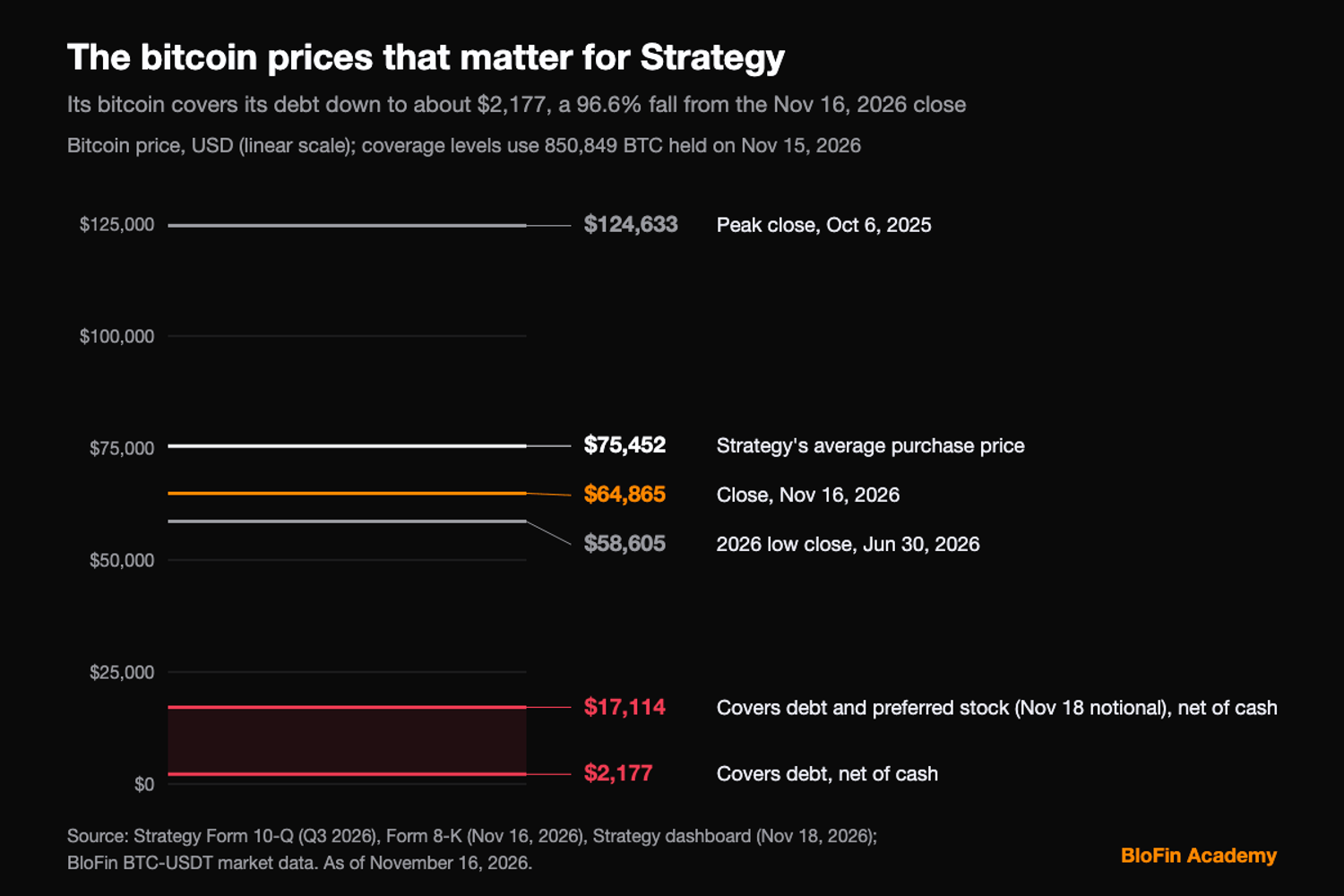
Three bitcoin prices frame what a fall does to Strategy, measured from the November 16, 2026 close. The average cost of $75,452 is where its coins go under water, which forces nothing. Far lower sit two coverage prices: about $17,114, where the coins just cover the debt and preferred stock net of cash, and about $2,177, where they just cover the debt.
Each coverage price starts from the debt in the 10-Q. It subtracts the USD Reserve and USD Cash in the November 16, 2026 8-K, then divides by 850,849 bitcoin. The notes and the secured loan come to $6.8 billion in principal, and the reserve and cash to $4.9 billion (source: Strategy Form 10-Q for the third quarter of 2026, Strategy Form 8-K filed November 16, 2026). For the preferred stock, the higher level adds the $12.7 billion notional value that Strategy's dashboard showed on November 18, 2026, after its STRC buybacks (source: Strategy dashboard). That lands within 0.3% of Strategy's own figure of $17,068, which leaves out the secured loans (source: Strategy credit dashboard).
Bitcoin price | What it marks | Fall from the November 16, 2026 close |
|---|---|---|
$75,452 | Strategy's average purchase price | Bitcoin is 14.0% under it |
$64,865 | BloFin BTC-USDT daily close, November 16, 2026 | Starting point |
$17,114 | Coins equal debt plus preferred notional value, net of cash | 73.6% |
$2,177 | Coins equal debt, net of cash | 96.6% |
Strategy publishes its own version of these levels and calls each one a BTC Floor. That is the bitcoin price at which its BTC Rating for a security falls to 1.0x. On November 17, 2026, its credit page showed $2,132 for the debt and $17,068 for the debt and preferred stock together, both worked out at its own input of $64,900 per bitcoin (source: Strategy credit dashboard). Strategy labels these figures illustrative and says the BTC Rating comes from no rating agency, so they are best read as the company's own sums.
Chief executive Phong Le has drawn his own line twice in 2026. In a Bloomberg TV interview, he said Strategy would start to worry about its debt only if bitcoin fell to around $8,000 to $10,000, The Block reported on July 15, 2026 (source: The Block, July 15, 2026). From the November 16, 2026 close, that is a fall of 84.6% to 87.7%.
On the February 5, 2026 earnings call, Le had put the point where the bitcoin reserve equals net debt at about $8,000, after a 90% fall. He named restructuring, new equity and new debt as the options there (source: The Block, February 6, 2026). That figure is now history, because the 2029-note buyback and the larger cash reserve have since pulled the net-debt price down to about $2,177.
The last threshold is a share price rather than a bitcoin price. mNAV compares MSTR's price with the bitcoin behind each share after senior claims. On November 17, 2026, the Strategy dashboard showed 1.09x, using MSTR's November 16 close of $103.03 and a bitcoin price of $64,900. With bitcoin at that price, MSTR would reach 1.0x at roughly $94.50, about 8% lower, and that level moves every time bitcoin does.
Strategy in the 2026 bitcoin bear market
The 2026 slump shows the chain under strain. Bitcoin's daily close fell 53.0% from $124,632.90 on October 6, 2025 to $58,605.40 on June 30, 2026, and stood at $64,865.40 on November 16, 2026 (source: BloFin BTC-USDT market data). Through it, Strategy's cash reserve fell as well as rose. The company sold some bitcoin, raised its STRC rate and paid every dividend it declared.
The reserve's path shows that it is a working balance. Strategy set it up with $1.4 billion on December 1, 2025, using money from share sales. By December 21, 2025 it held $2.2 billion, after a week in which Strategy sold $747.8 million of MSTR shares and bought no bitcoin (source: Strategy Form 8-K filed December 1, 2025, Strategy Form 8-K filed December 22, 2025).
By May 25, 2026 the reserve was down to $871 million. A week earlier, on May 19, Strategy had paid $1.4 billion to retire $1.5 billion of its 2029 notes (source: Strategy Form 8-K filed May 26, 2026, Strategy Form 10-Q for the third quarter of 2026).
The reserve was rebuilt quickly. It stood at $1.4 billion on June 21, 2026 and $2.6 billion a week later, the day before Strategy announced its reserve policy (source: Strategy Form 8-K filed June 22, 2026, Strategy Form 8-K filed June 29, 2026). Strategy's third-quarter release put it at $4.8 billion on October 25, 2026 (source: Strategy third-quarter 2026 results release). The latest 8-K gave about $4.8 billion on November 15, after $18.9 million of it went to preferred dividends that week (source: Strategy Form 8-K filed November 16, 2026).
Strategy made other moves alongside. It sold about $431.8 million of bitcoin in 2026 up to October 25, to help pay preferred dividends and STRC buybacks (source: Strategy third-quarter 2026 results release). It still bought 485 bitcoin in the week to November 15 (source: Strategy Form 8-K filed November 16, 2026). By October 25 it had also bought back about $2.0 billion of STRC at an average of $97.39 a share, about 2.6% under its $100 face value (source: Strategy third-quarter 2026 results release). Through the slump it raised STRC's rate in steps, from 11.00% for January 2026 to 12.00% from July (source: Strategy Form 8-K filed January 2, 2026, Strategy Form 8-K filed June 29, 2026).
MSTR took the harder fall. Its Nasdaq close slid from $151.95 on December 31, 2025 to $82.31 on June 26, 2026, then recovered to $103.03 by November 16, 2026 (source: Nasdaq MSTR historical data). That left it 32.2% down on the year, against 25.9% for bitcoin (source: BloFin BTC-USDT market data). If you want to see how MSTR reacts on the days bitcoin drops, the MSTRUSDT Perpetual trading page carries the contract's live chart.
The death spiral argument and Strategy's answer
The death spiral argument says a deep bitcoin fall could feed on itself at Strategy. The premium vanishes, share sales turn dilutive, buyers dry up, and the company sells bitcoin into a weak market. Strategy's answer is that selling is the last tool on a longer list, and its cash reserve is built to keep it there.
Writing for FXStreet on December 11, 2025, Derek Lim of Caladan laid out the critics' chain. With mNAV under 1, a share sale raises less than the bitcoin each share stands for, so it hands value to the new buyers. If raising money then gets hard and the business cannot cover its bills, bitcoin sales follow (source: FXStreet, December 11, 2025). Lim's own view was that the critics were right about the pressure but overstated the collapse. Citing Bitwise CIO Matt Hougan, he listed three conditions a forced sale needed at once, and only one, an mNAV under 1, was in place.
Phong Le's account of the same chain puts conditions on the last step. In a What Bitcoin Did interview reported on November 30, 2025, he said selling bitcoin would make sense on the numbers only if mNAV fell under 1 and money became hard to raise. He added, "I would not want to be the company that sells Bitcoin" (source: Cointelegraph, November 30, 2025).
The June 2026 policy then wrote the reserve into the rules. It also allowed bitcoin sales of up to $1.25 billion to fund the reserve, alongside sales to pay dividends and buy back stock (source: Strategy Form 8-K filed June 29, 2026).
What happened in 2026 gives each side something. The sales the critics warned of did arrive, at a scale far smaller than the holdings, and Strategy said they funded part of its preferred dividends and STRC buybacks. The reserve that Strategy said would protect the coins also shrank before it grew. Neither outcome settles the argument, because both depend on how long bitcoin stays low and whether buyers keep taking Strategy's shares and preferred stock.
Could Strategy go bankrupt?
Bankruptcy usually follows a missed legal payment. For Strategy, that means note interest, or note principal at a put date or maturity. A bitcoin fall raises that risk only by shrinking the coins and the share sales that could repay the notes. Preferred dividends sit outside it, because skipping one is no default.
Strategy's own risk factors spell out the order of events. Its 10-K names a sale of bitcoin, possibly below cost, as a step it may be forced into once the reserve is spent and new money is too costly or unavailable (source: Strategy Form 10-K for 2025). The same section warns that failing to pay debt service could lead to a default with serious results. The 10-Q adds that the notes can fall due early after certain events of default, so a missed payment on one series is the event that matters most.
Set against today's figures, the gap is wide but finite. The debt's principal of $6.8 billion compares with $55.2 billion of bitcoin at the November 16, 2026 close and $4.9 billion of reserve and cash. That is why the net-debt price sits near $2,177. In a fall deep enough to reach it, Le's February 2026 list of restructuring, new equity or new debt is the set of options the company has named. Each of those options depends on someone being willing to lend or invest at the time, and the common stock is last in line for whatever is left.
What a bitcoin fall means for MSTRUSDT traders
For a trader, the key question is where the liquidation price lives. Strategy has none on its bitcoin, but a leveraged position in the MSTRUSDT Perpetual does. A bitcoin sell-off usually reaches it through MSTR's own larger move, and liquidation is set off by the contract's mark price, not its last trade.
The MSTRUSDT Perpetual settles profit and loss in USDT and lets you pick leverage of up to 20x (source: BloFin MSTR contract details). Buyers and sellers swap a funding payment on a normal cycle of once every eight hours. Bitcoin trades around the clock, while MSTR's home exchange keeps regular hours of 9.30AM to 4PM ET on weekdays.
That gap matters in a weekend crash. BloFin's notice says that its stock futures, when the stock market is closed, including weekends and holidays, may be limited to reduce-only orders (source: BloFin stock futures notice). If that limit applies, a position can be cut but not added to until regular trading resumes. Unlike a share, a perpetual futures contract gives price exposure only: BloFin's notice says its stock futures carry no ownership, dividends or voting rights (source: BloFin stock futures notice).
If you already hold MSTR shares and worry about this chain, a short perpetual position can soften part of a drop. Hedging MSTR stock with the perpetual walks through sizing one. A hedge also gives up the gains if MSTR recovers, and it carries its own liquidation price, so it needs the same margin care as any other leveraged trade.
Worried a bitcoin crash could force Strategy to sell, and what that would do to MSTR? To get started, you'll need to first create a BloFin account, fund your account with cryptocurrency, and go to the MSTRUSDT Perpetual trading page.

Frequently asked questions
When are Strategy's next preferred dividends paid?
Strategy declared its next quarterly dividends on November 14, 2026: $2.50 a share on STRF and STRD, $2.00 on STRK and €2.50 on STRE, all payable on December 31, 2026. STRC pays daily, and its dividends for record dates from December 1 to 31 add up to $1.00 a share, paid between December 2, 2026 and January 4, 2027 (source: Strategy Form 8-K filed November 16, 2026).
Can holders of Strategy's preferred stock force a buyback?
Only in narrow cases: STRK's terms, for example, let holders make Strategy buy back their shares after a fundamental change, a defined event such as a takeover (source: STRK Certificate of Designations). Strategy itself may redeem all of STRK once less than a quarter of the original issue remains, or after certain tax changes. A missed dividend gives holders no right to sell back their shares; STRK holders gain board seats instead.
Does Strategy's 3.4 years of cover count bitcoin sales?
No. By Strategy's definition, the figure divides its USD Assets, meaning the USD Reserve plus USD Cash, by its yearly interest and dividend bill, so it counts cash alone (source: Strategy dashboard notes). The bitcoin sales allowed under the June 2026 policy, up to $1.25 billion to top up the reserve, sit outside it (source: Strategy Form 8-K filed June 29, 2026).
How much has Strategy paid in preferred dividends?
Strategy's third-quarter release put dividends paid on all its preferred stock at $1.5 billion to date. From January through September 2026 it paid $1.0 billion across the five series, of which STRC took $696.2 million (source: Strategy third-quarter 2026 results release, Strategy Form 10-Q for the third quarter of 2026).
Can Strategy use its USD Reserve to repay its notes?
Strategy's own cover figure does not count on it. That figure assumes none of the reserve goes to note puts or maturities, including the put on the 2028 notes, worth $1.0 billion, that falls on September 15, 2027 (source: Strategy dashboard notes, Strategy Form 10-Q for the third quarter of 2026). Any such use would also need the board's approval under the June 2026 policy.
Researched and written by the BloFin Academy editorial team with AI-assisted drafting. All facts independently verified. Sources are Strategy's Form 10-K for 2025, its Form 10-Q for the third quarter of 2026, its Forms 8-K filed December 1 and December 22, 2025 and January 2, May 26, June 22, June 29 and November 16, 2026, its third-quarter 2026 results release, the amended and restated Certificates of Designations for STRK and STRD, the Strategy dashboard, credit dashboard and dashboard notes, Nasdaq MSTR historical data, The Block, Cointelegraph and FXStreet. BloFin's sources are its BTC-USDT market data, its MSTR contract details and its stock futures notice, current as of November 19, 2026.
Nothing in this article constitutes financial advice. A fall in bitcoin can push MSTR down further and faster than the coin itself, and a leveraged MSTRUSDT position can be liquidated in a single move, including at times when Nasdaq is shut and trading may be limited to reduce-only orders. Strategy's thresholds are sums on current figures, never a promise about where a sale or a default would begin. Past performance does not indicate future results.