
Owning a share and holding a contract on its price can look alike on a screen. Both rise when the company's stock rises and fall when it falls, and over a few days the difference between them is hard to spot.
Over months that difference grows. A share bought outright sits in a brokerage account with no funding to pay and carries a vote, however far the price falls. A contract that tracks the price swaps small payments between buyers and sellers every few hours, and it can be closed for you if the money behind it runs short.
Crypto exchanges now list perpetual futures on US stocks. These are contracts with no expiry date that follow a share's price and settle in a stablecoin. They let someone who already holds crypto trade a stock without a broker, which leaves a practical question for anyone who thinks in months or years: what does holding one cost, and what does it leave out?
For Palantir Technologies (PLTR), BloFin's route is the PLTRUSDT Perpetual, which tracks Palantir's Nasdaq-listed shares and settles in USDT. Since it listed in February 2026, funding has cost a long position 1.25% of its value in total (source: BloFin PLTRUSDT funding history). Because Palantir pays no dividend, the contract has no payout to miss either.
What is the difference between holding the PLTR perpetual and owning Palantir shares?
Holding the PLTR perpetual means holding a position on Palantir's price, settled in USDT, while owning Palantir shares means owning part of the company. A long PLTRUSDT position settles funding, normally three times a day, carries no vote and can be liquidated. A share bought outright has no funding, carries a vote and stays in your brokerage account.
BloFin's notice describes its stock futures as derivatives that track the price of the stocks they reference, with no ownership interest in them. It adds that they are not a security and carry no voting rights, dividends, interest, rights offerings or shareholder rights tied to the stock (source: BloFin stock futures notice). What you hold is a position on the price, sized in PLTR and paid out in USDT.
Each contract is worth 0.01 PLTR, settles in USDT and allows leverage from 1x to 20x, three of the PLTR perpetual's contract terms (source: BloFin PLTRUSDT contract details). Over a long hold, seven differences matter.
What you get | A Palantir Class A share, bought outright | A long PLTRUSDT position |
|---|---|---|
Price exposure | In US dollars | In USDT |
A stake in Palantir | Yes | None |
Shareholder vote | One vote per share | None |
Funding payments | None | Paid or received, normally every eight hours |
Dividend | None paid to date | None |
Forced closing | None from a price fall | Liquidation if the margin runs too thin |
Adding to it outside US market hours | Depends on your broker | May be limited to reduce-only orders |
The price is the part the two routes share. The rest of the difference comes down to cost, control and risk.
The funding cost of a long PLTRUSDT position since February 2026
Funding on the PLTRUSDT Perpetual cost a long position 1.25% of its value in total over its first 824 settlements, from 4PM UTC on February 9 to 12AM UTC on November 11, 2026. That averages about 0.0015% per settlement. Longs paid at 500 settlements, received at 303 and paid nothing at 21 (source: BloFin PLTRUSDT funding history).
Funding is a payment between the two sides of the contract, charged on the full value of your position. With a positive funding rate the payment runs from longs to shorts, and with a negative rate it runs from shorts to longs. The PLTRUSDT rate is capped at +3% and floored at −3% per settlement, and the PLTR perpetual's funding rate normally settles every eight hours (source: BloFin PLTRUSDT market data, BloFin PLTRUSDT contract details).
Say you hold 10 PLTR on the contract at 1x. At the 172.47 USDT mark price at 4.24AM UTC on November 11, that position is worth 1,724.70 USDT, and at 1x your margin is the same amount (source: BloFin PLTRUSDT market data). Had it kept that value since listing, the whole funding record would have cost it about 21.56 USDT. Opening and closing it with market orders adds about 2.07 USDT, at BloFin's 0.0600% taker fee each way (source: BloFin fee schedule).
The total also hides how unevenly the cost arrived. Exactly 106 settlements came in at 0.0120% each between 4PM UTC on September 7 and 8AM UTC on October 16, including an unbroken run of 46 from September 28 to October 13. Those 106 add up to 1.272%, more than the whole record. The largest single rates were +0.7781% at 12AM UTC on March 2 and −0.9765% at 12AM UTC on April 13. The other 718 settlements together came to −0.022% (source: BloFin PLTRUSDT funding history).
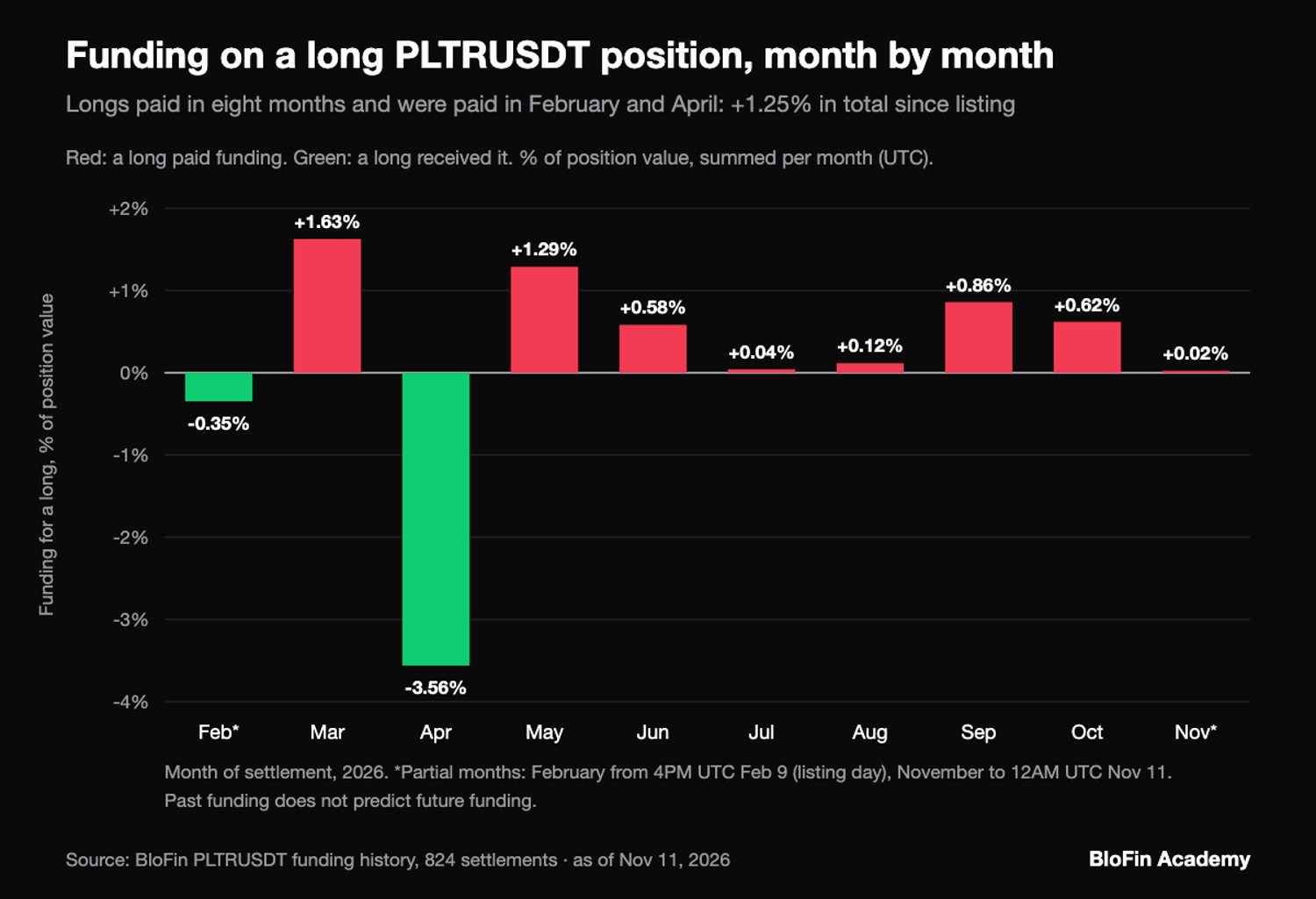
If rates stayed at the record's average, a year of 1,095 settlements would come to about 1.66% of the position's value, or about 28.65 USDT on the 10 PLTR example at the same price. That is only arithmetic, and the record shows why it is a weak guide. At the average of the 90 days to November 11, a year would come to about 5.99%, and at the 30-day average to about 2.85% (source: BloFin PLTRUSDT funding history). The total cost of a hold depends on the rates that settle across all of it (source: iShares).
Funding during Palantir's November 2 report week
Funding barely moved the result for a long PLTRUSDT holder in Palantir's third-quarter report week, while the price moved sharply. The 21 settlements from 12AM UTC on November 2 to 4PM UTC on November 8 summed to +0.0145%, about 0.26 USDT on a 10 PLTR long valued at the 178.63 USDT mark of the November 2 close (source: BloFin PLTRUSDT funding history, BloFin PLTRUSDT market data).
Palantir released its results on November 2, and held a webcast on them at 5PM ET (10PM UTC) the same day. Revenue for the third quarter came to $2.3 billion, 96% more than a year earlier, with US commercial revenue up 148% at $984 million (source: Palantir Q3 2026 results). The share still closed lower on each of the next three sessions. It fell 13.09% from $178.34 at the November 2 close to $154.99 on November 5 (source: Nasdaq PLTR historical data).
By the November 10 close of $168.82, the share was 5.34% below its November 2 close, a loss of $95.20 on 10 shares (source: Nasdaq PLTR historical data). The contract tracked the share closely at the two report-week closes measured. At 9PM UTC on November 2, the 4PM ET close, the PLTRUSDT mark price was 178.63 USDT, 0.16% above the share's close. At the next day's close the gap was 0.14% (source: BloFin PLTRUSDT market data, Nasdaq PLTR historical data).
So over a week, the price decides almost all of what a long holder gains or loses on either route. Over months, funding adds a second running cost, or income, that a shareholder never sees. The record since February shows how much its size depends on the months a hold happens to span.
Holding costs by holding period
What the perpetual costs to hold depends on how long you stay in and which weeks you hold through. On each 1,000 USDT of position value, a long paid 0.20 USDT in the record's last 7 days and 14.77 USDT in its last 90 days. A share held for either span paid no funding (source: BloFin PLTRUSDT funding history).
Holding span to 12AM UTC, November 11, 2026 | Settlements | Total of the rates | Funding on 1,000 USDT, long (USDT) | Funding on Palantir shares |
|---|---|---|---|---|
Whole record, from February 9 | 824 | +1.2500% | 12.50 paid | None |
90 days, from August 13 | 270 | +1.4773% | 14.77 paid | None |
30 days, from October 12 | 90 | +0.2341% | 2.34 paid | None |
7 days, from November 4 | 21 | +0.0204% | 0.20 paid | None |
The 90-day figure is larger than the whole record, because the 0.0120% stretch of September and October falls inside it, while April, when longs were paid, falls outside it. A hold of days costs little more than the trading fees. A hold of months adds a funding bill whose size you only learn as the rates settle.
Leverage changes what that bill means for your money, because funding falls on the full position. Holding 1,000 USDT of exposure at 2x takes 500 USDT of margin, so the whole record's 12.50 USDT would have been 2.5% of it. At 5x it would have been 6.25% (source: BloFin PLTRUSDT funding history).
For a holder thinking in years, the share route stays the same: no funding, a vote and the broker's custody. The perpetual's main costs keep running until the position is closed, so its total is known only once the hold is over.
Votes and dividends on Palantir shares
Palantir shares carry votes that the perpetual lacks, and no dividend that the perpetual misses. A Class A share has one vote, and Palantir's 10-K says the company has paid no cash dividend on its capital stock and expects none in the foreseeable future (source: Palantir 2025 Form 10-K).
Palantir's Class F shares carry a variable number of votes, set so that the founders' group can hold 49.999999% of all voting power on a matter. That makes a Class A vote count for less than its share of the stock suggests. Any dividend Palantir declared would be paid equally per share across the classes, unless each class voted to treat them differently (source: Palantir 2025 Form 10-K, Palantir description of securities).
Liquidation risk on a 1x PLTRUSDT long
A 1x PLTRUSDT long, with margin equal to the full position value, sits almost out of reach of liquidation. Under BloFin's isolated-margin formula, a 10 PLTR long opened at 172.47 USDT would be liquidated near 0.11 USDT, a fall of about 99.9%. At 2x, its liquidation price rises to about 88.61 USDT, about 48.6% below entry (source: BloFin liquidation price calculation).
Those figures use the first position tier, which covers up to 700 PLTR with a 2.5% maintenance margin rate and a 20x cap (source: BloFin PLTRUSDT position tiers). They deduct the 0.0600% taker fee for opening. They also assume a liquidation fee rate of the same 0.0600%, because BloFin's formula page names that rate without giving a number. The formula starts from your margin balance, so anything that lowers the balance moves the liquidation price up. At 5x, it sits at about 141.71 USDT, 17.8% below entry.
Once the mark price hits the liquidation price, BloFin can cut the position down or liquidate it in full. BloFin calculates the mark price as a fair value for the contract from a funding basis, the index price and other inputs. A liquidation therefore follows the contract's own mark through every hour it trades.
Before you open a position, the order panel shows its estimated Liq. Price, with the live mark and funding rate beside it on the PLTRUSDT Perpetual page.
Custody and investor protection on each route
Palantir shares and a PLTRUSDT position are held by different kinds of firm, under different protection. SIPC protects the cash and securities of customers when a SIPC-member brokerage firm fails, up to $500,000 including $250,000 in cash. It covers the broker's custody of your assets and excludes commodity futures contracts and digital assets that are not securities (source: SIPC).
SIPC's role is narrow even for shares. It works to return the securities and cash in your account if the broker fails, and it offers a Palantir share held there no protection against a fall in its price (source: SIPC). The market risk is yours on both routes.
On the perpetual route, the USDT behind your position sits in your BloFin account. It is covered by BloFin's own account-safety measures, not by SIPC. Weighing the two means weighing a broker's custody under SIPC against an exchange's custody of your USDT, each on its own terms.
The margin itself carries a second exposure. A PLTRUSDT position is margined and settled in USDT (source: BloFin PLTRUSDT contract details), so its value in dollars also depends on USDT holding the 1-to-1 dollar peg that Tether, its issuer, describes (source: Tether FAQs). That is the risk of a stablecoin losing its peg, which a share bought and held in dollars avoids.
Holding a PLTRUSDT long on BloFin
A PLTRUSDT long on BloFin has no end date of its own. It ends when you close it, at liquidation, or when a stop-loss or take-profit order fills. The Positions tab lists its current margin, unrealized profit and loss, entry price and an estimated liquidation price, and each funding settlement adds to your result or takes from it.
Time of day matters too. On weekends, on US market holidays and outside regular US trading hours, BloFin's notice says a stock future such as PLTRUSDT may be limited to reduce-only orders (source: BloFin stock futures notice). When that limit applies, an order goes through only if it shrinks or closes a position.
To open the position you pick a margin mode, leverage and order type, the steps of a first futures trade on BloFin. With isolated margin, the most one position can lose is the margin assigned to it, while cross margin uses your whole futures balance as collateral.
To end the hold, you close the position from the Positions tab with a limit or market order, which works in either position mode. In One-way mode, a Sell order for the same size with Reduce-only ticked on the trading page does the same; in Hedge mode BloFin ignores Reduce-only, so close from the Positions tab. A partial close keeps the remaining contracts at the margin and leverage they had. Closing a trade on BloFin costs the 0.0200% maker fee if your limit close rests on the book first, and the 0.0600% taker fee if you close at market (source: BloFin fee schedule).
Looking to trade Palantir? To get started, you'll need to first create a BloFin account, fund your account with cryptocurrency, and go to the PLTRUSDT Perpetual trading page.

Frequently asked questions
Do long positions on the PLTR perpetual ever get paid funding?
Yes, whenever the rate settles below zero, which happened at 303 of the contract's first 824 settlements. In two calendar months, February and April 2026, a long was paid on balance: about 0.35% and 3.56% of its position value. In the last 7 days of the record, 11 of 21 settlements were negative, though the week still cost longs a small amount overall (source: BloFin PLTRUSDT funding history).
Does the PLTR perpetual have an expiry date?
The PLTR perpetual has no set end date, which sets it apart from dated futures contracts. You can keep a position open while its margin holds, for as long as you choose. BloFin listed the contract at 3.30PM UTC on February 9, 2026 (source: BloFin PLTRUSDT market data). Its contract page also notes that BloFin may change the contract's parameters to suit the market, with no separate notice (source: BloFin PLTRUSDT contract details).
Does cross margin change the risk on a 1x PLTR perpetual long?
Yes. With cross margin, every open position draws on the full futures balance, so a loss elsewhere in the account can eat into the money that backs a 1x PLTRUSDT long. Isolated margin keeps each position's margin separate, and BloFin's liquidation formula for isolated positions starts from that margin alone (source: BloFin liquidation price calculation).
Can you vote Palantir shares by proxy?
Yes. Shareholders can vote by proxy, which Investor.gov describes as a way to vote for corporate directors and on other matters affecting the company instead of attending the meeting in person (source: Investor.gov, Palantir 2026 proxy statement). A long PLTRUSDT position carries no voting rights, so the proxy vote belongs to shareholders alone (source: BloFin stock futures notice).
Can an investor outside the US get SIPC protection on Palantir shares?
Yes, if the shares are held at a SIPC-member brokerage firm. SIPC says there is no requirement that a customer live in or be a citizen of the United States, and a non-US citizen with an account at a member firm is treated the same as a US resident. Its protection differs from deposit insurance at a US bank, because SIPC does not protect the value of any security (source: SIPC).
Researched and written by the BloFin Academy editorial team with AI-assisted drafting. All facts independently verified. Primary sources include Palantir's 2025 Form 10-K, its description of securities, its 2026 proxy statement and its third-quarter 2026 results on SEC EDGAR, Nasdaq's daily price table for Palantir, and SIPC's guide to what it protects, with context from iShares, Tether's FAQs and Investor.gov. BloFin facts come from its stock futures notice, fee schedule, liquidation price and funding pages, and its own PLTRUSDT contract details, position tiers, market data and funding history, current as of November 11, 2026.
Nothing in this article constitutes financial advice, and nothing in it is a recommendation to buy, sell or hold Palantir in any form. A long PLTRUSDT position pays funding whenever the rate is positive. If rates stayed at the average of the 90 days to November 11, 2026, that would come to about 6% of the position's value a year, with no dividend or vote in return. With leverage, a smaller fall in the mark price can reduce or liquidate the position, and the USDT margin carries stablecoin risk of its own. Past performance does not indicate future results. Do your own research and consider your risk tolerance before you trade on BloFin.