
Many people own a popular stock without ever buying it on its own. It sits inside an index fund in a retirement account, next to hundreds of other companies, and it nudges the fund a little on the days it moves a lot.
Searching for a fund built around one company turns up a confusing mix. Some funds hold the stock as one line among many, while others aim to double its daily move or to gain when it falls. A third group sells options on the stock to pay out income, and each kind charges in its own way.
Sorting them out takes a few plain questions. How much of the stock does each dollar actually buy, does the leverage reset every day, what does holding cost over time, and do you end up owning anything at all?
Palantir Technologies (PLTR) appears in all three kinds of fund, and its sharp fall in early November 2026 showed how differently they react to the same move. On BloFin, the PLTRUSDT Perpetual offers direct exposure to Palantir's price through a perpetual contract settled in USDT, with leverage you choose, funding payments and no ownership of shares.
What is a Palantir ETF?
A Palantir ETF is an exchange-traded fund, meaning a fund with shares that change hands on an exchange like a stock, that holds Palantir or tracks its price. Big index funds such as Invesco QQQ hold it as one company among about 100. Single-stock funds follow Palantir alone and add leverage, an inverse target or an options strategy.
Three kinds come up when you search. Index and sector funds hold Palantir because it belongs to the index they follow. Examples are QQQ, SPY (State Street's S&P 500 fund), XLK (State Street's technology sector fund) and IGV (the iShares software fund). Leveraged and inverse single-stock funds, such as Direxion's PLTU and PLTD and GraniteShares' PTIR, aim for a multiple of Palantir's daily move. Option-income funds, such as YieldMax's PLTY and PLTE from Harvest Portfolios, sell call options on Palantir and pay out the premiums.
In every case, you buy a share of the fund, and it is the fund that owns the assets. Invesco's QQQ held 48,407,893 Palantir shares in its holdings file for November 6, 2026 (source: Invesco QQQ holdings). A leveraged fund usually gets its exposure through swaps, which are contracts that pay the fund a multiple of the stock's move. GraniteShares says PTIR's swaps add up to 200% notional exposure, backed by US Treasury bills and cash (source: GraniteShares PTIR page).
Two terms come up in every fund comparison. Net asset value (NAV) is what a fund's holdings are worth per share. The expense ratio is the annual fee deducted from the fund's assets, shown as a percentage.
Palantir ETFs in the November 2026 sell-off
Over the six sessions to November 9, Palantir stock fell 8.10%, from $184.11 at the October 30 close to $169.20. Direxion's 2x fund PLTU fell 17.03% over those days, more than twice the share's fall. The inverse fund PLTD rose 7.50%, less than the fall it was built to mirror (source: Nasdaq PLTR historical data, Nasdaq PLTU historical data, Nasdaq PLTD historical data).
The biggest day was November 5, when Palantir dropped 9.73%, PLTU 19.63% and PLTD gained 9.51% (source: Nasdaq PLTR historical data, Nasdaq PLTU historical data, Nasdaq PLTD historical data). Day by day, PLTU stayed close to its target, and its daily move never sat more than 0.27 percentage points away from twice Palantir's over those six sessions. The gap came from linking the days together: twice the six-session fall is 16.20%, and the fund lost 17.03%.
Holding | $1,000 at the October 30 close | Value at the November 9 close |
|---|---|---|
Palantir stock | $1,000 | $919.02 |
PLTU (2x daily) | $1,000 | $829.72 |
PLTD (-1x daily) | $1,000 | $1,075.00 |
IGV (software fund) | $1,000 | $972.86 |
XLK (technology fund) | $1,000 | $951.92 |
QQQ (Nasdaq-100 fund) | $1,000 | $983.87 |
SPY (S&P 500 fund) | $1,000 | $995.99 |
The broad funds moved mostly with their other holdings, and the gap between IGV and XLK shows it. IGV held more than three times XLK's weight in Palantir, yet XLK fell 4.81% over the six sessions and IGV only 2.71%, while QQQ lost 1.61% and SPY 0.40%. The whole gap, and more, came on November 5, when XLK fell 8.00% and IGV 4.39% (source: Nasdaq IGV historical data, Nasdaq XLK historical data, Nasdaq QQQ historical data, Nasdaq SPY historical data). At IGV's November 6 weight of 8.23%, Palantir's fall accounts for roughly $6.66 of each $1,000 in the fund, and the rest came from its other holdings (source: iShares IGV holdings, State Street XLK holdings).
Which ETFs hold Palantir?
Palantir is held by the main US funds following the S&P 500 and Nasdaq-100, and by tech and software funds. In each issuer's holdings file for November 6, 2026, Palantir made up 8.23% of IGV and 2.47% of XLK. It was 1.74% of QQQ and 0.58% of SPY (source: iShares IGV holdings, State Street XLK holdings, Invesco QQQ holdings, State Street SPY holdings).
Fund | Issuer | What it follows | Palantir weight | Palantir's rank in the fund | Expense ratio |
|---|---|---|---|---|---|
IGV | iShares | North American software stocks | 8.23% | 2nd, after Microsoft at 9.39% | 0.38% |
XLK | State Street | Technology Select Sector Index | 2.47% | 8th of 79 lines | 0.08% |
QQQ | Invesco | Nasdaq-100 | 1.74% | 16th, after Cisco | 0.18% |
SPY | State Street | S&P 500 | 0.58% | 26th of 505 lines | 0.0945% |
Issuers publish these files each business day, and the weights shift whenever prices move. Invesco's file is dated November 6, when Palantir closed at $160.38. Palantir has since risen to $169.20, so its weight in QQQ would have been a little higher at the November 9 close (source: Invesco QQQ holdings, Nasdaq PLTR historical data). XLK's and SPY's expense ratios are State Street's gross figures, and QQQ's is Invesco's total expense ratio (source: State Street XLK holdings, State Street SPY holdings, Invesco QQQ holdings).
Palantir's place in QQQ and SPY comes from its membership of the Nasdaq-100 and the S&P 500, the indexes those funds follow. A small-company fund sits outside that group. The iShares Russell 2000 ETF (IWM) listed 1,977 holdings in its November 6 file, and none of them was Palantir (source: iShares IWM holdings).
How much Palantir does an index fund give you?
An index fund gives you Palantir exposure equal to your position multiplied by Palantir's weight in the fund. On the November 6 holdings, $1,000 of IGV carried $82.30 of Palantir and $1,000 of XLK carried $24.71. The same amount of QQQ carried $17.40, and $1,000 of SPY carried $5.80, so the rest of each dollar followed other companies.
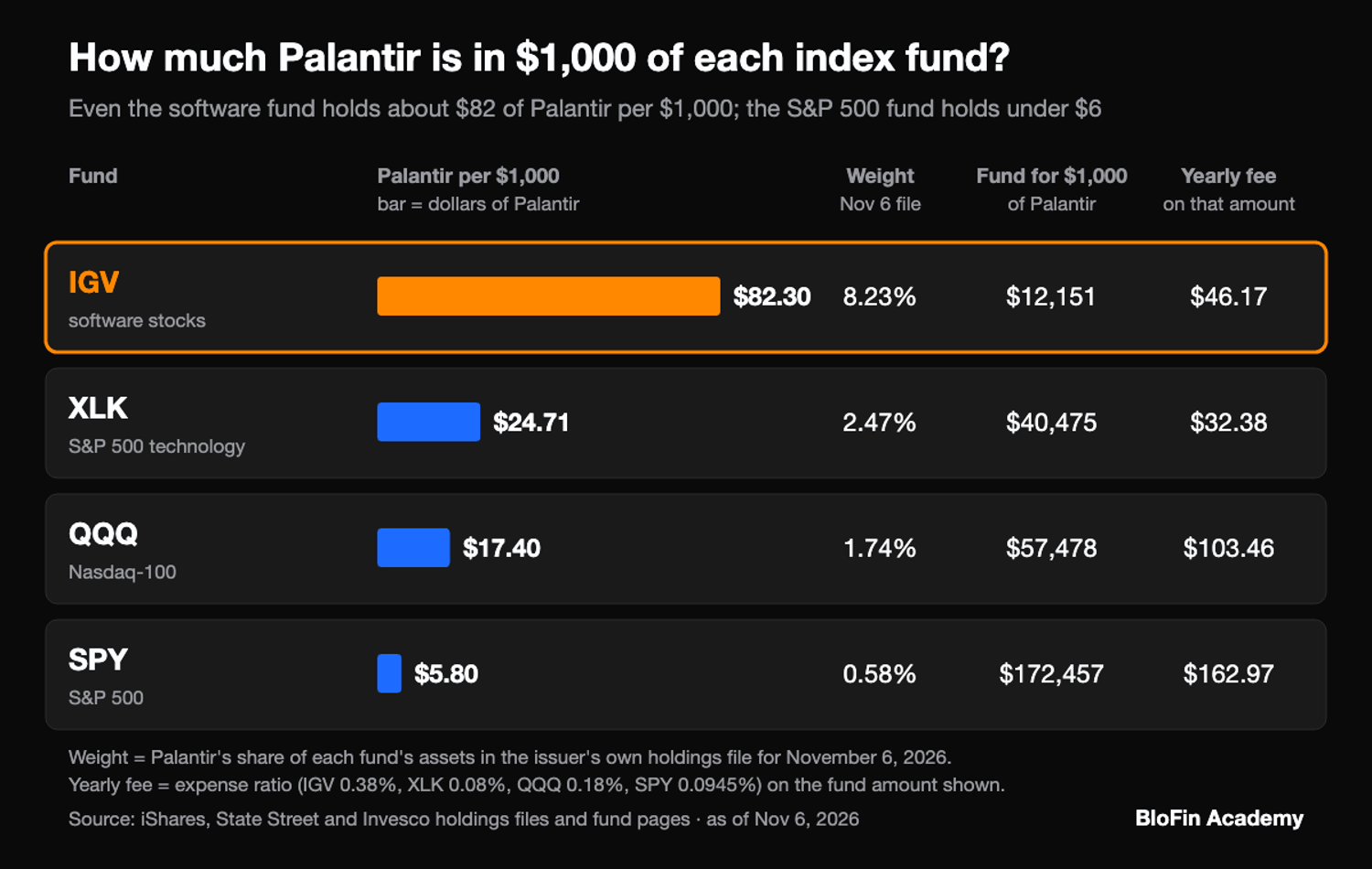
Turning the sum around shows how thinly that exposure is spread. Holding $1,000 of Palantir through each fund would take $12,151 of IGV, $40,475 of XLK, $57,478 of QQQ or $172,457 of SPY. At each fund's expense ratio, those amounts would cost $46.17, $32.38, $103.46 and $162.97 a year. Almost all of that fee pays for the other holdings (source: iShares IGV holdings, State Street XLK holdings, Invesco QQQ holdings, State Street SPY holdings).
The same weights set how much of a Palantir move reaches the fund. If Palantir rose by a tenth, $1,000 of QQQ would gain about $1.74 from Palantir alone. Apple, at 8.53% of QQQ, and Nvidia, at 7.68%, carry far more of the fund's direction (source: Invesco QQQ holdings). In XLK, Nvidia's 14.94% weight means $1,000 of the fund held $149.37 of Nvidia against $24.71 of Palantir (source: State Street XLK holdings).
That spread is what an index fund is built to give. A sharp fall in one company barely dents the whole, and the fee for that mix is low. For Palantir's own price, though, a broad fund mostly delivers everything else.
How do leveraged Palantir ETFs work?
Leveraged Palantir ETFs aim for a multiple of Palantir's move over a single day only. Direxion's PLTU seeks 200% of the share's daily performance, and PLTD seeks 100% of the inverse. GraniteShares' PTIR also seeks 2 times the daily change, and all three state their targets before fees and expenses (source: Direxion PLTU and PLTD page, GraniteShares PTIR page).
These are US exchange-listed funds with their own costs. PLTU and PLTD launched on December 11, 2024, with net expense ratios of 0.97% and 0.98%. PTIR trades on Nasdaq and launched on September 3, 2024, with a net expense ratio of 1.58% (source: Direxion PLTU and PLTD page, GraniteShares PTIR page). Direxion states plainly that "investing in the funds is not equivalent to investing directly in PLTR". Its leverage-risk note for PLTU, the 2x fund, warns that an investor could lose the whole investment in a single day.
Daily reset and compounding
A daily reset means the fund rebuilds its target exposure at every close. After a gain it adds exposure, because 2x of a bigger fund is a bigger position, and after a loss it cuts exposure. Each day starts fresh at exactly 2x, so the daily returns multiply into one another instead of adding up.
A round-number case makes the effect easy to follow. If a share goes from 100 to 110 and back to 99, it has lost 1% over two days. A 2x daily-reset fund gains 20% to 120 and then loses 20% to 96, a 4% loss. A fixed 2x position, such as 2 units held with 100 of margin, gains 20 and then loses 22. It ends at 98, which is twice the share's loss.
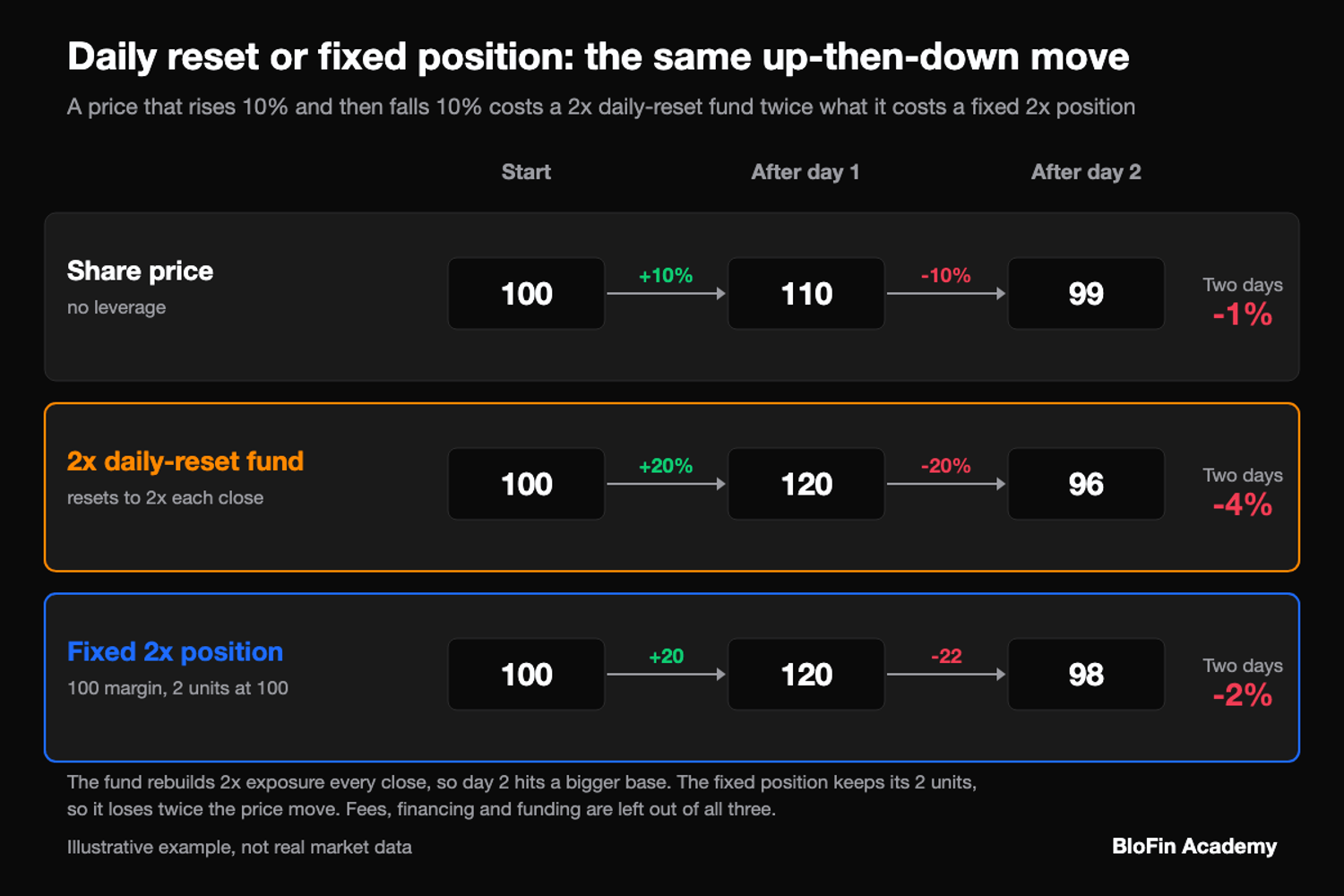
Choppy prices, which go up and down without much net change, wear down a daily-reset fund. A steady trend in one direction can work in its favor. Direxion warns that longer holding periods, higher volatility in Palantir and leverage all increase the effect of compounding. It adds that the funds will lose money if Palantir ends flat over any stretch longer than a single day (source: Direxion PLTU and PLTD page).
Leveraged Palantir ETF returns over longer periods
Over periods longer than a day, the leveraged funds drifted far from a simple multiple of Palantir's move. In 2026 through October, Palantir rose 3.58%, yet Direxion lists PLTU's NAV return at -26.35% and PLTD's at -25.53%. The 2x fund and the inverse fund each lost about a quarter of their value while the share gained (source: Direxion PLTU and PLTD page, Nasdaq PLTR historical data).
A no-cost daily reset helps separate compounding from the fund's costs. It takes twice each day's close-to-close Palantir move over the same dates and multiplies them together with no fees or financing. For 2026 to date it gives -19.76%, so the reset explains about 27 of the 33.5 points between twice Palantir's move and PLTU's return (source: Nasdaq PLTR historical data, Direxion PLTU and PLTD page). The fund's costs and its small daily misses account for the rest.
The three months to October 31 show the other side. Palantir climbed 49.61%, a rise strong enough to outweigh the day-to-day swings (source: Nasdaq PLTR historical data). A no-cost 2x reset would have returned 100.39%, slightly more than twice the share's gain, and PLTU's NAV return of 96.42% sat just under twice the stock's move (source: Direxion PLTU and PLTD page, Nasdaq PLTR historical data).
The inverse fund shows the same pattern from the opposite side. Over the year to October 31, Palantir fell 8.16%, so a simple -1x would have gained 8.16%. Direxion lists PLTD at -18.75% for that year (source: Direxion PLTU and PLTD page, Nasdaq PLTR historical data). A fund that bets against a stock can lose money in a year when the stock itself falls.
Period to October 31, 2026 | Palantir | Twice Palantir's move | 2x daily reset with no costs | PLTU NAV return |
|---|---|---|---|---|
1 month | -1.57% | -3.14% | -5.08% | -5.70% |
3 months | 49.61% | 99.22% | 100.39% | 96.42% |
2026 to date | 3.58% | 7.16% | -19.76% | -26.35% |
1 year | -8.16% | -16.32% | -39.88% | -45.96% |
Palantir option-income ETFs
Palantir option-income ETFs hold Palantir exposure and sell call options on it, paying the premiums out as regular distributions. YieldMax's PLTY sells call spreads on Palantir for weekly income. PLTE, from Harvest Portfolios and listed on the Toronto Stock Exchange, writes covered calls on up to 50% of its portfolio and pays monthly.
Buying a call option means paying for the right to buy a stock at a set price, the strike price, before a set date. A fund that sells calls collects a premium for taking on that obligation. It may give up gains when the stock rises past the strike price, and in a broad decline the premiums may offset only part of the fall (source: iShares covered call explainer).
YieldMax's own figures show that trade-off in Palantir's 2026 swings. In the three months to October 31, Palantir rose 49.61% and PLTY's NAV returned 38.06%. Over the year to October 31, Palantir fell 8.16% and PLTY's NAV returned -4.78% (source: YieldMax PLTY page, Nasdaq PLTR historical data). PLTY's gross expense ratio is 1.07%.
The payouts need a careful read. YieldMax estimated its November 5, 2026 distribution as 100.00% return of capital and 0.00% income. It notes that return of capital may lower the fund's NAV and trading price over time (source: YieldMax PLTY page). Return of capital means part of the money paid out came from the fund's own assets. Harvest Portfolios says PLTE also uses about 25% leverage, and its units are priced in Canadian dollars with a management fee of 0.40% (source: Harvest PLTE page).
How PLTRUSDT differs from a Palantir ETF
The PLTRUSDT Perpetual differs from a Palantir ETF in four main ways. It follows Palantir alone, with no other holdings mixed in, and its leverage is set by the trader. That leverage stays fixed in units instead of resetting daily. The contract charges funding in place of an expense ratio, and it gives no ownership of shares or fund units.
Contract size is counted in PLTR, from a minimum order of 0.01 PLTR (source: BloFin PLTRUSDT contract details). BloFin describes its stock futures as priced from a basket of existing tokenized stock indices, and they carry no voting or other shareholder rights (source: BloFin stock futures notice). The rest of the contract's terms, from settlement to tick size, are set out in BloFin's guide to the PLTRUSDT Perpetual.
The contract allows 1x to 20x leverage, depending on size. Positions up to 700 PLTR can use up to 20x with a 2.50% maintenance margin rate, and larger positions move into tiers with lower maximum leverage (source: BloFin PLTRUSDT position tiers). Isolated margin limits the risk to the margin set aside for one position, while cross margin uses the whole account balance, as BloFin's first futures trade guide shows.
When a position's mark price reaches its liquidation price, BloFin reduces or liquidates it, closing part or all of the position. Liquidation is triggered by the mark price, which may sit apart from the most recent trade price, as its explainer on mark price and last price sets out. Its page on leverage and liquidation adds that the order panel shows an estimated liquidation price before you trade.
Costs work differently from a fund's expense ratio. Each trade pays a fee on its notional value, 0.0200% for a maker order and 0.0600% for a taker order, under BloFin's fee structure. Funding settlements normally fall at 12AM, 8AM and 4PM in UTC terms, capped at 3% in either direction each period (source: BloFin PLTRUSDT contract details, BloFin PLTRUSDT market data). A positive rate means long positions pay short ones, and a negative rate reverses the flow, as BloFin's explainer on crypto funding rates describes.
Hours differ too. An ETF trades during exchange hours, while the PLTRUSDT Perpetual trades around the clock, including weekends. Orders may be limited to reduce-only outside the regular US session and on weekends and holidays. That session runs 2.30PM to 9PM UTC, the 9.30AM to 4PM ET New York day, since US clocks changed on November 1 (source: BloFin stock futures notice). The live price, funding rate and tiers are on the PLTRUSDT Perpetual trading page.
Daily-reset decay and funding over one month
From the October 2 to the November 4 Nasdaq close, Palantir fell 9.03% and Direxion's PLTU fell 19.77%, beyond twice the share's fall of 18.07%. A no-cost 2x daily reset of the same moves gives a 19.05% loss, which leaves fees and tracking with the remaining 0.72 points (source: Nasdaq PLTR historical data, Nasdaq PLTU historical data).
A 2x long on the PLTRUSDT Perpetual over a similar month lost money in a different way. On BloFin's UTC-day candles, the contract closed at 188.89 USDT on October 2 and 171.56 USDT on November 4, a 9.17% fall (source: BloFin PLTRUSDT market data). A long opened with 1,000 USDT of margin at 2x held 10.59 PLTR, worth 2,000 USDT at entry, and the price move cost it 183.49 USDT.
Funding and fees added a smaller cost. The 99 funding settlements between 12AM UTC October 3 and 4PM UTC November 4 summed to 0.5493%, with 71 positive, 24 negative and 4 at zero. The long paid about 10.99 USDT, estimated on its entry size. Taker fees of 1.20 USDT to open and 1.09 USDT to close left 803.23 USDT, a 19.68% loss on the margin (source: BloFin PLTRUSDT market data).
The two results come from two price series, Nasdaq session closes for the fund and UTC days for the contract, so each belongs beside its own underlying move. The more useful lesson is in how each loss built up. The fund cut its exposure after every down day to get back to 2x. The perpetual position kept its 10.59 PLTR, so by November 4 its leverage had risen to about 2.2x from the price move alone as its margin shrank.
Funding made up about 5.6% of the perpetual's loss in that month, and in a month of negative rates a long would have received funding. How these payments add up on a position held for weeks or months is covered in BloFin's guide to the PLTR perpetual's funding rate.
Index perpetuals and QQQX on BloFin
BloFin lists perpetuals on several US index funds, including SPYUSDT and QQQUSDT, and a QQQX spot pair that it labels a Nasdaq tokenized ETF. For QQQUSDT, Palantir's part of the move is its weight in QQQ, 1.74% in Invesco's November 6 file (source: BloFin market data, Invesco QQQ holdings).
SPYUSDT offers up to 50x and QQQUSDT up to 20x, and both were listed on March 5, 2026 (source: BloFin market data). QQQUSDT last traded at 680.62 USDT at about 6AM UTC on November 10, close to QQQ's November 9 close of $679.35 (source: BloFin market data, Nasdaq QQQ historical data). As long as it moves with QQQ, a 1,000 USDT QQQUSDT position carries about 17.40 USDT of Palantir exposure.
One ticker on the list is a trap: the SPX perpetual is the SPX6900 crypto token and has no link to the S&P 500, despite its ticker (source: BloFin market data).
Palantir ETFs and PLTRUSDT compared
Palantir ETFs and the PLTRUSDT Perpetual differ in how much Palantir they carry, how leverage behaves and what holding costs. A broad fund spreads a small Palantir stake across many companies. A single-stock fund gives a daily multiple that compounds, and the perpetual follows Palantir's price alone, with trader-set leverage and funding in place of a yearly fee.
Feature | Index or sector ETF | Leveraged single-stock ETF | Option-income ETF | PLTRUSDT Perpetual |
|---|---|---|---|---|
Palantir exposure | $5.80 to $82.30 per $1,000 | 2x or -1x the daily move | Palantir with calls sold on it | Palantir's price on the full position size |
Leverage | None | Reset to target each day | About 25% in PLTE | 1x to 20x, fixed in units |
Main holding cost | 0.08% to 0.38% a year | 0.97% to 1.58% a year | 0.40% management fee (PLTE) to 1.07% (PLTY) a year | Funding every eight hours, plus trading fees |
Ownership | Fund shares; the fund owns stock | Fund shares; exposure through swaps | Fund shares | None |
Hours | Exchange hours | Exchange hours | Exchange hours | 24/7, reduce-only possible outside US hours |
Account | Brokerage | Brokerage | Brokerage | BloFin, in USDT |
An index fund gives a spread of companies and ownership through a brokerage, with a small Palantir share. A leveraged fund gives a daily multiple through a brokerage, with compounding that grows with time and volatility. The perpetual gives Palantir's price alone, around the clock and settled in USDT, with funding, liquidation risk and leverage that drifts as the price moves. A stop-loss order closes a perpetual position automatically near a chosen price, although a market stop can slip.
Looking to trade Palantir? To get started, you'll need to first create a BloFin account, fund your account with cryptocurrency, and go to the PLTRUSDT Perpetual trading page.

Frequently asked questions
Does Palantir belong to any ETF?
Yes, and in IGV, the iShares software fund, it was one of the largest holdings. IGV's November 6, 2026 file listed 6,379,260 Palantir shares worth about $1.0 billion, an 8.23% weight second only to Microsoft and just ahead of Palo Alto Networks at 8.15% (source: iShares IGV holdings).
Is there a 2x Palantir ETF?
Yes, at least two US funds aim for twice Palantir's daily move: Direxion's PLTU and GraniteShares' PTIR. Both target 2x for one day only, and GraniteShares says PTIR should not be expected to deliver twice Palantir's return over longer periods (source: Direxion PLTU and PLTD page, GraniteShares PTIR page).
Is there an inverse Palantir ETF?
Direxion's PLTD seeks 100% of the inverse of Palantir's daily performance, so it rises on days the share falls. Like the 2x funds, it resets daily. Over the three months to the October 30, 2026 close, Palantir rose 49.61% and PLTD fell 41.82%, less than a simple mirror of the rise, because each day's loss was taken on a smaller fund (source: Nasdaq PLTR historical data, Nasdaq PLTD historical data).
What ETF holds both Palantir and Nvidia?
XLK, QQQ and SPY all hold both. In the November 6, 2026 files, XLK held 14.94% Nvidia and 2.47% Palantir, QQQ held 7.68% and 1.74%, and SPY held 7.10% and 0.58% (source: State Street XLK holdings, Invesco QQQ holdings, State Street SPY holdings). Nvidia carries the larger weight in each.
Can you trade PLTU on BloFin?
No. PLTU and PLTD have no contract among BloFin's perpetuals, and BloFin lists no Palantir spot pair (source: BloFin market data). Palantir exposure on BloFin comes through the PLTRUSDT Perpetual, a contract BloFin listed on February 9, 2026, in its stocks category (source: BloFin market data).
Can a 2x Palantir ETF go to zero?
Yes, in a single day. Direxion's PLTU loses about 2% for every 1% Palantir falls in a day, so a one-day fall of more than 50% would wipe out the fund even with Palantir still worth something (source: Direxion PLTU summary prospectus).
Researched and written by the BloFin Academy editorial team with AI-assisted drafting. All facts independently verified. Primary sources include the holdings files and fund pages of Invesco, State Street, iShares, Direxion, GraniteShares, YieldMax and Harvest Portfolios. Price data comes from Nasdaq's daily tables for Palantir, PLTU, PLTD, IGV, XLK, QQQ and SPY, with an iShares explainer on covered calls. BloFin facts come from its PLTRUSDT contract details, position tiers, stock futures notice and its own market data, current as of November 10, 2026.
Nothing in this article constitutes financial advice, and nothing in it is a recommendation to buy, sell or hold Palantir or any fund in any form. Leveraged and inverse ETFs can lose money over periods longer than a day even when Palantir moves their way, and Direxion's 2x fund lost 26.35% in 2026 through October while the share rose 3.58%. On the PLTRUSDT Perpetual, leverage magnifies losses, funding can turn against a position, and orders may be limited to reduce-only outside regular US hours. Past performance does not indicate future results. Do your own research and consider your risk tolerance before you trade on BloFin.