
A stock can fall in the same week its company reports excellent results, because the price already carries high hopes along with the numbers. Every listed company also publishes a long list of things that could hurt it, and bets against popular stocks tend to make louder headlines than the small print behind them.
Those sources are hard to use as they stand. The risk section of an annual report runs for many pages, and serious warnings sit beside standard legal wording. Headlines about short sellers often quote the biggest number they can find, which can be the face value of a bet and far more than the investor paid for it.
A more useful method is to sort those warnings by how directly each one could move the stock. The short sellers' claims go next to the company's own wording, each with its date, so you can see who said what and when.
Palantir Technologies (PLTR) rewards this kind of reading. Its filings warn about government budgets and its reliance on one chief executive, its accounts show heavy stock-based pay, and short sellers Citron Research and Michael Burry argue that the price is too high. You can trade its price on BloFin through the PLTRUSDT Perpetual, a perpetual contract settled in USDT, which brings risks of its own.
What are the main risks of Palantir stock?
The main risks of Palantir stock are a high price for its sales, reliance on government budgets and stock pay that dilutes holders. Hiring limits, reliance on chief executive Alex Karp, founder control, data and AI liability, criticism of its customers and a crowded retail following come next. Short sellers press hardest on the price.
Ranked by how directly each one can move the stock, they line up like this.
Risk | What to check | Source |
|---|---|---|
Valuation | 56.8 times the past 12 months' revenue, at the November 4, 2026 close | (source: Nasdaq PLTR historical data; Palantir Q3 2026 Form 10-Q; Palantir 2025 Form 10-K) |
Government reliance | 49.5% of third-quarter 2026 revenue | (source: Palantir Q3 2026 Form 10-Q) |
Stock pay and dilution | $982.1 million of expense for the year to September 30, 2026 | (source: Palantir Q3 2026 Form 10-Q; Palantir 2025 Form 10-K) |
Hiring and capacity | A November 2, 2026 remark by the chief executive that demand outruns what Palantir can serve | |
Key person and founder control | Founder voting power that can pass 49.999999% | (source: Palantir Q3 2026 Form 10-Q) |
Data, AI and cloud | At least $5.6 billion promised under one cloud deal, amended in March 2026 | (source: Palantir Q3 2026 Form 10-Q) |
Controversy | A $441 million UK health contract under review in June 2026 | (source: Reuters via The Star) |
Crowded trade | A 48.2% fall in closes, then a 94.9% rise, from November 2025 to October 2026 | (source: Nasdaq PLTR historical data) |
Competition is a slower risk for the stock, since its effect takes longer to show and is harder to date. The filing warns of intense competition from large software firms, government contractors and system integrators. It also says many rivals have larger sales budgets and greater financial and technical resources, and that Palantir may lack the resources to hold its position. Palantir's competitors matter most if large rivals start to win the same deals (source: Palantir Q3 2026 Form 10-Q).
Palantir stock valuation risk
Valuation risk is the chance that a stock falls because buyers decide to pay less for the same business, even while it keeps growing. Palantir shows this clearly. Revenue rose 96% to $2.3 billion in its third quarter of 2026, and the stock still closed lower over the next two sessions (source: Palantir Q3 2026 Form 10-Q; Nasdaq PLTR historical data).
The stock closed at $178.34 on November 2, with Palantir's earnings due after that day's close, and at $171.70 on November 4. That is a 3.7% fall, and it left the stock 17.9% under its $209.05 record close on October 9, 2026 (source: Nasdaq PLTR historical data). A good report and a lower price can sit together when buyers had hoped for even more.
At the November 4 close, the company was worth about $413.7 billion. That count uses all 2.4 billion Class A, Class B and Class F shares on the cover of the filing, counted on October 26. Revenue over the past 12 months was $7.3 billion, so buyers were paying 56.8 times sales, or close to $57 for each $1 of revenue (source: Palantir Q3 2026 Form 10-Q; Palantir 2025 Form 10-K; Nasdaq PLTR historical data).
A ratio that high means the stock can react sharply to a small change in mood, and why the stock costs so much takes more than one number to explain. A fall like this one is also part of Palantir stock's wider swings. The company itself warns that its stock "may decline regardless of our operating performance" (source: Palantir Q3 2026 Form 10-Q).
Government concentration and budget risk
Government concentration risk means a large part of Palantir's revenue depends on public budgets and on decisions it cannot control. Government customers paid $1.1 billion in the third quarter of 2026, or 49.5% of revenue. That was up 81% in dollars, and the share is down from 54% across all of 2025 (source: Palantir Q3 2026 Form 10-Q; Palantir 2025 Form 10-K).
The latest filing's budget warning is specific about timing. It says US defense spending may not stay at 2026 levels and that the current administration is working to cut overall government spending. It also lists delays in contract awards, which can push revenue from one quarter into a later one (source: Palantir Q3 2026 Form 10-Q).
Geography adds to this, since US customers made up 84% of third-quarter revenue, which ties the company closely to one country's spending choices. The filing also warns that a limited number of customers account for a substantial portion of revenue. The top three customers made up 16% of revenue in the first nine months of 2026, no single customer passed 10%, and one customer accounted for 27% of accounts receivable at September 30 (source: Palantir Q3 2026 Form 10-Q). The terms of Palantir's government contracts matter too, since a public buyer's budget can change from year to year.
Stock-based pay and dilution risk
Stock-based pay risk is the cost to existing holders when a company pays staff in shares and options, because each new share cuts everyone else's slice. Palantir recorded $982.1 million of this expense over the past 12 months, equal to 13.5% of revenue, and $318.9 million came in the latest quarter (source: Palantir Q3 2026 Form 10-Q; Palantir 2025 Form 10-K).
That quarterly expense rose 85.1% from a year earlier, but revenue grew faster, so it fell to 13.8% of sales from 14.6% (source: Palantir Q3 2026 Form 10-Q). The share count tells the other half of the story. Diluted shares, which include awards likely to become stock, stood 7.0% over basic shares in the quarter. Awards still outstanding, including options and restricted stock units, added up to 201.0 million, or 8.3% of all shares on the filing's cover (source: Palantir Q3 2026 Form 10-Q).
Michael Burry, the investor known for his bet against the housing market, has made this a central part of his case. MarketBeat reported on August 18, 2026 that he accuses Palantir of understating stock pay and puts the true cost at about $5 billion in the past year (source: MarketBeat via Yahoo Finance). That number is his own estimate. The filing sets the expense by each award's value on the day it was granted, so a later rise in the stock leaves the expense where it was. Those later gains are still real, though. Outstanding options had an average exercise price of $10.16 and a built-in value of $26.0 billion at September 30, 2026 (source: Palantir Q3 2026 Form 10-Q).
Hiring and capacity risk
Capacity risk is the gap between the work customers want done and the work a company can staff, and Palantir describes that gap from two ends. On the November 2 call, the chief executive spoke of demand greater than the company can meet, while the filing warns that it may struggle to hire enough people (source: Palantir Q3 2026 earnings call transcript; Palantir Q3 2026 Form 10-Q).
Alex Karp told analysts that "we really cannot satiate demand", in an answer about skeptical customers rather than hiring (source: Palantir Q3 2026 earnings call transcript). The same week's filing warns that the company may be unable to hire, train and keep the people it needs to meet customer demand. It adds that it may not be able to fill jobs on time or at all (source: Palantir Q3 2026 Form 10-Q).
Read together, they point to one risk, since demand becomes revenue only when the company can deliver the work. That link between staff and sales shows up in Palantir's revenue per employee, and a shortage of skilled people could slow revenue with buyers still waiting. Neither the call nor the filing puts a number on the gap, so the comments on hiring in each call are the thing to watch.
Key-person risk and founder control
Key-person risk at Palantir means the business leans heavily on Alex Karp, and founder control means outside holders have little say over who runs it. The filing calls the company highly dependent on Karp, and its voting setup gives the three founders effective control over matters put to a shareholder vote (source: Palantir Q3 2026 Form 10-Q).
The filing also says his experience would be hard to replace, that all senior officers are at-will staff who can leave, and that sales have long relied on the direct involvement of senior managers, including him (source: Palantir Q3 2026 Form 10-Q).
The founders are Alex Karp, Stephen Cohen and Peter Thiel, and in some cases their voting power could pass 49.999999%. The deals behind that control "could remain in place until the death of our last living Founder" (source: Palantir Q3 2026 Form 10-Q). Two of the founders were 58 and one was 44 at September 30, 2026, so that could be a long time. The filing also warns that sales by the founders could push the price down, which makes the founders' and funds' holdings useful to anyone watching insider selling.
Data breach, AI liability and cloud risks
Data breach, AI liability and cloud risks are the working dangers Palantir names in its own summary of risk factors. It warns of break-ins at its own systems and at those of partners and customers. It also warns that its use of AI could bring liability or harm its name, and that it relies on outside computing power (source: Palantir Q3 2026 Form 10-Q).
Palantir's software also draws attackers, and the filing says hackers see it as an attractive target. Two more points are missing from February's annual report. Since May, the quarterly filings have said the fighting in Iran has shown an intent to target Western technology firms, including Palantir (source: Palantir Q1 2026 Form 10-Q). The November filing adds that AI agents may take actions nobody intended or approved (source: Palantir Q3 2026 Form 10-Q).
Palantir's cloud commitments
Palantir depends on computing power from Amazon Web Services, Microsoft and others (source: Palantir Q3 2026 Form 10-Q), and that reliance now carries a large bill. At December 31, 2025, its purchase commitments that could not be canceled came to $1.8 billion, mainly for cloud hosting (source: Palantir 2025 Form 10-K).
In March 2026, Palantir amended one cloud deal and agreed to spend at least $5.6 billion over ten contract years, through February 2036. The yearly minimums run from $268 million to $979 million, and earlier obligations under that deal ended at the same time (source: Palantir Q3 2026 Form 10-Q).
Burry pointed at this in August 2026, when 24/7 Wall St. reported his claim about "the tripling of its non-cancellable infrastructure purchase agreements during 2026" (source: 24/7 Wall St. via Yahoo Finance). The filings fit that roughly, since $5.6 billion is about three times $1.8 billion. The two figures measure different things, though, because one covers all commitments at year-end and the other covers one deal over ten years. The largest yearly minimum, $979 million, equals 13.4% of the past 12 months' revenue. The November filing gives no new total for all its deals, so the full figure stays open until the next annual report (source: Palantir Q3 2026 Form 10-Q).
Palantir controversy and reputation risk
Palantir is controversial because of who buys its software, including defense, immigration and health agencies, and since May 2026 its filings have treated that criticism as a risk to the stock. It says some investors and advocacy groups have raised human rights concerns, and that the scrutiny could hurt the price and deter large investors (source: Palantir Q3 2026 Form 10-Q; Reuters via The Star) (source: Business Insider via Yahoo).
The filing refers to the "perceived human rights implications" of its products and customer ties, and says this may make it harder to attract or keep institutional investors (source: Palantir Q3 2026 Form 10-Q). That language is new this year, since the annual report filed in February never mentions human rights and the wording first appears in the May quarterly report (source: Palantir Q1 2026 Form 10-Q). Three dated cases show how the risk reaches contracts and fund flows.
UK health service. Reuters reported in June 2026 that Britain was reviewing Palantir's $441 million National Health Service (NHS) contract, awarded in 2023. A decision on extending it falls at the end of the first term, in early 2027, and AFP reported on October 1, 2026 that ministers were expected to decide by December. Palantir says its software helps patient care (source: Reuters via The Star) (source: AFP via France 24).
US immigration enforcement. Business Insider reported in April 2025 that Immigration and Customs Enforcement (ICE) ordered a $29.8 million prototype, which a spokesperson called a change to an existing contract (source: Business Insider via Yahoo). That sum equals 2.6% of government revenue in the third quarter of 2026. The exposure is more about reputation than money.
Fund exclusions. Norway's Storebrand said in October 2024 that it had excluded Palantir over its sales to Israel, a holding Globes put at $24 million (source: Globes). Palantir is still named on Storebrand's exclusion list for the third quarter of 2026 (source: Storebrand Q3 2026 exclusion list).
For a shareholder, each case matters for what it can do to revenue or to the pool of buyers. A UK decision against renewal would remove a named contract, while more exclusions would shrink the group of funds able to hold the stock.
What short sellers argue about Palantir
Short sellers, who profit when a price falls, argue that Palantir's stock costs far too much for what the company earns, and that some costs look smaller on paper than they are. Citron Research made a valuation comparison in 2025, and Michael Burry has bet against the stock since late that year, pressing its price and, in 2026, its stock pay and cloud commitments (source: Motley Fool on Citron's report) (source: Motley Fool on Burry's position) (source: MarketBeat via Yahoo Finance; 24/7 Wall St. via Yahoo Finance).
These investors stand to gain if they are right, so their arguments are only one side of the ledger. Growth is the other side, and weighing the two against your own plans is a separate decision.
Citron Research's valuation argument
Citron's short report was out by the morning of August 19, 2025, when the stock was down about 6.9%. It took OpenAI's $500 billion valuation, about 17 times sales, and applied the same ratio to Palantir. The Motley Fool's author agreed with the comparison, with one caveat: Palantir makes a profit and OpenAI does not (source: Motley Fool on Citron's report).
Michael Burry's Palantir puts
A put is an option contract that lets its owner sell a stock at a fixed price, known as the strike, up to a fixed date. If the stock stays over the strike through that date, the put expires worthless and the buyer loses what was paid. Much of the confusion over Burry comes from two different numbers for the same bet.
His fund, Scion Asset Management, reported puts on 5,000,000 Palantir shares, valued at $912.1 million, for September 30, 2025 (source: Scion Form 13F). That is the notional value, meaning the share count times the $182.42 Nasdaq close that day, and it says nothing about cost (source: Nasdaq PLTR historical data). In an X post reported on November 13, 2025, Burry wrote, "So I spent $9,200,000, Not $912,000,000". Each contract covers 100 shares, and he said he bought 50,000 of them at $1.84 a share, with a $50 strike in 2027 (source: Asianet Newsable). So the money he had at risk was about 1.0% of the headline number.
Date | What was disclosed | Source |
|---|---|---|
November 3, 2025 | Puts on 5,000,000 shares, as of September 30 | (source: Scion Form 13F) |
November 10, 2025 | The fund's SEC registration ended | (source: Bloomberg Law) |
April 10, 2026 | Says he owns June 2027 $50 puts and December 2026 $100 puts | (source: CNBC) |
June 2026 | Partly covered his bet with the stock near $107 | (source: MarketBeat via Yahoo Finance) |
August 18, 2026 | New March 2027 puts reported, with strikes in the low to mid $100s | (source: MarketBeat via Yahoo Finance) |
September 10, 2026 | Reported to have sold his December-dated Palantir puts while holding 2027-dated ones | (source: IBTimes UK) |
September 28, 2026 | Swapped outright shorts for puts expiring June to December 2027 | (source: Motley Fool on Burry's position) |
October 11, 2026 | Rolled most bearish bets into index positions and kept the Palantir puts | (source: Motley Fool on Burry's position) |
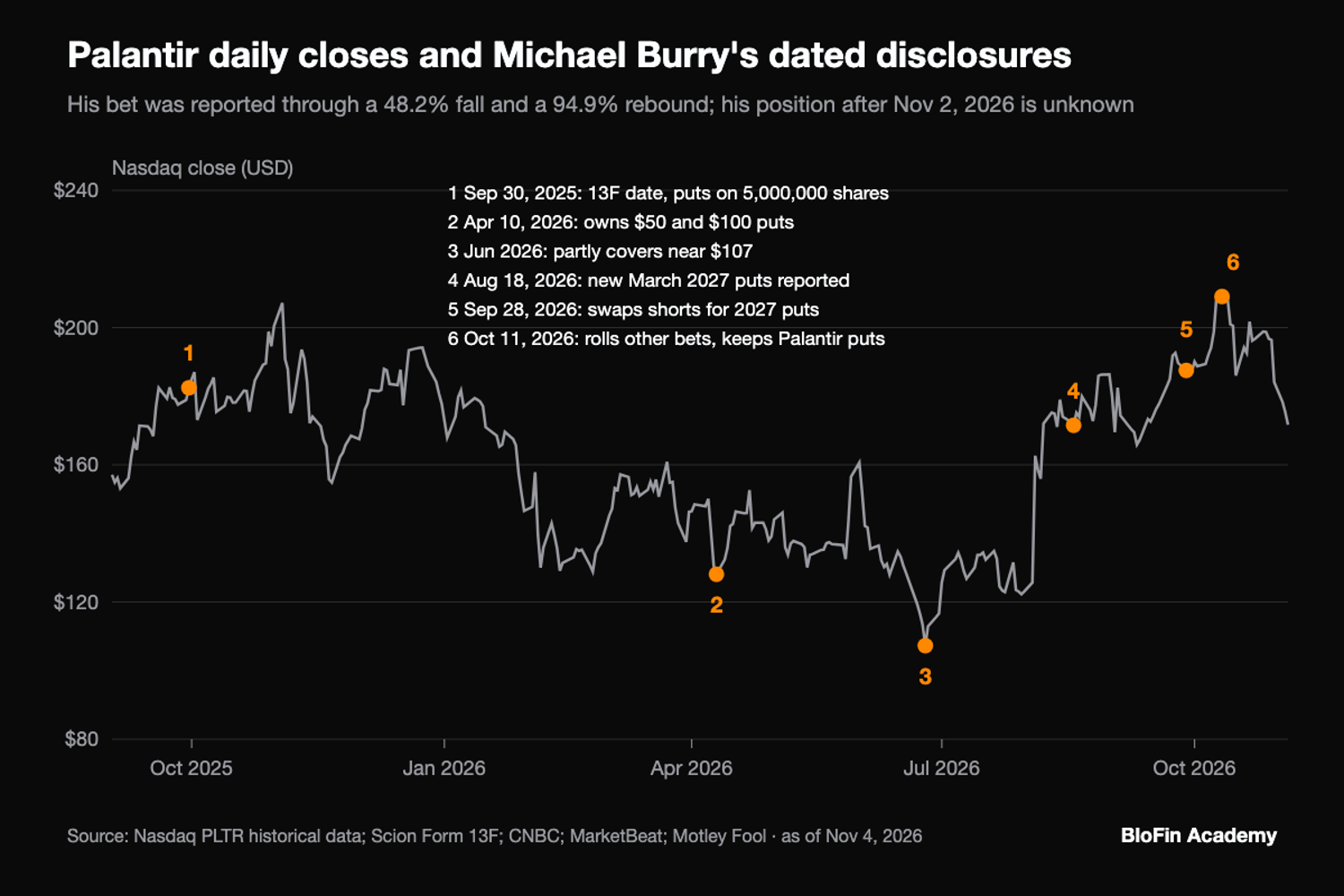
He has also questioned the accounts. In a February post, according to a Motley Fool article of October 31, 2026, he argued that accounts receivable, the money customers still owe, climbed faster than revenue in nine of 12 quarters (source: Motley Fool on Burry's position). That count is his own.
Nothing reported so far says what he did after the November 2 results, so his position today is unknown. Every position reported after the Form 13F reaches the public through press accounts, mostly of his own posts, and none of it comes from a regulatory filing. Bought puts cap the loss at the price paid, unlike the outright shorts he reported holding until September 28, 2026. That cap is also a different risk from shorting Palantir on BloFin, where a position can be liquidated.
What a Form 13F can show about a short position
A Form 13F shows less than the headlines imply. Large managers file it within 45 days after a quarter ends, and SEC staff guidance tells them, "You should not include short positions on Form 13F". They may still report put or call options they hold (source: SEC Form 13F FAQ). The fund's filing gave a value and a share count, with no strike price or expiry date. It is also the newest Form 13F on the fund's EDGAR list, filed on November 3, 2025 (source: SEC EDGAR filing list for Scion). A 13F figure quoted for Burry as current in 2026 therefore comes from an old date or from some other kind of source.
Crowded trade risk
Crowded trade risk is the danger that many similar buyers try to leave a stock at once, pushing the price down faster than the news alone would. Palantir has been linked to this risk through its retail following. In September 2025, a Motley Fool writer called individual investors the driving force behind the stock's momentum (source: Motley Fool on Palantir's retail following).
The same article ranked it the seventh most owned stock on Robinhood (source: Motley Fool on Palantir's retail following). The closes show how far a popular stock can travel, though they cannot show which buyers did the selling. Palantir fell 48.2% from $207.18 on November 3, 2025 to $107.27 on June 25, 2026. It then rose 94.9% to its record close on October 9, 2026 (source: Nasdaq PLTR historical data).
Short bets look small beside that activity. Short interest stood at 56.1 million shares for the October 15, 2026 settlement date, about 2.4% of Class A shares and 2.42 days of average volume (source: Nasdaq PLTR short interest).
The PLTRUSDT Perpetual follows this same stock, so its PLTRUSDT Perpetual page is one place to watch those swings, with the mark price and funding rate on show.
PLTRUSDT trading risks
The PLTRUSDT Perpetual adds trading risks of its own. BloFin offers up to 20x leverage, positions can be reduced or liquidated when the mark price moves against them, and outside regular US hours, orders may be restricted to reduce-only. Because the contract only tracks the price, it carries no shares, votes or dividends (source: BloFin PLTRUSDT contract details) (source: BloFin stock futures notice).
Report week shows the size of the danger. On the contract's daily chart, in UTC days, the price fell 13.8% from a high of 188.69 USDT on November 2, 2026 to a low of 162.60 USDT on November 3 (source: BloFin PLTRUSDT market data). Multiplied by 10x, that fall comes to 138.3% of the margin. On isolated margin at 10x, the margin is about a tenth of the position. A long held through a fall that size would be reduced or liquidated first.
Liquidation on BloFin uses the mark price as its trigger, and that price can differ from the last trade. Funding also matters to anyone holding for days. It is normally charged every eight hours, starting at 12AM UTC and then at 8AM and 4PM UTC, with a cap of 3% either way per period (source: BloFin PLTRUSDT market data).
Regular US hours run from 9.30AM to 4PM ET (2.30PM to 9PM UTC during US winter time), and the contract's trading hours change what you can do outside them. The 20x limit also applies only to the smallest positions, since how much leverage the contract allows falls as a position grows (source: BloFin PLTRUSDT position tiers).
Looking to trade Palantir? To get started, you'll need to first create a BloFin account, fund your account with cryptocurrency, and go to the PLTRUSDT Perpetual trading page.
Frequently asked questions
Has Palantir been sued by its shareholders?
Yes. Class actions filed from September to November 2022 in Colorado, known as Cupat v. Palantir, alleged false and misleading statements about the business. A court dismissed the case with prejudice on April 4, 2025. The plaintiffs appealed to the Tenth Circuit, which heard oral argument on March 16, 2026. At September 30, 2026, Palantir said it knew of no pending legal matter expected to do it material harm (source: Palantir Q3 2026 Form 10-Q).
Does Palantir work with China?
Palantir says, "We do not work with the Chinese communist party", and it does not host its platforms in China. It warns that this choice may limit its growth. Its products are also subject to US export controls, though it says most can generally be exported without a specific license (source: Palantir Q3 2026 Form 10-Q).
How much could a GDPR fine cost Palantir?
Palantir's filing says the most serious breaches of the EU's privacy law can bring fines of up to 4% of worldwide annual revenue, or a fixed sum if that is higher. On 2025 revenue of $4.5 billion, 4% comes to $179.0 million (source: Palantir Q3 2026 Form 10-Q; Palantir 2025 Form 10-K).
Can customers cancel their Palantir contracts?
Many can. The latest quarterly report says Palantir lets many customers end contracts for convenience before the stated term is over, with under twelve months' notice. Remaining performance obligations, the noncancelable contracted revenue still to be recognized, were $4.9 billion at September 30, 2026 (source: Palantir Q3 2026 Form 10-Q).
Can investors see Palantir's classified contracts?
Only in part. Palantir warns that classified programs limit what investors can learn about parts of its business, because security rules bar it from sharing the details. Investors can read total government revenue in each report, while the details of those programs stay out of view (source: Palantir Q3 2026 Form 10-Q).
Researched and written by the BloFin Academy editorial team with AI-assisted drafting. All facts independently verified. Primary sources include Palantir's third-quarter 2026 Form 10-Q and 2025 Form 10-K, Scion Asset Management's Form 13F and EDGAR filing list, the SEC's Form 13F guidance, and Palantir's November 2, 2026 earnings call transcript. Price and short interest data come from Nasdaq, with reporting from Bloomberg Law, CNBC, Reuters, AFP, Business Insider, The Motley Fool, MarketBeat, 24/7 Wall St., IBTimes UK, Globes and Asianet Newsable, plus Storebrand's own exclusion list. BloFin facts come from its stock futures notice, its academy guides and its own PLTRUSDT Perpetual data, current as of November 5, 2026.
Nothing in this article constitutes financial advice, and nothing in it is a recommendation to buy, sell or hold Palantir in any form. Palantir's stock fell 48.2% between closes from November 2025 to June 2026 while its revenue kept growing, and its filing warns that it may decline regardless of operating performance. The PLTRUSDT Perpetual moved 13.8% from high to low across two days of report week, more than the margin on a 10x isolated position, and its trading may be limited to reduce-only orders outside regular US hours. Past performance does not indicate future results. Do your own research and consider your risk tolerance before you trade on BloFin.