
Buying a foreign stock on the traditional market used to mean clearing three gates. You needed a broker licensed where you live and willing to trade the market you wanted, a bank that would move money into that account, and a market that happened to be open when you were awake. Miss any one and the answer was simply no, however much you wanted the exposure.
Tokenization collapses all three into an exchange account. The tokenized real world assets settle on a blockchain rather than through a national clearing system, they are funded with stablecoins rather than a bank wire, and they trade whenever you do. Those are the key benefits, more than any technology story: it turns a question of access into a question of whether you want the position.
NVDAX is the NVIDIA xStock, a tracker certificate issued by Backed Finance and listed on BloFin as the NVDAX/USDT pair. Buying it is simpler than most traders expect, and this guide walks through every step from account creation to your first filled order.
The core steps to buying NVDAX
NVDAX is a tokenized security available on the BloFin Spot market as the NVDAX/USDT pair. Tokenized stocks are blockchain-based digital assets representing real shares, and tokenized NVIDIA stock is backed 1:1 by actual NVDA shares held by custodians. NVDAX offers 24/7 trading for NVIDIA's tokenized stock, unlike traditional stock market hours on Nasdaq.
Create an account on BloFin and complete identity verification.
Deposit USDT or another supported asset into your account.
Transfer the funds to your Spot account.
Go to the Spot trading page and search for NVDAX/USDT.
Place a market or limit order for the amount you want.
Review your NVDAX holding in the Spot portfolio.
This guide focuses exclusively on how to buy tokenized NVIDIA on BloFin. If you want to understand what tokenized NVIDIA (NVDAX) is and what you actually own, read our dedicated NVDAX explainer. The sections below cover KYC, funding options, order types, and post-purchase management in detail.
What is tokenized NVIDIA (NVDAX) on BloFin?
NVDAX is the NVIDIA xStock, a tracker certificate issued by Backed Finance. It tracks the price of NVIDIA Corporation (Nasdaq: NVDA) on a blockchain, and on BloFin it trades like any other crypto spot pair, quoted against USDT.
Each token is collateralized 1:1 by real NVDA shares, custodied with Alpaca, a US self-clearing broker-dealer. You do not have to take that on trust: the issuer publishes reserve data through an open API that needs no key or account, so you can check shares held against tokens in circulation yourself (source: xStocks API). The guide on NVDAX proof of reserves walks through how.
What it is not is legal share ownership. Holding NVDAX allows you to gain exposure to NVIDIA's price without voting or shareholder rights. Dividends are the exception worth knowing about: Backed reinvests them, net of withholding tax, into the token's value through an on-chain rebasing multiplier, so the value reaches you as an adjusted balance rather than cash (source: xStocks Docs).
Three things follow from that structure. Your NVIDIA exposure sits in one exchange account next to Bitcoin, Ether, and everything else, with no separate brokerage relationship to maintain. Fractional sizing is native, so you buy decimal amounts rather than whole shares. And the market runs 24/7 rather than on Nasdaq trading hours. Evidently, tokenized stocks provide a seamless bridge to equity markets without the need for traditional brokerages. Our dedicated guide on what tokenized NVIDIA (NVDAX) is covers the full backing structure in depth.
Before you start: Create a BloFin account
Buying NVDAX needs the same two things as buying any asset on BloFin: a verified account and a funded Spot wallet. Both are general steps rather than NVDAX-specific ones, so this guide links to the dedicated walkthroughs instead of repeating them.
Create and verify your account. Sign up, complete identity verification, and enable two-factor authentication before you deposit anything. The full walkthrough is in create a BloFin account. Your verification level also sets your withdrawal ceiling, which starts at 20,000 USDT a day and rises with each tier, so it is worth completing if you plan to size up.
Fund your Spot account. You need a balance, typically in USDT, sitting in your Spot account. The complete deposit process, including choosing the correct network and sending a small test transfer, is in the BloFin deposit guide. Two things matter for NVDAX specifically: make sure the funds land in Spot rather than Funding or another sub-account, and hold slightly more USDT than your order size to cover fees and any slippage. If you fund with fiat, note that card, SEPA, and bank transfers carry a 48-hour hold before withdrawal, which does not stop you trading but does stop you moving the money straight back out.
One check to do before either step, because it is easier now than after you have funded an account: users in restricted jurisdictions, including the United States, cannot access tokenized assets on BloFin, and you will need to confirm you are not a UK citizen or a resident of another restricted region before trading xStock products.
With a verified account and USDT in your Spot account, everything below is the part that is specific to NVDAX.
Navigating to the NVDAX Spot market on BloFin
NVDAX is listed under BloFin's xStocks category in the Spot trading interface. To buy tokenized NVIDIA, traders use the NVDAX/USDT spot pair on BloFin, and that is exactly where you need to navigate.
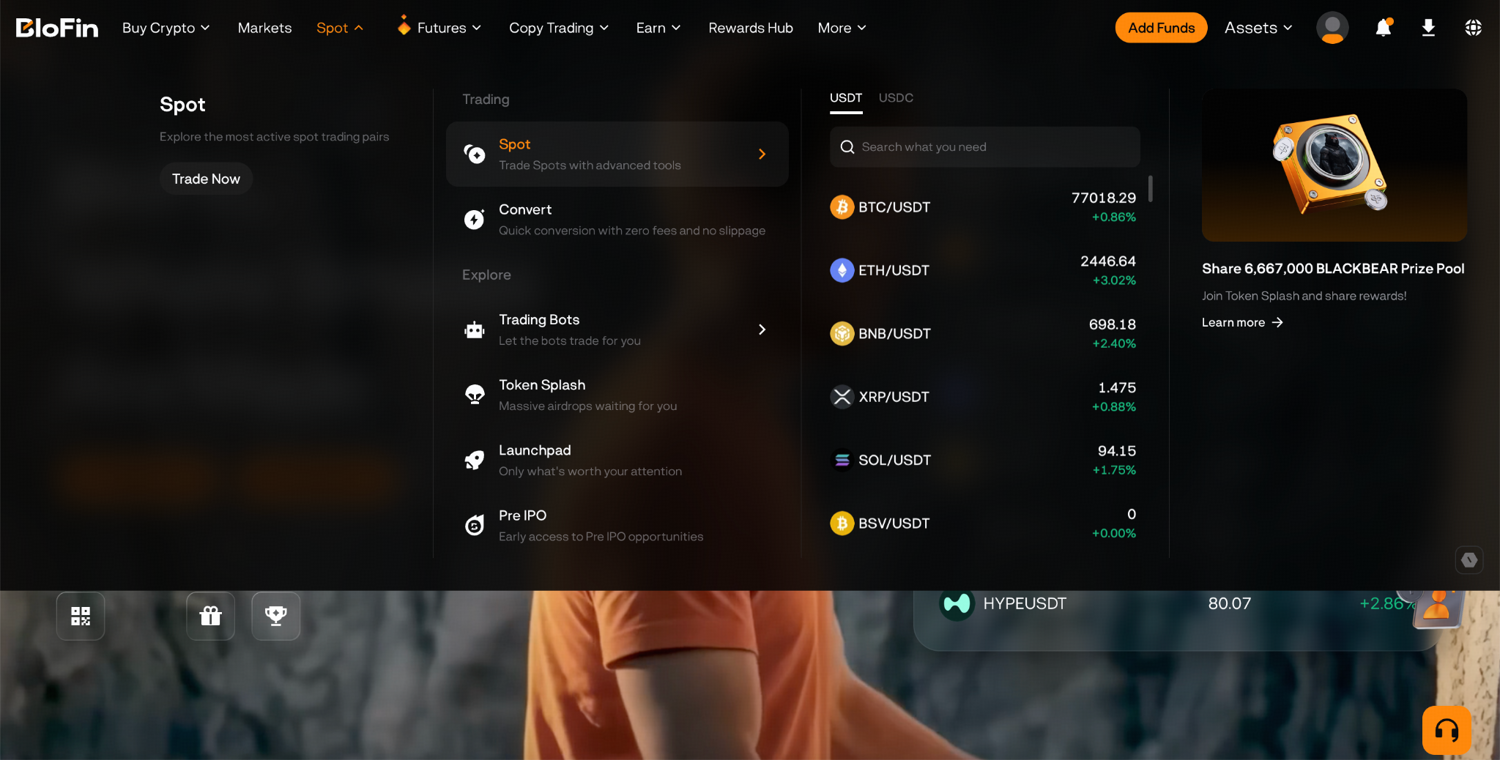
Step 1: Log in to your BloFin account and hover your cursor over the Spot tab. Then, click Spot.
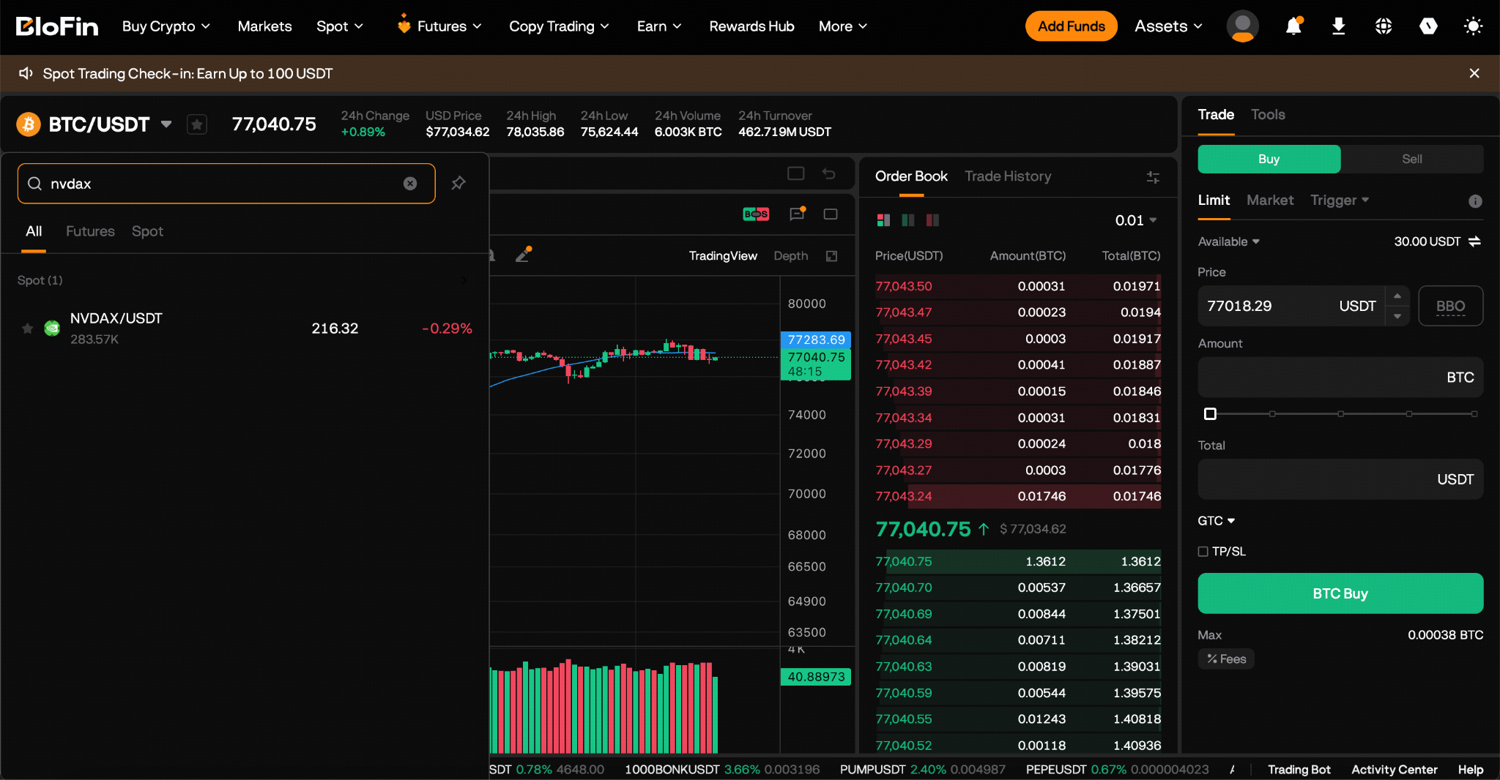
Step 2: Hover your cursor over the BTC/USDT Spot pair and in the search bar, type NVDAX.
Step 3: Select NVDAX/USDT from the results to open the NVDAX/USDT trading page.
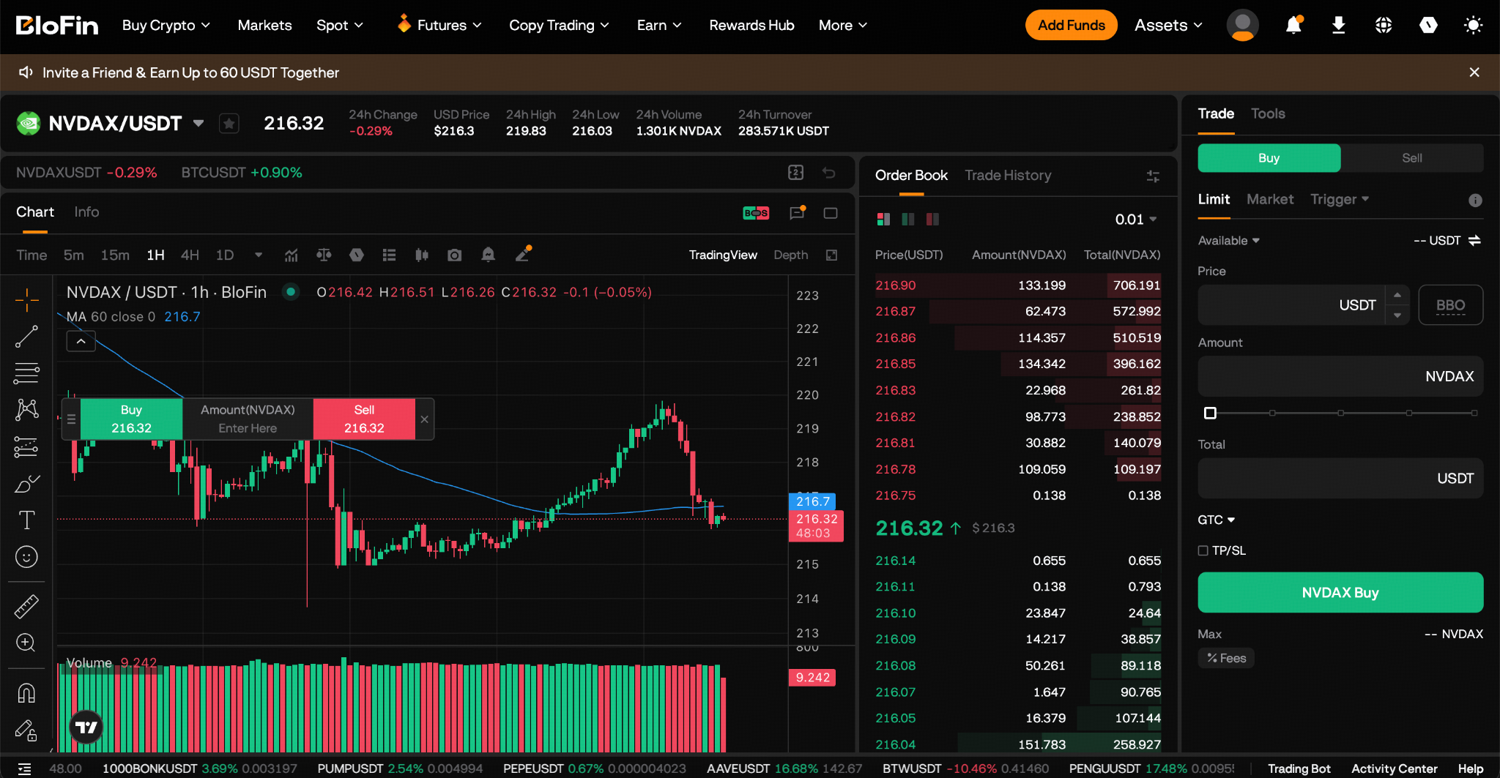
Before placing an order, glance at the price today, the 24-hour trading volume, and visible spreads. Liquidity and price gaps can occur because tokenized stock products trade on crypto infrastructure 24/7, and liquidity risks for tokenized stocks may exceed those of altcoins during off-hours. Our separate guide on NVDAX liquidity and slippage covers this in depth.
Tokenized NVIDIA stock offers price exposure without actual share ownership. For a side-by-side look at what differs from holding real NVDA shares, see tokenized NVDA vs real NVIDIA stock.
Placing your first NVDAX order: Market, limit, and advanced options
BloFin supports the usual order types for NVDAX, giving you control over price and execution speed. Spot trading is unleveraged, so there is no liquidation risk. If this is your first trade on BloFin, start small to get familiar with the interface, and see how to place your first trade for the general walkthrough.
Market order. Buys NVDAX immediately at the best available price in the book. Simplest when you want instant execution and are comfortable with the current price, though you accept whatever the book offers.
Limit order. You set an exact price and the order fills only at that level or better. This is the better choice when spreads are wide, which for NVDAX means outside Nasdaq hours, and around volatile moments like earnings.
Here is a worked example, buying 100 USDT worth of NVDAX:
Step 1: On the order panel of the NVDAX/USDT Spot trading page, select Buy.
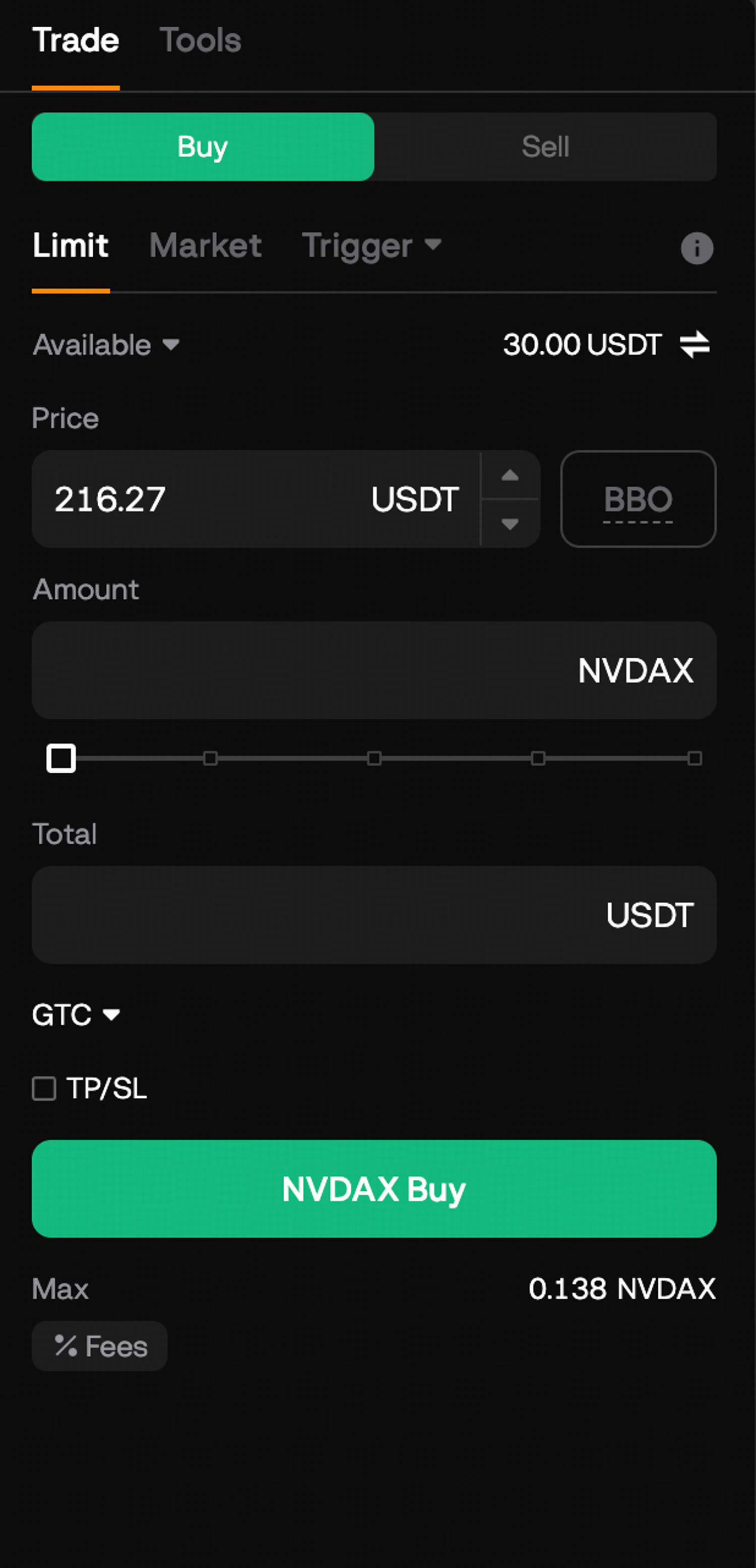
Step 2: Choose Market as the order type and enter 100 in the USDT amount field. If the field shows NVDAX instead, tap the Amount button and select Total.
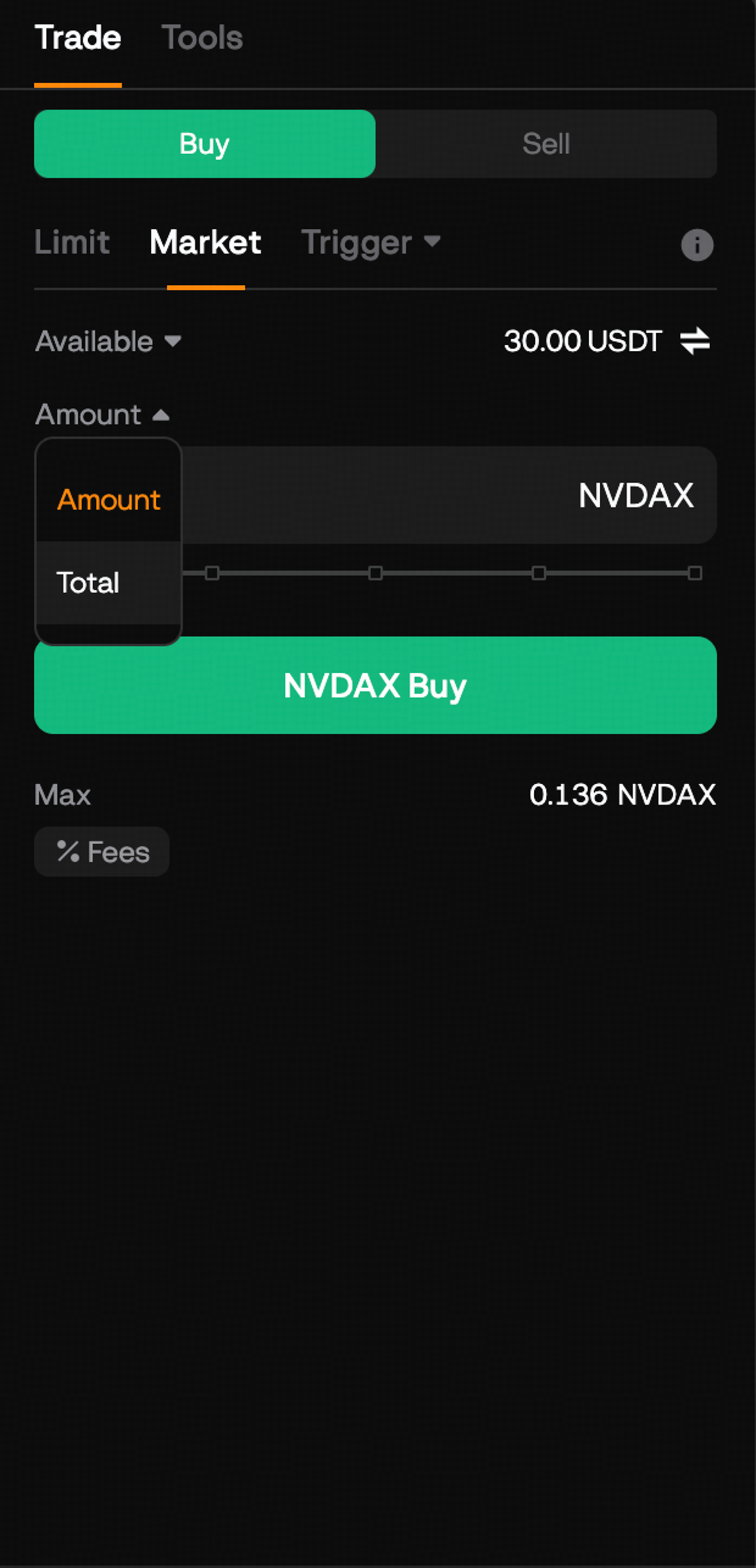
Step 3: Review the estimated quantity and fees, then click NVDAX Buy.
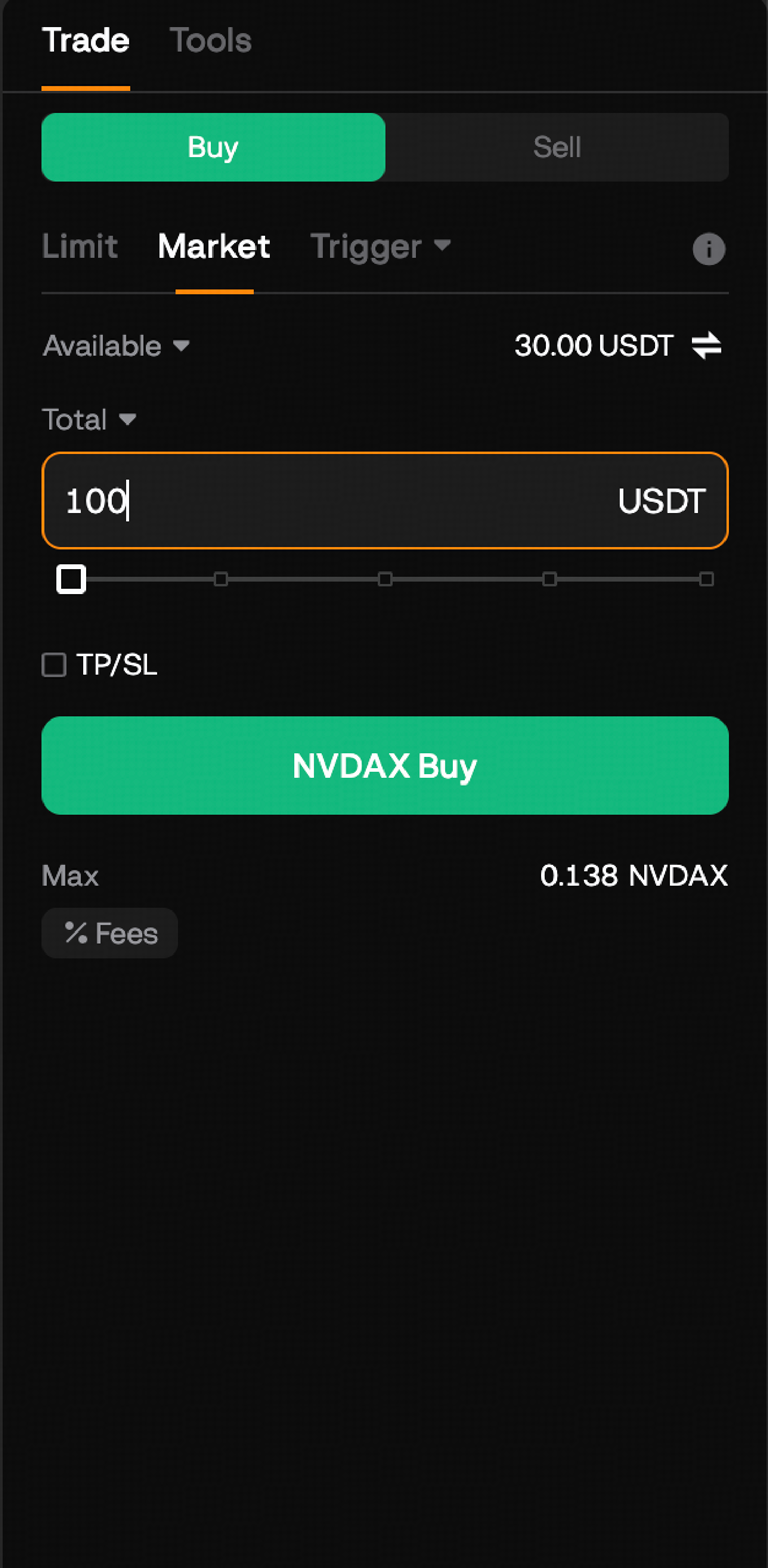
Partial fills can happen with limit orders during less liquid periods. Check the Open Orders and Order History tabs for actual execution details, filled value, and any remaining amount.
Advanced traders who want leverage for NVIDIA exposure should consult the guide on how to trade NVDA with leverage via the perpetual rather than using this spot workflow.
Reviewing, holding, and managing your NVDAX position
Once your order fills, NVDAX appears in your Spot account, representing your tokenized NVIDIA position. You can then proceed to monitor it on the platform without an external tracker. To do so, open the Assets page on BloFin, locate NVDAX, and view your total balance, its value in USDT, and recent transaction history.
You can pin NVDAX to a watchlist alongside pairs like BTC/USDT for quick access. Selling is the reverse of buying: choose Sell, pick your order type, confirm the amount, and check that the proceeds land in your Spot account.
On withdrawals, you can move NVDAX to a wallet you control. The network you select on BloFin must match your destination wallet, and getting that wrong usually means losing the funds. The NVDAX self-custody guide covers the full process.
Avoid concentrating your portfolio in a single tokenized stock. Keep some balance in stablecoins, review your exposure ahead of NVIDIA earnings, and size positions against your actual risk tolerance rather than your conviction. As retail investors, the key is to build diversified portfolios.
For a full breakdown of what rights and limitations accompany this tokenized security compared to traditional stock ownership, read tokenized NVDA vs real NVDA stock.
Maintain strong account security: keep 2FA enabled, use a unique password, and stay alert to phishing attempts.
Fees, liquidity, and practical risk checks when buying NVDAX
NVDAX trades like any other spot pair, but understanding fees, spreads, and depth before sending a large order will save you unpleasant surprises.
Fees. BloFin applies maker and taker fees on spot trades, with volume-based discounts at higher tiers. The mechanics are explained in all crypto trading fees explained. Unlike an ETF, there is no annual management fee on the token itself, so your cost is concentrated in trading rather than accruing while you hold.
Liquidity. This is the real difference from a major crypto pair. NVDAX turned over roughly $9 million in 24 hours against a token market cap near $36 million (source: CoinGecko). That is respectable for a tokenized equity and a rounding error next to NVIDIA's own Nasdaq volume, which means wider spreads and more slippage on large orders. Depth thins further outside Nasdaq hours. Our guide on NVDAX liquidity and slippage covers this in detail.
Price gaps. Because NVDAX runs 24/7 and NVDA does not, gaps appear between BloFin's market and the next Nasdaq session. That is normal rather than a malfunction, and the dedicated article on 24/7 price gaps explains how to manage it.
Structural risks. You are relying on the issuer and its custodian, so an issuer or custody failure is a real risk that direct share ownership does not carry. You get no voting rights. And regulators have been explicit that tokenized securities remain securities while the framework around them is still being written, so access and treatment vary by jurisdiction. A full rights comparison is in tokenized NVDA vs real NVIDIA stock.
Key benefits: Why crypto traders use BloFin for NVIDIA tokenized stock exposure
The practical draw is not the technology, it is not having to run two systems. Instead of maintaining a brokerage account with limited hours and fiat settlement delays alongside your crypto activity, NVDAX sits in the same account as BTC, ETH, and everything else, settled in stablecoins.
That consolidation has knock-on effects. Rebalancing between NVIDIA exposure and the rest of your portfolio takes one trade rather than a bank transfer and a settlement wait. Unified accounts let spot and derivatives positions share one margin pool, which also lets NVDAX sit inside the broader crypto ecosystem on the platform instead of being managed separately. And trading bots and copy trading work on NVDAX the same way they work on any other pair, so it fits the wider ecosystem around automated strategies rather than sitting beside them. For a full overview, see BloFin features explained.
Round-the-clock access matters more than it sounds for a non-US trader. If you are in Asia or Europe, Nasdaq's session lands in your night, and the ability to act on equity markets or macro news when it breaks rather than twelve hours later is a genuine structural advantage over a traditional platform. Unlike traditional stock markets, tokenized products also let some users invest with more flexible access and timing.
The tokenized asset market also lowers geographic barriers, removing the need for a US brokerage in many cases, which for some readers is the difference between having access to NVIDIA exposure and not. That said, this remains an evolving market where the investment case still carries real risks, especially as tokenized stocks can also interact with DeFi platforms and the wider crypto ecosystem, explored in the tokenized stocks pros and cons overview.
Checklist before you buy tokenized NVIDIA on BloFin
Run through this before placing your first NVDAX trade:
Understand what NVDAX is: a tracker certificate on NVIDIA's price, not a share with voting rights.
Confirm you are eligible to trade xStock products where you live.
Create a BloFin account and complete identity verification.
Enable two-factor authentication before depositing anything.
Deposit USDT and confirm it landed in your Spot account.
Navigate to NVDAX/USDT and check the current spread and order book depth.
Choose your order type, and prefer a limit order if the spread looks wide.
Double-check the side, amount, and price, then confirm.
The two checks people skip are the spread and the eligibility question, and both are cheaper to do now than to discover afterwards. For a deeper look at the product structure, continue with what tokenized NVIDIA (NVDAX) is.
Frequently asked questions
Do I need to complete KYC to buy NVDAX on BloFin?
Yes. Identity verification is required before you can access the NVDAX spot market, in line with compliance rules for tokenized equities. The process usually takes an ID document and a selfie and finishes within minutes, though it can vary by region and run longer at busy times. Your verification level also determines your daily withdrawal ceiling, starting at 20,000 USDT and rising with each tier. Enable two-factor authentication once you are approved, before depositing any funds.
What do I fund my account with to buy NVDAX?
Typically USDT, since NVDAX trades against it as NVDAX/USDT. You deposit a supported crypto asset, matching the network on both ends, for example ERC-20 to ERC-20, and for a first transfer it is worth sending a small test amount. Once the funds arrive, you may need to move them from a funding sub-wallet to Spot before the order screen will let you buy. If you fund with fiat instead, expect a 48-hour hold before those funds can be withdrawn again, though you can trade during that window.
Does buying NVDAX make me an NVIDIA shareholder?
No. NVDAX gives you economic exposure to NVIDIA's share price rather than legal ownership, so there are no voting rights and no shareholder-meeting access. The token is one of Backed's tokenized public securities. These are backed 1:1 by real shares held with a custodian, but that backing sits at the issuer level and does not make you a registered shareholder. Dividends are the one economic exception: Backed reinvests them into the token's value rather than paying cash, so you receive the value without receiving a payment. Holders have a primary claim to the collateral value of the backing rather than direct shareholder rights. For the full rights comparison, see the tokenized NVDA vs real NVIDIA stock guide.
Why is the NVDAX spread wider than a pair like BTC/USDT?
Because a tokenized stock has far less liquidity than a heavily traded crypto pair, and NVDAX can be less cost-efficient than ETFs or highly liquid crypto pairs because spreads are wider. NVDAX turns over single-digit millions a day against BTC's billions, so the bid-ask spread is wider and order-book depth thinner; for larger orders, that is exactly that trade-off between always-open access and thinner liquidity, with more slippage and a higher chance of partial fills. It widens further outside Nasdaq hours, when market makers cannot hedge efficiently against the underlying shares. Using limit orders, sizing sensibly, and checking depth before you trade all help. Pricing can also vary across exchanges when liquidity is fragmented.
Can I withdraw NVDAX to my own wallet?
Yes. Moving tokenized stocks to a wallet you control is what enables use on DeFi platforms in some setups. NVDAX is issued across several networks, including Solana, Ethereum, Arbitrum, and BNB Chain, and you can withdraw it from BloFin to a wallet you control, which is something you cannot do with shares held at a broker. The network you select must match your destination wallet, and sending on the wrong chain usually means the funds cannot be recovered. Check the minimum withdrawal amount on the withdrawal screen, and send a test amount first if the wallet is new. Once withdrawn into compatible on-chain venues, holders may also use tokenized assets as collateral for loans. The full process is in the NVDAX self-custody guide.
Can I trade NVDAX when the US stock market is closed?
Yes. NVDAX trades 24 hours a day, seven days a week, including weekends and US holidays, while NVDA is limited to traditional market hours. The trade-off is that liquidity thins when the underlying market is shut, so spreads widen and price can drift from where NVDA last closed, which is why gaps appear when Nasdaq reopens. Trading during the Nasdaq overlap gives you the tightest pricing; trading outside it buys you speed and costs you precision.
Is this the same as NVIDIA xStock?
Yes. NVDAX is the ticker for the NVIDIA xStock, a tracker certificate issued by Backed Finance through Backed Assets (JE) Ltd, carrying the ISIN CH1436219195, with collateral maintained through 1:1 backing by real NVDA shares held with a regulated custodian. If you see the token written as NVDAx elsewhere, that is the issuer's own notation for the same asset rather than a different product.
Researched and written by the BloFin Academy editorial team with AI-assisted drafting. Updated August 2026. Primary sources include BloFin platform documentation, Backed Finance, the xStocks product documentation and public reserve API, and the SEC. Verification tiers, withdrawal limits, fiat on-ramp providers, and supported networks are set by the venue and can change, so work from what is displayed in your account at the time you trade.
This article is educational content, not financial advice. Tokenized equities and crypto assets are volatile and carry a risk of loss. Tokenized stocks carry issuer, custody, platform, and network risks that direct share ownership does not, they confer no voting rights, they are unavailable in some jurisdictions including the United States, and markets for them can be considerably less liquid than the underlying shares, and past performance does not predict future results. Do your own research and consider speaking with a qualified financial professional before acting.