
Sooner or later, anyone who wants to own a precious metal has to decide which one to hold. Gold and silver sit side by side on dealer shelves, share a long history as money and often rise in the same weeks. They can look like a large and a small version of the same thing.
The resemblance is mostly on the surface. Central banks keep gold in their reserves, while factories use silver up in solar panels and other products, so the two prices answer to different buyers. Silver also moves further in both directions and takes up far more vault space for the same money. A chart of one price divided by the other shows which metal is ahead, but it leaves out who buys each one and what it costs to keep.
So choosing between gold and silver means choosing which kind of metal you want to own, and why. One is a reserve asset that central banks also buy, and the other is a metal that factories use up, with bigger swings and a higher storage bill.
On BloFin, gold (XAU) and silver (XAG) both trade as perpetual futures settled in USDT, including the XAGUSDT Perpetual. A perpetual leaves no bar to store, so its running cost is funding, paid or received every four hours.
Gold vs silver: Which metal should you hold?
Gold versus silver comes down to what the holding is for: gold has been the steadier store of value, while silver is the more volatile bet on metal prices and industry. Over the 10 years to November 3, 2026, a silver fund swung about twice as hard as a gold fund and still returned less (source: Nasdaq, SLV historical prices) (source: Nasdaq, GLD historical prices).
Those funds are the iShares Silver Trust (SLV) and SPDR Gold Shares (GLD), which trade like shares, so their daily closes give you a record of what an ordinary holder lived through. SLV gained 157.4% in those 10 years and GLD gained 189.0% (source: Nasdaq, SLV historical prices; Nasdaq, GLD historical prices). Both funds charge fees, so these returns slightly understate the metals themselves.
The two metals differ on four points that matter to a holder.
What differs | Gold | Silver |
|---|---|---|
Worst fall of the fund, past 10 years | 28.3% | 57.8% (source: Nasdaq, SLV historical prices; Nasdaq, GLD historical prices) |
Official-sector activity | 321 tonnes bought in Q3 2026 | 1.5 million ounces of net sales in 2025 |
Factory and solar demand | A small share of demand | Industry is the largest source of demand |
Weight of $10,000 of metal | About 77 grams | About 6 kilograms |
Neither metal pays you anything while you wait, so the first question is whether a metal belongs in your holdings at all. That means weighing silver as an investment and gold as an investment against stocks and cash.
What gold and silver are each for
Gold is bought largely as a store of value, while silver plays two roles: a monetary metal and an input that industry uses up. Technology took about 6.5% of gold demand in 2025, and industrial buyers took about 58% of silver demand, so the factory cycle reaches silver far more directly (source: State Street, "Silver is no substitute for gold"). The two totals differ, though: gold's includes fund buying and silver's leaves it out, and adding silver's 278.1 million ounces of fund buying brings its industrial share to about 47% (source: Silver Institute, World Silver Survey 2026).
Behind those shares, the World Gold Council's first full-year count has about 61% of gold's 5,002.3 tonnes of 2025 demand coming from bars, coins, funds and central banks, up from about 46% of 4,961.9 tonnes in 2024. Technology took 322.8 tonnes in 2025 (source: World Gold Council, Gold Demand Trends 2025). The council has since revised 2025 upward, putting demand over the first nine months at 3,884 tonnes against 3,699.5 tonnes in those tables, so these shares are first estimates (source: World Gold Council, Gold Demand Trends Q3 2026). Silver's 1,130.6 million ounces of 2025 demand included 657.4 million ounces of industrial use, of which solar panels alone took 186.6 million (source: Silver Institute, World Silver Survey 2026). State Street, which markets the GLD fund, ties silver demand to industrial activity and calls gold's demand far more countercyclical (source: State Street, "Silver is no substitute for gold").
The two markets also differ greatly in size. The World Gold Council counts about 224,200 tonnes of gold above ground at the end of the third quarter of 2026, worth about $30.0 trillion (source: World Gold Council, above-ground stocks). A simpler comparison uses one year of mining at BloFin's November 4 marks of $4,036.92 on the XAUUSDT Perpetual and $51.96 on the XAGUSDT Perpetual. Gold's 3,672 tonnes of 2025 output, on the council's first count, come to about $476.6 billion (source: World Gold Council, Gold Demand Trends 2025). Silver's 846.6 million ounces come to about $44.0 billion, so a year of new gold is worth about 10.8 times a year of new silver (source: Silver Institute, World Silver Survey 2026). A tonne is about 32,151 troy ounces (source: NIST conversion factors for precious metals).
Central-bank demand for gold and silver
Central banks are regular gold buyers, while official-sector silver volumes are tiny. They bought an estimated 321 tonnes of gold in the third quarter of 2026, up 42% from a year earlier (source: World Gold Council, Gold Demand Trends Q3 2026). Official-sector net sales of silver came to just 1.5 million ounces in all of 2025 (source: Silver Institute, World Silver Survey 2026).
The council published those figures on November 3, 2026, and it says the full year's central-bank buying is likely to at least match 2025. Buying over the first nine months reached 675 tonnes (source: World Gold Council, Gold Demand Trends Q3 2026).
Silver has no equivalent buyer: the Silver Institute calls the official sector's volumes trivial (source: Silver Institute, World Silver Survey 2026), and State Street's head of gold strategy says flatly that central banks do not hold silver (source: State Street, "Silver is no substitute for gold"). That comes from a firm with a gold fund to market, and the Silver Institute's figures show no large official buying either.
This matters to a holder because the reasons central banks buy gold are usually strategic, such as reducing reliance on the dollar, in State Street's reading (source: State Street, "Silver is no substitute for gold"). So part of gold's demand answers to something other than the economy. That support has limits, since GLD still fell 28.3% from its January 2026 high to its October low, in a year when central banks kept buying (source: Nasdaq, GLD historical prices).
Why silver is called poor man's gold
Poor man's gold is a nickname for silver, whose ounce costs far less than an ounce of gold, and many allocators treat the metal as a cheaper alternative. That framing hides what you actually take on with silver: higher volatility, heavier dependence on industry and no large-scale central-bank buyer behind the price (source: State Street, "Silver is no substitute for gold").
State Street argues that treating silver as the cheaper alternative could be a mistake (source: State Street, "Silver is no substitute for gold"). The price gap itself is what the gold/silver ratio measures: about 77.7 ounces of silver per ounce of gold at the November 4 marks of the two BloFin perpetuals.
A low price per ounce tells you nothing about value for money, because, before dealer premiums and tax, each dollar buys a dollar of metal either way. Say you have $5,000, which at those marks buys about 96.2 ounces of silver or about 1.24 ounces of gold. The stack of silver looks bigger, but a fall of a tenth costs you $500 in both cases, and the real difference is how often and how far each one falls.
Volatility and drawdowns of gold and silver
The silver fund has been about twice as volatile as the gold fund and has fallen about twice as far. SLV's yearly volatility over the 10 years to November 3, 2026 was 32.7% against 16.5% for GLD. Its largest drawdown, the fall from a high to a later low, was 57.8% against 28.3% (source: Nasdaq, SLV historical prices; Nasdaq, GLD historical prices).
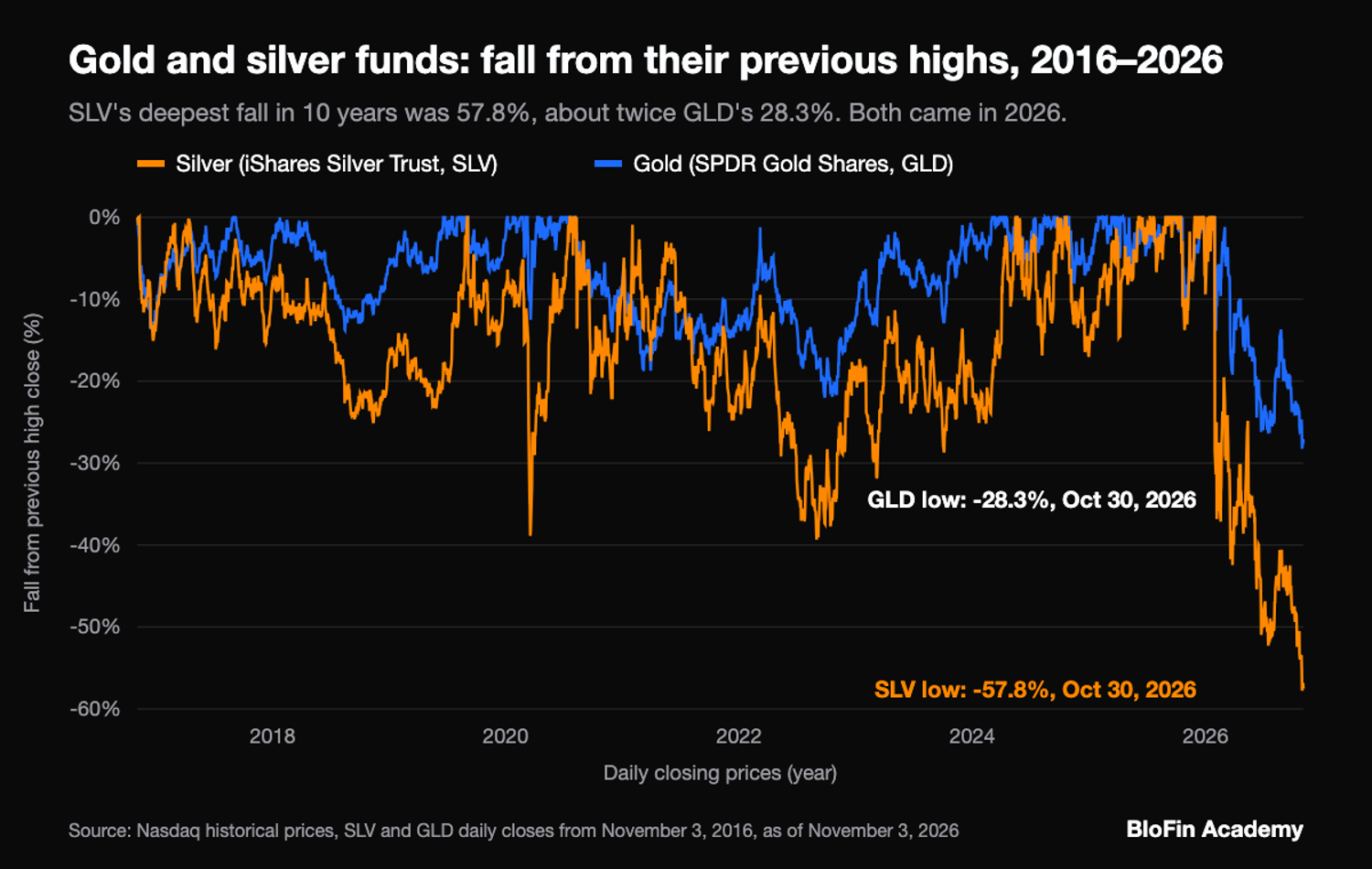
Both of those deepest falls came during silver's 2026 fall, and $10,000 held from each fund's high would have shrunk to about $4,223 in SLV and about $7,174 in GLD at the lows on October 30. Neither fund had regained its high by November 3 (source: Nasdaq, SLV historical prices; Nasdaq, GLD historical prices).
Smaller moves tell the same story, since SLV moved 3% or more in a day 254 times in those 10 years, against 50 times for GLD. Over the 119 months to October 2026, GLD rose in 63 months by an average of 4.3%, and SLV averaged 6.5% in those same months. GLD fell in the other 56 months by an average of 2.6%, and SLV averaged a 4.6% fall. SLV tends to take GLD's direction and stretch it, although it fell in 15 of the months GLD rose (source: Nasdaq, SLV historical prices; Nasdaq, GLD historical prices).
A much longer record points the same way. Over 40 years of quarterly returns, State Street counted 20 episodes when silver lost at least 10%, against six for gold (source: State Street, "Silver is no substitute for gold"). Gold looks calmer still beside bitcoin's swings.
Gold and silver performance in 2025 and 2026
The silver fund beat the gold fund in 2025 and gave more of the gain back in 2026. SLV rose 144.7% in 2025 against 63.7% for GLD, then fell 30.4% from the end of 2025 to November 3, 2026, against 9.3% for GLD. That still leaves SLV ahead at 70.3% to 48.4% across the whole period (source: Nasdaq, SLV historical prices; Nasdaq, GLD historical prices).
Your start date decides the winner: from the end of 2024 SLV leads, and from November 2016 GLD leads, because from then to the end of 2024 SLV rose 51.1% while GLD rose 94.8%. A comparison that quotes one window without naming it can prove either side (source: Nasdaq, SLV historical prices; Nasdaq, GLD historical prices).
What it costs to store and own each metal
Silver often costs more to store per dollar held because it takes up more space, the dealer GoldSilver says (source: GoldSilver, gold vs silver storage). BullionVault charges 0.12% a year to store and insure gold and 0.48% for silver, four times as much (source: BullionVault tariff). At the November 4 marks, $10,000 of silver weighs about 6 kilograms against about 77 grams of gold.
Those weights follow from the troy ounce of 31.1034768 grams (source: NIST conversion factors for precious metals). Your $10,000 buys about 192.5 ounces of silver or about 2.48 ounces of gold. Silver is also the less dense metal, at 10.5 grams per cubic centimeter against 19.3 for gold (source: Royal Society of Chemistry, silver) (source: Royal Society of Chemistry, gold). That gives you about 570 cubic centimeters of silver and about 4 of gold, so the same money takes up roughly 143 times the space.
Cost | Gold | Silver |
|---|---|---|
Vault storage and insurance at BullionVault | 0.12% a year, $4 monthly minimum | 0.48% a year, $8 monthly minimum |
Fund fee (GLD, SLV) | 0.40% a year | 0.50% a year |
UK value-added tax on buying bullion | Qualifying investment gold is exempt | Generally subject to VAT at 20%; exempt in an LBMA-approved vault |
The monthly minimums matter on small holdings: on $10,000 both percentages fall short of the minimum, so you would pay $48 a year for gold and $96 for silver (source: BullionVault tariff). Funds narrow the gap, since GLD's expense ratio costs about $40 a year on $10,000 and the SLV sponsor fee about $50 (source: SPDR Gold Shares) (source: iShares Silver Trust), so bulk is mostly a cost of holding the metal itself.
Tax can outweigh all of those for a UK buyer taking delivery. HMRC exempts investment gold from value-added tax (VAT) (source: GOV.UK, VAT Notice 701/21), while silver bullion is generally subject to VAT (source: The Royal Mint, bullion), and the UK standard rate is 20% (source: GOV.UK, VAT rates). Silver held in a London Bullion Market Association (LBMA) approved vault is exempt (source: BullionVault, buying silver).
Funding costs on the gold and silver perpetuals
Over the latest 50 settlements, staying long the XAGUSDT Perpetual cost about twice the funding of staying long the XAUUSDT Perpetual. Between 4AM UTC on October 27 and 8AM UTC on November 4, funding averaged 0.1000% a day on silver and 0.0480% a day on gold (source: BloFin XAG funding history) (source: BloFin XAU funding history).
Funding passes between the two sides of a perpetual and settles every four hours on both contracts, so those daily figures are the average rate per settlement multiplied by six. A positive rate has the long side paying the short side, and a negative rate reverses that, the same rule as funding on crypto perpetuals. All 50 silver rates were positive in that window. Gold had 35 positive rates and 15 negative ones, and those 15 paid gold longs (source: BloFin XAG funding history; BloFin XAU funding history).
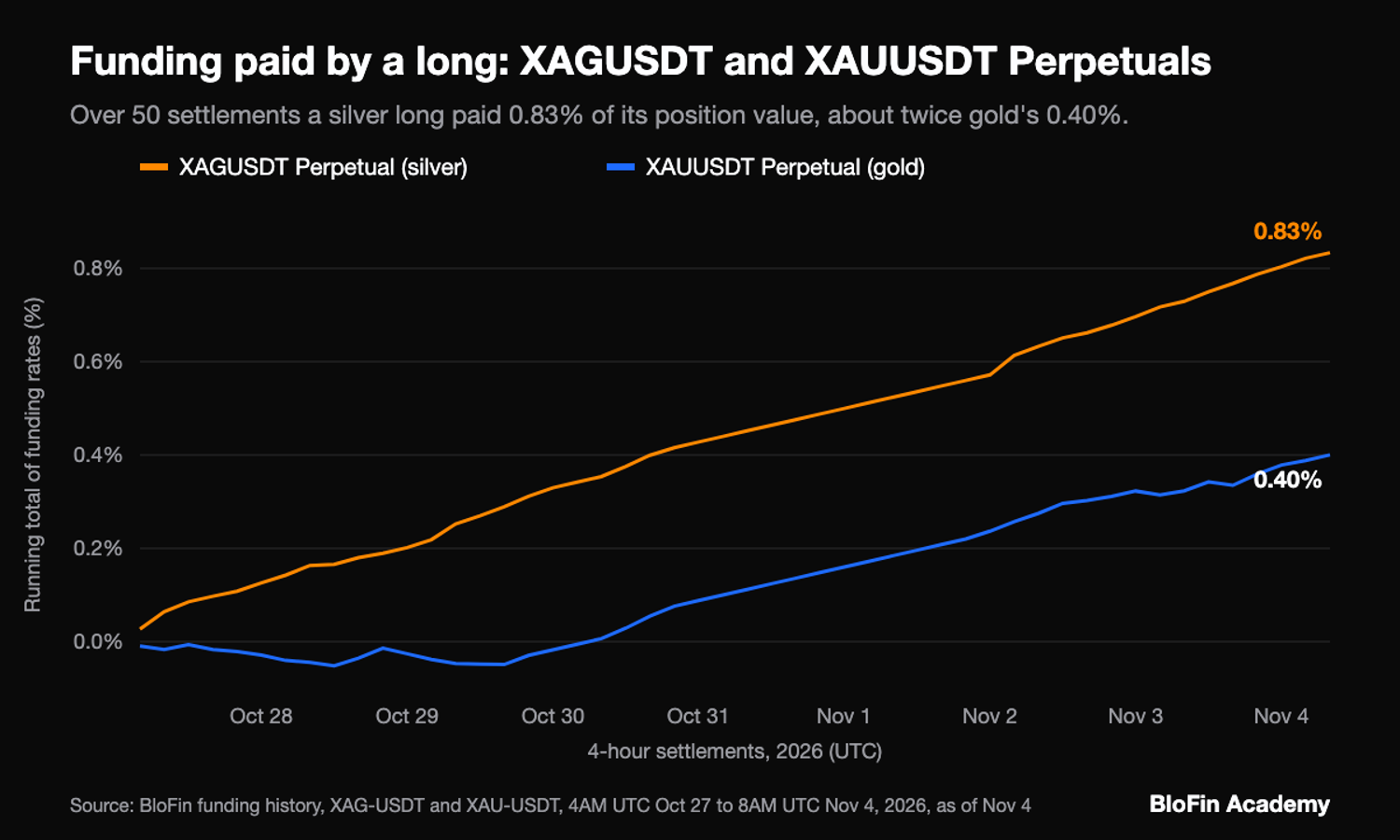
On a $10,000 long at 1x, the averages come to about $10.00 a day on silver and $4.80 a day on gold. Held for 30 days at those rates, that is about $300 and about $144, although the rate changes at every settlement and eight days is a short sample. Set against fund fees, the gap is wide: about five days of silver funding at that average equals a year of the SLV fee. About eight days of gold funding equals a year of the GLD fee.
So at that average, funding adds up within days, while a fund's fee or a vault's charge stays small across a year. The two rates need not move together, since only gold's rate turned negative in that window. That makes silver perpetual funding and gold perpetual funding two separate costs to track.
Silver's live funding rate shows on the XAGUSDT Perpetual page.
Holding gold, silver or a mix of both
You can also hold both metals, and a mix of the two funds has sat between them on volatility and falls. Over the 10 years to November 3, 2026, 75% GLD and 25% SLV had 19.5% volatility and a 36.3% worst fall, against 16.5% and 28.3% for GLD alone (source: Nasdaq, SLV historical prices; Nasdaq, GLD historical prices).
Share of the mix in SLV | Yearly volatility | Worst fall | $10,000 became |
|---|---|---|---|
0% (all GLD) | 16.5% | 28.3% | $28,903 |
25% | 19.5% | 36.3% | $29,449 |
50% | 23.4% | 43.9% | $29,076 |
100% (all SLV) | 32.7% | 57.8% | $25,741 |
Those mixes are rebalanced back to their weights every day and leave out trading costs and taxes. In this window, a 25% or 50% share of SLV changed the ending value only a little and raised the size of the falls by a lot. A window starting at the end of 2024 would favor SLV instead, so read the pattern as a measure of risk, with the return tied to its dates (source: Nasdaq, SLV historical prices; Nasdaq, GLD historical prices).
Three questions turn those numbers into a decision about your own holding, which only you can make.
How deep a fall could you sit through without selling? SLV's 57.8% fall and GLD's 28.3% fall each took about nine months, and a holder who sells near a low locks in the loss (source: Nasdaq, SLV historical prices; Nasdaq, GLD historical prices).
Do you want the holding to depend on industry? A silver position carries the factory and solar cycle, and a gold position carries far less of it.
How long will you hold, and in what form? Funding on a perpetual has added up within days at recent rates, fund fees stay small across a year, and silver's bulk costs more if you hold physical metal.
Traders who want a position on the gap between the metals, in place of a holding in either, use the gold/silver ratio trade with one long and one short.
The same questions apply when you compare silver with bitcoin or silver with platinum.
Gold and silver contracts on BloFin
BloFin lists a perpetual on each metal with the same leverage range and funding cycle, and adds a gold token on the spot market. The XAGUSDT and XAUUSDT Perpetuals settle in USDT and allow 1x to 100x leverage, while BloFin also lists Tether Gold (XAUT) as XAUT/USDT Spot and no silver spot pair or token.
Term | XAGUSDT Perpetual | XAUUSDT Perpetual |
|---|---|---|
Settlement | USDT | USDT |
Leverage | 1x to 100x | 1x to 100x |
Minimum order | 0.01 XAG | 0.001 XAU |
Minimum order's value at the November 4 mark | about $0.52 | about $4.04 |
Tick size | 0.01 | 0.01 |
Funding | Every 4 hours | Every 4 hours |
The terms come from BloFin's contract pages (source: BloFin XAG contract details) (source: BloFin XAU contract details). A gold buyer on BloFin therefore has a choice that a silver buyer lacks, between tokenized gold on the spot market and the perpetual. For silver the perpetual is the only route on BloFin, and its position tiers and other contract terms set how large a position can run at each leverage.
Leverage changes the comparison between the metals quickly. At 1x your margin matches the position, so a fall costs you the same as someone who owns the metal. At 10x, a fall of about 10% uses up the margin, and forced liquidation can close the position sooner than that. Both SLV and GLD fell by more than 10% on January 30, 2026, when SLV lost 28.5% and GLD lost 10.3%. SLV had five one-day falls of 10% or more in that decade, where GLD had one (source: Nasdaq, SLV historical prices; Nasdaq, GLD historical prices).
Looking to trade silver or gold? To get started, you'll need to first create a BloFin account, fund your account with cryptocurrency, and navigate to the XAGUSDT Perpetual, XAUUSDT Perpetual or XAUT/USDT Spot trading page.
Frequently asked questions
Do gold and silver prices move together?
The funds that track them mostly do, with SLV moving further. Daily returns of SLV and GLD had a correlation of 0.79 over the 10 years to November 3, 2026, where 1.0 would mean they always moved in step. On average, a 1% daily move in GLD came with a 1.56% move in SLV (source: Nasdaq, SLV historical prices; Nasdaq, GLD historical prices).
How often does silver beat gold?
Going by the closing prices of the funds that track them, silver beat gold in three of the nine calendar years from 2017 to 2025. The iShares Silver Trust (SLV) rose 47.3% in 2020 against 24.8% for SPDR Gold Shares (GLD), and 144.7% in 2025 against 63.7%. In 2022, SLV rose 2.4% while GLD fell 0.8% (source: Nasdaq, SLV historical prices; Nasdaq, GLD historical prices).
Which recovers faster after a fall, gold or silver?
After their 2020 highs, the gold fund recovered a little sooner, though both funds needed more than three and a half years. GLD closed at a high on August 6, 2020, fell 22.0% to its low in September 2022, and passed that high on March 4, 2024. SLV peaked on August 10, 2020, fell 39.3% and passed its high on May 15, 2024 (source: Nasdaq, SLV historical prices; Nasdaq, GLD historical prices).
Is gold more liquid than silver?
State Street, which markets the GLD fund, says so, and calls gold's price resilience compared with silver likely a knock-on effect of its stronger liquidity and broader demand (source: State Street, "Silver is no substitute for gold"). Trading in the two funds gives only a rough sense of the gap, since the gap changes with the window chosen. Over the 10 years to November 3, 2026, GLD averaged about $1.9 billion traded a day, against about $0.7 billion for SLV (source: Nasdaq, SLV historical prices; Nasdaq, GLD historical prices).
Can you buy gold with a small budget?
You can, because gold comes in small sizes. The Royal Mint sells gold bars in weights including 1 gram (source: The Royal Mint, bullion), which at the November 4 XAUUSDT mark holds about $130 of gold. A GLD share closed at $359.26 on November 3, about 8 times an SLV share at $44.84 (source: Nasdaq, SLV historical prices; Nasdaq, GLD historical prices). Silver's lower entry price is a convenience, and it never changes what each dollar can gain or lose.
Researched and written by the BloFin Academy editorial team with AI-assisted drafting. All facts independently verified. Primary sources include the World Gold Council, the Silver Institute, State Street, Nasdaq, BullionVault, GOV.UK, The Royal Mint, NIST and BloFin's XAG and XAU contract and funding pages, current as of November 4, 2026.
Nothing in this article constitutes financial advice, and nothing in it is a recommendation to buy, sell or hold gold or silver in any form. A silver fund bought at its January 2026 high had lost more than half its value by October, and a gold fund more than a quarter, so either metal can stay below your cost for years. Physical metal carries storage, insurance and dealer costs, and UK silver buyers can also pay VAT. On the XAGUSDT and XAUUSDT Perpetuals, funding can cost a long position every four hours, and leverage can liquidate your margin on a fall of a few percent. Past performance does not indicate future results. Do your own research and consider your risk tolerance before you trade on BloFin.