
Charts of silver leaving exchange vaults travel fast on investor forums, usually with a warning that the metal is running out. The bars are real, and so are the warehouses in New York, London and Shanghai that count them and publish the totals.
What the charts rarely say is which pile they track. One vault can hold bars that are ready to settle a futures contract, bars that belong to a fund, and bars an owner just wants kept safe. Only some of that metal can be delivered or lent, so a falling line can mean a real shortage or just a change in paperwork.
Reading silver inventories well means taking each count on its own terms and then checking it against the prices that show stress. Those are delivery notices, lease rates, backwardation and the gaps between the three big markets. Put together, they tell you how tight the physical market is, which no single stock figure can.
The XAGUSDT Perpetual is BloFin's silver market: a contract on the price of silver, coded XAG, that settles in USDT and never delivers metal. Vault data still matters to anyone trading it, because a squeeze in London or New York moves the silver price the contract's index tracks.
What are silver inventories?
Silver inventories are the stocks of silver bars kept in exchange-approved warehouses and London vaults, counted and published by the exchanges and the London Bullion Market Association (LBMA). The Silver Institute counted 1,394.5 million ounces of these known bullion stocks at the end of 2025, 13% more than a year before (source: Silver Institute, World Silver Survey 2026).
Most of it sits in two cities: at the end of 2025, London vaults held 894.4 million ounces and the vaults behind COMEX, the Commodity Exchange run by CME Group, held 449.4 million (source: Silver Institute, World Silver Survey 2026). The Shanghai Gold Exchange (SGE) and the Shanghai Futures Exchange (SHFE) held 24.9 million and 22.2 million. The same survey puts the 2025 market deficit at 40.3 million ounces, less than 3% of the metal in those vaults (source: Silver Institute, World Silver Survey 2026).
Each count also runs on its own clock. COMEX publishes its vault figures every business day, and the LBMA reports month-end holdings one month later (source: CFTC, COMEX deliverable supply analysis, LBMA, London vault data). Shanghai figures reach most readers through weekly market reports. On any given day, the newest numbers come from different dates, so each one needs its date beside it. Set those piles against a day of trade: the survey, quoting LBMA figures, says London's spot market dealt about 450 million ounces a day on average in 2025 (source: Silver Institute, World Silver Survey 2026).
Registered and eligible silver at COMEX
Registered silver at COMEX is metal in an approved vault with a warrant issued against it, which means it can be delivered on a futures contract. Eligible silver meets the contract's rules on brand and purity but has no warrant. Those are the definitions COMEX gave the US Commodity Futures Trading Commission (source: CFTC, COMEX deliverable supply analysis).
A warrant is a certificate that gives its holder title to metal in an exchange-approved warehouse (source: CFTC glossary). So moving silver from eligible to registered is a paperwork step at the vault. CME's daily report records it as an adjustment between the two columns.
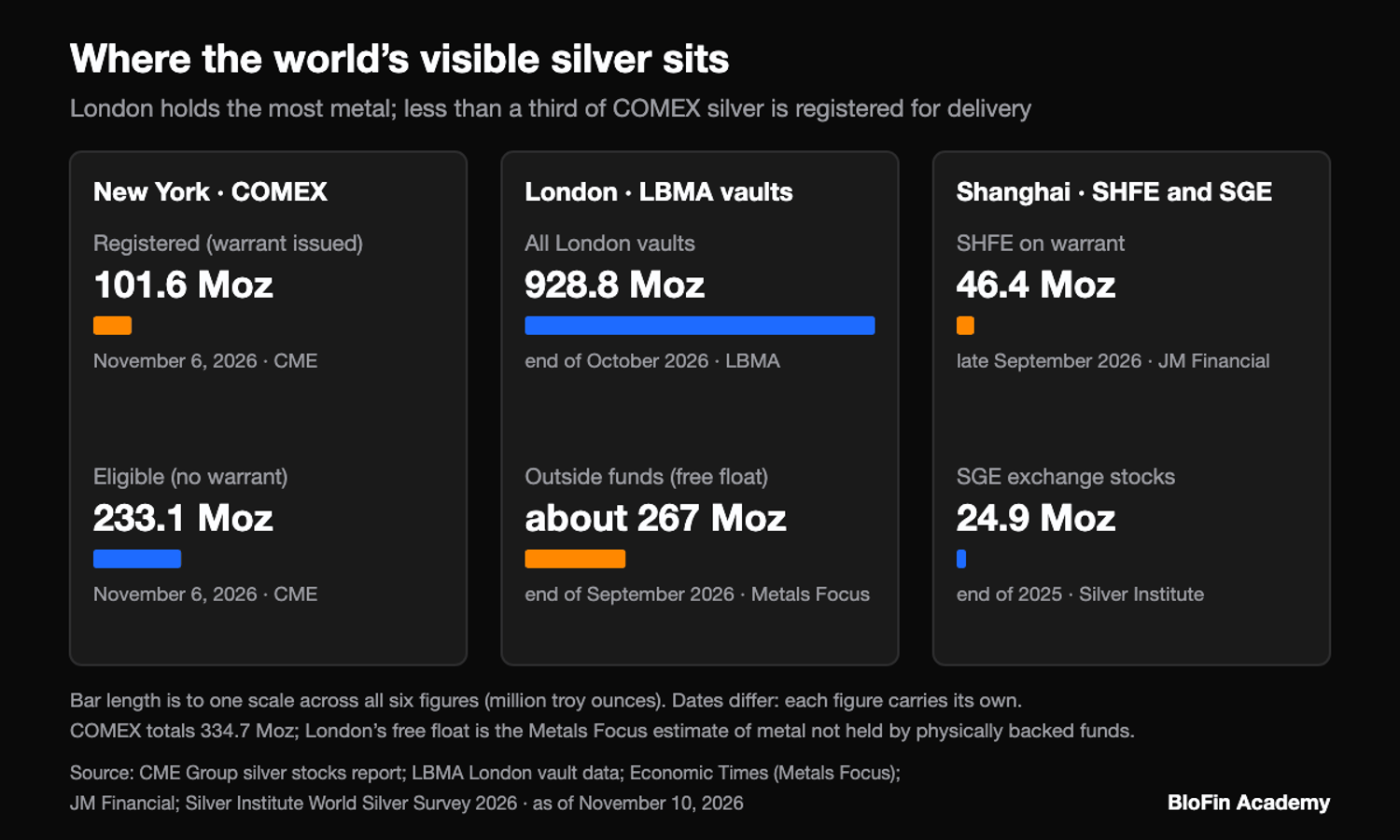
At the end of trading activity on November 6, 2026, COMEX vaults held 101.6 million ounces of registered silver and 233.1 million ounces of eligible silver (source: CME Group, silver stocks report). That is 334.7 million ounces in all. Registered metal made up 30.3% of it.
COMEX itself does not count all eligible silver as available. In a 2021 filing, it took registered silver plus half of eligible silver as its estimate of deliverable supply, because some of it may be held as a long-term investment (source: CFTC, COMEX deliverable supply analysis). COMEX applied that to three years of monthly averages, and it added that it might change the estimate later.
On the same 50% discount, the November 6 stocks give a deliverable supply of about 218.1 million ounces. That equals roughly 43,600 futures contracts of 5,000 ounces each, a yardstick for monthly delivery counts.

How COMEX silver stocks have changed since 2025
COMEX silver stocks climbed sharply in 2025 and have fallen since their peak. The Silver Institute says fear of US tariffs brought roughly 225 million ounces into CME vaults from December 2024 to the start of October 2025. It adds that CME inventories hit a record high in early October (source: Silver Institute, World Silver Survey 2026).
The survey's monthly table shows how fast the tide turned. CME inventories stood at 530 million ounces when September 2025 ended, then 482 million in October, 449 million in December and 360 million at the end of February 2026 (source: Silver Institute, World Silver Survey 2026). By November 6, 2026, the total of 334.7 million ounces was about 195 million below the September 2025 level, a fall of 36.9% (source: CME Group, silver stocks report).
Much of that metal crossed back to London. The survey says deliveries out of CME surged as the London squeeze unfolded in late 2025, and most of the bars went to London vaults. By the time the survey went to print, CME stocks were down 199 million ounces from that record (source: Silver Institute, World Silver Survey 2026).
Since the end of February 2026, the decline has slowed. The November 6 total sits about 7% below the survey's end-February figure of 360 million ounces (source: CME Group, silver stocks report, Silver Institute, World Silver Survey 2026).
COMEX delivery notices as a tightness signal
COMEX delivery notices show how much silver futures holders settle with real metal, which is why traders read them next to registered stock. A delivery notice is the seller's written notice, sent through the clearing house, that it plans to deliver against a short futures position (source: CFTC glossary).
CME lists each clearing firm's notices in two columns, ISSUED and STOPPED. A notice is given by the seller (source: CFTC glossary), so ISSUED is the delivering side. For the November 2026 contract of the 5,000-ounce silver future, notices reached 1,524 contracts by intent date November 9 (source: CME Group, metals issues and stops, month to date). That is about 7.6 million ounces.
Measured against the vaults, November's count is small so far. Its notices equal about 7.5% of the registered silver counted on November 6, or 3.5% of deliverable supply on our calculation from COMEX's 2021 method. The count is already close to the 1,761 contracts recorded for the whole August 2026 delivery month, though (source: CME Group, metals issues and stops, year to date).
The year's totals show how widely deliveries swing. In 2026, the totals for completed months ran from 1,761 contracts for August to 9,889 for January (source: CME Group, metals issues and stops, year to date). The five busiest delivery months of 2026, January, March, May, July and September, averaged about 8,300 contracts, against about 3,300 for the other five completed months. December 2025 had 12,946 contracts, about 64.7 million ounces, the largest month in the report. From January to October 2026, notices added up to 58,053 contracts, or about 290.3 million ounces.
That ten-month total is almost three times the registered stock of November 6, but the two are different kinds of number. Notices add up ten months of deliveries, while the stock is one day's count. A delivery transfers title through a warehouse receipt, so the bars do not have to leave the vault (source: CFTC glossary). A month's notices make the most sense against the registered stock of that same month, and a rising share alongside a shrinking stock is the pattern that points to strain.
London vault holdings at the LBMA
London vault holdings are the silver kept in the city's commercial vaults, which the LBMA reports each month, with figures going back to July 2016. At the end of October 2026, the vaults held about 928.8 million ounces, a little less than the 931.9 million a month earlier (source: LBMA, London vault data).
The count covers every form of silver held in vaults inside the M25 motorway around London, from large wholesale bars down to kilo bars, coins and small bars (source: LBMA, London vault data). That makes London the largest visible pile of silver in the world, and the market where the October 2025 squeeze began.
The series has swung widely over the years. On the LBMA's month-end figures, London held 1,180.1 million ounces in June 2021, the high point since the data began, and 711.4 million in March 2025, the low point (source: LBMA, London vault data). By September 2025, holdings had climbed back only to 790.3 million, about 33% under the 2021 peak.
Those figures match what analysts at the refiner Heraeus wrote that October. They put London's stock at 790 million ounces, "down more than 30%" from the 2021 peak (source: Kitco, October 13, 2025).
Much of London's silver is tied up in funds: Metals Focus estimated the free float outside them at about 136 million ounces in September 2025 and about 267 million a year later (source: Silver Institute, World Silver Survey 2026, Economic Times, October 30, 2026).
Lease rates and backwardation as squeeze signals
Lease rates and backwardation show a squeeze directly, because they measure what it costs to get metal right now. A silver lease rate is the price of borrowing silver for a set time, paid as interest. The academy page on how lease rates and backwardation work covers the same two terms for gold.
The London squeeze of October 2025 shows what a spike looks like. The Silver Institute says one-month silver lease rates jumped from 1% to over 30% that month, and overnight rates even reached 200% (source: Silver Institute, World Silver Survey 2026). Short sellers were forced to close their positions, which deepened the squeeze.
The spike did not last: rates quickly fell back as metal flowed back into London, the survey says. They then stayed high by past standards through the end of 2025, before dropping to around 2% to 3% by the middle of the first quarter of 2026.
Backwardation is the same warning seen on the futures curve. It describes a market where contracts for later months trade below nearer ones, the opposite of contango (source: CFTC glossary). The academy's explainer on backwardation and convenience yield shows how traders read that shape.
Silver showed both warnings in October 2025. Heraeus noted that silver's futures curve had slipped into backwardation as far out as 2027, with CME contracts a year or more ahead trading under spot (source: Kitco, October 13, 2025).
The EFP and the London and New York spread
An exchange for physical (EFP) is a deal in which one side hands over futures contracts and the other hands over the matching amount of the physical commodity, at a price gap both agree (source: CFTC glossary). In silver, it is the gap between a COMEX future and London metal. It shows how hard one market is pulling bars from the other.
In 2025 that gap blew out. The Silver Institute says fear that US imports of bullion would face tariffs pushed the silver EFP on CME to around $0.80 an ounce, higher than during the coronavirus pandemic of 2020. That drew a surge of deliveries into CME vaults (source: Silver Institute, World Silver Survey 2026). Over the whole of 2025, CME stocks rose by about 130 million ounces.
A wide gap pays traders to fly or ship bars to the dearer market. That is the physical form of arbitrage across venues, and the bars that move then show up in the vault counts. So the EFP reads best next to COMEX and London stocks: in 2025 the gap and the CME inflows rose together, and late in the year the flow ran back to London (source: Silver Institute, World Silver Survey 2026).
The Shanghai premium over London
The Shanghai premium is how much more silver costs in China than in London, once the Shanghai price in yuan per kilogram is turned into dollars per troy ounce. On monthly averages, Shanghai's silver benchmark stood 11.7% above the London price in October 2026, at about $63.69 an ounce against $57.0 (source: SGE, Shanghai Silver Benchmark Price, World Bank Pink Sheet, Federal Reserve, H.10 yuan rates).
Those figures are worked out from three published series. The Shanghai side is the average of the SGE's two daily benchmark prices for the month, converted at that month's average dollar-yuan rate from the Federal Reserve. For October 2026 that average covers the 17 SGE sessions from October 8 to 30. The London side is the World Bank's monthly average London price (source: Federal Reserve, H.10 yuan rates, World Bank Pink Sheet). The result is a raw gap, with nothing taken off for taxes, freight or financing.
Measured that way, the gap has gone through very different phases. It averaged 0.1% in 2021, 0.4% in 2022 and 4.3% in 2023, then 10.3% in 2024, 5.5% in 2025 and 12.5% over the first ten months of 2026 (source: SGE, Shanghai Silver Benchmark Price, Federal Reserve, H.10 yuan rates, World Bank Pink Sheet). Its widest month was March 2026, at 15.0%. Its narrowest since October 2019 was October 2020, when Shanghai sat 1.9% under London.
Shanghai warehouse stocks
Shanghai's exchange stocks fell hard in 2025 and into early 2026, then rebuilt. The Silver Institute put SGE stocks at 24.9 million ounces and SHFE stocks at 22.2 million at the end of 2025, down 39% and 49% in a year (source: Silver Institute, World Silver Survey 2026). Together they stood at 47.1 million ounces, a 10-year low, which the survey says partly reflected strong exports.
Weekly figures fill in the detail. ING analysts Ewa Manthey and Warren Patterson reported in November 2025 that SHFE on-warrant silver had fallen to 531,211 kilograms, about 17.1 million ounces, the lowest since 2015 (source: ING via FXStreet, November 27, 2025). A Motilal Oswal note dated February 27, 2026 said SHFE silver had dropped to 346.369 tonnes, or about 11.1 million ounces, without naming the series (source: Motilal Oswal, February 27, 2026).
By late September 2026, a JM Financial note put SHFE silver on warrant at 1,443,896 kilograms (source: JM Financial, September 28, 2026). That is about 46.4 million ounces, or 2.7 times the November 2025 on-warrant figure.
The Shanghai counts are different series. On-warrant stock is SHFE metal with warrants issued, while the survey's year-end number is labeled simply as exchange stocks, and the Motilal Oswal figure names no series. The survey's 22.2 million ounces is larger than the 17.1 million on warrant a month earlier, so joining these counts into one line would mix measures.
Does falling inventory mean a higher silver price?
Falling inventory does not reliably mean a higher silver price, and the record runs both ways. In 2025, CME stocks rose by about 130 million ounces while silver's yearly average London price rose 41.6% (source: Silver Institute, World Silver Survey 2026). Inventory and price climbed together that year.
From October 2025 to January 2026 the pattern flipped. CME stocks fell in each of those four months while silver's monthly average price rose, by 47.8% in January alone (source: Silver Institute, World Silver Survey 2026, World Bank Pink Sheet). Then in February 2026 both fell, the price by 11.1%. Across the seven monthly moves from August 2025 to February 2026, four fit the shortage story and three did not.
London's longer record is weaker still. Of the 123 monthly changes from August 2016 to October 2026, London's stock fell in 51 (source: LBMA, London vault data, World Bank Pink Sheet). Silver's monthly average price rose in 25 of those months, about half. In the 72 months when stocks rose, the price rose in 38. The correlation between the two monthly changes was 0.08, close to none.
Calendar years fit the shortage story more often. In six of the nine years from 2017 to 2025, London's stock and silver's December average moved in opposite ways (source: LBMA, London vault data, World Bank Pink Sheet). The sizes did not line up, though. In 2022 London lost 320.5 million ounces and the December average rose only 3.6%, while the yearly average fell. In 2020 it lost a quarter as much, 81.6 million, and the December average rose 46.2%.
The October 2025 squeeze came with lease rates above 30% and a backwardation as well as thin free stock in London. The stock figure on its own was never the whole signal. For the live price of the contract that follows silver, and its mark price used for liquidation, open the XAGUSDT Perpetual page.
Trading a tight silver market on BloFin
Trading a tight silver market means watching inventories, lease rates and premiums for signs of a squeeze, knowing the price can keep moving long after those signals turn. When the October 2025 squeeze sent lease rates above 30%, short positions were forced to close (source: Silver Institute, World Silver Survey 2026). That is why a squeeze matters most to anyone thinking about how to short silver.
BloFin offers that kind of position on the XAGUSDT Perpetual, where each contract is 0.01 XAG, and one XAG stands for one troy ounce of silver. Profit and loss is settled in USDT, and BloFin lists the market's trading hours as 24/7.
Because the perpetual never delivers metal, its mark follows an index price, not any one vault. BloFin builds that index from prices quoted by outside data vendors, and if those feeds stop, BloFin keeps the index at the last figure it calculated. While a position is open, funding between longs and shorts is paid every 4 hours.
Leverage shortens how long you can wait for a view to play out. A leveraged silver trade is closed by BloFin once the mark price reaches the trade's liquidation price. The Liq. Price field in the order panel shows an estimate of that level when you set up a trade. Silver's monthly average rose 47.8% in January 2026 and fell 11.1% the next month, and a far smaller move can end a leveraged trade before the vault numbers settle.
Inventory readings explain where pressure builds up. To see where it shows up first, it helps to know how the silver price is determined across spot trading, futures and the London benchmark.
Looking to trade silver? To get started, you'll need to first create a BloFin account, fund your account with cryptocurrency, and navigate to the XAGUSDT Perpetual trading page.

Frequently asked questions
Which COMEX vault holds the most silver?
JP Morgan Chase Bank's vault held about 125.1 million ounces on November 6, 2026, or 37.4% of all COMEX silver. Only 4.6% of its own stock was registered, so it held about half of all eligible silver. Asahi held the most registered metal, about 40.5 million ounces (source: CME Group, silver stocks report).
How many silver bars are in the London vaults?
The LBMA puts London's stock at about 962,975 silver bars at the end of October 2026, assuming a standard 30-kilogram bar. That is about 28,889 tonnes, 0.33% less than a month earlier, valued at $46.5 billion at the month-end LBMA price (source: LBMA, London vault data).
How much silver moves from eligible to registered in a day?
On November 6, 2026, adjustments moved a net 626,800 ounces from eligible to registered at COMEX. CNT accounted for about 647,000 ounces, while one other depository moved about 20,200 ounces back to eligible. That same day, eligible stock took in 599,534 ounces and shipped out 457,204 (source: CME Group, silver stocks report).
Why did silver move from London to New York in 2025?
Tariff fears drove it. US silver bullion imports hit a quarterly record of 91.1 million ounces in the first quarter of 2025, mostly from the United Kingdom and much of it flown into CME-approved warehouses. US exports then set a quarterly record of 101.9 million ounces in the fourth quarter, mostly back to London (source: Silver Institute, World Silver Survey 2026).
How many depositories hold COMEX silver?
CME's silver stocks report listed 13 depositories on November 6, 2026. Asahi, Brink's and JP Morgan Chase Bank held the most silver, together about 220.6 million ounces, or about two-thirds of the total. Texas Precious Metals held only eligible metal, and one of the two Malca-Amit vaults held none (source: CME Group, silver stocks report).
Researched and written by the BloFin Academy editorial team with AI-assisted drafting. All facts independently verified. Primary sources include CME Group's daily silver stocks report and its metals issues and stops reports, the COMEX deliverable supply analysis filed with the CFTC and the CFTC glossary, the LBMA's London vault data, the Silver Institute's World Silver Survey 2026, the Shanghai Gold Exchange's silver benchmark prices, the Federal Reserve's H.10 exchange rates, the World Bank's monthly silver prices, and reports from Kitco, the Economic Times, ING, Motilal Oswal and JM Financial, current as of November 10, 2026.
Nothing in this article constitutes financial advice, and nothing in it is a recommendation to buy, sell or hold silver in any form. Vault counts arrive days or a month late, and falling stocks have lined up with a rising price only about half the time, so a trade built on an inventory chart can be wrong for months. On the XAGUSDT Perpetual, a squeeze can move the price far enough to liquidate a leveraged position in either direction, and funding can cost you every four hours. Past performance does not indicate future results. Do your own research and consider your risk tolerance before you trade on BloFin.