
Every route for betting against silver comes with its own way of losing money. An inverse fund can lose value while the metal goes nowhere, borrowed shares can keep rising with no ceiling on the loss, and a leveraged short can be closed for you in the middle of a rally. Silver sharpens all of those risks, because its price tends to move in sudden bursts and traders on the wrong side often have to buy back in a hurry.
The route depends on your reason for being short. A trader expecting a fall over a few days has different needs from someone protecting a box of coins for months. The cheapest way to hold a short for a week can also be the most painful way to hold it through a squeeze. Many of those differences sit in the fine print, such as a daily reset, a margin call or a funding payment.
Silver shorts come in a few families. Funds and shares trade through a stock broker, while futures and options need a derivatives or margin account. CFDs and spread bets come from brokers in the countries that allow them, and perpetual futures run on crypto exchanges with stablecoins as the margin.
On BloFin, that last route is the XAGUSDT Perpetual, a contract margined in USDT that tracks silver's price and has no expiry date. You open the short with a Sell order, you can receive or pay funding every 4 hours while it stays open, and the main danger is a fast rally that reaches your liquidation price.
What does it mean to short silver?
Shorting silver means opening a position that gains when the silver price falls and loses when it rises. You sell first and buy back later, so your profit is the gap between those two prices after costs, and a price that keeps rising keeps adding to the loss.
Short profit = (entry price − exit price) × size − fees ± funding
People short silver for two main reasons. The first is a straight view that the price is about to fall, which makes the short a speculative trade with a planned exit. The second is protection: someone who holds bars, coins or shares in a silver fund can offset part of a fall while keeping the metal, and the short can be matched to that holding ounce for ounce.
The risk runs in the opposite shape to owning silver. A holder can lose at most what the metal cost, since a price can only fall to zero, while a short has no fixed limit on how high the price can climb against it. Leverage then shortens the distance, because a rise of 10% on a 5x short takes half of the margin before costs.
Ways to short silver compared
The main ways to short silver are inverse ETFs, borrowed shares of a silver fund, COMEX futures, CFDs and spread bets, put options, and a perpetual contract such as the XAGUSDT Perpetual. They differ most on three points: how much you can lose, what it costs to hold, and who can use them.
Route | Account you need | Cost of holding | Largest possible loss |
|---|---|---|---|
Inverse silver ETF | Stock brokerage | Yearly fund fee, plus daily-reset decay | The money you invested |
Short SLV shares | Margin account at a stock broker | Interest on the borrowed shares | No fixed limit |
Short COMEX futures | Futures account | Margin tied up, and margin can be raised | No fixed limit, and more funds can be called |
CFD or spread bet | Broker outside the US | Financing costs | UK retail clients: the funds in the account |
Put option | Options account | The premium, paid up front | The premium |
XAGUSDT Perpetual short | BloFin futures account funded with USDT | Funding, paid or received every 4 hours | The margin on an isolated position |
Inverse silver ETFs and daily-reset decay
An inverse silver ETF lets you bet against silver from an ordinary stock account, with nothing to borrow and no margin to watch. The ProShares UltraShort Silver ETF (ZSL) seeks two times the inverse of the daily performance of the Bloomberg Silver Subindex. ProShares describes it as the only ETF designed to profit when the daily price of silver futures declines. As of November 3, 2026, it had about $54.9 million in net assets and a 0.95% expense ratio (source: ProShares ZSL).
The word "daily" carries the risk. ProShares warns that for any holding period longer than a day the return may differ from the daily target, and that higher index volatility contributes to worse returns (source: ProShares ZSL). Take an index that moves from 100 to 110 and back to 100, which leaves it flat after two days. A 2x inverse fund starting at 100 drops 20% to 80, then rises 18.18% to 94.55. Its holder has lost 5.45% in a market that went nowhere. ZSL's own record shows the effect. For the nine months to September 30, 2026, its NAV return was -47.77% (source: ProShares ZSL) even though the iShares Silver Trust (SLV) returned -15.97% (source: iShares Silver Trust), so silver fell and the fund betting against it lost far more.
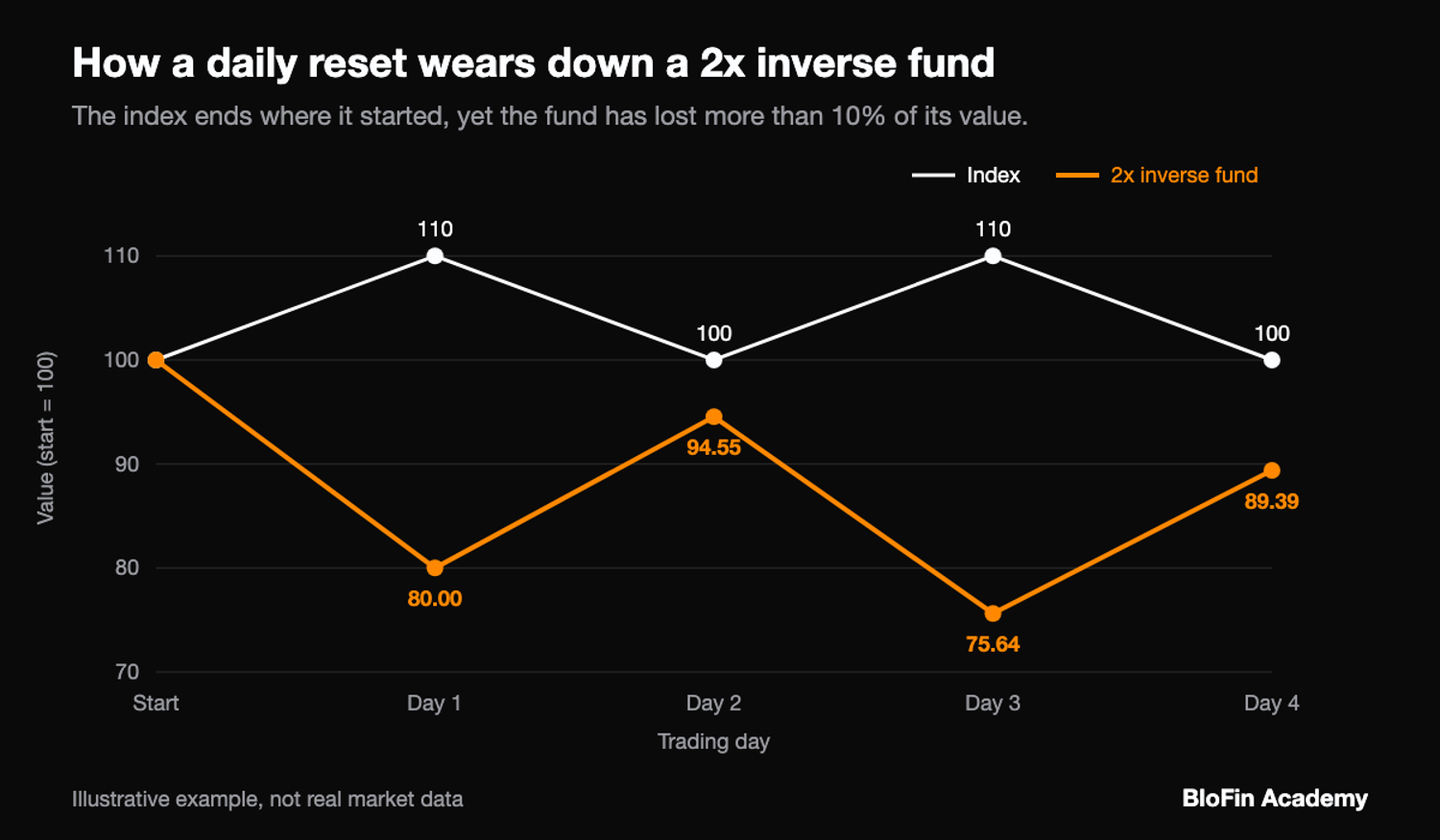
Silver's bursts make this decay more than a footnote, and ProShares says returns tend to drift further from the daily target over a longer hold in those conditions (source: ProShares ZSL). Older guides also name the VelocityShares 3x Inverse Silver ETN (DSLV), but Credit Suisse said in June 2020 that it would delist the note, effective July 12 (source: InvestmentNews).
Short selling SLV shares
Short selling a silver fund means borrowing its shares through a broker, selling them, and buying them back later. SLV is one such fund, with about $24.8 billion in net assets as of November 3, 2026 (source: iShares Silver Trust). The US Securities and Exchange Commission (SEC) says in its investor bulletin that the broker charges interest on the loan and that margin rules apply. It adds that the position is open to unlimited losses, because a stock can theoretically keep rising indefinitely (source: SEC Investor.gov).
One small detail works in the short's favor. SLV charges a 0.50% sponsor fee, and iShares says the amount of silver behind each share decreases over the life of the trust (source: iShares Silver Trust), so each share slowly represents less metal while you hold the short.
Short COMEX silver futures
Reuters calls the COMEX 5,000-ounce contract the global benchmark for silver futures. CME also lists a financially settled 100-ounce contract among its retail-focused products (source: Reuters via Kitco). Silver futures rose to about $52 an ounce on November 4, 2026 (source: CNBC). At that rounded price, one 5,000-ounce contract controls about $260,000 of silver and one 100-ounce contract controls about $5,200.
Margin makes that exposure affordable and also makes it dangerous. The standard futures risk disclosure warns that you may lose your initial margin and any additional funds you deposit. You may also have to pay substantial additional funds on short notice if the market moves against you or margin levels are increased. If you fail to pay in time, the position may be liquidated at a loss (source: Risk disclosure statement).
CFDs and spread bets
A contract for difference (CFD) pays you the change in price between opening and closing, and you trade it with a broker in place of an exchange. US law makes it unlawful for anyone other than an eligible contract participant to enter into a swap except on, or subject to the rules of, a designated contract market (source: US Code, Title 7, Section 2). Where a CFD counts as a swap, that rule generally shuts out US retail traders, because most individuals do not qualify as eligible contract participants (source: US Code, Title 7, Section 1a). Like other margin trading, CFDs also carry financing costs (source: Wikipedia, contract for difference).
A financial spread bet is in many ways the same product as a CFD, and it has remained mainly limited to the UK and Ireland (source: Wikipedia, contract for difference). The UK's Financial Conduct Authority (FCA) requires a retail client to post margin of at least 10% of the exposure when the underlying asset is a commodity other than gold. Silver is one, so that works out to 10:1 leverage. A firm must close the client's positions as soon as market conditions allow once net equity falls below 50% of the margin requirement. A retail client's liability is limited to the funds in the account, and the firm's risk warning, required for leveraged CFDs and spread bets alike, must give the percentage of its retail accounts that lose money (source: FCA Handbook, COBS 22.5).
Put options and silver miners
A put option gives its buyer the right to sell at a set price, and the holder risks the entire premium paid to buy it (source: SEC options bulletin). Shorting silver mining shares is a looser bet, because company-specific factors move those shares along with the metal (source: Market Realist).
XAGUSDT short on BloFin
A short on the XAGUSDT Perpetual involves no borrowed share and no contract roll at expiry. It settles in USDT, offers 1x to 100x leverage, and pays or collects funding every 4 hours (source: XAGUSDT contract information). Its main risk is liquidation in a rally, and its main advantage for a small trader is the ability to size a position far under a 100-ounce COMEX contract.
How to short silver on BloFin
To short silver on BloFin, you open the XAGUSDT order panel, choose a margin mode and leverage, enter a size with a stop, and press Sell. Only the side differs from a long, so the panel is the one any silver trade on BloFin uses, and you close the short later from the Positions tab.
Your USDT has to reach your futures trading account before Step 1, because a deposit lands in the Funding Account and you move it across from Assets with Transfer.
Step 1: Log in to your BloFin account and hover your cursor over the TradFi tab. Then, select Futures.
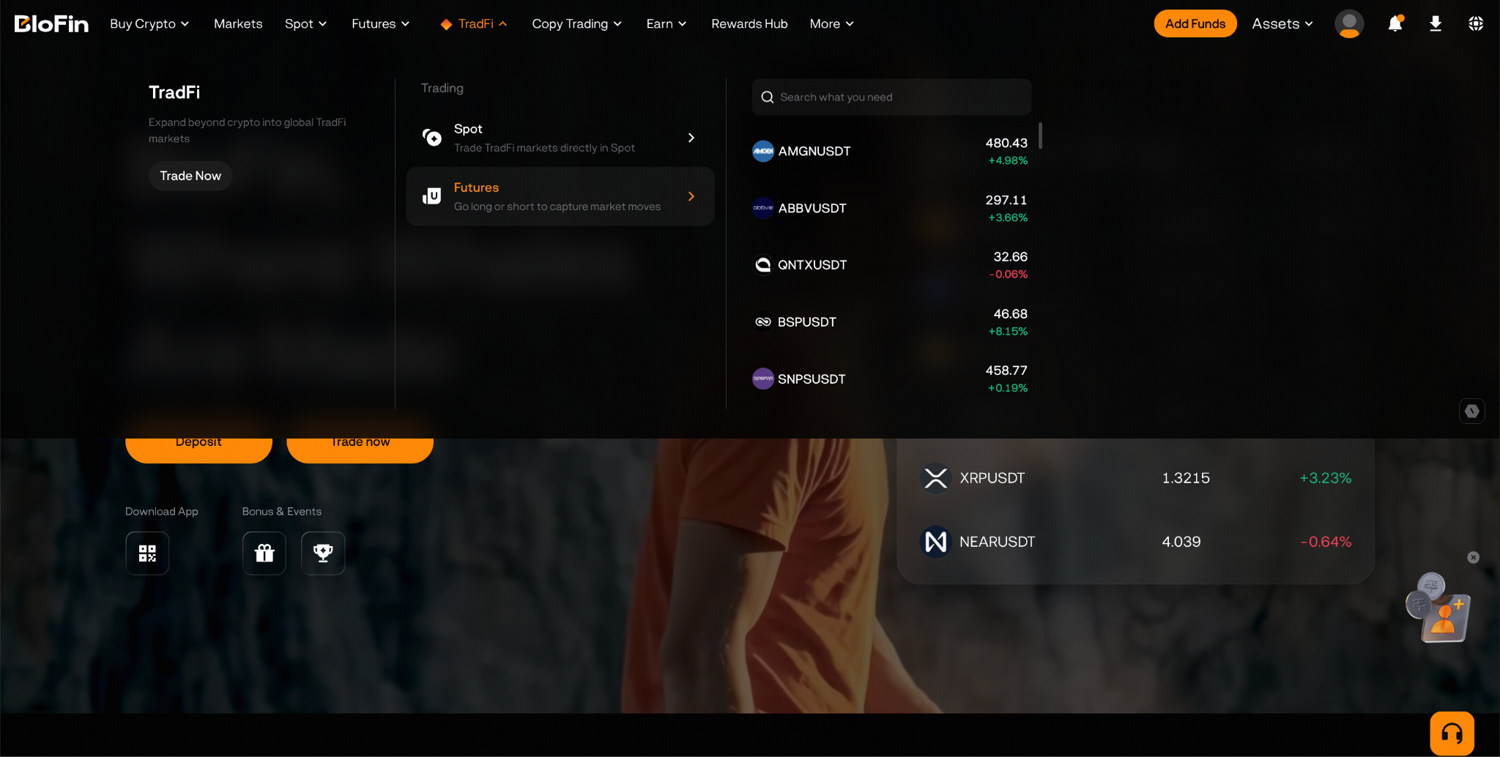
Step 2: Click on the trading pair in the top left corner and a pop-up window will appear. Type XAG in the search field and select the XAGUSDT Perpetual.
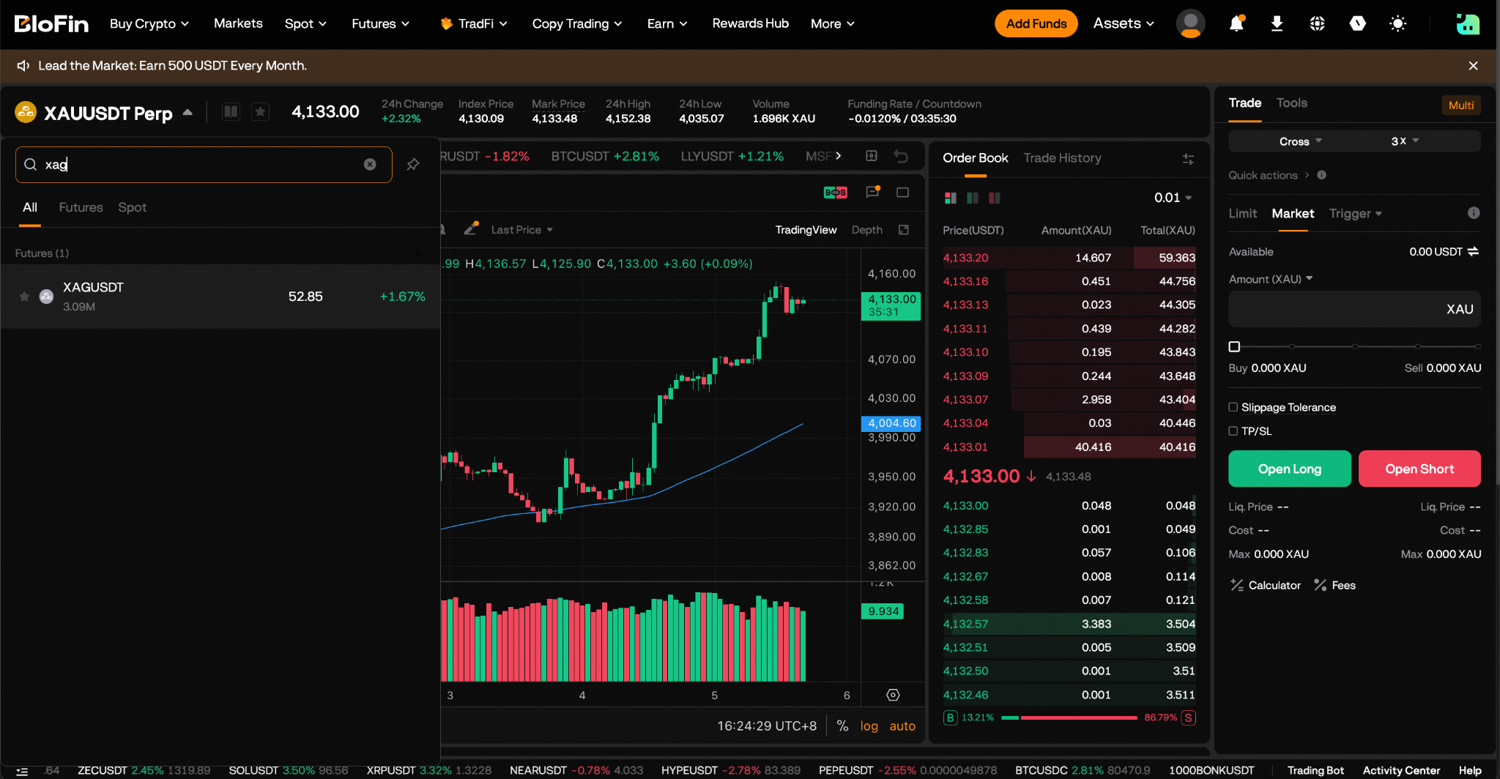
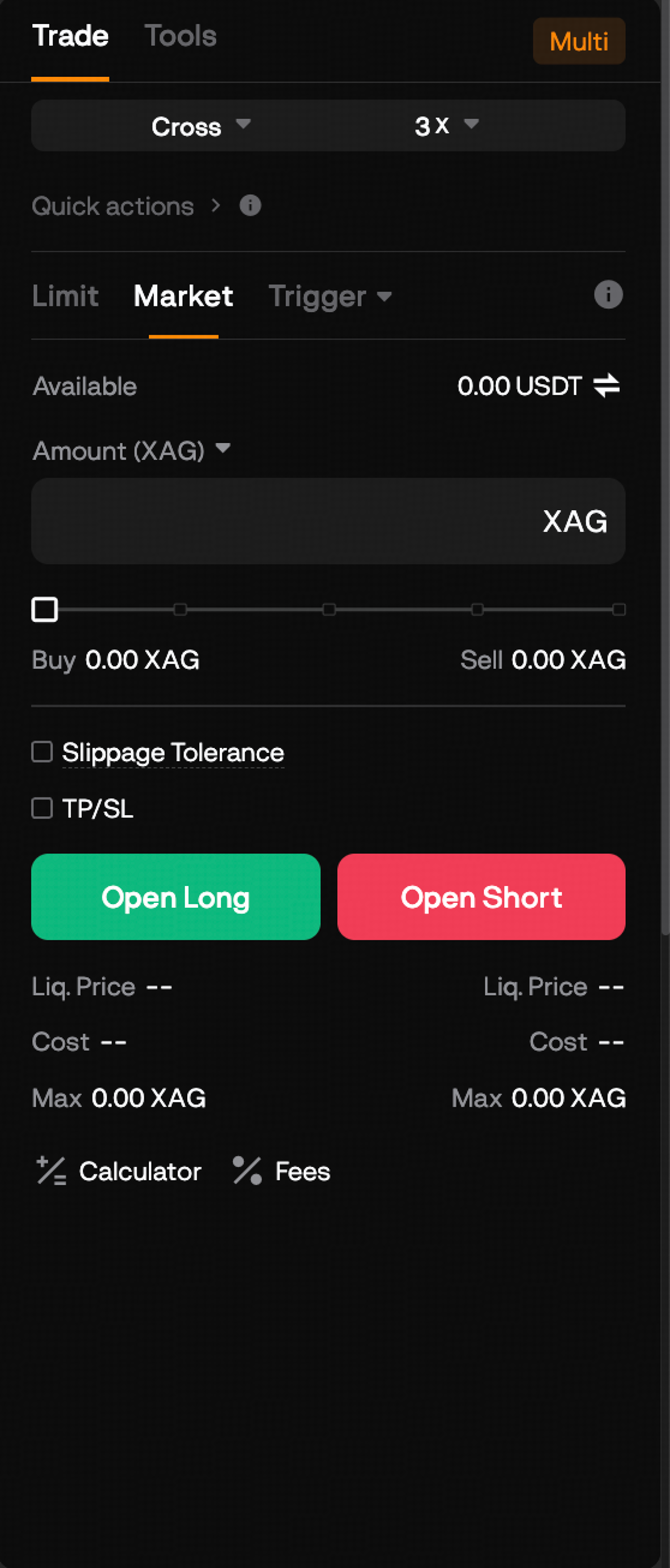
Step 3: Choose Isolated as your margin mode and set your leverage with the slider or by typing the multiplier. Isolated margin caps your risk at the margin you give that position, and BloFin suggests starting conservatively at 2x to 5x.
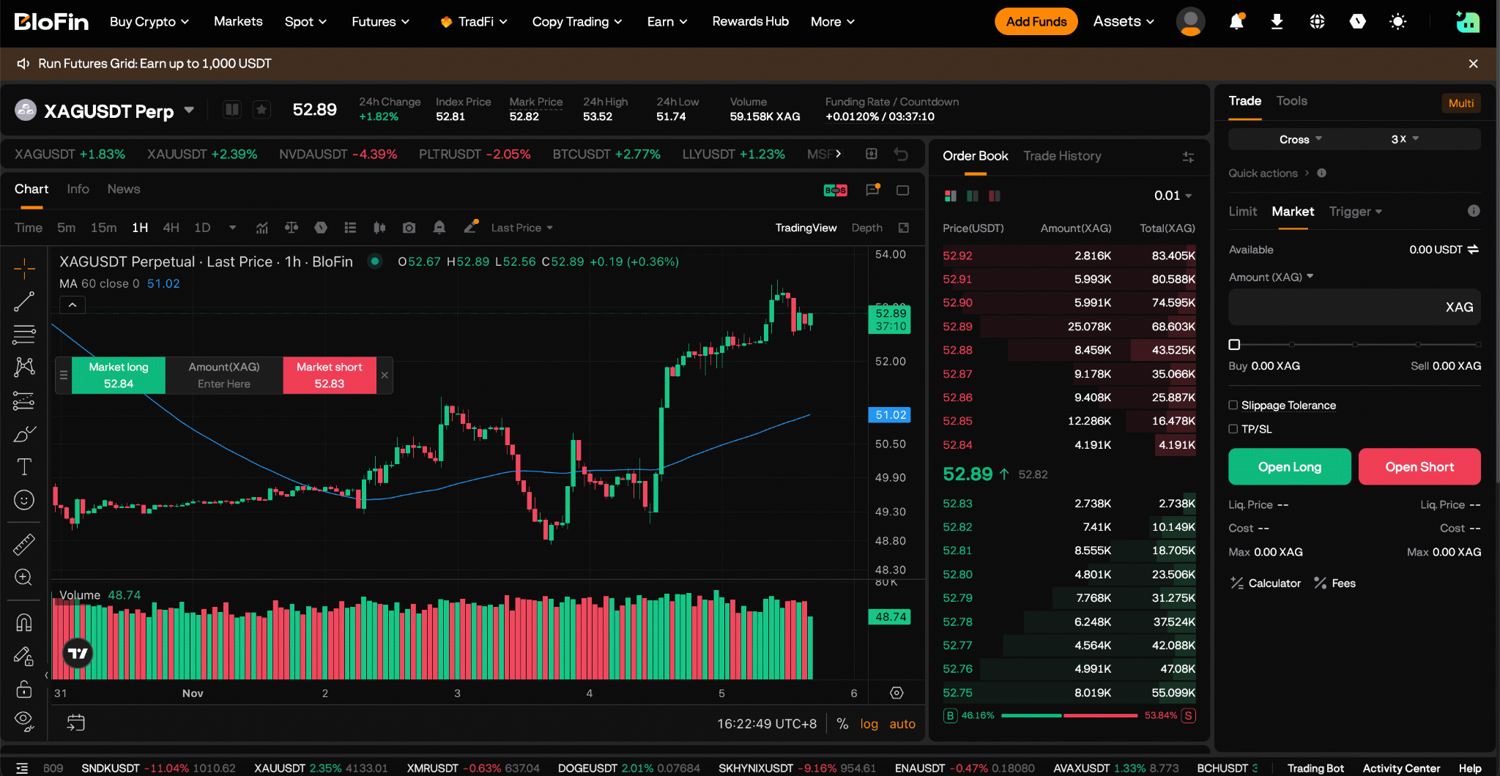
Step 4: Choose Limit or Market, then enter your size in Amount (XAG).
Step 5: Tick TP/SL and set the stop higher than your entry, with the take profit lower.
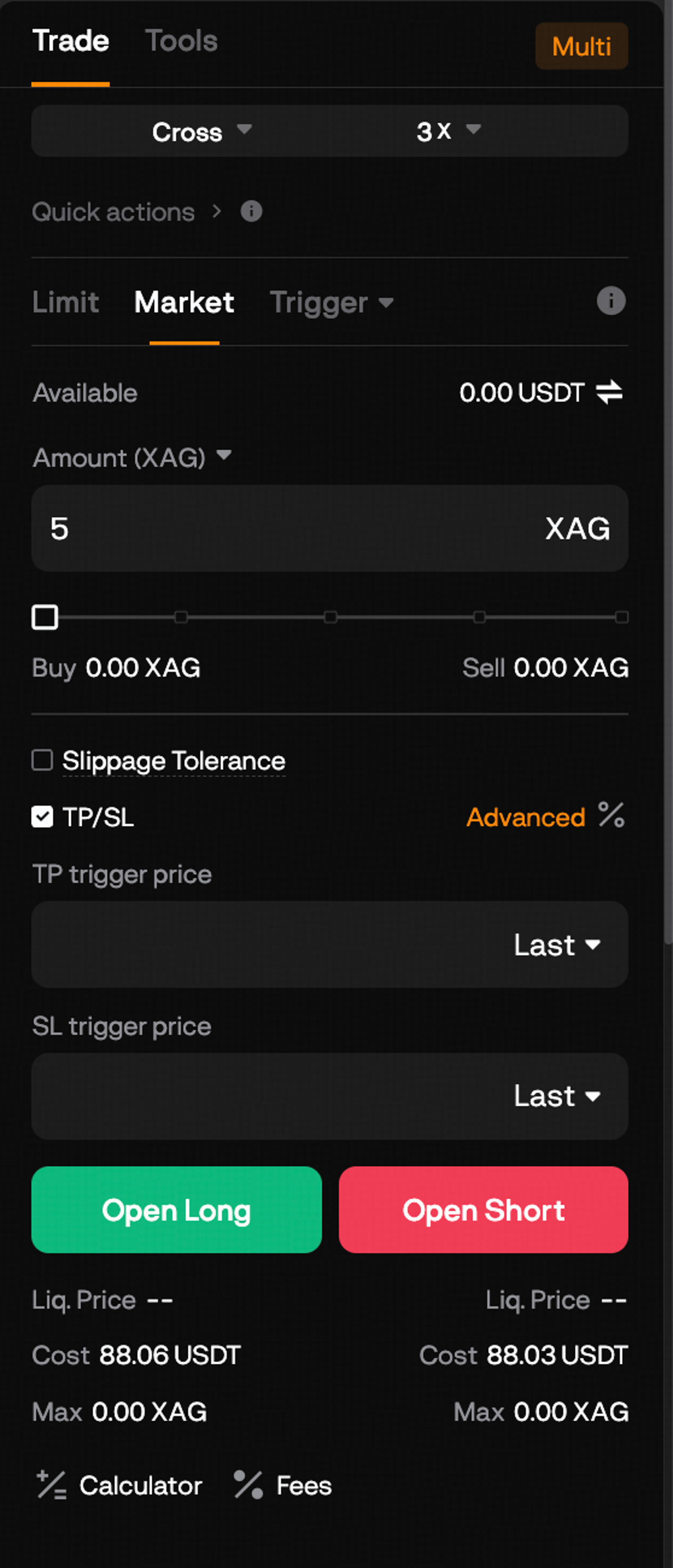
Step 6: Check Liq. Price and Cost, press Sell, then review the confirmation and confirm. To close the short later, click Close next to it under Positions.
At the 51.96 mark price shown on the XAGUSDT trading page on November 4, a short of 10 XAG is worth 519.60 USDT, so 5x leverage needs 103.92 USDT of margin. A stop 5% higher at 54.56 would lose 26.00 USDT, which is 25% of the margin, and a take profit 5% lower at 49.36 would gain the same 26.00 USDT.
Costs trim both results. Market orders at the 0.0600% taker fee (source: BloFin fees) cost about 0.31 USDT to open and about 0.33 USDT to close at the stop, while one funding payment at 0.0120% would add about 0.06 USDT to the short. A stop-out therefore costs about 26.58 USDT in total, and a take profit nets about 25.45 USDT. The loss at a stop depends on size and distance, and leverage only changes how much of your margin that loss uses.
You can check the live mark price and the current funding rate on the XAGUSDT trading page before you size a short.
Funding on a silver short
Funding on a silver short is a payment between longs and shorts, made every 4 hours on the XAGUSDT Perpetual (source: XAGUSDT contract information). With a positive rate, which usually goes with the contract trading over spot, longs pay shorts and your position collects the payment. With a negative rate, your short pays.
All 50 XAGUSDT rates between October 27 at 4AM UTC and November 4 at 8AM UTC were positive, and they add up to 0.8336% (source: XAGUSDT funding history). A 10 XAG short held at a steady 519.60 USDT over that window would have received about 4.33 USDT.
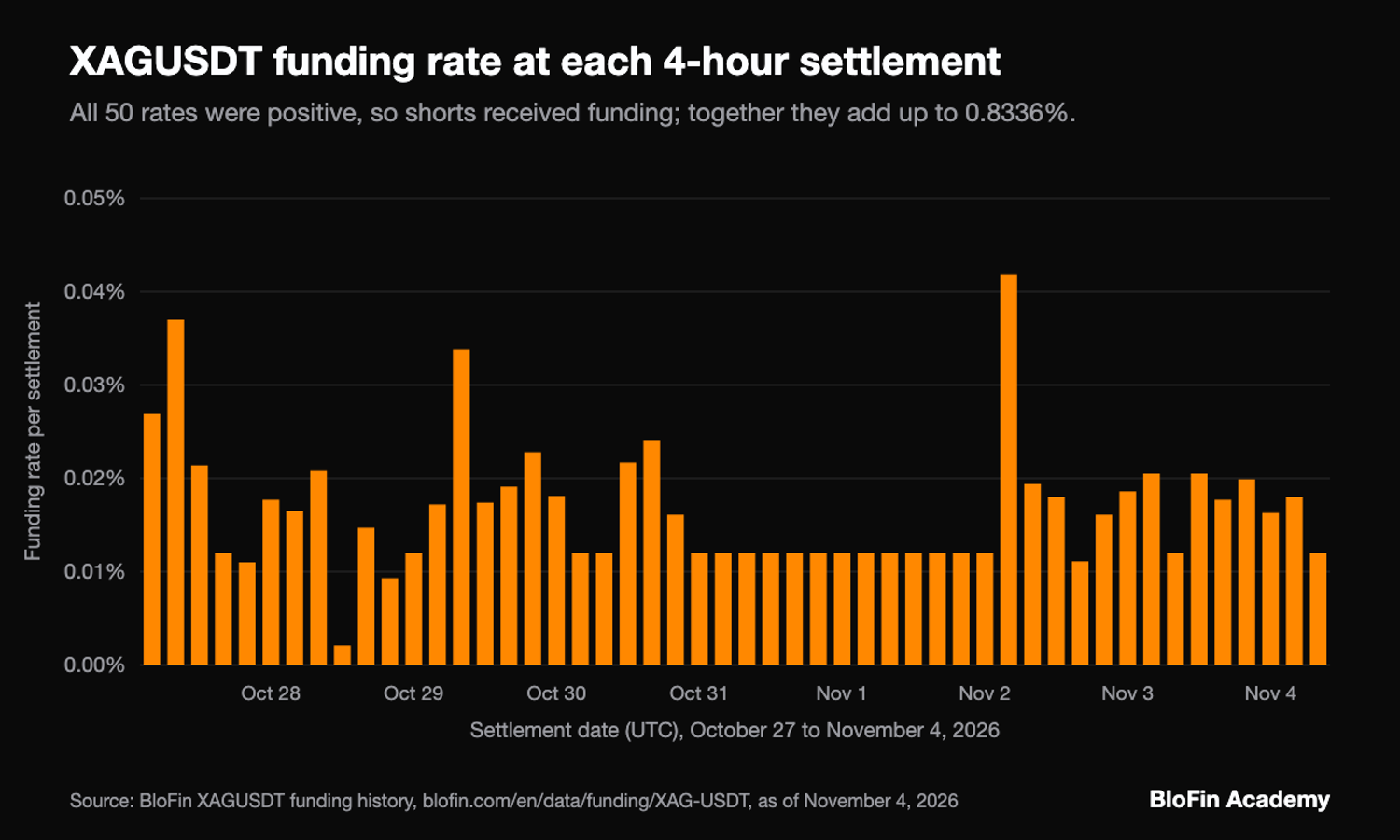
That income is never guaranteed, and gold shows how quickly the sign can change. Over the same window, 15 of the 50 rates on BloFin's gold perpetual were negative, so a gold short would have paid at those settlements (source: gold funding history). Funding is also small beside price risk, since the 0.8336% that silver shorts collected in eight days compares with the 5.81% rise over one 24-hour stretch to November 4 shown on the XAGUSDT trading page. Funding changes the cost of holding silver as time and position size grow, so it belongs in the plan for any short you intend to keep for weeks.
Short squeeze risk in silver
A short squeeze in silver happens when a rising price forces shorts to buy back, and that buying pushes the price higher still. Silver went through one in London in October 2025, then ran to a record in January 2026, and even an ordinary rally can do serious damage to a leveraged short.
Silver touched a new 2026 low beneath $49 overnight on November 3 (source: BullionVault), and spot silver then jumped to about $52 on November 4 as the dollar fell following the US midterm elections (source: CNBC). The XAGUSDT trading page showed the contract's last price at 52.01 that day, up 5.81% over 24 hours, which puts the price a day earlier near 49.15. A 10 XAG short from that level lost about 28.60 USDT, which comes to about 29% of the margin at 5x and about 58% at 10x. At 20x, a 5.81% rise is larger than the whole margin, so that short would have been liquidated.
Liquidation comes sooner than those shares suggest. BloFin liquidates on the mark price. A rise equal to one divided by your leverage would use the entire margin, and the position closes before that, because margin must stay over the maintenance level. That level is 0.50% on positions up to 400 XAG (source: XAGUSDT position tiers). Lower leverage on silver leaves a short more room, and a stop can still slip because it fills as a market order.
Real squeezes go further. The World Silver Survey records a squeeze in London in October 2025, when shorts had to cover while 1-month lease rates, the cost of borrowing silver, went from 1% to over 30% and overnight rates touched 200% (source: World Silver Survey 2026).
The rally that followed shows how far a short can be carried even after a squeeze ends. Silver later peaked at $84 in December 2025 (source: World Silver Survey 2026) and then set its all-time high on January 29, 2026, above $121 (source: Silver Institute). That is a rise of about 44% in weeks, enough to use the entire margin on any short at 3x or more. The same run then saw a one-day peak-to-trough drop of 38% (source: World Silver Survey 2026), which a short that had already been liquidated could not collect.
The February 2021 rush into silver adds a lesson about margin. Money managers had been net long since mid-2019, so the scope for a squeeze looked far from obvious, yet the most active Comex contract still jumped as much as 8.7% in early trading on February 1, 2021 (source: Fortune). CME then raised silver margins by about 18%, to $16,500 from $14,000 per contract, starting February 2 (source: Yahoo Finance UK). A short held through Monday's jump took the loss and then could have needed another $2,500 per contract. The higher margin arrived as silver was down 6% by that Tuesday afternoon (source: Yahoo Finance UK), so a margin rise can land after the damage is done.
Shorting into a silver deficit
Shorting into a silver deficit means betting on a lower price while the market uses more silver than it produces. On paper the deficit argues against the trade, yet it has been a poor timing tool, since 2025's shortfall and a wider forecast for 2026 sat alongside a slide of more than half from the January peak.
The Silver Institute counts 2025 as the fifth straight deficit and in April 2026 forecast a 46.3 million ounce shortfall for 2026 (source: Silver Institute), and the World Silver Survey puts the 2025 figure at 40.3 million ounces (source: World Silver Survey 2026). The price still fell through 2026, from above $121 to under $49 by November 3, a drop of about 60%. The Survey repeats the received wisdom that deficits don't matter until they do, and says 2025 bore it out (source: World Silver Survey 2026), so a deficit alone tells a short very little about when the market will turn.
A deficit tells you less about timing than tight physical inventories do, because tightness is what forces shorts out. Three readings matter most: lease rates, which show what it costs to borrow metal; the free float in London; and COMEX and London inventories. Metals Focus estimated London's free float at a record low of 136 million ounces at the end of September 2025, with exchange-traded products holding 83% of London's stock, before flows back into London eased the tightness (source: World Silver Survey 2026).
A tight reading does not say the price must rise. It says a short has a higher chance of meeting a sudden lack of metal to borrow, so a sensible response is smaller size and lower leverage, with the stop placed before you open the trade.
Hedging silver you already hold
Hedging silver you already hold means opening a short of the same size as your metal, so that a fall in the price on one side is offset by a gain on the other. A holder of 100 ounces shorts 100 XAG, since XAG is the currency code for one troy ounce of silver (source: ISO 4217 on Wikipedia).
The ratio for a fund takes one more step. iShares reports 506,435,238.40 ounces in the trust and 561,050,000 shares outstanding as of November 3, 2026, which works out at about 0.9027 ounces per share (source: iShares Silver Trust). So 100 SLV shares call for a short of about 90.27 XAG, and the figure needs checking from time to time because the fee keeps shrinking it.
At the same 51.96 mark, the 100-ounce short is worth 5,196 USDT, 3x leverage needs 1,732 USDT of margin, and the 0.0600% taker fee costs about 3.12 USDT each way. Over the October 27 to November 4 window, funding on that size would have paid the short about 43.31 USDT (source: XAGUSDT funding history), though the next window may look nothing like it.
If silver falls 10%, the short gains 519.60 USDT and roughly offsets the fall in your metal. If silver rises 10%, the short loses 519.60 USDT, which is 30% of the margin, while your gain sits unsold in a safe or a brokerage account. A rise of about a third, to near 69.28, would use the whole margin, and your bars cannot top it up. The hedge would then end right when the metal is worth the most, so it needs spare USDT behind it and a plan for adding margin.
A short on the contract leaves several things uncovered:
Dealer premiums. Coins and bars sell at their own premium over spot, and the short only tracks the contract's price.
Price gaps. The mark follows its index, so it will drift from spot silver and from SLV's price at times.
Currency. The short pays and settles in USDT, while your metal is valued in dollars.
Funding. A positive window can turn negative, and the short then pays to stay open.
Upside. A full hedge gives up the gain from a rally for as long as it stays on.
A crypto portfolio has no ounce count to match, so a silver hedge for crypto starts from how the two have moved together.
Looking to short silver? To get started, you'll need to first create a BloFin account, fund your account with cryptocurrency, and navigate to the XAGUSDT Perpetual trading page.
Frequently asked questions
Who is actually short silver?
Mostly swap dealers and producers or merchants, on the US data. In the Commodity Futures Trading Commission (CFTC) report for October 27, 2026, those two groups held 66,791 short COMEX silver futures against 116,226 contracts of open interest. Money managers held 13,543 shorts and stayed net long by 3,321 contracts (source: CFTC Commitments of Traders).
How much does it cost to short silver?
The cost depends on the route. ZSL's 0.95% expense ratio on a share worth $39.47 on November 3, 2026 comes to about $0.37 a year (source: ProShares ZSL). A 10 XAG short on the XAGUSDT Perpetual at the 51.96 mark needs 103.92 USDT of margin at 5x. Opening it with a limit order at the 0.0200% maker fee costs about 0.10 USDT, against about 0.31 USDT at market (source: BloFin fees).
Can a silver short lose more than the margin?
On BloFin, it depends on the margin mode: isolated margin caps the loss at the margin set aside for that position. Cross margin backs every open position with your full futures balance, so a losing silver short can draw on money you meant for other trades.
Is ZSL the same as shorting silver?
ZSL is a fund share you buy, which aims for twice the opposite of one day's move in a silver futures index, so you never hold a short position yourself. Its inception date is December 1, 2008, and it sits inside a commodity pool that generates a K-1 tax form (source: ProShares ZSL), which differs from selling a share short in a brokerage account.
Can retail buyers squeeze silver shorts?
Retail buyers have moved the price, and both times it fell back soon after. On the Friday before February 1, 2021, SLV took a $944 million net inflow (source: Fortune), and silver was down 6% by the Tuesday afternoon (source: Yahoo Finance UK). The World Silver Survey says physical investment had an outsized impact on the January 2026 rally and that retail flows into futures and options grew sharply, before the one-day drop of 38% (source: World Silver Survey 2026).
Researched and written by the BloFin Academy editorial team with AI-assisted drafting. All facts independently verified. Primary sources include ProShares, iShares, the SEC's Investor.gov, the CFTC, the FCA, Reuters, the Silver Institute, CNBC and BloFin's XAGUSDT trading, contract, funding and position tier pages, current as of November 4, 2026.
Nothing in this article constitutes financial advice, and nothing in it is a recommendation to buy, sell or hold silver in any form. A silver short can lose money quickly in a rally, leveraged positions can be liquidated, and funding can change sign at any settlement. Inverse funds can lose value over longer holds, and a hedge can fail through margin calls or gaps between the metal and the contract. Past performance does not indicate future results. Do your own research and consider your risk tolerance before you trade on BloFin.