Trading silver has usually meant going through a broker, for a futures account or fund shares. A first silver trade can now run on a crypto exchange, and that makes it feel easier than it is.
The order itself is the simple part. Silver can swing several percent while you sleep, so a first trade with no stop and too much size can lose most of its margin before you have worked out what happened. The real work comes before the button: where the money sits, how big the position is and how it will end.
A USDT-margined perpetual contract brings those decisions onto one order panel. It follows silver's price, has no expiry date and lets you hold a long or a short on a stablecoin balance, with an estimated liquidation price and a cost figure on the panel before you send anything.
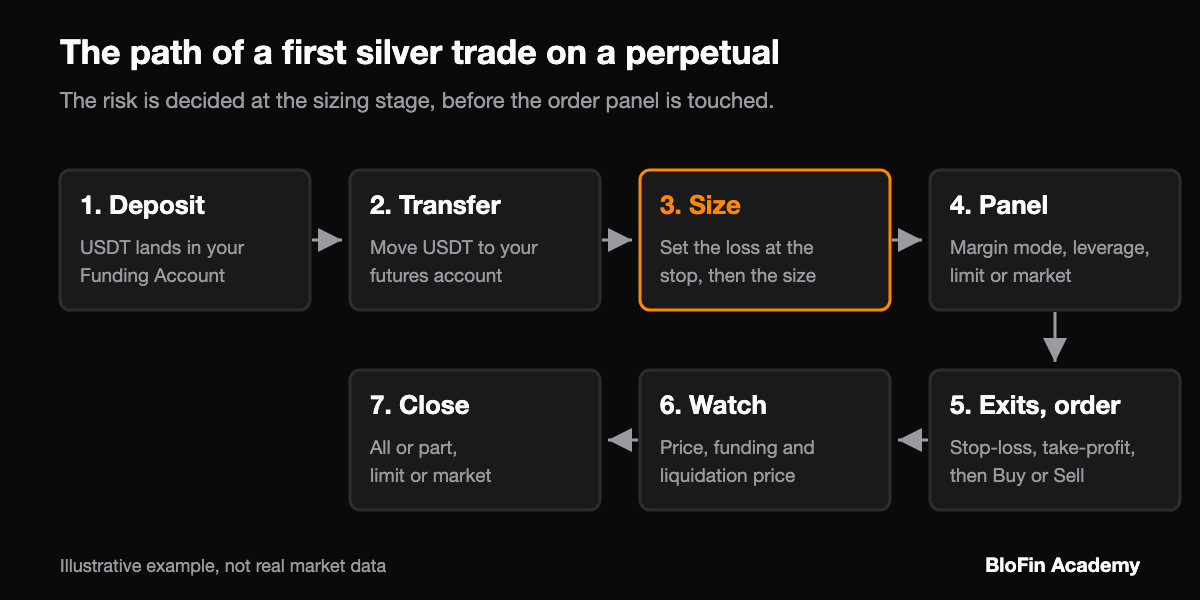
BloFin offers silver as the XAGUSDT Perpetual. A first trade there runs from a USDT deposit to a closed position, and its size comes from the distance silver usually travels in a day.
How do you trade silver on a perpetual?
To trade silver on a perpetual, deposit USDT, move it to your futures trading account and open the XAGUSDT Perpetual. Pick a margin mode and leverage, type a size in troy ounces of silver (XAG), set a stop-loss and take-profit, then go long with Buy or short with Sell. You close the trade later from the Positions tab.
Long profit = (exit price − entry price) × XAG size − trading fees ± funding.
For a short, swap the two prices inside the bracket, since a short gains when silver falls. XAG is silver's code in the International Organization for Standardization's ISO 4217 list, with one unit defined as one troy ounce (source: ISO 4217 on Wikipedia), which means a 6 XAG position tracks the price of 6 ounces. Orders go down to 0.01 XAG, leverage runs from 1x to 100x (source: BloFin XAG contract details), and the rest of the XAGUSDT contract terms stay the same whichever way you trade.
The perpetual is one of several routes to silver's price. COMEX's benchmark silver futures contract covers 5,000 ounces, and CME added a 100-ounce version aimed at retail traders (source: Reuters via Kitco, August 11, 2026). A CFD is a contract with a provider that pays the change in an asset's price (source: Wikipedia, contract for difference). A fund such as the iShares Silver Trust sells shares meant to reflect the price of the silver it holds (source: iShares Silver Trust). The perpetual is also the only silver product on BloFin, which has no silver spot pair or token. The routes to silver's price differ mainly in what you end up holding.
Depositing USDT and moving it to your futures account
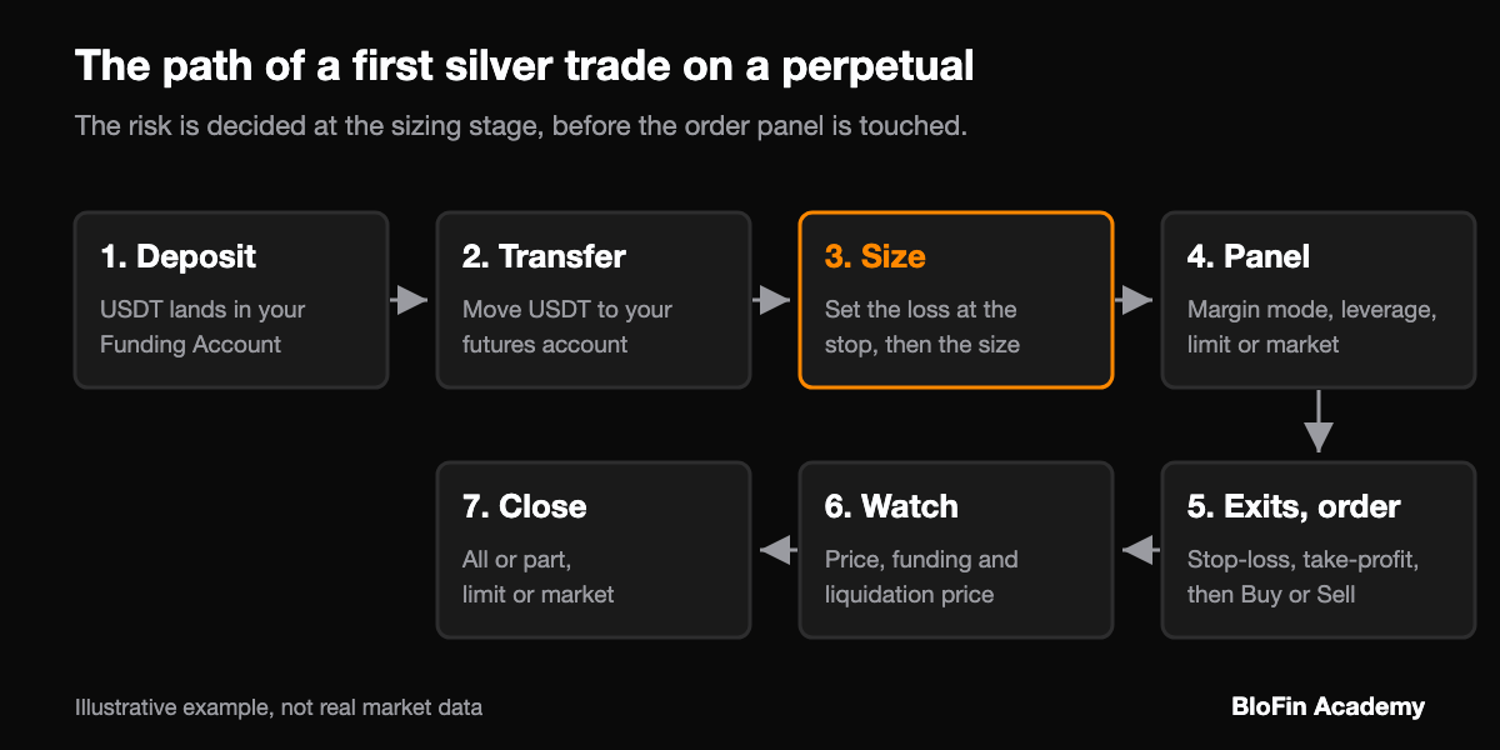
Getting USDT ready to trade takes two moves. A deposit lands in your Funding Account, and you then transfer the USDT to the trading account that backs futures orders. The XAGUSDT Perpetual settles in USDT, so USDT is the plain way to fund it, and moving it across is instant and free.
Step 1: Send USDT to BloFin from your wallet or another exchange, following BloFin's deposit guide. Each asset has a minimum deposit, and every deposit arrives in your Funding Account first.
Step 2: Under Assets, pick Transfer and send USDT from the Funding Account across to your futures trading account.

Move more than the margin you plan to use, because trading fees and funding also have to be paid while the position is open. A trade that locks about 104 USDT of margin, for example, leaves some room around it after a transfer of 120 USDT.
Sizing a first silver trade from the daily range
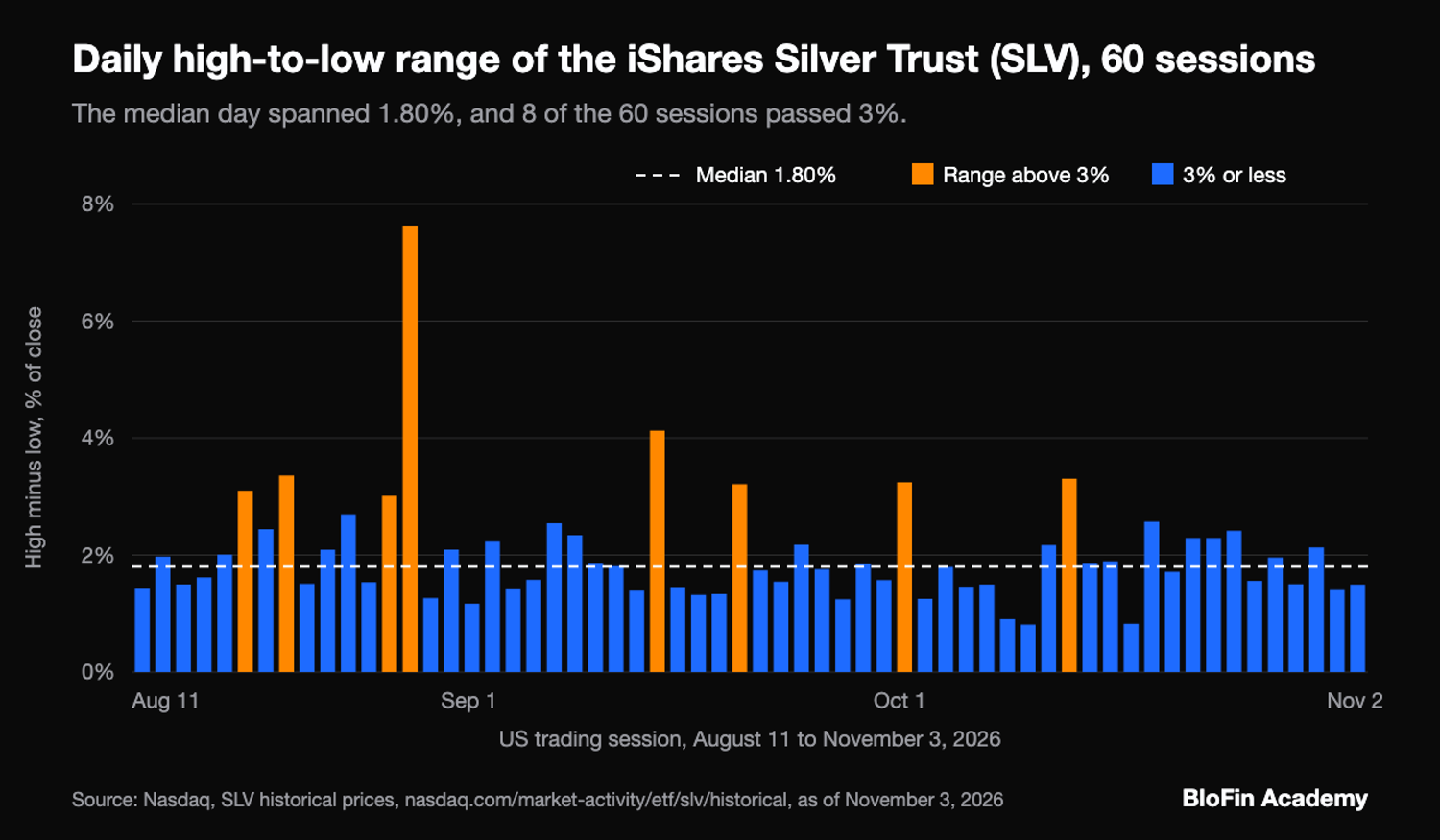
Size your first silver trade from the loss you accept at the stop, and set the stop from how far silver usually moves. Over the 60 US sessions to November 3, 2026, the iShares Silver Trust had a median daily range, high to low, of 1.80% of its close (source: Nasdaq, SLV historical prices).
The fund is only a stand-in for silver here, and its core session covers just US market hours, so its range can understate what silver does across a full day (source: NYSE, trading hours). Even so, the range passed 3% in 8 of those 60 sessions, and it reached 7.63% on August 28 (source: Nasdaq, SLV historical prices). A stop inside the normal range can be knocked out by everyday movement before your idea has been tested.
A single day can run far wider than that median. Spot silver was lower in late US trading on Tuesday, November 3 (source: Kitco PM, November 3). In the 24 hours to 8.18AM UTC on November 4, the XAGUSDT Perpetual traded between 48.73 and 52.05 USDT, a range of 3.32 USDT, and stood 5.81% higher at the end of that window (source: BloFin XAGUSDT trading page).
Size in XAG = your accepted loss in USDT ÷ the distance from entry to stop in USDT.
Say you accept a loss of about 10 USDT and plan to buy at 51.96 USDT, the contract's mark price at that same moment. A stop 3% away sits at 50.40 USDT, which is 1.56 USDT per XAG, well past the fund's median day and yet less than half of that 3.32 USDT swing. Dividing 10 by 1.56 gives 6.41 XAG, and the example rounds down to 6 XAG, worth 311.76 USDT.
The loss at the stop now depends only on the size and the distance, so leverage has a different task: it sets the margin the position locks up. At 3x, the margin is 103.92 USDT, and the whole of it would be gone after a 33.33% fall, at 34.64 USDT. At 20x the margin shrinks to 15.59 USDT, but a 5% fall to 49.36 USDT uses all of it, and the last price's 24-hour low of 48.73 was under that level. Higher settings shrink that room further, as silver's leverage and margin trade-offs show.
Two costs complete the worked trade. BloFin's regular futures taker fee is 0.0600% (source: BloFin fees), and the funding rate that settled at 8AM UTC on November 4 was 0.0120% (source: BloFin XAG funding history).
Worked first trade | Figure |
|---|---|
Entry, a long at the November 4 mark price | 51.96 USDT |
Size | 6 XAG |
Position value | 311.76 USDT |
Margin at 3x | 103.92 USDT |
Stop-loss | 50.40 USDT |
Take-profit | 54.30 USDT |
Taker fee to open, at 0.0600% | 0.19 USDT |
One funding payment at 0.0120% | 0.04 USDT |
Result at the stop, after fees and that funding | −9.77 USDT |
Result at the take-profit, after fees and that funding | +13.62 USDT |
Placing a silver order on the XAGUSDT order panel
Placing a silver order happens on the XAGUSDT order panel, from choosing the market to pressing Buy or Sell. You set the margin mode, the leverage, the order type, the price, the size and your exits, and the panel also shows an estimated Liq. Price and a Cost figure before you send the order.
Step 1: On the BloFin homepage, hover over the TradFi tab and select Futures.
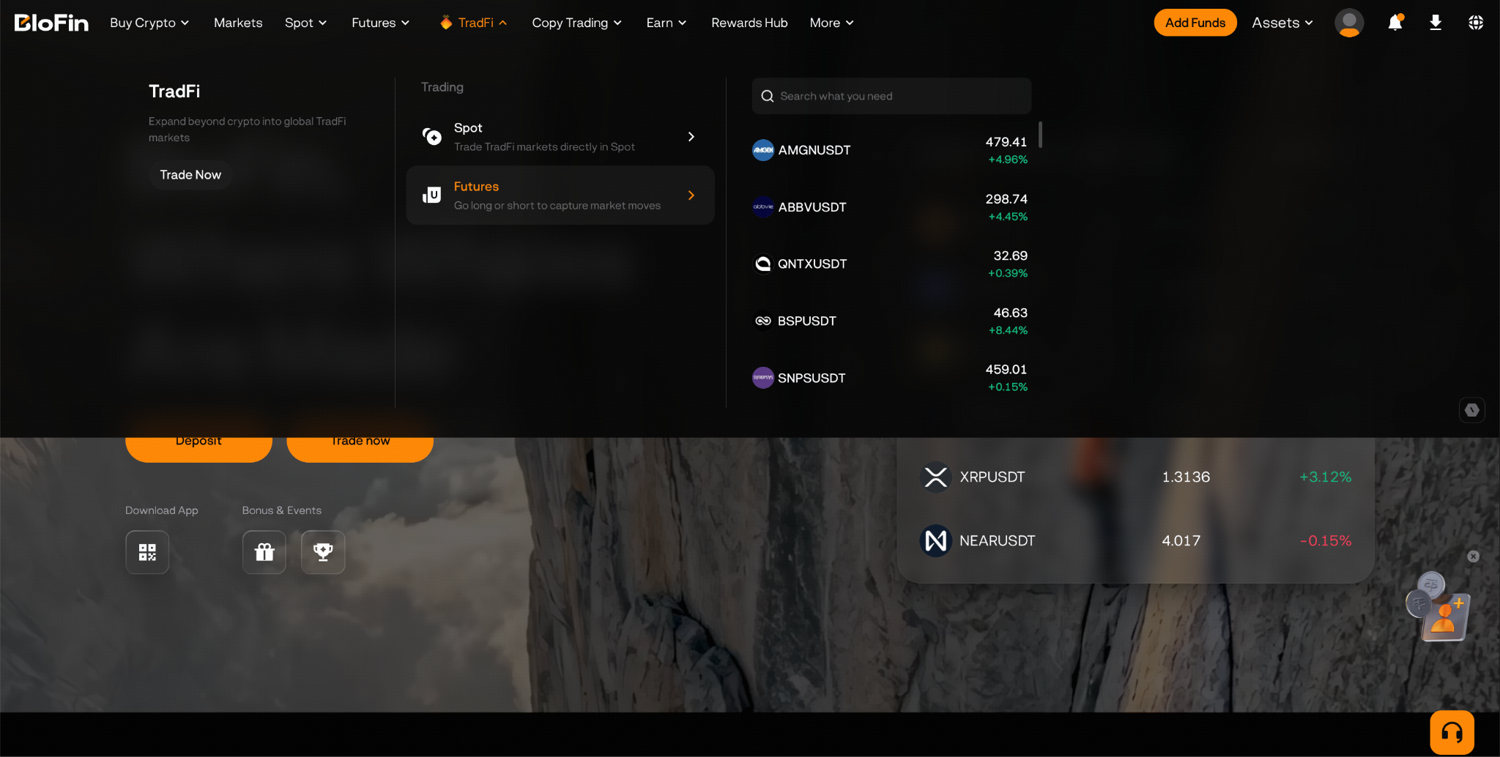
Step 2: Click the trading pair on the top left corner and a pop-up window will appear. Type XAG in the search field and select the XAGUSDT Perpetual.
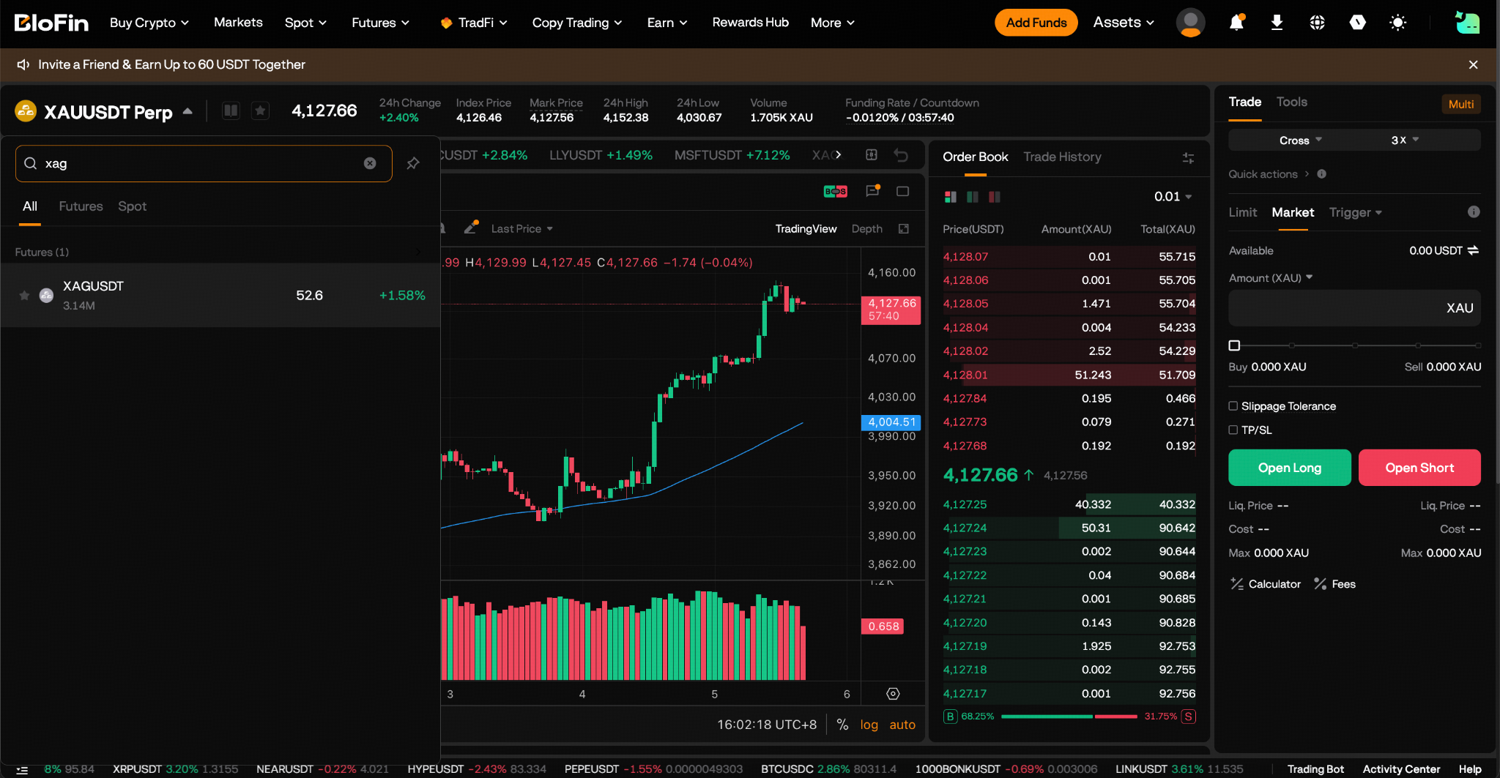
Step 3: Choose your margin mode, Cross or Isolated. Isolated limits your risk to the margin you allocate to that position, while cross puts your balance behind it as collateral, so isolated is the easier one to reason about on a first trade.
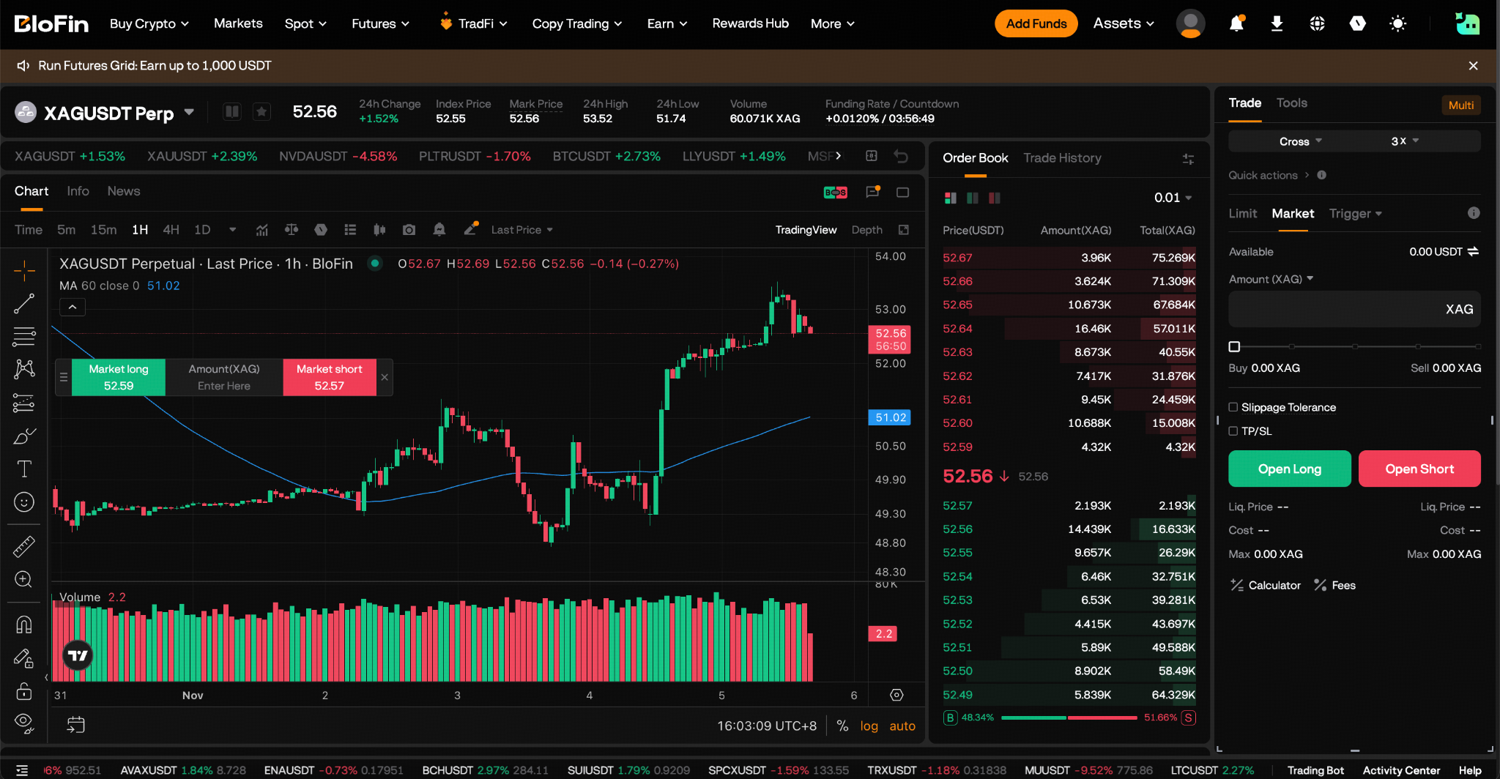
Step 4: Set your leverage, using the slider or typing the multiplier. BloFin's first-trade guide suggests starting at 2x to 5x on your first trades.
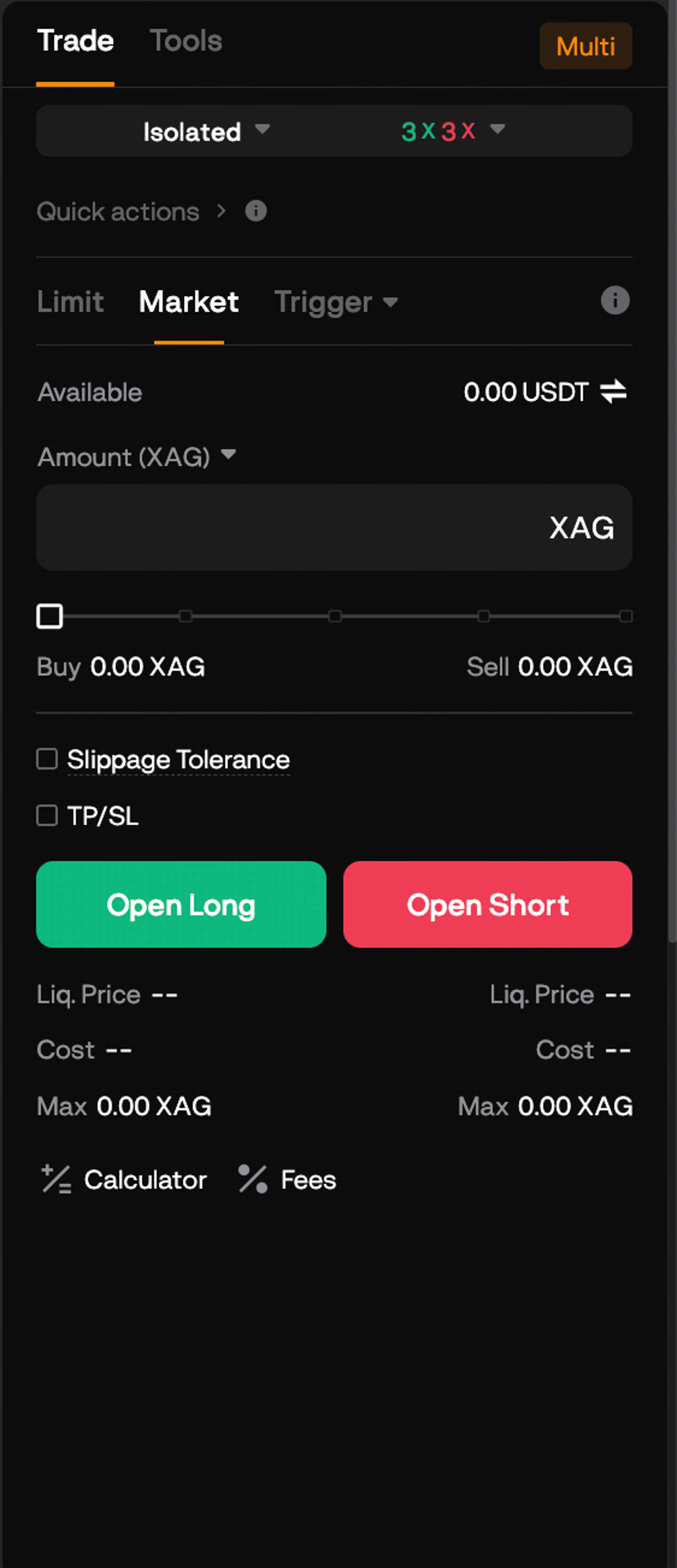
Step 5: Choose Limit or Market as the order type. With Trigger, the third choice, the order activates when the market hits a trigger price, then executes as a market or limit order.
Step 6: On a limit order, enter your price in Price USDT. Then type your size in Amount (XAG).
Step 7: Tick the box for take-profit (TP) and stop-loss (SL), labeled TP/SL, and enter both prices.
Step 8: A dropdown beside each price starts on Last. Leave it there, or switch it to Mark or Index to choose which price sets off the order. Advanced opens a window with Change % and a Limit fill if you want to set them another way.
Step 9: Buy opens a long and Sell opens a short, so check the estimated Liq. Price against your stop, click the one you want, then review the confirmation and confirm. Once the order fills, the trade appears under Positions with its entry price, estimated liquidation price, unrealized profit or loss and current margin.
Opening a short takes the same steps with Sell, though shorting silver brings risks of its own, such as a sudden squeeze.
Limit and market orders on silver
A limit order trades at your price or better, and it may wait unfilled. A market order goes through straight away, but its fill price carries no guarantee and can differ from the last trade (source: Investor.gov, types of orders). On a market as jumpy as silver, that gap is the price you pay for certainty of getting in.
The choice also sets the fee. BloFin's regular futures rates are 0.0200% for makers and 0.0600% for takers (source: BloFin fees), and a limit order that waits on the book pays the maker rate. On a 311.76 USDT position, that is about 0.06 USDT against 0.19 USDT to open.
Setting a stop-loss and take-profit on silver
On a silver long the stop-loss goes under your entry and the take-profit over it, and a short flips them. You can attach both with TP/SL as you place the order or add them later from the Positions tab, covering the full size or only some of it.
To add exits after entry, open Positions, click TP/SL and pick Entire Position or Partial Position.
The dropdown to select Last, Mark, or Index matters because the three prices are different numbers. At one moment on November 4, the XAGUSDT Perpetual's last trade was 52.01 USDT, its mark 51.96 and its index 51.94 (source: BloFin XAGUSDT trading page). Last reacts to every trade on the contract, including a brief spike, while the mark price tracks the index. That makes a mark-based stop harder for one odd trade to set off, and the mark is also the price that drives liquidation.
Unless you chose a Limit fill, exits set this way fill as market orders. A triggered stop becomes a market order (source: Investor.gov, types of orders), so a fast fall can fill you under 50.40 USDT, and the 9.77 USDT in the worked trade is the expected loss at that price and never a ceiling. Moving a stop further away to avoid being hit turns a planned loss into a larger one, while raising it under a rising price protects part of the gain.
Reading the liquidation price on a silver trade
The liquidation price is the level where BloFin liquidates a position because its margin can no longer carry the loss, and liquidation runs on the mark price, never the last trade. On a long it sits under your entry, and BloFin shows it as an estimated Liq. Price on the panel and under Positions.
On isolated margin, the worked long at 3x loses its whole margin at 34.64 USDT, so the panel's figure should sit somewhat over that. Liquidation arrives first because margin only has to drop to the maintenance requirement, set at the first tier's 0.50% of position value, up to 400 XAG (source: BloFin XAG position tiers). The stop at 50.40 USDT is far above that point, which is the arrangement you want: the stop fires on a normal bad day, and liquidation stays out of reach.
Run the same check every time before you confirm. If Liq. Price sits close to your stop, a fast move can reach both at nearly the same moment, and lowering the leverage is the direct fix, because it adds margin without changing the size. Under cross margin, the whole futures balance backs the position, so the liquidation price moves further away while the amount at risk grows.
Managing an open silver position
An open silver position changes in two ways while it runs: its profit or loss follows the price, and it pays or receives funding every four hours. The Positions tab shows the entry price, the estimated liquidation price, the unrealized profit or loss and the current margin, so that is the tab to check.
Funding settles six times a day in UTC: 12AM, 4AM, 8AM, 12PM, 4PM and 8PM (source: BloFin XAG contract details). A positive rate takes money from longs and hands it to shorts, and a negative rate does the reverse. Each payment is the position's nominal value times the rate (source: BloFin, funding FAQ), so the 0.0120% rate on the 311.76 USDT long comes to about 0.04 USDT.
Each of the latest 50 rates, settled between October 27 and November 4, was positive, between 0.0021% and 0.0418% (source: BloFin XAG funding history). Longs paid at each of those settlements and rates can change at the next one, so silver's funding rate decides much of what a long hold costs.
Silver can also move while you are away from the screen, as the 3.32 USDT swing to November 4 showed, which is why the stop goes in with the order. Silver trading hours differ from one market to the next, so a data release can land while the market you watch is quiet. How long you hold also shapes the bill: a trade closed within four hours crosses one settlement at most, while the silver trading strategies built on multi-day swings cross many.
You can check the current funding rate on the XAGUSDT Perpetual page before you hold through a settlement.
Closing or partly closing a silver position
A silver futures position stays open until you close it, it hits a take-profit or stop-loss, or it is liquidated. Closing it yourself starts from Positions, where you can exit all of it or part of it with a limit or a market order, and a partial close leaves the rest running.
Step 1: Go to the Positions tab and click Close next to your XAGUSDT position.
Step 2: Choose Limit or Market, enter the amount, plus the price on a limit close, and click Confirm.
Step 3: To close only part of the position, enter part of the amount. The remainder keeps its original margin and leverage. BloFin also offers Close All.
In one-way mode, you can also close from the trading page itself, with a Sell order for a long or a Buy order for a short. In hedge mode, longs and shorts on a contract are held separately, so use Close under Positions (source: BloFin API documentation). The fee depends on the path: a limit close that rests on the book fills as a maker at 0.0200%, and a market close pays the taker rate of 0.0600%.
The worked long can end two ways. At the stop, the price loss is 9.36 USDT, and the 0.19 USDT fee to open, the 0.18 USDT fee to close and one funding payment bring it to 9.77 USDT, which is 9.4% of the margin. At the 54.30 USDT take-profit, the 14.04 USDT gain falls to 13.62 USDT after the same kinds of cost. The gain is 1.5 times the price loss, so the trade can lose more often than it wins and still come out even.
A partial close lets you bank some of a move. Selling 3 XAG at 53.00 USDT would lock in 3.12 USDT, less a fee of about 0.10 USDT at market or 0.03 USDT at a limit. The stop on the other 3 XAG would then cost 4.68 USDT if it fired, before fees and funding.
Copy trading silver on BloFin
Copy trading is a second route to the same contract, since XAGUSDT is on BloFin's copy-trading list. A lead trader's trades execute in your account in proportion to your allocation, which starts at 100 USDT. You need no separate application, and futures copy trading can transfer assets for you automatically.
The lead trader decides the entries and exits, and silver's swings apply just the same, so that trader's loss on a sharp down day reaches your allocation too. With copy trading, your main decision becomes which lead trader to follow.
A pre-trade checklist for silver
A pre-trade checklist for silver gathers your balance, size, stop, leverage, exits and funding into one quick review before you press Buy or Sell. Each item has a figure or a setting you can read from the panel or work out, and any you cannot fill in is a reason to wait.
Balance: your futures trading account holds more USDT than the margin you plan to use.
Loss at the stop: you have written down the USDT you accept losing, and your size in XAG comes from it.
Stop distance: your stop sits beyond an ordinary day's range, and you have looked at the last 24 hours on the contract.
Leverage and margin mode: Liq. Price sits well past your stop.
Exits: TP/SL is ticked, and the dropdown shows the price you meant to choose.
Funding: you know the current rate's sign and the next settlement time.
Calendar: you know what US data is due, such as the monthly employment report, and when it lands in UTC.
Looking to trade silver? To get started, you'll need to first create a BloFin account, fund your account with cryptocurrency, and navigate to the XAGUSDT Perpetual trading page.
Frequently asked questions
What is the smallest silver trade you can place?
The smallest XAGUSDT order is 0.01 XAG (source: BloFin XAG contract details). At the November 4 mark of 51.96 USDT, that is worth about 0.52 USDT and needs about 0.17 USDT of margin at 3x. A trade sized to risk about 10 USDT at a 3% stop needs far more: about 104 USDT of margin at 3x, plus room for costs. Each deposit also has to meet the minimum for its asset.
How long can you hold a silver position?
A position can stay open until you close it, a take-profit or stop-loss fires, or it is liquidated, so the limit is what the holding costs. Over the latest 50 settlements to November 4 the rate averaged about 0.0167% (source: BloFin XAG funding history), or about 0.10% a day across six settlements. At that pace, seven days on a 311.76 USDT long would cost about 2.18 USDT, or 2.1% of a 3x margin, and real rates change every four hours.
Can you flip a silver long into a short?
BloFin's first-trade guide describes a Reverse function, which closes the position and opens an equal one in the opposite direction, using two market orders. If your balance cannot cover the new position, a smaller one opens instead. Since both orders pay the taker rate, reversing a 311.76 USDT long costs about 0.37 USDT in fees before any slippage, and the new short starts with its own liquidation price, so check that again.
How much does a silver trade cost in fees?
You pay a fee to open and another to close. On a 6 XAG long opened at 51.96 USDT and closed at 54.30 USDT, two market orders cost about 0.38 USDT at 0.0600%, and two limit orders would cost about 0.13 USDT at 0.0200% (source: BloFin fees). A limit order can wait unfilled, though, and funding comes on top for each settlement the position crosses.
Is silver a good market for a first trade?
A silver perpetual offers a small minimum order and a panel that shows your liquidation price before you trade. Against that, silver can move further than gold in a session. On November 3, the iShares Silver Trust lost 1.60% (source: Nasdaq, SLV historical prices) while SPDR Gold Shares lost 0.66% (source: Nasdaq, GLD historical prices), a move about 2.4 times as large. If you widen the stop to match, the same risk in USDT buys a smaller position.
Researched and written by the BloFin Academy editorial team with AI-assisted drafting. All facts independently verified. Primary sources include Nasdaq, NYSE, Kitco, Reuters, the iShares Silver Trust, Investor.gov and BloFin's XAG contract details, position tiers, funding history, fee and help pages, current as of November 4, 2026.
Nothing in this article constitutes financial advice, and nothing in it is a recommendation to buy, sell or hold silver in any form. The worked trade is an illustration built on one dated price. The XAGUSDT Perpetual covered more than 6% of its price in the 24 hours to the morning of November 4, a stop can fill worse than its level in a fast move, and leverage can liquidate a position outright, while funding paid or received every four hours changes the result of any hold. Past performance does not indicate future results. Do your own research and consider your risk tolerance before you trade on BloFin.