
Most people who get into crypto have at least one asset they genuinely believe in long-term. Bitcoin, Ethereum, Solana, or something else entirely. The conviction is there. The problem is the price. You want more of it, but committing everything at once feels risky when crypto can move 10% in either direction on any given day. Trying to time a better entry just leads to hesitation, and hesitation usually means doing nothing at all.
Dollar-cost averaging is the practical answer to that problem. Instead of searching for the perfect entry, you spread your purchases across multiple price levels over time, buying more when the price dips and less when it's elevated. The BloFin Spot DCA Bot automates that process on the spot market, so you can build your crypto position systematically without watching charts all day.
What is the BloFin Spot DCA Bot?
The BloFin Spot DCA Bot is an automated trading tool that gradually accumulates a spot crypto asset across multiple price levels using a dollar-cost averaging strategy. It starts by purchasing an initial amount of the asset, then makes additional purchases each time the price drops by a set percentage, steadily lowering your average cost with each buy. When the price recovers to your take profit target, the bot sells, realizes the profit, and begins a fresh accumulation phase automatically.
Because this operates on the spot market, there's no leverage involved. You're buying and holding the actual cryptocurrency, which means no margin requirements, no liquidation risk, and no funding fees. What the bot accumulates is yours directly.
How the BloFin Spot DCA Bot works
The bot runs in accumulation cycles. Each cycle starts with an initial purchase and ends when either the take profit is hit, the stop loss triggers, or the maximum number of additional purchases is reached.
Here's how a cycle plays out. The bot places the first buy at the current market price. From there, it monitors the price and waits. If the price rises to your take profit target from that first entry, the cycle closes quickly and a new one starts. But if the price dips instead, the bot gets to work. Each time the price falls by your configured price step percentage, it makes another purchase, adding to the position and pulling the average cost lower. The more the price dips and the more purchases that accumulate, the lower your average entry becomes.
This is where the strategy has its edge: because your average cost keeps dropping on the way down, a smaller recovery is all that's needed to hit your take profit. You don't need the price to fully retrace back to your original entry. You just need it to recover enough from the blended average across all your purchases.
The cycle ends when one of three things happens. The price recovers to your take profit target and the full position is sold for a profit, starting the next cycle immediately. The price hits your stop loss level, triggering an exit to limit further losses. Or the bot reaches its maximum additional purchase count, after which it holds the position and waits for either the take profit or stop loss to resolve the cycle.
What you're actually building
One thing worth understanding about the Spot DCA Bot that often gets glossed over: at the end of a successful cycle, you're selling the crypto you've accumulated rather than holding it indefinitely. The bot buys on the way down, then sells when the take profit fires. Your profit comes from the spread between your blended average purchase price and the take profit price.
This is different from simply buying and holding an asset for the long term. The bot is running a repeating buy-low, sell-at-target cycle on the spot market, not a passive accumulation strategy. That said, in between cycles, or if you stop the bot mid-cycle, you're holding real crypto in your Spot Account. If the price has fallen since the cycle started and you stop the bot before the take profit fires, you're left owning the asset at whatever average cost the bot has built up. Whether that's a desirable outcome depends on your view of the asset and how comfortable you are holding it at that price.
Key parameters explained
Price step (%) controls how far the price needs to drop from the previous purchase before the next one triggers. A smaller price step means more purchases fire during smaller dips, lowering your average faster but burning through your purchase count more quickly. A larger price step spaces purchases further apart and requires a bigger decline before the bot adds again.
Take profit per cycle (%) is the percentage gain above your blended average purchase price that closes the cycle. Because additional purchases lower that average, the take profit target becomes easier to hit after each dip purchase. The key is setting a realistic target relative to the asset's typical recovery moves.
Initial order amount is the size of your first purchase in USDT when a new cycle begins.
Safety order amount is the base size of your additional dip purchases. Each successive purchase is a multiple of this base amount, so later purchases in a cycle are larger and have a stronger effect on pulling the average cost down.
Maximum safety orders determines how many additional dip purchases the bot can make per cycle. Once that count is reached, the bot stops buying and holds the accumulated position until the cycle resolves. The total USDT that could be deployed if all additional orders fire is worth calculating upfront since that's your maximum exposure per cycle.
Stop loss sets the price level at which the bot exits the entire position at a loss. This is the exit valve if the market drops far enough that waiting for the take profit no longer makes sense.
What markets suit the Spot DCA Bot?
The strategy works best in markets that experience dips and recoveries rather than sustained trends in one direction. When an asset pulls back and then bounces, the bot catches the dip with additional purchases and closes the cycle on the recovery. That repeated pattern is what makes the DCA approach earn consistently over time.
In a prolonged downtrend where the price keeps falling without meaningful bounces, the bot will accumulate through its additional purchase count and then sit with an open position waiting for a recovery that may take a while to come. The stop loss is the protection here, giving you a defined exit if the decline goes deeper than you're willing to hold through.
It's also less effective in a straight-up rally. If the price shoots up from the moment the first purchase fires, the cycle closes quickly at the take profit with only the initial order having executed. That's a fine outcome but the DCA aspect of the strategy, the averaging benefit, doesn't come into play. The bot simply runs a quick cycle and starts the next one.
Spot DCA Bot vs Futures DCA Bot
For traders who are open to using leverage on the futures market, BloFin also offers a Futures DCA Bot that applies the same accumulation logic to futures contracts. The mechanics are nearly identical: initial order, additional dip purchases, take profit cycle. The key difference is that the Futures version uses leverage, which amplifies both returns per cycle and risk. It also introduces margin management, liquidation exposure, and funding fees that the Spot DCA Bot doesn't carry.
The Spot DCA Bot is the simpler, lower-risk version of the two. Because you're buying the actual asset rather than a leveraged contract, the downside in any given cycle is capped by the asset's price movement rather than amplified by leverage. For traders who want the DCA cycle mechanic without the complexity of managing a leveraged futures position, the Spot version is the more straightforward choice.
Who is the Spot DCA Bot for?
The Spot DCA Bot suits traders who have a constructive view on a crypto asset and want to build exposure to it in a disciplined way, rather than trying to time a single entry. It's particularly well-suited to people who find themselves hesitating on entries because they're worried about buying at the wrong price. The bot removes that hesitation by systematically making purchases at progressively lower levels, taking the decision out of your hands.
It also works well for traders who are already accumulating crypto regularly and want to automate and systematize that process. Rather than manually deciding when to buy each week or month, the bot triggers purchases based on actual price behavior, meaning you tend to buy more when the asset is cheaper.
That said, the bot still requires you to believe in the asset you're running it on. If the price falls past your stop loss, you exit at a loss. If you stop the bot mid-cycle during a drawdown, you're left holding an asset that has declined. The DCA approach manages timing risk, but it doesn't eliminate the fundamental risk of owning an asset that goes down in value. Choosing your asset and sizing your cycles thoughtfully matters as much as the parameters themselves.
Before you get started
Interested in getting started? You'll first need USDT in your BloFin Spot Account to fund the bot. If your balance is in your Funding Account, move it across to your Spot Account before you begin.
The Spot DCA Bot works on assets you have at least a basic conviction about, since the strategy involves accumulating more of an asset when it drops. Think about the asset you want to run the bot on and ask yourself: if the price falls 10 or 15% while the bot is accumulating, are you comfortable holding that position while it recovers? If the answer is yes, the setup makes sense. If you're uncertain, starting with a smaller investment gives you a lower-stakes way to see how the strategy behaves.
How to get to the Spot DCA Bot
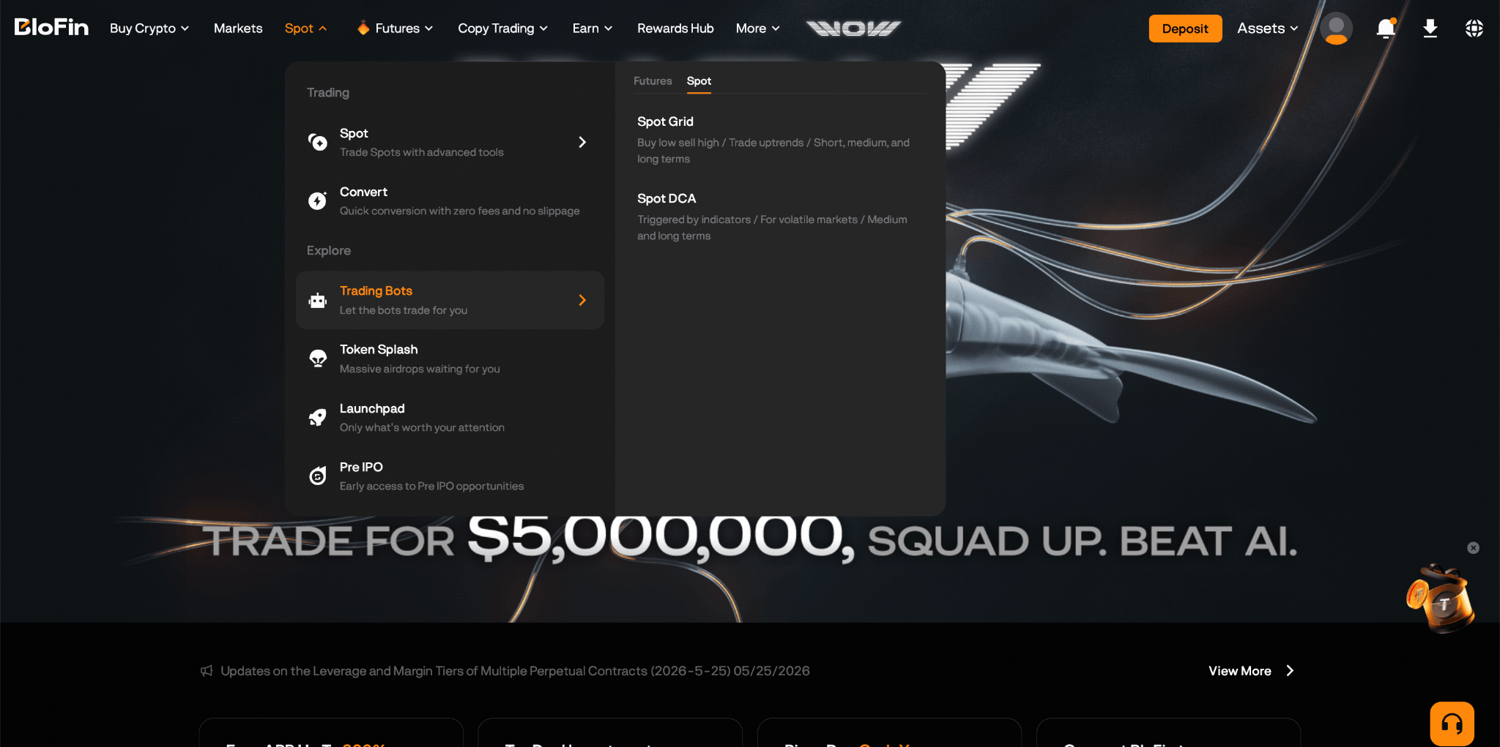
Step 1: Log in to your BloFin account and hover your cursor over the Spot tab in the navigation bar. Then, select Trading Bots.
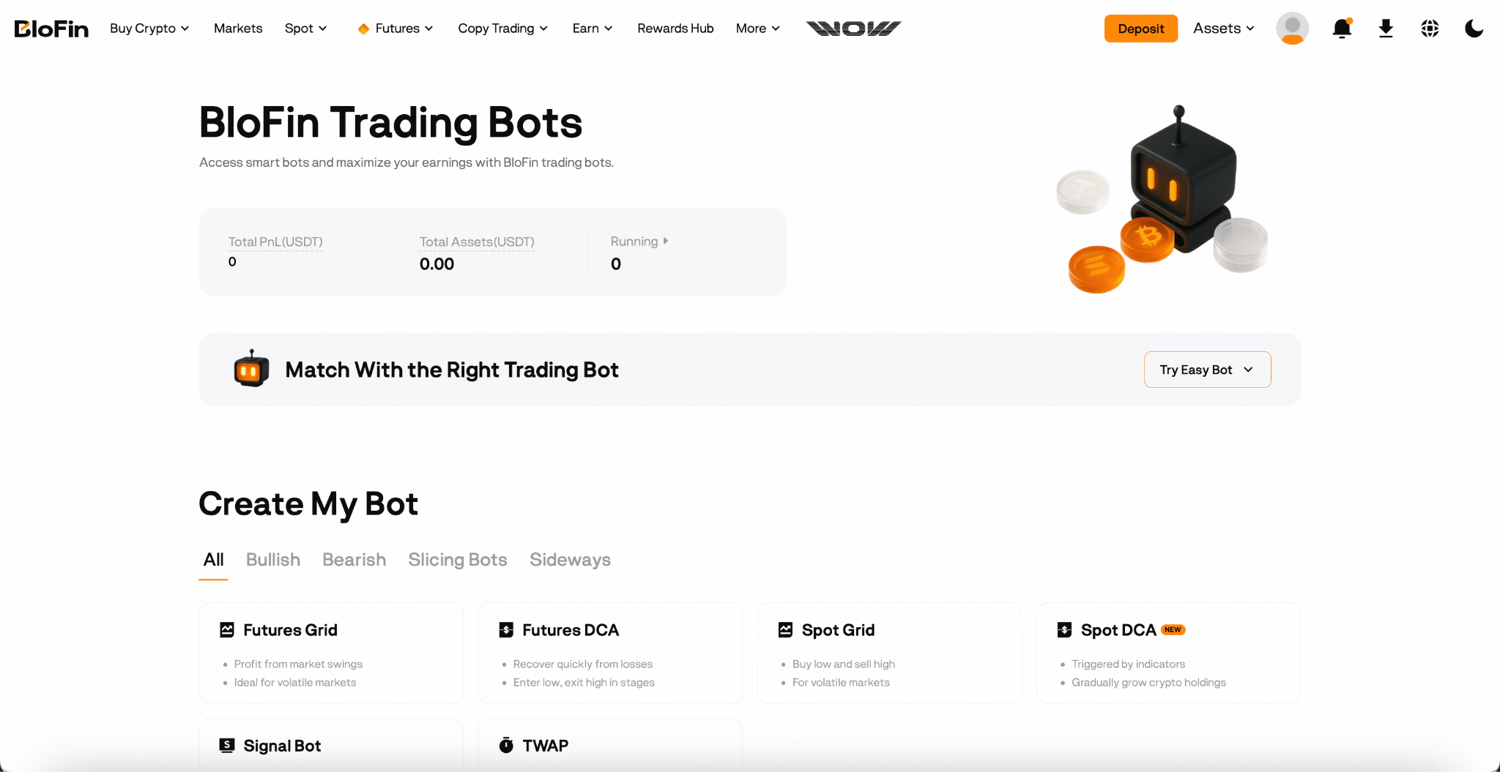
Step 2: On the BloFin Trading Bots page, click Spot DCA to open the bot creation page.
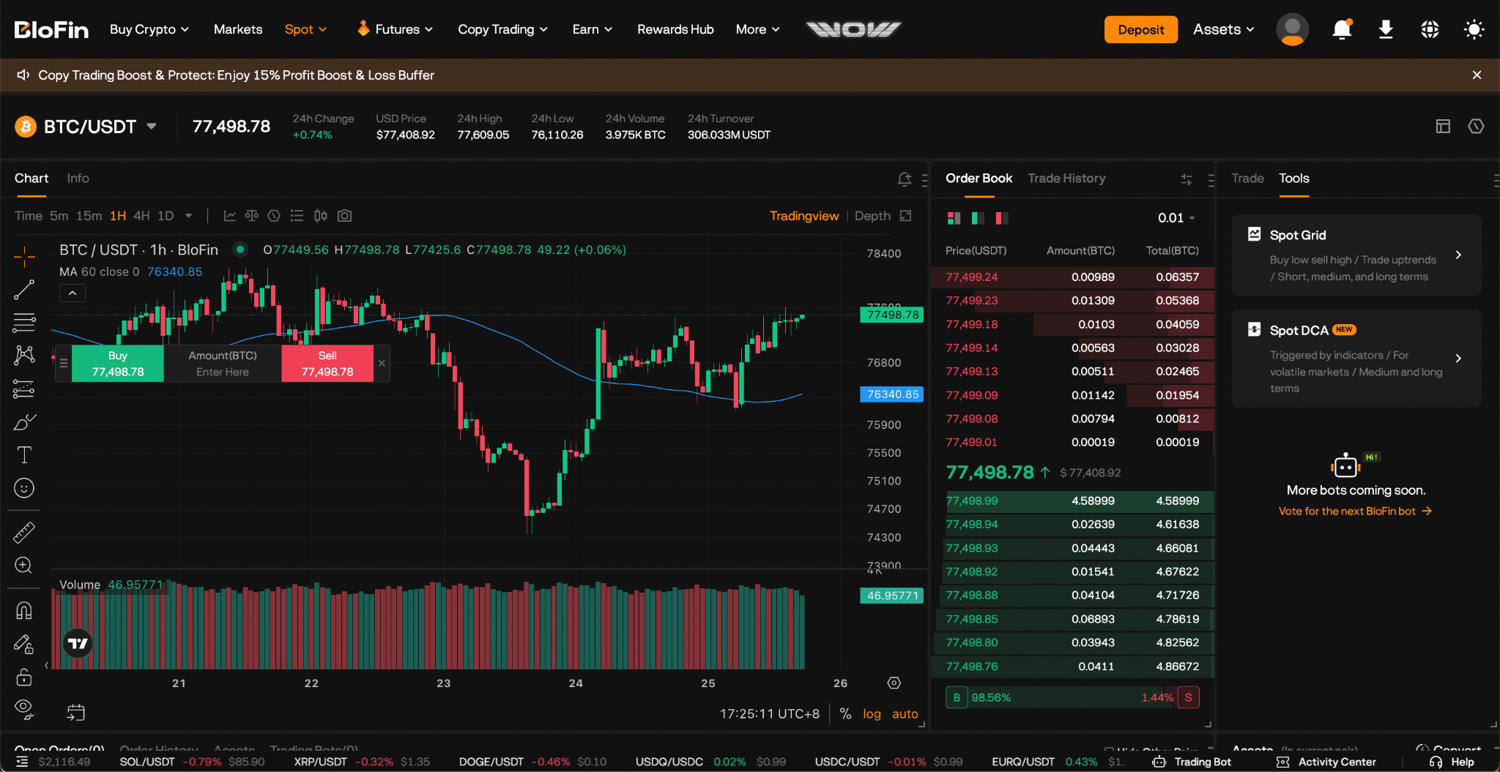
Alternatively, you can also access the Spot DCA Bot through the Spot trading page.
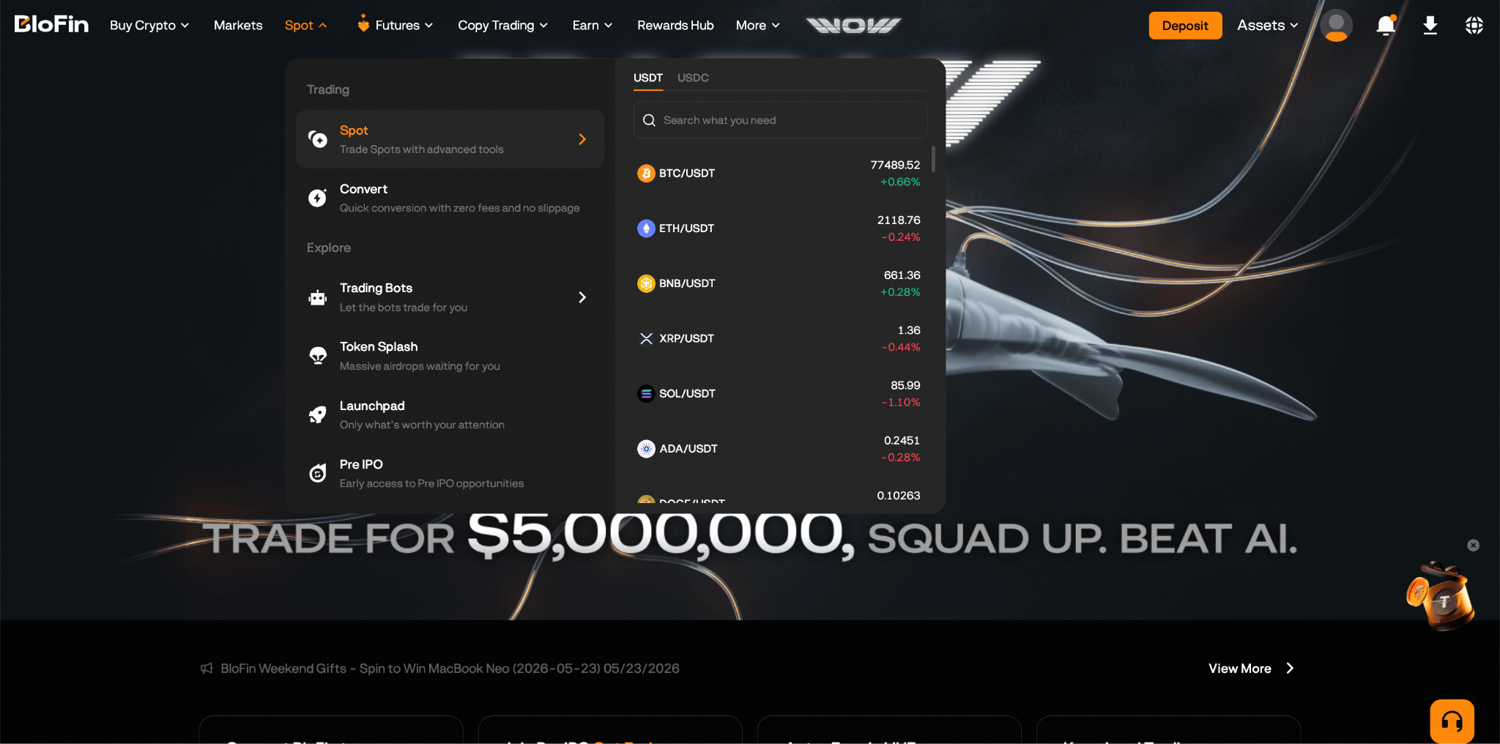
Step 1: Log in to your BloFin account and click on the Spot tab in the navigation bar.
Step 2: Click the Tools tab on the order panel located on the right side of the trading chart and select Spot DCA.
Choosing between AI Strategy and manual
The first real decision you'll make on the creation page is whether to let the bot configure itself or set every parameter yourself. Neither option is inherently better. The right choice depends on one thing: how well you know the asset's typical price behavior.
If you're running the bot on an asset you've been watching closely and have a feel for how deeply it tends to dip before recovering, manual setup lets you calibrate the parameters to that pattern. If you're less certain about the asset's volatility profile and just want to get something running on reasonable settings, the AI Strategy does that legwork for you.
Using the AI Strategy
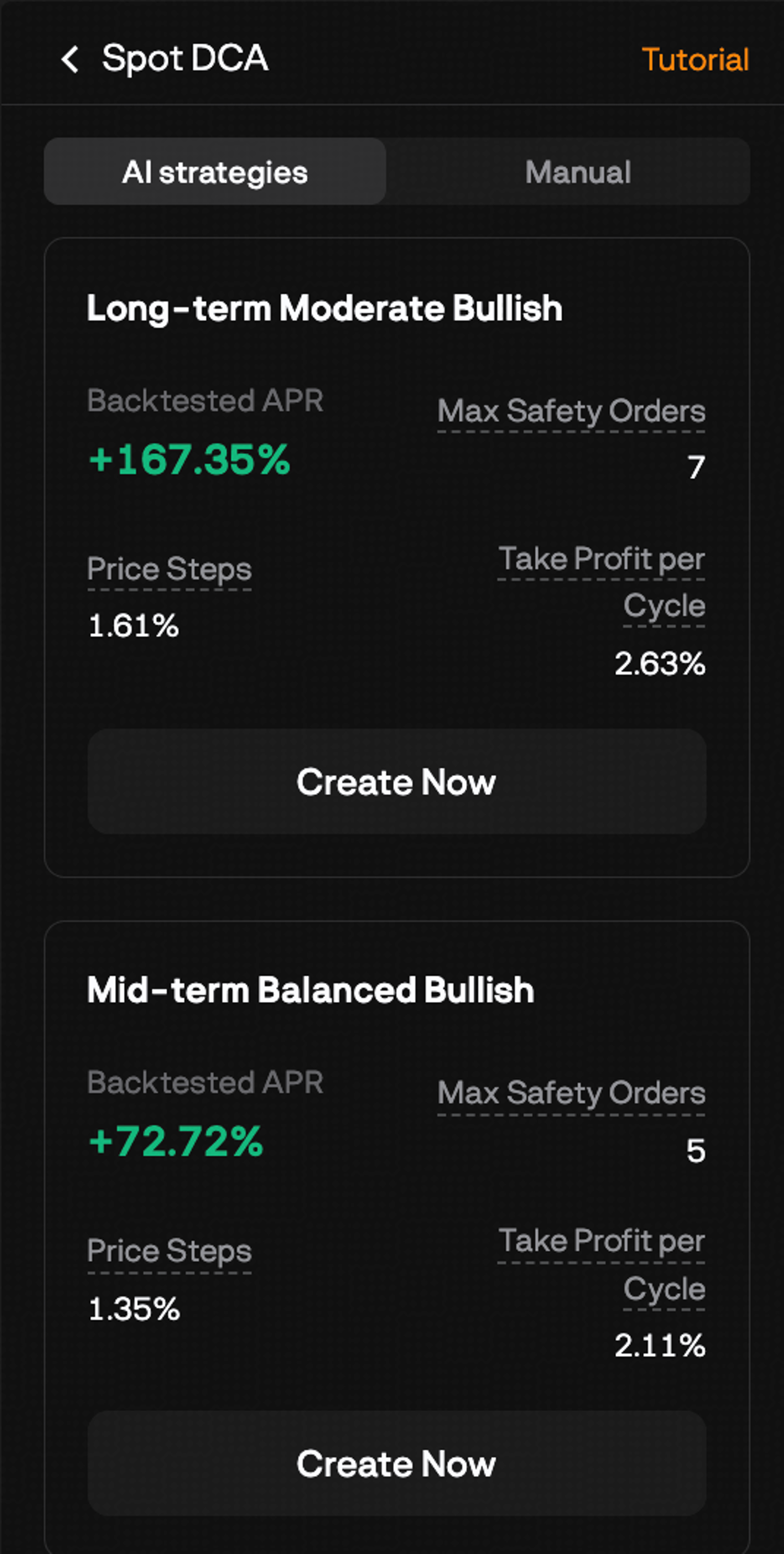
Select your trading pair, choose a risk profile from the available presets (Moderate, Balanced, or Aggressive), enter your investment amount, and click Create Now. The bot generates parameters based on the asset's historical behavior and activates immediately.
The risk profile you choose shapes how the bot responds to dips. A conservative setup tends toward smaller, more frequent purchases with tighter take profit targets. An aggressive setup is more tolerant of deeper drawdowns, placing larger additional purchases further apart. Take a moment to review the parameters generated before confirming so you know what you're launching.
Setting up manually
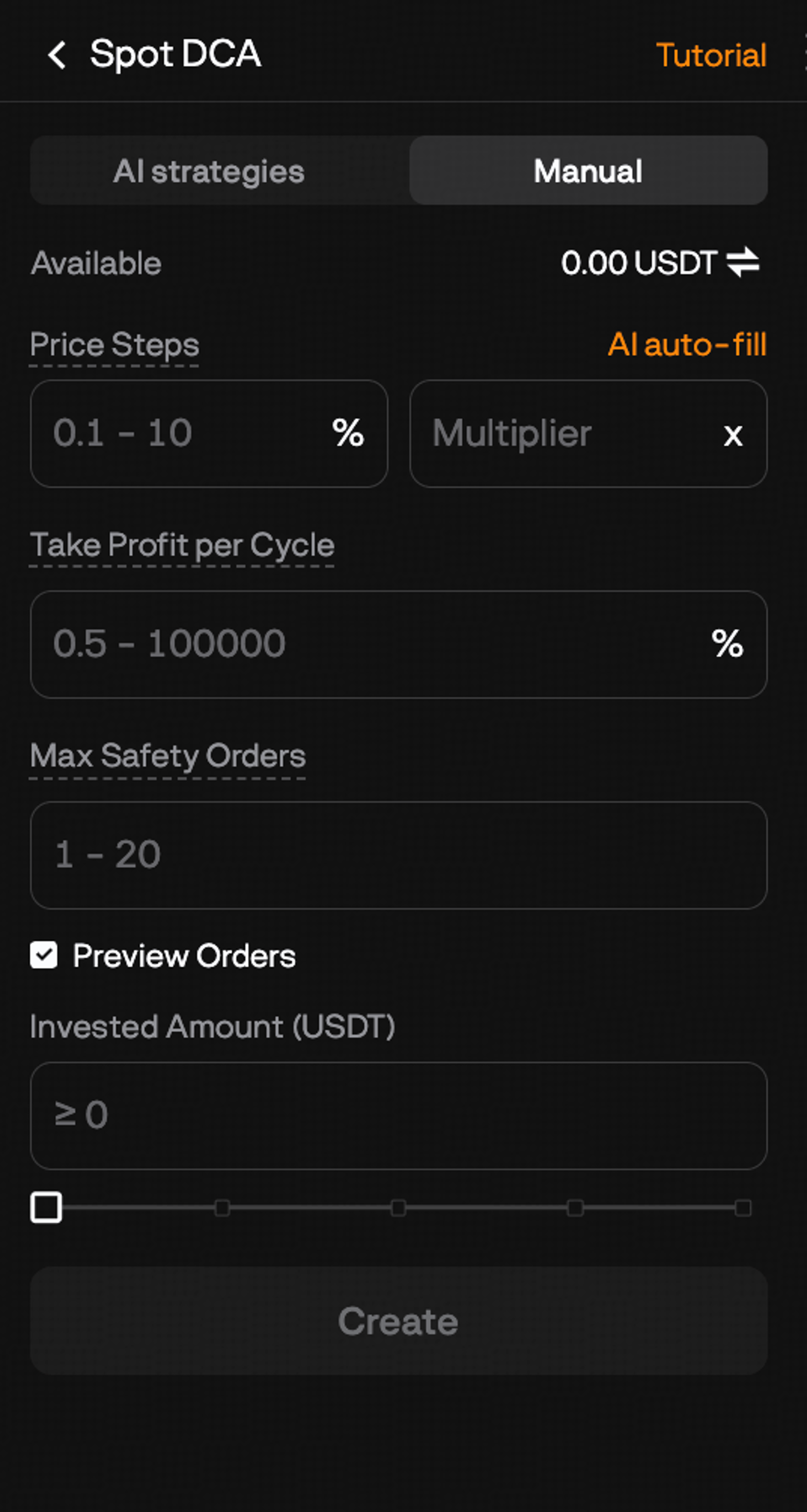
Manual setup puts you in control of the accumulation structure. Here's what each parameter decides.
Step 1: Select your trading pair. Pick the asset you want to accumulate. This should be something you're genuinely comfortable holding, because the bot will be buying more of it as the price falls.
Step 2: Set your price step percentage. This is the percentage drop from the previous purchase that triggers the next one. Think of it as how far the market needs to dip before the bot adds to your position. A tighter price step, say 1 to 2%, means the bot accumulates frequently on small dips. A wider step, say 4 to 5%, means the bot waits for more significant moves before adding. Look at how the asset has actually behaved recently: shallow and frequent pullbacks favor a tighter step, while an asset prone to sharp drops favors a wider one.
Step 3: Set your take profit per cycle. This is the percentage gain on your blended average purchase price that triggers the close. Set it relative to what the asset realistically recovers. If the asset tends to bounce 3 to 5% after a dip, a 2% take profit will close cycles quickly and frequently. A 10% target on the same asset means cycles take much longer to complete or may not complete at all in low-volatility conditions.
Step 4: Set your initial order and safety order amounts. The initial order is your first purchase when a new cycle starts. The safety order is the base size for each additional dip purchase, with each successive one being a larger multiple of that base. Before finalizing these, calculate what the total deployment would be if every additional order fires. That figure is the maximum you're putting at risk in a single cycle, and it should sit comfortably within what you're prepared to hold.
Step 5: Set your maximum safety orders. This caps how many additional purchases the bot can make per cycle. More orders means more room to average down through a deeper drawdown. But it also means more capital deployed per cycle. Balance the depth of averaging you want against the total exposure you're comfortable with.
Once you're satisfied, click Create, review the order confirmation, and click Confirm to launch.
What happens at launch
The bot places the initial purchase immediately at the current market price, opening the first position of the first cycle. A confirmation pop-up appears with a Details button. It's worth opening the Details view right away to confirm all orders are placed as expected and you have a clear read on the bot's starting state.
Managing a running bot
The Details page is where you track everything. Get there from the Trading Bots tab on the Spot trading page, select DCA, and click Details next to your running bot.
Because this is a spot strategy with no leverage, managing a running Spot DCA Bot is considerably calmer than a futures equivalent. There's no liquidation price inching closer and no funding fees accumulating. What you're tracking is simpler: where is the current price relative to your average purchase price, how many additional orders have fired, and how far away is the take profit.
The most important number on the Details page is your current average purchase price across the cycle. That's the real benchmark for the take profit calculation. If the bot has fired three additional orders and your average cost has dropped meaningfully from the initial entry, a much smaller price recovery than you might expect is enough to close the cycle profitably.
Stopping the bot mid-cycle
If you stop the bot while a cycle is in progress, all pending buy orders are canceled. The crypto the bot has already purchased stays in your Spot Account at the quantity and average cost accumulated up to that point. You own it outright. There's no forced exit and no additional transaction at the point of stopping. What you do with that holding afterward is entirely up to you.
Reading your bot's performance over time
After a few cycles have completed, the pattern in your order history tells you a lot about whether the setup suits the asset and current conditions.
Cycles that close quickly with only the initial order having fired suggest the price is recovering before dipping enough to trigger additional purchases. That's fine, but it means the DCA averaging benefit isn't coming into play. If quick, clean cycles are the norm, your price step might be set tighter than the asset's typical dip depth.
Cycles that routinely burn through all the additional orders before the take profit fires suggest the market is moving more sharply than your parameters expected. You might consider a wider price step, a lower take profit target, or a lower maximum order count to reduce per-cycle exposure.
Completed cycles where several additional orders fired and the take profit still closed the cycle are the ideal outcome. That's the strategy working as designed: accumulating through the dip, then closing cleanly on the recovery.
What's next
Running the Spot DCA Bot over a few cycles gives you a practical understanding of how DCA parameters interact with actual market behavior. Most traders who use it regularly end up iterating on their settings based on what they observe, tightening or widening the price step as they develop a feel for the asset.
If you want to compare how the Spot DCA Bot stacks up against the spot automation options on BloFin, the Spot Grid Bot takes a different approach, capturing back-and-forth price swings rather than building a directional position.
For traders interested in applying the same DCA cycle logic with leverage on the futures market, the BloFin Futures DCA Bot operates on the same mechanic with amplified returns and higher risk.
Frequently asked questions
What is the BloFin Spot DCA Bot?
The BloFin Spot DCA Bot is an automated trading tool that accumulates a spot crypto asset across multiple price levels. It places an initial purchase, then adds more at set price intervals as the price dips, lowering the average cost with each additional buy. When the price recovers to the take profit target, the cycle closes and a new one begins. No leverage is involved.
Does the Spot DCA Bot use leverage?
No. The Spot DCA Bot operates on the spot market with no leverage. All purchases are of the actual cryptocurrency, and there is no margin, no liquidation risk, and no funding fees.
What is a trading cycle?
A cycle starts when the bot places its initial purchase and ends when the take profit fires, the stop loss triggers, or you manually stop the bot. A completed take profit cycle is immediately followed by a new cycle, allowing the bot to run continuously.
How does the bot lower my average cost?
Each time the price drops by your configured price step percentage, the bot places another purchase at that lower price. Because later purchases are larger multiples of the base safety order size, they carry more weight in the average and pull it down more meaningfully. After several additional purchases, your blended average entry can be well below where the price was when the first order fired.
What happens when the maximum number of additional purchases is reached?
The bot stops buying and holds the accumulated position until either the take profit or stop loss resolves the cycle. No further purchases are made regardless of how much further the price drops.
What happens when the take profit fires?
The bot sells the entire accumulated position at the take profit price, realizes the profit from the spread between the blended average purchase price and the take profit level, and immediately begins a new cycle with a fresh initial purchase.
Is the Spot DCA Bot suitable for beginners?
It's one of the more accessible bots on BloFin because there's no leverage to manage and the concept is straightforward: buy on dips, sell on recovery. The main risk to understand is that if the market falls below your stop loss, you exit at a loss, and if you stop the bot mid-cycle, you're holding whatever the bot has bought at the current prices. Neither scenario is catastrophic, but they're worth being aware of before you start.
What's the difference between the Spot DCA Bot and the Spot Grid Bot?
The Spot Grid Bot places buy and sell orders across a range and profits from the spread between completed buy-sell pairs, capturing oscillations in both directions. The Spot DCA Bot buys as the price dips and sells when the take profit fires, building up a position on the way down and closing it on the recovery. The grid bot earns from sideways chop; the DCA bot earns from dip-and-recover patterns.
What's the difference between the Spot DCA Bot and the Futures DCA Bot?
Both bots use the same cycle mechanic: initial purchase, additional dip purchases, take profit close. The Futures DCA Bot applies this to futures contracts with leverage, while the Spot DCA Bot buys the actual underlying asset with no leverage. The Futures version can generate larger returns per cycle but introduces margin risk, liquidation exposure, and funding fees. The Spot version is simpler and lower risk.
How many Spot DCA Bots can I run at the same time?
You can run up to 20 trading bots simultaneously on BloFin, and multiple Spot DCA Bots can be created for the same trading pair.
What tokens are supported for the Spot DCA Bot?
Currently, only USDT is supported as the quote currency.
Where can I view my bot's order history and cycle details?
Click Details next to your running bot in the Trading Bots section. From there you can see the current cycle status, all open orders, order history, and the parameters the bot is running with.
How do I access the Spot DCA Bot on BloFin?
From the navigation bar, hover over Spot and click Trading Bots. Then select DCA Bots and click Spot DCA.
What's the difference between the AI Strategy and manual setup for the Spot DCA Bot?
The AI Strategy generates parameters based on the asset's historical behavior and a risk level you choose (conservative, moderate, or aggressive). Manual setup gives you control over every parameter. The right choice depends on how well you know the asset's typical price patterns. If you're familiar with how deeply and frequently the asset tends to dip, manual lets you dial in accordingly. If you're less certain, the AI Strategy provides a data-driven baseline.
Can I stop the bot mid-cycle?
Yes. Stopping the bot cancels all pending buy orders. Any crypto the bot has already purchased stays in your Spot Account at the accumulated quantity and average cost. There's no forced sale. You keep what the bot has bought.
How is the take profit calculated?
The take profit is calculated as a percentage gain above your blended average purchase price across the current cycle, not above your initial entry. Because additional purchases lower that average, the take profit target becomes progressively easier to hit with each dip purchase that fires.
How do I know how much capital the bot could deploy in one cycle?
Multiply out your safety order sizes based on the multiplier and the maximum number of additional orders you've set, then add the initial order amount. That total is the maximum the bot could deploy if every additional order fires in a single cycle. It's worth calculating this before launch so the number doesn't come as a surprise.
Are there funding fees with the Spot DCA Bot?
No. Funding fees apply to open futures positions. Because the Spot DCA Bot only holds spot crypto, no funding fees are charged at any point in the cycle.
What happens when a cycle completes?
The full accumulated position is sold at the take profit price and the profit is realized. The bot immediately starts a new cycle by placing a fresh initial purchase at the current market price.
Can I adjust parameters while the bot is running?
No. Parameters are fixed once the bot is live. To change your configuration, stop the bot and create a new one. Any crypto purchased during the stopped cycle stays in your Spot Account.
What if the price keeps falling and all my additional orders fire?
Once the maximum additional order count is reached, the bot holds the fully accumulated position and waits. No further purchases are made. The cycle resolves when the take profit is hit (the price recovers enough above the blended average). If it’s not hit, the bot continues holding.
Disclaimer: This content is for educational purposes only and does not constitute financial, investment, legal, or tax advice. Crypto assets are highly volatile and carry significant risk of loss. Always verify local regulations and consult a qualified professional before making financial decisions.