
Betting that a share will fall has always been harder than betting it will rise, but on BloFin the process is simpler: to short Alphabet, you open a Sell position on the GOOGLUSDT Perpetual in the Futures section and later close it with a Buy. For active crypto traders and investors who already use derivatives or want a direct way to trade a bearish view with leverage and defined risk controls, that structure lets you target a drop in Alphabet’s price without borrowing shares.
The traditional route means borrowing stock from someone who owns it, selling what you borrowed, and buying it back later to return it, which requires a margin account, a locate on the borrow, and a fee for as long as you hold. Plenty of brokers will not offer it at all to a retail account.
That machinery exists because a share is a registered claim that has to be given back. It also puts a floor under who can express a negative view: you need the account type, the borrow availability, and the collateral, and in a squeeze the borrow can be recalled from under you.
Derivatives remove the borrow from the problem. A perpetual futures contract references a price without anyone holding the underlying, so selling one first and buying it back later is a symmetrical trade rather than a loan. Nothing is borrowed, nothing is recalled, and the short side works exactly like the long side in reverse.
On BloFin, the instrument that does this for Alphabet is the GOOGLUSDT Perpetual. You open a Sell position, the contract tracks Alphabet Class A through an index, and your profit is the distance the price falls before you buy it back. From there, the key decisions are account setup, margin mode, leverage, order type, position management, funding fees, and the risk of losses if the trade moves against you.
What shorting Alphabet on BloFin actually means
Shorting Alphabet on BloFin means opening a Sell position on the GOOGLUSDT perpetual contract in the Futures section, then closing it later with a Buy. You never touch an Alphabet share, and nothing is borrowed. The contract is USDT-margined, references the Alphabet Class A price, and was listed on March 26, 2026 at 15:00 UTC (source: BloFin).
GOOGLUSDT settles in USDT, carries leverage from 1x to 20x, has a tick size of 0.01 USDT, a minimum order of 0.01 GOOGL and a maximum of 4,000 GOOGL on a limit order, and settles funding every eight hours from 00:00 HKT (source: BloFin GOOGL contract details). Size is quoted in GOOGL, so an order for 10 is exposure to ten share-equivalents, not to a fraction of one.
Two things follow from it being a derivative rather than a share. The cost of holding a short is funding, which replaces the borrow fee a stock loan would charge. And the position is cash-settled inside the exchange, so the vote, the dividend and any claim on Alphabet all stay with the shareholder. The tokenized spot product GOOGLX/USDT is the opposite trade and a different instrument entirely.
Before you start: What you need in place
The account requirements are the same as for any BloFin futures trade, so they are covered on their own pages rather than repeated here.
A verified account with futures enabled. Sign up, complete identity verification and turn on two-factor authentication. The walkthrough is in create a BloFin account.
USDT in your futures balance. Deposit, then move the balance from Funding into the account your futures positions draw on. The deposit process is in the BloFin deposit guide. Hold more than the margin the position needs, so an adverse move has room before it reaches your liquidation price.
One constraint is specific to stock perpetuals and worth knowing before you plan an entry. Outside regular Nasdaq hours, and on weekends and public holidays, BloFin may limit stock futures to reduce-only orders, which lets you close or cut a position but not open one (source: BloFin). A short you intended to open on a Sunday evening waits for the session.
Setting margin mode and leverage for a short
Margin mode and leverage are set before the order, and both work the same way on the short side as the long side, so the full treatment lives in how to trade Alphabet with leverage and the general mechanism in leverage and liquidation.
What matters for a short specifically is which direction the danger runs. A long is liquidated by a fall, and a fall has a floor at zero. A short is liquidated by a rise, and a rise can keep going, so the adverse tail is the open-ended one. That asymmetry is the argument for isolated margin mode on a directional short: it caps what the position can consume at the margin you assigned it, where cross margin would let one gap in Alphabet reach the rest of your futures balance. In practice, isolated margin mode puts only the margin assigned to one position at risk, while cross margin mode uses the whole futures balance to support open positions.
GOOGLUSDT allows 1x to 20x. Alphabet routinely moves 2% to 3% in a session, so at 20x a single ordinary day can take most of the margin behind the position. Starting at 2x to 5x leaves the distance between entry and liquidation wide enough that a normal session does not decide the trade. For risk management, proper position sizing and your chosen risk percentage matter more than headline leverage, and traders should confirm available funds, use stops, and treat a $500 account at 50x controlling $25,000 in trades as a general leverage illustration rather than a suggestion for this market.
How to open a short on GOOGLUSDT
The entry is four steps once margin mode and leverage are set.
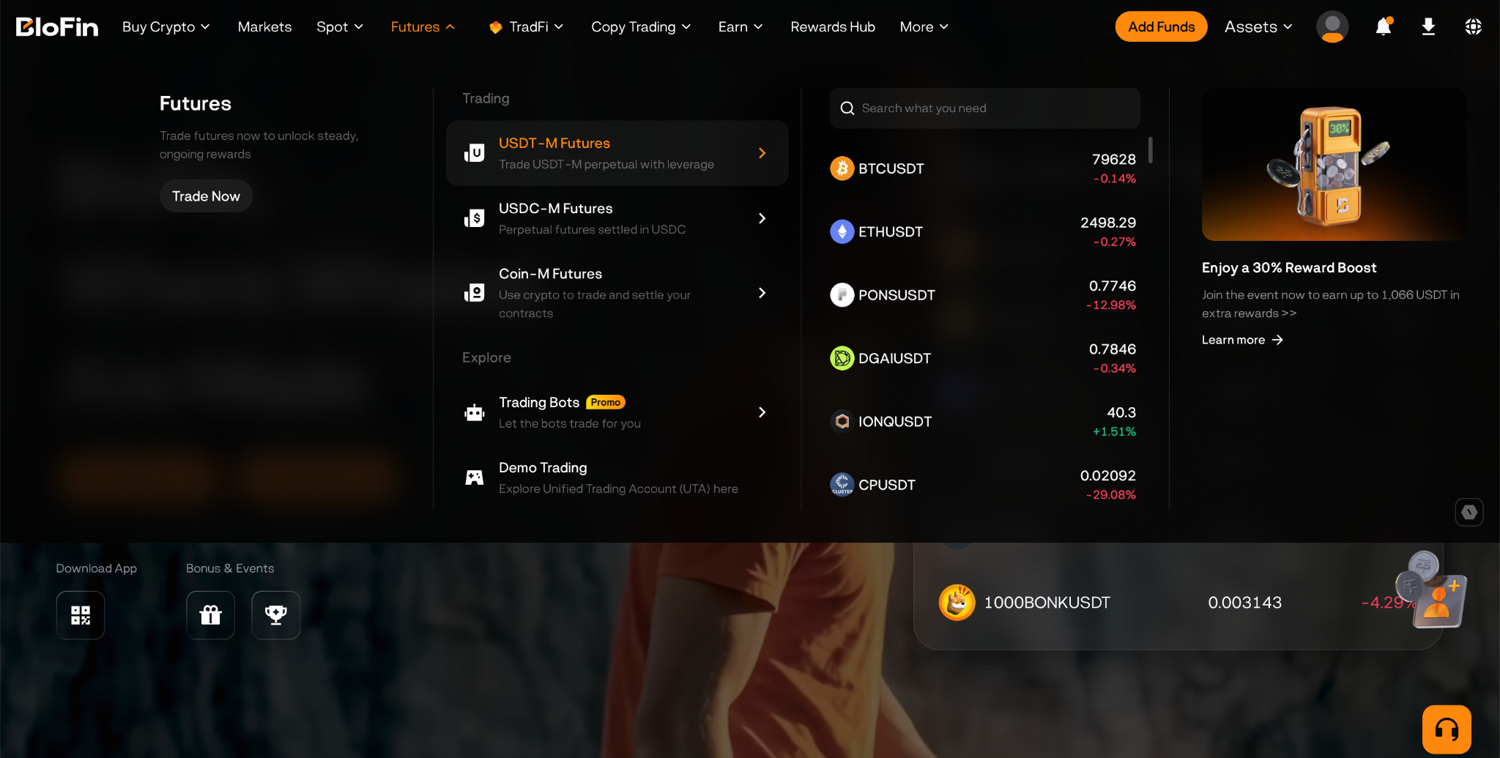
Step 1: Log in to your BloFin account and hover your cursor over the Futures tab. Then, click USDT-M Futures.
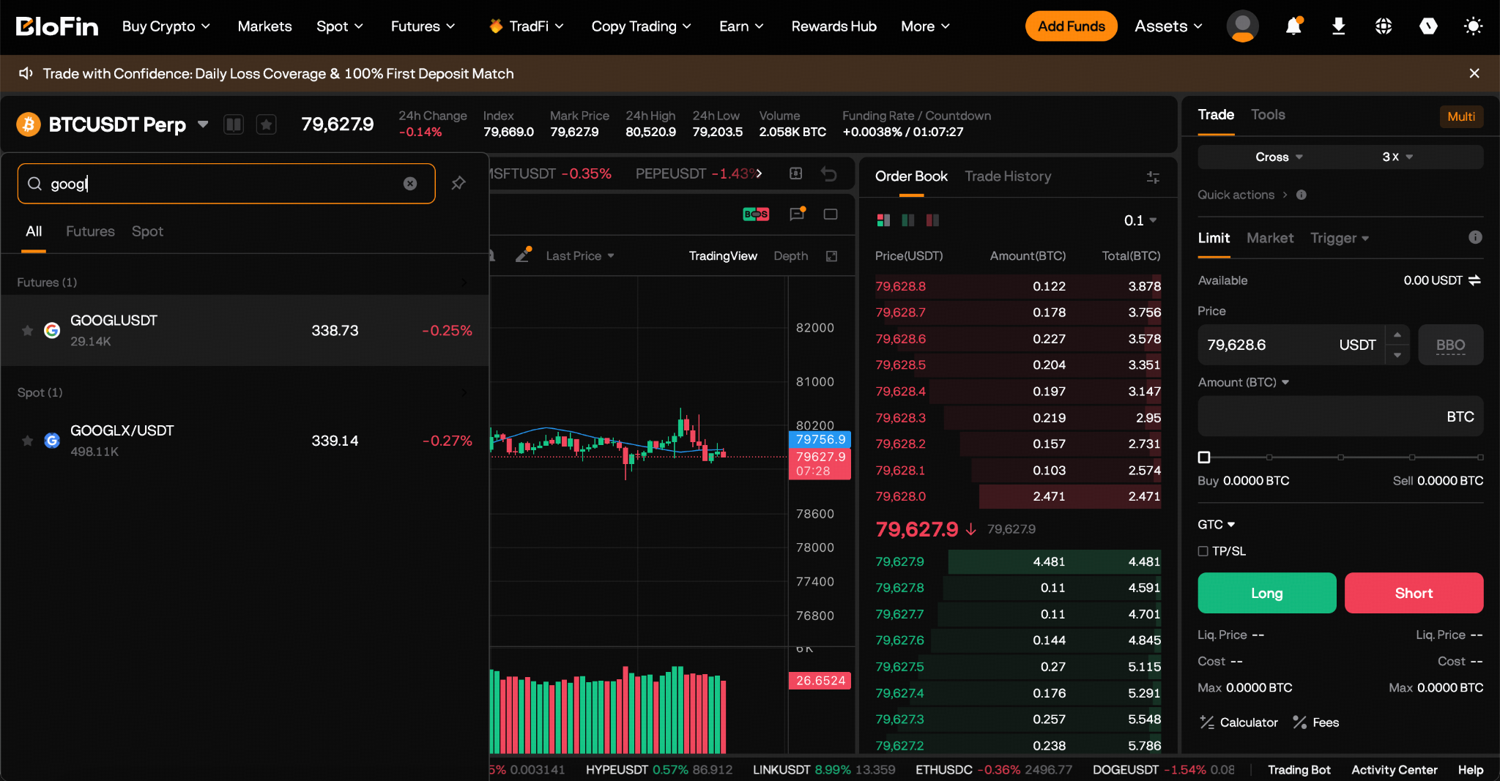
Step 2: Hover your cursor over the BTCUSDT trading pair and a pop-up window will appear. Type GOOGL in the search field and select the GOOGLUSDT Perpetual. The chart loads alongside the order panel in the trading interface, which includes TradingView charting tools.
Step 3: Set your margin mode to Isolated and choose your leverage before entering any order.
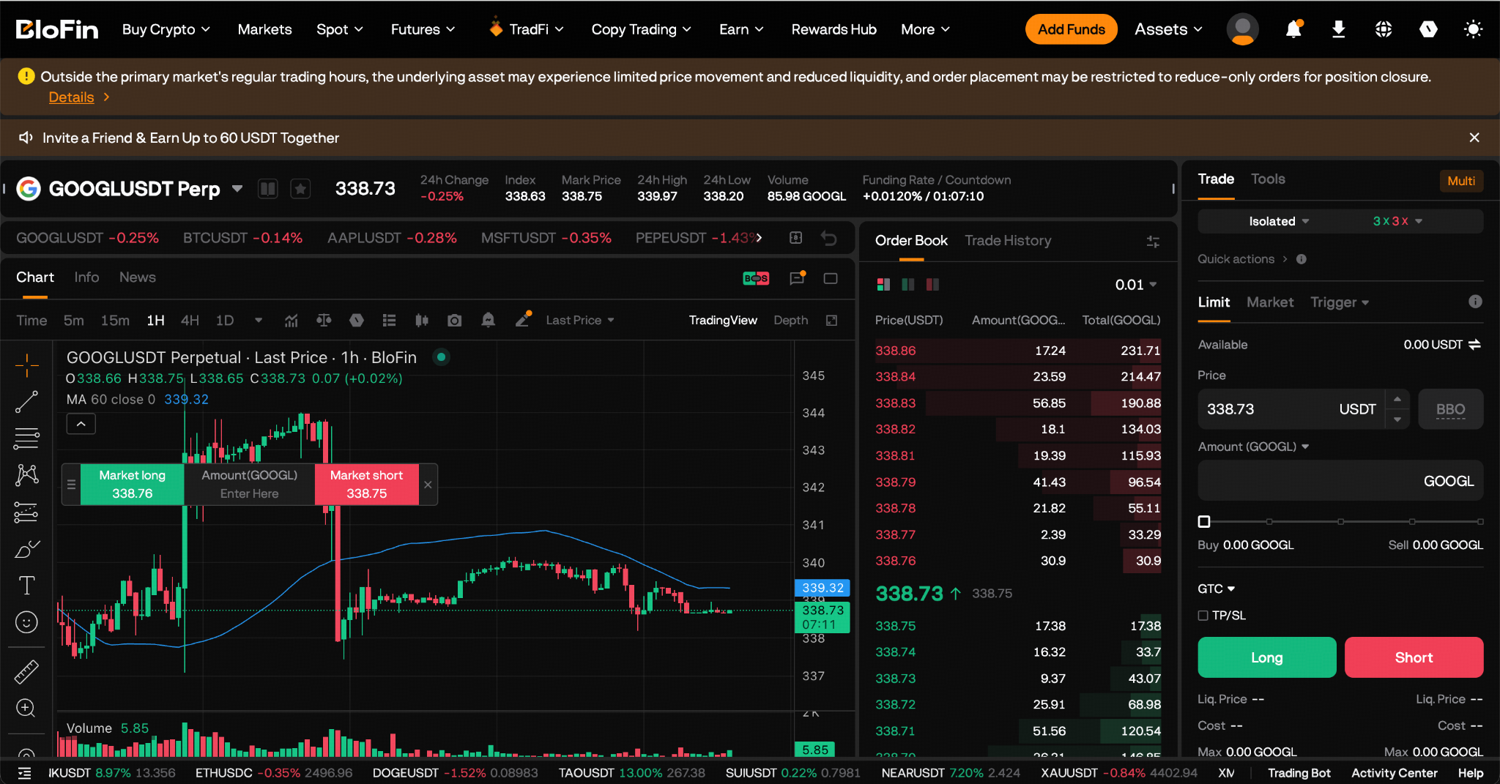
Step 4: On the order panel, select Sell/Short, choose Market or Limit as the order type, and enter the size in GOOGL.
Step 5: Review the estimated margin and liquidation price, then submit. With no existing long, this opens a new short, and it appears in Positions with its entry price, size, margin used and estimated liquidation price.
Worked example (shorting 1 GOOGL at 5x): with the mark price at 338.65 USDT on September 7, 2026, one GOOGL of exposure is 338.65 USDT of notional, and at 5x that requires roughly 67.73 USDT of initial margin (source: BloFin GOOGL contract details). If Alphabet falls 3% to about 328.49, the position gains about 10.16 USDT, or 15% on the margin. If it rises 3% instead, it loses the same 10.16 USDT, and a rise of around 20% would take the whole allocation. This is an example of one position, not a template for every trade. Those are round numbers to show the arithmetic, not a forecast.
Order types when entering a short
On the sell side, the available order types are market orders, limit orders, and trigger orders, and the difference between them matters more on a short because the move you are selling into is usually a rise.
A market order sells immediately at the best bid, which suits shorting into a spike but pays the spread; the order book shows the available bids and market depth behind that fill, and on a stock perpetual that spread widens outside the Nasdaq session. A limit order lets you name a higher price and wait for the market to come to you, which is the natural fit for shorting strength, at the cost of possibly never filling. A trigger order sits dormant until the price reaches a level you set; the trigger price is the level that activates the order when price moves to it, which is how you short a breakdown without watching the screen.
Pending entries sit in Open Orders until they fill or you cancel them. Before sizing anything large, read the book: a wide spread in a quiet window will move your average entry more than the order type will.
Setting take-profit and stop-loss on a short
A stop-loss matters more on a short than on a long, because the loss side is the unbounded one and because Alphabet gaps upward on news that arrives when the market is closed.
BloFin lets you attach take-profit and stop-loss orders to an open GOOGLUSDT position in two modes: to close the entire position or only part of it. On a short the sides invert: your take-profit sits below the entry, and your stop-loss sits above it. Both can trigger as market or limit orders, and market gives you fill certainty in a fast move where limit gives you a price you may not get. If supported on the position screen, a Trailing Stop is another risk management option.
Working from the same example, a short entered at 338.65 might take profit near 320, about 5.5% lower, and stop out near 352, about 4% higher. The stop is the number that decides the trade: at 5x, a 4% adverse move is 20% of the margin, and setting it before you enter is the difference between a planned loss and a liquidation. Alphabet's scheduled events are the ones to plan around, and they are covered in trading Alphabet around earnings and trading Alphabet around court rulings.
Managing an open short: funding, mark price and the closed market
Three things move against or for a short while it is open, and only one of them is the price.
Funding is the carry. It settles every eight hours from 00:00 HKT by default, shortened automatically to four, two or one hour when volatility warrants (source: BloFin). When the perpetual trades above its index the rate is positive and shorts are paid; when it trades below, shorts pay. Before holding the position, check the current funding rate. A short held through a period of persistent positive funding is being paid to wait, which is the one structural advantage the short side has here, and it reverses when sentiment does.
The mark price, not the last trade, drives your unrealized profit and loss and your liquidation, and it is derived from the index rather than from BloFin's own book. A thin print on the exchange will not liquidate you, and price moves in the index will, which is why the chart can look calmer than your position is. The distinction is set out in mark price versus last price.
The closed market is the third. Alphabet stops trading at 4:00 p.m. Eastern and the reference price stops updating with it, while news does not stop arriving. A short carried overnight or across a weekend is carried into whatever the index does when it resumes, and reduce-only limits mean you may not be able to add to the position at the moment you most want to. How those gaps behave is worked through in tokenized Alphabet price gaps. Traders should monitor open positions and available funds during closed-market windows.
How to close a short and realize your profit or loss
Closing a short means buying back what you sold. The quickest route is Close on the position row, which pre-fills the size, and you can take a market fill immediately or set a limit Buy and wait. Partial closes work the same way: holding 10 GOOGL short and buying 5 leaves you short 5, with those buybacks closing individual trades within the broader position.
On the worked example, a short of 1 GOOGL entered at 338.65 and bought back at 320 returns 18.65 USDT before costs. Trading fees are 0.0200% maker and 0.0600% taker, charged on both the open and the close (source: BloFin), so on 338.65 USDT of notional a taker entry and a taker exit cost about 0.41 USDT between them. Funding sits on top of that and can run either way. Bought back at 352 instead, the same position loses 13.35 USDT plus costs.
Realized profit and loss lands in your trade history in USDT and the margin and any released funds return to your futures balance. One thing to check afterwards: any take-profit, stop-loss or trigger order attached to the closed position. Some cancel with it and some are left resting, and an orphaned trigger can open a position you did not intend. The full walkthrough is in how to close a trade on BloFin.
What decides whether a short works
The tools are the easy part. These are the things that actually determine the outcome, and every one of them is set before you enter.
The gap you cannot trade through. Alphabet can open several percent higher on an earnings beat or a favorable ruling, and a stop-loss triggers an order at your level rather than guaranteeing a fill there. Position size, not stop placement, is what caps the damage in that case.
Leverage against a normal day. A 2% to 3% session is ordinary for Alphabet. At 20x that is 40% to 60% of your margin, so the multiplier decides whether an average day is noise or an emergency.
Funding across a long hold. Settlements come at least three times a day and more often in volatile stretches. A short that is right about direction but slow can still lose to carry.
Liquidity in the window you trade. The book thins outside the Nasdaq session, so a market order at 3 a.m. fills further from the last print than the same order at midday.
The side you clicked. Selecting Buy when you meant Sell, or cross margin when you meant isolated, exposes more capital than you planned. Read the confirmation before you accept it.
BloFin is a cryptocurrency derivatives exchange. It emphasizes low latency and institutional-grade security for traders, with Fireblocks custody for crypto assets, ISO 27001 certification, proof of reserves, 1:1 backing of customer funds, real-time Chainalysis monitoring, and segregation of assets.
Because the position is margined and liquidated, what you can lose on an isolated short is the margin assigned to it rather than an unlimited amount. That is a real difference from borrowing and selling a share, and it is not a reason to size carelessly: losing the whole allocation on one ordinary session is entirely possible at high leverage. Size with position sizing and keep the leverage low enough that a normal day does not decide the trade.
Frequently asked questions
Can you short Alphabet stock on BloFin?
You can short Alphabet's price, through the GOOGLUSDT perpetual contract in the Futures section. Open a Sell position and close it later with a Buy, and your profit is the distance the price falls in between. It is a derivative rather than the share itself, so nothing is borrowed, and funding replaces the stock-lending fee. BloFin does not offer traditional equity short selling, and the tokenized spot pair GOOGLX/USDT is a long-only instrument.
Do I need to borrow shares to short Alphabet on BloFin?
Borrowing is what a perpetual contract removes from the trade. On a traditional short you locate stock to borrow, sell it, pay a lending fee while you hold, and return it at the end, and the lender can recall it. A perpetual references the price without anyone holding the underlying, so selling first is a normal order rather than a loan. The cost of holding is funding, which settles every eight hours and can run in your favor.
What leverage can I use to short GOOGLUSDT?
Between 1x and 20x, read from the contract page on September 7, 2026 (source: BloFin GOOGL contract details). Other BloFin contracts go considerably higher, up to 150x on BTCUSDT, but the stock perpetuals are capped at 20x. Given that Alphabet moves 2% to 3% in an ordinary session, an effective 2x to 5x leaves room for a normal day without putting the margin behind the position at risk.
Does a short pay or receive funding on GOOGLUSDT?
Both, depending on the rate. When the perpetual trades above its index the funding rate is positive and shorts receive it from longs; when it trades below, shorts pay. Settlement is every eight hours from 00:00 HKT by default and can shorten to four, two or one hour in volatile conditions (source: BloFin). Check the published funding history for the pair before planning a hold of several days, because carry decides a slow trade.
Can I short Alphabet outside Nasdaq hours?
The contract keeps quoting, but opening is restricted. Outside regular Nasdaq hours, and on weekends and public holidays, BloFin may limit stock futures to reduce-only orders, which lets you close or reduce a position rather than open one (source: BloFin). The reference index also stops updating when the underlying stops trading, so a position carried through that window meets whatever the index does when it resumes.
How much can I lose on a short position?
On an isolated-margin short, the margin you assigned to that position. Liquidation closes the trade before the loss runs past it, which is a genuine difference from borrowing and selling a share, where the loss is open-ended. On cross margin the exposure extends to your whole futures balance. Neither arrangement makes a large position safe: at 20x, a move of about 5% against you takes the entire margin behind the trade.
What is the difference between shorting GOOGLUSDT and selling GOOGLX?
Selling GOOGLX means disposing of a token you already hold, so it closes a position rather than opening a negative one, and once your balance reaches zero there is nothing left to sell. Shorting GOOGLUSDT opens a position that profits from a fall without owning anything first. By contrast, the Spot market is for Spot trading, which means buying assets at current market prices, so if you want to hold ETH or another token directly you would use spot rather than a perpetual short. The spot product is backed by real shares and withdrawable to a wallet; the perpetual is a cash-settled contract that exists only inside the exchange. BloFin offers over 230 cryptocurrencies across Spot and Futures, an average 0.1% fee for each user on Spot, and over 530 perpetual contracts, plus a unified account with API access, trading bots, a BloFin app that mirrors desktop, and a unified trading account so traders do not need to transfer funds between markets. BloFin Copy Trading is one-click copy trading that lets users review leader metrics from experienced traders, copy positions automatically, set allocation and risk limits, and use a sub account if needed to separate strategies while sub accounts operate under one main profile.
Researched and written by the BloFin Academy editorial team with AI-assisted drafting. All facts independently verified. Primary sources include BloFin's GOOGLUSDT contract details page for specifications, leverage and funding cadence, its March 26, 2026 futures listing announcement, its published fee schedule, the "Updates to BloFin Stock Futures Trading" notice for session restrictions, and the funding-rate settlement frequency notice, current as of September 2026.
Nothing in this article constitutes financial advice, and nothing in it is a view on the direction of Alphabet's share price. A short position in GOOGLUSDT can be liquidated in full by a price move far smaller than the leverage multiple suggests, and a stop-loss does not guarantee an exit at your chosen level, because a gap or a resuming index can carry price straight through it. The perpetual confers no ownership of Alphabet stock, no vote and no dividend. Contract parameters, fees and funding intervals are set by BloFin and can change without separate announcement, so read the live contract page before you size a position. Past performance does not indicate future results. Do your own research and consider your risk tolerance before you trade on BloFin.