
Owning a stock through a risky week is uncomfortable when you would rather keep it than sell it. Selling ends your ownership, and buying back later can cost more than the price you sold at, so a shareholder may look for a way to soften a fall while still holding.
The usual answer is a second position that profits when the share loses value. Traders call that a hedge, and it has a price of its own: when the share rises, the second position loses, so a hedge narrows both the losses and the gains you can make.
Perpetual futures on stocks give you one way to build that second position. A perpetual future never expires, and a short position in one gains when the contract's price falls. Because it trades in USDT, the hedge can sit on a crypto exchange while the shares stay with your broker.
Palantir Technologies (PLTR) is one of the stocks with such a contract. On BloFin, the PLTRUSDT Perpetual tracks the price of Palantir shares and is settled in USDT, so a short on it can offset Palantir shares held anywhere.
What is a Palantir stock hedge?
A Palantir stock hedge is a second position that gains when Palantir shares fall, so it offsets some or all of a loss on shares you keep. On BloFin, that position is a short on the PLTRUSDT Perpetual, sized to the shares you hold. It reduces your risk, and it also gives up the gains.
Corporate Finance Institute describes hedging in the same terms. A hedge does not stop an investment from losing value; if it does lose, the loss is reduced by gains on another investment (source: CFI, hedging). The share can still fall, and the short pays you roughly what the share costs you.
A hedge ratio is the value of the hedge compared with the value of the position it covers. CFI notes that a ratio close to 1 is called fully hedged and a ratio close to 0 is called unhedged (source: CFI, hedge ratio). A short of 100 PLTR against 100 shares has a ratio of 1.
A hedge is different from a short on its own. A trader who shorts Palantir with nothing else is betting on a fall. A hedger holds the shares and the short together, so the two results roughly cancel and the combined position moves very little, the same idea crypto holders use to hedge spot holdings with futures.
How a PLTRUSDT short offsets Palantir shares
A PLTRUSDT short offsets Palantir shares because the two positions move in opposite directions on the same price. Each contract is 0.01 PLTR, so 100 shares need a short of 100 PLTR, or 10,000 contracts. When Palantir falls $1, the shares lose $100 and the short gains about 100 USDT.
That one-for-one size is the simplest hedge, and it keeps the ratio at 1 whatever the share price does, because the count of shares and the size of the short stay equal. The PLTR perpetual allows up to 20x leverage and moves in ticks of 0.01 USDT (source: BloFin PLTRUSDT contract details).
At 1x leverage, the margin behind the short equals the short's full value. At the 4PM ET (9PM UTC) close on November 2, 2026, the last PLTRUSDT trade was 178.76 USDT, so 100 PLTR short at 1x needed 17,876 USDT of margin (source: BloFin PLTRUSDT market data). A liquidation price is the price at which a position's margin can no longer cover its loss, and BloFin liquidates the position there. Higher leverage needs less margin and brings the short's liquidation price closer.
The cost of the offset is the upside. From the November 5 close to the November 6 close, Palantir rose from $154.99 to $160.38, so 100 shares gained $539 (source: Nasdaq PLTR historical data). Over the same hours the PLTRUSDT price went from 154.97 to 160.97 USDT, and the short lost 600 USDT.
The hedged holder ended that day 61 down in USD and USDT combined, while the shares alone gained $539. You keep the shares, but for as long as the short is on, Palantir's rallies stop adding to your wealth.
Funding is a payment that passes between the longs and the shorts on a perpetual contract at set times, every eight hours on PLTRUSDT. The short side of a hedge pays it or receives it at each settlement while the short is held, on top of the trading fee charged when the short opens and when it closes.
A Palantir hedge through the November 2 report
A one-for-one PLTRUSDT hedge held through Palantir's November 2, 2026 report turned a $2,335 loss on 100 shares into a combined gain of 23.28 in USD and USDT after fees and funding. The shares fell 13.09% over the three sessions to November 5. The short gained 2,379 USDT, and fees and funding cost 20.72 USDT between them.
Palantir's third-quarter results came out on November 2, with revenue up 96% year over year at $2.3 billion, and the company set its results webcast for 5PM ET (10PM UTC), an hour after Nasdaq closed (source: Palantir Q3 2026 results). The share closed that day at $178.34 and closed November 5 at $154.99.
The worked hedge opens the short at 178.76 USDT, the last PLTRUSDT trade before the November 2 close, and closes it at 154.97 USDT, the last trade before the November 5 close (source: BloFin PLTRUSDT market data). Both legs are measured from one 4PM ET (9PM UTC) close to another, so the shares and the short cover the same hours. A taker order is one that fills straight away.
Leg | November 2, 4PM ET (9PM UTC) | November 5, 4PM ET (9PM UTC) | Result |
|---|---|---|---|
100 Palantir shares (USD) | 17,834.00 | 15,499.00 | −2,335.00 |
PLTRUSDT short, 10,000 contracts (USDT) | 178.76 | 154.97 | +2,379.00 |
Taker fees, open and close (USDT) | 10.726 | 9.298 | −20.02 |
Funding, nine settlements (USDT) | −0.70 | ||
Hedged result (USD and USDT) | +23.28 |
BloFin's 0.0600% taker fee is worked on the position's value: 17,876 USDT to open and 15,497 USDT to close. Funding summed to −0.0039% over nine settlements, so the short paid about 0.70 USDT, measured on the opening value (source: BloFin PLTRUSDT funding history). Those nine settlements ran from 12AM UTC November 3 (7PM ET November 2) to 4PM UTC November 5 (11AM ET).
The contract kept trading through the night after the report. BloFin calculates a mark price as its fair value for each contract and liquidates on it. On the mark price, the short was about 1,621 USDT up at the mark's lowest point early on November 3, against its 178.76 USDT entry (source: BloFin PLTRUSDT market data).
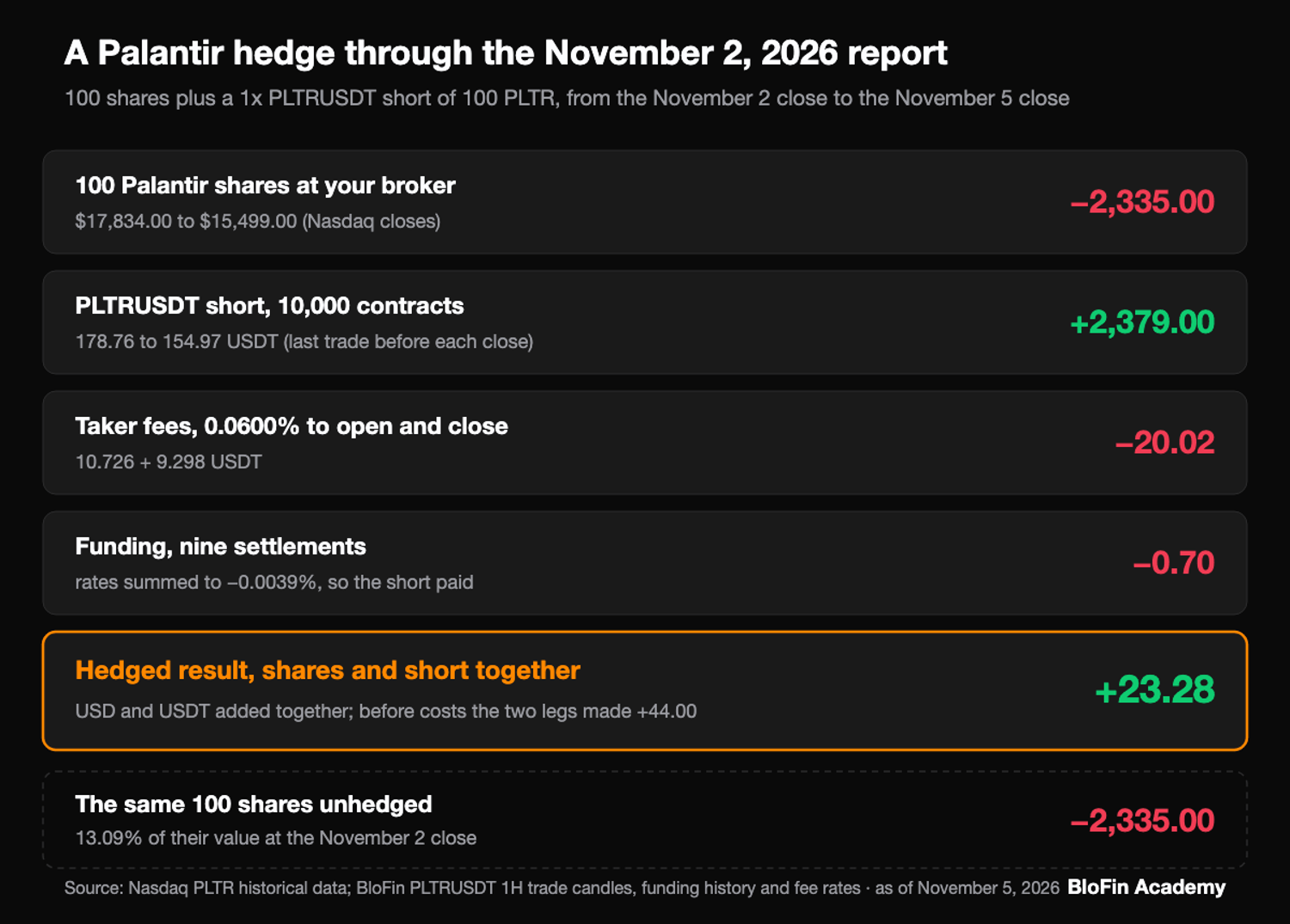
By the November 5 close, the shares and the short together were 44 up in USD and USDT combined before costs. Unhedged, the same 100 shares finished November 5 down $2,335, or 13.09% of their value at the November 2 close.
How to open a Palantir hedge on BloFin
Opening a Palantir hedge on BloFin takes a USDT balance in your futures account and one Sell order on the PLTRUSDT Perpetual, sized to match your shares. Isolated margin limits a position's possible loss to the margin assigned to it. The worked hedge uses isolated margin at 1x. The shares stay at your broker, untouched.
The order panel is the same one used for a first futures trade on BloFin. For a hedge, the shares you hold set the direction and the size, with 100 Palantir shares as the example.
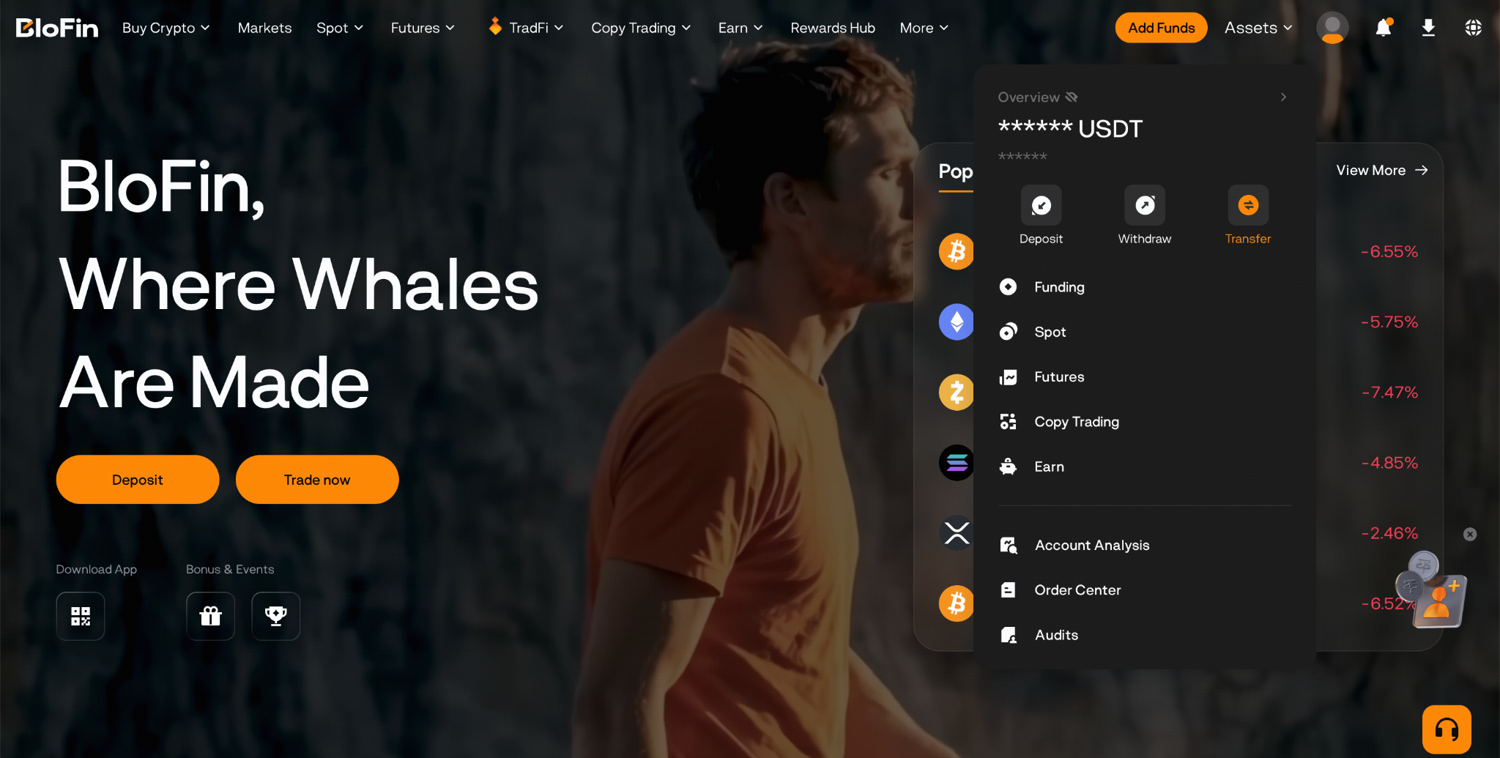
Step 1: Put the margin for the short into your Futures Account. Deposits arrive in the Funding Account, so open Assets, pick Transfer and shift the USDT across. At 1x, 100 PLTR at 178.76 USDT needed 17,876 USDT, plus the trading fee.
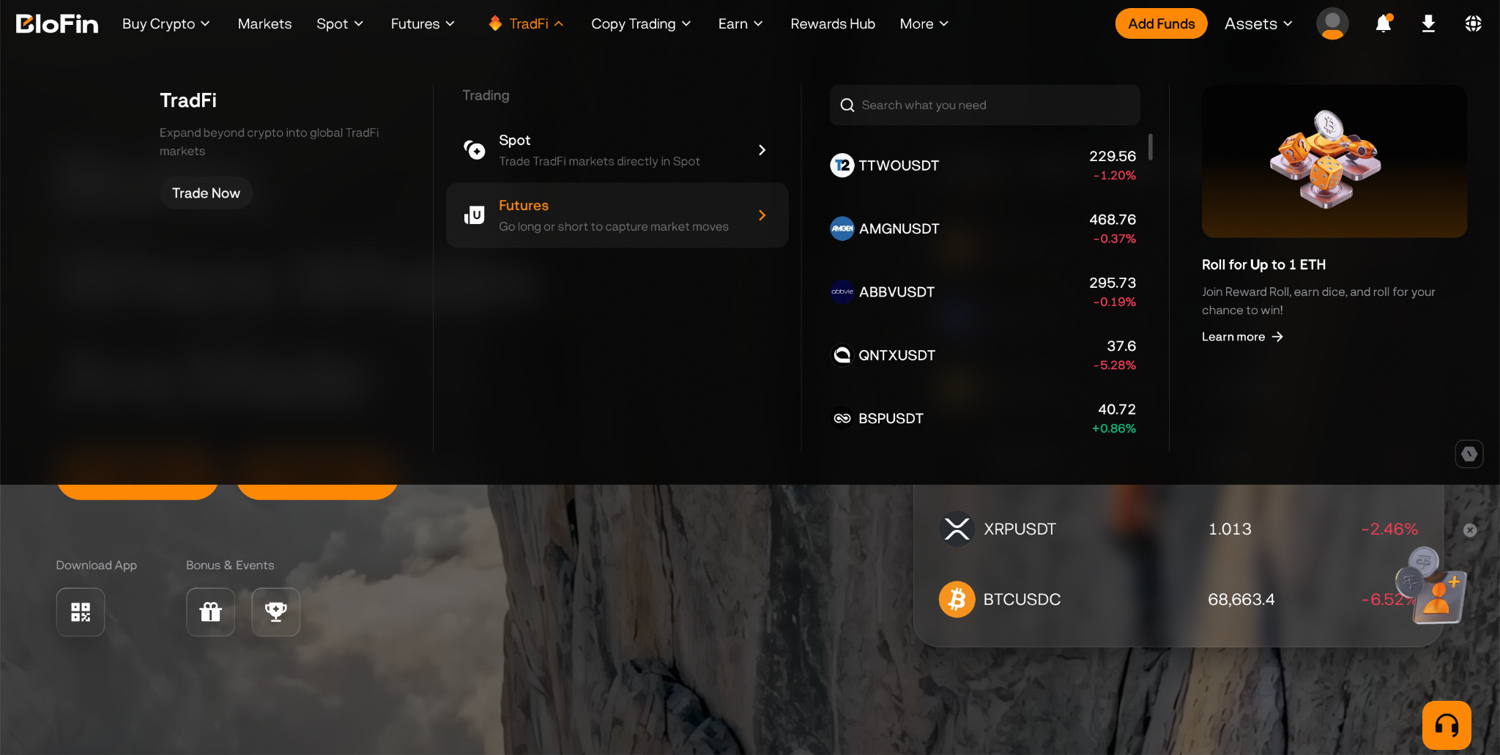
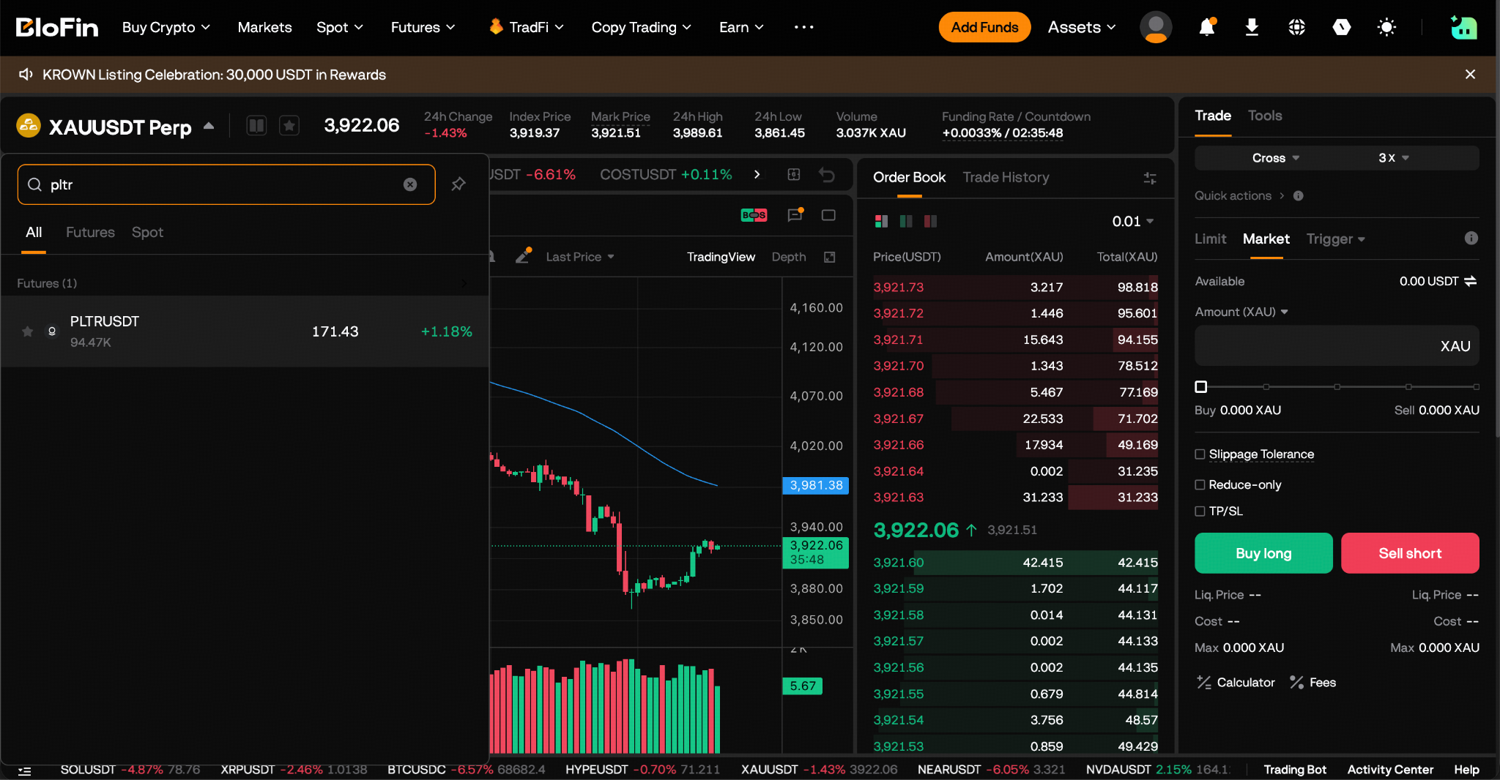
Step 2: Hover your cursor over the TradFi tab and click Futures. Then, type PLTR into the trading pair search and select the PLTRUSDT Perpetual.
Step 3: Set the margin mode to Isolated and lower the leverage to 1x, with the slider or by entering 1. With Isolated, the short's loss stops at the margin assigned to that one position. With Cross, every USDT in the futures account backs all your positions together.
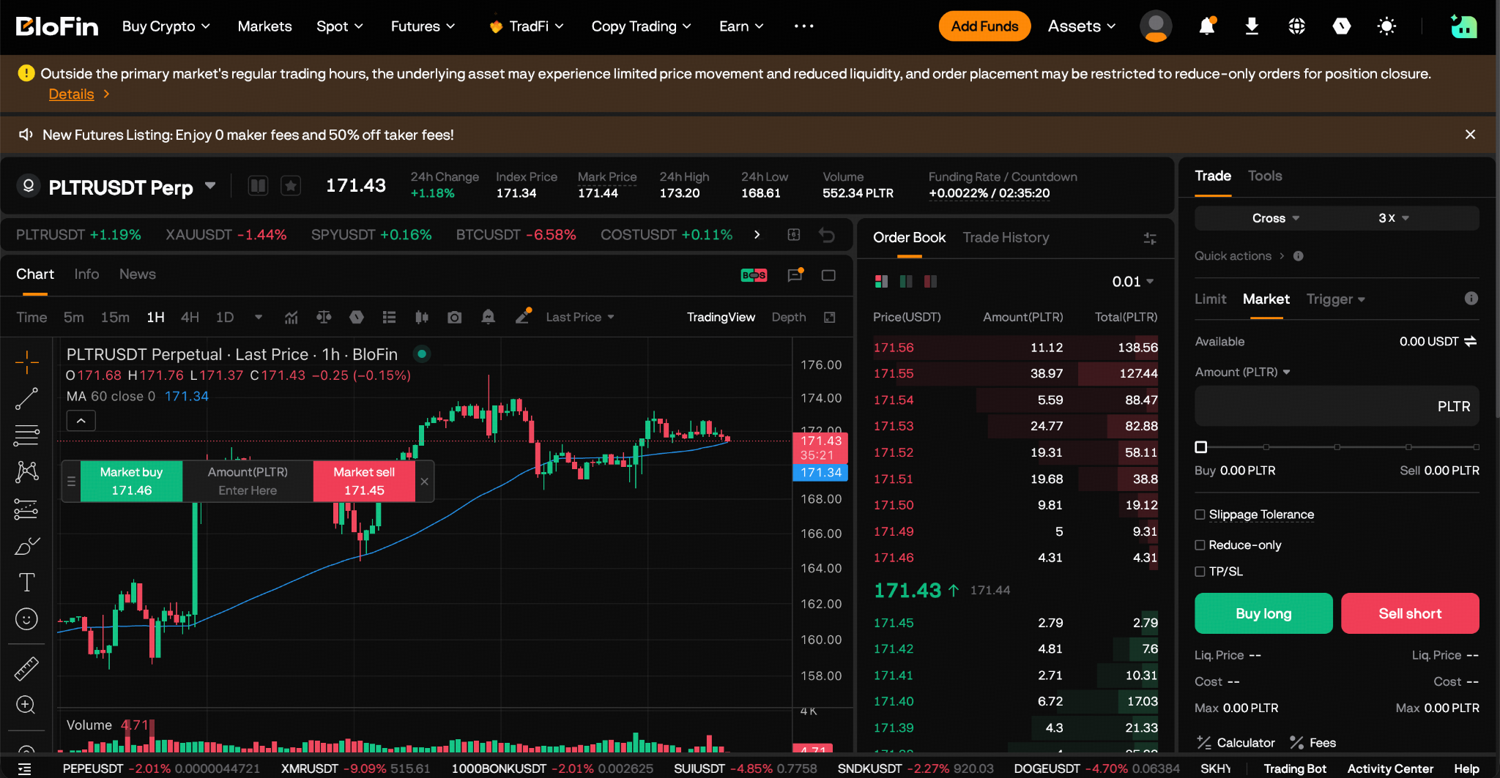
Step 4: Choose Limit to set your own price or Market to fill straight away. A limit order that sits in the book until it fills is charged the 0.0200% maker fee, and a market order is charged 0.0600% as a taker. One market order on PLTRUSDT can be at most 600 PLTR, so 100 PLTR fits in one (source: BloFin PLTRUSDT contract details).
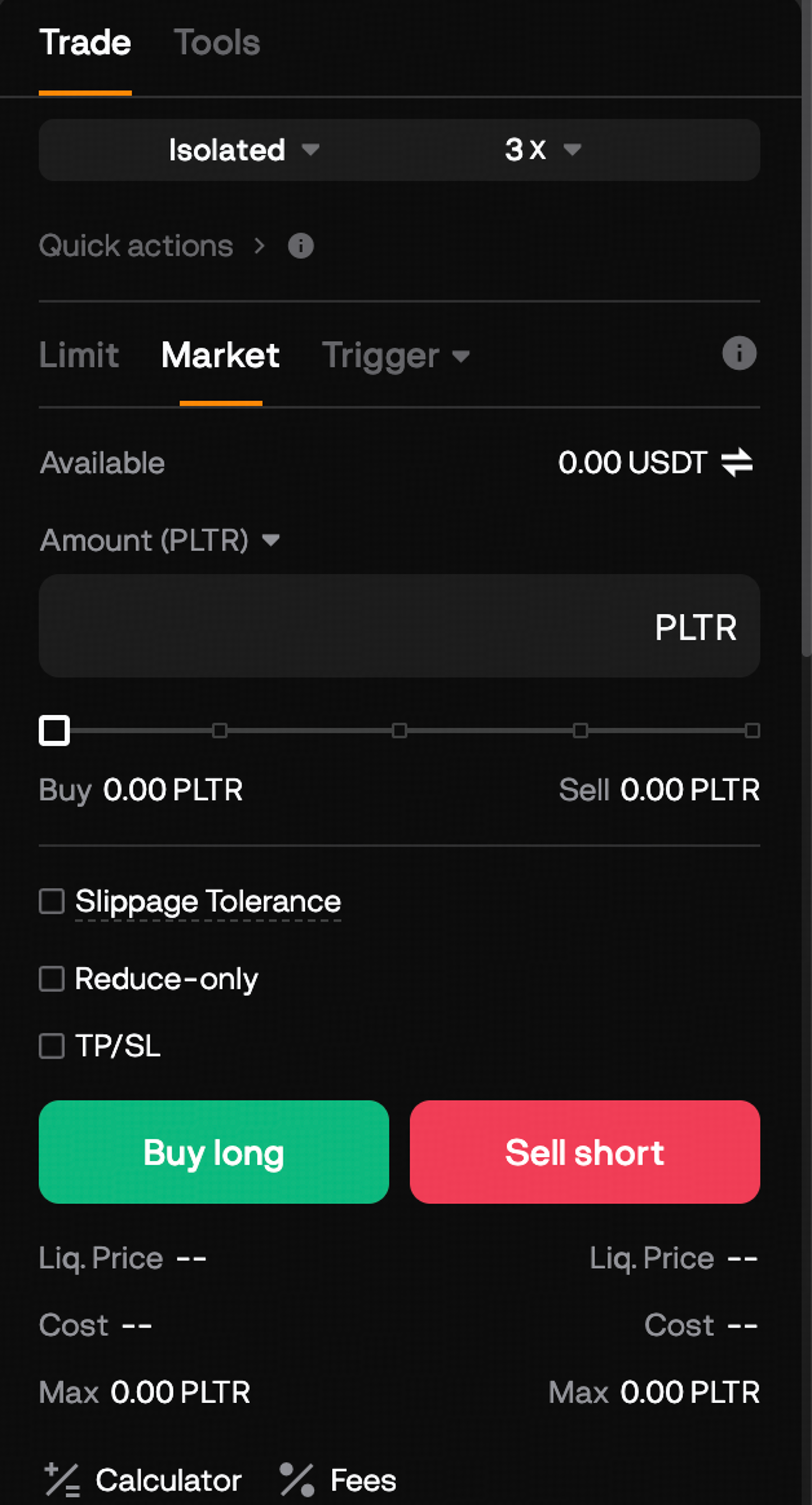
Step 5: Enter 100 in the size box with its unit set to Amount (PLTR). The box first shows Cost (USDT), so switch the unit before typing; 100 PLTR is 10,000 contracts of 0.01 PLTR each. Keep Reduce-only switched off for this order: it opens a new short, and BloFin's trade page describes reduce-only orders as being "for position closure" (source: BloFin PLTRUSDT Perpetual page).
Step 6: Decide whether to attach TP/SL. A stop-loss on the short closes it if Palantir climbs, which takes the hedge away from the shares at that price, and a take-profit closes it on a fall. Each stop-loss trigger follows the last trade by default and can be switched to the mark price.
Step 7: Check the Liq. Price estimate shown in the panel, then click Sell and confirm the order. At 1x on a 178.76 USDT entry, BloFin's formula puts it at 348.60 USDT, assuming a 0.0600% liquidation fee.
Step 8: In the Positions tab, the new short should list a size of 100 PLTR with its entry price, estimated liquidation price and margin. From here, a fall in Palantir shows as a gain on this line and a loss at your broker.
Funding and fees on the short side of the hedge
The short side of a Palantir hedge pays a trading fee on its value when it opens and again when it closes, and it pays or receives funding every eight hours while it stays open. A positive PLTRUSDT funding rate means the short receives funding, and a negative one means the short pays.
Funding on a perpetual contract pulls the contract's price toward the price it tracks. With a positive rate, money flows from longs to shorts; with a negative rate, it flows from shorts to longs. The fee equals the position's value times the rate, and PLTRUSDT settles at 12AM, 8AM and 4PM UTC.
In standard time those settlements fall at 7PM ET the evening before, 3AM ET and 11AM ET; in daylight saving time they fall at 8PM ET, 4AM ET and 12PM ET. A hedge held for a few days crosses several of them: the worked hedge crossed nine between the November 2 and November 5 closes. Rates in that stretch ran from −0.0027% to +0.0012%, small in both directions.
On the worked hedge, trading fees outweighed funding. The maker rate is 0.0200% of the position's value and the taker rate 0.0600%. Two market orders cost 20.02 USDT, against 0.70 USDT of funding; two resting limit orders would have cost 6.67 USDT.
Past funding rates never set future ones, and a run of negative rates would turn the hedge's holding cost from small to noticeable. If you want to see the current rate before you open the short, the PLTRUSDT trading page shows it with a countdown to the next settlement.
Nasdaq hours vs PLTRUSDT hours for a hedge
Palantir shares trade on Nasdaq's timetable, while the PLTRUSDT Perpetual trades 24 hours a day, every day. BloFin's notice says that away from regular weekday hours, and through weekends and public holidays, trading on its stock contracts "may be limited to reduce-only orders" (source: BloFin stock futures notice). Inside Nasdaq's regular session, the notice sets no such limit.
Regular Nasdaq trading lasts from 9.30AM until 4PM ET on weekdays. Extended trading adds a pre-market from 4AM ET (9AM UTC in standard time, 8AM UTC in daylight time) and an after-hours session that ends at 8PM ET (1AM UTC in standard time, 12AM UTC in daylight time). Nasdaq notes that some brokers set different extended-hours times (source: Nasdaq trading hours). In standard time, the regular session is 2.30PM to 9PM UTC, and in daylight saving time 1.30PM to 8PM UTC.
That regular session is 32.5 hours of a 168-hour week, or 19.3%. For the other 80.7%, the contract keeps moving while the share trades only in extended sessions or not at all, and opening or adding to a PLTRUSDT position may not be possible. Reduce-only orders exist to close or shrink what you already hold, so the hedge can still come off.
The practical effect falls on timing. Palantir's November 2 webcast came after the close. An opening order for a report night placed before Nasdaq shuts at 4PM ET falls inside regular hours. That close is at 9PM UTC in winter's standard time and 8PM UTC in summer's daylight time. After the close, BloFin may limit PLTRUSDT to reduce-only orders. If you buy more shares in your broker's after-hours session, the matching short may have to wait until Nasdaq reopens for regular trading.
The mismatch also works the other way. A shareholder can sell in after-hours trading at a broker that offers it, and the short can still be cut with a reduce-only order. The notice is silent on what happens to orders already waiting in the book, or to TP/SL triggers, during a reduce-only window.
Basis between PLTRUSDT and the Nasdaq close
Basis is the difference between the contract's price and the share's price at the same moment. On a Palantir hedge, it decides how closely the short's gain matches the shares' loss. At the three closes measured, November 2, 5 and 6, PLTRUSDT's last trade was between 0.02 USDT under and 0.59 USDT over Palantir's Nasdaq close.
At the November 2 close the last PLTRUSDT trade was 178.76 USDT against Palantir's $178.34 close, a basis of +0.42, or 0.236%. At the November 5 close the contract stood at 154.97 USDT against $154.99, a basis of −0.02 (source: BloFin PLTRUSDT market data, Nasdaq PLTR historical data).
That change in basis is the whole of the worked hedge's result before costs. The short was opened 0.42 above the share and closed 0.02 below it, so it gained 0.44 per PLTR more than the shares lost. On 100 PLTR that is the 44.00 the two legs made together, in USD and USDT combined, before fees and funding.
Basis can work against you just as easily. On November 6, the contract closed 0.59 above the share's $160.38 close, which is why the hedged holder lost 61 in USD and USDT combined over that day.
On the mark price, a hedge shows a slightly different result from one measured on trades. From the November 2 close to the November 3 close, the short gained 299 USDT on the mark while the shares lost $294. Liquidation runs on the mark price, so the mark is the series that matters for the short's margin.
Liquidation risk on the short side of a Palantir hedge
Maintenance margin is the minimum margin a position must keep. The short side of a Palantir hedge can be liquidated if Palantir rises far enough, even while the shares gain. At tier 1's 2.5% maintenance margin, a 1x isolated short opened at 178.76 USDT has an estimated liquidation price of 348.60 USDT, assuming a 0.0600% liquidation fee (source: BloFin PLTRUSDT position tiers).
BloFin's formula for a short divides the margin plus size × entry price by size × (1 + maintenance margin rate + liquidation fee rate) (source: BloFin liquidation price calculation). The page gives no number for that fee, so 0.0600% is an assumption.
Leverage on a 100 PLTR short at 178.76 USDT | Margin (USDT) | Estimated liquidation price (USDT) | Rise needed |
|---|---|---|---|
1x | 17,876.00 | 348.60 | 95.01% |
2x | 8,938.00 | 261.45 | 46.26% |
Both estimates assume a 0.0600% liquidation fee and tier 1, for positions of up to 700 PLTR. The trigger is the mark price: once it touches the estimate, liquidation of the futures position starts.
Palantir has come close to rises of that size within the past year. From the June 25, 2026 close of $107.27 to the October 9 close of $209.05, the share gained 94.88% (source: Nasdaq PLTR historical data). A 1x short opened at 107.27 USDT would have had an estimated liquidation price of 209.18 USDT, assuming a 0.0600% liquidation fee.
Palantir's share traded above 209.18 during the sessions of October 9, 12, 13 and 14. A 2x short from the same starting price had an estimated liquidation price of 156.89 USDT, assuming a 0.0600% liquidation fee, and the share closed above that level on August 4, at $162.66 (source: Nasdaq PLTR historical data).
When the short is liquidated, the shares have gained about what the short lost, so the combined position has held its value up to that point. What changes is that the hedge is gone, the fee is charged, and every move after that hits the shares alone. A margin top-up has to come from USDT on BloFin, since the shares at your broker cannot back the short.
Beta-weighted hedging with QQQUSDT
Beta is the size of a stock's typical move when the market moves 1%. A beta-weighted hedge covers a stock with a short on a broad market contract, sized by that beta. For Palantir, the candidate is BloFin's QQQUSDT Perpetual, and a beta of 1.245 called for a $1.245 short per $1 of shares.
Beta measures a stock's sensitivity to market risk, and CFI notes that a stock can have high total volatility and a low beta when its swings are largely unrelated to the market (source: CFI, beta). That second point is the weakness of a QQQ hedge on a single stock like Palantir.
Invesco QQQ is a fund that tracks the Nasdaq-100 index (source: Invesco QQQ). The beta here is the slope of a regression of Palantir's daily returns on QQQ's, using 250 daily returns (251 Nasdaq closes) from November 11, 2025 to November 10, 2026 (source: Nasdaq PLTR historical data, Nasdaq QQQ historical data). Correlation, which runs between −1 and +1, measures how closely two series rise and fall together, and it was 0.441. R² is the share of one series' variation that lines up with the other's, and it was 0.195.
That R² means QQQ's daily moves lined up with 19.5% of the variation in Palantir's, and 80.5% was Palantir's own. Standard deviation measures the typical size of a daily move. Over the same 250 sessions, a QQQ hedge at a beta of 1.245 would have cut Palantir's daily standard deviation from 3.81% to 3.42%, a reduction of 10.3%. CFI calls this kind of ratio the minimum variance hedge ratio, used in cross-hedging (source: CFI, hedge ratio).
The size follows a simple rule: contracts = beta × position value ÷ contract value, where the contract value is the QQQUSDT price times its contract size of 0.01 QQQ (source: BloFin QQQUSDT market data). With 100 Palantir shares worth $16,882 at the November 10 close and QQQUSDT at 684.81 USDT, about 7.21AM UTC (2.21AM ET) on November 11, the hedge was 1.245 × 16,882 ÷ 6.8481 = 3,069 contracts (source: BloFin QQQUSDT market data).
The report night shows the gap. From the November 2 close to the November 3 close, Palantir fell 1.65% while QQQ rose 0.62%. A QQQ short sized at 1.245 × $17,834 lost $136.59 on QQQ's Nasdaq closes, on top of the shares' $294 loss. By the November 5 close the QQQ short had gained $1,109.69, covering 47.5% of the shares' $2,335 loss.
QQQ lined up more closely with a basket of large technology shares. A basket of Palantir, Nvidia, Microsoft, Oracle and Snowflake, set back to equal weights each day, had a beta of 1.094 and an R² of 0.384 against QQQ over the same 250 sessions (source: Nasdaq NVDA historical data, Nasdaq MSFT historical data, Nasdaq ORCL historical data, Nasdaq SNOW historical data). A QQQ hedge cut its daily standard deviation from 2.38% to 1.87%, a reduction of 21.5%.
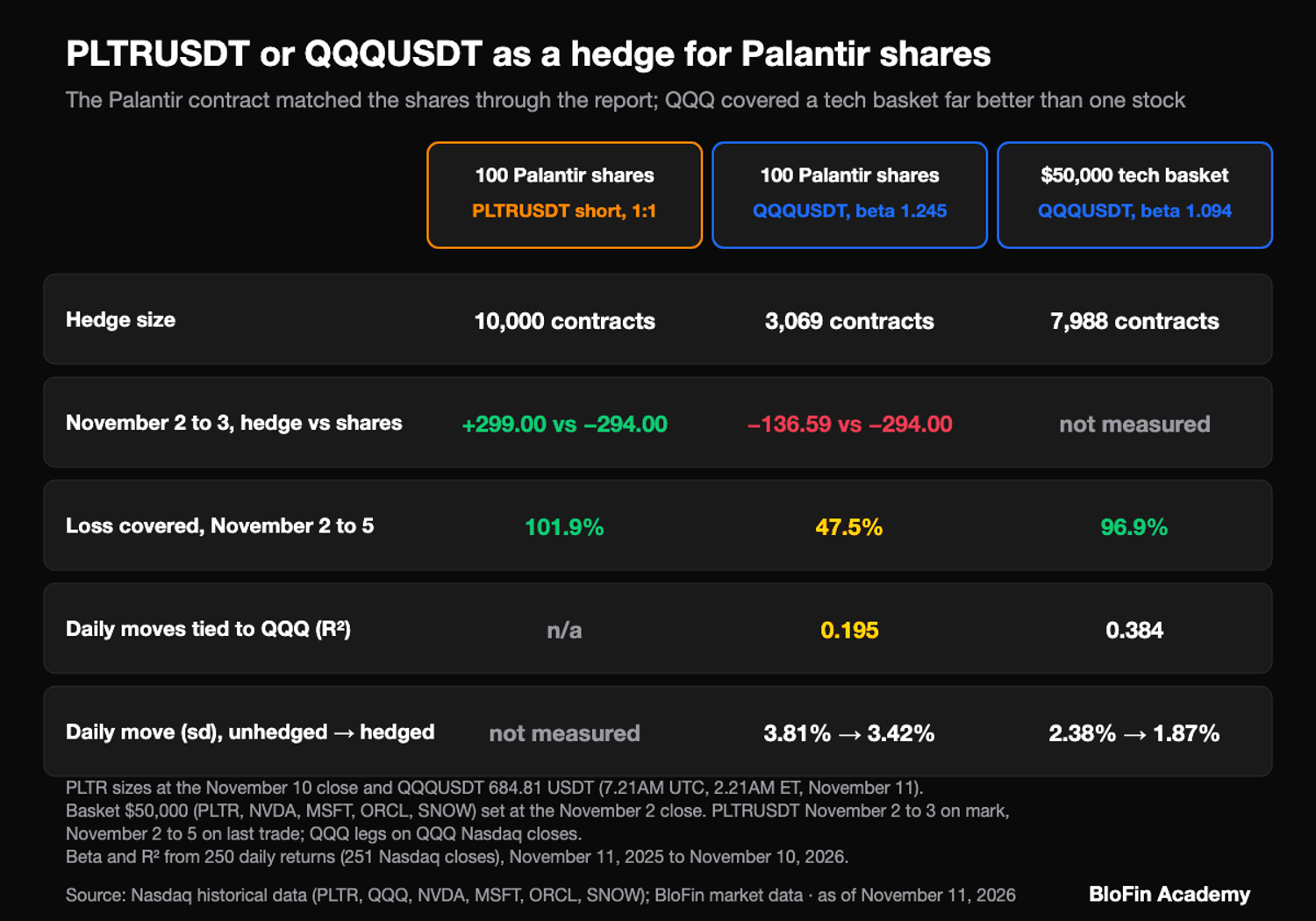
A $50,000 basket of that kind, $10,000 in each stock at the November 2 close, lost $2,821.56 by November 5. A QQQ short sized at 1.094 × $50,000 gained $2,733.84 on QQQ's Nasdaq closes, covering 96.9%. At the November 11 QQQUSDT price, that hedge would be 7,988 contracts. QQQUSDT allows up to 20x leverage (source: BloFin QQQUSDT market data).
Palantir's daily standard deviation of 3.81%, against 1.35% for QQQ, is a measure of how volatile Palantir stock is on its own, and that is the part a market hedge leaves in place.
How to close or resize a Palantir hedge
Closing a Palantir hedge on BloFin means buying back the PLTRUSDT short, either all at once or in parts. The hedge ends the moment either leg closes: sell the shares and the short becomes a plain bet on a fall, or close the short and the shares carry the full risk again.
A short closes with a buy order, and the Close button in the Positions tab works in either of BloFin's position modes. In One-way mode, a Buy from the order panel with Reduce-only ticked also closes it. In Hedge mode BloFin ignores Reduce-only, so a Buy from the order panel can open a long instead. Closing with a limit order that rests until filled costs the 0.0200% maker rate, and closing at market costs 0.0600%. Closing part of the short keeps the remainder open on the margin and leverage it started with.
Step 1: Go to the Positions tab, find the PLTRUSDT short and press Close. Choose Limit or Market, type the amount to buy back, then press Confirm.
Step 2: In One-way mode, you can instead place a Buy order on the order panel for the size you want to remove, with Reduce-only ticked, so the order can only shrink the short. In Hedge mode, use Close under Positions.
Step 3: To resize after selling some shares, use Close under Positions for the same amount of PLTR, or, in One-way mode, a Buy with Reduce-only ticked. For example, if you sell 40 of your 100 shares, buying back 40 PLTR, or 4,000 contracts, keeps the hedge ratio at 1 on the 60 shares left.
Step 4: Check the Positions tab once more. The remaining size should match the shares you still hold, or the line should be gone if you closed it all.
Timing matters on the way out as much as on the way in. Selling the shares near Nasdaq's close and buying back the short in the same minutes keeps the two legs on close to matching prices. How the two legs are taxed depends on where you live and can differ between a share and a derivative, so a local tax adviser is the right person to ask.
Looking to trade Palantir? To get started, you'll need to first create a BloFin account, fund your account with cryptocurrency, and go to the PLTRUSDT Perpetual trading page.

Frequently asked questions
Can one day's rally liquidate a Palantir hedge?
At 1x or 2x, no single session in the past year rose far enough. Palantir's largest one-day rise in the 250 sessions to November 10, 2026 was 29.45%, from $125.65 on August 3 to $162.66 on August 4, with an intraday high 30.94% above the August 3 close (source: Nasdaq PLTR historical data). A 3x short needs a 30.01% rise to reach its estimated liquidation price and a 5x short needs 17.00%, assuming a 0.0600% liquidation fee. The largest five-session rise was 39.78%, from July 31 to August 7.
Can you hedge only part of your Palantir shares?
Yes, by shorting fewer PLTR than you hold. A short of 50 PLTR, or 5,000 contracts, against 100 shares is a hedge ratio of 0.5. Through the November 2 report it would have gained 1,189.50 USDT from 178.76 to 154.97 USDT, against the shares' $2,335.00 loss. That left a combined loss of 1,145.50 in USD and USDT before about 10.01 USDT of taker fees (source: BloFin PLTRUSDT market data, Nasdaq PLTR historical data).
Can you hedge Palantir shares held at another broker?
Yes, because the two legs never need to meet. BloFin's stock futures track the referenced share's price and convey no ownership interest in it, so the short settles in USDT and the shares stay at your broker (source: BloFin stock futures notice). Profits on the short stay in USDT on BloFin, and to withdraw them you first move them into the Funding Account under Assets, the only account BloFin processes withdrawals from.
Does a Palantir hedge ratio drift as prices move?
A one-for-one PLTRUSDT hedge stays at a ratio of 1, since 100 shares and 100 PLTR short move together. A QQQ hedge drifts, because the two prices move by different amounts. A QQQ short sized at 1.245 × $17,834 on November 2 was worth $21,093.64 by November 5, against Palantir at $15,499, a ratio of 1.361. Getting back to 1.245 meant shorting 29.82 QQQ instead of 32.60, a Reduce-only buy of 2.78 QQQ (source: Nasdaq PLTR and QQQ historical data). CFI calls this kind of adjustment a dynamic hedge (source: CFI, hedge ratio).
What does a Palantir hedge cost if the stock goes nowhere?
The fixed cost is the trading fee on the short: on 100 PLTR worth $16,882 at the November 10 close, a market open and close would cost 20.26 USDT, and two resting limit orders 6.75 USDT. Funding can add or subtract. Over the 42 settlements from 8AM UTC (4AM ET) October 28 to 12AM UTC November 11 (7PM ET November 10), PLTRUSDT's rates summed to +0.0233%. A short of that size received about 3.93 USDT on its November 10 value; 21 rates were positive, 20 negative and one zero (source: BloFin PLTRUSDT funding history).
Researched and written by the BloFin Academy editorial team with AI-assisted drafting. All facts independently verified. Primary sources include Palantir's third-quarter 2026 results release filed with the SEC, Nasdaq's daily price tables for Palantir, QQQ, Nvidia, Microsoft, Oracle and Snowflake and its trading-hours page, Invesco's QQQ fund page, and Corporate Finance Institute's guides to hedging, hedge ratios and beta. BloFin facts come from its stock futures notice, contract details, position tiers, liquidation price help page, funding history and its own PLTRUSDT and QQQUSDT market data, current as of November 11, 2026.
Nothing in this article constitutes financial advice, and nothing in it is a recommendation to buy, sell, hold or hedge Palantir in any form. A hedge reduces risk and gives up gains: from the November 5 to the November 6 close, a one-for-one PLTRUSDT hedge on 100 shares ended 61 down in USD and USDT combined while the shares alone gained $539. The short side can be liquidated on a sharp rise, funding can be paid as well as received, and trading may be limited to reduce-only orders outside regular hours. Past performance does not indicate future results. Do your own research and consider your risk tolerance before you trade on BloFin.