
A company's quarterly report is a scheduled event that can reprice a stock overnight. The numbers usually arrive after the exchange has shut, when only a thin after-hours market is open, and by the next morning the share can start a long way from where it closed.
That timing forces a hard choice. Whatever you hold at the close is what you carry into news nobody has seen yet, and a stop placed on the chart protects you less than it seems to once the price starts to jump. The direction is hard to call, though past reports give you a fair idea of how far the price can travel.
Perpetual futures on stocks add a twist, because they keep trading through the evening while the share market is shut. That gives you a live price on the night. It also means a leveraged position can be reduced or liquidated hours before the next regular session begins, so your position size matters at least as much as the direction you pick.
Palantir Technologies (PLTR) shows all of this clearly, since its shares jumped by more than a quarter after one 2026 report and barely moved by the close after another. On BloFin the Palantir contract is the PLTRUSDT Perpetual, which settles in USDT and traded through Palantir's May 4, August 3 and November 2, 2026 reports.
What does trading Palantir around earnings mean?
Trading Palantir around earnings means settling three things while the regular session is open on report day: whether a position stays on through the results, how big it is and where its stop sits. The release lands minutes after the 4PM ET Nasdaq close (9PM UTC in US winter), so your position at the bell meets the first reaction (source: SEC EDGAR, filing of November 2, 2026).
In US summer that close falls at 8PM UTC. From there the trade passes through three stretches of time, and each one asks you a different question. Report day's regular session is when you settle your size. The night, from the release through the webcast and on to the next morning, tests what your orders can still do. The following morning brings the full share market in, and the question becomes whether you want to stay with the move.
The numbers themselves take a different skill. Judging them calls for a line-by-line read of the release, from GAAP and adjusted profit to bookings and guidance.
Palantir's report timing and reduce-only limits
Palantir reports on a Monday after the 4PM ET Nasdaq close (9PM UTC in US winter), and its webcast starts at 5PM ET (10PM UTC). Both fall outside regular trading hours for BloFin's stock futures, when orders may be limited to reduce-only (source: BloFin stock futures notice). A reduce-only order can cut or end a position, yet it cannot start or enlarge one.
All eight reports from February 2025 to November 2026 came on a Monday (source: SEC EDGAR, Palantir 8-K filings). The November 2, 2026 filing reached the SEC at 4.06PM ET, or 9.06PM UTC, under seven minutes after the closing bell (source: SEC EDGAR, filing of November 2, 2026). The August 3 filing landed at the same 4.06PM ET, which was 8.06PM UTC during US daylight time (source: SEC EDGAR, filing of August 3, 2026). The webcast started at 5PM ET for each of the May, August and November 2026 reports (source: Palantir Q1 2026 results) (source: Palantir Q2 2026 results) (source: Palantir Q3 2026 results).
BloFin's regular stock futures session runs from 2.30PM to 9PM UTC under US standard time and an hour earlier under daylight time (source: BloFin stock futures notice), and the perpetual's trading hours sets out holidays and early closes.
For planning, treat the 4PM ET close as your last moment with every kind of order available. A position you want through the results should already be open and sized by then, because adding to it later may not be possible, although a reduce-only order can still cut it. Palantir's two most recent fourth-quarter reports came on February 3, 2025 and February 2, 2026 (source: SEC EDGAR, Palantir 8-K filings). If that pattern holds, the next one falls in US winter hours, with the close at 9PM UTC and the webcast at 10PM UTC.
How much Palantir stock moves after earnings
After Palantir's eight reports from February 2025 to November 2026, the next session closed an average of 12.1% away from the report-day close, with a median of 7.9%. Four closes were higher and four were lower, so the record says far more about size than about direction (source: Nasdaq, PLTR historical prices).
Each move starts from the close on report day and runs to the next session's open and close, along with that day's intraday high or low in the direction of the move (source: Nasdaq, PLTR historical prices). Each report date is the day Palantir filed its results 8-K (source: SEC EDGAR, Palantir 8-K filings).
Report date | Close before the report | Next open | Next close | Intraday high or low next session | Close five sessions later |
|---|---|---|---|---|---|
February 3, 2025 | $83.74 | +22.8% | +24.0% | +27.7% | +39.3% (source: Nasdaq, PLTR historical prices) |
May 5, 2025 | $123.77 | −8.9% | −12.0% | −14.9% | −4.3% (source: Nasdaq, PLTR historical prices) |
August 4, 2025 | $160.66 | +6.9% | +7.8% | +9.8% | +13.7% (source: Nasdaq, PLTR historical prices) |
November 3, 2025 | $207.18 | −7.3% | −7.9% | −10.4% | −6.5% (source: Nasdaq, PLTR historical prices) |
February 2, 2026 | $147.76 | +11.7% | +6.8% | +11.7% | −3.3% (source: Nasdaq, PLTR historical prices) |
May 4, 2026 | $146.03 | −3.9% | −6.9% | −7.7% | −6.3% (source: Nasdaq, PLTR historical prices) |
August 3, 2026 | $125.65 | +15.5% | +29.5% | +30.9% | +39.5% (source: Nasdaq, PLTR historical prices) |
November 2, 2026 | $178.34 | −5.7% | −1.6% | −7.3% | Not complete at November 4 (source: Nasdaq, PLTR historical prices) |
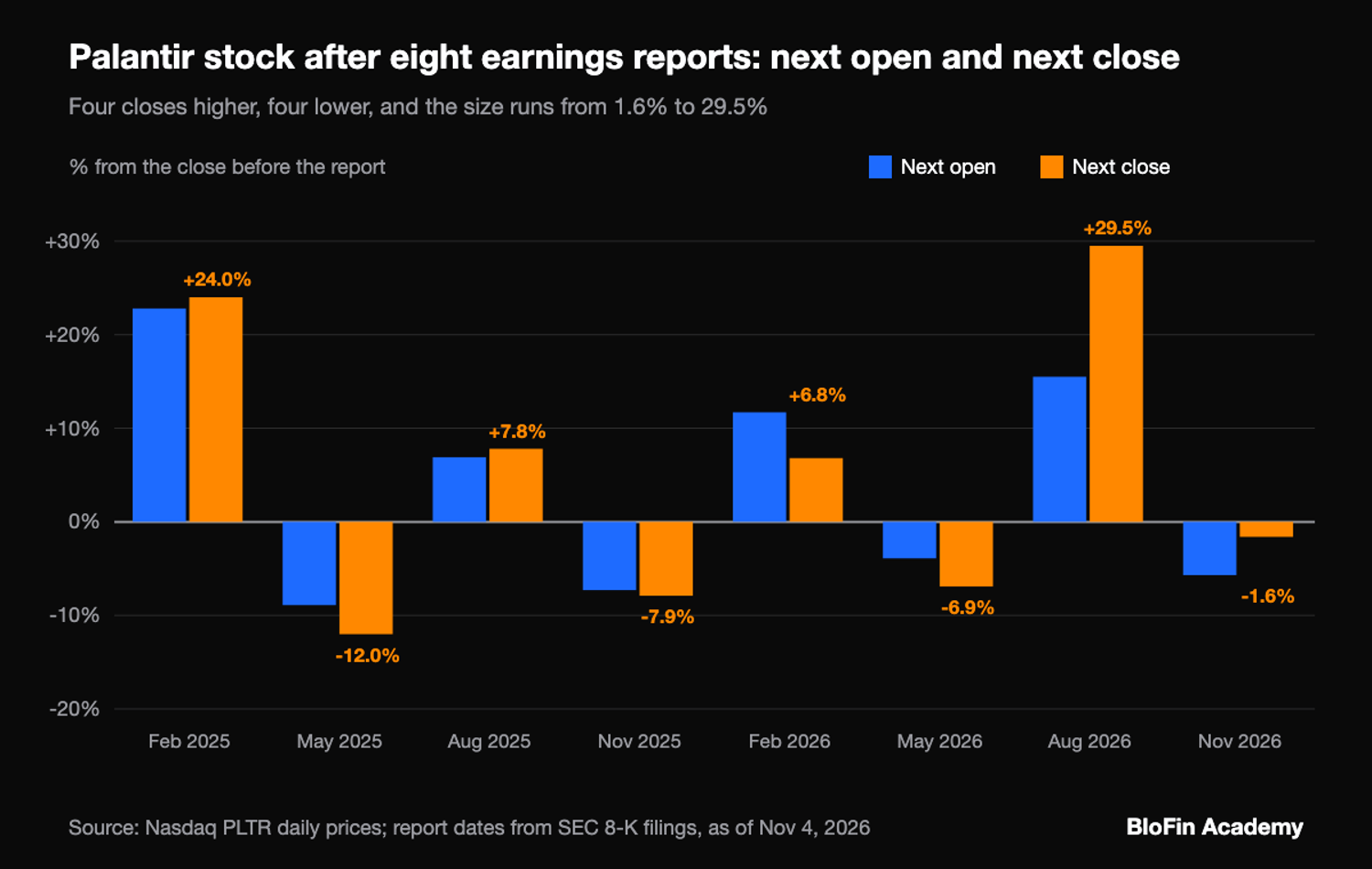
Set those moves beside an ordinary session and the difference is plain. In the year to November 4, 2026, Palantir's average move from one close to the next was 2.4% once the four report reactions are left out. So an average report session moved about five times as far as an average day (source: Nasdaq, PLTR historical prices).
The session's high or low matters more than the close when you use leverage. A long is at risk from the session's lowest price and a short from its highest, even if the share recovers by 4PM ET (9PM UTC in US winter). After the May 2025 report the share closed 12.0% lower, but at one point that day it had been 14.9% lower, and that wider figure is the one to test a position against (source: Nasdaq, PLTR historical prices).
Palantir's November 2, 2026 report night
Palantir's November 2, 2026 report shows why the day's fall and the reaction are two separate numbers. The shares closed 3.1% lower that day at $178.34, before any results were out. The reaction came afterwards, through an after-hours price of $171.52 reported by Investing.com on November 2 (source: Investing.com, Palantir Q3 2026 transcript) and a next close of $175.40 (source: Nasdaq, PLTR historical prices).
The results themselves looked strong. Sales of $2.3 billion were 96% up on a year before, the US commercial line climbed 148% to reach $984 million, and the full-year revenue forecast went up to about $8.5 billion (source: Palantir Q3 2026 results). Even so, Palantir's share price fell, so strong numbers gave no protection to a long held through them.
The next session shows how much your reading depends on the moment you take it. Measured from the $178.34 close, the share opened 5.7% lower at $168.18, touched $165.25, or 7.3% lower, and closed just 1.6% lower at $175.40. A day later it closed at $171.70, which was 3.7% under the report-day close (source: Nasdaq, PLTR historical prices). So the same report could be described as a heavy fall at 9.30AM ET (2.30PM UTC) and a mild one at 4PM ET (9PM UTC).
Adding the day's fall to the after-hours fall overstates the reaction, because the first part happened while nobody had seen the results. The clean comparison runs from the close before the release to the prices that came after it.
The options-implied move and the actual move
The options-implied move is the size of swing that option prices suggest after a report, in either direction. EarningsWatcher, reading the at-the-money straddle, put it at ±12.7% for Palantir's November 2, 2026 report (source: EarningsWatcher, Palantir implied move). The next session closed 1.6% lower, inside that range, with a low 7.3% under the close (source: Nasdaq, PLTR historical prices).
A straddle pairs a call with a put at one strike price, and what it costs before a report gives traders a rough measure of the move they expect. The figure carries no direction. EarningsWatcher itself calls it a market price, not a forecast (source: EarningsWatcher, Palantir implied move).
Report date | Options priced | Next close | Intraday high or low next session |
|---|---|---|---|
May 5, 2025 | ±14.5% | −12.0% | −14.9% (source: EarningsWatcher, Palantir implied move) |
August 4, 2025 | ±12.0% | +7.8% | +9.8% (source: EarningsWatcher, Palantir implied move) |
November 3, 2025 | ±10.1% | −7.9% | −10.4% (source: EarningsWatcher, Palantir implied move) |
February 2, 2026 | ±11.1% | +6.8% | +11.7% (source: EarningsWatcher, Palantir implied move) |
May 4, 2026 | ±9.7% | −6.9% | −7.7% (source: EarningsWatcher, Palantir implied move) |
August 3, 2026 | ±12.2% | +29.5% | +30.9% (source: EarningsWatcher, Palantir implied move) |
November 2, 2026 | ±12.7% | −1.6% | −7.3% (source: EarningsWatcher, Palantir implied move) (source: Nasdaq, PLTR historical prices) |
How often the move beat the options price depends on the measure you pick. Only one next-session close of the seven landed outside the priced range, in August 2026. The intraday high or low went past it four times, in May 2025, November 2025, February 2026 and August 2026 (source: EarningsWatcher, Palantir implied move). EarningsWatcher's longer record shows the same pattern, with the peak move beating the options price in 12 of 17 Palantir reports (source: EarningsWatcher, November 2026 report).
For a leveraged position the intraday count is the one that matters, since a position can be closed out at the low even when the close looks calm. So treat the implied move as the smallest swing worth planning for, and remember that August 2026 went more than twice as far as options had priced (source: EarningsWatcher, Palantir implied move).
Post-earnings drift in Palantir stock
Post-earnings drift describes a share price that keeps heading the way it first reacted for several sessions after results. Of Palantir's seven reports from February 2025 to August 2026, six left the share on the first session's side of the report-day close five sessions later, but the move kept growing after only three (source: Nasdaq, PLTR historical prices).
The size of that follow-through varied a lot, though. After February 2025, August 2025 and August 2026, the move grew, with August 2026 stretching from 29.5% to 39.5%. After May 2025 most of the fall faded, from 12.0% down to 4.3%, while November 2025 and May 2026 ended the week close to where the first session left them. February 2026 reversed completely, from a 6.8% gain to a 3.3% loss (source: Nasdaq, PLTR historical prices).
Seven reports make a short record, so this describes what happened, with no promise about the next one. It does tell you that a position kept open after the first session is carrying a fresh decision each day, with price risk that can match the report night's in size. November 2026's fifth session falls on November 9, so that report has no five-session figure yet.
How the PLTR perpetual moved on report nights
BloFin listed the PLTRUSDT Perpetual on February 9, 2026, and it then traded through Palantir's May, August and November reports. From its price at the Nasdaq close to half an hour before the next open, it fell 1.1% after May's report, rose 15.5% after August's and fell 6.2% after November's (source: BloFin PLTRUSDT market data).
Each night starts from the opening price of the hourly candle that holds the release, which was 8PM UTC in May and August and 9PM UTC in November. The first-hour figures span sixty minutes, and the highest and lowest prices run until the hourly candle that holds the next Nasdaq open (source: BloFin PLTRUSDT market data).
Report night | Price at the Nasdaq close (USDT) | First-hour high | First-hour low | Highest and lowest before the next open's hour | Price 30 minutes before the next open |
|---|---|---|---|---|---|
May 4, 2026 | 146.24 | 149.16 (+2.0%) | 143.49 (−1.9%) | +2.0% and −3.7% | 144.63 (−1.1%) (source: BloFin PLTRUSDT market data) |
August 3, 2026 | 126.15 | 142.98 (+13.3%) | 125.68 (−0.4%) | +17.0% and −0.4% | 145.71 (+15.5%) (source: BloFin PLTRUSDT market data) |
November 2, 2026 | 178.76 | 187.21 (+4.7%) | 173.98 (−2.7%) | +4.7% and −9.0% | 167.64 (−6.2%) (source: BloFin PLTRUSDT market data) |
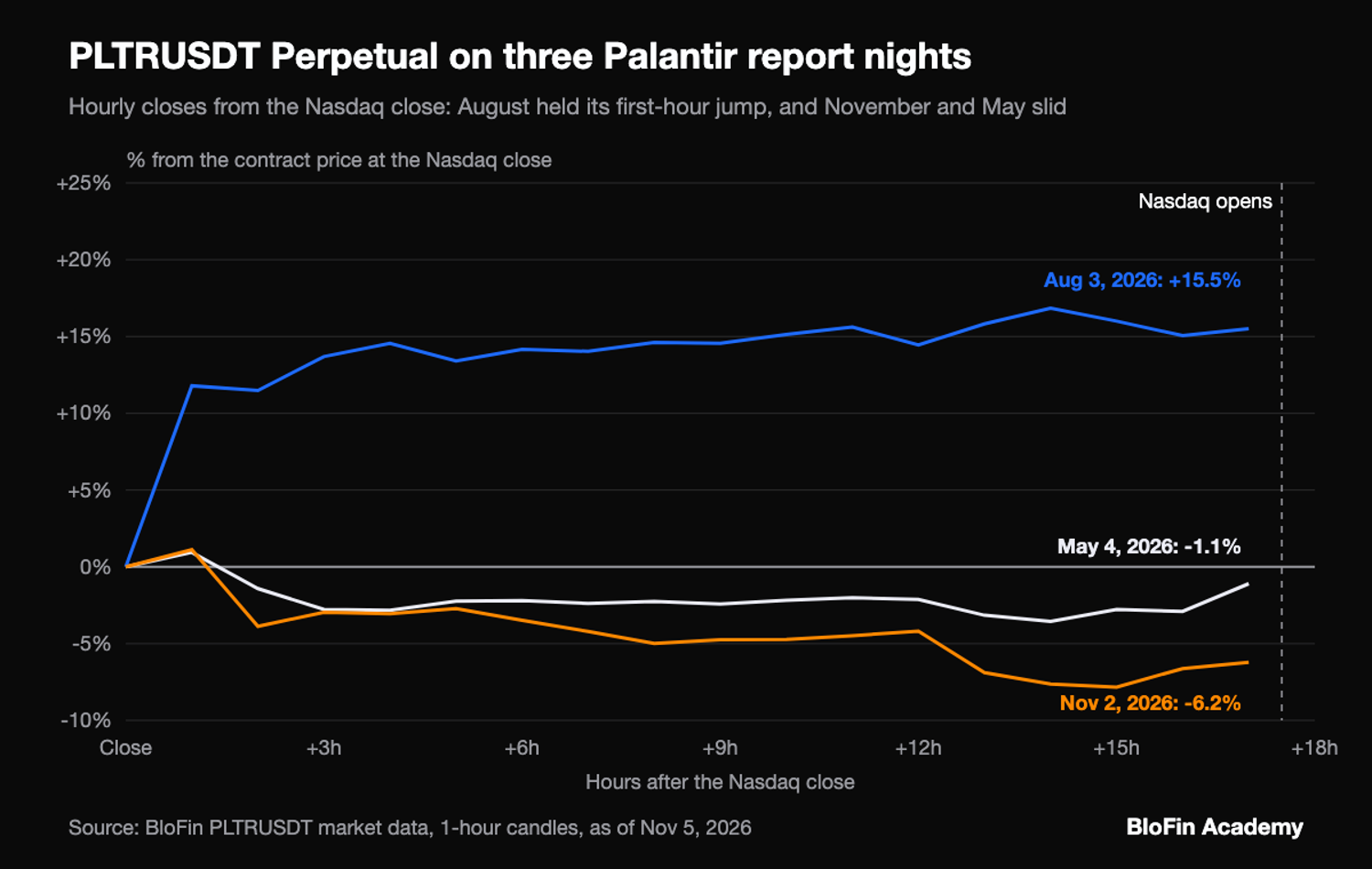
August's path stands apart from the other two. Its price jumped in its first hour and then held most of the gain, so the night's direction was clear almost at once. November traded on both sides of the close in its first hour, as high as 187.21 and as low as 173.98 USDT, and only later settled lower. May stayed within about 4% of its close all night, then fell as low as 137.79 USDT in the hour that held the Nasdaq open (source: BloFin PLTRUSDT market data).
The perpetual's price and the Nasdaq open
Half an hour before the next Nasdaq open, the contract's price sat 0.4% above where the share then opened in August, 0.3% below it in November and 3.1% above it in May (source: BloFin PLTRUSDT market data) (source: Nasdaq, PLTR historical prices). So the overnight price was a close guide to the opening gap on two nights and a poor one on the third, and that third night was also the quietest.
Its extremes can also run past the share's. On November 3, the contract's low of 162.60 USDT was 9.0% under its price at the close, while Nasdaq's low for the session was 7.3% under the share's close. After May's report the contract's low came about two hours after Nasdaq had shut, at 134.12 USDT, 8.3% under its price at the close, against 7.7% for Nasdaq's low. So a test built on the share's daily prices can understate what a perpetual position had to survive (source: BloFin PLTRUSDT market data) (source: Nasdaq, PLTR historical prices).
Trading volume on the contract
Volume rose with each report. The first hour traded 9.93 PLTR in May, 408.35 PLTR in August and 642.64 PLTR in November, followed by 1,066.73 PLTR in the hour that held November's webcast (source: BloFin PLTRUSDT market data). Thin trading means a larger order moves the price further, so a quiet night can still fill you badly.
Two limits apply to reading these candles. A candle records trades, including ones that only closed positions, so it says nothing about whether a new position could be opened at that hour. Candles also show traded prices, whereas BloFin's liquidation engine runs on the mark price, which can sit away from the last trade for short spells. The live price, mark and index sit side by side on the PLTRUSDT Perpetual page.
Holding or closing a position before Palantir reports
Closing before the 4PM ET bell (9PM UTC in US winter) takes the report-night move off your account, along with any gain it might have brought. Holding keeps both outcomes open. A partial close sits between those two, with a smaller position left running.
To close a futures position, use the Close button in the Positions tab. In One-way mode you can also place an opposite order from the trading page, a Sell for a long and a Buy for a short. Closing part of it keeps the remainder open at the same leverage. Neither choice is correct in general. What matters is whether you can name the largest loss you could accept, and whether your position fits inside it.
Some traders stay flat through the numbers and wait for the regular session, when the first reaction has already happened. That removes the overnight jump, yet it leaves plenty of risk. From the next open to the next close, the share gained 12.1% after August 2026 and 4.3% after November 2026, while it lost 4.3% after February 2026 and 3.4% after May 2025 (source: Nasdaq, PLTR historical prices). Someone who bought the February 2026 open because the news looked good would have lost money that same day.
Waiting also has a cost of its own when the move is one-way. August 2026 opened 15.5% higher, so a long opened at that open missed more than half of the 29.5% move (source: Nasdaq, PLTR historical prices). Each of these routes swaps one risk for another, and you get to choose only which one you carry.
Position size for a Palantir report night
Position size for a Palantir report starts from the most you can accept losing, divided by the largest recent reaction. With a 100 USDT limit and the 14.9% low after May 2025's report (source: Nasdaq, PLTR historical prices), a long's exposure comes to about 671 USDT. Against the 30.9% high after August 2026's report (source: Nasdaq, PLTR historical prices), a short gets about 324 USDT.
At Nasdaq's November 4 close of $171.70 (source: Nasdaq, PLTR historical prices), 671 USDT is about 3.91 PLTR. Leverage decides how much margin you post for that exposure, about 224 USDT at 3x. Your loss at a stop comes down to how large the position is and how far away the stop sits, with leverage playing no part. Leverage does decide how close liquidation sits, though, and on a report night that distance can be reached within hours.
These are estimates for an isolated position on BloFin's first tier, up to 700 PLTR, with 2.50% maintenance margin (source: BloFin PLTRUSDT position tiers). They use BloFin's liquidation formula (source: BloFin, liquidation price calculation), taking the 0.0600% regular taker fee (source: BloFin fee schedule) as its liquidation fee rate. That rate is an assumption, because BloFin's formula gives no number, although its own worked example uses 0.06% (source: BloFin, forced liquidation rules). Each distance is then tested against the eight sessions that followed Palantir's reports, on Nasdaq's daily prices (source: Nasdaq, PLTR historical prices).
Leverage | Long liquidated after a fall of about | Short liquidated after a rise of about | Sessions whose low reached the long's level | Sessions whose high reached the short's level |
|---|---|---|---|---|
2x | 48.7% | 46.3% | 0 of 8 | 0 of 8 (source: Nasdaq, PLTR historical prices) |
3x | 31.6% | 30.0% | 0 of 8 | 1 of 8 (source: Nasdaq, PLTR historical prices) |
5x | 17.9% | 17.0% | 0 of 8 | 2 of 8 (source: Nasdaq, PLTR historical prices) |
10x | 7.6% | 7.3% | 3 of 8 | 4 of 8 (source: Nasdaq, PLTR historical prices) |
20x | 2.5% | 2.4% | 4 of 8 | 4 of 8 (source: Nasdaq, PLTR historical prices) |
A short at 3x sits right at the edge, since its 30.0% distance was passed by the 30.9% high after August 2026, and the contract's own high that day was 30.4% above its price at the close (source: BloFin PLTRUSDT market data). BloFin reduces or liquidates a position, closing part or all, once its mark price touches the liquidation price (source: BloFin, forced liquidation rules). The figure that counts for a real order is the estimated Liq. Price the order panel shows before you place it.
Cross margin changes the picture, because your whole futures balance then stands behind every open position, so a report-night loss can reach beyond this one trade. Everyday sizing depends on the leverage you choose for the contract and on Palantir's usual daily range.
Stop-loss orders on a Palantir report night
A stop-loss order closes a position once the price reaches your trigger, but on a report night the price can jump past it. On BloFin, tick TP/SL, short for take profit and stop-loss, on the order panel; the trigger defaults to Last and also offers Mark and Index. Set this way it fills as a market order, so the price can slip.
August 3, 2026 shows the scale of it. Say you went into the close short 2 PLTR, and measure the short from 126.15 USDT, the first traded price of the 8PM UTC hour, with a stop 3% higher at 129.93 USDT. You planned on a loss of about 7.56 USDT. Within that hour the price traded as high as 142.98 USDT and ended the hour at 141.02 USDT, where the same short would be down about 29.74 USDT, or 3.9 times the plan (source: BloFin PLTRUSDT market data). An hourly candle hides the path, so a real fill could have landed anywhere between the trigger and the high.
A stop can also fire on a move that later fades. Take a long held into the close, measured from 178.76 USDT, the first traded price of the 9PM UTC hour on November 2, with a stop 5% lower at 169.82 USDT. The contract's low in the 4AM UTC hour on November 3 was 169.68 USDT, in an hour that traded just 15.22 PLTR, so that stop would have triggered on a last-price basis overnight. The contract fell as low as 162.60 USDT before the open (source: BloFin PLTRUSDT market data). The share still closed that day at $175.40 on Nasdaq (source: Nasdaq, PLTR historical prices).
So the width of a stop and the size of a position have to be set together. A wider stop on a smaller position leaves more room for an overnight swing while keeping the same planned loss, though neither setting can promise a fill at your level. The mark price is less exposed to one thin trade, which may matter on a quiet night. The same logic applies to overnight and weekend gaps on the contract on days without a report.
Funding and fees around a Palantir report
Funding and fees are small next to a report-night move. The first settlement after the November 2 report, at 12AM UTC on November 3, was −0.0017%, so a 1,000 USDT long received about 0.02 USDT from shorts (source: BloFin PLTRUSDT funding history). A market order each way on that long costs about 1.20 USDT in regular taker fees (source: BloFin fee schedule).
Funding is charged daily at 12AM, 8AM and 4PM UTC (source: BloFin PLTRUSDT funding history). With a negative rate shorts pay longs, and with a positive rate longs pay shorts. Rates can occasionally jump: +0.1359% on October 19 and −0.0218% on October 24, 2026 (source: BloFin PLTRUSDT funding history). Even that larger October 19 rate comes to about 1.36 USDT on 1,000 USDT, far less than a 1% price move.
Fees depend on how you close. At the regular level, fees apply to the position's value, at 0.0200% for a limit order filled as a maker and 0.0600% for a market order (source: BloFin fee schedule). On a night when the price is moving fast, a market close gets you out while a limit close may sit unfilled, so the small extra fee is usually the lesser concern.
Checklist before Palantir's next report
Before Palantir's next report, confirm the date, convert the release and webcast times to UTC, and make your hold-or-close decision before the bell. After that come three checks: your exposure against the largest recent reactions, a stop with room for a jump, and the liquidation price on the order panel.
Date. Watch for Palantir's press release, which on October 12, 2026 gave November 2 as the date (source: Palantir date notice).
Times. In US winter the close is 9PM UTC and the webcast 10PM UTC. In US summer they are 8PM and 9PM UTC.
Hold or close. Decide during the regular session, because reduce-only limits may apply once it ends.
Size. Divide your largest acceptable loss by 14.9% for a long and by 30.9% for a short, then update those two figures after each report.
Leverage. Compare the panel's Liq. Price with the largest reactions, keeping in mind that the contract's own extremes can run past the share's.
Stop. Allow for a fill beyond your trigger, and decide whether Last or Mark should fire it.
Take a 671 USDT long at 3x, with its estimated liquidation price about 31.6% away. A stop 10% beneath the entry drops the planned loss to about 67 USDT, plus whatever a jump adds in slippage. To place an order in full, follow the step-by-step trade guide.
Looking to trade Palantir? To get started, you'll need to first create a BloFin account, fund your account with cryptocurrency, and go to the PLTRUSDT Perpetual trading page.
Frequently asked questions
Does Palantir stock rise or fall after earnings?
Palantir stock has closed higher slightly more often than lower. Across the 12 reports from February 2024 to November 2026, the next session closed higher seven times and lower five times, with an average move of 14.7%. The biggest rise was 30.8% in February 2024 and the biggest fall was 15.1% in May 2024 (source: Nasdaq, PLTR historical prices).
Does most of Palantir's earnings move happen at the open?
The open usually carries most of Palantir's earnings move, though the session often adds to it. In six of the eight reports from February 2025 to November 2026, the next close finished further from the report-day close than the open did, in the same direction. The average opening gap was 10.3%, against 12.1% for the close (source: Nasdaq, PLTR historical prices).
Does the Palantir earnings call move the price?
The hour of Palantir's earnings call can be a busy one, although it also holds the wider reaction, so the call cannot be separated out. The webcast starts at 5PM ET (10PM UTC in US winter) (source: Palantir Q3 2026 results). In that hour the PLTRUSDT Perpetual traded a range of 3.3% in May 2026, 2.3% in August and 5.7% in November, when the price went between 171.33 and 181.11 USDT (source: BloFin PLTRUSDT market data).
How quickly does the PLTR perpetual react to Palantir's results?
The PLTR perpetual can reprice within the hour. On August 3, 2026, the first hour after the close held 23.7% of the night's trading volume, and on November 2 it held 23.4%, with 62.2% across the first two hours. May 4 was far quieter, with only 8.5% in the first hour, since the night traded just 116.39 PLTR in total (source: BloFin PLTRUSDT market data).
Does Palantir's earnings move hold a month later?
Palantir's first reaction has often stayed on the same side of the pre-report close beyond a month, though not always by much. EarningsWatcher counts 13 of 15 reports in which the earnings-day direction still held 30 sessions later, with the same count at seven sessions and a median move of ±14.4% from the pre-report close at 30 sessions (source: EarningsWatcher, Palantir implied move). That is a record of past reports, and it says nothing about the next one.
Researched and written by the BloFin Academy editorial team with AI-assisted drafting. All facts independently verified. Primary sources include Palantir's SEC filings and third-quarter 2026 results release, with share prices from Nasdaq's daily history for PLTR. Options-implied figures come from EarningsWatcher and the after-hours price from Investing.com. BloFin figures come from its PLTRUSDT market data, position tiers and funding history, its stock futures notice, and its help center articles on liquidation, current as of November 5, 2026.
Nothing in this article constitutes financial advice, and nothing in it is a recommendation to buy, sell or hold Palantir in any form. Palantir's share rose as much as 30.9% within the session after its August 2026 report, and a leveraged PLTRUSDT Perpetual position held through a report can be reduced or liquidated within hours. A stop can fill well past its trigger when the price jumps, and outside regular hours you may be limited to reduce-only orders, so you can cut a position but may not be able to add to it. Past performance does not indicate future results. Do your own research and consider your risk tolerance before you trade on BloFin.