
A popular chip stock can swing sharply in a single session, and a trader who expects the next move to be up often wants more exposure than their cash alone would buy. Borrowing to buy more is the old answer, and it cuts both ways, because the same borrowed exposure that doubles a gain also doubles a loss.
At a stockbroker, borrowing to buy shares runs through a margin account. The broker lends part of the price, holds your shares as collateral and can ask for more money if the price falls. Someone who keeps their money in stablecoins may have no such account, and may not want to move money back into a bank to open one.
A perpetual contract gives the same kind of exposure from inside a crypto exchange. You post an amount called margin, choose a leverage level, and the contract follows the stock's price with no expiry date. Leverage sets how large a position that margin can carry, and it also sets how small a move can wipe the margin out.
On BloFin, Advanced Micro Devices trades as the AMDUSDT Perpetual, margined and settled in USDT, a stablecoin that tracks the US dollar, with leverage of up to 20x. Going long AMD there means buying the contract, so you gain when AMD's price rises and lose when it falls.
Opening a leveraged AMD long, step by step
To trade AMD with leverage on BloFin, you’ll need to first create an account, deposit USDT, move it into your futures account and open the AMDUSDT Perpetual trading page. Then choose isolated margin, set a leverage from 1x to 20x, enter your size and a stop-loss, and press Buy (Long) during regular weekday trading hours, with each contract worth 0.01 AMD.
The contract offers leverage from 1x to 20x (source: BloFin, AMDUSDT contract information). BloFin listed it at 2PM UTC on May 6, 2026, with each contract worth 0.01 AMD (source: BloFin, AMDUSDT listing notice).
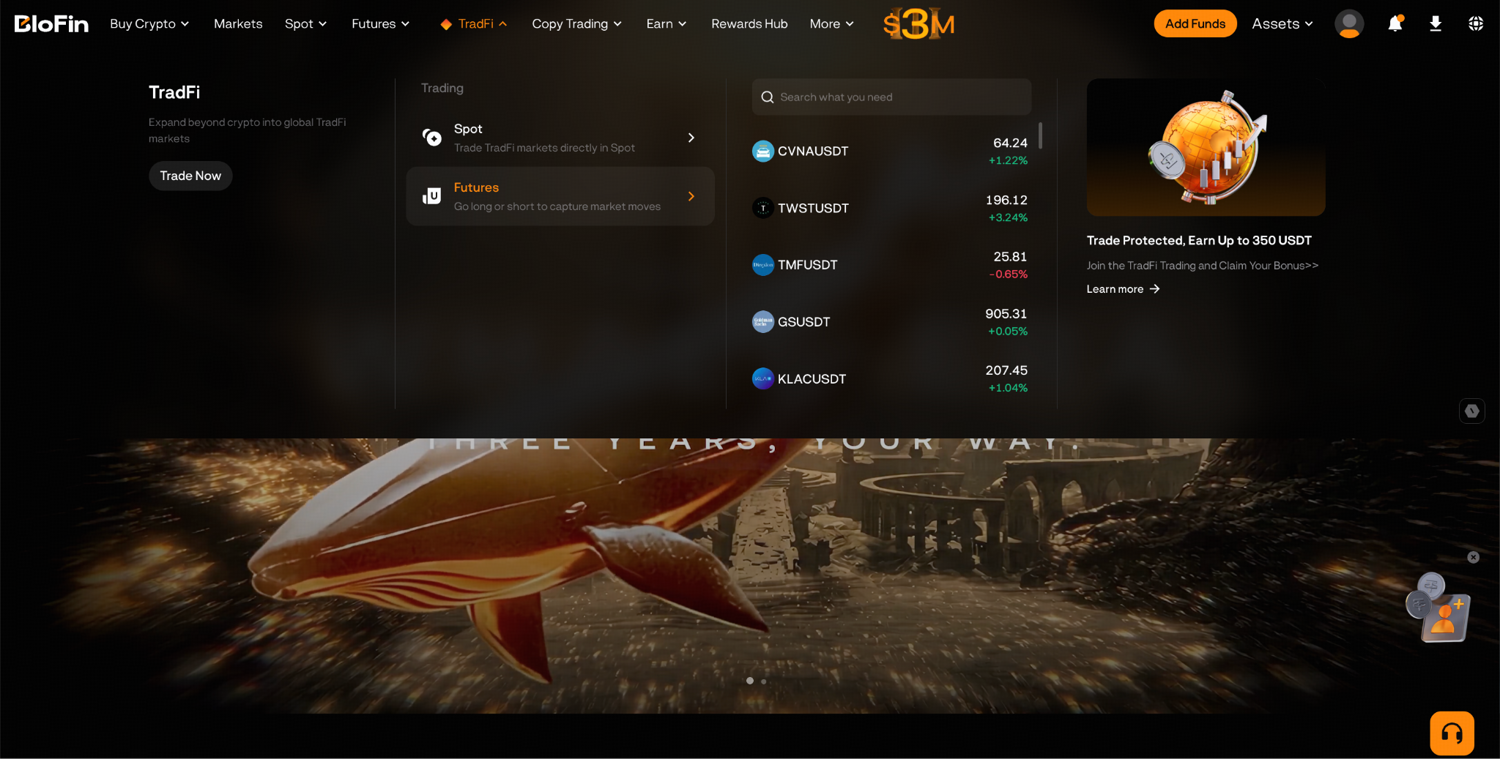
Step 1: Log in to your BloFin account and hover your cursor over the TradFi tab. Then, click Futures.
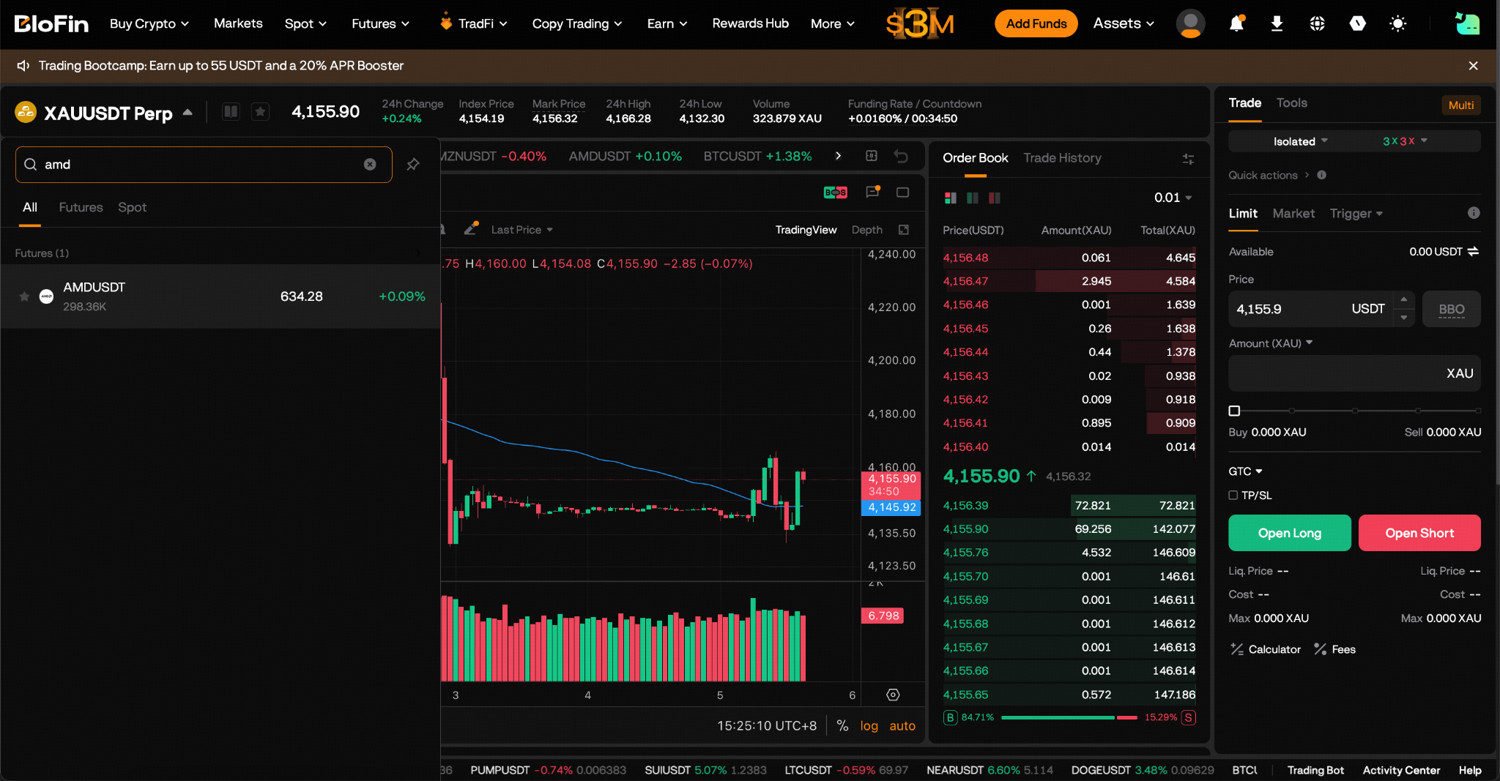
Step 2: Click on the XAUUSDT trading pair in the upper left corner and a pop-up window will appear. Type AMD in the search field and select AMDUSDT.
Step 3: In the order panel, click Cross and switch the margin mode to Isolated, so only the margin you commit to this position is at risk.
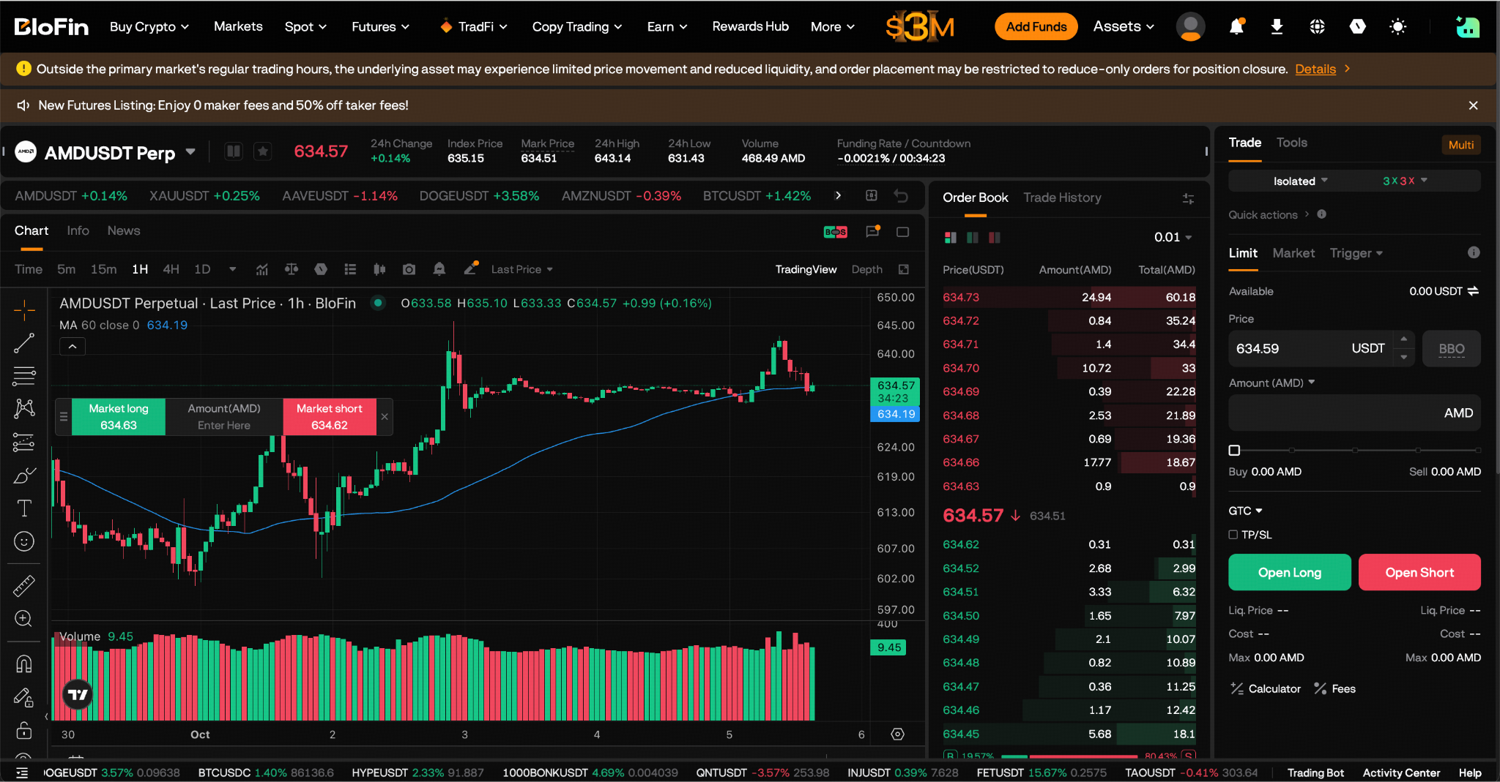
Step 4: Click the leverage multiple beside Isolated and set your leverage, keeping in mind that lower leverage needs more margin and puts the liquidation price farther from your entry.
Step 5: Choose Limit to name your price or Market to buy at once.
Step 6: Enter your size in the Amount field, then read the Liq. Price and Cost figures under the order buttons.
Step 7: Tick TP/SL and enter a stop-loss trigger price below your entry, plus a take-profit above it if you want one.
Step 8: Click Open Long and then Confirm on the website.
Step 9: Open the Positions tab and read the average entry price, the liquidation price, the margin and the running profit or loss.
The contract itself gives you AMD's price movement only, with no dividends or voting rights (source: BloFin, stock futures notice). That is the core of how the AMD perpetual works. The contract's live mark price and its order book are on the AMDUSDT Perpetual page.
Order size on the AMDUSDT Perpetual: Contracts and AMD
One AMDUSDT contract equals 0.01 AMD, so 100 contracts give the price exposure of one AMD share, and the smallest order is 0.01 AMD, a single contract. A single limit order can reach 2,000 AMD, which is 200,000 contracts, and a single market order 200 AMD, which is 20,000 contracts.
BloFin states those limits in AMD, and the step from one unit to the other is always 100, so 25 contracts is 0.25 AMD, and 3 AMD is 300 contracts (source: BloFin, AMDUSDT contract information).
The number that matters for risk is the position's value in USDT, which traders call its notional value. It is the size in AMD times the price. The margin you post is that value divided by your leverage. BloFin works out isolated margin as the contract value times the number of contracts times the entry price, divided by the leverage (source: BloFin, margin mechanism).
Say AMD trades at 600 USDT on the contract. The same size needs very different margin depending on the leverage you pick.
Order size in AMD | Number of contracts | Position value at 600 USDT | Margin at 5x | Margin at 10x | Margin at 20x |
|---|---|---|---|---|---|
0.01 AMD | 1 | 6 USDT | 1.20 USDT | 0.60 USDT | 0.30 USDT |
0.1 AMD | 10 | 60 USDT | 12 USDT | 6 USDT | 3 USDT |
1 AMD | 100 | 600 USDT | 120 USDT | 60 USDT | 30 USDT |
5 AMD | 500 | 3,000 USDT | 600 USDT | 300 USDT | 150 USDT |
Leverage lowers the margin a position needs, while its value, and therefore every dollar of gain or loss, stays the same. Beside those size limits, the contract moves in price steps of 0.01 USDT and settles funding every eight hours (source: BloFin, AMDUSDT contract information). The AMD perpetual contract specs set out what each of those terms does to an order.
How profit and loss work on a leveraged AMD long
A long AMD position earns the rise in the mark price times its size in AMD, and loses the same amount on a fall. One AMD earns or loses 1 USDT for every $1 move, and one contract 0.01 USDT. Leverage changes only the margin, so it changes the gain or loss as a percentage of margin.
BloFin works out a long's unrealized profit as the latest mark price minus the average entry price, times the position size in AMD. It shows that result as PnL, and as PnL% it divides it by the margin actually backing the position (source: BloFin, How to Trade on BloFin Futures). The mark price is BloFin's estimate of the contract's fair value, built from the index and a funding basis. It is the price used for open profit, margin ratio and liquidation (source: BloFin, index, mark and last price).
Say you buy 1 AMD, 100 contracts, at 600 USDT, so the position is worth 600 USDT, and the mark price then falls 5% to 570 USDT. The loss is 570 minus 600, times 1 AMD, which comes to 30 USDT at any leverage. Against 120 USDT of margin at 5x that is a PnL% of -25%, against 60 USDT at 10x it is -50%, and against 30 USDT at 20x it is -100%. At 20x, a 5% fall is the whole margin, and liquidation would already have closed the position before the fall was finished.
Falls of that size happen to AMD. It closed at $630.63 on Friday, September 25, 2026, then traded as low as $596.07 on Monday, September 28, about 5.5% lower, before closing that day at $607.87 (source: Yahoo Finance, AMD historical prices). AI chip stocks fell in premarket trading that morning after OpenAI paused training and testing of some of its most advanced AI models (source: TipRanks). Four sessions later, on October 2, AMD closed at $633.91, above that Friday close (source: Yahoo Finance, AMD historical prices). A 20x long bought at the Friday close had an estimated liquidation price about 15.79 USDT below its entry, worked out from BloFin's liquidation formula. A fall like Monday's in the mark price would have closed it before the recovery came, so the leverage you choose has to leave room for a day like that.
How to choose leverage for an AMD long
Choose leverage by the fall you want the position to survive. On a long bought at 600 USDT, BloFin's estimated liquidation price sits about 15 USDT below the entry at 20x, and about 46 USDT below at 10x. Pick the fall AMD might make against you, then use leverage low enough to stay well clear of it.
Liquidation is the forced closing of a position whose margin has run too low. BloFin reduces or liquidates a position once its margin, with the running profit or loss counted, falls to the maintenance margin plus the fee for closing it (source: BloFin, Forced Liquidation Rules). Maintenance margin is the least margin that keeps a position open. On AMDUSDT, positions of up to 200 AMD sit in the first tier, with a maintenance margin rate of 2.5% and leverage of up to 20x (source: BloFin, AMDUSDT position tiers).
BloFin publishes the formula for an isolated long's estimated liquidation price (source: BloFin, liquidation price calculation). The worked example in its liquidation rules uses a closing fee rate of 0.06% (source: BloFin, Forced Liquidation Rules). Using the first-tier rate of 2.5%, the estimates for 1 AMD bought at 600 USDT are worked out from that formula.
Leverage on 1 AMD at 600 USDT | Margin posted | A 5% fall as a share of margin | Estimated liquidation price, worked out from BloFin's formula |
|---|---|---|---|
2x | 300 USDT | 10% | about 307.88 USDT |
5x | 120 USDT | 25% | about 492.61 USDT |
10x | 60 USDT | 50% | about 554.19 USDT |
20x | 30 USDT | 100% | about 584.98 USDT |
A 20x long has about 15 USDT of room, 2.5% of the price, before BloFin takes it over. That is less than half of AMD's fall of about 5.5% from its September 25 close to its low on September 28. Liquidation runs on the mark price, so a brief dip in the last traded price can leave the long open, while a slide in the mark closes it (source: BloFin, index, mark and last price). A safer habit is to decide first how much USDT you can lose, then work back to a size and leverage. That is the method behind sizing an AMD position and behind leverage and liquidation on any contract.
Larger positions face stricter terms, because from 200.01 AMD the maintenance margin rate rises to 3.33% and the maximum leverage falls to 15x, and from 1,000.01 AMD it is 5.00% and 10x (source: BloFin, AMDUSDT position tiers). A position of a few AMD stays well inside the first tier, and AMD margin requirements only start to climb once a position passes 200 AMD.
Isolated or cross margin for an AMD position
Isolated margin ring-fences one position: the margin you lock when you open it is the most that position can lose. Cross margin lets every free balance in your futures account back all your positions, so a loss on one draws on money you set aside for others (source: BloFin, How to Trade on BloFin Futures).
For a first AMD trade, isolated margin is the simpler choice, because the numbers on your screen describe the whole risk. Say you put 60 USDT behind a 1 AMD long at 10x and keep another 500 USDT free in the same futures account. In isolated mode the long can lose its 60 USDT and no more, and the 500 USDT stays untouched. In cross mode the same long keeps drawing on the 500 USDT as the price falls, so its liquidation price sits much lower, but a steep enough fall can take far more than 60 USDT.
BloFin's margin guide makes the same point with a larger account. Say you hold 2,000 USDT in the futures account and open a 10x long. In isolated mode with 1,000 USDT committed, a fall to the liquidation price costs that 1,000 USDT and leaves the rest. In cross mode the same fall leaves the long open, so it can recover if the price turns, yet it can lose all 2,000 USDT if the fall continues (source: BloFin, margin mechanism).
Cross margin also links positions together, so a loss on a crypto contract can weaken the margin behind an AMD long held beside it. For most people starting out, isolated mode at low leverage, with a stop-loss above the liquidation price, keeps each trade's worst case small and known before the order goes in.
Limit and market orders on the AMDUSDT Perpetual
A limit order buys only at your price or better and can wait in the order book, while a market order buys at once at the best price available. On AMDUSDT a single market order can carry up to 200 AMD. Limit orders are usually cheaper, because an order that waits in the book pays the lower maker fee.
A maker order is one that rests in the order book before it fills. A taker order fills at once against orders already there, and every market order is a taker order (source: BloFin, futures trading fees). A limit order that crosses the book at once is charged as a taker too, so a buy limit priced well above the current price fills straight away and pays the higher fee. Knowing which of the market, limit and stop orders you are sending tells you in advance which fee you will pay.
Orders also have to stay close to the index price at the moment you send them. BloFin's price limits keep a buy within about 3% above it and a sell within about 3% below it (source: BloFin, AMDUSDT contract information).
Order type | What it does | When to use it on an AMD long |
|---|---|---|
Limit | Buys at your price or better; can wait unfilled | Entering at a planned price and paying the maker fee |
Market | Buys at once at the best price available, up to 200 AMD (source: BloFin, AMDUSDT contract information) | Entering or leaving immediately |
Stop (TP/SL, trigger) | Sends an order when a trigger price is reached | Setting your exit before the price gets there |
Trailing stop | Moves the trigger up behind a rising price | Keeping part of a gain while the price climbs |
Reduce-only (a setting) | Lets an order only shrink or close a position | Every order meant to close, so it can never flip you short |
With Reduce-only ticked, an order can shrink or close the position you already hold, and it will not open one in the other direction. It also does not guarantee that the order fills (source: BloFin, reduce-only orders). BloFin's perpetual futures also offer trailing stops, one of several stop-loss orders on BloFin. A trailing stop follows the price by a percentage you set, which the order form labels Variance %, and sends a market order if the price falls back by that much.
Fees on a leveraged AMD trade
BloFin charges a futures fee each time an order fills, on the position's full value: 0.02% for a maker order and 0.06% for a taker order at the standard rate. You pay it when you open and again when you close, and leverage does not change it, because the fee follows the position's value.
Those are the standard rates, and accounts on a higher fee tier can pay less. The fee is the position value times the fee rate, and the position value is the contract value times the number of contracts times the fill price (source: BloFin, futures trading fees). Because the fee is charged on the full value, it takes a bigger bite out of your margin the higher your leverage.
Say you buy 5 AMD at 600 USDT at 10x, with a market order in and a market order out.
Cost line on 5 AMD at 600 USDT, 10x | Amount |
|---|---|
Position value | 5 x 600 = 3,000 USDT |
Margin at 10x | 300 USDT |
Taker fee to open, 0.06% (source: BloFin, futures trading fees) | 1.80 USDT |
Taker fee to close, 0.06% (source: BloFin, futures trading fees) | 1.80 USDT |
Round trip | 3.60 USDT, or 1.2% of the margin |
With limit orders that rest in the book on both sides, the same trade would pay 0.60 USDT each way at the 0.02% maker rate. At 20x the margin halves to 150 USDT and the same 3.60 USDT becomes 2.4% of it, so a leveraged position has to rise a little before it earns back its fees.
When BloFin listed AMDUSDT on May 6, 2026, it charged no maker fee and half the taker fee for the first 48 hours after listing only (source: BloFin, AMDUSDT listing notice). The standard rates are therefore the ones to plan with, and funding comes on top of them for as long as the position stays open.
How to set a stop-loss and take-profit on an AMD long
Set a stop-loss when you place the order, by ticking TP/SL and entering a trigger price below your entry and above your liquidation price. When AMD's price reaches the trigger, BloFin sends an order that closes the long. A take-profit works the same way with a trigger above your entry.
You can attach the stop to the buy order itself, and it goes live once the order has fully filled. You can also add one to an open position, either for the whole position or for part of it (source: BloFin, TP/SL orders). When you place a take-profit and a stop-loss together on one position, the first to trigger cancels the other.
Each stop also has a trigger price type, and on BloFin the trigger can follow the last price, the mark price or the index price (source: BloFin, TP/SL orders). The choice matters, because liquidation runs on the mark price. A stop set on the last price fires only when the last traded price reaches your level, so it can miss a slide in the mark (source: BloFin, index, mark and last price). A stop on the mark price watches the same number that liquidation does.
Even then, BloFin says plainly that a stop-loss is not a sure way to avoid liquidation. A triggered order priced outside the price limits may not fill at all, or may fill only in part (source: BloFin, TP/SL orders). Say you hold 1 AMD bought at 600 USDT at 20x, with an estimated liquidation price of about 584.98 USDT. A stop at 590 leaves about 5 USDT between the two. If the price jumps straight through both, the stop cannot help.
This risk grows around the hours when the stock market is closed. The price index behind the contract comes from outside data vendors, and when no outside price is available it stays fixed at its last value (source: BloFin, AMDUSDT listing notice). Company news lands in those hours too. AMD announced its agreement to acquire World Labs at 4.05PM ET on September 28, 2026, just after BloFin's regular hours for stock futures had ended for the day (source: AMD, World Labs acquisition announcement). The index can then move sharply when trading resumes, which is the weekend gap risk any open position carries. A wider stop with lower leverage, rather than a tight stop at 20x, gives the stop room to work.
Funding while you hold an AMD long
Funding is a payment between long and short positions every eight hours, at 12AM, 8AM and 4PM UTC. When the rate is positive, a long pays it; when the rate is negative, a long receives it. It is worked out on the position's full value, and if you close before a settlement, that settlement skips you.
BloFin works out each payment as the position's value times the funding rate (source: BloFin, funding rates). On AMDUSDT, funding settles every eight hours from 12AM Hong Kong time, which is 4PM UTC (source: BloFin, AMDUSDT contract information).
Recent settlements on AMDUSDT show how small the payments are next to a price move, and how often the sign flips (source: BloFin, AMDUSDT funding history).
Funding settlement (UTC) | Funding rate | What a 1 AMD long worth 600 USDT pays or receives |
|---|---|---|
12AM, September 21, 2026 | +0.0619% (source: BloFin, AMDUSDT funding history) | pays about 0.37 USDT |
8AM, September 28, 2026 | -0.0519% (source: BloFin, AMDUSDT funding history) | receives about 0.31 USDT |
12AM, October 2, 2026 | +0.0188% (source: BloFin, AMDUSDT funding history) | pays about 0.11 USDT |
At 10x, the 0.37 USDT paid at the September 21 settlement would be about 0.6% of the 60 USDT margin, so funding matters more the longer you hold and the higher your leverage. Before you open a long, check the current rate and the countdown to the next settlement, both shown at the top of the AMDUSDT trading page. If the rate is positive and a settlement is minutes away, opening just after it saves one payment. Over weeks those payments add up, and how the AMD funding rate is set decides whether a long hold costs or earns.
In isolated mode, each funding settlement also changes the position's estimated liquidation price (source: BloFin, Forced Liquidation Rules). A long that keeps paying funding therefore sees that price creep closer over time, which is one more reason to check the position every day or two.
How to close a leveraged AMD long
Closing a long means selling the same amount, either with Close on the position or with a sell order for the size you hold and Reduce-only ticked, so the order can only shrink the long. Your profit or loss then settles in USDT in your futures account, and funding stops with the position.
BloFin offers three ways out of a long position. You can place a Sell order for the size you hold, or use Close on the Positions tab for all or part of the long. The Close All button ends everything at once with a market order, and BloFin warns that when the market moves violently, that order may not be executed (source: BloFin, How to Trade on BloFin Futures). Closing remains possible outside regular weekday trading hours, because the limit BloFin may apply then still allows reduce-only orders, the kind that close positions (source: BloFin, stock futures notice).
Say you bought 2 AMD at 600 USDT and the mark price has risen to 630 USDT. Selling 1 AMD with Reduce-only ticked takes about 30 USDT of profit before fees. The other 1 AMD stays open at the same entry price, with its own stop and its own share of funding. If you later want out completely, Close All ends the rest at the market price.
Two things are worth knowing before you need them. Reverse closes your long and opens a short of the same size at once, both with market orders (source: BloFin, How to Trade on BloFin Futures). A short gains when AMD falls instead of rising, and shorting AMD on BloFin has its own costs and risks. A sell larger than your long, placed without Reduce-only ticked, can open a short with the difference by accident (source: BloFin, reduce-only orders).
When it is done, AMDUSDT should no longer appear under Positions, and the USDT should show in your futures balance. You can then leave it there for the next trade, or transfer it back to the Funding Account.
Before your first leveraged AMD trade
A first leveraged AMD trade goes best with a small size, isolated margin, low leverage and a stop set before you press Buy. Check the time, the funding rate and the liquidation price first, and decide in advance at what price you will take the loss.
Run through the same seven checks before every trade.
The time falls within regular weekday trading hours, so BloFin accepts a new long.
Margin mode is Isolated, and the margin is money you can afford to lose.
Leverage leaves the liquidation price further away than AMD's biggest recent daily moves.
Size is right in AMD, with 100 contracts per share.
A stop-loss sits between the entry and the liquidation price, triggered on the mark price.
You know the funding rate and when the next settlement is due.
You know how you will close: at a take-profit, at the stop, or by hand with Reduce-only.
Say you have 300 USDT in the futures account and want 1 AMD at 600 USDT. At 5x the long needs 120 USDT of margin, which leaves 180 USDT spare, and its liquidation price sits near 492.61 USDT, worked out from BloFin's formula. A stop-loss on the mark price at 570 USDT, 5% below the entry, would cost about 30 USDT plus about 0.70 USDT in taker fees if it filled at the trigger. That is about a quarter of the margin, a loss you chose in advance, far from the liquidation price.
Once those seven are settled, placing the order takes a minute, and you know before you press Buy how much the trade can lose.
Looking to trade the AMDUSDT Perpetual with leverage? To get started, you'll need to first create a BloFin account, fund your account with cryptocurrency, and go to the AMDUSDT Perpetual trading page.
Frequently asked questions
Can you trade AMD stock with leverage?
A US brokerage margin account lets you borrow up to half the purchase price of the shares under the Federal Reserve's Regulation T, which works out to about 2x. Some firms demand a bigger deposit, and FINRA rules set a maintenance requirement of at least a quarter of the shares' value (source: Investor.gov, Understanding Margin Accounts). The AMDUSDT Perpetual reaches up to 20x on AMD's price (source: BloFin, AMDUSDT contract information). It conveys no ownership interest in AMD shares (source: BloFin, stock futures notice).
How much AMD can 100 USDT control?
With AMD at 600 USDT, 100 USDT of margin at 1x covers 16 contracts, or 0.16 AMD, because each contract needs 6 USDT of margin at 1x. At 5x it covers 83 contracts (0.83 AMD), at 10x 166 contracts (1.66 AMD) and at 20x 333 contracts (3.33 AMD). Trading fees come out of the same balance, so the size you can open is slightly smaller in practice, and the higher the leverage, the smaller the fall that liquidates it.
Can you add margin to an open AMD position?
In isolated mode you can add margin to an open AMD position, and BloFin's liquidation price formula shows that doing so moves its liquidation price further from the current price (source: BloFin, liquidation price calculation). You can also remove margin, which moves it closer. Once the mark price reaches the liquidation price, though, you can no longer change the margin or place orders on that position, because BloFin's liquidation engine has taken it over (source: BloFin, Forced Liquidation Rules).
Can you change the leverage on an open AMD long?
You can change the leverage on an open AMD long without canceling its orders first, the stop-loss included, and BloFin updates the leverage on those orders to match. Click the leverage multiple in the order panel or the Leverage Adjustment button in the Positions panel, check the Margin Required field and click Confirm (source: BloFin, adjusting leverage). Lowering the leverage needs more margin, so keep enough free USDT in the futures account before you do it (source: BloFin, adjusting leverage).
Does BloFin charge a fee to cancel an AMD limit order?
Canceling an AMD limit order that has not filled costs nothing, because BloFin charges futures trading fees when an order is executed, on the contracts that fill (source: BloFin, futures trading fees). Every order still waiting to fill is listed under the Open Orders tab, where you can cancel it. The fee follows the value that fills, so if part of the order filled before you canceled the rest, only that part has paid a fee, and it stays open as a position.
Researched and written by the BloFin Academy editorial team with AI-assisted drafting. All facts independently verified. Primary sources include BloFin's AMDUSDT listing notice, its stock futures notice, its AMDUSDT contract information, position tier and funding history pages, and its help center guides to futures trading, deposits, transfers, margin, fees, TP/SL orders, reduce-only orders, index, mark and last prices, funding rates, forced liquidation and liquidation prices. They also include BloFin's deposit guide, AMD's price history from Yahoo Finance, AMD's announcement of its World Labs acquisition, TipRanks' report on the chip-stock sell-off and Investor.gov's bulletin on margin accounts, current as of October 5, 2026.
Nothing in this article constitutes financial advice, and nothing in it is a recommendation to buy, sell or hold AMD in any form. A leveraged AMDUSDT long can be liquidated by a single day's move in AMD: at 20x, a fall of about 2.5% from your entry reaches the estimated liquidation price, and in isolated mode you lose the whole margin posted. A stop-loss can fill well below its trigger when the price gaps, funding can be charged every eight hours, and outside regular weekday trading hours, and on weekends and market holidays, BloFin may accept only orders that reduce or close a position. Past performance does not indicate future results. Do your own research and consider your risk tolerance before you trade on BloFin.