
When a big technology stock is climbing fast, a trader who expects more of the same often wants a bigger position than their cash alone would buy. Borrowed money is the usual way to get it, and the borrowing that makes a gain larger makes a loss larger by exactly the same amount.
At a stockbroker, that borrowing happens inside a margin account. The broker lends part of the purchase price, holds your shares as security and can demand more cash, or sell the shares, if the price falls far enough. Someone whose savings sit in stablecoins may have no such account and little wish to route money back through a bank to open one.
A perpetual futures contract offers the same kind of exposure from inside a crypto exchange. You post a sum called margin, choose a leverage multiple, and the contract follows the share price with no expiry date. In place of a margin call there is liquidation. Once the price moves far enough against you, the exchange closes the position and the margin behind it is gone.
On BloFin, the contract that follows Meta Platforms is the METAUSDT Perpetual, margined and settled in USDT, a stablecoin that tracks the US dollar. A long is a buy order on it, sized in META, while the tokenized share itself trades without leverage on the METAX/USDT Spot market.
How do you trade Meta with leverage?
To trade Meta with leverage on BloFin, deposit USDT, open the METAUSDT Perpetual, choose isolated margin and a leverage between 1x and 20x, then place a buy order sized in META. The contract's smallest order is 0.01 META (source: BloFin METAUSDT contract details).
Leverage sets how much margin a position needs. It leaves the gain or loss per dollar the same. At a price of 740 USDT, one META earns or loses 1 USDT for every 1 USDT the price moves, whether you post the full 740 USDT at 1x or 37 USDT at 20x. What leverage changes is the size of the fall that uses up the margin.
Whatever the entry price, a long is closed out after a fall of about 17.9% at 5x, 7.6% at 10x and 2.5% at 20x, worked out with BloFin's published formula (source: BloFin liquidation price FAQ). That link between leverage and the size of fall a position can survive drives every choice that follows, from the margin coin to the exit.
A long is the side that gains when Meta rises. It shares one order panel with a short on the META perpetual, and shorting Meta on BloFin opens with a sell order where a long opens with a buy.
What you need before a leveraged Meta trade
Before your first Meta trade with leverage, you’ll need to create a BloFin account and fund it with cryptocurrency. If you’re unsure of how to do so, you may check out our sign-up and deposit guides.
USDT or multi-currency margin for a Meta position
Most accounts back a Meta position with USDT, so its margin moves with Meta's price alone. BloFin's Multi-currency margin mode, open to accounts with at least 10,000 USDT of trading equity, lets bitcoin, ether and other coins count as margin too. They are valued in US dollars, so a fall in those coins can drain a Meta position's margin.
In the default Spot and futures mode of the unified trading account, USDT-settled positions share one pool of USDT. You switch to Multi-currency margin mode under Account Mode in the futures settings, and only with no open positions or orders. BloFin may ask you to pass a short quiz first. In that mode the account can run up liabilities, and heavy futures losses can lead BloFin to sell spot assets to cover them.
Say 0.12 BTC is your only collateral, worth 10,200 USDT with bitcoin at 85,000 USDT, before any discount rate. It backs a 40 META long worth 29,600 USDT at 740, roughly 2.9x. If bitcoin falls 20% while Meta stands still, the collateral loses 2,040 USDT. On this position that is the same hit to the margin as a 6.9% fall in Meta. Two prices you would normally judge apart now share one margin balance.
BloFin also lists discount rates for collateral coins. Scheduled changes to them appear on the Discount Rates tab of its Parameter Adjustments page (source: BloFin Parameter Adjustments), so the margin a coin supplies can shift even on a quiet day. For a first Meta trade, USDT margin keeps the arithmetic to one price.
Opening a leveraged Meta long, step by step
Opening a Meta long with leverage takes eight choices on the METAUSDT order panel, from the position mode to the buy button itself. Set the mode and leverage before the size, because BloFin works out the margin, the cost and the liquidation price from all three. Read those figures before the order goes in.
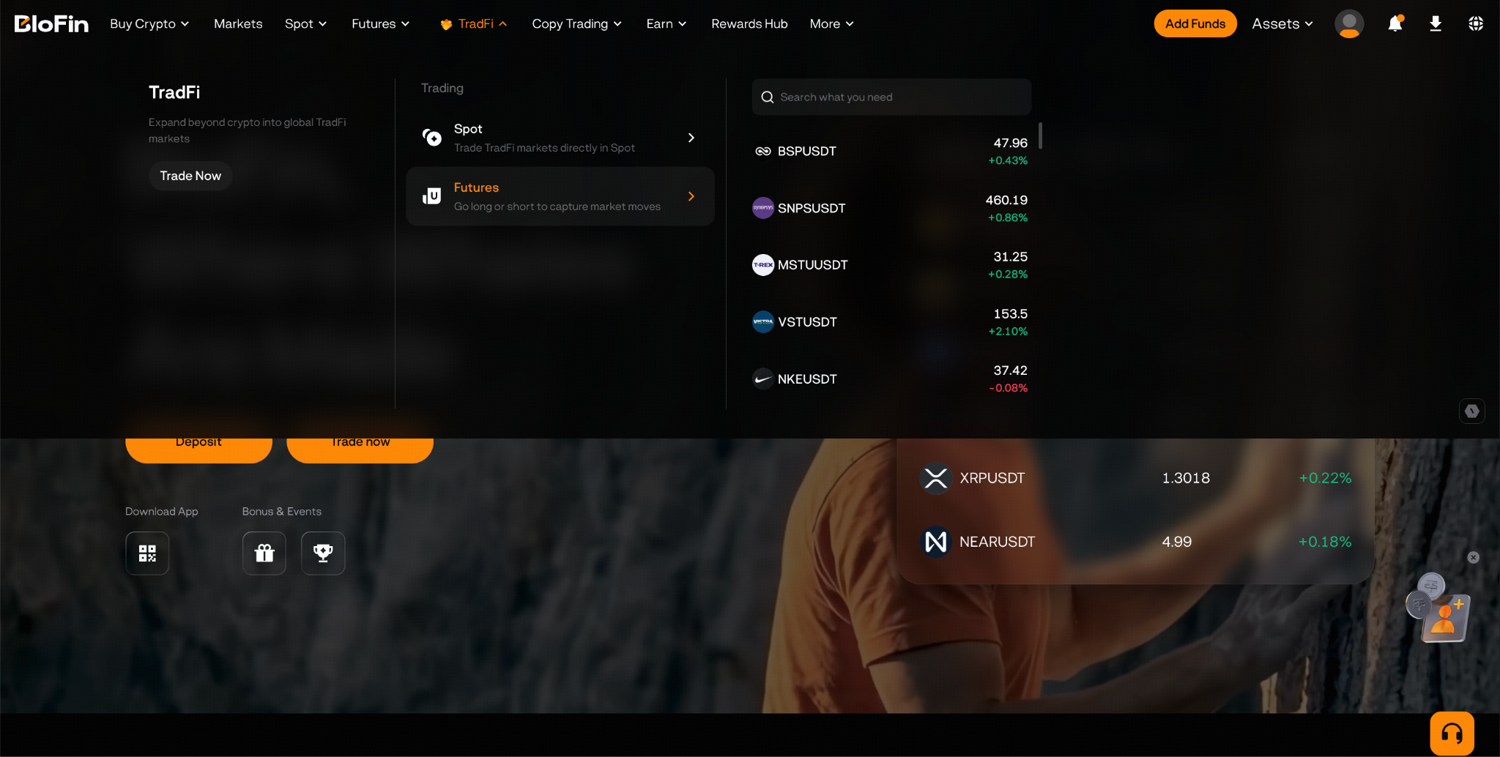
Step 1: Log in to your BloFin account and hover your cursor over the TradFi tab. Then, click Futures.
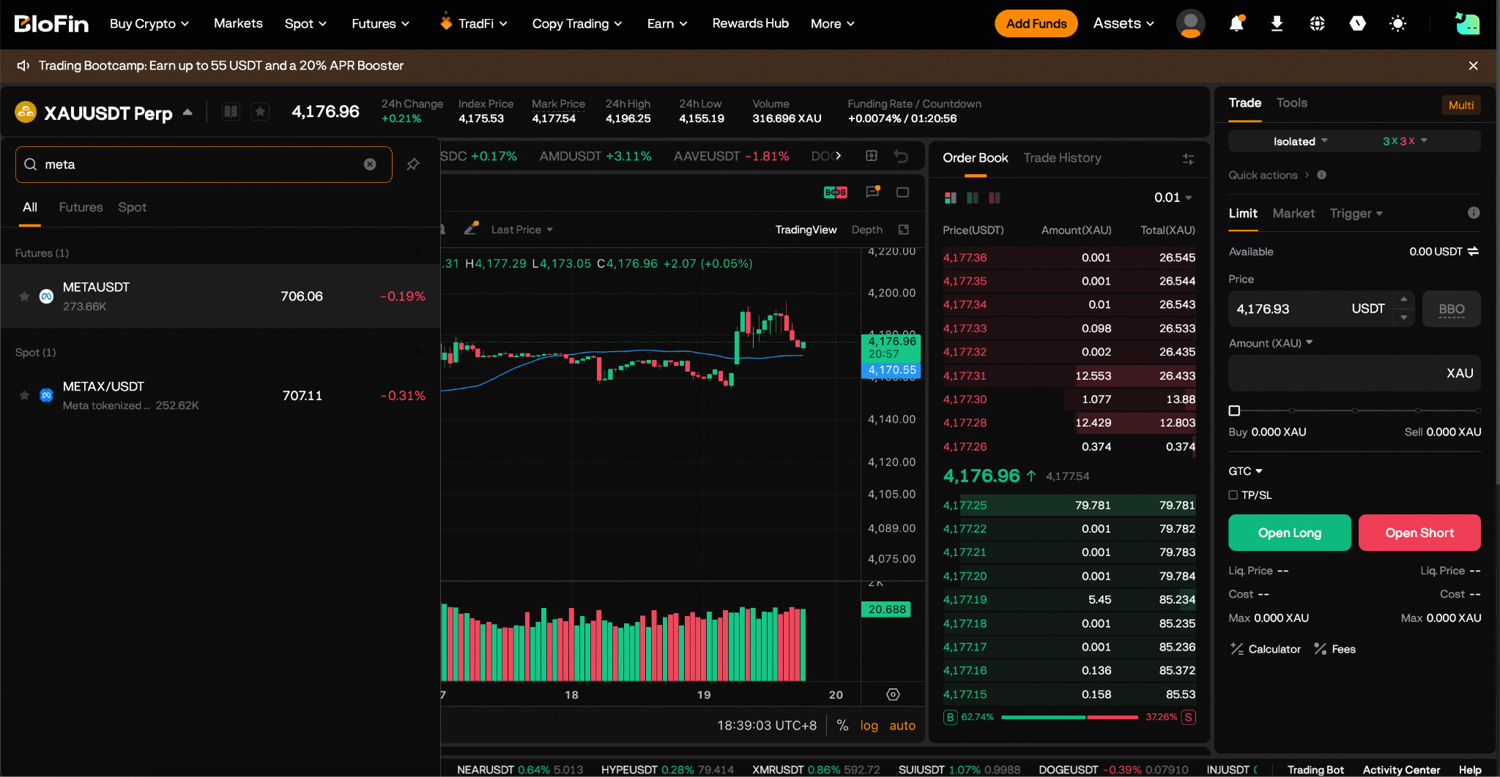
Step 2: Click on the XAUUSDT trading pair on the top left corner and type METAUSDT in the search field. Select the METAUSDT Perpetual.
Step 3: Click Cross at the top of the order panel and, in Change Margin Mode, choose Isolated, so the long can lose only the margin you assign to it.
Step 4: Click the leverage figure beside it, 3X until you change it, to open Adjust Leverage, and set a multiple from 1x to 20x. Up to 100 META can use the full 20x, and larger positions face lower caps (source: BloFin METAUSDT position tiers).
Step 5: Pick the order type. Limit waits at the buying price you type in Price, Market fills straight away against the cheapest offers, and a Trigger order is sent only once Meta trades at a level you choose.
Step 6: Type the size in Amount (META). One contract is 0.01 META, so 1 META is 100 contracts, and the smallest order, a single contract, carries 7.40 USDT of exposure at 740.
Step 7: Leave Reduce-only unticked. With it ticked, a buy order can only shrink a short you already hold, so it cannot open your long.
Step 8: Tick TP/SL and enter a stop-loss trigger under your entry and above the liquidation price, plus a take-profit over the entry if you have a target in mind.
Step 9: Before you click Buy, compare the Liq. Price with the biggest recent drop and the Cost with the margin you meant to risk. After the fill, the long sits under Positions with its entry price, margin and liquidation price.
Say you buy 1 META at 740 USDT at 5x in isolated margin. The position is worth 740 USDT and needs 148 USDT of margin, and it would be closed out near 607.55 USDT. That uses tier 1's 2.50% maintenance margin and the 0.06% taker fee from BloFin's fee structure. At 20x the same long needs 37 USDT, and its liquidation price of about 721.47 USDT sits only 18.53 USDT under the entry.
The live mark price, the funding rate and the countdown to the next settlement sit at the top of the METAUSDT Perpetual trading page. The METAX/USDT Spot market is the route for holding the token itself, with no leverage and no liquidation price.
Isolated or cross margin on a Meta long
Isolated margin caps a Meta long's worst loss at the margin you assign it, and it puts the liquidation price closest to your entry. Cross margin lets the long draw on your whole futures balance, which pushes the liquidation price much lower but puts that entire balance at risk in a steep enough fall.
BloFin publishes both versions of its formula. In isolated mode the liquidation price comes from the position's own margin. In cross mode, with one position open, the whole account balance takes its place in the same formula (source: BloFin liquidation price FAQ).
Say you hold 500 USDT in the futures account and buy 1 META at 740 at 10x. In isolated mode, 74 USDT backs the long and liquidation comes near 683.50 USDT, after a fall of 7.6%, while the other 426 USDT stays untouched. In cross mode the same long leans on all 500 USDT, so the price that closes it drops to about 246.31 USDT, a fall of 66.7%. That long is far harder to close out, and a fall deep enough to do it would take the full 500 USDT.
Cross margin also ties positions together. With a crypto position open beside the Meta long, a loss on it lowers the balance the Meta long relies on. BloFin describes its liquidation price for two or more positions as a reference figure only. For a first trade, isolated mode keeps the numbers on the screen equal to the whole risk.
How much leverage a Meta long survived in late September
A 1 META long opened at the September 24, 2026 close survived the next two weeks only at 5x or lower. BloFin's mark price, the price liquidation runs on, fell from 778.03 USDT that evening to 752.85 USDT by 2PM UTC the next day. It reached 718.32 USDT on September 28, enough to close out 20x and then 10x.
Meta's shares had climbed from $572.34 on August 31 to $777.59 on September 24, about 35.9% in under four weeks. They then fell to an intraday low of $713.19 on September 28, about 8.3% below that close (source: Stock Analysis META price history). A trader who bought into that run had the direction of the month right and still faced a sharp two-session drop.
Each liquidation price below applies tier 1's 2.50% maintenance margin and the 0.06% fee in BloFin's formula to a 1 META long opened at that 778.03 USDT mark, Nasdaq's 8PM UTC close on September 24.
Leverage | Margin on 1 META | Estimated liquidation price | Fall that triggers it | When the mark price reached it |
|---|---|---|---|---|
20x | 38.90 USDT | 758.55 USDT | 2.5% | in the hour from 1PM UTC on September 25, which takes in Nasdaq's 9.30AM ET open |
10x | 77.80 USDT | 718.62 USDT | 7.6% | in the hour from 2PM UTC on Monday, September 28 |
5x | 155.61 USDT | 638.78 USDT | 17.9% | never; the lowest mark, 710.84 USDT on October 8, sat 8.6% under the entry |
3x | 259.34 USDT | 532.31 USDT | 31.6% | never |
The 20x long lost its 38.90 USDT around Nasdaq's open the next day, and the 10x long lasted until the following Monday morning in New York. The 5x long was still open on October 12, when Meta rose 3.38% to close at $742.96 (source: Stock Analysis META price history). Even after that bounce, at the 744.16 USDT mark at 8PM UTC, it showed a loss of about 33.87 USDT, or 21.8% of its margin.
It had also paid funding along the way. Between September 25 and October 12 there were 54 funding settlements, and 41 of them carried a positive rate, which a long pays. Together they came to +0.3134%, about 2.3 USDT on a 1 META position (source: BloFin METAUSDT funding history).
The useful habit, the same one behind leverage and liquidation on any contract, is to look at the biggest recent drop before you pick a multiple. Choose leverage whose liquidation price sits well past that drop, then size the position so that losing the whole margin is a sum you have already accepted.
Position tiers and bigger Meta positions
BloFin decides a position's tier from your open position, your open orders and the new order added together (source: BloFin METAUSDT position tiers). Up to 100 META the maintenance margin rate is 2.50% and leverage reaches 20x. From 100.01 META it rises to 3.33% with a 15x cap, and from 800.01 META to 5.00% with a 10x cap.
The step moves the liquidation price closer. At 740, a 100 META long at 10x is closed out after a fall of about 7.6%, while a 120 META long at the same 10x goes after about 6.8%. Tier 2's higher maintenance rate takes a bigger slice of the same margin. A 120 META position is worth 88,800 USDT, so a first trade usually sits well inside tier 1.
Setting a take-profit and stop-loss for a Meta long
On a Meta long, the stop-loss sits under your entry and above the liquidation price, and the take-profit sits over the entry. Each order waits for a trigger price, which can follow the last traded price, the mark price or the index price. That choice decides whether your stop watches the same price that liquidation does.
Step 1: On the order form, tick TP/SL and enter the take-profit and stop-loss triggers. Once the buy order has fully filled, the two become active as linked stop-loss and take-profit orders: when one of them fires, the other is canceled.
Step 2: Pick the price each trigger watches: Last Price, Mark Price or Index Price (source: BloFin TP/SL FAQ). Liquidation runs on the mark price, while the last price is simply the latest trade.
Step 3: For an open long, set TP/SL from the position itself in the Positions tab. Entire Position TP/SL closes the whole long with a market order. Partial Position TP/SL closes a set amount as a limit or a market order, and you can place several on one position.
Say your 5x long from 740 carries a mark-price stop 5% lower, at 703 USDT. If it fills at the trigger, the loss is 37 USDT plus roughly 0.87 USDT in taker fees on the way in and out. That is about a quarter of the 148 USDT margin, a loss you chose in advance, and the stop sits far from the 607.55 USDT liquidation price.
A stop sends an order, and that order fills at the next price available. When Meta reopens well below where it last traded, a market stop fills under its trigger, so a stop works best beside leverage low enough to survive a gap.
Funding while a Meta long is open
Funding is a payment between longs and shorts, settled every eight hours at 12AM, 8AM and 4PM UTC by default, and a positive rate means the long pays. BloFin can shorten that interval when market conditions call for it, as it did with hourly settlements on the evening of September 20, 2026 (source: BloFin funding FAQ) (source: BloFin METAUSDT funding history). The trading page shows the rate beside a countdown to the next settlement.
You pay the rate on the position's full value. At a rate of +0.0120%, a 1 META long at 740 pays about 0.089 USDT per settlement, roughly 0.27 USDT a day, whatever its leverage. A position closed before a settlement owes nothing for it, although BloFin notes that the charge can take up to a minute to run (source: BloFin funding FAQ).
Leverage makes funding weigh more against your margin. The 0.27 USDT a day is about 0.2% of the 148 USDT behind a 5x long and about 0.7% of the 37 USDT behind a 20x long. A high-leverage long held for weeks pays a noticeable share of its margin in funding.
The countdown matters at entry. If the rate is positive and a settlement is minutes away, opening just after it saves one payment. The rate follows how far the contract trades from its index, the mechanism behind crypto funding rates, which is why it can change sign within a day.
Meta's earnings report and an open leveraged long
Meta reports its results four times a year, after Nasdaq closes, with the company's call at 4.30PM ET. Its third-quarter 2026 report was set for Wednesday, October 21 (source: Meta Q3 2026 results notice), and Meta announces each date in advance (source: Meta investor relations). Nasdaq's 4PM ET close is 8PM UTC while US daylight saving time runs, so a leveraged METAUSDT long held into the release meets the market's reaction in the evening UTC.
A report-night move can be larger than the two-session slide that closed out the 10x long in September. A long carried into results therefore needs more room than one held through an ordinary week, so trading Meta around earnings starts from the size of past report-night moves.
Three settings decide the risk you carry into a report: the leverage, the size and whether part of the long is closed before the release. Lower leverage pushes the liquidation price beyond the move you could plausibly face. A smaller size shrinks the margin at stake, and a partial close banks part of the position at a known price. Each one uses the same controls that opened the long, and each can be set before the result is known.
The night between the release and the 9.30AM ET open is when a long is most exposed to price gaps while Nasdaq is closed, since the first regular trade can land far from the last one. A trader who would rather hold Meta through the report without liquidation risk can compare that choice in METAX or the META perpetual.
Partial close, reduce-only orders and closing a Meta long
Closing a Meta long means selling the size you hold, either with Market Close or Limit Close on the position or with a sell order that has Reduce-only ticked. A smaller amount closes part of the long and leaves the rest open at the same entry price. Funding stops on whatever you close.
Step 1: In the Positions tab, find the METAUSDT long you want to close.
Step 2: Choose Market Close to sell at once at the best bid, or Limit Close to set your own selling price and wait for it.
Step 3: Enter the Amount to close. Selling 1 META of a 2 META long leaves 1 META open at the original entry price, with its own margin and funding.
Step 4: Press Confirm, then check Position History for the result and Open Orders for any take-profit or stop-loss still waiting there.
A sell order with Reduce-only ticked does the same job from the order panel, and it is the safer setting for a resting take-profit. It can never open a short: an order bigger than your long either closes only what you hold or is rejected. The setting governs the purpose of the order and leaves its fill to the market (source: BloFin reduce-only FAQ).
Closing stays possible at any hour. Outside Nasdaq's regular weekday session, at weekends and on market holidays, stock futures on BloFin may be restricted to reduce-only orders, the very orders that close a position (source: BloFin stock futures notice). On weekdays the open window runs 1.30PM to 8PM UTC while US daylight saving time is in force and 2.30PM to 9PM UTC in standard time.
Close All in the Positions tab shuts every open futures position at once with market orders, a way of closing a trade on BloFin that suits an emergency more than a planned exit.
Looking to trade Meta with leverage? To get started, you'll need to first create a BloFin account, fund your account with cryptocurrency, and navigate to the METAUSDT Perpetual page or the METAX/USDT Spot trading page, or browse the lead traders you can copy on METAUSDT.
Frequently asked questions
Can you trade Meta stock with leverage at a stockbroker?
A US margin account lets you borrow up to 50% of the purchase price of shares under the Federal Reserve's Regulation T, roughly 2x. FINRA rules then require equity of at least 25% of the shares' value, and many brokers ask 30% to 40% (source: Investor.gov, Understanding Margin Accounts). The broker may also sell shares bought on margin without telling you first.
How much Meta can 100 USDT control with leverage on BloFin?
At a price of 740 USDT, 100 USDT of margin backs about 2.70 META at 20x, a position worth about 1,998 USDT. At 5x the same margin backs about 0.67 META, worth about 495.80 USDT, both before the opening fee. Sizes move in steps of 0.01 META, and a single market order can carry up to 200 META, a single limit order up to 2,000 META (source: BloFin METAUSDT contract details).
Can you change the leverage on an open Meta position?
You can change the leverage on an open Meta position from the leverage figure on the order panel or the leverage button in the Positions panel, check Margin Required, then press Confirm. Lowering the leverage needs more free margin, and raising it on an isolated position leaves the freed margin inside that position until you move it out (source: BloFin leverage adjustment FAQ).
Why does the liquidation price of a Meta long change while it is open?
In isolated mode, the estimated liquidation price of a Meta long moves when you add or remove margin and at every funding settlement, because each payment changes the margin left in the position. In cross mode, gains and losses on your other positions move it too. Once the mark price reaches it, BloFin's liquidation engine takes over and you can no longer change the margin or place orders on that position (source: BloFin forced liquidation rules).
Does a leveraged Meta long on BloFin earn Meta's dividend?
A leveraged Meta long on BloFin earns no dividend, because BloFin's stock futures carry no entitlement to dividends, interest or voting rights in the underlying shares (source: BloFin stock futures notice). The position tracks Meta's price and nothing else, so a long held across an ex-dividend date simply follows the share price.
Researched and written by the BloFin Academy editorial team with AI-assisted drafting. All facts independently verified. Primary sources include BloFin's METAUSDT trading page, position tiers, contract details, funding history and hourly mark prices, its Parameter Adjustments page and its April 21, 2026 stock futures notice, plus BloFin help center articles on liquidation price, forced liquidation, TP/SL orders, reduce-only orders, leverage adjustment and funding. They also include Meta's notice of its third-quarter 2026 results date, Stock Analysis price history and Investor.gov's bulletin on margin accounts, current as of October 2026.
Nothing in this article constitutes financial advice, and nothing in it is a recommendation to buy, sell or hold Meta in any form. A leveraged METAUSDT long loses its whole isolated margin once the mark price reaches the liquidation price, and in late September 2026 that took under a day at 20x and two sessions at 10x. Cross margin and Multi-currency margin mode can put your whole futures balance, and coins you hold as collateral, behind the same position, and a stop can fill well under its trigger when Meta gaps after a quarterly report. Past performance does not indicate future results. Do your own research and consider your risk tolerance before you trade on BloFin.