
Shorting a stock means taking a trade that makes money when the price falls and loses money when it rises. The steps to open one take a few minutes, and the risks all come from the other direction, because a rising price has no ceiling and can climb a long way on a single night of news.
Shorting a share the old way needs a stockbroker. You borrow shares from the broker, sell them at today's price and buy them back later to hand them back, paying interest for every day the loan is open. Any dividend the company pays while you are short comes out of your account and goes to the lender.
A perpetual futures contract lets you place that bet without any loan. The contract tracks a share's price, never expires and is settled in a stablecoin, so a short starts with an ordinary sell order. In place of loan interest there is funding, a small payment between buyers and sellers that can go to you or come from you.
For Microsoft, that contract on BloFin is the MSFTUSDT Perpetual, margined and settled in USDT. A Microsoft short there is a sell order, and the rest of the trade follows from that one choice: the margin behind it, the exit orders around it and the hours when you can open it.
How do you short Microsoft stock on BloFin?
To short Microsoft stock on BloFin, you sell the MSFTUSDT Perpetual, a USDT-margined contract that follows Microsoft's share price, and buy it back later. Every 1 USDT fall in the price earns 1 USDT per MSFT of size, and every rise costs the same. Orders start at 0.01 MSFT, with leverage from 1x to 20x (source: BloFin MSFTUSDT contract details).
Profit on a short = (entry price − exit price) × size in MSFT − trading fees ± funding.
Because nothing is borrowed, there is no loan to repay and no lender who can ask for shares back. With isolated margin, one position's loss stops at the margin you put behind it, since BloFin closes the short at its liquidation price before the loss grows past that. The MSFT perpetual on BloFin explains the contract itself, from how its price follows Nasdaq to its fees and margin tiers.
Why traders short Microsoft stock
Traders short Microsoft stock for three main reasons. They expect a fall, often around a quarterly report, or they want to protect shares they already own, or they are running one side of a pair trade. The sell order is the same each time, while the size and the exit plan change with the reason.
A directional short is the first kind, opened because you expect the price to drop. That view might rest on a valuation you think is stretched, a report you expect to disappoint, or a chart that has turned lower. Whatever the reason, the trade only pays if the price falls by more than your fees and funding before you close it.
A hedge starts from a holding. Someone who owns Microsoft shares through a broker can short the perpetual to soften a fall without selling them, and hedging with the MSFT perpetual works out how large that short should be. A pair trade shorts Microsoft against a long in another technology stock, so it pays on the gap between the two whichever way the market moves.
Shorting the MSFT perpetual compared with a broker short sale
Shorting the MSFT perpetual differs from a broker short sale in what you sell and what you owe. A broker lends you real Microsoft shares, charges interest on the loan and makes you pay any dividend to the lender (source: Investor.gov, An Introduction to Short Sales). On the perpetual you pay or receive funding, and no dividend changes hands.
Feature | Broker short sale of Microsoft shares | Short on the MSFTUSDT Perpetual |
|---|---|---|
What you sell | shares your broker lends you | a contract that follows Microsoft's price |
Account you need | a margin account, funded in dollars | a BloFin futures account, funded in USDT |
Cost of holding | interest on the borrowed shares, at a rate that can change daily | funding every eight hours, paid or received |
Dividend | the short seller pays it to the lender | nothing paid or owed |
How it can end without you | the lender recalls the shares or the broker buys them in | liquidation at the liquidation price |
Largest possible loss | unlimited in theory | the margin behind an isolated position |
The interest on borrowed shares is usually called the borrow fee, and it moves. Schwab says the most liquid shares can sometimes be shorted for nothing while the least liquid can cost more than 100% a year, and it gives the example of a rate jumping from 20% to 85% overnight (source: Schwab, What to Know About Short Selling).
The loan can also end before you choose to close. Interactive Brokers notes that announced dividends often lead lenders to recall their shares before the record date, which pushes borrow fees up. It also says it may buy in a short position without the holder asking (source: Interactive Brokers, Risks of short selling).
Microsoft's December 2026 dividend shows the gap in money. Its board declared $0.98 a share. The payment date is December 10, 2026, and November 19 is both the record date and the ex-dividend date (source: Microsoft dividend announcement). A broker short of 10 shares held over that date owes the lender $9.80, which Schwab says is taken from the short seller's account on the pay date (source: Schwab, What to Know About Short Selling).
BloFin's stock futures notice says its stock contracts carry no right to dividends, and it describes no dividend payment between longs and shorts (source: BloFin stock futures notice). So a short on the MSFTUSDT Perpetual owes nothing on November 19. At about 0.18% of a share price near $531, the payout is small either way, though it is one less cost to track.
Before your first Microsoft short
Before your first Microsoft short, you need a BloFin account, USDT in the account your futures trades draw on, the position mode you want and a check of the trading hours. New positions open during Nasdaq's regular session, and outside it BloFin can limit the contract to reduce-only orders, the kind that only ever make a position smaller (source: BloFin stock futures notice).
Step 1: Create your BloFin account and send USDT to it from a wallet or another exchange. A deposit lands in your Funding Account, so move the USDT from there to your Futures Account with Transfer, found under Assets. Moving funds between your own BloFin accounts is instant and free.

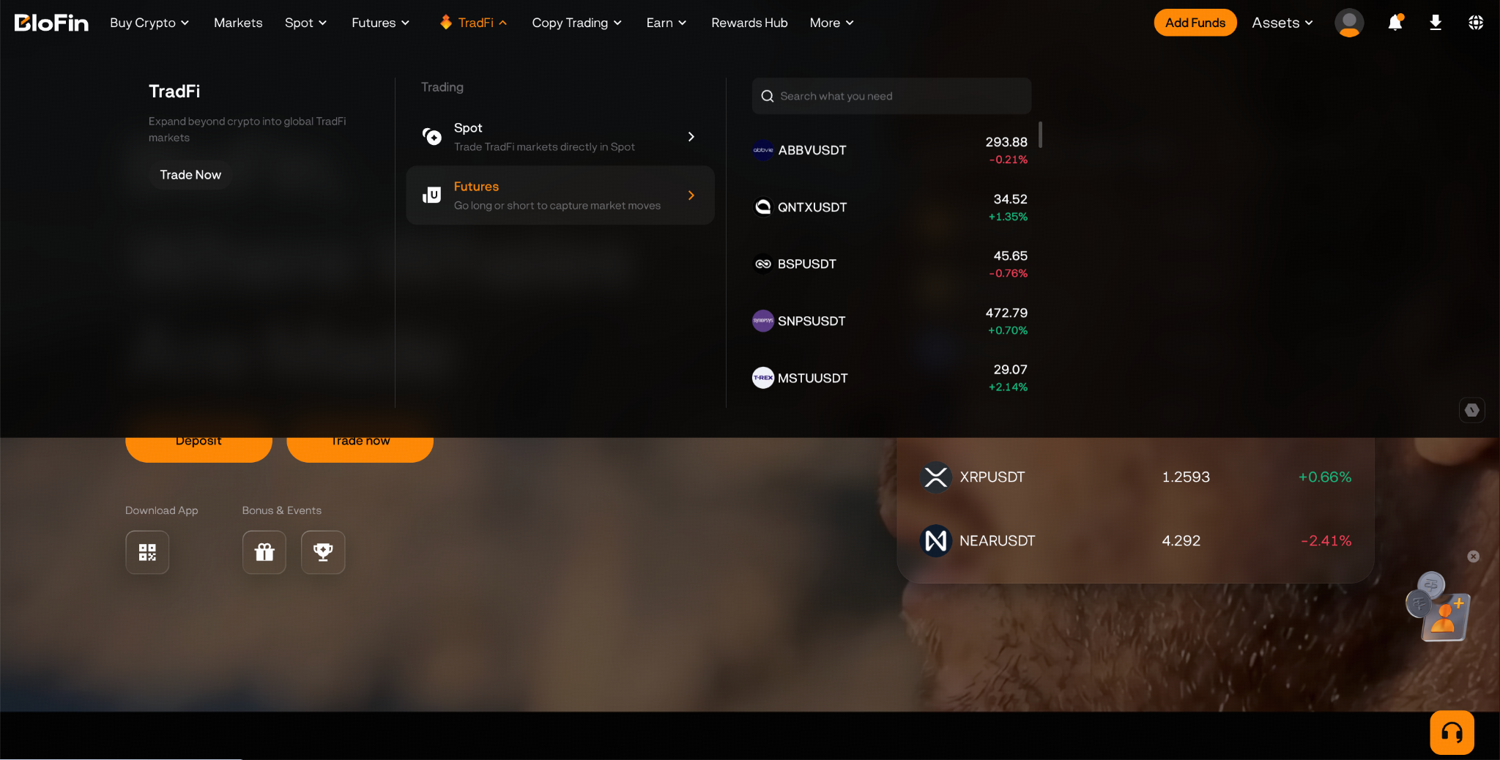
Step 2: Hover your cursor over the TradFi tab and select Futures.
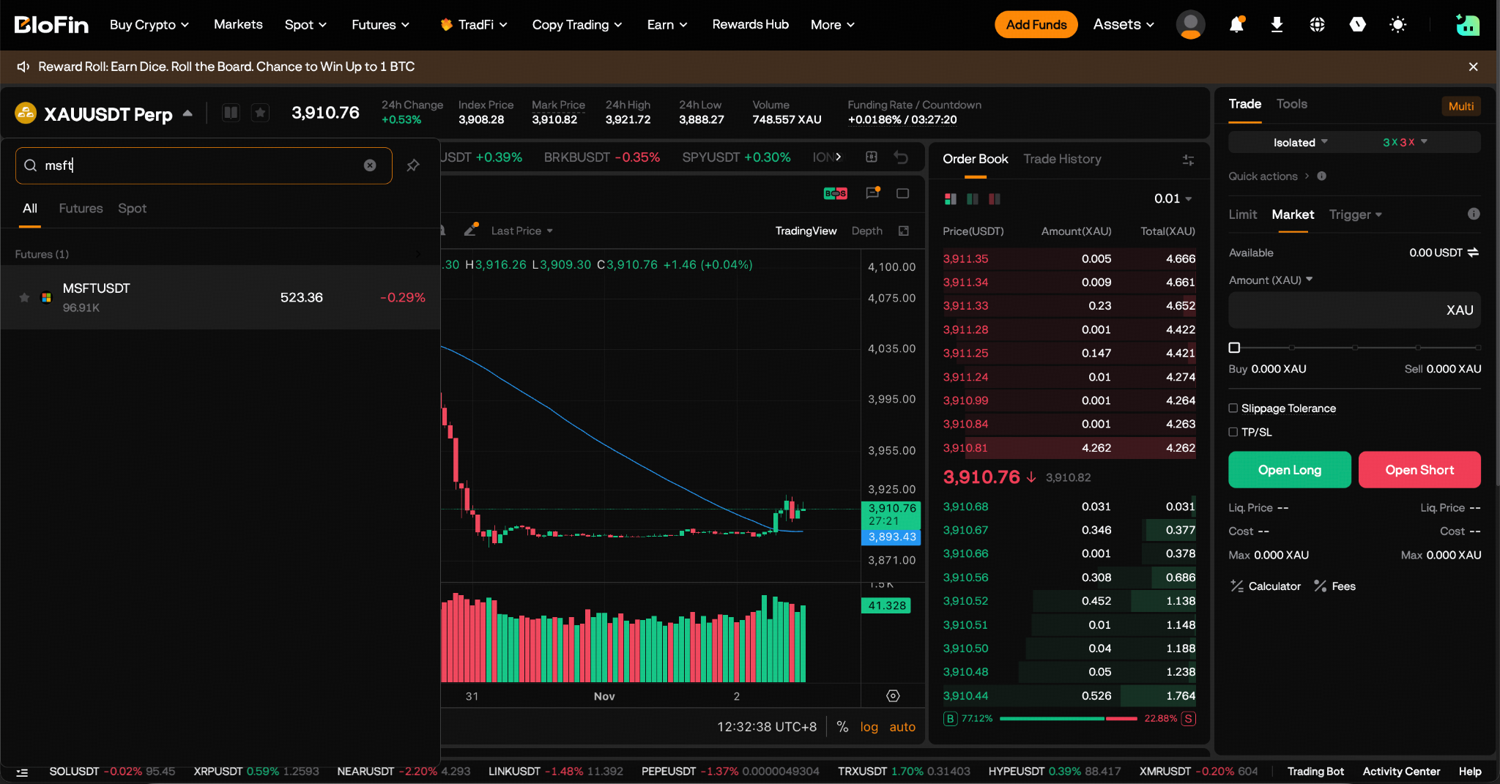
Step 3: Click on the trading pair at the top left corner and search for MSFT. Select the MSFTUSDT Perpetual.
Step 4: Check your position mode. Open the settings icon in the top-right corner, select Position Mode, pick One-way Mode or Hedge Mode and click Confirm (source: BloFin position mode FAQ). In one-way mode a sell first shrinks any Microsoft long you hold, while hedge mode keeps a long and a short open side by side.
You can switch modes only when you have no open positions or open orders, so set it before your first trade. Then check the time against Nasdaq's hours, 9.30AM to 4PM ET on weekdays.
The US leaves daylight saving time on Sunday, November 1, so from Monday, November 2 the same session runs from 2.30PM to 9PM UTC (source: BloFin stock futures notice). Outside those hours, including weekends and US market holidays, you can still close a short, though opening a new one can be blocked until the next session.
The notice marks November 26 and December 25, 2026 as full-day closures. It also gives early closes at 6PM UTC on November 27 and December 24, when the reduce-only window starts three hours sooner than on a normal winter weekday.
Opening a Microsoft short, step by step
Opening a Microsoft short takes seven choices on the MSFTUSDT order panel: margin mode, leverage, order type, price, size, the Reduce-only box and exit orders. Then you press Sell/Short and confirm. The panel shows the estimated liquidation price and the margin the order will use before you commit, so read both first.
Step 1: The margin mode, shown first on the order panel, reads Cross; click it and switch to Isolated. Isolated margin limits what this short can lose to the margin you assign it, while cross margin lets a losing position draw on the rest of your futures balance.
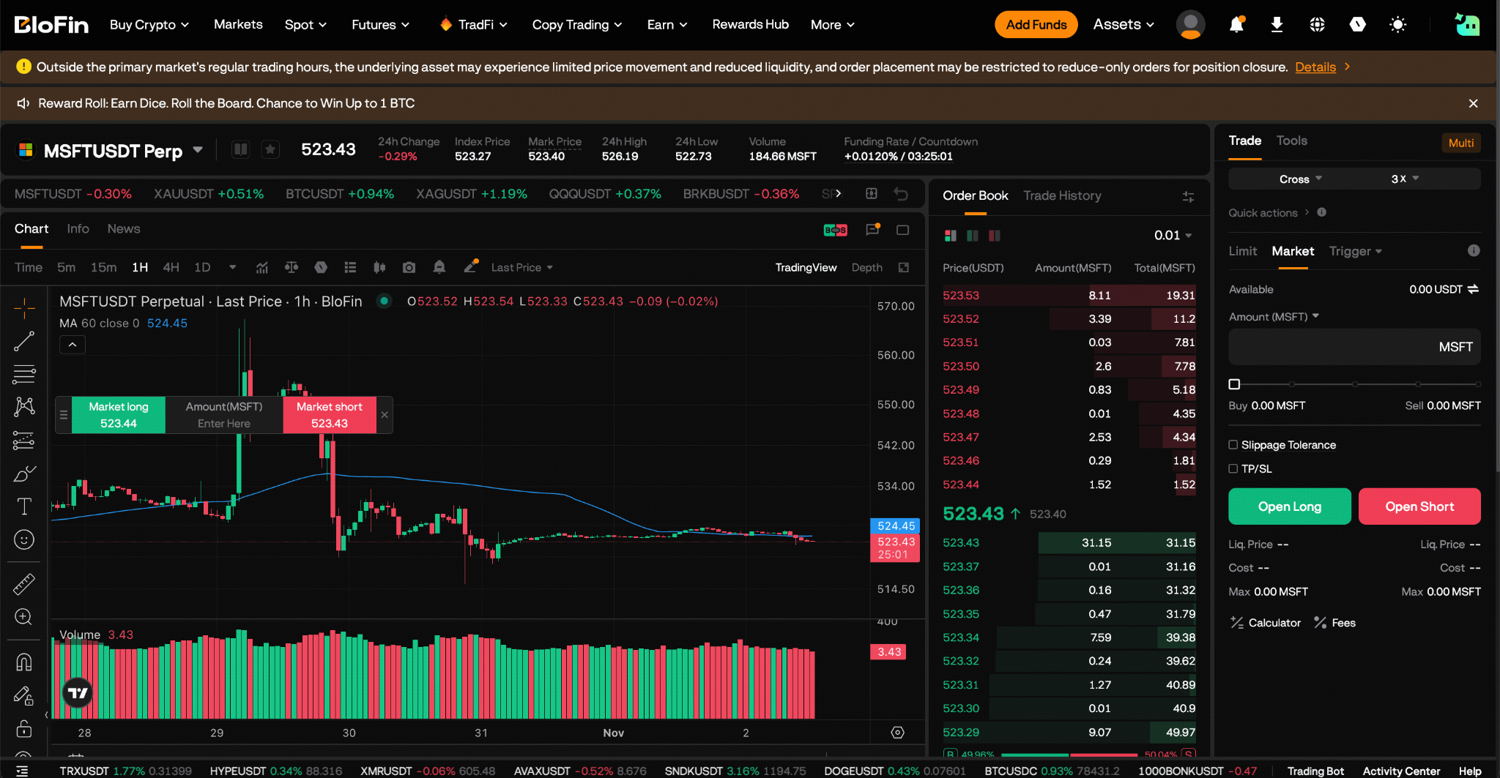
Step 2: Next to it is the leverage setting, which may read 3X; click it and choose anything from 1x to 20x. Choosing less leverage ties up more margin and pushes the liquidation price further above your entry, giving the short more room in a rally.
Step 3: Choose Limit, Market or Trigger. A limit order sells at the price you type under Price, or at the best bid or offer (BBO) when you tap BBO. A market order fills straight away, and a trigger order is placed only once the price touches the trigger level you chose.
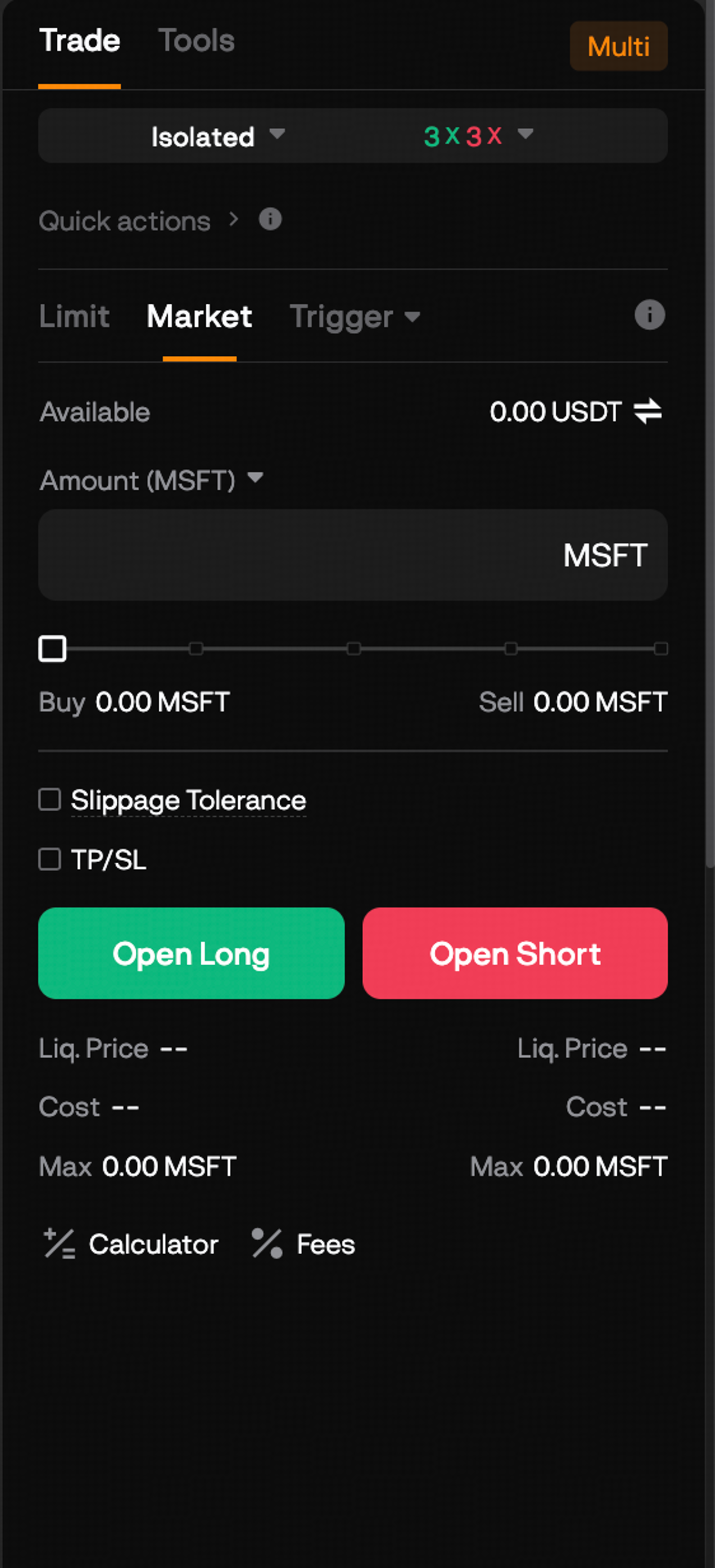
Step 4: Enter your size under Amount (MSFT). Each contract is 0.01 MSFT, so a 1 MSFT short is 100 contracts. Limit orders can go up to 2,000 MSFT each, and market orders up to 200 MSFT (source: BloFin MSFTUSDT contract details).
Step 5: Leave Reduce-only unticked. With that box ticked, a sell can only shrink a position you already have, so it would never open a short.
Step 6: For a limit order, tick TP/SL if you want your take-profit and stop-loss in place the moment the short opens, with the take-profit under your entry and the stop-loss over it.
Step 7: Read the estimated Liq. Price and the Cost of the order, then press Sell/Short and confirm the order in the window that opens, as BloFin's guide to your first trade shows. The short then shows under Positions, listing the entry, the size, the margin used and the estimated liquidation price.
Margin and liquidation on a worked short
Take a 1 MSFT isolated short opened at 532.09 USDT, the perpetual's last price when Nasdaq closed at 4PM ET (8PM UTC) on October 27, 2026 (source: BloFin MSFTUSDT price chart, 1-hour candles). The margin is the position's value divided by your leverage, so 20x needs 26.60 USDT and 2x needs 266.05 USDT.
BloFin liquidates an isolated short once its margin no longer covers the maintenance margin plus the closing fee. Up to 200 MSFT, the maintenance margin is 2.50% of the position's value (source: BloFin MSFTUSDT position tiers). Using the 0.06% taker fee as the closing fee, BloFin's formula gives these prices (source: BloFin liquidation price FAQ).
Liquidation price of an isolated short = (margin + MSFT amount × entry price) ÷ (MSFT amount × (1 + maintenance rate + closing fee)).
Leverage | Margin (USDT) | Liquidated near (USDT) | Rise that liquidates |
|---|---|---|---|
2x | 266.05 | 778.21 | 46.3% |
3x | 177.36 | 691.74 | 30.0% |
5x | 106.42 | 622.57 | 17.0% |
10x | 53.21 | 570.69 | 7.3% |
20x | 26.60 | 544.75 | 2.4% |
The percentage rise that liquidates depends on leverage alone, so those five figures hold at any Microsoft price for a short of up to 200 MSFT, the first margin tier. Opening this short costs about 0.32 USDT as a taker or 0.11 USDT as a maker, at the 0.06% and 0.02% rates in BloFin's guide to closing a trade. Leverage and liquidation covers the general rules behind these prices.
The MSFTUSDT Perpetual page puts this order panel next to the chart, together with the funding rate and a countdown to the next settlement, so you can rehearse each step before any margin is at risk.
Take-profit and stop-loss on a Microsoft short
On a Microsoft short the take-profit goes under your entry price and the stop-loss goes over it, the reverse of a long. You can attach both to a limit order with TP/SL before it fills, or add them afterwards from Positions, as BloFin's stop-loss guide shows.
Step 1: On a limit order with TP/SL ticked, enter a take-profit trigger lower than your entry and a stop-loss trigger higher than it.
Step 2: Choose what each trigger watches, Last Price or Mark Price. BloFin's guide calls the mark price the safer default for perpetuals. The last price can spike on one big trade, while the mark price follows a steadier reference, so a stop that watches it is less likely to fire on a brief spike.
Step 3: For a short that is already running, open Positions, click TP/SL next to it and pick Entire Position or Partial Position. Tick Limit if you want the exit to be a limit order at a set price, then click Confirm.
With the 1 MSFT short at 532.09 USDT, a stop 5% higher at 558.69 USDT caps the price loss at 26.60 USDT. A take-profit 5% lower at 505.49 USDT locks in a gain of the same 26.60 USDT, and trading fees come off either result.
A stop only protects you if it sits closer to your entry than the liquidation price. At 20x this short is liquidated near 544.75 USDT, just 2.4% over the entry, so liquidation would close it long before a 5% stop could fire.
A triggered stop also becomes a market order unless you tick Limit, so in a fast rise the fill can land well over the trigger. That matters most on the nights Microsoft reports, when the price can move several percent inside one hour.
Funding on a Microsoft short
Funding on a Microsoft short settles at 12AM, 8AM and 4PM UTC on BloFin's eight-hour schedule for MSFTUSDT, as a payment passed between the two sides. With a positive rate, the longs pay and your short collects. With a negative rate, your short pays the longs. Each payment is the rate times the position's value at the settlement.
A rate of +0.0027%, for example, pays the 1 MSFT short at 532.09 USDT about 0.01 USDT, a tiny sum beside a normal day's swing in the price (source: BloFin MSFTUSDT funding history). Crypto funding rates explains why the rate moves.
Settlements, September 25 to October 28, 2026 | Result |
|---|---|
Positive (shorts received) | 59 |
Negative (shorts paid) | 38 |
Zero | 3 |
Sum of all 100 rates | +0.3292% |
Funding received by a 1 MSFT short held throughout | about 1.74 USDT |
Over those 100 settlements the largest rate was +0.0493% and the most negative was −0.0029%, so the positive side was both more frequent and larger (source: BloFin MSFTUSDT funding history). The sign can still flip from one settlement to the next, so read the rate and countdown on the trade page before you count on receiving it.
BloFin's contract page lists the eight-hour schedule for MSFTUSDT and says the platform may adjust parameters to market conditions without a separate announcement (source: BloFin MSFTUSDT contract details).
Short squeeze risk on a Microsoft report night
A short squeeze happens when a rising price pushes short sellers to buy back, and their buying lifts the price further still (source: Schwab, What to Know About Short Selling). For a Microsoft short, the riskiest hours often come after a quarterly report, which Microsoft releases once Nasdaq has closed while the perpetual keeps trading.
The July 2026 report shows how fast that can go. Microsoft released its results for April to June 2026, the fourth quarter of fiscal 2026, once trading ended on July 29, 2026, with revenue up 18% to $90.0 billion and Azure up 43% (source: Microsoft Q4 FY2026 results). Reuters reported that the shares gained more than 8% in after-hours trading once Microsoft gave its forecast (source: Reuters via Zawya).
Two measures describe the next day. On Nasdaq, the share closed at $451.10 on July 30 against $390.54 the day before, a 15.5% rise (source: Yahoo Finance, MSFT history). The perpetual's last price at the 8PM UTC close rose 15.2%, from 392.24 to 451.91 USDT, and its mark price rose 15.3%, from 392.04 to 451.89 USDT.
Liquidation follows the mark price, so take a 1 MSFT isolated short opened at the July 29 close, at a mark of 392.04 USDT. For each leverage, here is the UTC hour in which the mark first reached its liquidation price between the July 29 and July 30 closes (source: BloFin MSFTUSDT price chart, 1-hour candles).
Leverage | Margin (USDT) | Liquidated near (USDT) | Rise needed | First reached |
|---|---|---|---|---|
20x | 19.60 | 401.37 | 2.4% | July 29, in the 8PM UTC hour |
10x | 39.20 | 420.48 | 7.3% | July 29, in the 10PM UTC hour |
5x | 78.41 | 458.71 | 17.0% | July 30, in the 6PM UTC hour |
3x | 130.68 | 509.67 | 30.0% | not reached by the July 30 close; the peak used 51.2% of the margin |
2x | 196.02 | 573.38 | 46.3% | not reached by the July 30 close; the peak used 34.2% of the margin |
The 20x short was gone within the first hour after the close, and the 10x short within three hours, both while Nasdaq was shut. The mark price peaked at 459.01 USDT on July 30, 17.1% over the entry, which liquidated the 5x short as well.
Funding barely registered against that move. The three settlements over the next day paid a short +0.0038% in total, about 0.017 USDT on 1 MSFT, against a price loss of 59.85 USDT at the mark close.
The hours matter as much as the size of the move. From the 8PM UTC close, BloFin could hold the perpetual to reduce-only orders, so through the night you could still close a losing short or let a stop fire. Opening a fresh short at the higher price could be blocked until the Nasdaq open at 1.30PM UTC on July 30.
Reuters tied the July jump to the results and the forecast, and short covering may have added to it. Short interest fell 12.0% between the July 15 and July 31 counts, from 92.4 million to 81.3 million shares, and the July 31 figure equalled 2.03 days of average trading volume (source: Nasdaq, MSFT short interest).
On October 15, 2026, short interest equalled 3.18 days of average trading volume. FINRA collects these figures from brokers twice a month (source: FINRA, equity short interest), so they always describe positions from a week or more earlier.
Microsoft set Wednesday, October 28, 2026, after the Nasdaq close, for its results for July to September 2026, its first quarter of fiscal 2027, with the call following at 5.30PM ET, or 9.30PM UTC (source: Microsoft earnings date notice). The July figures describe one night and say nothing about the size or direction of the next move. BloFin's Microsoft Q1 FY2027 earnings preview covers what the report contains.
Closing a Microsoft short
Closing a Microsoft short means buying back the same size you sold. You do it from the Positions tab with Close, at a limit price or at market, and you can close all of it or only part. The result then goes into your futures balance, minus fees.
Step 1: Open Positions under the chart and find your MSFTUSDT short.
Step 2: Click Close, then choose Limit to name your buy-back price or Market to close at once.
Step 3: Type the amount to close (and, for a limit close, your buy-back price first), then press Confirm. BloFin's guide to closing a trade says the rest of a partly closed short stays open with its original margin and leverage settings.
Step 4: Look in Open Orders for any take-profit, stop-loss or limit order still linked to the short, and cancel any you no longer need. The finished trade shows in Position History.
Close All, followed by Confirm, closes every open futures position at market in one action, which is quick but also ends trades you may want to keep. A close is a reduce-only order by definition, so you can still close outside Nasdaq's hours, though BloFin's trade page warns that prices may move less and liquidity may be thinner then.
Looking to short Microsoft's share price from your crypto balance? To get started, you'll need to first create a BloFin account, fund your account with cryptocurrency, and go to the MSFTUSDT Perpetual trading page.
Frequently asked questions
What is the smallest Microsoft short on BloFin?
The smallest short is one contract, 0.01 MSFT (source: BloFin MSFTUSDT contract details). At 532.09 USDT that is a position of about 5.32 USDT, which needs about 0.27 USDT of margin at 20x or the full 5.32 USDT at 1x, before fees.
Can you short Microsoft on BloFin at the weekend?
Opening a new short at the weekend may be blocked, because BloFin can limit its stock contracts to reduce-only orders whenever Nasdaq is shut (source: BloFin stock futures notice). You can still close or shrink a short you hold, and new shorts open again with Monday's session at 9.30AM ET, which is 2.30PM UTC from November 2, 2026.
Can a Microsoft short lose more than its margin?
An isolated short can lose up to the margin you assigned to it, plus fees and any funding paid, because BloFin liquidates it at that point. If a liquidation fills at a worse price, BloFin's insurance fund covers the gap, and auto-deleveraging takes over if the fund runs short (source: BloFin forced liquidation rules). The contract page shows the fund's current balance. With cross margin, a losing short can draw on your whole futures balance.
How long can you hold a short on the MSFTUSDT Perpetual?
You can hold it for as long as you like, since a perpetual has no expiry date; the short ends when you close it or when BloFin liquidates it. A longer hold means more funding settlements, three a day on the eight-hour schedule, which can pay you or cost you. It also means sitting through each quarterly report the short is open for.
Can a 1x Microsoft short be liquidated?
It can, though only after a very large rise. A 1x short of 1 MSFT opened at 532.09 USDT posts the full 532.09 USDT as margin and is liquidated near 1,037.62 USDT, about 95.0% higher, using BloFin's formula and the tier-1 maintenance rate. Until then it loses 1 USDT for every 1 USDT rise in the price.
Researched and written by the BloFin Academy editorial team with AI-assisted drafting. All facts independently verified. Primary sources include Microsoft's dividend announcement, earnings date notice and fourth-quarter fiscal 2026 results, the Investor.gov bulletin on short sales, the short-selling guides of Charles Schwab and Interactive Brokers, Reuters via Zawya, Yahoo Finance price history, Nasdaq short-interest data and FINRA. BloFin's sources are its MSFTUSDT contract details, position tiers, price chart, order panel and funding history, its stock futures notice, its liquidation and position mode FAQs and its Academy guides, current as of October 28, 2026.
Nothing in this article constitutes financial advice, and nothing in it is a recommendation to buy, sell or hold Microsoft in any form. A short loses money as Microsoft's price rises, and that rise has no upper limit. A single report night has moved the price more than 15%, enough to liquidate leveraged shorts within hours. The MSFTUSDT Perpetual pays no dividends, charges or pays funding every eight hours, and may accept only orders that reduce a position outside US market hours. Past performance does not indicate future results. Do your own research and consider your risk tolerance before you trade on BloFin.