
Many long-term investors end up with more of one large technology company than they planned, either because the shares grew or because a fund they own leans on the same few names. They want to keep it, yet one bad results night could take a large bite out of it.
Selling ends the worry and the investment together, and may bring a tax bill. A stockbroker can sell you put options, which set a minimum sale price. Each put costs a premium, runs out on a fixed date and needs an options account, which many people who keep their savings in stablecoins do not have.
A hedge is the middle path. You keep what you own and add a second position that makes money when the first one loses it, so a fall lands on both and largely cancels out. For a Microsoft holding, that second leg can be a short on a perpetual futures contract, which tracks the share price and has no expiry date.
BloFin lists a perpetual on Microsoft, the MSFTUSDT Perpetual, with margin, profit and loss all held in USDT. A sell order on it, sized to the Microsoft shares you hold or to the part of a fund that is Microsoft, turns that holding into a hedged one for as long as the short stays open.
What is hedging with the MSFT perpetual?
Hedging with the MSFT perpetual means opening a short on the MSFTUSDT Perpetual equal to the Microsoft shares you own, during Nasdaq's regular session. Each contract is 0.01 MSFT, so 10 shares are matched by a 10 MSFT short of 1,000 contracts. A fall in Microsoft then costs the shares roughly what it pays the short.
Opening it takes a plain sell order, the same order shown in BloFin's walkthrough of a first trade. It becomes a hedge only because of the shares you own elsewhere and a size picked to match them. On its own, a short is a bet on a fall. Held beside the shares, its loss in a rise is offset by what the shares gain.
Fidelity describes hedging as buying or selling an investment to help reduce the risk of loss on a position you already have, and it counts heavy exposure to one company's stock as a usual reason (source: Fidelity hedging guide). Crypto holders use the same idea to hedge spot crypto with futures; here a Microsoft contract replaces the coin.
Once price moves cancel, four smaller things decide how well a Microsoft hedge works: funding, the short's liquidation price, opening hours and small price gaps between the two legs. BloFin's guide to the MSFT perpetual sets out the contract those costs come from.
How a short on the perpetual offsets Microsoft shares
A short on the MSFTUSDT Perpetual gains about 1 USDT for every dollar Microsoft falls, for each MSFT of size. So a 10 MSFT short gains about 100 USDT when the share drops $10, which is the same amount 10 shares lose at a broker. A rise works the other way, and the short gives back what the shares make.
BloFin's stock perpetuals track the prices of their US-listed common stocks (source: BloFin MSFTUSDT listing notice), which is why one MSFT on the contract follows one Microsoft share. Say you hold 10 shares and Microsoft falls 5% from 520 to 494. The shares lose $260, and a 10 MSFT short opened at 520 USDT gains 260 USDT. If Microsoft rises 5% to 546 instead, the shares gain $260 and the short loses 260 USDT.
The two halves of that trade live in different places. The shares, and any gain or loss on them, stay at your broker in US dollars. On BloFin, everything about the short, from its margin to its gains and losses, is counted in USDT. When Microsoft falls, the money the short makes lands in your BloFin futures account, while the loss shows on your broker statement.
That split matters most in a rise. The shares gain, but that gain sits at the broker and cannot top up the short's margin, so the short has to carry its loss on the USDT you posted for it.
Sizing an MSFT hedge for shares you hold
An MSFT hedge for shares is sized in shares, never in dollars: one MSFT on the contract for each Microsoft share. Because each contract is 0.01 MSFT, the number of contracts is your share count times 100, so 25 shares are hedged with 25 MSFT, or 2,500 contracts, whatever Microsoft's price happens to be.
Counting in shares keeps the hedge right as the price moves. A short sized to a dollar amount would need resizing every time Microsoft moved, while a short of 25 MSFT keeps covering 25 shares until you change it. Orders start at 0.01 MSFT, and a single market order can be at most 200 MSFT (source: BloFin MSFTUSDT contract details).
Here is the sizing for three holdings, with the perpetual at a round 520 USDT.
Holding | Short to open | Contracts | Short's value at 520 USDT |
|---|---|---|---|
10 Microsoft shares | 10 MSFT | 1,000 | 5,200.00 USDT |
25 Microsoft shares | 25 MSFT | 2,500 | 13,000.00 USDT |
25 shares, half hedged | 12.5 MSFT | 1,250 | 6,500.00 USDT |
A hedge can also cover part of a holding. Shorting half the shares cuts the effect of any move in half, so a 5% fall costs a 25-share holding about $325 at 520 instead of $650, and you keep half of any rise.
Size also decides the margin bracket. BloFin's first margin tier covers positions up to 200 MSFT, needs 2.50% maintenance margin and allows up to 20x. Above 200 MSFT the rate rises to 3.33% and leverage stops at 15x (source: BloFin MSFTUSDT position tiers). A hedge for 250 shares therefore sits in the second tier, and its liquidation price comes a little closer.
Hedging the Microsoft part of a QQQ holding
To hedge the Microsoft part of a QQQ holding, multiply the fund's value by Microsoft's weight in it and divide by the perpetual's price. Microsoft was 6.17% of QQQ in Invesco's holdings as of October 29, 2026, so $10,000 of QQQ held about $617 of Microsoft, matched by a 1.19 MSFT short at 520 USDT.
That weight comes from the fund's own holdings list, which showed 56,006,941 Microsoft shares out of 102 holdings (source: Invesco QQQ holdings). It moves every day with Microsoft's price against the fund's other holdings, and Invesco notes that the Nasdaq-100 changed its weighting method on May 1, 2026, so check it again before each resize.
The method is the one taught for futures in general by CME Group, owner of the Chicago Mercantile Exchange (CME): divide the value you want to protect by the value of one contract (source: CME Group, contract notional value). The value to protect here is only the Microsoft slice, $617, and one MSFT on the perpetual is worth one share's price, so 617 divided by 520 gives 1.19 MSFT, or 119 contracts.
A short of that size removes Microsoft's own moves from the fund and leaves every other stock untouched. The five worst days for QQQ in the year to October 30, 2026 show how little that is when the whole market falls (source: Nasdaq QQQ historical data).
Date | QQQ move | Microsoft move | $10,000 of QQQ | Short on the $617 Microsoft slice |
|---|---|---|---|---|
June 5, 2026 | −4.80% | −2.66% | −$480.01 | +16.40 USDT |
June 23, 2026 | −3.29% | +1.80% | −$329.29 | −11.09 USDT |
October 16, 2026 | −2.50% | −1.93% | −$250.00 | +11.88 USDT |
October 22, 2026 | −2.86% | −2.23% | −$285.85 | +13.74 USDT |
October 30, 2026 | −3.47% | −1.55% | −$347.39 | +9.58 USDT |
On June 23, 2026 Microsoft rose while the fund fell, so the short lost money on a bad day for the fund. The short gains are scaled from Microsoft's daily close-to-close moves on its $617 slice (source: Nasdaq MSFT historical data).
Beta and the hedge ratio
Beta measures how much one price tends to move when another moves 1%. Measured on Nasdaq's daily closes for Microsoft and QQQ over the year to October 30, 2026 (251 daily returns), Microsoft's beta to QQQ was 0.551. QQQ's beta to Microsoft was only 0.210, because the two moved together loosely, with a correlation of 0.34 (source: Nasdaq MSFT historical data; Nasdaq QQQ historical data).
The first figure says Microsoft tended to move 0.55% for each 1% QQQ moved, though its own daily swings were larger. The second matters if an MSFT short is to stand in for the whole fund: $10,000 of QQQ times 0.210 is about $2,096, or a 4.03 MSFT short at 520 USDT. With a correlation of 0.34, that larger short would have removed only about 11.5% of the variance in the fund's daily returns, and the 1.19 MSFT slice hedge about 5.8%.
Over the two years to October 30, 2026 (501 daily returns), the same calculation gives a beta of 0.698 and a correlation of 0.53. Any beta describes a past window, and a weaker link is exactly when a proxy hedge fails.
The closer match for a whole fund is a contract on the fund itself. BloFin also lists a QQQUSDT Perpetual, and the comparison of Microsoft ETFs and the MSFT perpetual weighs those routes in detail.
Setting Microsoft against QQQ on purpose, long one and short the other, is a different trade with a different goal, laid out in BloFin's guide to MSFT pair trades.
Opening an MSFT hedge, step by step
The short side of an MSFT hedge is opened in six steps on the MSFTUSDT order panel. Confirm the session is open first, then set margin mode and leverage before typing the size, since the panel's cost and liquidation estimates depend on all three. Check both figures before you press Sell.
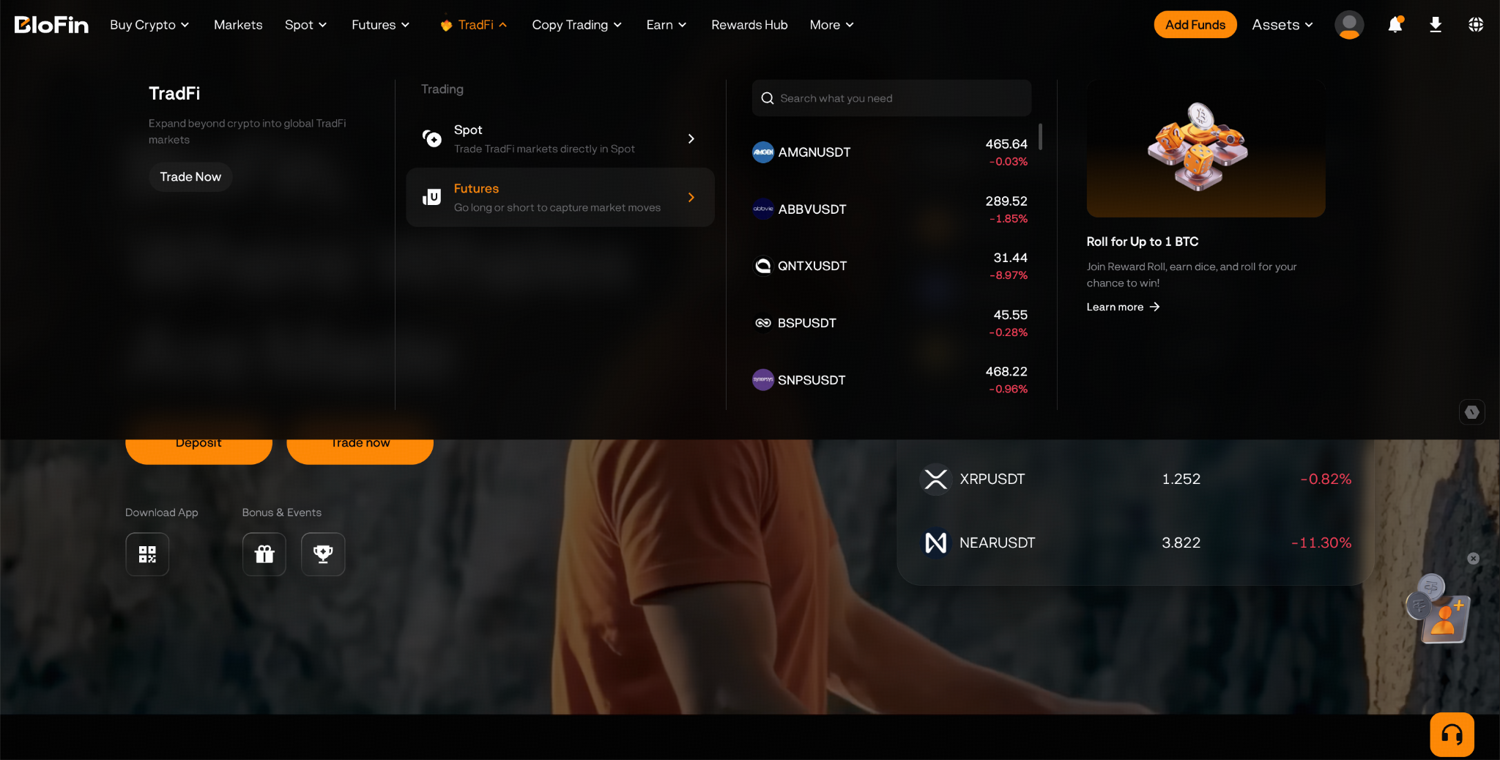
Step 1: Check that Nasdaq's regular session is open, 9.30AM to 4PM ET (2.30PM to 9PM UTC in US standard time), and that USDT sits in your Futures Account. Hover over TradFi, choose Futures and search for MSFT to reach MSFTUSDT, the same route as BloFin's first-trade guide.
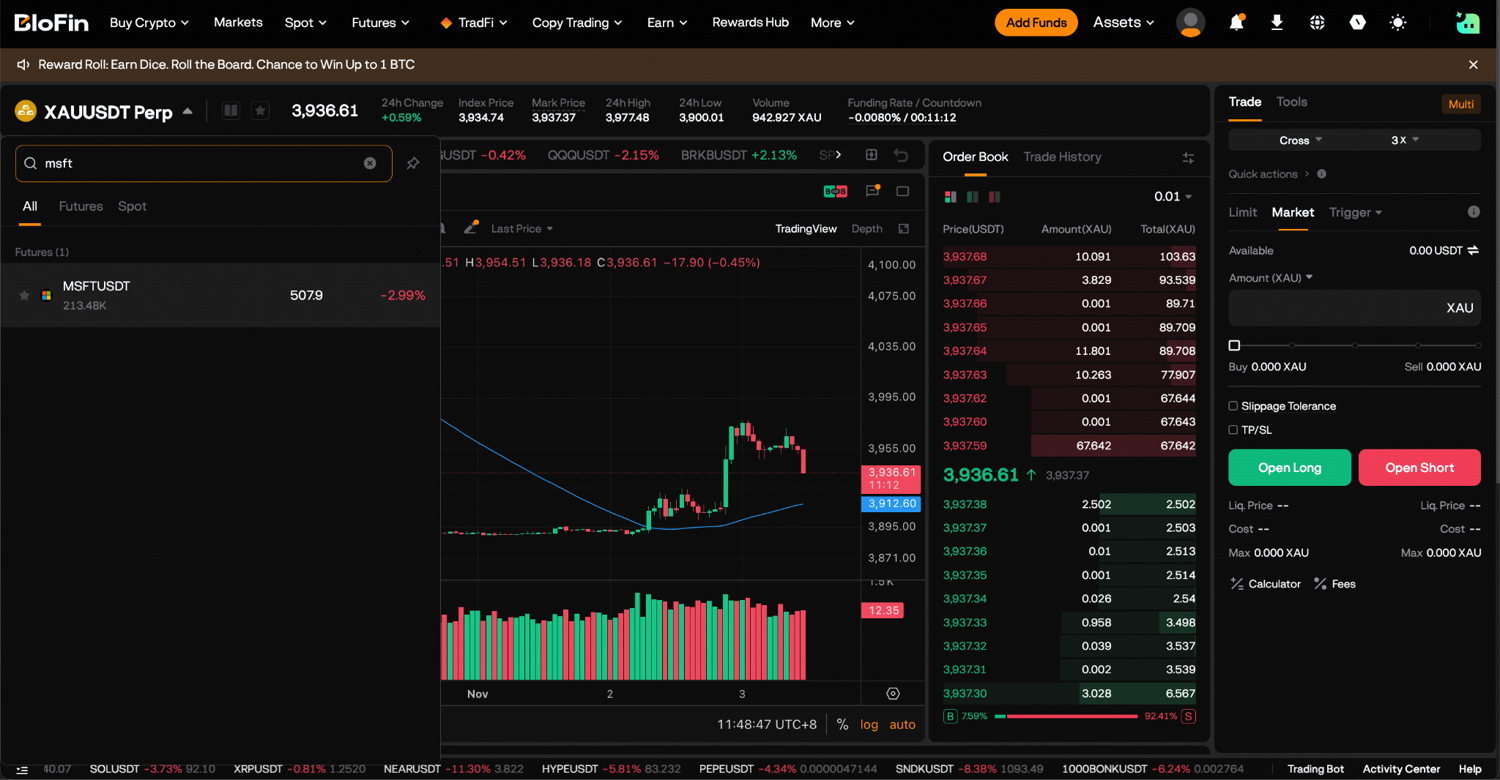
Step 2: The order panel opens on Cross. Switch it to Isolated, so the short can only lose the margin you put behind it and a sudden rise cannot draw on the rest of your balance.
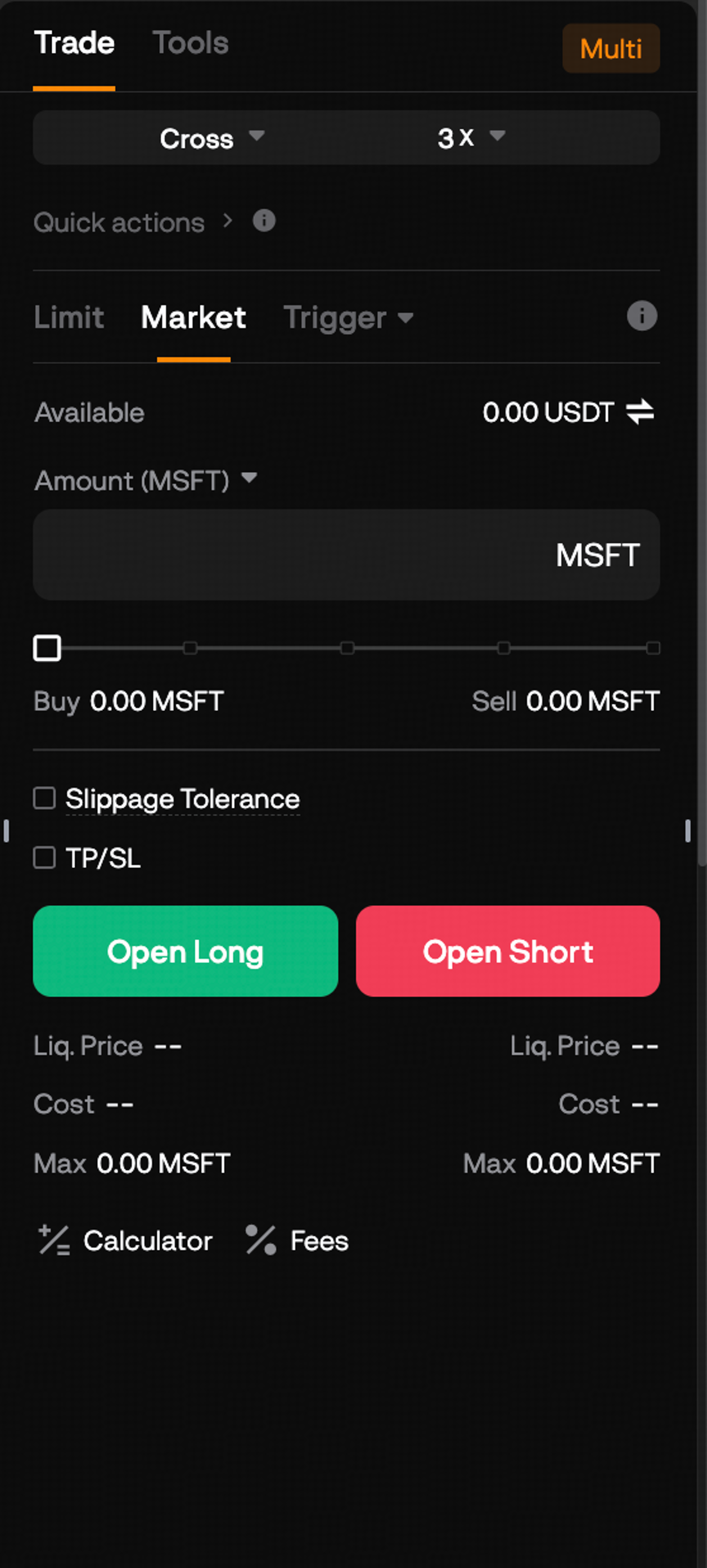
Step 3: The leverage figure reads 3X by default; click it to choose your own. Picking less leverage ties up more USDT and moves the liquidation price higher, away from your entry.
Step 4: Pick Market to sell straight away, or Limit to name your price. A limit order takes a figure in the Price field, or BBO fills in the best bid or offer for you.
Step 5: Enter the size in Amount (MSFT): 10 for 10 shares, or 1.19 for the Microsoft share of $10,000 in QQQ. Keep Reduce-only clear, because that box blocks any order that would open a position.
Step 6: Read Liq. Price and Cost beside the order buttons, then press Sell and confirm. The Positions tab then lists the short, showing what you sold, at what price, the margin behind it and where it would be liquidated.
While the hedge is open, three readings on the MSFTUSDT Perpetual trading page matter most: the mark price, which drives liquidation, the funding rate, and how long remains before funding is next paid.
When an MSFT hedge can be opened and closed
You can open or add to an MSFT hedge on weekdays from 9.30AM to 4PM ET: in UTC, 2.30PM to 9PM in US standard time and 1.30PM to 8PM in summer. At other times BloFin may restrict stock futures to reduce-only trading, so the short can be cut or closed at any hour but may not be opened.
BloFin's stock futures notice sets this rule and gives the session in UTC for both seasons (source: BloFin stock futures notice). Orders of that kind can only shrink an open position, all the way to zero if you choose (source: BloFin reduce-only FAQ). So lifting a hedge works at any hour, while starting one, or adding to it, belongs in the session.
The broker side keeps longer hours. Nasdaq runs pre-market trading from 4AM to 9.30AM ET and after-hours trading from 4PM to 8PM ET, subject to your broker (source: Nasdaq trading hours). In US standard time those sessions run from 9AM to 2.30PM UTC and from 9PM to 1AM UTC. You can therefore buy more shares at 6PM ET (11PM UTC), when the perpetual may accept no new short, and the new shares may stay unhedged until 9.30AM ET (2.30PM UTC) the next weekday.
The session moves on holidays. For Thanksgiving, Nasdaq stays closed on Thursday, November 26, 2026; it shuts at 1PM ET, which is 6PM UTC, on both November 27 and December 24, and stays closed on December 25 (source: Nasdaq trading hours). A hedge meant to cover those long weekends has to be in place before the last session ends. The full calendar is in the page on trading hours and reduce-only windows.
Leverage and liquidation on the hedge's short
Because the shares and the short are held in separate accounts, a sharp rise can liquidate the short even while the shares gain. At a round 520 USDT, a first-tier isolated short is closed out after a rise of about 17.0% at 5x, 7.3% at 10x and 2.4% at 20x, under BloFin's liquidation formula.
BloFin works out an isolated short's liquidation price as margin plus position value, divided by size multiplied by (1 + maintenance rate + fee rate) (source: BloFin liquidation price FAQ). With the first tier's 2.50% rate (source: BloFin MSFTUSDT position tiers) and the 0.06% taker fee taken as the fee rate (source: BloFin fee schedule), a 10 MSFT short opened at 520 USDT looks like this.
Leverage | Margin for a 10 MSFT short | Liquidation price | Rise that triggers it |
|---|---|---|---|
1x | 5,200.00 USDT | 1,014.04 USDT | 95.0% |
2x | 2,600.00 USDT | 760.53 USDT | 46.3% |
3x | 1,733.33 USDT | 676.03 USDT | 30.0% |
5x | 1,040.00 USDT | 608.42 USDT | 17.0% |
10x | 520.00 USDT | 557.72 USDT | 7.3% |
20x | 260.00 USDT | 532.37 USDT | 2.4% |
Microsoft's biggest one-day rise of 2026 is a useful yardstick. The share closed 15.51% higher on July 30, 2026, the session after its April to June 2026 (Q4 FY2026) results (source: Nasdaq MSFT historical data). A move that size would have closed out a 10 MSFT short at 10x or 20x, and the protection with it, and left a 5x short only about 1.5 points from its 17.0% limit.
A liquidation leaves the shares unhedged at the worst moment, and if it happens at night the short may not be reopened until 9.30AM ET, 2.30PM UTC, the next weekday. Lower leverage costs more margin up front and buys more room, which is the trade-off BloFin's lesson on leverage and liquidation explains in general. Choosing a multiple and a size for MSFTUSDT is covered in the guide to sizing an MSFT position.
Funding and fees: What an MSFT hedge costs
Funding is the main ongoing cost or credit of an MSFT hedge. It is normally paid every eight hours (4PM, 12AM and 8AM UTC); whenever the rate is above zero, the long side pays the short side. Over the 30 days to November 2, 2026, rates summed to +0.28%, about 14.32 USDT received by a 5,200 USDT short (source: BloFin MSFTUSDT funding history).
The rate can turn against the short for weeks. Every one of the 42 settlements between 4PM UTC on August 3 and 8AM UTC on August 17, 2026 was negative, a total of −0.83%, or roughly 43.08 USDT taken from that short (source: BloFin MSFTUSDT funding history). Across the 612 settlements from the listing on April 20, 2026 to November 2, 383 were positive, 218 negative and 11 zero, and a short held throughout would have received a net 4.51% of its value.
As with crypto funding rates on any perpetual, the rate tracks where the contract trades against its index, so other traders' positioning sets it, whatever your hedge is doing. MSFTUSDT's own record, including how the sign moves around report nights, is set out on the MSFT funding rate page.
Trading fees apply twice, once to open the short and once to close it. Under BloFin's fee structure, an order resting on the book pays the 0.02% maker rate and one filling immediately pays the 0.06% taker rate. On a 10 MSFT short at 520 USDT, that is about 1.04 USDT a side as a maker and 3.12 USDT as a taker, or 2.08 and 6.24 USDT for the round trip.
An MSFT hedge over the October 28 report
Microsoft published its July to September 2026 (Q1 FY2027) results on October 28, 2026, after Nasdaq's close, ahead of a 5.30PM ET (9.30PM UTC) call (source: Microsoft Q1 FY2027 results). Ten shares hedged with a 10 MSFT short opened at that close would have ended the next session about 0.34 USDT lower, against 8.70 lower unhedged.
The share closed at $531.01 on October 28 and $530.14 on October 29 (source: Nasdaq MSFT historical data). The perpetual last traded at 532.38 USDT as Nasdaq shut at 8PM UTC on October 28, and at 530.91 USDT at the same hour a day later (source: BloFin MSFTUSDT price chart, 1-hour candles). The short also went through three funding settlements on October 29: −0.0024% at 12AM UTC, +0.0012% at 8AM and +0.0019% at 4PM (source: BloFin MSFTUSDT funding history).
Part of the result | Calculation | USDT |
|---|---|---|
10 shares | (530.14 − 531.01) × 10 | −8.70 |
10 MSFT short | (532.38 − 530.91) × 10 | +14.70 |
Taker fees to open and close | 0.06% of 5,323.80 plus 0.06% of 5,309.10 | −6.38 |
Funding received by the short | net +0.0007% of 5,323.80 | +0.04 |
Hedged result | all four lines | −0.34 |
Counting a dollar and a USDT as equal, fees took most of what the hedge saved on a flat night. The night was quiet only at the closes, though. Within two hours of the release the perpetual's mark price, which BloFin's liquidation engine watches, rose from 532.41 to 568.47 USDT, 6.77% higher, while the shares at the broker could reflect that only in after-hours trading (source: BloFin MSFTUSDT price chart, 1-hour candles).
That peak put the short 360.90 USDT behind for a while. At 20x, with a liquidation price near 545.05 USDT for a short opened at 532.38, the short would have been closed out, leaving the shares bare as the price fell back. At 10x it came within 0.45% of its 571.00 USDT liquidation price. At 5x the same loss used about a third of the margin, and the hedge came through the night intact.
So a report-night hedge needs room for the move it is meant to absorb, even when the next close ends up flat. The same reasoning for an outright position is set out in the guide to trading Microsoft around earnings.
Basis risk between the perpetual and Nasdaq shares
Basis risk is the chance that a hedge's two legs do not move by exactly the same amount. Across 134 Nasdaq sessions from April 20 to October 28, 2026, the MSFTUSDT Perpetual's first trade after the 4PM ET (8PM UTC) close sat a median 0.10% from Microsoft's close. It was higher on 124 days and never over 0.34% away (source: Nasdaq MSFT historical data; BloFin MSFTUSDT price chart, 1-hour candles).
That gap shows up in the October 28 example. The perpetual stood 0.26% over the share at the October 28 close and 0.15% over it a day later, so the short gained 6.00 USDT more than the shares lost, which covered most of the fees (source: Nasdaq MSFT historical data; BloFin MSFTUSDT price chart, 1-hour candles).
The gap exists because the perpetual's index comes from a basket of tokenized stock indices, a different feed from the one that sets Nasdaq's closing price (source: BloFin stock futures notice). In regular hours the two track closely. Overnight and at weekends that index can move while Nasdaq is shut, so the short's balance may change hours before the shares' price catches up.
While the perpetual trades over the share, a narrowing premium helps a short hedge slightly and a widening one hurts it, usually by a fraction of a percent of the holding.
Other ways to protect a Microsoft holding
Investors protecting Microsoft shares usually choose between three routes. Selling some shares removes the risk for good, and a protective put limits losses under a chosen price for a premium. The perpetual short offsets moves both ways with no premium or expiry, in exchange for funding and a liquidation price.
Route | Upfront cost | Ends | Keeps any rise | Main risk |
|---|---|---|---|---|
Sell part of the holding | trading cost, possible tax | at once | only on the shares kept | missing a rebound |
Protective put at a broker | the put's premium | on the expiry date | yes, minus the premium | the put expires worthless |
Short on the MSFTUSDT Perpetual | opening fee | when you close it | offset by the short | liquidation in a sharp rise; funding |
Fidelity points out that a hedge can reduce risk on a holding without a taxable sale, that a protective put is bought share for share on the same stock, and that hedging involves additional costs (source: Fidelity hedging guide). Schwab adds that protective puts can be expensive, especially when markets are volatile, and may expire worthless if the fall is milder than expected (source: Schwab, How to Hedge in a Volatile Market).
Unlike a put, the perpetual short gives away gains along with losses. In return, it can be opened in any size down to 0.01 MSFT, sized to an exact share count, and closed at any hour.
Lifting an MSFT hedge
Lifting an MSFT hedge means buying back the short, an order BloFin takes at any hour because a closing order only reduces the position. After that, the shares take Microsoft's full price swings again and funding ends. A partial buy-back keeps a smaller hedge open at its original entry price.
Step 1: Open the Positions tab on the MSFTUSDT trading page and find the short that hedges your shares.
Step 2: Press Close beside it and pick Market for an immediate buy-back or Limit for one at your price, the flow shown in closing a futures trade on BloFin.
Step 3: Type the MSFT amount to buy back, 10 to end a 10-share hedge or 5 to halve it, add a price if it is a limit order, and press Confirm.
The closed part moves to Position History, and any order still waiting shows under Open Orders.
A Buy placed from the order panel with Reduce-only ticked has the same effect, and the box stops a mistyped amount from flipping you into a long (source: BloFin reduce-only FAQ). Putting the hedge back on needs Nasdaq's session, so one removed on Saturday may not return before 9.30AM ET (2.30PM UTC) on Monday.
When the shares are being sold as well, sequence counts. Sell them first and the open short stands alone, losing on any rise until it is bought back; buy the short back first and the shares are exposed until they are sold. Keeping the gap between the two trades short limits either risk.
Looking to hedge a Microsoft holding with the MSFTUSDT Perpetual? To get started, you'll need to first create a BloFin account, fund your account with cryptocurrency, and go to the MSFTUSDT Perpetual trading page.
Frequently asked questions
Does an MSFT hedge need Hedge Mode on BloFin?
One-way Mode is enough for an MSFT hedge against shares at a broker, since the short is your only MSFTUSDT position. Hedge Mode is for keeping a long and a short open on one contract together. Switching modes on BloFin requires an account with no open positions and no pending orders (source: BloFin position mode FAQ).
What happens to an MSFT hedge on Microsoft's ex-dividend date?
Microsoft's $0.98 quarterly dividend goes ex on Thursday, November 19, 2026, and is paid on December 10 (source: Microsoft dividend announcement, September 2026). All else equal, the share opens about one dividend lower that morning. If the perpetual's price follows the share down, the short gains about the same amount. BloFin's stock futures carry no dividend rights and its notice describes no dividend adjustment (source: BloFin stock futures notice), so the shareholder keeps the cash, as Microsoft's dividend record explains.
Can you hedge Microsoft shares for just one night?
For a one-night hedge, open the short before Nasdaq closes at 4PM ET, which is 9PM UTC in US standard time and 8PM UTC in daylight saving time; after that, BloFin may turn away new shorts. It can then be closed at any hour, since a closing order is reduce-only. Two funding settlements, normally at 12AM and 8AM UTC, fall before the next session opens, and the fees to open and close are usually the larger cost.
How long can an MSFT hedge stay open?
With no expiry on the MSFTUSDT Perpetual, a hedge lasts until you buy it back, a stop triggers or liquidation closes it. Held for months, its funding adds up as a cost or a credit, and a QQQ hedge drifts out of size as Microsoft's weight in the fund changes. BloFin may also change contract settings without announcing each change (source: BloFin MSFTUSDT contract details).
What does an MSFT hedge cost over a month?
For a 10 MSFT short at a round 520 USDT, taker fees to open and close come to about 6.24 USDT, or about 2.08 USDT with maker orders. Over the 30 days to November 2, the same short also received about 14.32 USDT in funding, so the month's net was a credit of about 8.08 USDT before any gap between the two legs.
Researched and written by the BloFin Academy editorial team with AI-assisted drafting. All facts independently verified. Primary sources include BloFin's MSFTUSDT contract details, position tiers, funding history, price chart and fee schedule, its MSFTUSDT listing notice and stock futures notice, and its help center articles on liquidation price, reduce-only orders and position mode. They also include Invesco's QQQ holdings, Nasdaq's MSFT and QQQ historical data and trading hours, Microsoft's fiscal 2027 first-quarter results and September 2026 dividend announcement, CME Group's lesson on contract notional value, Fidelity's guide to hedging and Charles Schwab's guide to hedging in a volatile market, current as of November 2, 2026.
Nothing in this article constitutes financial advice, and nothing in it is a recommendation to buy, sell, hold or hedge Microsoft in any form. An MSFT hedge removes most of the price risk on your shares but leaves a short that can be liquidated in a sharp rise while the shares' gain sits at your broker, out of reach of the short's margin. A short closed out at night may not be reopened until the next regular session, funding can run against the short for weeks, and an MSFT short covers only a small part of a fund such as QQQ. Past performance does not indicate future results. Do your own research and consider your risk tolerance before you trade on BloFin.