
Some traders have a firm view about one company and no view at all about the market around it. They might think its cloud business is gaining ground on rivals, or that its last results were judged too harshly, while having no idea whether the whole index rises or falls next month.
Buying the share on its own mixes those two things together. A good week for the company can still end in a loss if the market slides. A strong market can also lift a stock whose own story has gone wrong, so the result says little about whether the original idea was right.
A pair trade separates them. You buy one asset and sell a related one at the same time, so a move that lifts or sinks both largely cancels, and what is left is how the first asset did against the second. Perpetual futures make the second leg easy, because selling one is as simple as buying one.
BloFin offers Microsoft as the MSFTUSDT Perpetual, alongside perpetuals on the Nasdaq-100 fund QQQ and on many of Microsoft's software and cloud rivals, all margined and settled in USDT. That puts both legs of a Microsoft pair in one futures account, on one order screen.
What is an MSFT pair trade?
An MSFT pair trade is a long on the MSFTUSDT Perpetual together with a short on a related perpetual, such as QQQ or a software peer. You size the short by beta: Microsoft moved about 0.55% for each 1% move in QQQ in the 12 months to October 30, 2026, so 5,200 USDT long pairs with about 2,860 USDT short.
Fidelity calls pairs trading a non-directional, relative value strategy: you are betting on how two prices move against each other, while the market's direction matters less (source: Fidelity, What Is Pairs Trading?). On BloFin both legs are ordinary futures orders, a buy on one contract and a sell on the other. The same idea works for any two assets that tend to move together, as BloFin's guide to correlation trading in crypto shows for coins.
The pair can face either way. Long Microsoft and short the peer pays off if Microsoft does better than the peer. The reverse pair, short Microsoft and long the peer, pays off if Microsoft does worse. Neither direction says anything about whether the market will rise. For how the contract on the Microsoft leg works, see the MSFT perpetual on BloFin.
How the two legs of an MSFT pair offset
The two legs of an MSFT pair offset because a market-wide move pushes both prices the same way. When the Nasdaq falls, the long Microsoft leg loses and the short QQQ leg gains; when it rises, the reverse happens. Sized correctly, those two results roughly cancel, leaving the part of Microsoft's move that the market did not explain.
Here is the arithmetic with round numbers. Say you hold 10 MSFT long at 520 USDT and 4.09 QQQ short at 700 USDT. If the whole market drops and QQQ falls 2%, the short gains about 57 USDT. If Microsoft falls only by its usual share of that, about 1.1%, the long loses about 57 USDT and the pair is flat. If Microsoft falls 3% instead, the long loses 156 USDT, the pair is down about 99 USDT, and that loss is Microsoft's own underperformance.
The canceling works because the market's share of each move is common to both legs. Wikipedia's entry on pairs trading describes the same effect, noting that a pair helps to hedge both sector risk and market risk (source: Wikipedia, Pairs trade). What survives is a bet on the difference between the two, which traders call the spread.
There is one twist with QQQ as the second leg: Microsoft is inside it. Microsoft was 6.17% of the Invesco QQQ Trust in its holdings as of October 29, 2026, behind Nvidia at 8.08% and Apple at 7.99% (source: Invesco QQQ holdings). So the 4.09 QQQ short, about 2,863 USDT, also shorts about 177 USDT of Microsoft, and the pair's real Microsoft exposure is a little smaller than the long leg alone.
Which perpetuals can pair with MSFT on BloFin
Fourteen of BloFin's perpetuals make natural second legs for Microsoft. Two of them are the QQQ and SPY funds. Six are large technology companies: Oracle, Alphabet, Amazon, Nvidia, Apple and Meta. Six are software companies: Adobe, ServiceNow, IBM, Snowflake, CrowdStrike and Atlassian. Each contract is 0.01 of one share of its underlying.
All of them are linear USDT perpetuals like the Microsoft one, so the two legs share a margin currency and a funding schedule. BloFin's guide to TradFi assets explains the stock, fund and commodity markets on offer, and the list has grown since it was written: Snowflake, Adobe, Atlassian and CrowdStrike were all added in September 2026.
Being listed is the easy test. The harder one is whether a leg actually moves with Microsoft, which is what correlation measures: 1 means two prices always move together, 0 means they move independently. Microsoft's correlation and beta with each leg, measured on Nasdaq's daily closes from October 30, 2025 to October 30, 2026, were as follows (source: Nasdaq MSFT historical data).
Second leg | What it tracks | Correlation with Microsoft | Microsoft's beta to it | Leverage up to |
|---|---|---|---|---|
SNOW | Snowflake | 0.49 | 0.24 | 25x |
NOW | ServiceNow | 0.48 | 0.24 | 20x |
ORCL | Oracle | 0.46 | 0.26 | 20x |
CRWD | CrowdStrike | 0.41 | 0.24 | 25x |
TEAM | Atlassian | 0.40 | 0.17 | 20x |
AMZN | Amazon | 0.39 | 0.37 | 20x |
SPY | S&P 500 fund | 0.39 | 0.99 | 50x |
ADBE | Adobe | 0.37 | 0.30 | 20x |
QQQ | Nasdaq-100 fund | 0.34 | 0.55 | 20x |
IBM | IBM | 0.27 | 0.18 | 20x |
NVDA | Nvidia | 0.25 | 0.22 | 20x |
META | Meta | 0.16 | 0.13 | 20x |
GOOGL | Alphabet | 0.16 | 0.15 | 20x |
AAPL | Apple | 0.11 | 0.16 | 20x |
Two things stand out. Four of the six software companies tracked Microsoft more closely over that year than every megacap it is usually compared with except Oracle, and no leg reached even 0.5. Apple and Alphabet, two of the most common comparisons for Microsoft, moved almost independently of it day to day. A pair needs a leg that tracks Microsoft, which is a narrower test than which company runs the better business, the question BloFin's comparisons of Apple and Microsoft stock and Alphabet and Microsoft stock take up.
Sizing the legs of an MSFT pair by beta
Beta tells you how many percent Microsoft tended to move when the second leg moved 1%, and it sets the short's size. Multiply the long leg's value by the beta: 5,200 USDT of Microsoft times 0.55 is 2,860 USDT, or 4.09 QQQ at 700 USDT, about 2,863 USDT once rounded.
QuantInsti's pairs trading guide calls the number of units sold per unit bought the hedge ratio, and takes it from a regression of one stock's price on the other (source: QuantInsti, pairs trading basics). The beta here is also a regression, but of daily returns over the year to October 30, 2026, so it sizes the legs by how far each tends to move in a day rather than by price level. With a long of 10 MSFT at a round 520 USDT, the sizes for five second legs come out like this.
Second leg, at a round price | Beta | Short value, beta-sized | Short size, beta-sized | Short size, equal dollars |
|---|---|---|---|---|
QQQ at 700 USDT | 0.55 | 2,860 USDT | 4.09 QQQ | 7.43 QQQ |
AMZN at 240 USDT | 0.37 | 1,924 USDT | 8.02 AMZN | 21.67 AMZN |
ORCL at 130 USDT | 0.26 | 1,352 USDT | 10.40 ORCL | 40.00 ORCL |
NVDA at 200 USDT | 0.22 | 1,144 USDT | 5.72 NVDA | 26.00 NVDA |
GOOGL at 280 USDT | 0.15 | 780 USDT | 2.79 GOOGL | 18.57 GOOGL |
The last column is the simpler choice: the same value on both sides. It only cancels the market if the two legs move by the same amount, and Microsoft moved by less than a full point for each point QQQ moved. An equal-dollar QQQ short of 7.43 QQQ therefore turns the pair into a bet that the market falls, on top of the bet on Microsoft.
Beta also changes over time, so a size set today may need adjusting. By the same calculation, Microsoft's beta to QQQ was 0.761 over the six months to April 30, 2026 and 0.420 over the six months after it. Over two years to October 30, 2026 it was 0.698, against 0.551 over one year, so any size taken from it describes the past window it was measured in.
Risk left in an MSFT pair
Once the market's share cancels, an MSFT pair is left holding Microsoft's own moves, and over the year to October 30, 2026 those were most of its moves. The QQQ short removed about 11.5% of the variance of Microsoft's daily returns, cutting their typical daily swing only from 2.07% to 1.95%.
That small figure follows from the correlation of 0.34. The square of a correlation, 0.115 here, is the share of one price's daily variation the other explains. A Microsoft pair therefore stays a large bet on Microsoft itself, and taking out the market's part makes it only a little calmer than a plain long.
The days that matter most are Microsoft's own news days. Over the same year, four sessions supplied 37.0% of all the variance left after the QQQ leg, going by Nasdaq's daily closes for Microsoft (source: Nasdaq MSFT historical data) and for QQQ (source: Nasdaq QQQ historical data). Two of the three largest, January 29 and July 30, came the day after Microsoft reported on January 28, 2026 (source: Microsoft FY26 Q2 results) and July 29, 2026 (source: Microsoft FY26 Q4 results).
Session | Microsoft's close-to-close move | QQQ's move | Microsoft's own move after the QQQ leg | On a 5,200 USDT beta-sized pair |
|---|---|---|---|---|
January 29, 2026 | −9.99% | −0.60% | −9.66% | −502.50 USDT |
May 29, 2026 | +5.45% | +0.37% | +5.24% | +272.59 USDT |
June 26, 2026 | +5.71% | −1.38% | +6.47% | +336.24 USDT |
July 30, 2026 | +15.51% | +3.30% | +13.69% | +711.91 USDT |
So a pair does strip out the market, yet its own result still swings on days when Microsoft reports, announces a deal or gets a rating change. A pair held through those days is exposed to them as fully as a plain long.
Opening an MSFT pair trade, step by step
An MSFT pair is opened in two orders on BloFin's futures pages, one for each leg, while Nasdaq's regular session is open. Set margin mode and leverage on each leg before typing its size, since the panel's cost and liquidation figures depend on all three, and place the two orders within moments of each other.
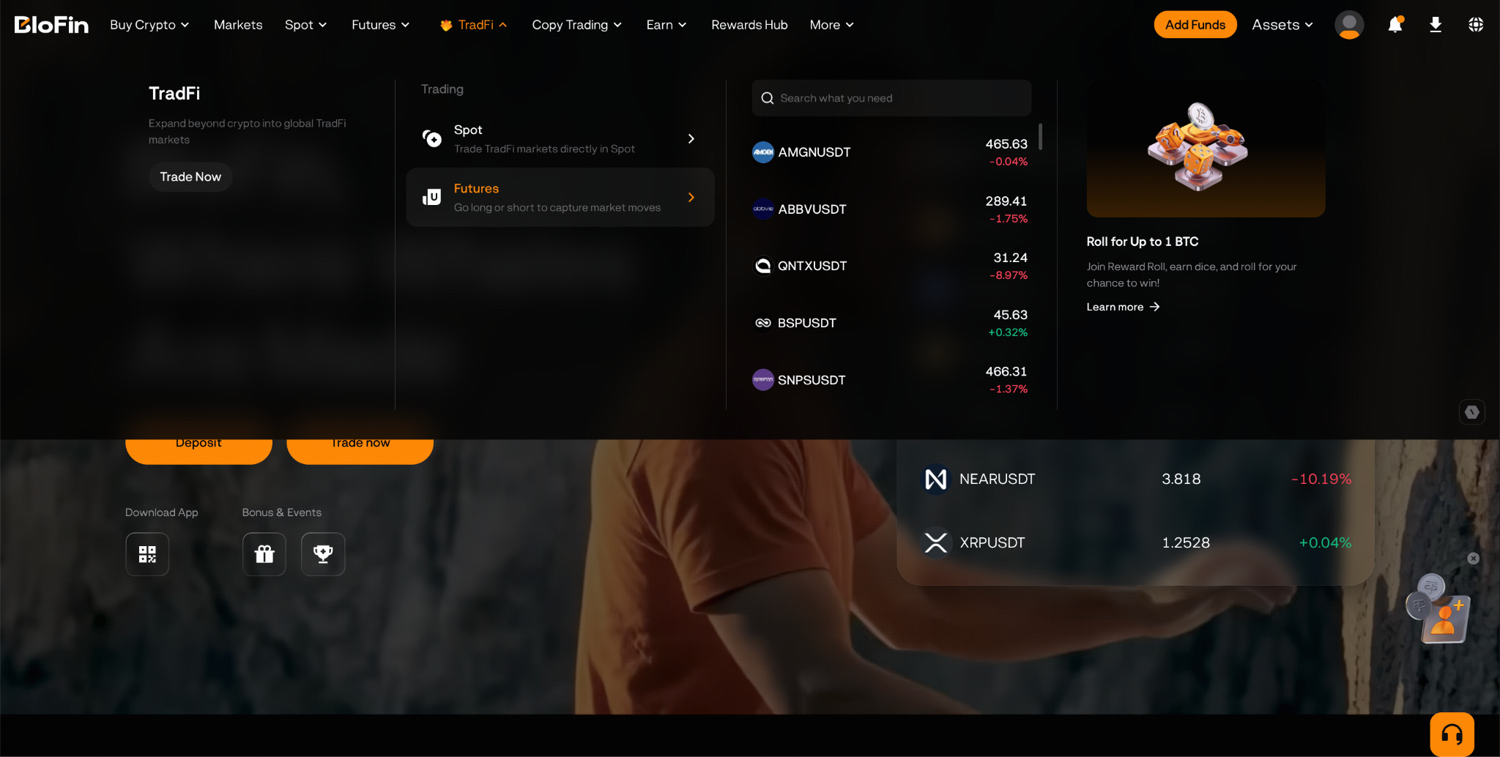
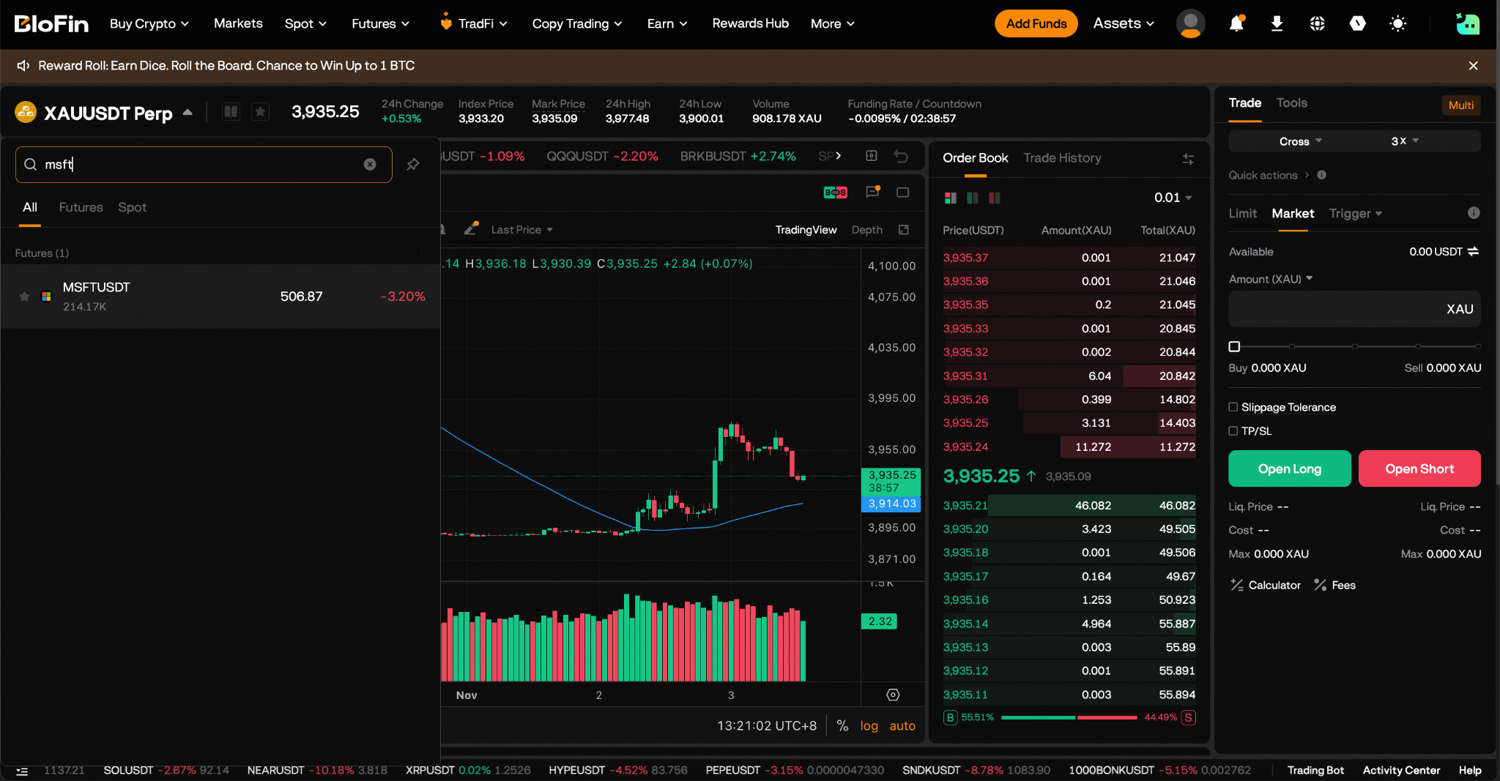
Step 1: Make sure USDT is in your Futures Account and the session is open, 9.30AM to 4PM ET. Hover over TradFi, click Futures, then type MSFT in the search box and open MSFTUSDT, the same route BloFin's walkthrough of a first trade follows.
Step 2: A new order panel starts in Cross margin mode. Choose Isolated if you want each leg to stand on its own margin, so a loss on one leg stays inside that leg's margin.
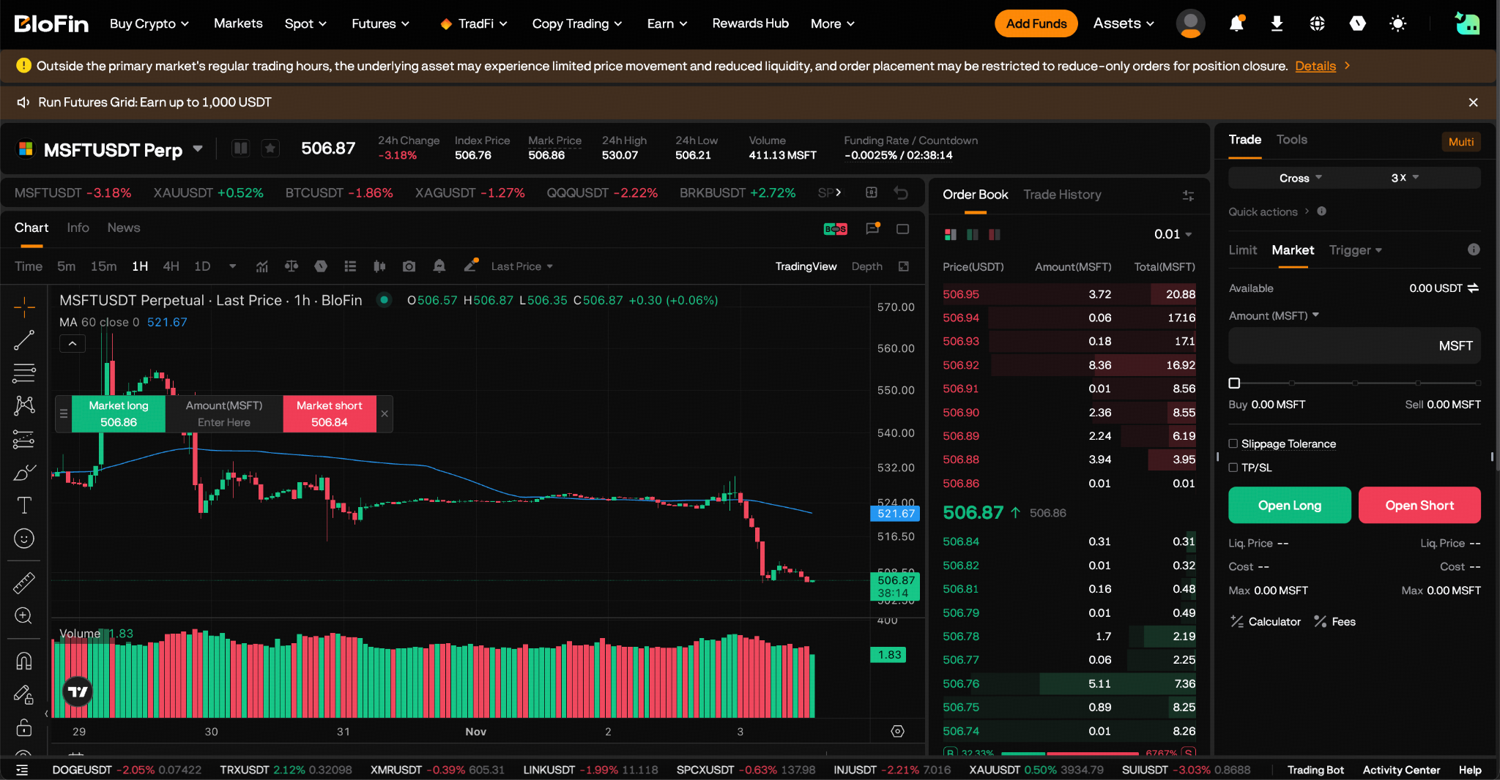
Step 3: Click the leverage figure, which shows 3X at first, and choose your own. Pick Market to fill at once or Limit to set a price in the Price field.
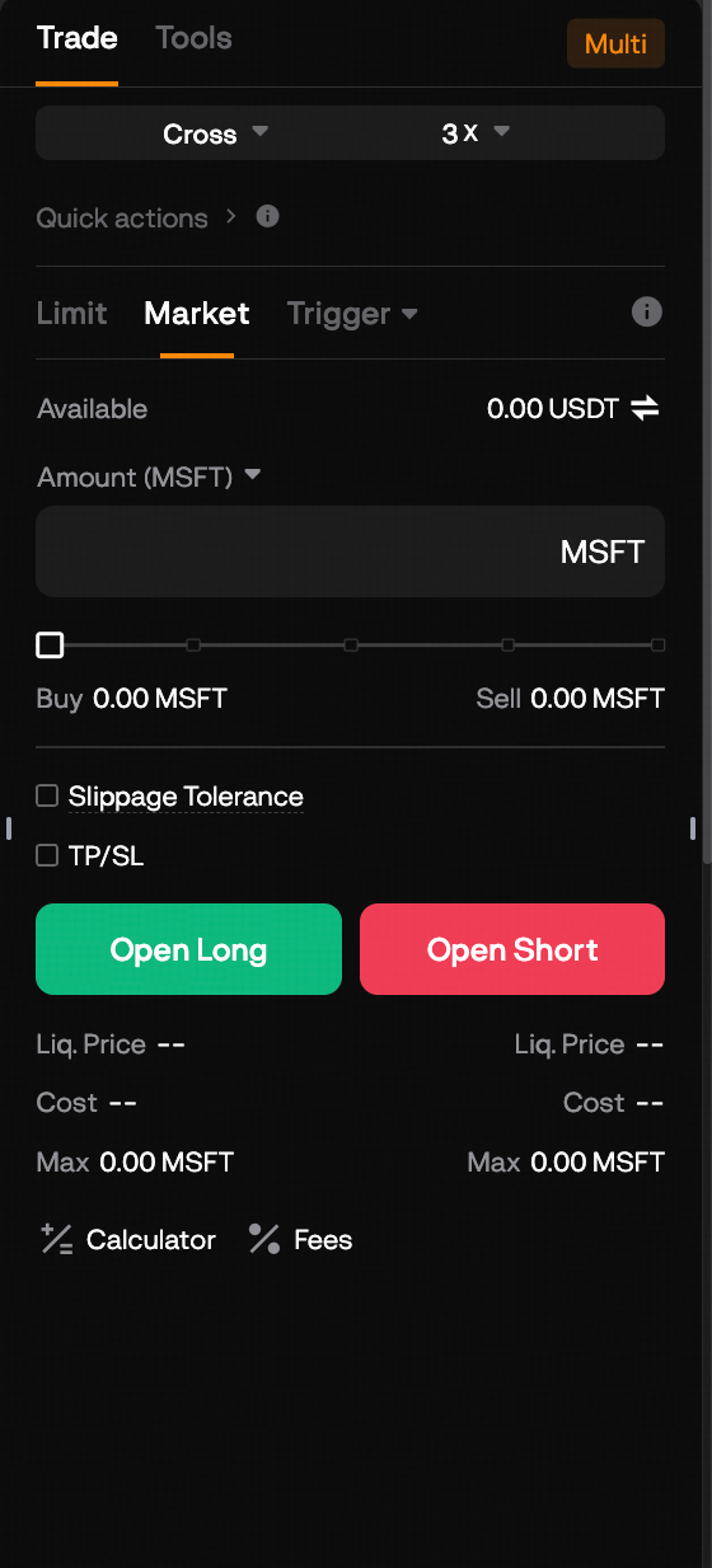
Step 4: Type the Microsoft size in Amount (MSFT), 10 in the example, check Liq. Price and Cost, and press Buy. Leave Reduce-only clear, since that box blocks orders that open a position.
Step 5: Search for QQQ to open the QQQUSDT Perpetual, or the peer you chose, and repeat Steps 2 and 3 on its order panel. Type the beta-sized amount, 4.09 QQQ in the example, check the same two figures and press Sell.
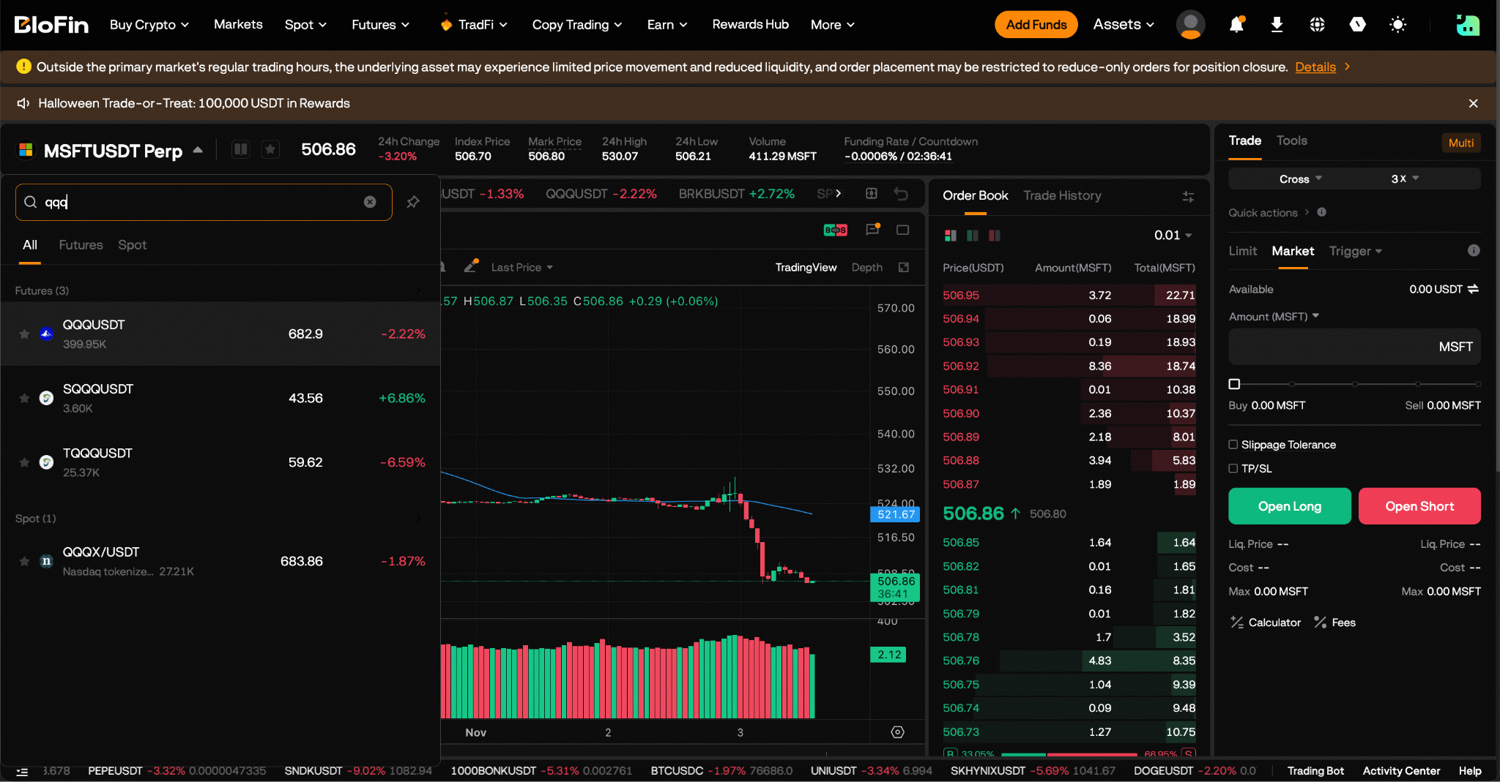
Step 6: Open the Positions tab. It now lists both legs, each with its own entry price, margin and liquidation price.
Fidelity notes that pairs traders generally fill the short side first (source: Fidelity, What Is Pairs Trading?). On a perpetual a short fills the same way as a long, so the real concern is the gap between the two orders: while only one leg is open, you hold a plain long or a plain short. The MSFTUSDT Perpetual trading page shows the mark price and the next funding time for the Microsoft leg while the pair runs.
Trading hours for both legs
Both legs of an MSFT pair share one timetable. You can open or add to either leg on weekdays between 9.30AM and 4PM ET, or 2.30PM to 9PM UTC in winter and 1.30PM to 8PM UTC in summer. Outside those hours, both contracts may accept reduce-only orders only, which can shrink or end a leg but not start one.
BloFin sets this rule in its stock futures notice, covering weekends and market holidays as well as weeknights (source: BloFin stock futures notice). The QQQ contract carries the same limit, because QQQ trades on the same US market as Microsoft (source: BloFin QQQUSDT listing notice). A reduce-only order can only shrink a position, all the way to zero (source: BloFin reduce-only FAQ).
The shared hours help in one way: the two legs open together and may stop accepting new orders at the same moment, so a pair is never half-open because one market shut first. It also means you may not be able to rebalance a pair, adding to one leg after a big overnight move, until 9.30AM ET the next weekday. Holidays shorten the session for both legs together, and the guide to the MSFT perpetual's trading hours lists the Microsoft contract's holiday calendar.
Funding and fees on both legs
Funding is charged on each leg separately, normally three times a day, eight hours apart, at 12AM, 8AM and 4PM UTC. When a contract's rate is positive, its longs pay its shorts. In a long MSFT and short QQQ pair, the Microsoft leg pays when Microsoft's rate is positive, and the QQQ leg receives when QQQ's rate is positive.
The two contracts' rates are set by their own traders, so they can differ widely. BloFin publishes every contract's past rates, Microsoft's (source: BloFin MSFTUSDT funding history) and QQQ's (source: BloFin QQQUSDT funding history) among them. Over the 90 settlements in the 30 days to November 2, 2026, the rates added up as follows. A settlement at exactly zero counts in neither column, so some rows add up to fewer than 90.
Perpetual | Sum of rates, 30 days | Positive settlements | Negative settlements | On a 5,200 USDT short |
|---|---|---|---|---|
GOOGL | +1.84% | 90 | 0 | +95.73 USDT |
NVDA | +1.19% | 85 | 4 | +62.09 USDT |
ORCL | +1.14% | 79 | 10 | +59.23 USDT |
META | +1.12% | 83 | 7 | +58.41 USDT |
AMZN | +1.10% | 82 | 7 | +57.41 USDT |
QQQ | +1.05% | 64 | 26 | +54.77 USDT |
MSFT | +0.28% | 53 | 34 | +14.32 USDT |
AAPL | −0.08% | 48 | 41 | −4.06 USDT |
For the example pair, a long of 5,200 USDT of Microsoft paid about 14.32 USDT over that month. The 4.09 QQQ short, about 2,863 USDT at 700, received about 30.16 USDT, for a net credit of about 15.84 USDT. The reverse pair, short Microsoft and long QQQ, would have paid the same amount.
None of that is fixed. Each rate follows where its contract trades against its index, the same pull explained for coins in crypto funding rates, and the explainer on the MSFT perpetual's funding rate traces Microsoft's own record. A month in which the shorts received can be followed by one in which they pay.
Trading fees apply to four orders: two to open the pair and two to close it. Under BloFin's fee structure, a resting order pays the 0.0200% maker rate and an immediate fill pays the 0.0600% taker rate. On the example's 8,063 USDT of combined value, a round trip costs about 9.68 USDT at taker rates or 3.23 USDT at maker rates.
Margin and liquidation on each leg
Each leg of an MSFT pair has its own margin and its own liquidation price, even when the pair as a whole is flat. A sharp fall in Microsoft can liquidate the long leg while the QQQ short is making money, because isolated margin on one leg cannot be used to support the other.
BloFin works out an isolated liquidation price from the position's margin, its value, its maintenance margin rate and a fee rate (source: BloFin liquidation price FAQ). Microsoft's first tier needs 2.50% maintenance margin (source: BloFin MSFTUSDT position tiers) and QQQ's first tier 2.00% (source: BloFin QQQUSDT position tiers). With the 0.0600% taker fee as the fee rate, the example pair looks like this.
Leverage on both legs | Margin for both legs | Microsoft long liquidated at | Fall that triggers it | QQQ short liquidated at | Rise that triggers it |
|---|---|---|---|---|---|
2x | 4,031.50 USDT | 266.83 USDT | 48.7% | 1,028.81 USDT | 47.0% |
3x | 2,687.67 USDT | 355.77 USDT | 31.6% | 914.49 USDT | 30.6% |
5x | 1,612.60 USDT | 426.93 USDT | 17.9% | 823.05 USDT | 17.6% |
10x | 806.30 USDT | 480.30 USDT | 7.6% | 754.46 USDT | 7.8% |
20x | 403.15 USDT | 506.98 USDT | 2.5% | 720.16 USDT | 2.9% |
The danger runs in one direction for each leg. The long is at risk from a Microsoft fall and the short from a rise in the second leg. A pair is therefore most exposed when Microsoft drops on its own news while the market holds up, as on January 29, 2026.
The reverse pair has the mirror risk. A Microsoft short opened at the 4PM ET close on July 29, 2026, at 392.24 USDT, met the largest one-day rise in Microsoft's shares over the year to October 30, 2026 on the following day. On BloFin's hourly prices the mark reached 459.01 USDT on July 30, just beyond the 458.94 liquidation price of a 5x short (source: BloFin MSFTUSDT price chart, 1-hour candles). Even a 5x short leg would have been closed out, while the long QQQ leg gained.
Lower leverage ties up more USDT and buys more room on each leg, the trade-off explained in BloFin's guide to how leverage leads to liquidation. Picking a multiple and a size for the Microsoft contract is covered in the guide to sizing an MSFT perpetual position.
An MSFT pair over the October 28 report
On October 28, 2026, Microsoft reported its fiscal 2027 first quarter, covering July to September, with an analyst call at 5.30PM ET, after Nasdaq's close (source: Microsoft Q1 FY2027 results). A pair of 10 MSFT long and 4.03 QQQ short, opened at that close and closed at the next, made 16.42 USDT after fees and funding, while the long alone lost 21.12.
The perpetuals' last prices at Nasdaq's 4PM ET close, 8PM UTC, give the inputs. Microsoft's stood at 532.38 USDT on October 28 and 530.91 a day later; QQQ's stood at 726.59 and 716.67 (source: BloFin MSFTUSDT and QQQUSDT price charts, 1-hour candles). The short was 4.03 QQQ, because 0.55 times the long's 5,323.80 USDT value, divided by 726.59, gives 4.03.
Part of the result | Calculation | USDT |
|---|---|---|
Long 10 MSFT | (530.91 − 532.38) × 10 | −14.70 |
Short 4.03 QQQ | (726.59 − 716.67) × 4.03 | +39.98 |
Taker fees, four orders | 0.0600% of each order's value | −9.87 |
Funding, Microsoft leg | three settlements summing to +0.0007%, paid by the long | −0.04 |
Funding, QQQ leg | three settlements of +0.0120%, received by the short | +1.05 |
Pair result | all five lines | +16.42 |
QQQ fell 1.37% on BloFin over those 24 hours, while Microsoft's perpetual fell only 0.28%. At a beta of 0.55, a 1.37% fall in QQQ would have meant about a 0.75% fall in Microsoft, so Microsoft did about 0.47 points better than the market's move alone suggested. The pair captured that gap, minus costs.
The QQQ leg carried more news than it seemed to. Alphabet released its own third-quarter results the same evening (source: Alphabet Q3 2026 results), and its class A shares closed 12.64% lower on October 29, at $283.82 against $324.89 (source: Nasdaq GOOGL historical data). Alphabet's class A shares were still 2.61% of QQQ in its October 29 holdings, after the fall, so a slice of the short's gain came from a second company's report.
A long Microsoft and short Alphabet pair that night would have traded two reports at once, with the result driven mostly by Alphabet's move. Choosing a second leg that is not reporting the same evening keeps a report-night pair about Microsoft. The trades available around the report itself are set out in BloFin's guide to trading Microsoft around earnings.
The night was also less calm than its closes suggest. In the 9PM UTC hour, the second of the pair's life, Microsoft's mark price touched 568.47 USDT, a 6.77% gain on its starting level, while QQQ's mark never got more than 0.64% past its own start. At that peak the long was 360.90 USDT ahead and the short barely changed, and in the 2PM UTC hour the next day the long had swung to a loss, its mark down to 520.47 USDT.
Closing an MSFT pair trade
Closing an MSFT pair means closing both legs: selling the Microsoft long and buying back the short. Outside the US session BloFin may limit trading to reduce-only orders. A closing order only reduces a position, so both legs can still be closed on weekends and US holidays.
Traders usually decide in advance what ends a pair: the gap between the two legs reaching a target, the gap moving against them by a set amount, or a time limit passing. Fidelity's guide calls the duration limit the hardest rule to stick to (source: Fidelity, What Is Pairs Trading?), and QuantInsti's adds a stop loss for a spread that keeps widening when it was expected to return to its average (source: QuantInsti). Wikipedia names the underlying risk drift: the two prices drift apart and the gap trends instead of reverting to its old average (source: Wikipedia, Pairs trade).
Step 1: Open the Positions tab on either leg's trading page; both legs are listed.
Step 2: Press Close beside the Microsoft long and pick Market for an immediate fill or Limit to name a price; BloFin's guide to closing a trade shows each screen.
Step 3: Type the amount to close, 10 MSFT to end the leg or 5 to halve it, and press Confirm.
Step 4: Press Close beside the QQQ short, pick Market or Limit, type the same share of it, 4.09 QQQ in full or about 2.05 to halve it, and press Confirm.
Finished legs appear under Position History, while unfilled orders stay in Open Orders. Halving both legs keeps the pair's balance. Closing only one leaves a plain long or short, and reopening the other side may have to wait until 9.30AM ET on the next weekday.
Looking to trade Microsoft against its peers with the MSFTUSDT Perpetual? To get started, you'll need to first create a BloFin account, fund your account with cryptocurrency, and go to the MSFTUSDT Perpetual trading page.
Frequently asked questions
Is a pair trade the same as hedging Microsoft shares?
A hedge and a pair use the same kind of short but serve different ends. A hedge protects Microsoft shares you already own elsewhere, so its short is sized to those shares. A pair opens a long and a short together on BloFin to trade one stock against another, and it is sized by beta, so it can be opened with no shares at all.
How does cointegration differ from correlation in a pairs trade?
Correlation measures how closely two prices' daily moves line up, while cointegration asks whether the gap between the two prices tends to return to an average. QuantInsti's guide warns that correlation alone can give spurious results and names the cointegration test as the most common check for a pair (source: QuantInsti).
Can you hold an MSFT pair trade over a weekend?
An MSFT pair can stay open over a weekend, and funding keeps settling on both legs on Saturday and Sunday. Outside the weekday session BloFin may accept reduce-only orders only, so either leg can be closed, though a new order to enlarge one might be held back until 9.30AM ET on Monday. Each leg's price can still move on its index while Nasdaq is shut.
Does Microsoft's dividend affect an MSFT pair trade?
Microsoft shares go ex-dividend on Thursday, November 19, 2026, for a $0.98 quarterly payment that reaches shareholders on December 10 (source: Microsoft dividend announcement, September 2026). BloFin's stock futures carry no dividend rights (source: BloFin stock futures notice). If the perpetual follows the share down by the dividend that morning, the long leg loses about that amount, and a QQQ short gains only Microsoft's small share of it.
How much USDT does an MSFT pair trade need?
The margin for an MSFT pair is the sum of both legs' margins. At 5x on each leg, a 5,200 USDT Microsoft long needs 1,040 USDT and the 4.09 QQQ short, about 2,863 USDT, needs about 573 USDT, about 1,613 USDT in all. Keeping more than that in the account leaves room for fees, funding and a move against either leg.
Researched and written by the BloFin Academy editorial team with AI-assisted drafting. All facts independently verified. Primary sources include BloFin's perpetual futures listings, MSFTUSDT and QQQUSDT funding histories, position tiers and price charts, its stock futures notice, QQQUSDT listing notice and help center articles on liquidation price and reduce-only orders. They also include Nasdaq's historical data for Microsoft, QQQ, Alphabet and the other second legs, Invesco's QQQ holdings, Microsoft's fiscal 2027 first-quarter results and September 2026 dividend announcement, Alphabet's third-quarter 2026 results, Fidelity's guide to pairs trading, QuantInsti's pairs trading guide and Wikipedia's entry on pairs trading, current as of November 2, 2026.
Nothing in this article constitutes financial advice, and nothing in it is a recommendation to buy, sell or hold Microsoft or any other asset in any form, or to trade one against another. An MSFT pair can lose on both legs at once if Microsoft falls while its second leg rises, and either leg can be liquidated on its own while the other is gaining. Beta and correlation describe the past, funding on either leg can turn against you, and adding to either leg may not be possible outside the US regular session. Past performance does not indicate future results. Do your own research and consider your risk tolerance before you trade on BloFin.