
Some stocks move like a leveraged version of something else, and traders who expect that something to fall look for a way to profit from the drop. Going short is that way in. You sell first, buy back later, and keep the difference if the price has fallen, while a rise costs you money for as long as the trade stays open.
At a stock broker, a short starts with a loan. The broker lends you shares from its own inventory or from another customer's margin account, you sell them, and you later buy shares on the market to hand back. The loan sits under margin rules, it can carry interest and other charges, and any dividend paid while you hold it is yours to cover (source: Investor.gov, Stock Purchases and Sales: Long and Short).
A perpetual futures contract gets you the same exposure with no loan at all. It follows a price with no end date and pays out in a stablecoin, so you open a short simply by selling the contract. What you pay to hold it is funding, an amount that changes hands between long and short traders at fixed times, and it can land on either side of your ledger.
Strategy (MSTR), formerly MicroStrategy, counted 850,849 bitcoin among its holdings on November 15, 2026, in a Form 8-K filed the next day (source: Strategy Form 8-K filed November 16, 2026). Those holdings are why its shares tend to swing with the coin. On BloFin you can short it through the MSTRUSDT Perpetual, which sits alongside BloFin's other stock and tradfi markets. The order itself takes a minute. The decisions that matter come first: the margin mode, the leverage, and where the stop goes.
The stock has given short sellers a lot to watch lately. MSTR's Nasdaq close of $103.03 on Monday, November 16, 2026 was 37.4% under its October 6 close of $164.55, and bitcoin fell 24.1% between its daily UTC closes on the same dates (source: Nasdaq, MSTR historical prices, BloFin price data). A fall that size draws people toward a short, and it also leaves room for the sharp rebounds that make an MSTR short risky.
How do you short MSTR stock on BloFin?
You short MSTR on BloFin by selling the MSTRUSDT Perpetual, with USDT as your margin. You borrow no shares, so no lender can ask for them back. A drop in the contract's price is your profit and a climb is your loss, you close by buying the same amount back, and funding settles between longs and shorts meanwhile.
The contract settles in USDT, offers leverage from 1x to 20x and moves in steps of 0.01 USDT (source: BloFin MSTR contract details). One contract equals 0.01 MSTR, so a 1 MSTR position is 100 contracts and 10 MSTR is 1,000 (source: BloFin MSTRUSDT market data). Funding normally settles three times a day: 4PM UTC, 12AM UTC and 8AM UTC (source: BloFin MSTR contract details).
Timing matters, because Nasdaq runs its regular session in MSTR shares from 9.30AM ET until 4PM ET, and since the US clock change on November 1 those times fall at 2.30PM UTC and 9PM UTC. Outside that session on weekdays, and at weekends and on holidays, BloFin says its stock perpetuals, MSTRUSDT included, may be limited to reduce-only orders (source: BloFin stock futures notice). In reduce-only mode a position can shrink but cannot grow, so a window like that can block a new short while still letting you close one from Positions. Plan the entry for Nasdaq hours, outside the windows where BloFin's notice allows that limit.
Step by step: Opening an MSTR short
Opening an MSTR short takes nine steps on the MSTRUSDT order panel. You check your balance, set the margin mode and leverage, choose an order type and size, and add a stop-loss and take-profit. Then you read the liquidation estimate, sell, and watch the position. The margin mode, the leverage and the stop decide most of the outcome.
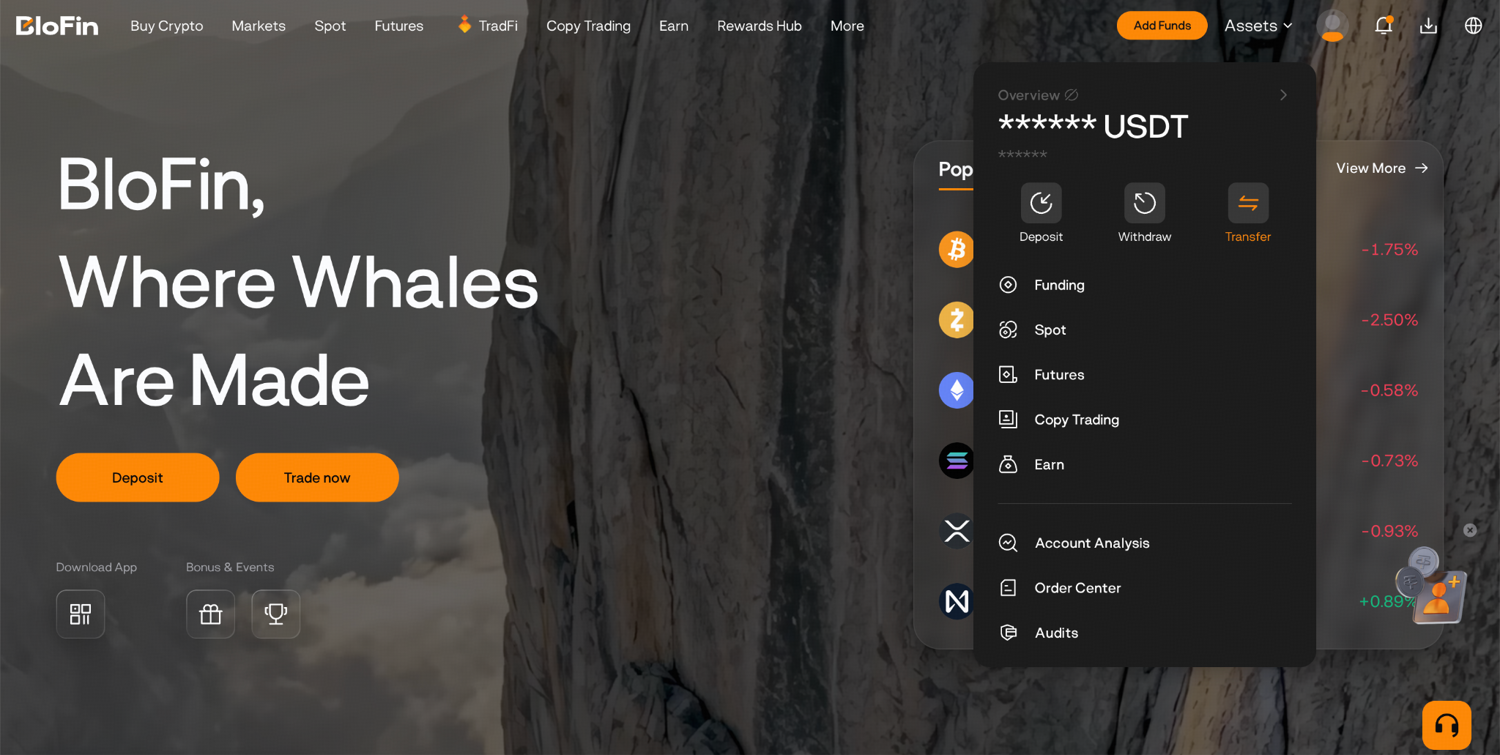
Step 1: Make sure you have USDT ready to trade. The order panel shows it as Available. If the figure is zero, deposit USDT and move it to your futures balance first, following BloFin's walkthrough for a first futures trade. Hover over the Assets tab and click Transfer.
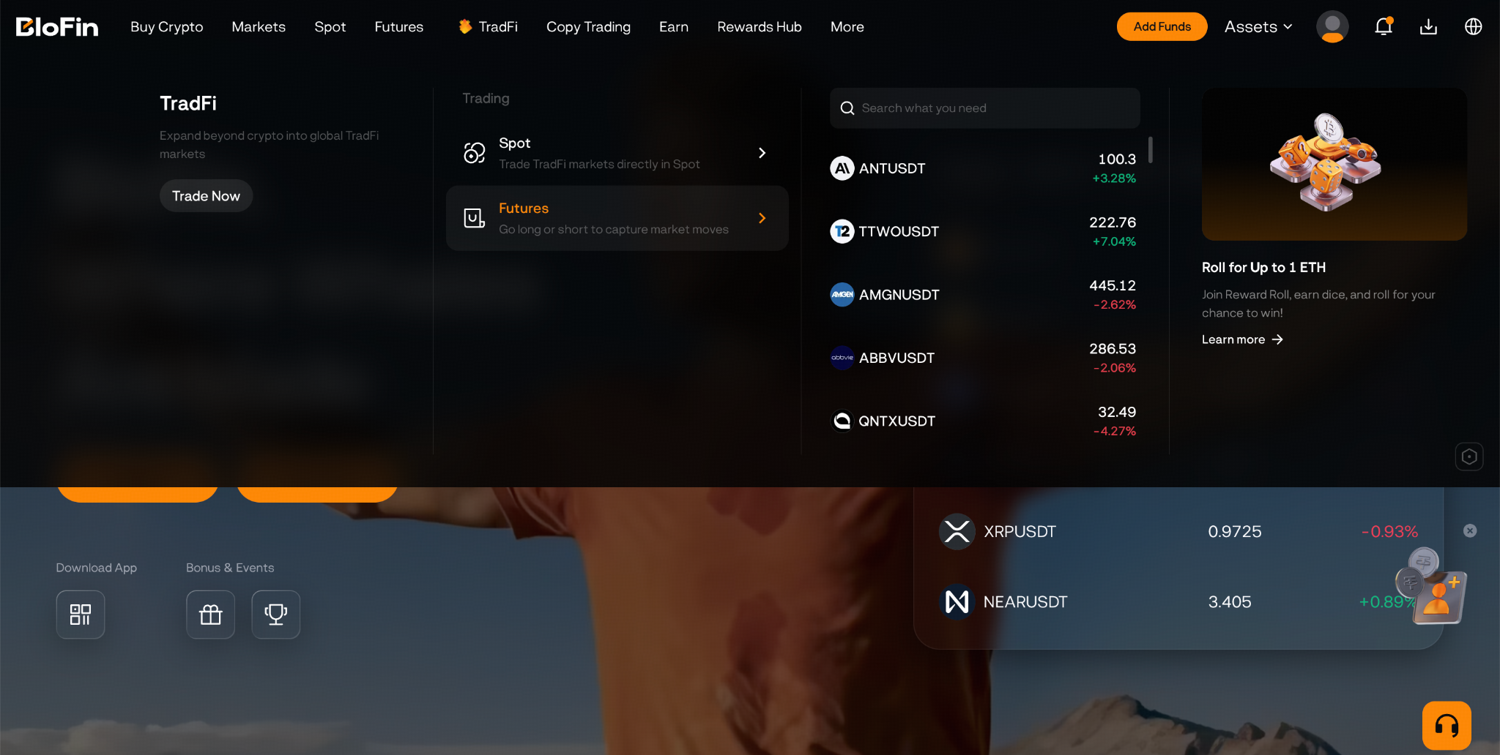
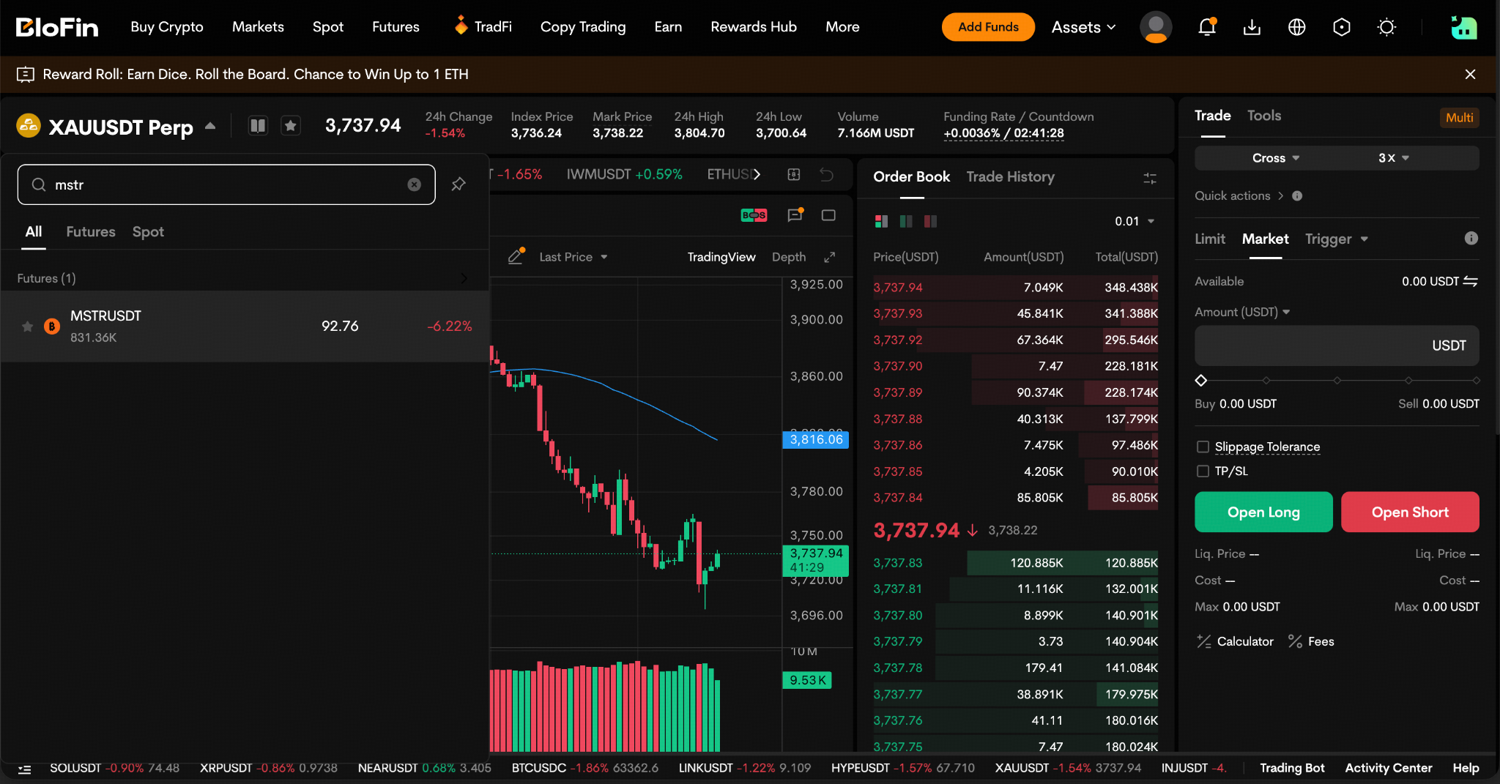
Step 2: Hover your cursor over the TradFi tab and click Futures. Then, click the trading pair at the top left corner and search for the MSTRUSDT Perpetual.
Step 3: Set the margin mode with the margin-mode button, which shows the mode in use, such as Cross. Isolated margin limits the risk to the collateral you assign to this one trade, while cross margin lets every open position draw on your whole account balance, as explained in this primer on crypto margin trading (source: Atomic Wallet Academy on margin modes). Because a short loses money as the price climbs, with no top to how far it can climb, the mode sets how much of your account one rally can reach.
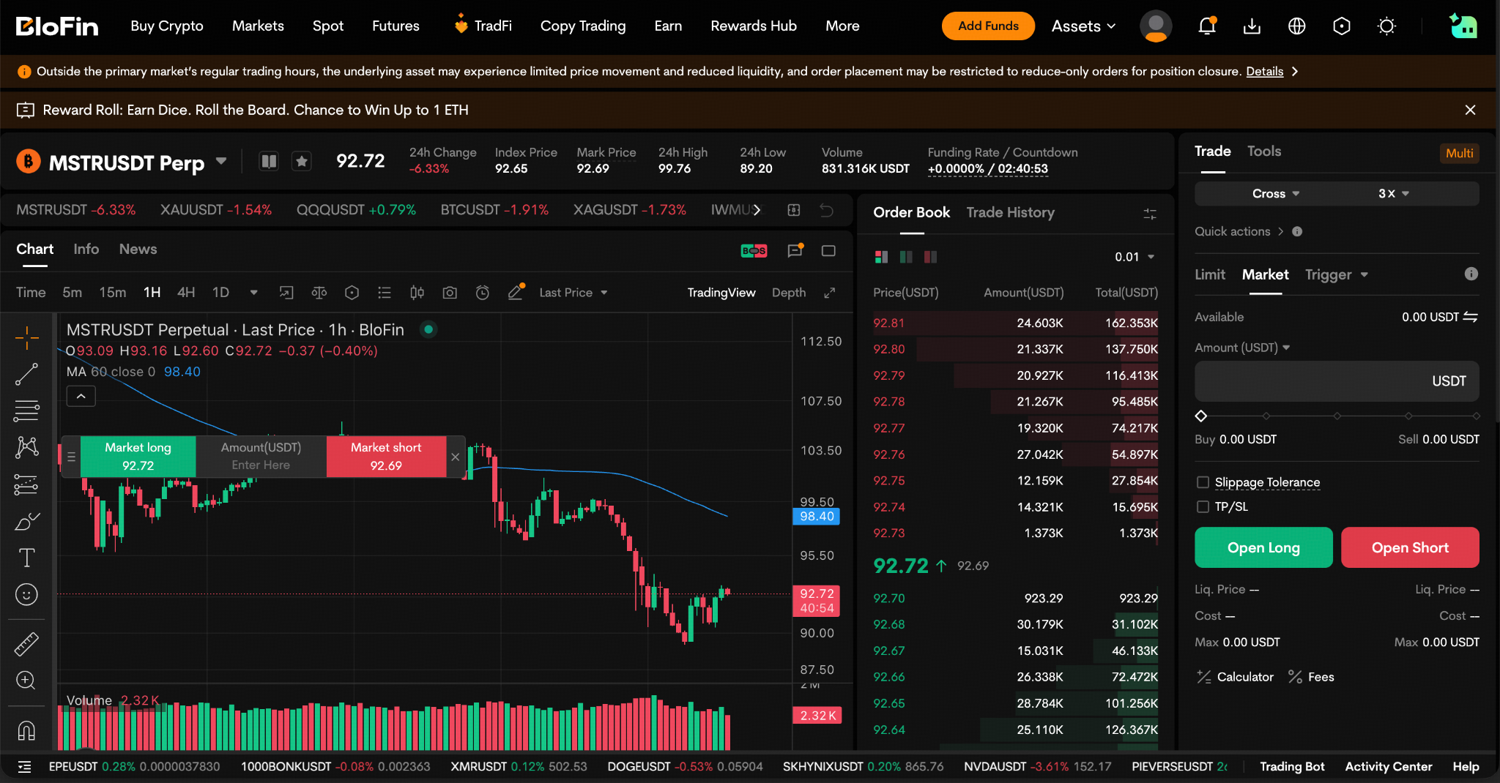
Step 4: Click the leverage button beside it, which shows your multiplier followed by an X, and choose from 1x to 20x. Strategy's shares already swing hard with bitcoin. In isolated margin, every step up in leverage pulls your liquidation price closer to your entry.
Step 5: Pick the order type. Limit lets you name your price in the Price box, and BBO, short for best bid or offer, sits beside that box. Market fills straight away at the best price available, and the panel lists a Trigger order as the third type.
Step 6: Enter your size in the Amount (USDT) box or drag the percentage slider, and check the Max figure, given in MSTR. Leave Reduce-only unticked, because it limits an order to shrinking a position you already have.
Step 7: Tick TP/SL to attach your take-profit and stop-loss prices. For a short, the stop-loss goes higher than your entry and the take-profit lower, the mirror image of a long. That stop works as a buy stop: it waits over the market and becomes a market order once its price trades, the usual way short sellers cap a loss (source: Investor.gov, Types of Orders).
Step 8: Read the Liq. Price under the Sell button. That is the estimated price at which BloFin would close your short for you. If your stop sits at or beyond it, cut the leverage until the stop comes first, then click Sell.
Step 9: Follow the open short under Positions. After any jump in bitcoin, set the page's mark price against the liquidation price you noted, since that distance is the rise your short can still take.
Position size sets what the stop costs in money. With the same leverage and the same stop distance, a short ten times larger loses ten times as much when the stop fires, 500 USDT instead of 50 USDT.

How to close an MSTR short
You close an MSTR short by buying back the same amount of the MSTRUSDT Perpetual, and the simplest place to do it is the Positions tab. Until then the short stays open, unless your take-profit or stop-loss fires first or BloFin liquidates it, because a perpetual never expires on its own.
Step 1: Find your MSTRUSDT short under Positions and close it there, at market or at a limit price you set, either in full or just a portion.
Step 2: Check Position History afterwards. Your profit or loss settles in USDT, and funding stops on whatever you closed.
A partial close leaves the rest of the short running, and BloFin's close-trade walkthrough shows the steps. A reduce-only window still lets you close, since a close from Positions only makes the position smaller. In Hedge mode, a Buy from the order panel opens a separate long instead of closing the short, so close from Positions.
Each close also costs a fee that depends on how the order fills. On BloFin's futures fee schedule, the Regular tier pays 0.0200% for a maker order, a resting limit order that another trader fills later, and 0.0600% for a taker order that fills at once (source: BloFin fee schedule). On a short you plan to close with a stop, assume the taker rate.
A worked MSTR short in round numbers
A short gains the price fall times its size and loses the price rise times its size, and leverage changes only how much margin backs it. In this illustrative example, you sell 10 MSTR at 100 USDT in isolated margin at 5x, which puts a 1,000 USDT position on 200 USDT of margin.
You place the take-profit at 90 USDT and the stop-loss at 105 USDT, and the numbers work out as follows, with the 0.0600% taker rate paid on the position's value when you open and when you close.
Outcome on a 10 MSTR short from 100 USDT (illustrative) | Price falls to 90 USDT | Price rises to 105 USDT |
|---|---|---|
Price gain or loss | +100.00 USDT | −50.00 USDT |
Opening fee | −0.60 USDT | −0.60 USDT |
Closing fee | −0.54 USDT | −0.63 USDT |
Net result before funding | +98.86 USDT | −51.23 USDT |
Share of the 200 USDT margin | +49.4% | −25.6% |
Where liquidation sits is the other half of the plan. A common estimate finds the price at which the margin left after your loss equals the maintenance margin, the smallest amount of margin the position must keep. MSTRUSDT's first position tier, for positions up to 600 MSTR, uses a maintenance margin rate of 2.50% in both margin modes (source: BloFin MSTRUSDT position tiers). For this short that gives about 117.07 USDT, a rise of 17.1%, ignoring fees, so the 105 USDT stop fires well before it.
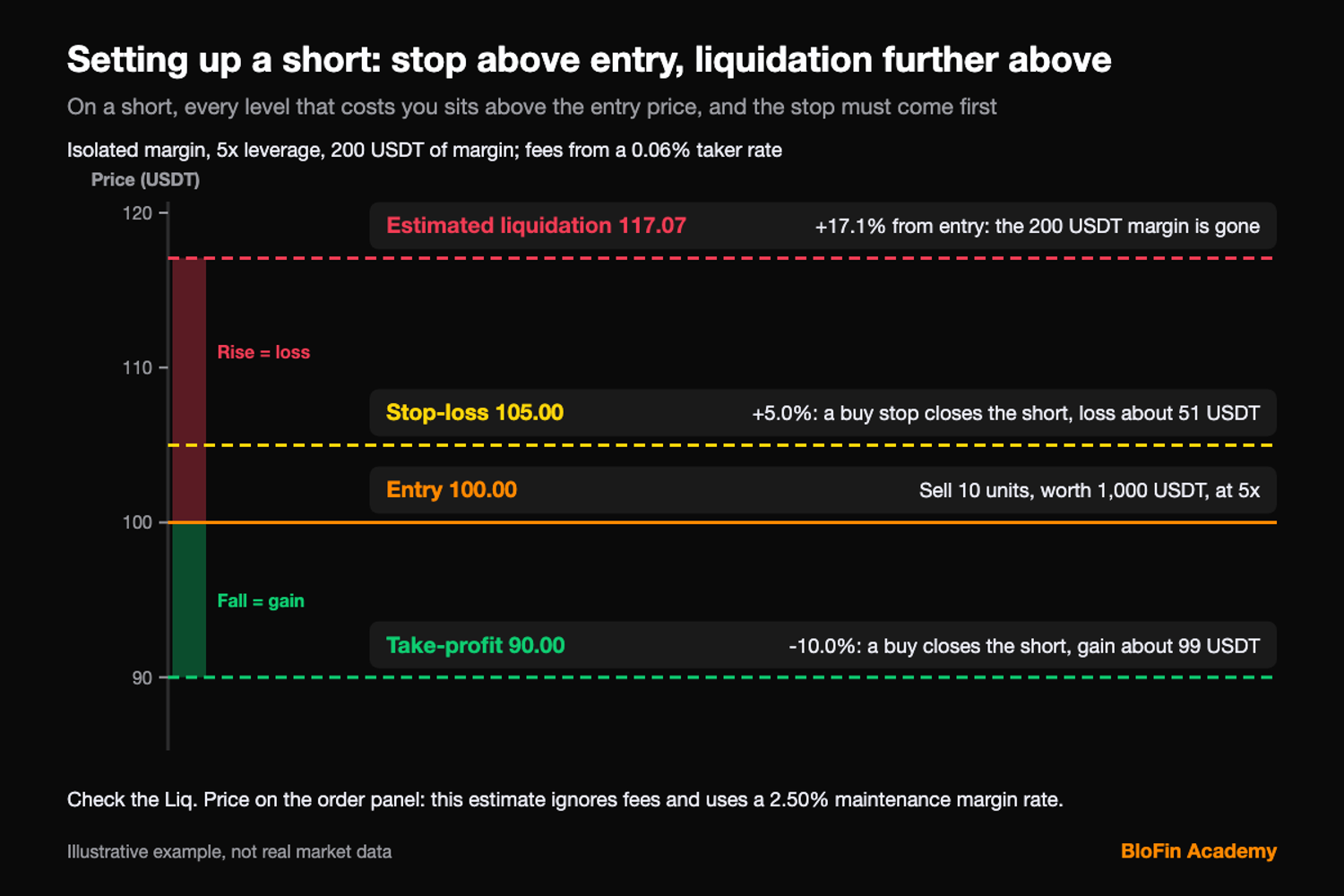
Leverage moves that level fast. In isolated margin, the same estimate puts liquidation near 146.34 USDT at 2x, 107.32 USDT at 10x and 102.44 USDT at 20x. In Cross mode, your whole futures balance stands behind the short as well, so liquidation sits higher. At 20x, liquidation would come before the 105 USDT stop could ever fire, so the stop would protect nothing. The figure that counts is the Liq. Price under the Sell button on the MSTRUSDT trading page, which includes BloFin's own inputs and shows how much of a rally your short can take before you sell.
Shorting the perpetual vs shorting MSTR shares at a broker
Shorting MSTRUSDT differs from shorting MSTR shares in what you owe while the trade is open. A broker short borrows real shares, so it can carry interest on the stock loan, which Interactive Brokers charges as a stock borrow fee (source: Interactive Brokers, Short Sale Cost), and the lender can want its shares back. A perpetual short borrows nothing, and its running cost is funding.
Point of difference | MSTR shares sold short at a broker | MSTRUSDT Perpetual short on BloFin |
|---|---|---|
What you sell | borrowed MSTR shares | a USDT-settled contract on MSTR's price |
Account needed | a margin account at a stock broker | a BloFin futures balance in USDT |
Holding cost | interest on the stock loan, plus other fees | funding at each settlement, paid or received |
Dividends | owed to the lender if one is paid | none, since the contract carries no shareholder rights |
Early close by someone else | a recall of the loaned shares can end in a buy-in | liquidation once losses use up the isolated margin |
Trading hours | Nasdaq's sessions | around the clock, with reduce-only windows possible outside Nasdaq hours |
A recall is the part of a broker short that the perpetual has no version of. Suppose the lender recalls the shares you borrowed and your broker cannot replace them within a day or two. The lender can then buy the shares in, at a price you do not choose, and the cost lands in your account (source: Interactive Brokers, Overview of short stock buy-ins and close-outs).
Funding replaces the borrow fee with one payment that can go either way. A positive rate takes money from the longs and hands it to the shorts, while a negative rate does the reverse (source: IG, How funding rates work in perpetual futures). So a funding rate that pays shorts on one settlement can charge them on the next. MSTRUSDT settled at −0.5316% at 12AM UTC on November 15, 2026, so the illustrative 1,000 USDT short would have paid about 5.32 USDT. At 12AM UTC on November 16 it settled at 0.0942% (source: BloFin, MSTRUSDT funding history). Each settlement is capped at 3% in either direction (source: BloFin MSTRUSDT market data), and the trading page shows the live rate before you sell.
Some of the short selling in MSTR shares is hedging. Hedge funds that buy convertible notes, the kind of bond Strategy has sold for years, often short the common stock to hedge, as Protos reported on April 13, 2026 (source: Protos, Strategy's STRC gives hedge funds a new reason to short MSTR). So a large short interest in MSTR shares partly reflects hedges sized to bonds, and it says little about who is short MSTRUSDT.
The most you can lose shorting MSTR
On a broker short, the loss has no theoretical cap, since a stock's price can keep rising. On an MSTRUSDT short, isolated margin risks the margin you put on that position, and cross margin backs it with everything in your futures balance. If the price gaps past your liquidation level, BloFin's insurance fund absorbs the shortfall, with auto-deleveraging behind it.
A short at a broker is margin trading, and the SEC's investor office lists what that can bring. It counts selling short among the uses of margin borrowing. It also warns that a margin account can lose more than was deposited and can face a margin call, a demand for more cash or securities at short notice (source: Investor.gov, Leveraged Investing Strategies). Short 10 MSTR shares at $100 and a run to $200 costs $1,000, and a run to $300 costs $2,000, with nothing in the trade to stop it there.
The perpetual puts a limit on that loss through the margin itself. In isolated margin, a liquidation takes the margin you assigned and leaves the rest of your balance alone, so the 5x example can lose its 200 USDT plus fees. In cross margin, a losing position draws on the whole account, and in extreme cases a cross position can liquidate the entire balance (source: Atomic Wallet Academy on margin modes). Bigger MSTRUSDT positions also carry higher maintenance margin rates and lower maximum leverage, from 20x in the first tier down to 1x for positions over 300,000 MSTR (source: BloFin MSTRUSDT position tiers).
The last question is what happens if MSTR jumps straight past your liquidation price before the position can be closed. The shortfall from a liquidation lands first on MSTRUSDT's insurance fund, which held 35,255.85 USDT at 3.50PM UTC on November 17, 2026 (source: BloFin MSTR contract details). If that fund falls short, BloFin can use auto-deleveraging, which closes opposing positions at the mark price, the most profitable first (source: BloFin, What Is Auto-Deleveraging (ADL)).
Risks specific to shorting Strategy
Three risks hit an MSTR short harder than a short on most stocks. Bitcoin keeps trading through the weekend while Nasdaq is shut, MSTR has jumped by double digits in a day when bitcoin rallies, and a Strategy 8-K on bitcoin buying usually lands on a Monday morning. Each can move the price against you at once.
Bitcoin's weekend moves while Nasdaq is shut
MSTR's regular Nasdaq session ends at Friday's close, while bitcoin and the MSTRUSDT Perpetual keep going. MSTR ended Friday, November 13, 2026 at $111.62 on Nasdaq (source: Nasdaq, MSTR historical prices). Over the weekend, the perpetual traded as low as 95.72 USDT on Saturday, 14.2% under that close, and on Monday Nasdaq opened at $103.735, 7.1% under Friday (source: BloFin MSTRUSDT market data, Nasdaq, MSTR historical prices).
That weekend favored shorts, and the same weekend gap can run the other way. A bitcoin rally on a Saturday lifts the perpetual while the shares stay shut, and a reduce-only window may leave you able to close but not to add (source: BloFin stock futures notice). A stop set for weekday trading can also fill well beyond its level after a jump.
Sharp rallies when bitcoin jumps
MSTR's biggest up days come when bitcoin rises too. In the 12 months to November 16, 2026, MSTR closed at least 10% higher on eight trading days, and bitcoin's daily UTC close rose on all eight of them (source: Nasdaq, MSTR historical prices, BloFin price data).
The largest was February 6, 2026. MSTR rose 26.1% that day, from $106.99 to $134.93, while bitcoin rose 12.2% over the same dates (source: Nasdaq, MSTR historical prices, BloFin price data). A rise like that goes past the 17.1% that liquidates the 5x isolated-margin example. It also clears any stop placed for a normal day, so the stop distance on an MSTR short is best tested against days like that one.
Monday morning 8-K filings
Strategy reports its bitcoin buying in a Form 8-K, and it usually files on a Monday morning. Of its 65 Form 8-K filings in 2026 through November 16, 45 went in on a Monday (source: SEC EDGAR, Strategy 8-K filings). The SEC accepted 42 of those Monday filings before Nasdaq's 9.30AM ET open.
The latest was accepted at 8AM ET on Monday, November 16, 2026 (source: SEC EDGAR, filing index for the November 16, 2026 Form 8-K). It reported 485 bitcoin bought for $33.4 million from November 9 to November 15, paid for out of MSTR share sales. That week Strategy raised $244.7 million by selling 2,087,040 new MSTR shares, and $206.3 million of it went on buying back its STRC preferred stock (source: Strategy Form 8-K filed November 16, 2026). A filing like that lands before Nasdaq's 9.30AM ET open while the perpetual is already trading, so MSTRUSDT can react before the regular session starts.
Checks before you place an MSTR short
Four checks before you press Sell catch most of what goes wrong on an MSTR short. The stop sits higher than the entry and lower than the Liq. Price. You know the loss at the stop in USDT, fees included. You know which side funding last paid, and whether a weekend or Monday 8-K falls inside your holding time.
Strategy's share price has fallen hard this autumn, and the same stock closed at least 10% higher on eight separate days in the past year. A short on the perpetual removes the borrowing, the recall and the borrow fee from that trade, and it leaves the price risk exactly where it was. If the stop distance only works on a quiet day, the trade is too large or the leverage too high.
Want to test an MSTR short plan before a bitcoin jump tests it for you? The MSTRUSDT order panel has a TP/SL option, so the stop above your entry can go in with the order itself. To get started, you'll need to first create a BloFin account, fund your account with cryptocurrency, and go to the MSTRUSDT Perpetual trading page.

Frequently asked questions
How large can one MSTRUSDT order be?
One MSTRUSDT market order tops out at 700 MSTR and one limit order at 7,000 MSTR, while the smallest order is 0.01 MSTR, which is one contract (source: BloFin MSTR contract details). A short larger than 700 MSTR therefore goes in as a limit order or as several market orders, and each fill is priced separately.
Can you short Strategy's preferred stock on BloFin?
None of Strategy's preferred shares, STRK, STRF, STRD, STRC or STRE, is listed on BloFin. The STRK-USDT market on BloFin is Starknet, a crypto token that happens to share the ticker (source: BloFin MSTRUSDT market data). The only Strategy contract to short on BloFin is the MSTRUSDT Perpetual on the common stock.
Can you short MSTU, the 2x MSTR fund, on BloFin?
Yes. BloFin lists the MSTUUSDT Perpetual, a contract on a fund its listing notice names as T-Rex 2X Long MSTR Daily Target ETF, whose ticker is MSTU, with leverage from 1x to 20x and 0.1 MSTU per contract. It started trading at 11.30AM UTC on October 12, 2026 (source: BloFin MSTU listing notice). Between the November 13 and November 16, 2026 closes, MSTU fell 15.5% while MSTR fell 7.7%, about twice the move (source: Nasdaq, MSTU historical prices, Nasdaq, MSTR historical prices).
How does auto-deleveraging work on BloFin?
Auto-deleveraging starts when an insurance fund runs short or loses 30% of its peak value within eight hours, a threshold BloFin can adjust. BloFin then closes positions held against yours at the mark price. Its queue puts profitable positions ahead of losing ones, and within that order the highest return and the lowest margin ratio come first. A five-light indicator on each position shows its place in that queue (source: BloFin, What Is Auto-Deleveraging (ADL)).
Does an MSTRUSDT position give you any rights in Strategy?
An MSTRUSDT position gives you exposure to the share price and nothing more. Under BloFin's stock futures notice, these contracts are not securities and give you no ownership of the shares behind them, so they pay no dividends and carry no votes or other shareholder rights (source: BloFin stock futures notice). A short therefore owes no dividend either, which a broker short of the shares would have to cover if Strategy ever paid one.
Researched and written by the BloFin Academy editorial team with AI-assisted drafting. All facts independently verified. Primary sources include Strategy's Form 8-K filed November 16, 2026 and its 8-K filing record on SEC EDGAR, Nasdaq's daily price histories for MSTR, MSTU and bitcoin, and Investor.gov's guides to short sales, order types and leveraged investing. Other sources are Interactive Brokers on short-stock buy-ins and borrow fees, IG on funding rates, Atomic Wallet Academy on margin modes and Protos on convertible-note hedging. BloFin facts come from its MSTR contract details, position tiers, funding history, fee schedule, stock futures notice, MSTU listing notice, auto-deleveraging FAQ and MSTRUSDT market data, current as of November 17, 2026.
Nothing in this article constitutes financial advice, and nothing in it is a recommendation to buy, sell, hold or short Strategy in any form. A short on the MSTRUSDT Perpetual loses money when the price rises, and MSTR has risen more than 20% in a single day when bitcoin rallied, enough to liquidate a 5x short in isolated margin and to carry a stop well past its level. Funding can turn against a short at any settlement, and outside Nasdaq hours you may only be able to reduce a position. Past performance does not indicate future results. Do your own research and consider your risk tolerance before you trade on BloFin.