
A number of listed companies keep bitcoin as a treasury asset, the way other firms hold cash or government bonds. For a few of them, the coins are now the biggest thing they own. Their shares then rise and fall with the crypto market as much as with anything the business sells.
That creates an awkward problem for someone whose money already sits in crypto. The best-known of these companies is listed on a US stock exchange, so buying its shares usually takes a brokerage account, a switch into dollars and an order placed during New York market hours. Each step takes time, and the price keeps moving while you set them up.
Crypto exchanges offer a shorter path through stock perpetuals, which are futures contracts with no end date pegged to one company's share price. You post USDT as margin, and you can go long or short on the price. Profits and losses settle in USDT, so you trade the price without owning a single share.
The company is Strategy, formerly MicroStrategy, and BloFin lists its stock as the MSTRUSDT Perpetual with leverage of up to 20x. Before choosing how to trade it, it helps to know what one MSTR share is, what it is tied to and why it moves so sharply.
What is MSTR stock?
MSTR stock is the Class A common stock of Strategy Inc, the company once called MicroStrategy, listed on Nasdaq under the ticker MSTR. Its main asset is bitcoin, with 850,849 coins held on November 15, 2026. It also still runs an AI-powered analytics-software business (source: Strategy Form 8-K filed November 16, 2026, Strategy Form 10-K for 2025).
A share count turns that into a size. Strategy's latest quarterly report counted 402,714,357 Class A shares and 19,640,250 Class B shares on October 25, 2026, which makes 422,354,607 in all (source: Strategy Form 10-Q for the third quarter of 2026). At the Nasdaq close of $103.03 on November 16, 2026, all of those shares were worth about $43.5 billion (source: Nasdaq MSTR historical data). That figure is the company's market cap, and it moves whenever the share price does.
Detail | MSTR stock |
|---|---|
Company | Strategy Inc (formerly MicroStrategy Incorporated) |
Head office | Tysons Corner, Virginia |
Incorporated in | Delaware |
Exchange and ticker | The Nasdaq Global Select Market, MSTR |
Listed share class | Class A common stock (1 vote each) |
Class A shares (October 25, 2026) | 402,714,357 |
Class B shares (October 25, 2026) | 19,640,250 (10 votes each) |
Fiscal year | the calendar year |
The same report shows Class A as Strategy's only common stock on an exchange, with four preferred stocks beside it under their own tickers (source: Strategy Form 10-Q for the third quarter of 2026). A Class B share has ten votes and a Class A share has one (source: Strategy Form 10-K for 2025). That gives Class B far more weight in control than its 4.7% slice of the share count suggests. For a buyer the rule is simpler: the stock you can trade is Class A, and the company behind it runs Strategy's two businesses side by side.
Strategy and MicroStrategy: One company, several tickers
Strategy and MicroStrategy are one company with two names, and it was already using Strategy as a trade name by February 5, 2025. On August 11, 2025, it changed its legal name from MicroStrategy Incorporated to Strategy Inc, and the Class A stock kept the ticker MSTR the whole time (source: Strategy Form 8-K of February 5, 2025, Strategy's name-change Form 8-K).
Those two dates explain why both names still appear. A filing from February 5, 2025 already called the company "MicroStrategy Incorporated d/b/a Strategy" (source: Strategy Form 8-K of February 5, 2025). D/b/a means "doing business as", so the brand changed while the legal name stayed put. The legal change followed six months later and took effect on Nasdaq at the open on August 12, 2025 (source: Strategy's name-change Form 8-K). Plenty of searches, headlines and older broker screens still say MicroStrategy, and they all mean the company behind MSTR.
The ticker list is where a crypto reader can trip. Strategy also has four preferred stocks on Nasdaq: STRF, STRC, STRK and STRD (source: Strategy Form 10-Q for the third quarter of 2026). They pay dividends, and the annual report calls them "digital credit" as a group (source: Strategy Form 10-K for 2025). On BloFin, STRK-USDT is the Starknet crypto token, which has nothing to do with Strategy's STRK preferred, and none of Strategy's preferred stocks trades on BloFin.
Old charts need one more adjustment. Strategy split its Class A and Class B stock 10-for-1, with split-adjusted trading from the open on August 8, 2024 (source: Strategy's stock-split announcement). Today's charts divide every earlier MSTR price by ten, so a price in a 2024 headline can look ten times higher than the same day on a modern chart. MSTR's full price record shows every period on that adjusted basis.

What does MSTR stock do?
MSTR stock gives you a stake in a company whose biggest asset is bitcoin. Strategy held 850,849 bitcoin on November 15, 2026, and it paid $64.2 billion for them in total, an average of $75,452 per coin (source: Strategy Form 8-K filed November 16, 2026). When bitcoin rises or falls, the value behind each share moves the same way.
You can measure that link by dividing the 850,849 coins held on November 15 by the 422,354,607 Class A and Class B shares the quarterly report counted on October 25. On that basis, each MSTR share stands for about 0.002 bitcoin, or 2.01 bitcoin per 1,000 shares. Strategy has sold more shares since October 25, including 2,087,040 in the week to November 15, so bitcoin per share on November 15 itself was slightly lower (source: Strategy Form 8-K filed November 16, 2026). Bitcoin per share is the starting point for Strategy's mNAV, which compares the share price with the value of the coins behind it. The shares also tend to swing harder than the coin, partly because the debt and preferred stock that rank ahead of the common shares make each share's slice of the bitcoin rise and fall faster than the coin. That pattern is the core of why MSTR moves more than bitcoin.
The software side is real but small next to the coins. Total revenue for the third quarter of 2026 was $125.4 million, while the bitcoin on the balance sheet was worth $70.8 billion at fair value on September 30 (source: Strategy Form 10-Q for the third quarter of 2026). The annual report calls Strategy the world's first and largest Bitcoin Treasury Company, and only after that does it describe the AI-powered analytics software (source: Strategy Form 10-K for 2025).
Strategy values its bitcoin at the market price every quarter, so its profit swings with the coin. In the third quarter of 2026 it reported operating income of about $21 billion on that $125.4 million of revenue. Almost all of it came from the rise in its bitcoin's value (source: Strategy Q3 2026 earnings release). A profit that size says more about bitcoin's quarter than about the business, so keep that in mind when reading Strategy's quarterly results. The coins themselves come from a cycle of raising money and buying bitcoin that Strategy keeps repeating.
What moves the MSTR share price
Four things move MSTR most: the bitcoin price, the premium or discount the market puts on Strategy's bitcoin (its mNAV), Strategy's sales of new shares, and index decisions that force funds to buy or sell. The software business rarely moves the shares on its own, so a day's big move usually starts with one of these.
Driver | What changes for a shareholder | Where it is published |
|---|---|---|
Bitcoin price | the value of the coins behind each share | any bitcoin price page; Strategy's weekly Form 8-K shows what it paid |
mNAV (market value against bitcoin value) | how much you pay for each dollar of bitcoin the company holds | data trackers, each with its own definition |
Share issuance | the number of shares that own the same bitcoin | the weekly Form 8-K and each quarterly report |
Index decisions | forced buying or selling by index funds | index providers' announcements |
Bitcoin comes first, and Strategy's own buying shows where the coin stands against its cost. From November 9 to 15, 2026, Strategy bought 485 bitcoin at an average of $68,887. That is 8.7% below the $75,452 average it has paid across all its holdings (source: Strategy Form 8-K filed November 16, 2026). So in that week, bitcoin was trading below what the company had paid for its coins on average.
The mNAV adds the market's own verdict on top. The Block describes enterprise mNAV as the company's overall market value, counting debt, cash and preferred stock, set against the value of its bitcoin. It reported that reading slipping below 1 on June 26, 2026 (source: The Block). The same day brought MSTR's lowest close of the past year, $82.31 (source: Nasdaq MSTR historical data). An mNAV below 1 means investors were valuing the whole company at less than the bitcoin it holds.
Issuance is how Strategy pays for most of its coins. In that same November week it sold 2,087,040 new Class A shares for $244.7 million in net proceeds. Only $33.4 million of it bought the 485 bitcoin, while $206.3 million went on buying back STRC preferred stock and $5.0 million stayed as cash (source: Strategy Form 8-K filed November 16, 2026). Selling shares above the bitcoin value each one stands for can raise bitcoin per share. Selling below it lowers that figure, which is why mNAV and issuance are usually read together.
Index decisions are the fourth force, and Nasdaq added MSTR to the Nasdaq-100 before the open on December 23, 2024 (source: Nasdaq's annual changes to the Nasdaq-100). In mid-November 2026 it made up less than 0.2% of that index (source: Stock Analysis Nasdaq-100 list). An index fund must buy a stock when it joins and sell it when it leaves. What the managers think of the company does not change that, and MSTR faces this kind of decision at the end of November 2026.
MSTR in November 2026: The MSCI removal and the sell-off
MSCI, which runs indexes that many global funds track, confirmed on November 11, 2026 that it will drop Strategy from its global equity indexes after the close on November 30, Crypto Briefing reported. MSCI's new screen removes companies whose main activity is holding assets, the way a fund does, rather than running a business (source: Crypto Briefing).
JPMorgan had previously estimated that the exclusion could trigger roughly $2.8 billion of selling (source: Cointelegraph). The shares were already falling as bitcoin weakened, and MSTR closed at $128.93 on November 6, 2026 and at $103.03 on November 16. That is a fall of 20.1% in six trading sessions, including 7.7% on November 16 alone. Against its close a year earlier, on November 14, 2025, the share was down 48.4% (source: Nasdaq MSTR historical data).
Strategy kept buying through the slide and added the 485 bitcoin in the week of November 9 to 15 (source: Strategy Form 8-K filed November 16, 2026). These events overlap, and no single filing pins the fall on one cause. For a holder, the first useful question is what MSCI's new rule tests and how index funds respond to it. The next is the reasons reported for the fall, taken one at a time. The removal only takes effect after November 30, so for now it is an announced change still to come.
Ways to get MSTR exposure
A crypto holder has four routes to MSTR exposure. Outside BloFin, you can buy Class A shares through a broker or buy a leveraged fund that tracks MSTR. On BloFin, you can trade the MSTRUSDT Perpetual on Strategy's share price or the MSTUUSDT Perpetual on a 2x MSTR fund. Only the first route makes you a shareholder of the company.
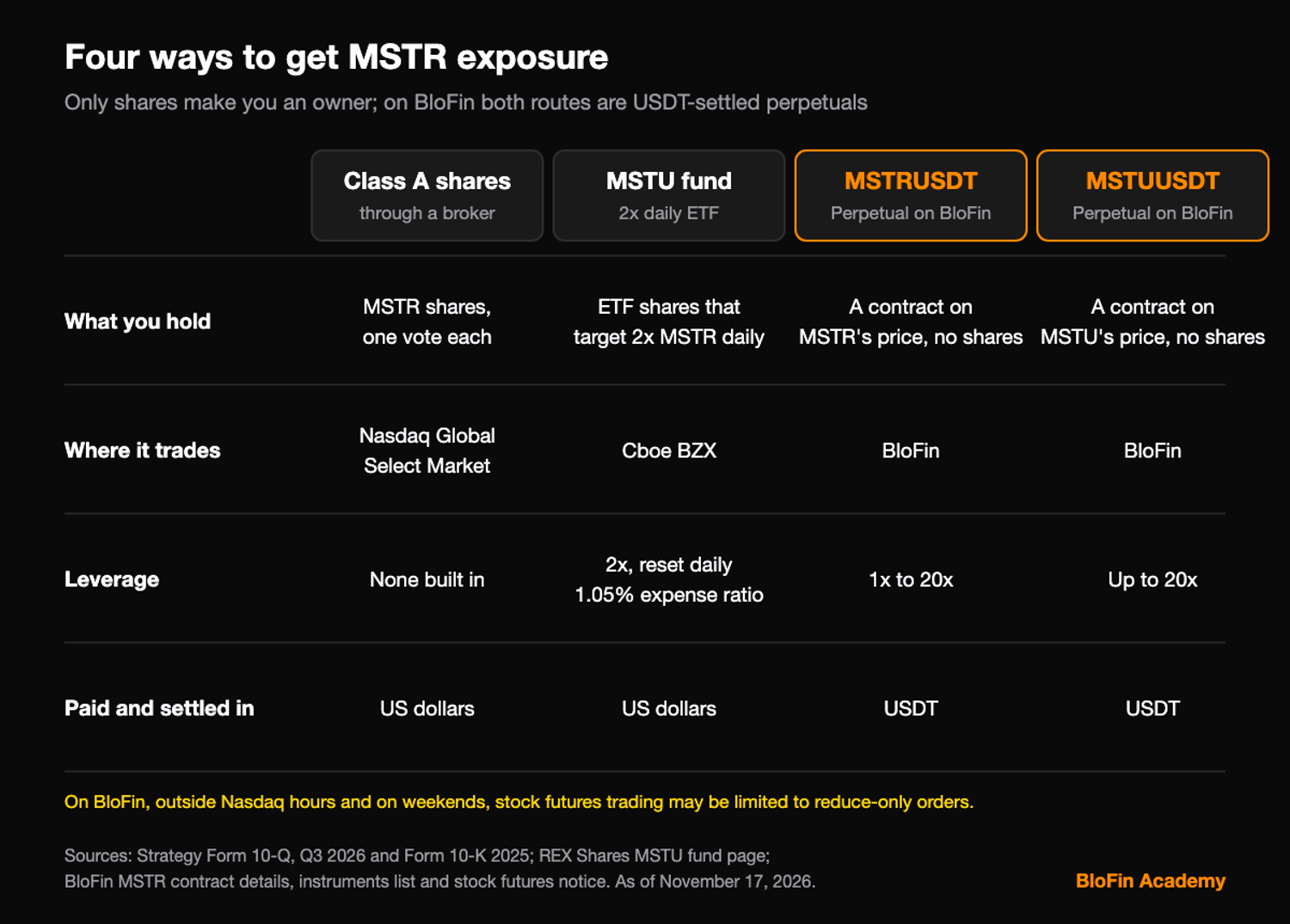
A broker is the direct route, where you open an account that can trade US stocks, convert your money to dollars and buy shares, or a fraction of one at some brokers. The shares are then yours, each with its Class A vote, and they trade on the Nasdaq Global Select Market (source: Strategy Form 10-Q for the third quarter of 2026).
A 2x fund is the leveraged route, and the T-REX 2X Long MSTR Daily Target ETF, ticker MSTU, aims for twice MSTR's daily move before fees. It lists on Cboe BZX and has a total expense ratio of 1.05% (source: REX Shares MSTU fund page). The issuer says the target holds for a single trading day only, so over a week or a month, the fund's return can drift away from twice MSTR's.
On BloFin, the route is a perpetual, and BloFin lists the MSTRUSDT Perpetual on Strategy's share price and the MSTUUSDT Perpetual on the MSTU fund, both with up to 20x leverage. It has no Strategy spot token and no MSTRX pair for the shares. Before choosing between the two, weigh leverage on a fund that already doubles MSTR against the same leverage on MSTR itself.
Choosing among the four comes down to whether you want to hold the share itself or just follow its price, and whether your money is in dollars or in USDT. If you want to act on Strategy's moves from a USDT balance, BloFin's fee page lists what each trade costs. You can then weigh that cost against the hours and leverage of each option.
Trading MSTR on BloFin
The MSTRUSDT Perpetual follows Strategy's share price, takes USDT as margin and never expires. The smallest order is 0.01 MSTR and leverage runs from 1x to 20x. Funding passes between longs and shorts on a normal schedule of 12AM, 8AM and 4PM UTC. The rate for each funding period is capped at 3% either way (source: BloFin MSTR contract details, BloFin MSTRUSDT market data).
The contract gives you price exposure and nothing more: you hold a position, not a share, so no Class A vote comes with it. How perpetuals differ from dated futures explains why a perpetual can run without a settlement date. Funding keeps its price close to the share's, since longs pay shorts while the rate sits above zero, and the payment flips direction once it dips below.
To see the numbers, say you put 100 USDT of margin behind a 5x long. The MSTRUSDT last price was 103.02 USDT at 7.16AM UTC on November 17, 2026. At that price, 4.85 MSTR makes a position worth about 499.65 USDT, which needs about 99.93 USDT of margin. A 5% rise would gain about 24.98 USDT before fees and funding, a quarter of your margin, and a 5% drop would cost you the same amount. A short works the other way and gains when the price falls.
Leverage is why a 5% move costs a quarter of your margin, and a bigger move against you can end in liquidation. Check your liquidation price before opening the trade, and know which price BloFin uses for it, because mark price and last price can briefly part ways in a fast market.
Trading hours follow Nasdaq more than crypto. Strategy's shares trade from 9.30AM to 4PM ET, Monday to Friday, which in UTC is 2.30PM to 9PM during US standard time. Outside that window, and when the markets are shut for weekends and holidays, BloFin's notice says stock futures, the MSTRUSDT Perpetual among them, "may be limited to reduce-only orders" (source: BloFin stock futures notice). So plan any new position for the Nasdaq session. The price limits, the insurance fund and the rest of the contract's full terms are worth reading before your first order.
Following Strategy into the MSCI change at the end of November? To get started, you'll need to first create a BloFin account, fund your account with cryptocurrency, and go to the MSTRUSDT Perpetual trading page.

Frequently asked questions
Does MSTR stock pay a dividend?
Strategy does not currently pay dividends on its Class A common stock, the share that trades as MSTR, and its annual report says so plainly (source: Strategy Form 10-K for 2025). The dividends that show up in Strategy's news belong to its preferred stocks. By late October 2026, the company had sold about $431.8 million of bitcoin during the year. That money helped pay those preferred dividends and buy back some STRC preferred shares (source: Strategy Q3 2026 earnings release).
What are MSTR's CUSIP and ISIN?
MSTR's CUSIP is 594972408. A CUSIP is the nine-character code US markets give each security, and this one appears on a 2026 Schedule 13G/A ownership filing for Strategy's common stock (source: Capital International Investors Schedule 13G/A). The ISIN, the code used by markets worldwide, is US5949724083. It starts with US for the country, adds the nine CUSIP characters and ends with a check digit calculated from the rest. With either code, you can check that a broker listing is Strategy's Class A stock rather than a fund or a preferred share.
How does the SEC classify Strategy?
The SEC files Strategy under industry code 6199, finance services, and assigns the company's filings to the Office of Crypto Assets in its Division of Corporation Finance (source: SEC EDGAR company page for Strategy). The same EDGAR page lists MicroStrategy as a former name for filings through August 11, 2025. Strategy still describes an AI-powered analytics software business beside its bitcoin, so data sites use both labels.
Can you trade MSTR on the weekend?
Nasdaq does not open on Saturdays or Sundays, yet the MSTRUSDT Perpetual on BloFin kept printing trades across November 14 and 15, 2026. Its lowest trade that weekend was 95.72 USDT on Saturday, November 14, about 14.2% below Friday's Nasdaq close of $111.62 on November 13 (source: BloFin MSTRUSDT market data, Nasdaq MSTR historical data). Those prints show trades took place, but for stock futures in closed hours BloFin's notice adds that activity "may be limited to reduce-only orders". Under that limit an order may only cut an existing position, so a fresh trade would wait for the Nasdaq session.
Why does MSTR's market cap differ between websites?
A site's market cap depends on the shares it counts and the price it uses. Counting only the 402,714,357 Class A shares at the November 16, 2026 close gives about $41.5 billion. Adding the 19,640,250 Class B shares lifts that to about $43.5 billion (source: Strategy Form 10-Q for the third quarter of 2026, Nasdaq MSTR historical data). A site working from an older share count, or a price from another moment, ends up with yet another figure.
Researched and written by the BloFin Academy editorial team with AI-assisted drafting. All facts independently verified. Primary sources include Strategy's Form 8-K filed November 16, 2026, its Form 10-Q for the third quarter of 2026, its Form 10-K for 2025, its name-change Form 8-K of August 2025, its Form 8-K of February 5, 2025, its 2024 stock-split announcement, its Q3 2026 earnings release, a Schedule 13G/A filing, the SEC's EDGAR company page, Nasdaq's Nasdaq-100 announcement and MSTR historical data, the Stock Analysis Nasdaq-100 list, the REX Shares MSTU fund page, The Block, Crypto Briefing and Cointelegraph. BloFin's sources are its MSTR contract details, instruments list, market data and stock futures notice, current as of November 17, 2026.
Nothing in this article constitutes financial advice, and nothing in it is a recommendation to buy, sell or hold Strategy in any form. MSTR's price is tied to bitcoin, the shares fell 48.4% over the past year, and index removals can add forced selling on top. The MSTRUSDT Perpetual gives you no share or vote, its funding payments, normally every eight hours, can cost you money, and at high leverage a move of a few percent can liquidate your margin, including while Nasdaq is closed and you may only be able to reduce a position. Past performance does not indicate future results. Do your own research and consider your risk tolerance before you trade on BloFin.