
Few big companies have been as closely tied to one person as Nvidia was to its co-founder Jensen Huang. He started the chipmaker in 1993 and ran it for 33 years. On November 12, 2026, the board said he had resigned as chief executive and as a director, effective at once. The news came after weeks of reports about his private life and a board investigation into national security concerns. Colette Kress, the chief financial officer, is now interim CEO while the board looks for a permanent one (source: Nvidia, November 12, 2026).
The share price showed how much investors had tied to him. Nvidia stock opened on November 12 at $151.01, 13.1% below the previous close, and recovered during the day to finish at $166.19, down 4.3% (source: calculated from Yahoo Finance data). About 743 million shares changed hands, roughly six and a half times a normal day from August to October 2026. Rival chipmakers went the other way. From November 4 to November 12, Nvidia fell 17.0% while AMD rose 19.7% and Broadcom 11.9% (source: calculated from Yahoo Finance data).
Investors call this key man risk, and in Nvidia's case it hit the company's own shares far harder than the rest of the chip sector or the S&P 500. BloFin lists a USDT-settled perpetual contract on the company, the NVDAUSDT Perpetual, along with contracts on AMD and Broadcom.
What happened to Jensen Huang?
On November 12, 2026, Nvidia announced that Jensen Huang had resigned as its president, chief executive and board member. He left after reports that he had an affair with a woman whom US officials reportedly believe worked for Chinese intelligence, and later reports of relationships with Nvidia staff. Nvidia's announcement gave no reason, and the allegations come from news reports.
The events took about two weeks, and the dates matter because the stock reacted to each step.
Date (2026) | What happened |
|---|---|
Late October | The New York Times reported a close relationship between Huang and an executive at Megaspeed, a Singapore buyer of Nvidia chips that US officials had been investigating for more than a year |
November 8 | Nvidia's board opened an independent investigation into reports that Huang had been the target of a foreign intelligence effort, and Huang told staff he had been unfaithful to his wife |
November 10 | The independent directors hired Joon H. Kim, a former acting US Attorney, and the law firm Wachtell, Lipton, Rosen & Katz to run the investigation |
November 11 | The New York Times reported a second relationship, with an Nvidia vice president who reported to Huang, and the board accepted his resignation |
November 12 | Nvidia announced the resignation, named Kress interim CEO and appointed Harvey C. Jones as the board's first chair |
November 17 | Nvidia's third-quarter results, kept on their original date |
(source: Nvidia, November 8, 2026, Nvidia, November 10, 2026, TechCrunch, November 12, 2026, CNBC, November 8, 2026)
In its first statement, the board said it had "no reason to believe" that national security or Nvidia's secrets had been compromised. It added that its inquiry would look at all the information available (source: Nvidia, November 8, 2026). Huang has since agreed to answer questions from Congress in a closed-door session, according to TechCrunch.
What is key man risk?
Key man risk is the chance that a company loses value because it relies heavily on one person, usually a founder or chief executive. If that person leaves, falls ill or is caught up in a scandal, the company's plans, customer ties or decisions can suffer. It is also called key person risk.
Every company depends on its leaders to some degree, so the question is how much. The risk is highest when one person makes most of the big decisions, holds the key relationships and has no clear successor. In that case a company can lose value even though its products, contracts and factories are the same the day after the exit. Investors are pricing the decisions that person would have made over the next ten years.
Nvidia scored high on all three counts. Huang ran the company from its founding and has said about 60 people report directly to him. The company had no obvious successor or succession plan, according to TechCrunch (source: TechCrunch, November 12, 2026). His exit left investors with a question the products alone could not answer: who makes the next big decision?
Say you own $1,000 of Nvidia stock bought at the November 4 close of $200.13. By the November 12 close of $166.19 it was worth about $830, a loss of $170 (source: calculated from Yahoo Finance data). That $170 was lost over six trading days that also brought news of the reported conduct, the investigation and the exit of the person who ran the company. Not all of it was about Huang, because AMD and Broadcom also fell sharply on November 5.

How did Nvidia stock react to Huang's resignation?
Nvidia stock fell in two sharp steps, and each one was a gap between one day's close and the next day's open. A gap happens when news arrives while the market is shut. The stock then opens at a new price without trading at the levels in between, which is why both drops arrived at once.
The first gap followed the board's investigation and Huang's message to staff on Sunday, November 8. The stock closed on Friday at $186.64 and opened on Monday at $173.07, 7.3% lower. The second followed the board accepting his resignation on November 11. It closed that day at $173.73 and opened on November 12 at $151.01, 13.1% lower.
The second day shows how a first reaction can differ from where a stock settles. Nvidia touched $148.80 during the session, 14.3% below the previous close. It then climbed about 12% from that low to close at $166.19, which was 4.3% below the day before and 17.0% below November 4 (source: calculated from Yahoo Finance data).
The fall did not start with the scandal. Nvidia's highest close of the past year was $239.24 on October 6, 2026. By October 30 it had already slipped to $204.64, before the board opened its investigation, and from the October high to the November 12 close it fell 30.5%. Part of that fall was shared with the whole sector. On November 5 alone, Nvidia lost 9.3%, AMD 17.3% and Broadcom 10.4% (source: calculated from Yahoo Finance data).
Trading volume tells you how many investors changed their minds at once. On November 12 about 743 million Nvidia shares traded, against an average of about 114 million a day from August to October 2026. Six and a half times the usual volume means many holders sold at the same time, and just as many buyers took their shares at lower prices.
Why did AMD and Broadcom rise while Nvidia fell?
AMD and Broadcom rose while Nvidia fell, a split that suggests investors saw Huang's exit as a risk to Nvidia itself rather than to the AI-chip business as a whole. From November 4 to November 12, 2026, Nvidia fell 17.0% while AMD rose 19.7%, Broadcom rose 11.9% and the chip maker TSMC rose 2.5% (source: calculated from Yahoo Finance data).
That split is the difference between company-specific risk and sector risk. A sector risk, such as a drop in data-center spending, hits every company that sells into that market, and on November 5 all four stocks fell together. A company-specific risk hits one name. The money that leaves it often goes to its rivals, because investors who still want to own AI chips buy them from another supplier. Al Jazeera's reporter in New York described investors "shifting to other tech stocks" on November 12 (source: Al Jazeera, November 12, 2026).
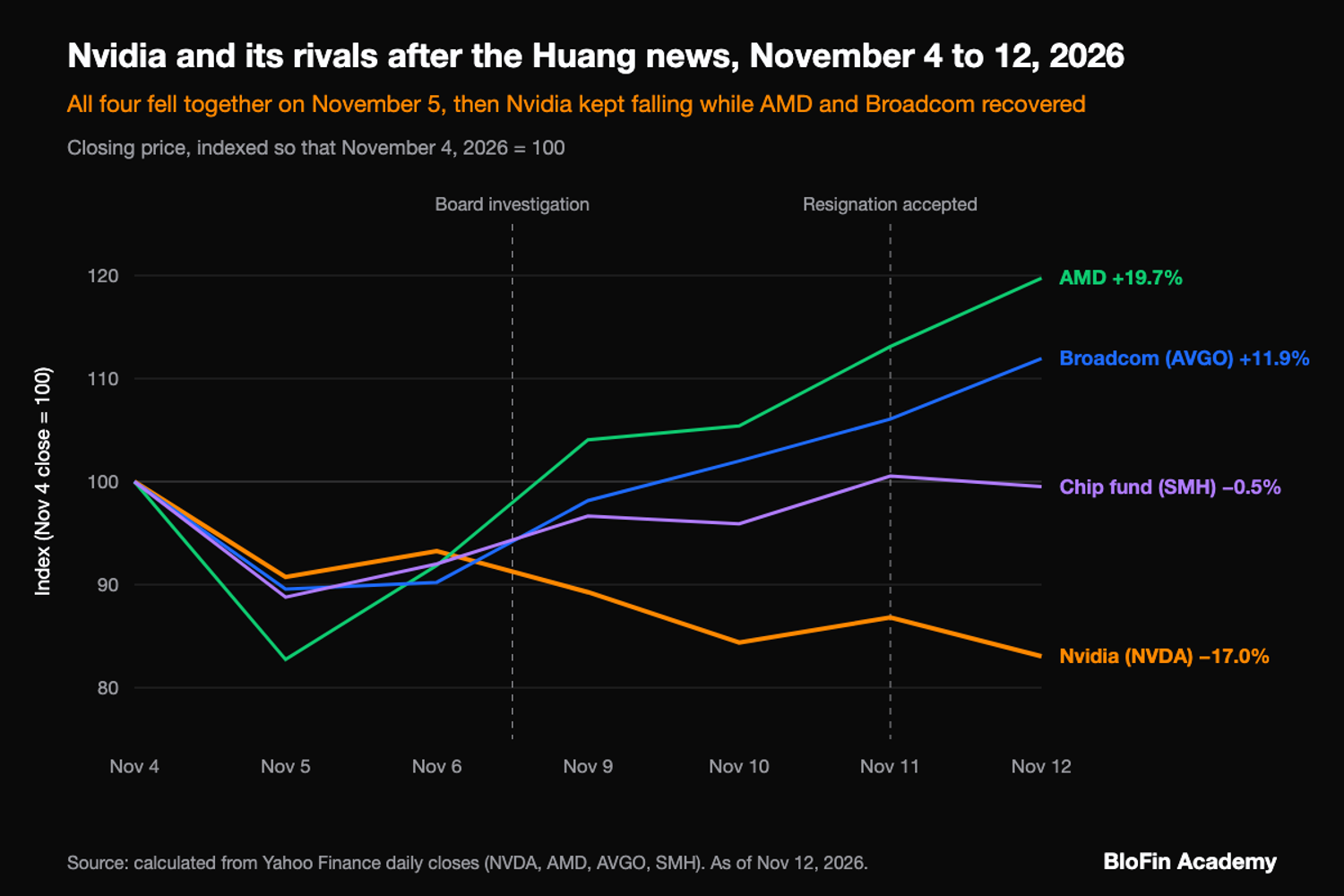
A fund of chip stocks shows the two forces canceling out. The VanEck Semiconductor ETF, known by its ticker SMH, ended November 12 only 0.5% below its November 4 close. Over the same days Nvidia ended 17.0% lower, and gains in other chipmakers roughly made up for its fall.
Say you had split $1,000 equally between Nvidia and AMD on November 4. By November 12 the Nvidia half was worth about $415 and the AMD half about $599, so the pair was worth about $1,014 (source: calculated from Yahoo Finance data). Owning more than one company in the same industry is how investors limit key man risk, because one leader's exit then hits only part of the money.
Price moves alone never prove why money moved, and other news can move each of these stocks in the same weeks. What the numbers show is that the market did not mark down the whole AI-chip business when Huang left. If you want to follow that split on BloFin, the NVDAUSDT Perpetual trades alongside the AMDUSDT Perpetual and a contract on Broadcom.
How does Nvidia's fall affect the S&P 500?
Nvidia's fall pulls on the S&P 500 in line with its weight in the index. On November 10, 2026, Nvidia made up 6.30% of the S&P 500 fund (SPY), its second-largest holding after Apple (source: State Street, SPY holdings). Multiply the weight by the move and you get the drag on the index.
From November 4 to November 12, Nvidia fell 17.0%. At a weight of about 6.3%, that took roughly 1.1 percentage points off the S&P 500 fund, which fell 1.3% over the same days (source: calculated from Yahoo Finance data). Most of the index's loss over those six trading days came from one company. Nvidia's weight on November 4 was a little higher than 6.3%, because it had not yet fallen, so the true drag was slightly larger.
That is why a scandal at one company can move "the market". The S&P 500 weights each company by its market value, and the Magnificent 7 stocks made up about a third of it in November 2026. A fund that leaves the seven out, the Defiance Large Cap ex-Mag 7 ETF (XMAG), ended November 12 up 0.3% from November 4. That is the S&P 493 at work (source: calculated from Yahoo Finance data).
Say you hold $1,000 of an S&P 500 fund. About $63 of it sits in Nvidia, so a 17% fall in Nvidia costs you about $11 before anything else moves. From November 4 to 12 the whole $1,000 lost about $13. The other $937, spread across roughly 500 companies, lost only about $2 between them.
What happened to Apple stock when Steve Jobs resigned?
Apple stock fell 0.65% on August 25, 2011, the day after Steve Jobs resigned as chief executive. By August 31 it was 2.3% above its August 24 close (source: calculated from Yahoo Finance data). He was Apple's co-founder, and the board credited his vision and leadership with saving the company, which makes his exit the closest well-known match for Huang's.
The difference was the plan. Apple named Tim Cook, its chief operating officer, as CEO in the same announcement, and the departing chief executive stayed on as chairman. The press release said he had "strongly recommended" that the board put its succession plan into effect (source: Apple, August 24, 2011). Investors knew who was in charge the next morning, and they knew the founder still backed the company.
Nvidia's announcement had neither of those. Kress is interim CEO and still the chief financial officer. The board is looking for a permanent CEO inside and outside the company, and Huang left the board as well as the top job (source: Nvidia, November 12, 2026). Apple's low on the day after its news was about 3% below the previous close. Nvidia's was 14.3% below.
Say you held $1,000 of Apple stock at the August 24, 2011 close. It was worth about $993 the next day and about $1,023 a week later (source: calculated from Yahoo Finance data). The same $1,000 in Nvidia at the November 11, 2026 close was worth about $957 at the next close, and about $857 at that day's low.
The comparison has limits. Apple's new chief already ran its worldwide operations, while Huang's exit came about two weeks after the first public reports. What it shows is what lowers key man risk: a named successor, a planned handover and a founder who stays close to the company.
What to watch at Nvidia after Huang
Three events will decide how much key man risk stays in Nvidia's share price: the November 17 earnings report, the search for a permanent chief executive and the investigation. Each has a date or a decision you can follow, and each can move the stock as sharply as the resignation did.
Say you hold $1,000 of Nvidia stock into the earnings report. A move the size of the November 12 opening gap, 13.1%, would change its value by about $131 before you could trade at regular-session prices. The move can go in either direction, and a report that reassures investors can gap the stock up just as sharply. Nvidia releases its results after the US market closes, so the reaction usually shows up as a gap at the next open.
Event | When | What it tells investors |
|---|---|---|
Third-quarter results and earnings call | November 17, 2026 | Whether orders and product plans held up under an interim CEO |
A permanent CEO is named | No date given | Who makes Nvidia's big decisions from now on, and whether the board chose an insider |
The investigation reports | No date given | Whether the problem stays with Huang personally or reaches the business |
The first of these has a fixed date and the other two do not, which matters for anyone holding the stock. A dated event lets you decide in advance how much you want to hold through it. An undated one can land on any morning, the way the resignation did, so the only protection is the size of the position you already hold.
Nvidia's November 17 earnings under an interim CEO
Nvidia reports its third-quarter results on November 17, 2026, as planned before the resignation. It will be the company's first report with Kress as interim CEO (source: Nvidia, November 12, 2026). After a founder leaves, investors read the first report for signs that customer orders and product plans have not changed. Harvey C. Jones, the new chair, has said he expects the company's operations, customer commitments and product roadmap to continue without interruption. The Nvidia earnings preview covers what analysts expect from the report itself.
The search for a permanent CEO
The board has started looking for a permanent chief executive and will consider people from inside and outside Nvidia. It gave no timetable. Until a name is announced, investors have to price a range of possible leaders. That is one reason a stock can stay more volatile than usual after a sudden exit.
The investigation, Congress and export rules
The board's investigation, run by Joon H. Kim and Wachtell, Lipton, is still open, and Huang has agreed to brief Congress (source: Nvidia, November 10, 2026, TechCrunch). The national security questions touch on how Nvidia's chips reach buyers in Asia, which ties into Nvidia's China and export control risk. If the findings point to the company rather than to Huang alone, the key man question would become a question about the business.
How to trade Nvidia's CEO news on BloFin
BloFin lists the NVDAUSDT Perpetual, a USDT-settled contract that follows Nvidia's share price. You can trade Nvidia with leverage of up to 50x on it, and one contract is 0.01 share. A perpetual contract has no expiry date. Holding one gives you no shares, so you get no vote and no dividends.
Funding, a regular payment between traders who are long and short, costs or pays you at set times for as long as you hold. Outside regular weekday trading hours, and on weekends and market holidays, trading may be limited to reduce-only orders, which lets you reduce a position or close it, but not open a new one or make it bigger (source: BloFin, stock futures trading hours). News that breaks overnight can then arrive as a gap when full trading resumes, as it did twice in Nvidia's week.
Here is what a gap like November 12 does to a leveraged position. Say you put up 200 USDT in Isolated margin, so only that 200 USDT backs the trade. You open a 5x long worth 1,000 USDT at the November 11 close of $173.73, which is about 576 contracts. A 13.1% gap down takes about 131 USDT, or 65% of your margin, before fees and funding (source: calculated from Yahoo Finance data).
At 10x on the same 200 USDT in Isolated margin, a move of a little under 10% against you is enough for liquidation. A 13.1% gap would have closed the position. In Cross mode, the default on BloFin, the rest of your futures balance also backs the position. That moves the liquidation price further away, but it puts more of your balance at risk.
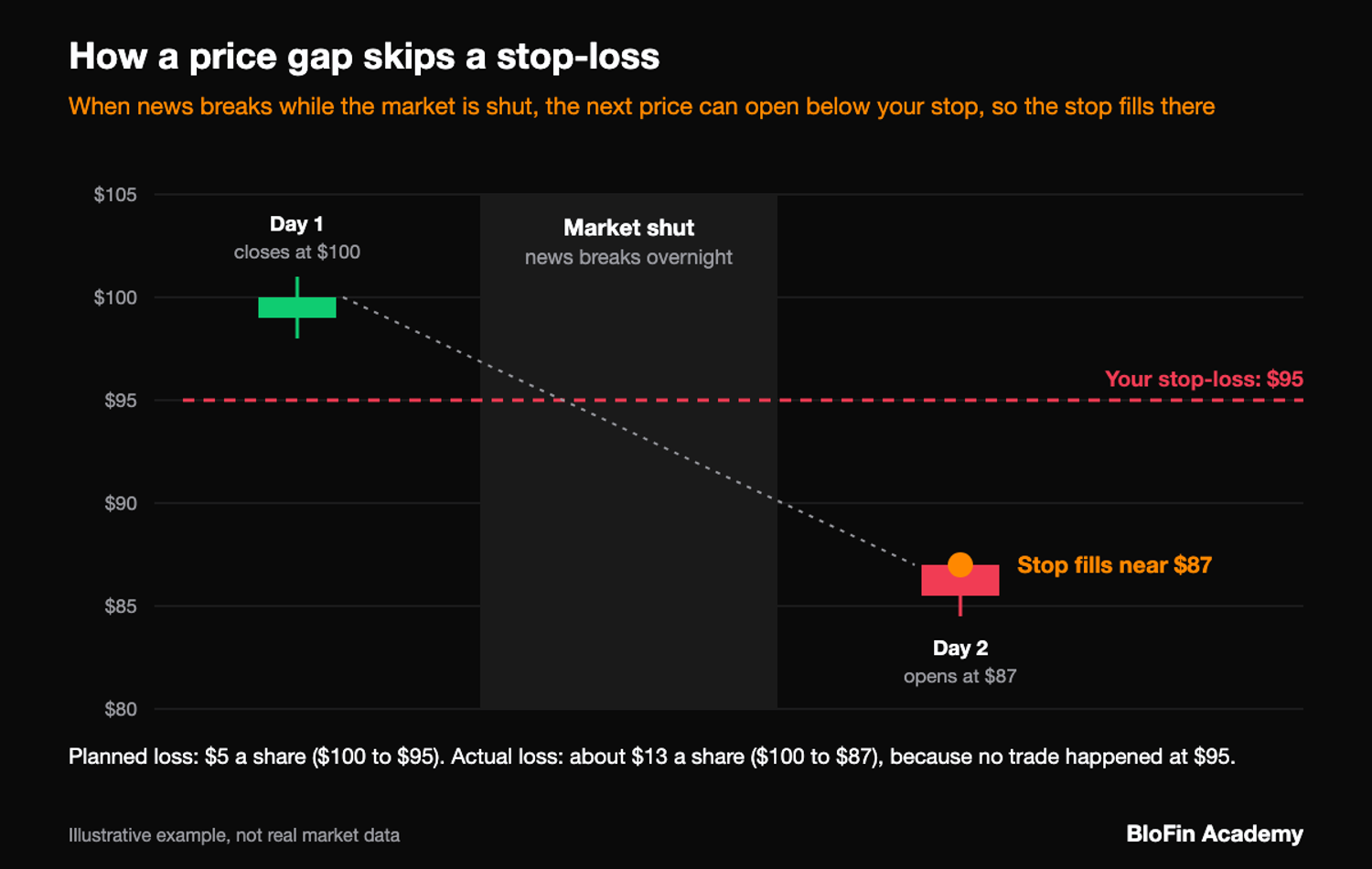
A stop-loss on BloFin closes your position at a price you choose in advance. If the stock opens sharply lower, though, the stop can fill past your price at the next available one, which may be far below the level you set. Gap risk on the Nvidia perpetual covers the weekend and overnight details.
How to open an Nvidia perpetual on BloFin
Step 1: Create your BloFin account and send USDT to it. A deposit lands in your Funding Account, so move the USDT to your Futures Account with Transfer, found under Assets.

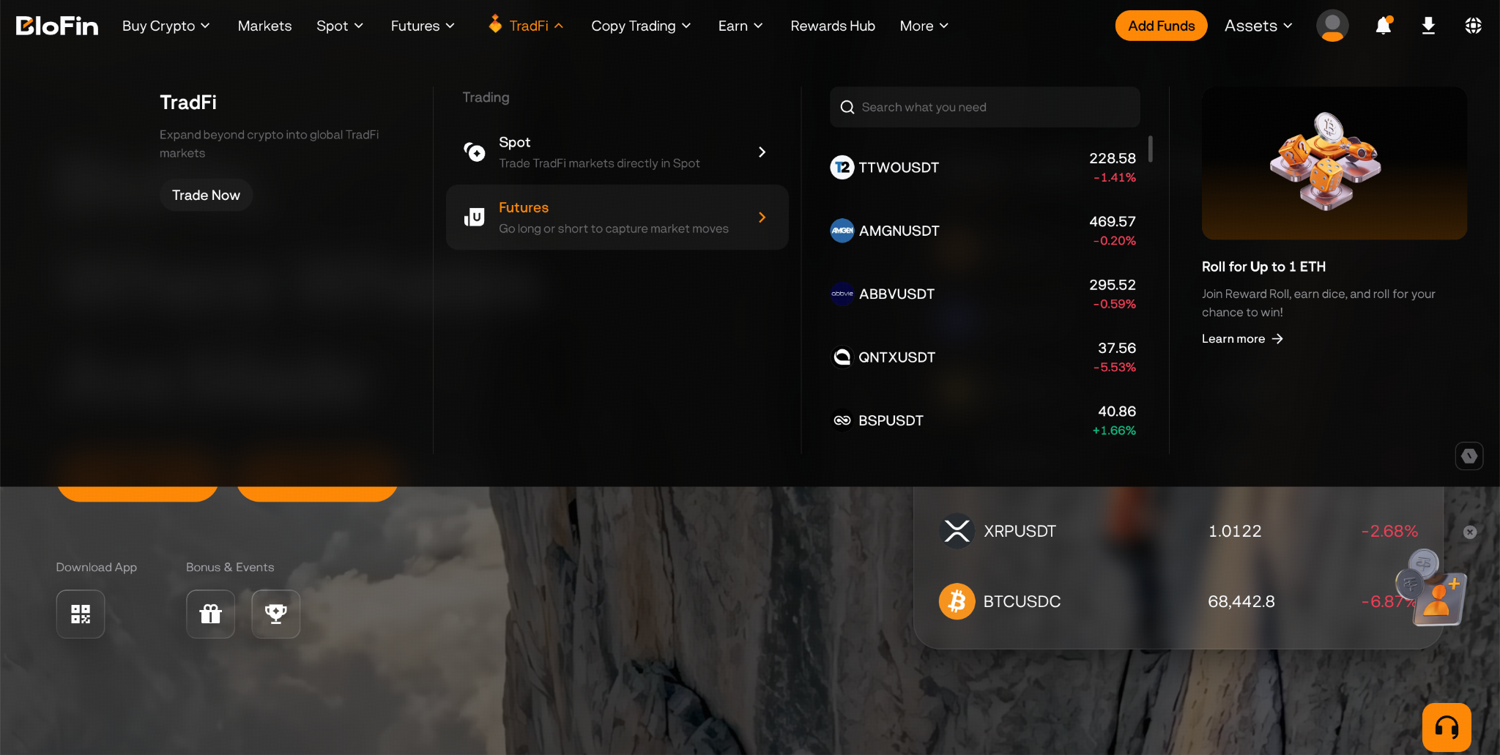
Step 2: Hover your cursor over the TradFi tab and select Futures.
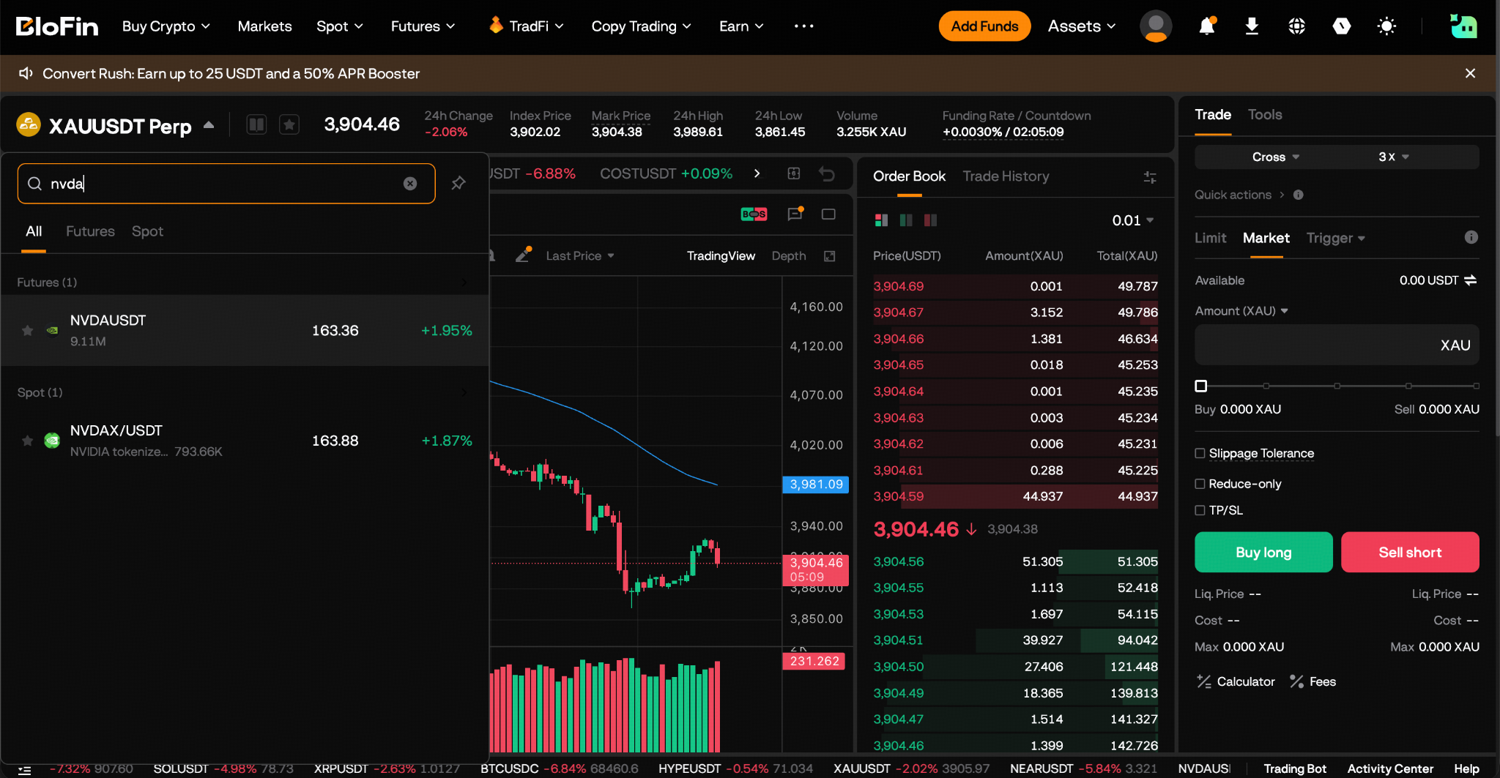
Step 3: Click on the trading pair at the top left corner and search for NVDA.
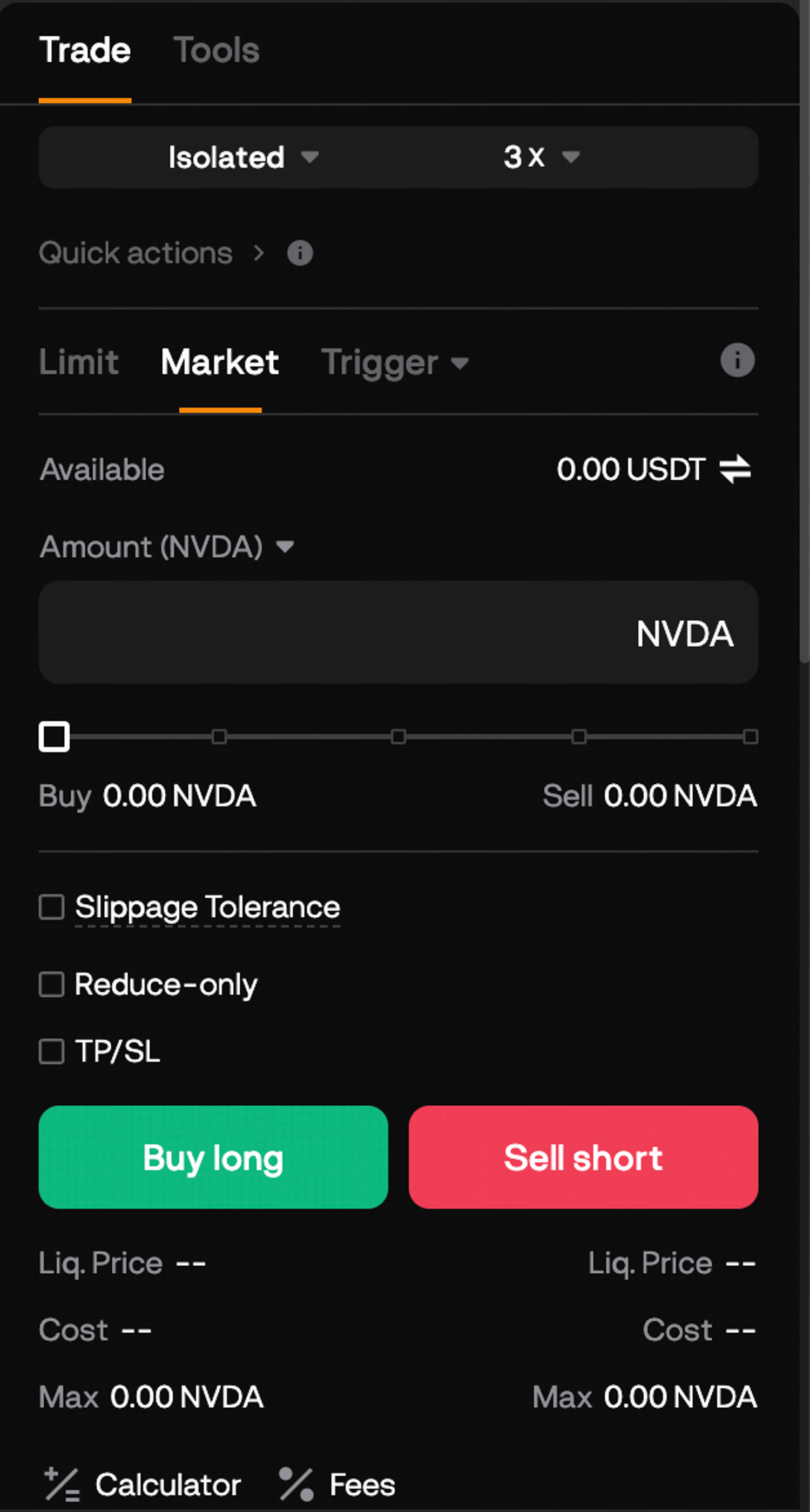
Step 4: On the order panel, click the margin mode button, shown as Cross by default, to choose your margin mode, and click the leverage button beside it to set your leverage. Cross lets a losing position draw on the rest of your futures balance, while Isolated limits the loss to the margin you assign. Then choose Limit, which fills only at your price or better, or Market, which fills right away at the best price available, and enter your amount.
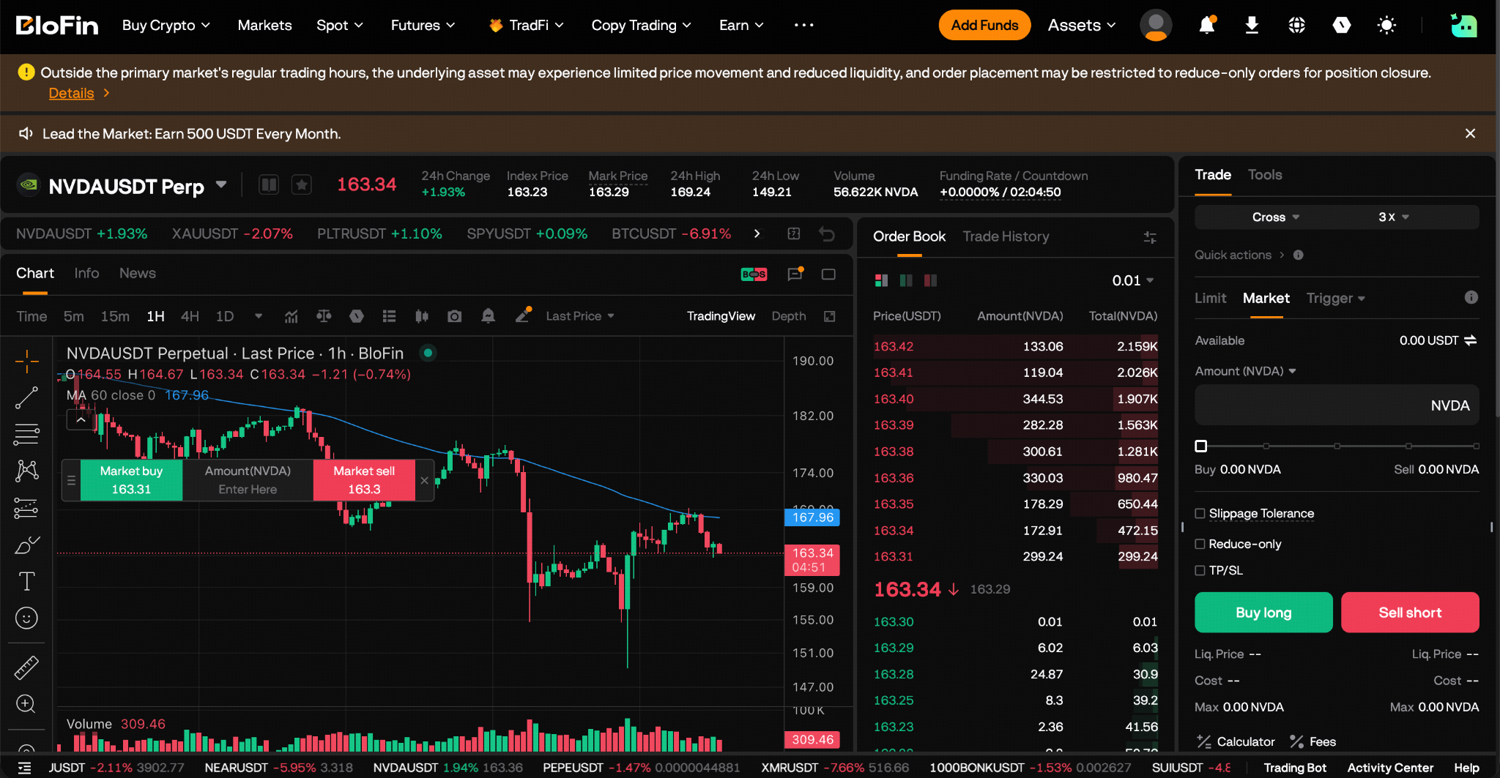
Step 5: Tick TP/SL and enter a stop-loss price. Before you click Buy to go long or Sell to go short, check Liq. Price and Cost. Your first trade on BloFin walks through the order screen in more detail. Your open trade then shows under Positions, and closing a trade on BloFin shows how to exit.
Looking to trade Nvidia and its rivals after Jensen Huang's resignation? To get started, you'll need to first create a BloFin account, fund your account with cryptocurrency, and navigate to the NVDAUSDT Perpetual, AMDUSDT Perpetual or AVGOUSDT Perpetual page.

Frequently asked questions
Who is Nvidia's interim CEO?
Colette Kress, Nvidia's chief financial officer, is interim chief executive and keeps her finance role until a permanent CEO is named. She joined Nvidia as CFO in September 2013 after nearly 25 years in finance roles at technology companies including Cisco and Microsoft (source: Nvidia, November 12, 2026).
Who is Harvey Jones, Nvidia's new chair?
Harvey C. Jones is the first chair in the history of Nvidia's board, a role created on November 12, 2026. He is a former chief executive and executive chairman of Synopsys, and he has sat on Nvidia's board since 1993, the year the company was founded (source: Nvidia, TechCrunch).
Does Jensen Huang still own Nvidia stock?
Huang owns about 3.6% of Nvidia's shares, a stake that makes him one of the richest people in the world (source: Al Jazeera, November 12, 2026). Nvidia's announcement of his resignation makes no mention of his shareholding (source: Nvidia, November 12, 2026).
Who could replace Jensen Huang as Nvidia CEO?
President Donald Trump suggested former Apple chief executive Tim Cook as Huang's successor in a post on Truth Social. Cook stepped down as Apple's chief executive in September and now serves as its executive chairman. Al Jazeera reported no indication that Cook is interested in the job (source: Al Jazeera, November 12, 2026).
How much is Nvidia worth now?
Nvidia's market value fell below $4 trillion on November 12, 2026, after Huang's resignation, for the first time since July 2025, according to Al Jazeera (source: Al Jazeera, November 12, 2026). The shares recovered during the day, and at the $166.19 close the company was worth about $4.0 trillion (source: companiesmarketcap). Market value is the share price multiplied by the number of shares, so it moves every trading day with the stock.
Researched and written by the BloFin Academy editorial team with AI-assisted drafting. All facts independently verified. Sources include Nvidia, Apple, TechCrunch, CNBC, Al Jazeera, State Street, Yahoo Finance and BloFin, current as of November 13, 2026.
Nothing in this article constitutes financial advice, and nothing in it is a recommendation to buy, sell or hold any stock, ETF or crypto asset. The investigation, the search for a permanent chief executive and the November 17 report can each move Nvidia stock sharply, and the allegations described here are news reports that Nvidia has not confirmed. A gap like November 12, 2026 can take most of the margin on a leveraged position, or close it through liquidation, before a stop-loss can fill at its price, and a perpetual contract pays no dividends, carries funding costs and may be limited to reduce-only orders outside regular market hours. BloFin services are not available in restricted locations, including the United States. Past performance does not indicate future results. Do your own research and consider your risk tolerance before you trade on BloFin.