
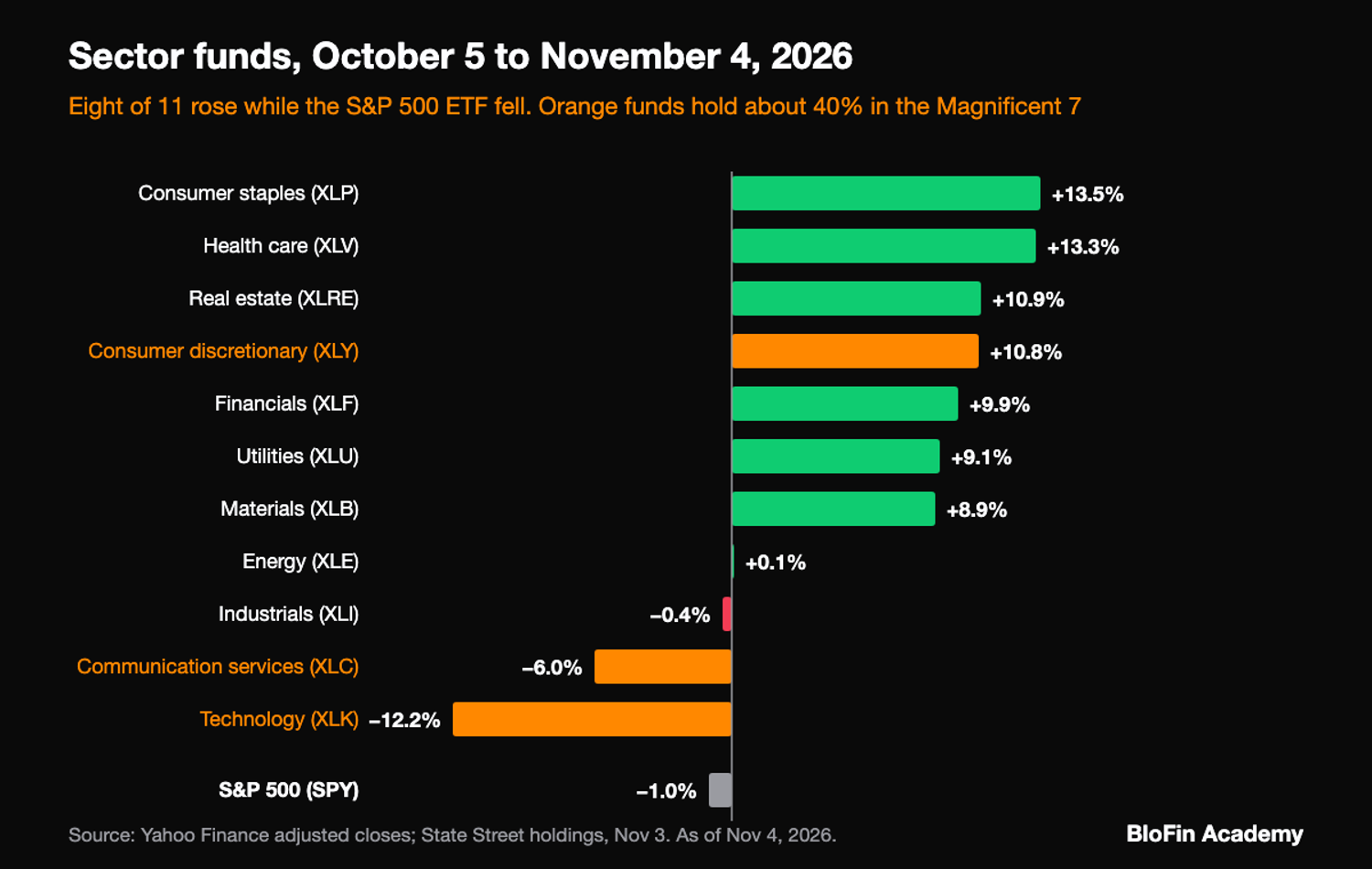
Seven companies make up about a third of the S&P 500, so when the news says the stock market fell, it often means those seven fell. Yet eight of the 11 main sector funds, which each track one part of the market, rose between October 5 and November 4, 2026. Over that stretch Nvidia, Alphabet and Meta each lost more than 15% and the S&P 500 ETF slipped 1.0%.
That ETF is a fund that tracks the index and trades like a single share. The seven themselves split widely, with Alphabet down 16.6% and Microsoft and Amazon each up 5.8% (source: calculated from Yahoo Finance data). What has changed is how little the seven now move together. For most of the past few years, traders could treat these stocks as one big bet on technology, and in 2023 all seven beat the index. By November 4, 2026, only three were beating it for the year, and in late October CNBC measured the correlation between the seven at its lowest in more than a decade (source: CNBC, October 28, 2026).
That raises a question: how much does the rest of the market protect you when they fall? An S&P 500 fund already holds about a third of its money in the seven. A sector fund can hold more: the consumer discretionary fund holds about 40% in Amazon and Tesla alone (source: State Street, XLY holdings), so you can own them without ever choosing to. Spreading evenly across the whole market has softened their falls, but it has usually still lost money when they fell, and it has cost gains when they rose.
These names also matter if you trade from a crypto account. BloFin lists a USDT-settled perpetual contract, with profits and losses paid in USDT, on all seven, alongside the SPYUSDT Perpetual on the S&P 500 ETF. Big moves in them have also often come with big moves in bitcoin.
What are the Magnificent 7 stocks?
The Magnificent 7 stocks are seven of the largest US companies: Nvidia, Apple, Microsoft, Alphabet, Amazon, Meta and Tesla. The label is informal, so no index provider or exchange decides who is in the group. Together they make up about a third of the S&P 500, which is why their moves dominate market headlines.
Each company now depends on a different part of the AI boom, or in Apple's case on staying out of its spending race. Here is each company's share of the S&P 500 ETF, SPY, on November 3 (source: State Street, SPY holdings), along with what investors are watching in each (source: CNBC):
Company (ticker) | Share of SPY | What investors are watching |
|---|---|---|
Nvidia (NVDA) | 7.7% | How long demand for its AI chips lasts |
Apple (AAPL) | 7.4% | Devices and services |
Microsoft (MSFT) | 5.9% | Growth in its Azure cloud business |
Alphabet (GOOGL, GOOG) | 4.5% | Google Cloud, its Gemini AI model and Search |
Amazon (AMZN) | 3.8% | Growth in its AWS cloud business |
Meta (META) | 2.1% | Consumer AI apps and what its spending earns |
Tesla (TSLA) | 1.7% | AI, robotics and robotaxis more than electric cars |
Alphabet appears twice in the index because it has two share classes, and its GOOGL shares carry voting rights while its GOOG shares do not (source: Fidelity, Magnificent 7 stocks). Although people call all seven tech stocks, only Apple, Microsoft and Nvidia sit in the S&P 500's information technology sector. Alphabet and Meta are in communication services, and Amazon and Tesla are in consumer discretionary (source: Schwab, Magnificent 7 stocks). That matters when you compare sectors, because an S&P 500 tech sector fund leaves out four of the seven.
Where the name Magnificent 7 came from
Bank of America strategist Michael Hartnett coined the name in 2023 (source: Reuters via BNN Bloomberg, June 15, 2026), and it echoes the title of the 1960 Western film (source: Schwab). It followed FANG and FAANG, the earlier labels for the market's favorite tech stocks (source: Reuters).
How much of the S&P 500 are the Magnificent 7?
The Magnificent 7 made up about 33% of the S&P 500 ETF on November 3, 2026, adding up the seven's weights in the fund's holdings file (source: State Street). That figure moves with their share prices: Benzinga put it at 34.8% on October 13 (source: Benzinga, October 14, 2026), and Schwab at about 34% in August (source: Schwab).
The group also produced more than 40% of the index's total return in 2025 (source: Fidelity). The S&P 500 is weighted by company size, so a big company's move counts for more than a small one's. Say all seven fall 10% in a month and every other stock stays flat. Multiply 33% by 10% and the index loses about 3.3%, even though 493 companies did not move at all. For the index to finish level, those other companies, which hold the remaining 67%, would need to rise about 5%.
Real months are less tidy, but the same arithmetic applies. Nvidia fell 16.2% and Alphabet fell 16.6% between October 5 and November 4 (source: calculated from Yahoo Finance data). Using the November 3 weights as a rough guide, those two stocks alone took about 2 points off the index, in a period when the S&P 500 ETF fell 1.0%. The rest of the index gave about a point of that back.
What is the S&P 493?
The S&P 493 is a nickname for the S&P 500 without the Magnificent 7. It is a way of talking about the rest of the market, and no official index carries the name. One fund, the Defiance Large Cap ex-Mag 7 ETF (XMAG), aims to give exposure to the S&P 500 without the seven, following a BITA index of the largest US stocks that leaves them out (source: Defiance, XMAG). The equal-weight S&P 500 is another common comparison, since it gives every company about the same share. The Invesco S&P 500 Equal Weight ETF, RSP, returned 18.0% in 2026 to November 4, against 13.3% for the S&P 500 ETF, SPY. In 2023 the order was the reverse, at 13.7% against 26.2% (source: calculated from Yahoo Finance data).
How have the Magnificent 7 stocks performed?
The Magnificent 7 stocks beat the S&P 500 easily in 2023 and 2024, but fewer of them have done so since. All seven beat the index in 2023 and six did in 2024, while two did in 2025 and three had in 2026 by November 4.
Here is each stock's return by calendar year, including dividends (source: calculated from Yahoo Finance data):
Stock | 2022 | 2023 | 2024 | 2025 | 2026 to Nov 4 |
|---|---|---|---|---|---|
Apple | −26.4% | +49.0% | +30.7% | +9.1% | +28.9% |
Nvidia | −50.3% | +239.0% | +171.2% | +38.9% | +7.6% |
Microsoft | −28.0% | +58.2% | +12.9% | +15.6% | +15.7% |
Alphabet | −39.1% | +58.3% | +36.0% | +66.0% | −7.5% |
Amazon | −49.6% | +80.9% | +44.4% | +5.2% | +15.3% |
Meta | −64.2% | +194.1% | +66.0% | +13.1% | −4.3% |
Tesla | −65.0% | +101.7% | +62.5% | +11.4% | −14.3% |
S&P 500 (SPY) | −18.2% | +26.2% | +24.9% | +17.7% | +13.3% |
How many of the seven beat SPY | 0 | 7 | 6 | 2 | 3 |
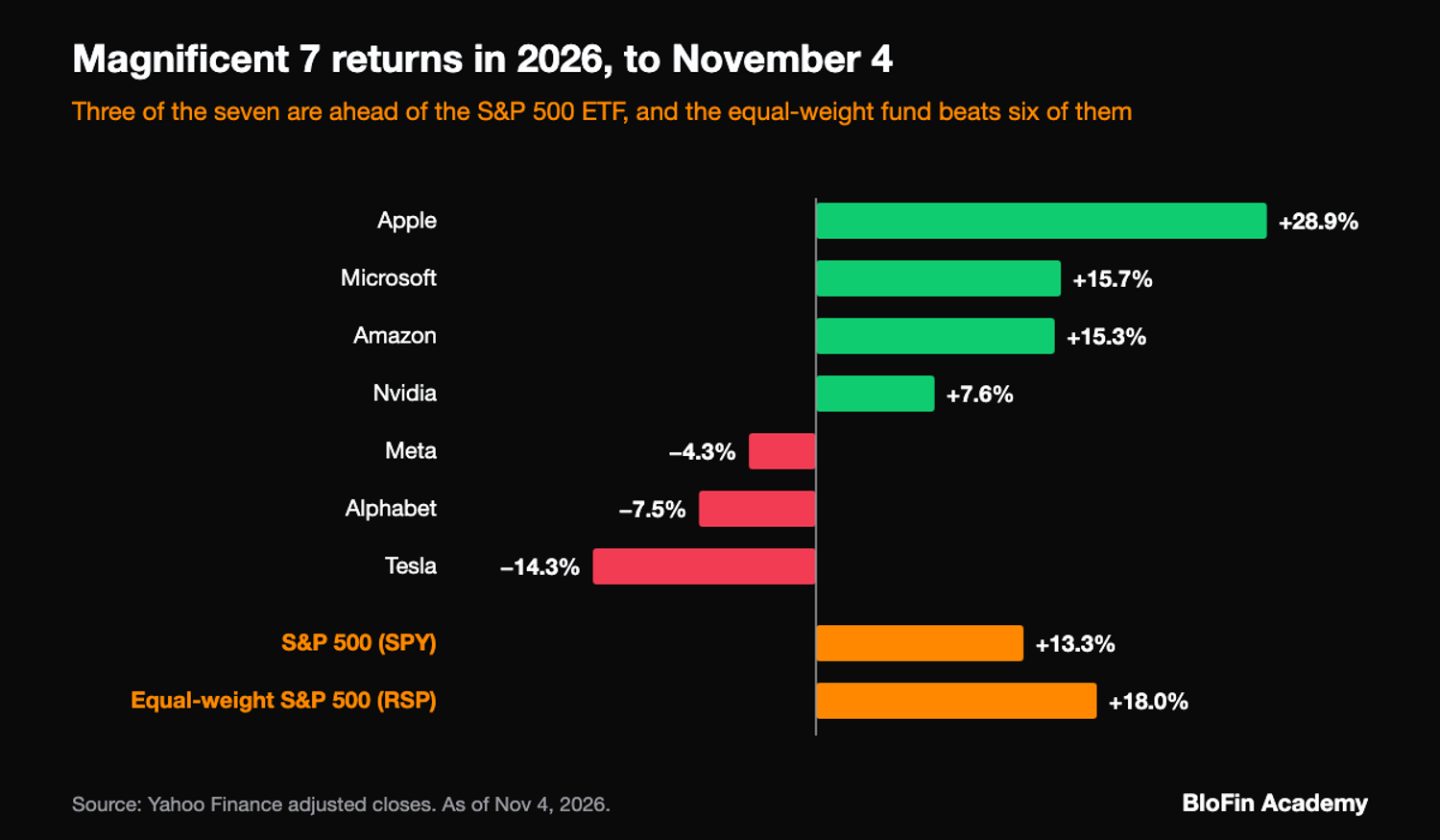
The count can hide the size of a win. The group's average return in 2025 was 22.7% (source: calculated from Yahoo Finance data), well ahead of SPY, largely because of Nvidia and Alphabet.
The count can also change in a day. Only Apple was beating SPY for the year on November 3. Then on November 4, the day after Democrats won both chambers of Congress in the midterm elections, Microsoft rose 6.7%, Amazon rose 6.1% and Apple rose 5.3%, while Nvidia and Tesla each lost more than 3% (source: calculated from Yahoo Finance data). Yahoo Finance reported that chip stocks fell as markets priced in possible limits on data center construction (source: Yahoo Finance, November 4, 2026). Nvidia's next results call is on November 17 (source: Nvidia, conference call notice), and how earnings season works explains why those dates move prices.
The worst year is worth as much attention as the best. All seven fell further than the index in 2022, and the average loss across the group was 46.1%, against 18.2% for SPY (source: calculated from Yahoo Finance data). That year still shapes the long-run record. Counted from the end of 2022, all seven are ahead of SPY's 110.2%. Counted from the end of 2021, SPY's return is 72.0%, and Microsoft (71.9%), Amazon (59.6%) and Tesla (9.3%) are all behind it (source: calculated from Yahoo Finance data). These stocks can win by a wide margin and lose by one too, so your start date changes the answer.
Why the Magnificent 7 stopped moving together
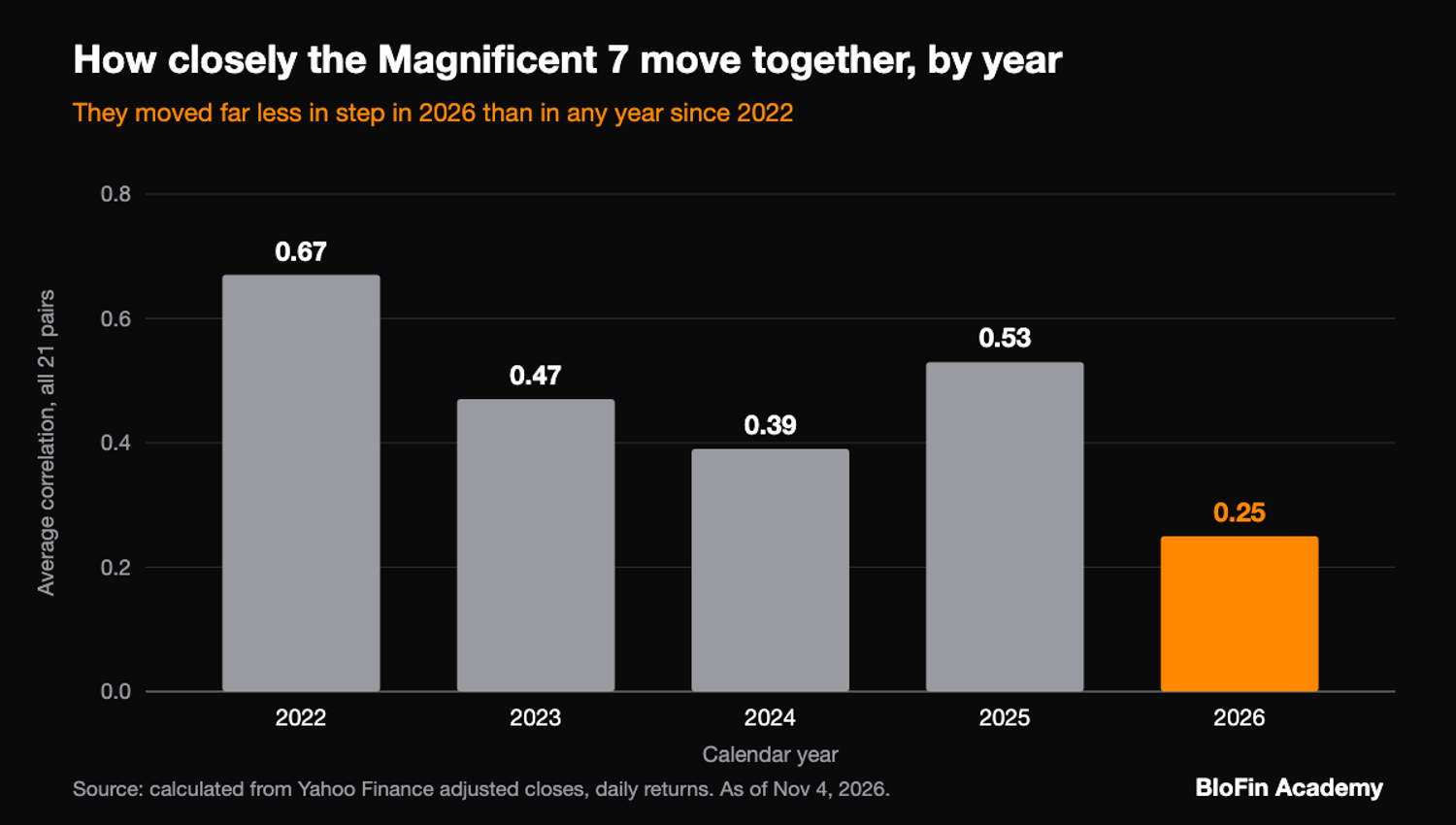
The Magnificent 7 stopped moving together because investors now judge each company on its own AI position rather than buying the group as one trade. Correlation shows this clearly. It measures how closely two stocks move, from 1 when they move in step to 0 when one tells you nothing about the other.
CNBC averaged the 60-day correlation across all 21 pairs of the seven and found it at its lowest in more than a decade (source: CNBC). The same test on daily returns for each calendar year shows the same drop. The average fell from 0.67 in 2022 to 0.25 in 2026, and it was 0.20 over the last 63 trading days to November 4 (source: calculated from Yahoo Finance data).
Gil Luria, an analyst at D.A. Davidson, told CNBC that the seven have different exposures to AI, so investors need to choose between them where they once bought the whole group. Apple, once punished for spending little on AI, is now being rewarded for it. Meta turned negative for the year after reporting negative free cash flow, meaning it spent more cash than its business brought in, and raising the low end of its spending plans (source: CNBC).
Results then widened the split. Alphabet lost 12.6% on October 29 (source: calculated from Yahoo Finance data), the day after a third-quarter report showing about 51.4 billion of capital spending and free cash flow of about 9.1 billion (source: Alphabet, third-quarter results). Microsoft, which also reported on October 28 (source: CNBC), lost 0.2% on October 29 (source: calculated from Yahoo Finance data). Some of this was already building in the debate over an AI bubble, where the question is whether all that spending will pay off.
Big gaps between the seven are nothing new, however. The gap between the best and worst of them from October 5 to November 4 was 22.4 points. That is about the same as the median gap, meaning the middle result, across 59 periods of 21 trading days, about a month each, since November 2021 (source: calculated from Yahoo Finance data). What has changed is the day-to-day link between them, so a strong day for Nvidia now says much less about Meta or Apple.
Magnificent 7 vs MANGOS
MANGOS stands for Meta, Anthropic, Nvidia, Google, OpenAI and SpaceX, a newer nickname for leaders of the AI boom (source: New York Times via Business Standard). It spread in June 2026, around SpaceX's record stock market debut, which valued the company above both Tesla and Meta (source: Reuters). Only Meta, Nvidia and Alphabet (Google) appear in both groups.
Company | Magnificent 7 | MANGOS | Publicly traded? |
|---|---|---|---|
Meta | Yes | Yes | Yes |
Nvidia | Yes | Yes | Yes |
Alphabet (Google) | Yes | Yes | Yes |
Apple | Yes | No | Yes |
Microsoft | Yes | No | Yes |
Amazon | Yes | No | Yes |
Tesla | Yes | No | Yes |
No | Yes | Yes, since June 2026 | |
No | Yes | No, filed to go public on October 26, 2026 (source: IPO Scoop) | |
No | Yes | No |
The name is far from settled. Some people read the "A" as Apple instead of Anthropic, and others prefer different labels altogether, such as Bank of America's "AI Big 10", which adds Broadcom, Micron and AMD to the original seven (source: Reuters). Roundhill's chief executive told Reuters he expects new terms to sit beside the Magnificent 7 and not replace it (source: Reuters).
MANGOS also has a practical limit, which is that you can't buy two of its six members on a stock exchange yet. The New York Times reported in early July that more than a dozen mutual funds had been formed around the group in a month. They use options, which are contracts that give the right to buy or sell at a set price, and other instruments to roughly track the two private companies. It also reported that Meta, Nvidia and Alphabet shares all fell in June (source: New York Times). Derek Horstmeyer, a finance professor at George Mason University, was blunt about the timing: "Once something is a coined term, it's already run its course" (source: New York Times).
Does the stock market fall when the Magnificent 7 fall?
The S&P 500 usually falls when the Magnificent 7 fall, and the average company usually does better. In 59 periods of about a month since November 2021, the seven lost over 3% on average in 15. SPY fell in 14, while the equal-weight fund beat it in 11 and rose in three (source: calculated from Yahoo Finance data).
The index's fall comes partly from its weighting, so it can overstate how the average company did. From October 5 to November 4, 2026, the seven averaged −4.2% and SPY lost 1.0%, yet the equal-weight fund gained 5.8% (source: calculated from Yahoo Finance data). When money moves out of big tech and into other groups like this, traders call it sector rotation. A bad month for these seven can therefore look like a broad sell-off on your screen while the average company is rising.
The opposite case is worth knowing too. In 12 of those 15 periods, the equal-weight fund fell as well, so in those periods the drop reached well beyond the seven. To tell which one you are looking at, compare SPY with RSP. BloFin's SPYUSDT Perpetual follows SPY and its QQQUSDT Perpetual follows the Nasdaq 100 through QQQ, so you can trade the S&P 500 or the more tech-heavy Nasdaq 100.
Are you diversified if you own an S&P 500 fund?
An S&P 500 fund diversifies you only partly. Diversification means spreading money across holdings that don't all move together, and a standard S&P 500 fund held about 33% of its money in the Magnificent 7 on November 3, 2026. You own about 500 companies, but seven of them can still decide how your fund does in a month.
The same seven also sit inside funds that can sound like a way out of them. Sector funds are weighted by company size too, so the biggest names take a large share. Here are the November 3 shares for the technology fund (source: State Street, XLK holdings), the communication services fund (source: State Street, XLC holdings) and the consumer discretionary fund and SPY (source: State Street):
Fund | Share held in the seven | Which of the seven |
|---|---|---|
Technology sector (XLK) | 42.4% | Nvidia, Apple, Microsoft |
Communication services sector (XLC) | 41.7% | Meta, Alphabet |
Consumer discretionary sector (XLY) | 40.3% | Amazon, Tesla |
S&P 500 (SPY) | 33.1% | All seven |
The other eight sector funds hold none of them, because the seven sit in only three sectors. An equal-weight fund such as RSP holds them too, but at about the same small share as every other company (source: Invesco, RSP). Seven companies out of about 500 is about 1.4%.
This changes how you read a rotation. From October 5 to November 4, the communication services fund lost 6.0%, as Meta and Alphabet, about 42% of it, fell 15.1% and 16.6%. The consumer discretionary fund gained 10.8%, yet Amazon and Tesla, about 40% of it, rose only 5.8% and 1.7%, so most of that gain came from its other holdings (source: calculated from Yahoo Finance data). A fund's holdings file shows how much of the seven it carries, which its sector name doesn't.
What held up when the Magnificent 7 fell
The groups holding the least of the seven usually fell the least. Across the same 15 periods when the seven lost more than 3%, here is how each group did (source: calculated from Yahoo Finance data):
Group | Share held in the seven, Nov 3, 2026 | Median return in those periods | Periods it rose, out of 15 |
|---|---|---|---|
Energy (XLE) | 0% | +2.0% | 9 |
Utilities (XLU) | 0% | −0.3% | 7 |
Consumer staples (XLP) | 0% | −1.1% | 6 |
Equal-weight S&P 500 (RSP) | About 1.4% | −1.9% | 3 |
Health care (XLV) | 0% | −2.1% | 5 |
Real estate (XLRE) | 0% | −2.2% | 4 |
Industrials (XLI) | 0% | −2.3% | 3 |
Financials (XLF) | 0% | −2.6% | 3 |
S&P 500 (SPY) | 33.1% | −2.9% | 1 |
Materials (XLB) | 0% | −3.2% | 5 |
Communication services (XLC) | 41.7% | −4.5% | 2 |
Consumer discretionary (XLY) | 40.3% | −5.6% | 1 |
Technology (XLK) | 42.4% | −6.9% | 1 |
Average of the seven | 100% | −8.7% | 0 |
At least one sector fund rose in 13 of the 15 periods, so a fall in the seven rarely means nothing is working. Finding the winner is harder, because it changed: energy led in six periods, utilities in three, and staples, health care and real estate in two each.
Energy's record leans on 2022, the year that holds eight of the 15 periods, when the energy fund returned 64.3%. In the seven periods since, energy, utilities, staples and real estate each rose in four. In the median period only three of the 11 sector funds rose, and in the periods ending in June and September 2022 all 11 fell (source: calculated from Yahoo Finance data).
What diversification costs
Spreading out costs you some of the gains in good months. In 2022 the equal-weight fund lost 11.6%, against 18.2% for SPY and an average of 46.1% for the seven. In 2023 it returned 13.7%, against 26.2% for SPY and an average of 111.6% for the seven. Across the 27 periods when the seven rose more than 3%, it beat SPY in only five (source: calculated from Yahoo Finance data).
Over longer runs, that gap adds up. From the end of 2022 to November 4, 2026, the equal-weight fund returned 68.3%, against 110.2% for SPY. Counting the bad year of 2022 as well, from the end of 2021, it returned 48.7% against 72.0% (source: calculated from Yahoo Finance data). So far in 2026 the order is reversed. These past periods can't tell you which kind of month comes next.
Ways to hold less of the seven include an equal-weight fund such as RSP, a fund that leaves them out such as XMAG, and the eight sector funds that hold none of them. Each has tended to give up part of the gains when the seven lead.
Magnificent 7 ETFs
The Roundhill Magnificent Seven ETF, ticker MAGS, is a fund built to hold only these seven, in equal amounts, with the weights reset every quarter. It launched on April 11, 2023 and has a gross expense ratio of 0.30%, the fund's yearly fee before any waivers (source: Roundhill, MAGS).
MAGS gets part of its exposure through total return swaps, which are contracts that pay the return of a stock without owning it (source: Roundhill). Other funds use the same group for different aims (source: Roundhill, ETF list). Direxion runs one of them (source: Direxion, QQQU and QQQD).
Fund | Ticker | What it aims to do | Gross yearly fee |
|---|---|---|---|
Roundhill Magnificent Seven ETF | MAGS | Hold the seven in equal amounts | 0.30% |
Roundhill Daily 2X Long Magnificent Seven ETF | MAGX | Twice the group's daily return | 0.96% |
Direxion Daily Magnificent 7 Bull 2X ETF | QQQU | Twice the daily return of an index of the seven | 1.00% |
Roundhill Magnificent Seven Covered Call ETF | MAGY | Weekly income from selling call options on MAGS | 1.19% |
A 2x fund aims to double the day's loss as well as the day's gain, and a covered call fund sells options on its holdings to collect income, which caps its gains (source: Roundhill, MAGY).
Equal weighting changes the result. Put $1,000 into MAGS right after a quarterly reset and about $143 goes to each stock, while $1,000 in SPY puts about $77 in Nvidia and about $17 in Tesla (source: State Street). MAGS returned 6.5% in 2026 to November 4, against 13.3% for SPY (source: calculated from Yahoo Finance data), and it holds only these seven, where SPY holds about 500 companies. That makes it a much more concentrated bet, and these stocks have swung more than the index. Over 59 periods of 21 trading days since November 2021, the standard deviation, a measure of how widely returns swing, was 4.4 points for SPY, against 14.8 for Nvidia and 17.5 for Tesla (source: calculated from Yahoo Finance data).
How to trade the Magnificent 7 on BloFin
BloFin lists a USDT-settled perpetual contract on each of the seven stocks, so you can go long or short any one of them from a crypto balance. It also lists stocks outside the group. Leverage limits and funding payments differ by contract, and stock market hours affect how each one trades.
Perpetual on BloFin | Maximum leverage |
|---|---|
50x | |
20x | |
Outside the seven: JPMorgan, Berkshire Hathaway, Eli Lilly, Costco, Coca-Cola | 20x |
A perpetual contract follows an asset's price and has no expiry date. You hold a contract and own no shares, so you get no votes or dividends. A long position profits if the price rises, and a short position profits if it falls. Funding, a regular payment between traders who are long and short, is paid every eight hours on the NVDAUSDT Perpetual, so it costs or pays you for as long as you hold. Outside the main market's regular hours, the asset a contract follows may see limited price movement and reduced liquidity, meaning fewer buyers and sellers. Orders may also be restricted to reduce-only, which means you can only close a position (source: BloFin, stock futures trading hours).
Leverage lets you hold a position larger than the money you put up, which is called margin. Position size matters more than usual here, because these stocks can move a long way in a month. Say you open a 1,000 USDT long on the NVDAUSDT Perpetual at 5x, which ties up 200 USDT of margin and, at about $200, comes to about 500 contracts of 0.01 share each. If Nvidia repeats its 16.2% fall from October 5 to November 4, you lose about 162 USDT before fees and funding, or about four-fifths of your margin. A stop-loss on BloFin closes the position at a price you set in advance. How leverage and liquidation work shows how far the liquidation price, where a position is closed because its margin has fallen too low, sits at different leverage levels.
How to open a stock perpetual on BloFin
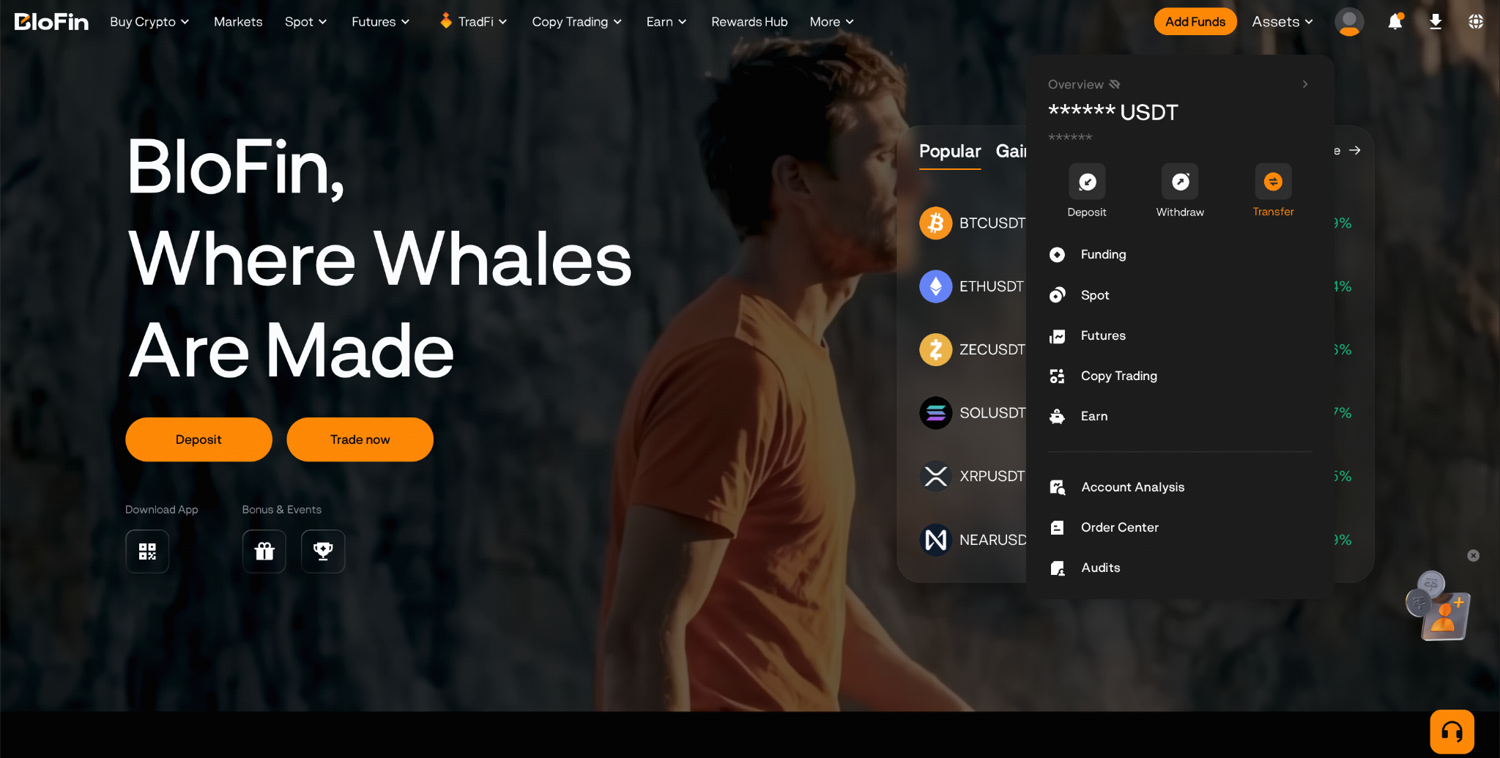
Step 1: Create your BloFin account and send USDT to it. A deposit lands in your Funding Account, so move the USDT to your Futures Account with Transfer, found under Assets.
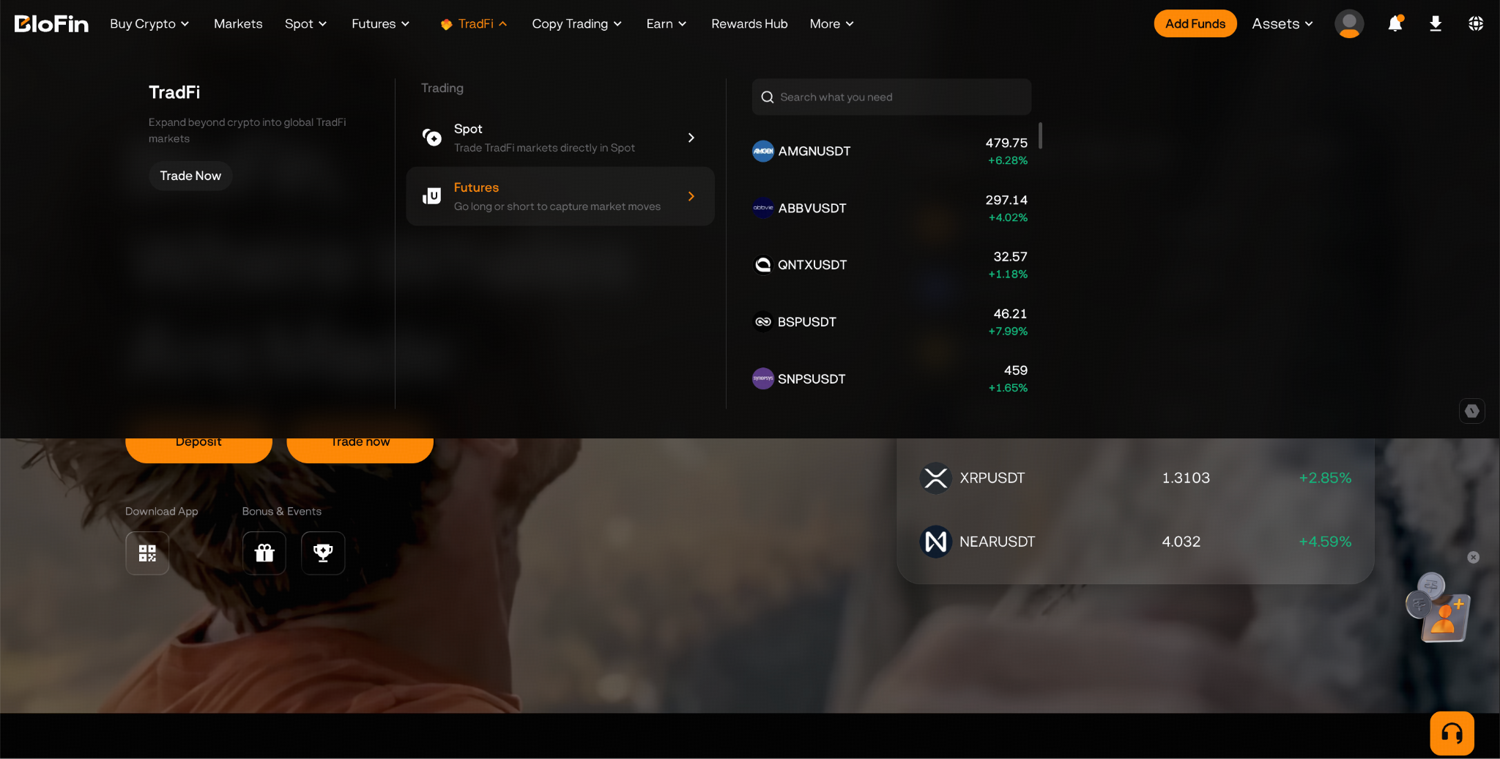
Step 2: Hover your cursor over the TradFi tab and select Futures.
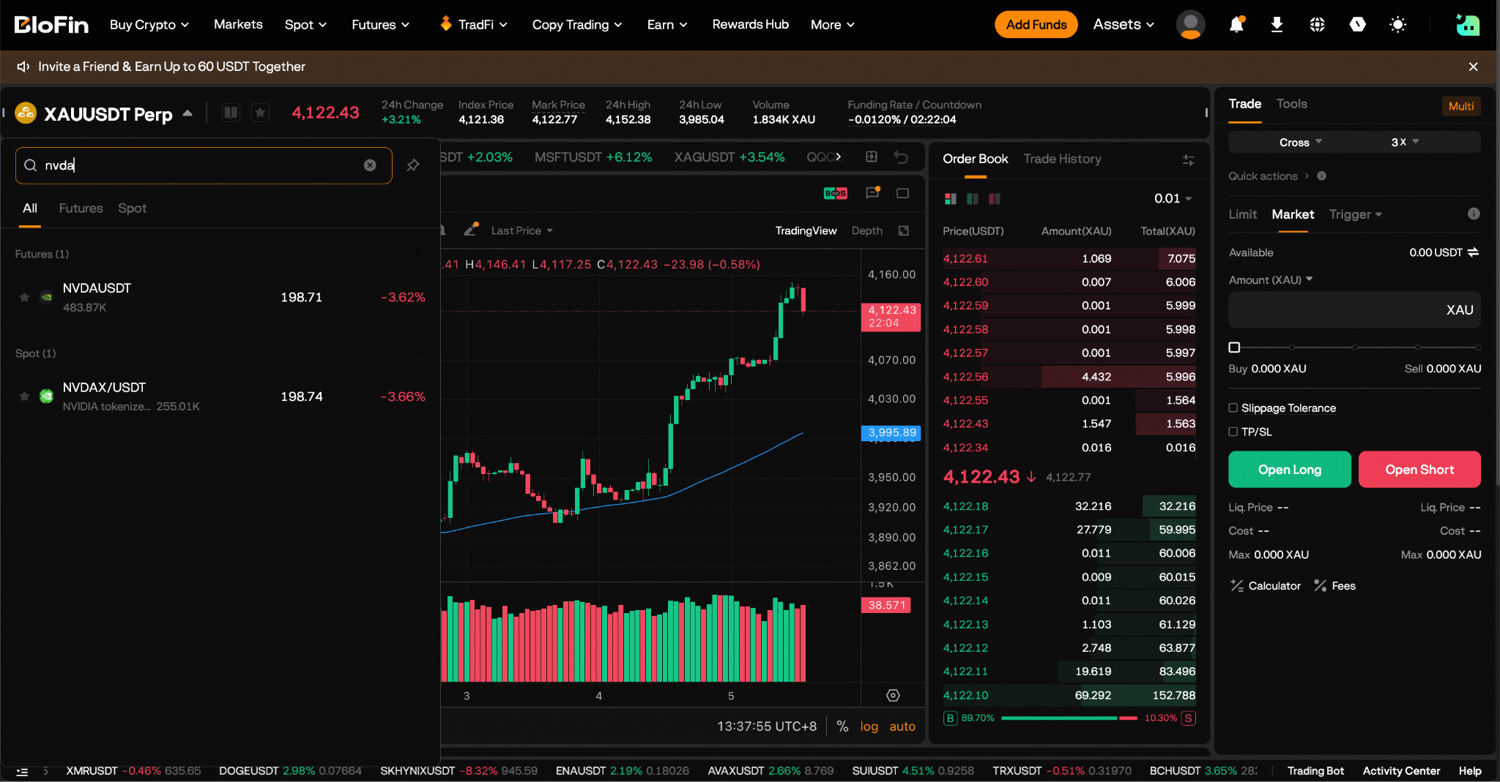
Step 3: Click on the trading pair at the top left corner and search for the stock, such as NVDA or AAPL.
Step 4: On the order panel, click the margin mode button, shown as Cross by default, to choose your margin mode, and click the leverage button beside it to set your leverage. Cross lets a losing position draw on the rest of your futures balance, while Isolated limits the loss to the margin you assign. Then choose Limit, which fills only at your price or better, or Market, which fills right away at the best price available, and enter your amount.
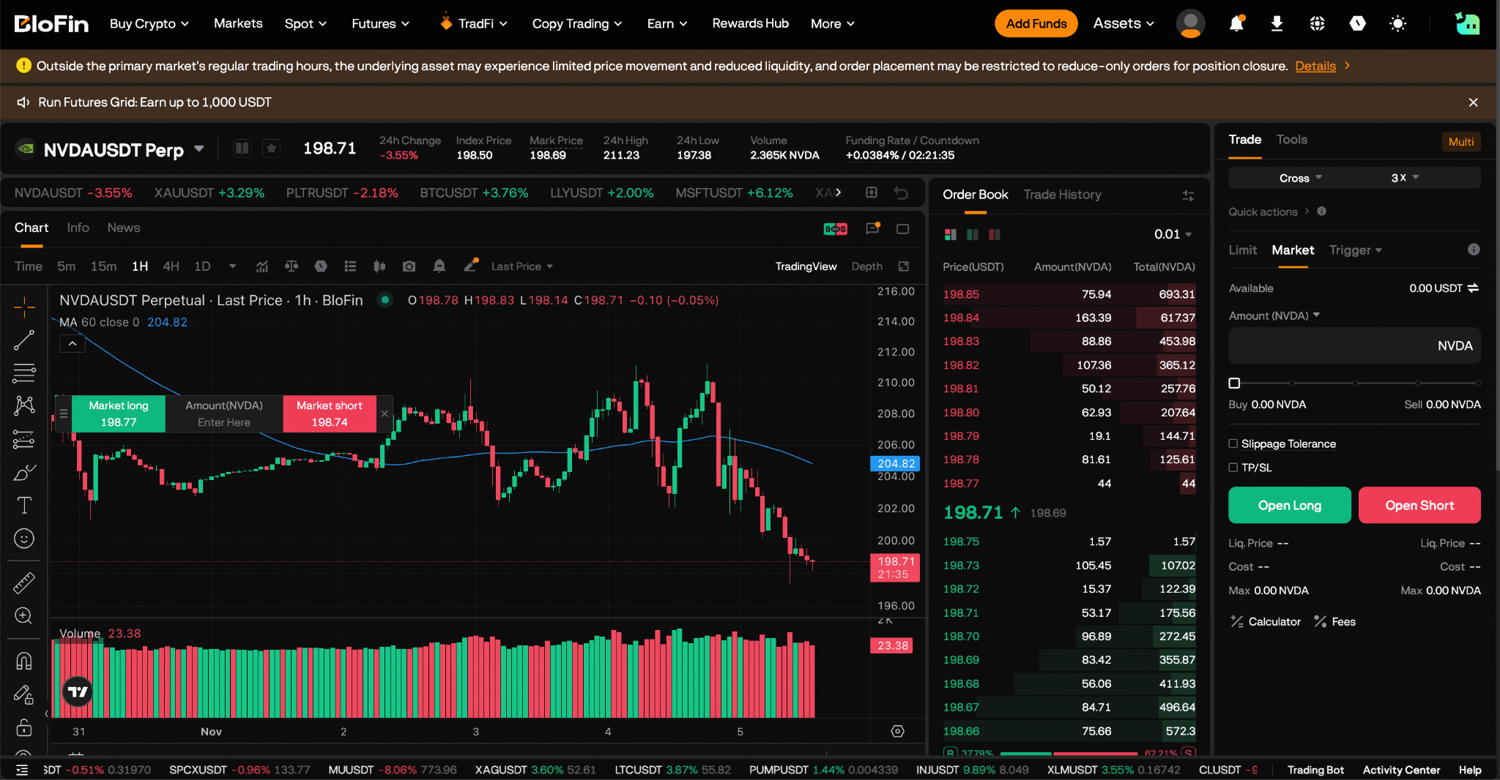
Step 5: Tick TP/SL and enter a stop-loss price. Before you click Buy to go long or Sell to go short, check Liq. Price and Cost. Your first trade on BloFin walks through the order screen in more detail. Your open trade then shows under Positions, and closing a trade on BloFin shows how to exit.
Looking to trade the Magnificent 7? To get started, you'll need to first create a BloFin account, fund your account with cryptocurrency, and navigate to the NVDAUSDT Perpetual, SPYUSDT Perpetual or QQQUSDT Perpetual page.
Frequently asked questions
What is the difference between the Magnificent 7 and FAANG?
FAANG stood for Facebook, Amazon, Apple, Netflix and Google. The Magnificent 7 drops Netflix and adds Microsoft, Nvidia and Tesla, while Facebook and Google now appear under their parent names, Meta and Alphabet. FAANG fell out of favor around the pandemic, partly because Netflix lost so much market value against Nvidia and Tesla (source: Schwab).
Is Tesla still part of the Magnificent 7?
Yes, Tesla has been one of the seven since the name was coined, although it is the odd one out. It differs from the other six, which Schwab describes as mainly software, cloud and chip companies. It also had the lowest return of the seven in 2026 to November 4 (source: calculated from Yahoo Finance data). Its market value, its lead in electric vehicles and its work on AI and self-driving explain its place in the group (source: Schwab).
Is there an ETF to short the Magnificent 7?
Yes. The Direxion Daily Magnificent 7 Bear 1X ETF, ticker QQQD, aims for the opposite of the Indxx Magnificent 7 Index's daily return (source: Direxion). Older lists may still name Roundhill's MAGQ, but Roundhill said in November 2024 that it would close that fund, with trading ending on November 27, 2024 (source: PR Newswire, Roundhill). Inverse funds reset daily, so their return over weeks can differ from the simple opposite of the index's. On a stock perpetual, you take the short position directly, one stock at a time.
Do the Magnificent 7 affect bitcoin?
They have tended to move together, though bitcoin has its own drivers. Across 59 periods of 21 trading days since November 2021, bitcoin's correlation with the seven's average return was 0.57. It finished higher in only 4 of the 15 periods when the seven fell more than 3%, and in 21 of the 27 when they rose more than 3% (source: calculated from Yahoo Finance data). That history is a small sample, and it doesn't tell you what comes next.
Are the Magnificent 7 stocks still a good investment?
That depends on what you already own and how big a fall you could sit through. All seven lost more than the index in 2022 and all seven beat it in 2023, so a strong record can still include a bad year. A standard S&P 500 fund already holds them, so buying them on top raises your share, while an equal-weight fund such as RSP gives each company about the same share.
Researched and written by the BloFin Academy editorial team with AI-assisted drafting. All facts independently verified. Sources include Yahoo Finance, Reuters, CNBC, State Street, Invesco, Benzinga, Schwab, Fidelity, Nvidia, Alphabet, Roundhill, Defiance, Direxion, The New York Times, IPO Scoop and BloFin, current as of November 5, 2026.
Nothing in this article constitutes financial advice, and nothing in it is a recommendation to buy, sell or hold any stock, ETF or crypto asset. These stocks can fall further than the index, as all seven did in 2022, and past returns and correlations do not predict future ones. Stock perpetuals carry funding costs, liquidity in the asset a contract follows may be reduced outside regular market hours, and a leveraged position can lose its full margin or be liquidated. BloFin services are not available in restricted locations, including the United States. Past performance does not indicate future results. Do your own research and consider your risk tolerance before you trade on BloFin.