
Shares that have climbed fast attract a particular kind of trader: the one who thinks the climb has gone too far and wants to be paid if the price comes back down. That trade is called a short, and it turns the usual sums upside down. A falling price earns you money and a rising price costs you, with no ceiling on how high a stock can go.
The traditional way to short a stock runs through a broker, who lends you shares that you sell and must later buy back and return. The loan falls under margin rules and can carry interest and other fees, and if the borrowed stock pays a dividend, you owe that too (source: Investor.gov, Stock Purchases and Sales: Long and Short). For someone who holds only crypto, all of that sits behind a brokerage account they may never have opened.
A perpetual futures contract reaches the same bet with no borrowing at all. It follows a price, never expires and pays out in a stablecoin, which lets you open a short by selling the contract itself. In place of a stock loan you meet funding, a small payment passed between longs and shorts that can land on either side.
On BloFin, that contract is the PLTRUSDT Perpetual, which follows the share price of Palantir Technologies (PLTR) through an index (source: BloFin, Updates to BloFin Stock Futures Trading) and offers up to 20x leverage (source: BloFin PLTR contract details). The sell order takes a few minutes to place. The real decisions come before you click: how much margin to risk, where the stop goes and whether to hold through a report night.
How do you short Palantir stock on BloFin?
To short Palantir on BloFin, you put USDT in your trading account, open the PLTRUSDT Perpetual, pick a margin mode and leverage, set a stop above your entry, then send a Sell order at your chosen size. You gain if the contract's price falls and lose if it rises, and you close later through Close in the Positions tab.
The PLTR perpetual's contract terms set the limits on each order. The smallest is 0.01 PLTR, a market order tops out at 600 PLTR and a limit order at 6,000 PLTR (source: BloFin PLTR contract details).
Outside Nasdaq's regular session (9.30AM to 4PM ET, and 2.30PM to 9PM UTC in US winter time), at weekends and on market holidays, trading in stock futures on BloFin may narrow to reduce-only orders (source: BloFin, Updates to BloFin Stock Futures Trading). That can block an opening Sell but not an order that closes your short, so check when the PLTR perpetual trades before you plan an entry.
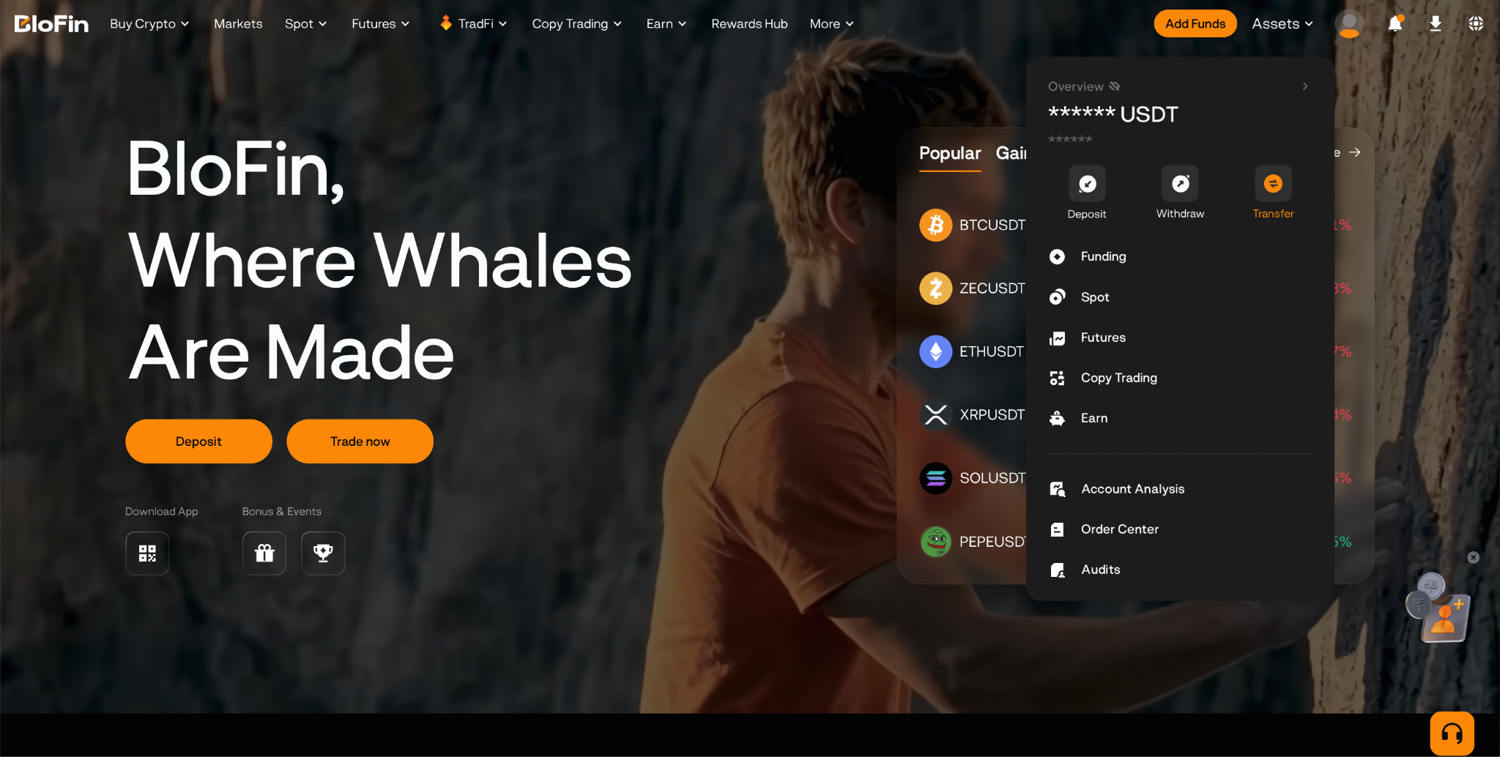
Step 1: Fund your account. Your deposit arrives in the Funding Account first, which means going to Assets, then Transfer, to move the USDT across to your Futures Account. The transfer is instant and free.
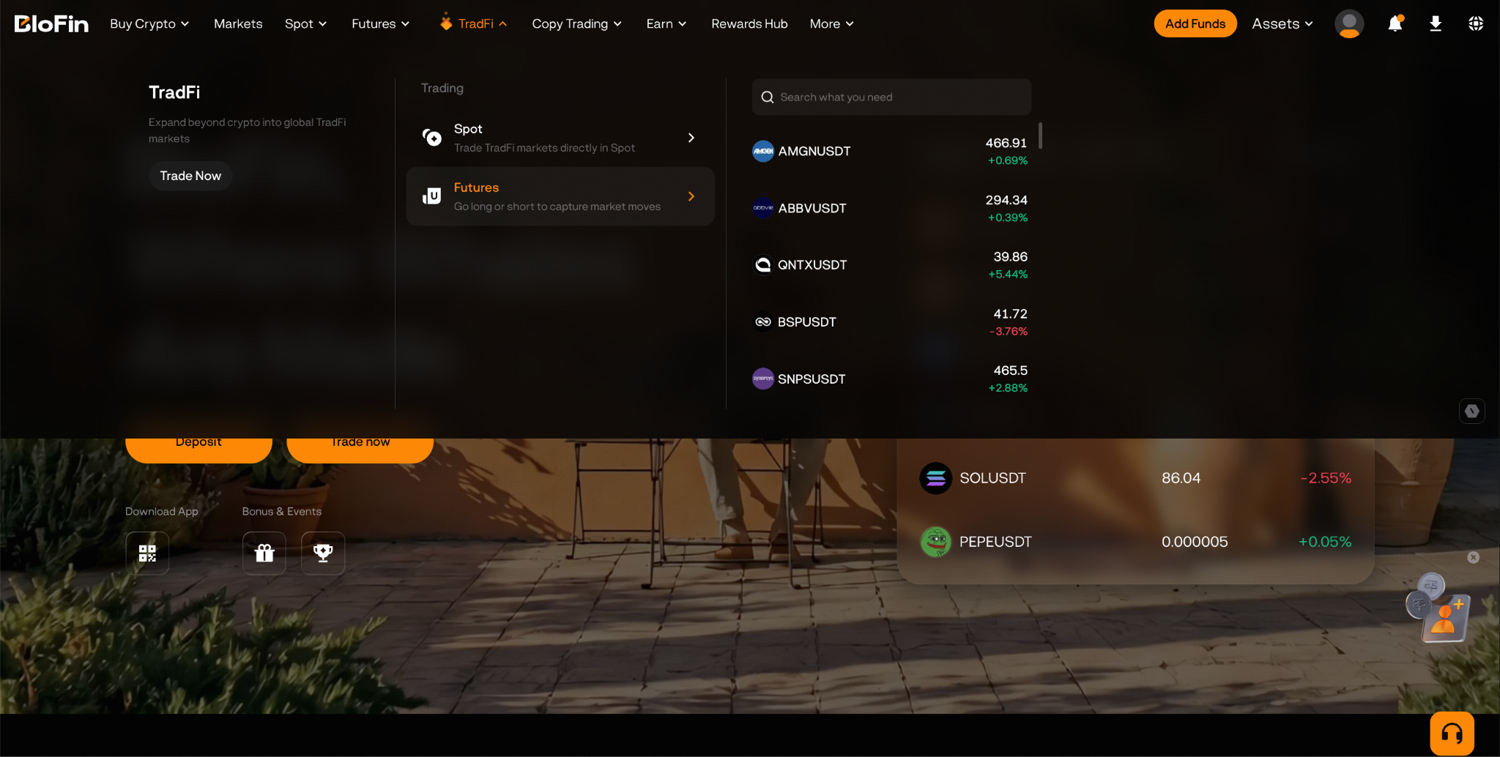
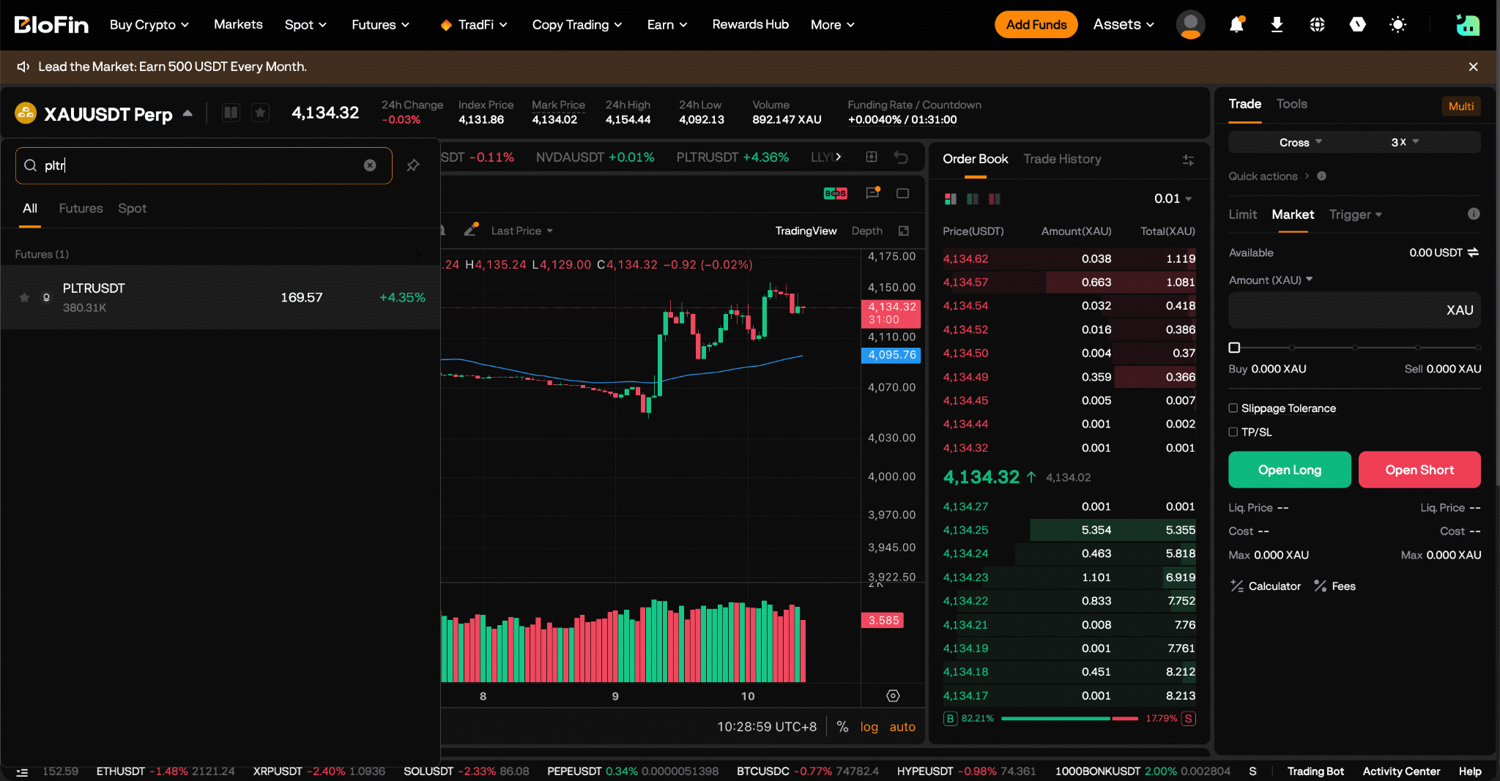
Step 2: Hover your cursor over the TradFi tab at the top of the page, click Futures and search for PLTRUSDT.
Step 3: Pick Cross or Isolated as your margin mode. With isolated, only the margin you give this one position is at risk, while cross puts your whole futures balance behind it. A short loses on a rise, and a rise has no fixed limit, so this choice decides how much of your account one bad move can reach.
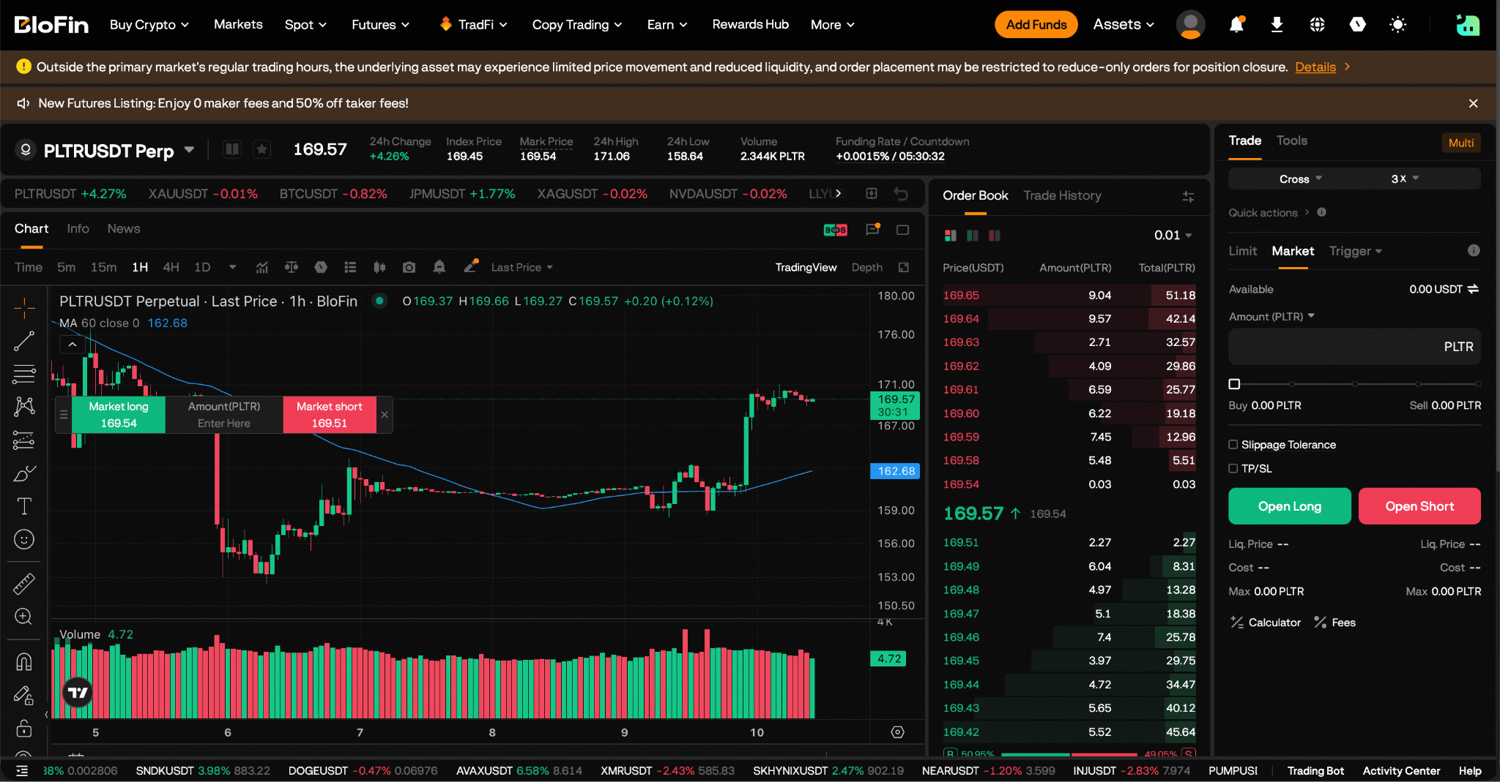
Step 4: Drag the leverage slider or type the multiplier you want. PLTRUSDT runs from 1x to 20x (source: BloFin PLTR contract details), and BloFin's guide to your first trade starts people at 2x to 5x. Lower leverage pushes your liquidation price farther from your entry.
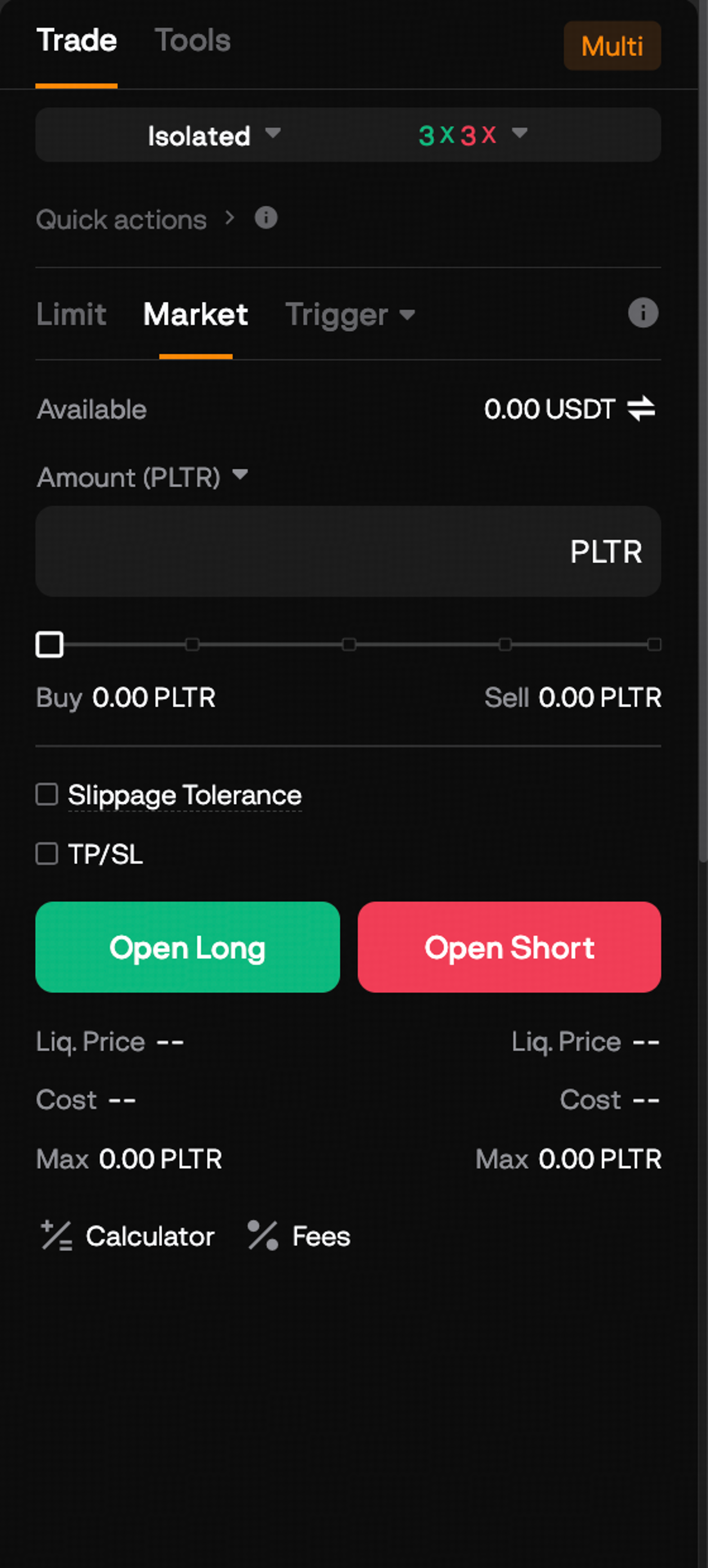
Step 5: Decide how the order fills. With Limit you name the price, Market fills right away at the best price on offer, and with Trigger the order waits until the market hits a level you choose. TP/SL (take profit and stop-loss) and Reduce-only sit on the Limit and Market forms only, so choose one of those to follow Steps 6 and 7 as written. A sell limit can sit no more than about 3% under the index price, and BloFin's two-minute premium adjustment can only pull that limit closer to the index (source: BloFin PLTR contract details).
Step 6: Enter your size under Amount (PLTR). One contract is 0.01 PLTR, so 1 PLTR is 100 contracts (source: BloFin PLTRUSDT market data). Leave Reduce-only unticked, since that setting is for orders that close a position.
Step 7: Tick TP/SL and fill in both prices. On a short, the stop-loss goes above your entry and the take-profit goes under it, the reverse of a long. Each trigger starts on Last, and a dropdown beside the price box changes it to Mark or Index. Both orders then fill as market orders, and the Advanced window lets you set a limit fill for a stop-loss on BloFin instead.
Step 8: Read the estimated Liq. Price on the panel, click Sell, then review the confirmation and confirm.
Step 9: Open the Positions tab and check four numbers: your entry price, current margin, unrealized profit and loss, and estimated liquidation price. Look at the gap between the mark price and the liquidation price after any sharp move, because that gap is the rise your position can still absorb.
How to close a Palantir short
Closing a Palantir short means buying back the same amount of the PLTRUSDT Perpetual, most simply through Close in the Positions tab. In One-way mode, a Buy order on the trading page does the same job. A futures position otherwise stays open until a take-profit or stop triggers or BloFin liquidates it, so the trade has no end date of its own.
Step 1: In the Positions tab, click Close next to your PLTRUSDT short.
Step 2: Choose Limit or Market, then enter the price and the amount you want to close.
Step 3: Click Confirm, and your profit or loss settles in USDT while funding stops on the part you closed.
You can close part of a futures position too. Buying back 4 PLTR of a 10 PLTR short leaves 6 PLTR open at the same leverage, and Close All shuts every open futures position on your account at market in one go. A resting limit order pays the standard 0.0200% maker rate when it fills, while a market order costs the standard 0.0600% taker rate (source: BloFin fee schedule).
How a Palantir short makes or loses money
A Palantir short earns USDT when the price falls, equal to the drop times its size in PLTR, and costs you the same sum when the price climbs. Fees come off when you open and when you close. Leverage changes only the margin you post, which is why the same move looks so much larger at 10x than at 2x.
Say you sell 10 PLTR at 169.78 USDT, the last trade on PLTRUSDT at 3PM UTC (10AM ET) on November 3, 2026, half an hour into the Nasdaq session (source: BloFin PLTRUSDT market data). The position is worth 1,697.80 USDT. Now run two simple outcomes, a 10 USDT fall and a 10 USDT rise, paying the standard 0.0600% taker rate on the position's value at each end, as in BloFin's fee guide.
Line on a 10 PLTR short from 169.78 USDT | Price falls to 159.78 USDT | Price rises to 179.78 USDT |
|---|---|---|
Price gain or loss | +100.00 USDT | −100.00 USDT |
Opening fee | −1.02 USDT | −1.02 USDT |
Closing fee | −0.96 USDT | −1.08 USDT |
Net result, before funding | +98.02 USDT | −102.10 USDT |
Net result on 339.56 USDT of margin at 5x | +28.9% | −30.1% |
The USDT result stays the same at any leverage, and only the margin behind it changes. At 2x the same position needs 848.90 USDT of margin, so the 10 USDT rise costs about 12.0% of it. At 10x the margin is 169.78 USDT, and that same rise costs about 60.1%.
BloFin values an open position on the mark price, a reference price that combines the index, a funding basis and other inputs, and it uses the last trade for what you actually realize (source: BloFin, Index, Mark and Last Price). The PLTRUSDT Perpetual page shows the live mark, the funding rate in force and a countdown to the next settlement.
Borrow fees and funding on a Palantir short
A Palantir short on the perpetual has no borrow fee, because you sell a contract and borrow no shares. The holding cost is funding, which normally changes hands at 12AM, 8AM and 4PM UTC (source: BloFin PLTR contract details). You collect funding when the rate is above zero and pay it when the rate is under zero.
Funding is charged on what the whole position is worth, whatever leverage you chose, and closing before a settlement means that round never touches you. The sign follows the contract's price against spot: a perpetual trading above spot pays shorts, and one trading under spot charges them.
PLTRUSDT's own record shows both sides. Across the 100 settlements from 12AM UTC on October 3 to 12AM UTC on November 5, 2026, 71 rates were positive, 25 negative and 4 zero, and together they add up to +0.5486% (source: BloFin, PLTRUSDT funding history). On a position worth 1,697.80 USDT, that comes to about 9.31 USDT received by a short. A 0.93 USDT rise in the price would cost the same 10 PLTR short that much, so funding is small change beside the price.
The total also hides how much the recent weeks differ from the early ones. Thirty-five of those settlements paid exactly 0.0120%, all of them on or before October 16. The 49 from October 20 onward came to 27 positive, 19 negative and 3 zero, and they sum to −0.0099%, so the same short paid about 0.17 USDT over those 16 days (source: BloFin, PLTRUSDT funding history).
Single settlements can stand out as well. The rate hit +0.1359% at 12AM UTC on October 19, worth about 2.31 USDT to that short, and −0.0218% at 4PM UTC on October 24, costing about 0.37 USDT (source: BloFin, PLTRUSDT funding history). BloFin caps the rate at 3% either way per settlement, which on the same position would be about 50.93 USDT (source: BloFin PLTRUSDT market data). So treat funding as a credit you may or may not collect. If short sellers crowd in and the contract trades under spot, the rate turns negative and the position that was being paid starts paying.
Short squeezes and Palantir's short interest
A short squeeze happens when a sharp rise pushes traders with short positions to buy back and limit their losses, and those purchases drive the price up further. Palantir's short interest, the shares sold short and still open, was 56,092,550 at the October 15, 2026 settlement (source: Nasdaq, PLTR short interest), about 2.4% of its Class A shares (source: Palantir Form 10-Q, Q3 2026).
Nasdaq's glossary describes the squeeze as a surge of forced buying that deepens the losses of short sellers still in the trade (source: Nasdaq, Short squeeze). That 2.4% uses the 2,306,705,341 Class A shares on the cover of Palantir's latest 10-Q, counted on October 26 (source: Palantir Form 10-Q, Q3 2026). Days to cover is the shares sold short divided by average daily volume, a rough guide to how many normal sessions it would take all those sellers to buy back.
Settlement date, 2026 | Palantir shares sold short | Days to cover |
|---|---|---|
June 30 | 87,264,219 | 1.87 |
July 31 | 68,066,419 | 2.25 |
August 31 | 65,131,893 | 2.16 |
September 30 | 55,587,983 | 2.43 |
October 15 | 56,092,550 | 2.42 |
Those figures come from Nasdaq's short interest table for Palantir (source: Nasdaq, PLTR short interest). Short interest fell 35.7% from June 30 to October 15, while the stock climbed: its close rose 71.9% over the same span, from $116.67 to $200.50 (source: Nasdaq, PLTR historical prices). These counts record positions and give no reasons, so they cannot say how much of that fall was short sellers giving up.
Treat the number as context, for two reasons. It lags: firms report twice a month, and FINRA's calendar publishes the October 30 reading on November 10 (source: FINRA, Short Interest Reporting). It also counts shares sold short through brokers, so it says nothing direct about who is short PLTRUSDT.
A squeeze reaches a perpetual by a different road. No lender can call back shares you never borrowed, but every short still closes with a buy, whether you click the button or a stop does it for you. In a fast rally, stops and forced closes all turn into buying at once. A short interest near 2.4% looks modest, and it says little about how far a rally can run: the stock rose about 72% from June 30 to October 15 as that figure fell (source: Nasdaq, PLTR historical prices).
Where a Palantir short gets liquidated at 2x, 5x and 10x
A Palantir short is liquidated by a rise, and leverage sets how small that rise can be. From a 169.78 USDT entry in isolated margin, BloFin's margin formula (source: BloFin, Liquidation Price Calculation) and its 2.50% first-tier maintenance rate (source: BloFin, PLTRUSDT position tiers) put the estimated liquidation price near 182.10 USDT at 10x, 198.65 USDT at 5x and 248.31 USDT at 2x.
BloFin treats a position as ready for reduction or liquidation once its margin rate reaches 100%. An isolated position's rate is its margin balance plus profit, divided by its maintenance margin plus the transaction fee (source: BloFin, Liquidation Price Calculation). The first tier covers positions up to 700 PLTR at that 2.50% rate (source: BloFin, PLTRUSDT position tiers). Solve for the price of a short, assuming a liquidation fee equal to the standard 0.0600% taker rate, and you get one line.
Estimated liquidation price = entry price × (1 + 1 ÷ leverage) ÷ (1 + 0.025 + 0.0006)
Leverage on a short from 169.78 USDT | Margin per 1 PLTR | Estimated liquidation price | Rise needed from entry | Margin used up if price reaches 177.58 USDT |
|---|---|---|---|---|
2x | 84.89 USDT | 248.31 USDT | 46.3% | 9.2% |
5x | 33.96 USDT | 198.65 USDT | 17.0% | 23.0% |
10x | 16.98 USDT | 182.10 USDT | 7.3% | 45.9% |
The last column uses a real price. PLTRUSDT's highest trade after that entry, through the early hours of November 5, was 177.58 USDT on November 4, only 4.6% up (source: BloFin PLTRUSDT market data). On last trades and before fees, that was enough to take nearly half the margin of a 10x short within about a day.
These figures are estimates, and the Liq. Price on your panel is the one that counts. BloFin runs liquidation on the mark price and not the last price, so a spike in trades matters only if the mark follows. Once the mark reaches your liquidation price, BloFin reduces or liquidates your short, closing part or all of it, and from then on you cannot add margin or place orders for it (source: BloFin, Forced Liquidation Rules).
Those estimates apply to isolated margin, because under cross margin the liquidation price moves with your whole futures balance. Sizing a position against Palantir's usual moves comes down to choosing your leverage.
Report-night gap risk on a Palantir short
Report night is one of the sharpest risks on a Palantir short, because results arrive after the Nasdaq close while the contract keeps trading. After the August 3, 2026 report, PLTRUSDT climbed from 126.15 USDT to 144.50 USDT in four hours, a 14.5% move against any short held through it (source: BloFin PLTRUSDT market data).
Palantir's newest report shows that the direction is never settled in advance. On November 2, the company said third-quarter revenue reached $2.3 billion, up 96% on the year, and it lifted its full-year revenue forecast, which now stands at about $8.5 billion (source: Palantir Q3 2026 results, Exhibit 99.1). The shares closed at $178.34 that day, before the release, and they ended November 3 at $175.40 and November 4 at $171.70 (source: Nasdaq, PLTR historical prices). A short from the November 2 close was 3.7% ahead two sessions later, even with revenue growing that fast.
August ran the other way, and it is the night to study if you plan to hold a short through a report. Say you were short 1 PLTR at 126.15 USDT, the price at 8PM UTC (4PM ET) on August 3, as the session ended. Palantir's second-quarter results reached the SEC minutes later, at 4.06PM ET (8.06PM UTC) (source: Palantir Form 8-K, August 3, 2026). In the first hour the contract traded as high as 142.98 USDT and closed that hour at 141.02 USDT, and by 12AM UTC it stood at 144.50 USDT (source: BloFin PLTRUSDT market data).
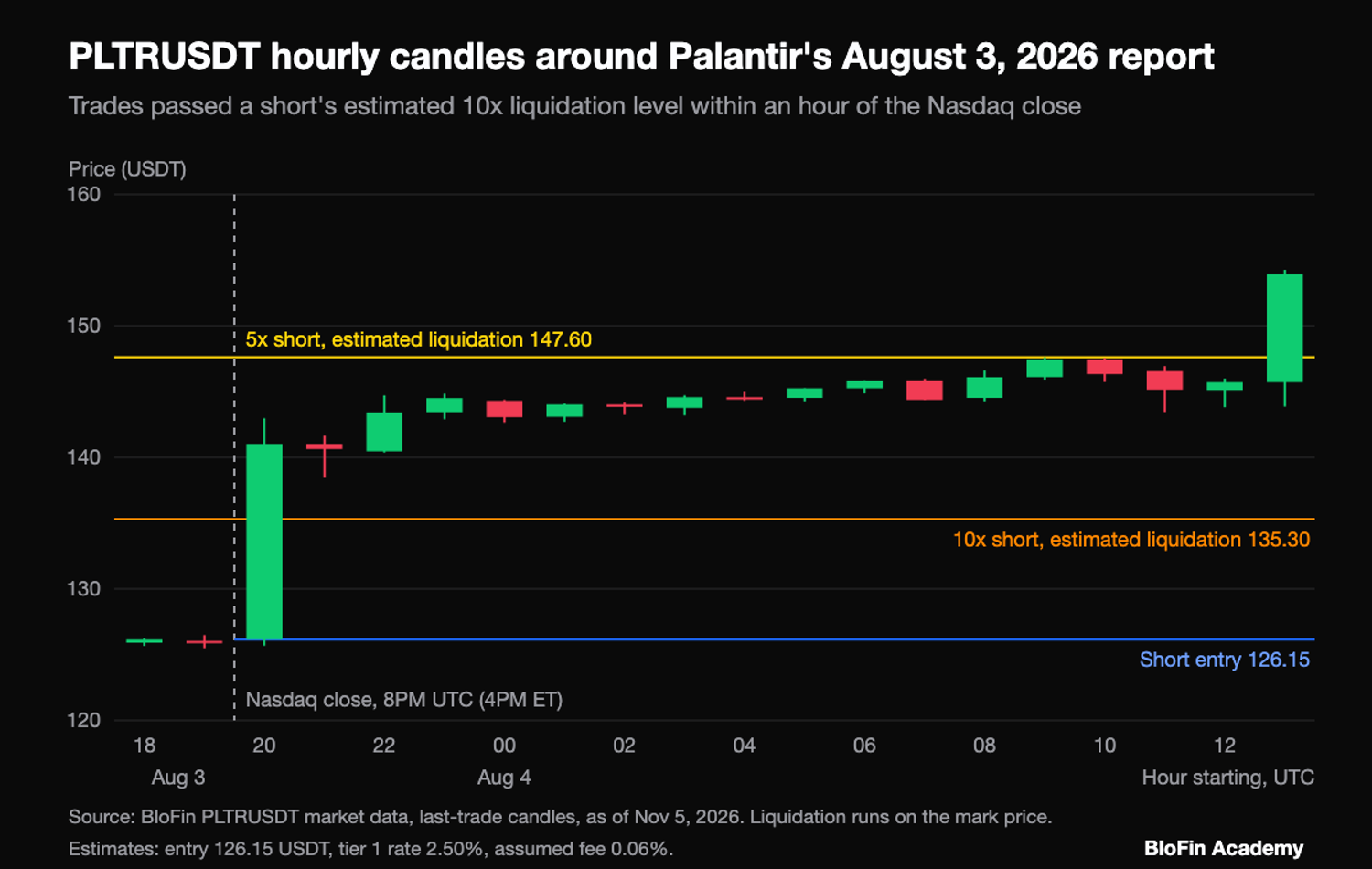
The same one-line formula from a 126.15 USDT entry gives estimates of 135.30 USDT at 10x, 147.60 USDT at 5x and 184.50 USDT at 2x. Trades passed the 10x level inside the first hour. They stopped a fraction of a cent short of the 5x level in the hour from 9AM UTC on August 4, when the high was 147.60 USDT. They cleared it in the hour from 1PM UTC, when the high was 154.26 USDT. The 2x level held that week, with PLTRUSDT's high through August 7 at 172.30 USDT, and trades passed it on August 27, when the day's high was 186.80 USDT (source: BloFin PLTRUSDT market data). These candles show last trades and liquidation follows the mark, so a crossing here does not prove the mark got there at the same moment.
The shares' own regular session had to wait until the next morning. They closed at $125.65 on August 3 and opened at about $145.15 on August 4, a 15.5% gap, then closed at $162.66, up 29.5% on the day before (source: Nasdaq, PLTR historical prices). By that open, a short sitting in the contract had already carried the overnight jump.
A stop helps, but it can slip in a move this fast. A market stop 5% above that entry, at 132.46 USDT, plans a loss of 6.31 USDT per PLTR. Your size and the distance to the stop set that loss, and leverage plays no part in it. On the default Last setting, the trigger would have fired in that first hour, and a market order takes whatever price is available. An hourly candle cannot show the exact fill, but a fill as late as the hour's 141.02 USDT close would cost 14.87 USDT, more than twice the plan (source: BloFin PLTRUSDT market data). At 10x, that price sits past the 135.30 USDT liquidation estimate, so the position could be liquidated before the stop fills. Gaps like this can also open overnight and at weekends. The one certain way to avoid a report-night gap is to close the short before the release.
Long or short on Palantir: How to decide
Choosing long or short on Palantir comes down to what you expect, what would prove you wrong and what being wrong costs in USDT. Both sides use the same contract, margin and fees, so the real differences are which way a gap hurts, where the stop sits and which side funding pays at each settlement.
Point of difference | Long PLTRUSDT | Short PLTRUSDT |
|---|---|---|
Opens with | Buy | Sell |
Closes in One-way mode with | Sell | Buy |
Gains when the price | rises | falls |
Stop-loss sits | under your entry | above your entry |
At a positive funding rate | pays | receives |
Report-night gap that hurts | a gap down | a gap up |
Room for the price to go against you | down to zero | no fixed limit |
Four questions turn those differences into a decision you can test before you trade. What specific price would prove the idea wrong? That level is your stop, and if it sits beyond your estimated liquidation price, your leverage is too high. Does a Palantir report fall inside the time you plan to hold? If it does, either size for a move like August's or close first. What does the stop cost in USDT at your chosen size, and could you take that loss twice? Which way has funding been paying lately, and does the trade still work if the sign flips?
Whether the stock itself deserves a short is a separate decision, and it turns on the risks Palantir faces as a business. If your answers point the other way, you go long on BloFin from the same panel, with a Buy order in place of the Sell.
Looking to trade Palantir? To get started, you'll need to first create a BloFin account, fund your account with cryptocurrency, and go to the PLTRUSDT Perpetual trading page.
Frequently asked questions
Can you short Palantir with crypto?
You can, through the PLTRUSDT Perpetual, where your margin and your profit or loss are both in USDT. There are no shares to borrow and no brokerage account involved. BloFin has no Palantir token or spot pair, so a short on BloFin always means selling this contract.
Do you owe dividends when you short Palantir?
Palantir has never paid a dividend on its common stock and says it has no plans to, so a broker short has nothing to hand over today (source: Palantir Form 10-Q, Q3 2026). A PLTRUSDT short sits outside that system altogether, since BloFin's notice says stock futures pay no dividends and carry no voting or other shareholder rights (source: BloFin, Updates to BloFin Stock Futures Trading).
Can you lose more than your margin on a Palantir short?
An isolated short risks the margin you gave it, so a 5x short of 1 PLTR at 169.78 USDT puts 33.96 USDT on the line, plus fees. A cross short draws on your entire futures balance, which means a large rise can eat well past the margin you first had in mind.
Can you hold a Palantir short over the weekend?
Your position stays open until you close it, a stop or take-profit triggers, or it is liquidated, and funding keeps settling on Saturdays and Sundays. PLTRUSDT settled at −0.0026%, −0.0015% and +0.0005% on Saturday, October 31, 2026, for example (source: BloFin, PLTRUSDT funding history). Closing your short stays allowed during a reduce-only period (source: BloFin, Updates to BloFin Stock Futures Trading).
Does a BloFin stop-loss use the mark price or the last price?
A stop-loss on BloFin futures triggers on the last price by default, and the dropdown next to the trigger price lets you switch to the mark or the index. Liquidation always uses the mark. So a short set on Last can stop out on one brief spike in trades that never moves the mark, and a short set on Mark ignores that spike.
Why do websites show different short interest percentages for Palantir?
The share count underneath differs. On the October 15, 2026 reading of 56,092,550 shares, MarketBeat shows 2.58% of float (source: MarketBeat, PLTR short interest), while the same figure is about 2.43% of Class A shares and 2.33% of all three share classes on the 10-Q cover (source: Palantir Form 10-Q, Q3 2026). Check which base a site uses before you compare two numbers.
Researched and written by the BloFin Academy editorial team with AI-assisted drafting. All facts independently verified. Primary sources include Palantir's third-quarter 2026 results release, its Form 10-Q and its August 3, 2026 Form 8-K on SEC EDGAR, Nasdaq's daily price and short interest tables for Palantir, FINRA's short interest calendar and Investor.gov. BloFin facts come from its stock futures notice, contract, position tier, funding and fee pages, its help pages on the mark price and liquidation, and its own PLTRUSDT market data, current as of November 5, 2026.
Nothing in this article constitutes financial advice, and nothing in it is a recommendation to buy, sell or hold Palantir in any form. A short on the PLTRUSDT Perpetual loses money when the price rises, and a rise has no fixed limit, so a report-night jump like August 3, 2026 can carry trades past a 10x liquidation estimate within an hour and cost your full margin. A stop can fill well past its level in a fast move, and funding can turn against you at any settlement. Past performance does not indicate future results. Do your own research and consider your risk tolerance before you trade on BloFin.