
When the stock market turns rough, investors tend to move money into companies that sell things people buy in any economy, such as groceries, medicine and electricity. Late 2026 showed that habit clearly. From October 5 to November 10, with dividends, the main US healthcare fund rose 12.9%, the consumer staples fund 12.3% and the utilities fund 9.4%. Over the same weeks the technology fund lost 15.9% and the S&P 500 fund 3.2% (source: calculated from Yahoo Finance data).
The trigger was a loss of confidence in AI stocks. On October 30, CNBC reported that tech stocks were under severe pressure because investors' appetite was fading for the most capital-hungry part of the AI buildout (source: CNBC). Then on November 5 the S&P 500 fell 4.4%, its worst day since April 2025, and the technology fund fell 8.0%. The staples fund lost only 0.8% and the utilities fund 0.7% (source: AP via BNN Bloomberg, calculated from Yahoo Finance data).
That is what defensive stocks are for, and it is only part of their record. They have also fallen hard in a fast crash, dropped when interest rates rose and trailed the market for years at a time. Knowing which sectors count, and what each one reacts to, tells you how much protection to expect.
BloFin lists USDT-settled perpetual contracts on several large defensive companies, including the COSTUSDT Perpetual on Costco, the KOUSDT Perpetual on Coca-Cola and the LLYUSDT Perpetual on Eli Lilly.
What are defensive stocks?
Defensive stocks are shares in companies whose sales and profits hold up when the economy slows, because people keep buying what they sell, such as food, household goods, medicine and electricity. Their prices usually fall less than the overall market in a sell-off and rise less in a boom, which is why they are also called non-cyclical stocks.
The idea rests on how households spend. When money gets tight, you can put off a new car, a holiday or a sofa, but you still buy toothpaste, fill prescriptions and pay the power bill. A company selling those things sees steadier revenue from one year to the next, and steadier revenue usually means steadier earnings and dividends. Investors pay for that reliability, so the shares tend to hold their value better when the outlook darkens.
The name causes one common mix-up. Defense stocks are companies that make weapons, aircraft and military equipment, and they belong to the industrials sector. A defensive stock is any company whose business holds up in a downturn, and the two groups barely overlap.
Say you lose your job and your household has to cut its spending. The first things to go are usually the big, optional purchases: the car upgrade, the kitchen renovation, the flights abroad. The weekly shop, the pharmacy and the electricity bill stay, and so does the money those companies collect. That is the whole case for defensive stocks, and it also explains their weak spot. They protect you when the economy is the problem, and they protect you less when the problem is something else, such as rising interest rates or a market-wide panic.
Which sectors are defensive?
Three of the 11 sectors in the S&P 500 are usually called defensive: consumer staples, healthcare and utilities. Each has its own sector fund, run by State Street. The largest companies in each fund show what sort of business the label covers.
Sector (fund) | What the companies sell | Largest companies in the fund | Dividend yield, 12 months to November 10, 2026 |
|---|---|---|---|
Consumer staples (XLP) | Food, drinks, household goods, tobacco, and the stores that sell them | Walmart, Costco, Procter & Gamble, Coca-Cola, Philip Morris | 2.41% |
Healthcare (XLV) | Medicines, health insurance, medical devices, lab equipment | Eli Lilly, Johnson & Johnson, AbbVie, Merck, UnitedHealth | 1.35% |
Utilities (XLU) | Electricity, gas and water | NextEra Energy, Southern Company, Duke Energy, Constellation Energy, American Electric Power | 2.77% |
(source: State Street, XLP, State Street, XLU, State Street, XLV, calculated from Yahoo Finance data)
The S&P 500 fund (SPY) paid 1.01% over the same 12 months, so two of the three defensive funds paid more than twice as much in dividends as the overall market (source: calculated from Yahoo Finance data). Comparing consumer discretionary and consumer staples shows how staples differ from the companies that sell things people can delay, and healthcare stocks breaks down the six industries inside healthcare.
Each sector earns the label for its own reason. Staples companies sell cheap, frequent purchases that households rarely cut. Healthcare demand follows illness and age more than the economy, and much of it is paid by insurers and governments. Utilities usually hold a local monopoly on supplying power, gas or water, with prices approved by regulators, so their income is among the most predictable in the stock market.
Are telecom stocks still defensive?
Phone companies used to be the fourth defensive sector, because people keep paying their phone bills in a recession. That changed after the close on September 28, 2018. S&P Dow Jones Indices and MSCI broadened the telecommunication services sector into communication services, and they moved Alphabet and Facebook into it from technology and Netflix from consumer discretionary (source: S&P Dow Jones Indices and MSCI).
On November 9, 2026, Meta and Alphabet's two share classes made up 40.59% of the communication services fund (XLC), while the three big phone companies, AT&T, Verizon and T-Mobile, made up 13.34% (source: State Street, XLC). The fund now moves almost one for one with the S&P 500. Beta measures how much a stock moves when the market moves. Since the end of 2018 the fund's beta has been 0.97, against 0.50 for AT&T and 0.33 for Verizon (source: calculated from Yahoo Finance data). The phone companies still behave defensively, but the sector that holds them no longer does.
Is real estate a defensive sector?
Real estate is sometimes grouped with the defensive sectors because rent keeps coming in, but its record in a downturn is weaker. The real estate fund (XLRE) fell 37.8% in the Covid crash, more than the S&P 500 fund's 33.7%, and lost 32.2% in the 2022 bear market. Property companies borrow heavily and their shares compete with bonds for income-seeking investors, so they tend to fall when interest rates rise (source: calculated from Yahoo Finance data).
Defensive vs cyclical stocks
Cyclical stocks are companies whose sales rise and fall with the economy, such as carmakers, airlines, banks, builders and makers of luxury goods. Defensive stocks sell necessities, so their sales swing less from boom to recession, and their share prices usually swing less too.
The difference shows up in beta. Over the five years to November 10, 2026, the staples fund had a beta of 0.35, so it tended to move about a third as much as the S&P 500. The technology fund's beta was 1.39 (source: calculated from Yahoo Finance data).
Here is how all 11 sector funds, and two funds built to be less volatile, measured over those five years. Volatility is a yearly figure for how widely a price swings, and the S&P 500 fund's was 17.3% (source: calculated from Yahoo Finance data):
Fund | Sector | Beta versus the S&P 500 | Volatility per year |
|---|---|---|---|
XLP | Consumer staples | 0.35 | 14.0% |
XLU | Utilities | 0.43 | 17.4% |
SPLV | Low-volatility S&P 500 stocks | 0.43 | 12.7% |
XLV | Healthcare | 0.53 | 15.4% |
XLE | Energy | 0.55 | 25.6% |
USMV | Minimum-volatility US stocks | 0.59 | 12.4% |
XLRE | Real estate | 0.70 | 19.3% |
XLF | Financials | 0.84 | 18.4% |
XLB | Materials | 0.85 | 19.2% |
XLI | Industrials | 0.87 | 17.8% |
XLC | Communication services | 0.99 | 21.2% |
XLY | Consumer discretionary | 1.22 | 24.2% |
XLK | Technology | 1.39 | 26.5% |
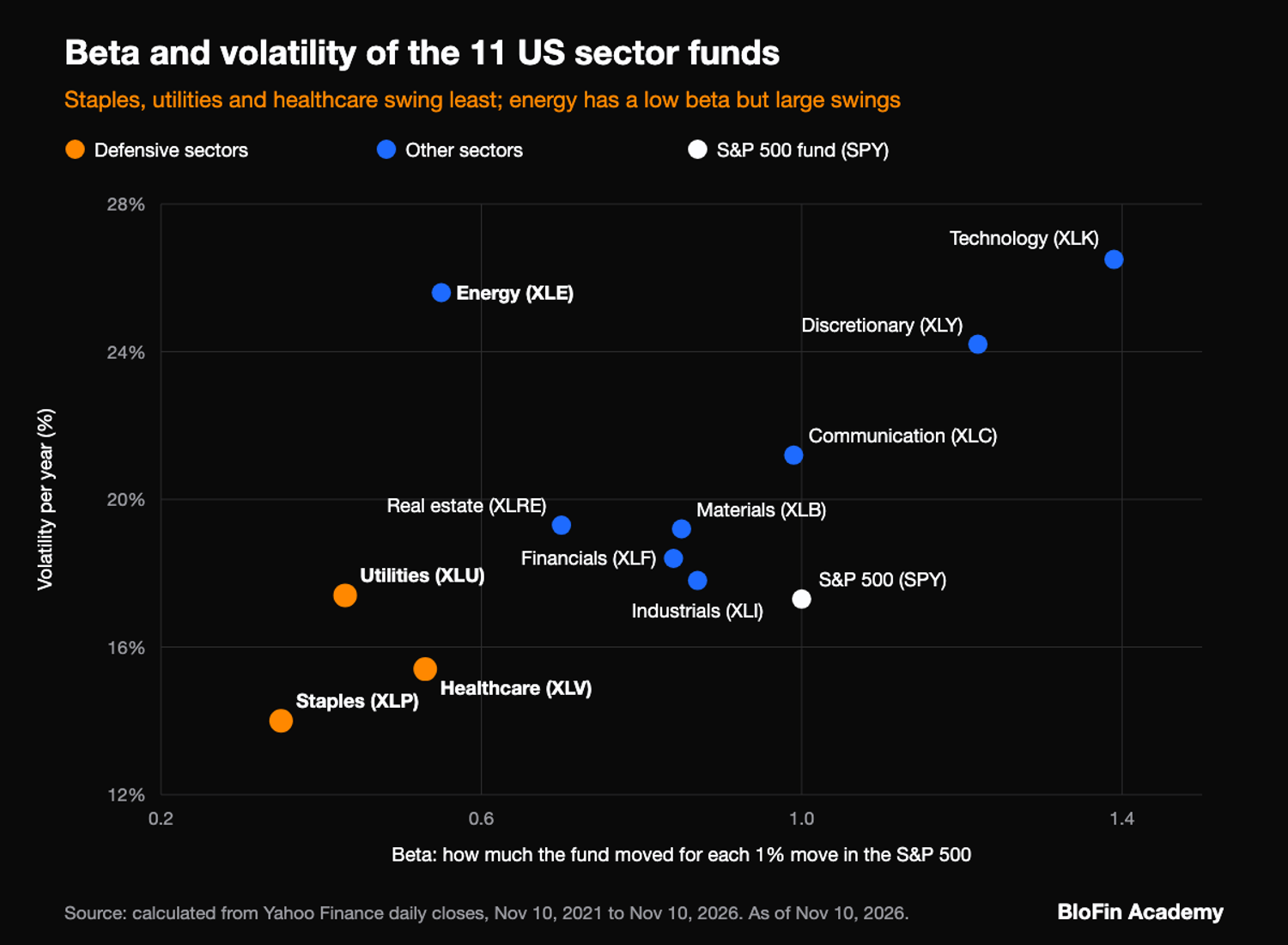
Energy shows why a low beta alone does not make a stock defensive. Oil and gas companies follow the oil price more than the stock market, so their beta is low, but their own swings are among the largest of any sector. The energy fund fell 56.1% in the Covid crash and then rose 44.5% during the 2022 bear market, when almost everything else fell (source: calculated from Yahoo Finance data). A defensive stock needs both: a business that holds up in a downturn and a share price that swings less than the market.
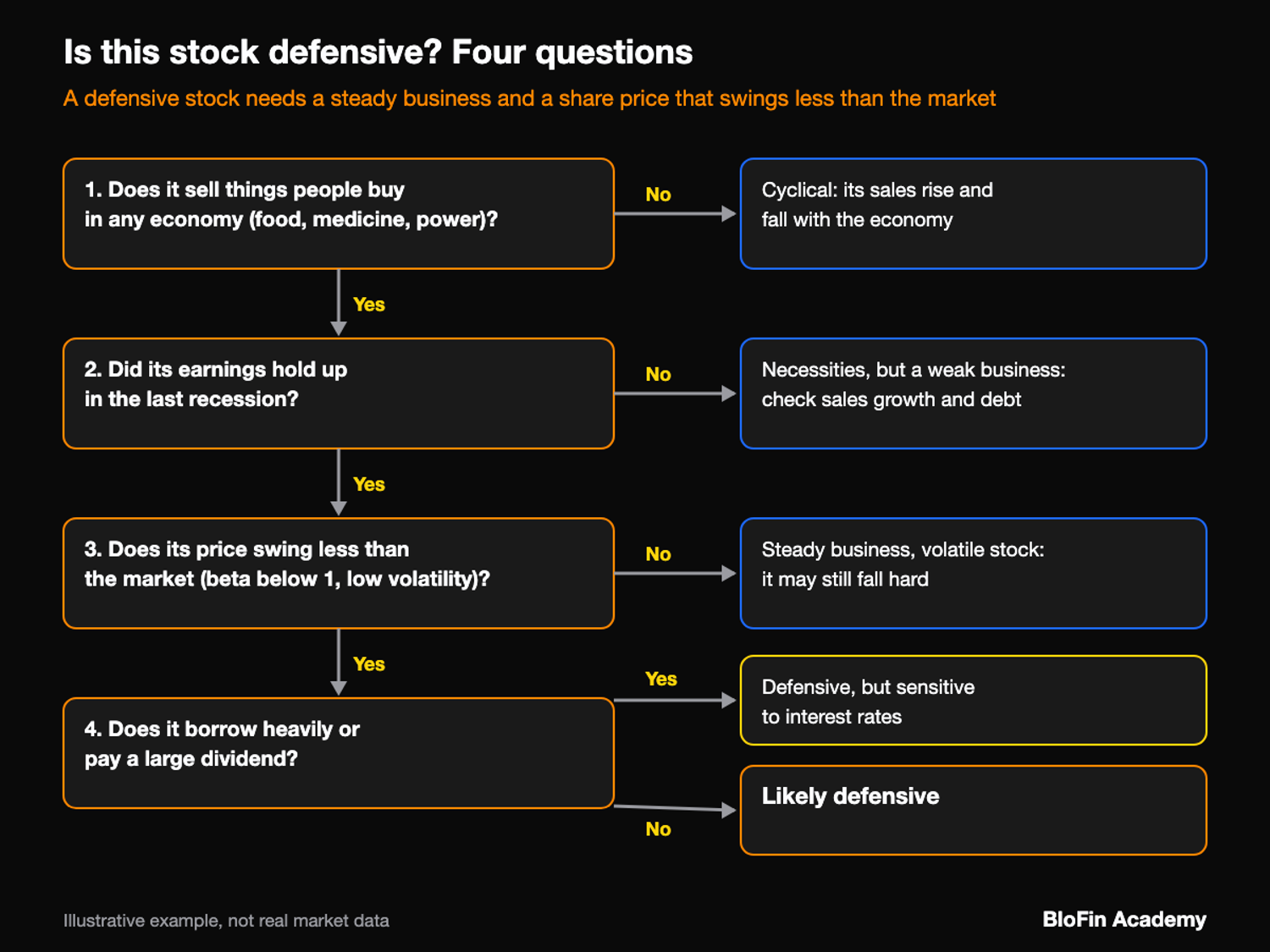
Most companies sit somewhere between the two labels. Bank stocks are cyclical because loan losses rise in a recession, yet a large bank's shares can swing less than a fast-growing tech company's. A useful habit is to ask what the company sells, how its earnings held up in the last downturn, and how much its share price moved compared with the market.

How did defensive stocks do in sell-offs?
In the four big US stock market falls since 2018, the staples and healthcare funds lost less than the S&P 500 fund every time. The utilities fund lost less in three of the four. These are total returns with dividends, from each peak to its low (source: calculated from Yahoo Finance data):
Sell-off | S&P 500 (SPY) | Staples (XLP) | Healthcare (XLV) | Utilities (XLU) | Minimum volatility (USMV) | Technology (XLK) |
|---|---|---|---|---|---|---|
September 20 to December 24, 2018 | −19.3% | −10.5% | −13.9% | −1.6% | −12.5% | −22.7% |
February 19 to March 23, 2020 (Covid crash) | −33.7% | −24.2% | −27.9% | −35.4% | −33.0% | −31.2% |
January 3 to October 12, 2022 | −24.5% | −10.6% | −11.6% | −11.3% | −17.3% | −33.1% |
February 19 to April 8, 2025 (tariff sell-off) | −18.8% | −5.9% | −8.8% | −8.3% | −8.6% | −25.7% |
The slower falls are where the defensive sectors protected you most. In 2022 and in the 2025 tariff sell-off, staples, healthcare and utilities each lost less than half as much as the S&P 500. In late 2018 the utilities fund barely moved while the market lost almost a fifth.
The Covid crash shows the limit. When investors sold everything in five weeks, the utilities fund fell further than the S&P 500, and the minimum-volatility fund fell almost as far. Even single stocks with a strong defensive reputation dropped hard: Coca-Cola lost 36.6% and Duke Energy 36.7% (source: calculated from Yahoo Finance data). Walmart, the largest company in the staples fund, fell far less than the market. Four sell-offs are a small sample, and a defensive label describes how a stock has usually behaved, not a promise about the next fall.
Defensive sectors also tend to fall less than tech without reliably rising when tech drops. Sector rotation tests that over five years of tech's up and down months.
Why utilities now behave like two different stocks
The utilities sector holds two kinds of business that react very differently to the AI boom. Regulated utilities such as Duke Energy and Southern Company sell power at prices set by state regulators, so their earnings change slowly. Power producers such as Vistra and Constellation Energy sell power into open markets, and their shares have become a bet on how much electricity AI data centers will need.
The numbers show the split. Over five years Duke Energy had a beta of 0.18 and Southern Company 0.22, while Vistra had 1.26, and Constellation, which has traded only since January 2022, had 1.21. Both power producers swung by about 49% a year, nearly three times as much as the S&P 500 fund. In 2026 to November 10, Duke has returned 12.9% and Southern 10.0%, while Constellation has lost 23.9% and Vistra 18.3% (source: calculated from Yahoo Finance data).
The power producers move on AI news. On January 27, 2025, the Chinese AI lab DeepSeek released models that may have cost far less to train, and investors began to doubt forecasts of data-center power demand. Vistra fell more than 28% that day and Constellation more than 21% (source: Utility Dive). The same pattern appeared on a smaller scale on November 5, 2026, when Vistra fell 6.2% while Duke rose 0.4% (source: calculated from Yahoo Finance data).
Regulated companies dominate the utilities fund. NextEra Energy, Southern Company and Duke Energy were its three largest holdings on November 9, 2026, at 28.23% together, while Constellation made up 6.61% (source: State Street, XLU). That mix helps explain why XLU fell only 0.7% on November 5. It has still returned just 4.6% in 2026, while staples and healthcare made about 19% and 23%, and the 23.9% fall in Constellation is part of that gap (source: calculated from Yahoo Finance data). Before you treat a utility as defensive, check which of the two businesses it runs.
How interest rates move defensive stocks
Defensive stocks often behave a little like bonds. Investors buy them for steady dividends, so when the yield on government bonds rises, those dividends look less attractive by comparison and the shares tend to fall. Utilities feel it twice, because they borrow heavily to build power plants and pay more interest when rates go up.
Over the five years to November 10, 2026, the utilities fund tended to fall in weeks when the 10-year Treasury yield rose, with a correlation of −0.34. Correlation runs from 1, when two things always move together, to −1, when they always move in opposite directions. Staples came in at −0.25 and healthcare at −0.23, against −0.11 for the S&P 500 fund (source: calculated from Yahoo Finance data). Real estate was the most rate-sensitive sector, at −0.43.
The 2023 rate jump shows what that means in practice. From July 31 to October 19, 2023, the 10-year yield rose from 3.97% to 4.98% (source: US Treasury, July 2023, US Treasury, October 2023). Over those 11 weeks the utilities fund lost 11.9%, almost twice the S&P 500 fund's 6.5% fall, and the staples fund lost 10.2%, while the healthcare fund lost only 3.8% (source: calculated from Yahoo Finance data). Say you held $10,000 in the utilities fund on July 31, 2023. By October 19 it would have been worth about $8,810, while the same amount in the S&P 500 fund would have been worth about $9,350. Staples and utilities, the two defensive sectors with the highest dividend yields, did worse than the market, because the threat came from rates rather than from the economy.
The 2022 bear market mixed both forces. The 10-year yield rose from 1.52% at the end of 2021 to 4.21% on October 21, 2022, but the economy also weakened. Over those same months the defensive sectors still lost far less than the market, about 9% to 10% against SPY's 20.3% (source: US Treasury, calculated from Yahoo Finance data). The 10-year yield stood at 4.98% on November 10, 2026, which is why the Federal Open Market Committee (FOMC) meeting and inflation data matter for defensive stocks as well as for tech.
What defensive stocks cost you
The protection has a price, and you pay it in strong markets. Defensive stocks rise less than the market in good years, so over a long bull market they usually leave you with a smaller pot, even after their higher dividends.
Say you put $10,000 into each fund on November 10, 2021. Five years later, with dividends reinvested, the S&P 500 fund would be worth about $17,294, the healthcare fund $15,342, the utilities fund $15,147 and the staples fund $14,256 (source: calculated from Yahoo Finance data). The staples fund cost you about $3,000 of gains in exchange for smaller losses along the way. The minimum-volatility fund did little better, at about $14,390, so swapping sectors for a low-volatility fund did not remove the cost (source: calculated from Yahoo Finance data). Many investors split the difference, holding a broad fund for growth and a smaller defensive share for the falls.
Strong years make the gap obvious. In 2023, when the S&P 500 fund returned 26.2%, the staples fund lost 0.8% and the utilities fund 7.2% (source: calculated from Yahoo Finance data). Investors who give up on defensive stocks after a year like that often sell just before the protection becomes useful. Those who rush in after a crash often buy after the damage is done.
Dividends make up part of the difference. At the last 12 months' rates, $10,000 in the utilities fund paid about $277 a year and the staples fund about $241. The S&P 500 fund paid about $101 (source: calculated from Yahoo Finance data). A dividend is paid out of profits and can be cut, so check a high yield on a single stock. An unusually high yield often means the share price has fallen because investors expect the payout to shrink.
Why defensive stocks led in late 2026
Defensive stocks led in late 2026 because investors sold AI-linked companies and moved into businesses whose earnings depend less on the AI buildout. Grocers, drugmakers and regulated power companies sell to households whatever happens to AI spending, and falling bond yields made their dividends more attractive at the same time.
From October 5 to November 10, Walmart returned 19.5%, Procter & Gamble 16.3% and Costco 15.6%, while the technology fund fell 15.9% (source: calculated from Yahoo Finance data). In 2026 to November 10, healthcare has returned 23.5% and staples 19.4%, ahead of the S&P 500 fund's 10.8% (source: calculated from Yahoo Finance data).
Say you had put $10,000 into the staples fund and $10,000 into the technology fund on October 5. By November 10 the staples money would be worth about $11,230 and the tech money about $8,410, a gap of about $2,800 in five weeks (source: calculated from Yahoo Finance data).
The move is a clear case of sector rotation, the shift of money from one part of the market to another as investors change their view of what comes next. It also fits the doubts covered in is the AI boom a bubble, since the companies that fell hardest were those most exposed to AI spending. They included the AI-linked power producers inside the utilities sector.
Falling interest rates helped too. The 10-year Treasury yield dropped from 5.31% on October 5 to 4.84% on November 5, which made dividend-paying stocks look more attractive. It was back at 4.98% by November 10 (source: US Treasury). Five weeks of strength say little about what comes next. Rates are the thing to watch, since a yield near 5% is the level that hit defensive stocks in 2023. If you want to follow one of the staples leaders directly, BloFin's COSTUSDT Perpetual tracks Costco and its KOUSDT Perpetual tracks Coca-Cola.
How to invest in defensive stocks
The simplest way to invest in defensive stocks is a sector fund: XLP for staples, XLV for healthcare or XLU for utilities. Each holds the S&P 500 companies in its sector and charges 0.08% a year (source: State Street, XLP, State Street, XLU, State Street, XLV).
XLU holds 31 companies, XLP 34 and XLV 61 (source: State Street, XLP, State Street, XLU, State Street, XLV). Holding all three spreads your money across the different risks each sector carries.
Low-volatility funds take another route. The iShares MSCI USA Min Vol Factor ETF (USMV) picks the mix of US stocks expected to swing least together, within a set of limits (source: iShares, USMV, MSCI). On November 9, 2026, information technology made up 30.29% of the fund, its largest sector, ahead of healthcare at 14.77% and financials at 13.86%, with staples at 10.23% (source: iShares, USMV). It is a calmer version of the whole market. Over five years it swung less than any of the three defensive sector funds, yet it holds plenty of tech (source: calculated from Yahoo Finance data).
Single stocks need more care, because a defensive sector can still contain a company in trouble. General Mills, a maker of cereal and snacks, lost about a third of its value over the five years to November 10, 2026, even with dividends. As the share price fell, its trailing yield climbed above 7% (source: calculated from Yahoo Finance data). Before you buy one, look at whether its sales are still growing, how much debt it carries, and how its dividend has changed. An S&P 500 fund already holds every company in the three defensive funds. Adding them tilts your portfolio toward those sectors and adds no new companies.
How to trade defensive stocks on BloFin
BloFin lists USDT perpetuals on Costco, Coca-Cola and Vistra, on healthcare companies including Eli Lilly, UnitedHealth and Merck, and on the SPY fund that tracks the S&P 500. The Costco, Coca-Cola, Vistra and Eli Lilly contracts offer leverage of up to 20x and the SPY contract up to 50x.
One contract is 0.01 share for Costco and Vistra and 0.1 share for Coca-Cola. BloFin has no contract on XLP, XLU or XLV, or on Walmart, Procter & Gamble, PepsiCo, Johnson & Johnson or any regulated utility. A fund spreads your money across dozens of companies, while a perpetual ties you to one. A contract on Coca-Cola carries the risks of that one company. Vistra is the only company in the utilities fund with a BloFin contract, and it is a power producer whose shares have swung more than the S&P 500.
These contracts follow the share price and never expire. You hold a contract and own no shares, so you receive no dividends, which matters when much of a defensive stock's return comes from its payout. Funding, a regular payment between traders who are long and short, is paid at set intervals. It adds a cost or a payment for as long as you hold. Outside regular weekday trading hours, and on weekends and market holidays, trading may be limited to reduce-only orders, which means you can trim or close a position but not open a new one (source: BloFin, stock futures trading hours).
A defensive stock still has bad days, and leverage multiplies them. Margin is the money you put up, and leverage lets you hold a position several times its size. Costco's worst day in ten years came on May 18, 2022, when the stock fell 12.5%. Put 200 USDT of margin behind a 1,000 USDT long on the COSTUSDT Perpetual, which is 5x leverage. At Costco's November 10 close of $1,066.14, that is about 94 contracts of 0.01 share each, and a day like May 18 would take about 125 USDT, over 60% of your margin, before fees and funding (source: calculated from Yahoo Finance data).
The same trade on the VSTUSDT Perpetual carries far more risk. At 5x, the 6.2% fall in Vistra on November 5, 2026 would have cost about 31% of your margin. The 28% fall of January 27, 2025 would have wiped it out.
Liquidation closes a leveraged position before the loss can exceed your margin, and at 5x it comes a little under a 20% move against you. With a stop-loss on BloFin you choose an exit price in advance, but if the stock opens beyond it, the order fills at the next price available.
How to open a defensive stock perpetual on BloFin
Step 1: Create your BloFin account and send USDT to it. A deposit lands in your Funding Account, so move the USDT to your Futures Account with Transfer, found under Assets.
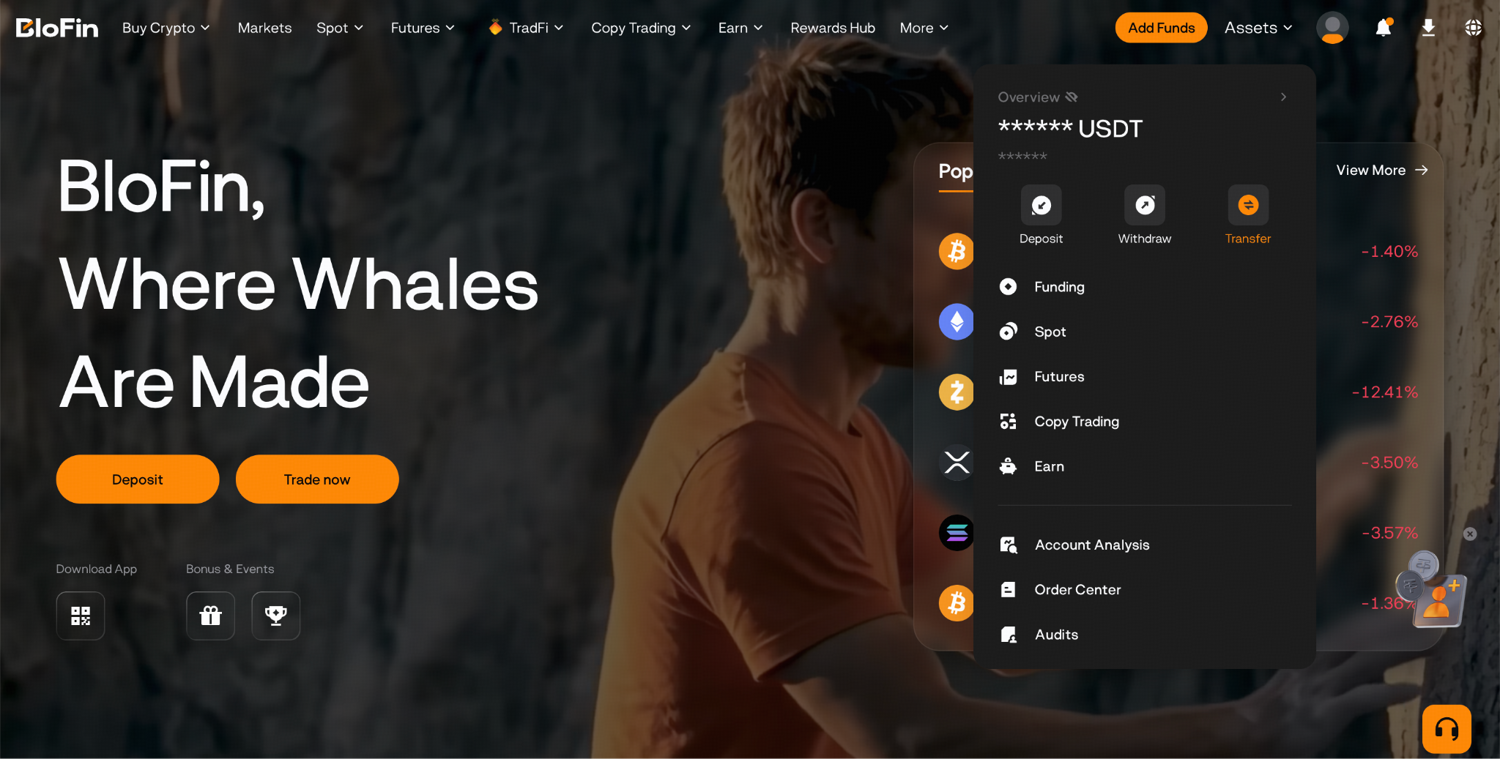
Step 2: Hover your cursor over the TradFi tab and select Futures.
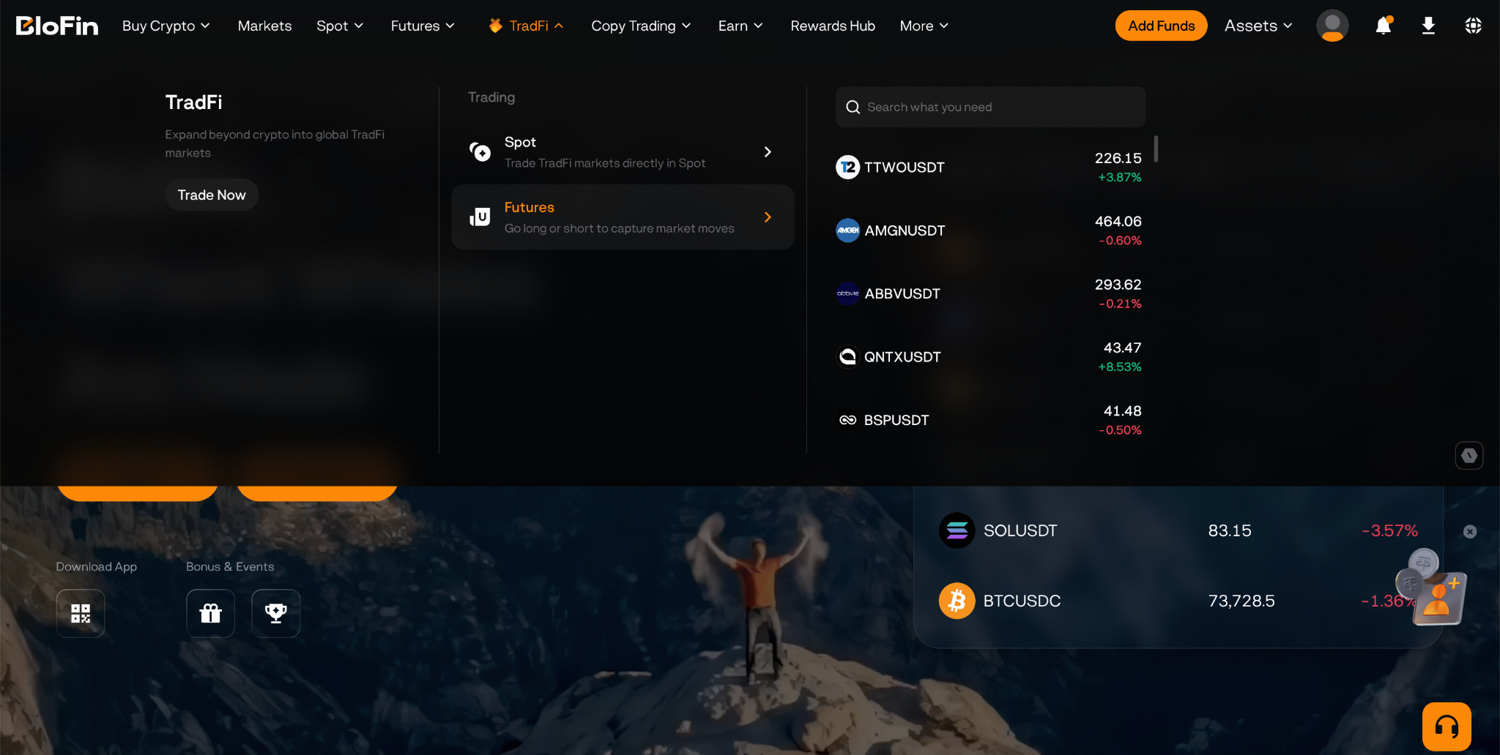
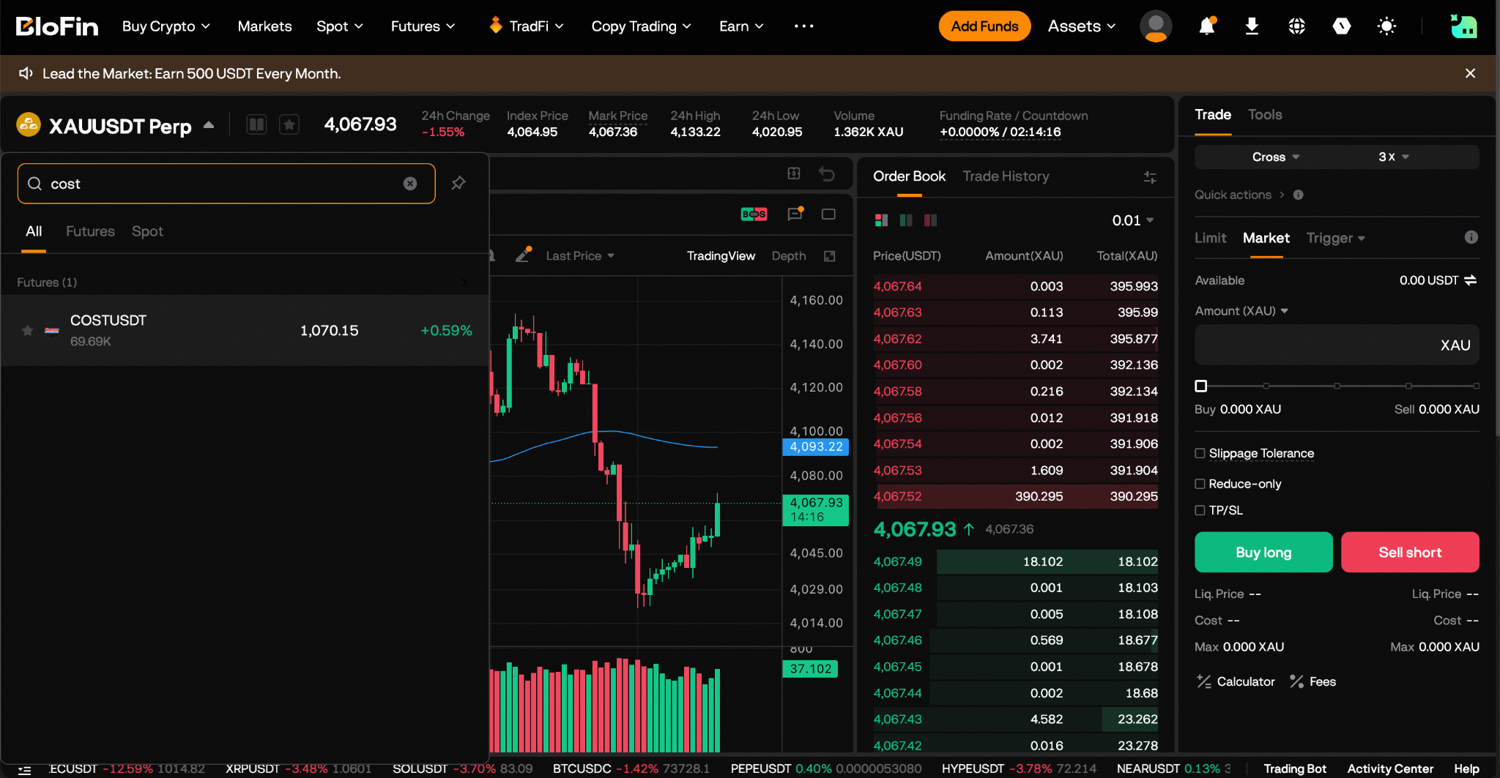
Step 3: Click on the trading pair at the top left corner and search for the stock, such as COST or KO.
Step 4: On the order panel, click the margin mode button, shown as Cross by default, to choose your margin mode, and click the leverage button beside it to set your leverage. Cross lets a losing position draw on the rest of your futures balance, while Isolated limits the loss to the margin you assign. Then choose Limit, which fills only at your price or better, or Market, which fills right away at the best price available, and enter your amount.
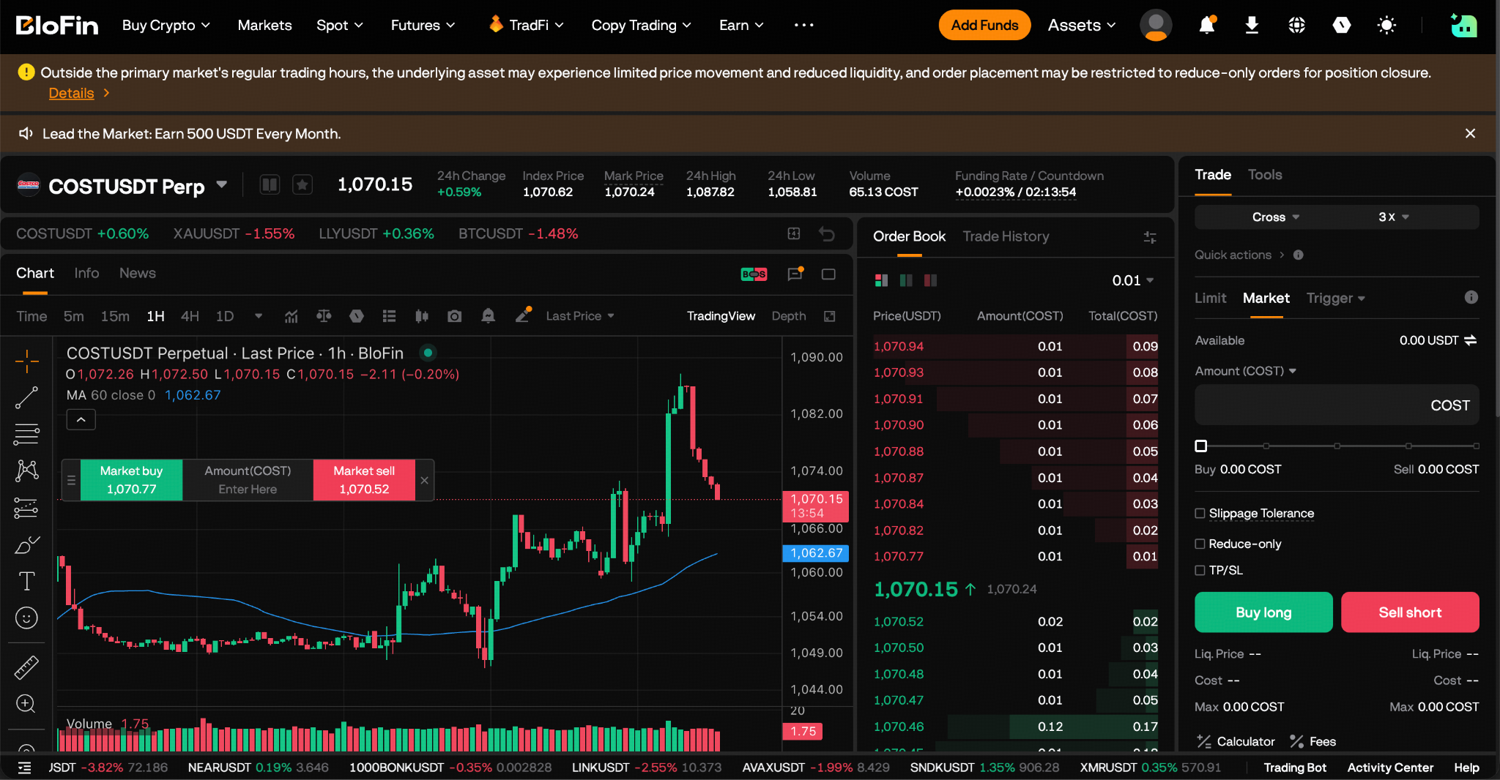
Step 5: Tick TP/SL and enter a stop-loss price. Before you click Buy to go long or Sell to go short, check Liq. Price and Cost. Your first trade on BloFin walks through the order screen in more detail. Your open trade then shows under Positions, and closing a trade on BloFin shows how to exit.
Looking to trade defensive stocks? To get started, you'll need to first create a BloFin account, fund your account with cryptocurrency, and navigate to the COSTUSDT Perpetual, KOUSDT Perpetual, VSTUSDT Perpetual or LLYUSDT Perpetual page.

Frequently asked questions
Are defensive stocks recession-proof?
Defensive stocks usually lose less in a downturn, but their prices still fall. In the Covid crash of early 2020, the staples fund lost about a quarter of its value and the utilities fund more than a third. The S&P 500 fund lost about a third (source: calculated from Yahoo Finance data). Their sales hold up in a recession, yet the shares can still drop when investors sell everything at once or when interest rates rise.
What are the best defensive stocks?
The largest defensive stocks by fund weight are Walmart, Costco and Procter & Gamble in staples. In healthcare they are Eli Lilly and Johnson & Johnson, and in utilities NextEra Energy and Southern Company (source: State Street, XLP, State Street, XLU, State Street, XLV). Which one suits you depends on what you want: the steadiest price, the highest dividend or the fastest growth. Even the steadiest of them can fall, so only invest money you can afford to lose. A low beta, steady earnings through past recessions and a dividend that has been raised over time are the usual signs of a defensive company.
Is Walmart a defensive stock?
Walmart is a consumer staples company and the largest holding in the staples fund, at 11.21% on November 9, 2026 (source: State Street, XLP). It held up far better than the market in the Covid crash, losing 2.5% from February 19 to March 23, 2020 (source: calculated from Yahoo Finance data). The S&P 500 fund lost 33.7% over those weeks, and Walmart's beta over the five years to November 10, 2026 is 0.39 (source: calculated from Yahoo Finance data). Its dividend yield is lower than many staples companies, at under 1%, because its share price has risen faster.
Are bank stocks defensive?
Bank stocks are cyclical. Banks lose money on loans when borrowers lose their jobs, so their earnings fall in a recession. In the Covid crash the financials fund fell 42.8%, while the S&P 500 fund fell 33.7% (source: calculated from Yahoo Finance data). Their five-year beta of 0.84 puts them far closer to the market than staples or utilities.
Do defensive stocks move with bitcoin?
Defensive stocks have moved almost independently of bitcoin. Over the three years to November 6, 2026, the weekly correlation between bitcoin and the staples fund was −0.10. For the utilities and healthcare funds it was close to zero, against 0.24 for both the S&P 500 and technology funds (source: calculated from Yahoo Finance data). A correlation near zero means that knowing bitcoin's direction in a given week told you almost nothing about theirs.
Researched and written by the BloFin Academy editorial team with AI-assisted drafting. All facts independently verified. Sources include Yahoo Finance, State Street, iShares, MSCI, S&P Dow Jones Indices, the US Treasury, CNBC, the Associated Press, Utility Dive and BloFin, current as of November 11, 2026.
Nothing in this article constitutes financial advice, and nothing in it is a recommendation to buy, sell or hold any stock, ETF or crypto asset. Defensive stocks still fall: the utilities fund lost 35.4% in the 2020 crash, staples and utilities fell further than the S&P 500 when bond yields jumped in 2023, and a single defensive company can lose a third of its value over years. Past betas, correlations and sell-off results do not predict future ones. Stock perpetuals pay no dividends and carry funding costs, trading may be limited to reduce-only orders outside regular market hours, and a leveraged position on a power producer such as Vistra can be liquidated in a single day. BloFin services are not available in restricted locations, including the United States. Past performance does not indicate future results. Do your own research and consider your risk tolerance before you trade on BloFin.