
People cut back on new sneakers, vacations and restaurant meals long before they stop buying toothpaste, milk and laundry detergent. The stock market splits shoppers' spending the same way, into consumer discretionary stocks, the companies selling things people want, and consumer staples stocks, the companies selling things people need. In 2026 the two groups have gone very different ways. To November 9, the main US staples fund returned 19.3% with dividends, while the main discretionary fund returned 2.0% and an S&P 500 fund 11.2% (source: calculated from Yahoo Finance data).
Then the mood flipped. On November 9 the S&P 500 had its best day since April 8, helped by a fall in oil prices and a rebound in tech shares (source: CNBC). The discretionary fund rose 2.9% and the staples fund 0.9% (source: calculated from Yahoo Finance data). Next week brings a direct test of shoppers, because Home Depot reports on November 17 (source: Home Depot) and Target on November 18 (source: Target).
Knowing which group a company sits in tells you a lot about how its shares are likely to behave when the economy changes. A discretionary stock tends to swing harder in both directions, and a staples stock tends to move less. That difference is also why traders compare the two groups to judge how much risk the market as a whole is willing to take.
BloFin lists USDT-settled perpetual contracts on five companies in the main discretionary fund, the AMZNUSDT Perpetual, TSLAUSDT Perpetual, MCDUSDT Perpetual, NKEUSDT Perpetual and CVNAUSDT Perpetual, which tracks the used-car seller Carvana. It also lists two staples, the KOUSDT Perpetual and COSTUSDT Perpetual. With any of them you can go long, which profits if the price rises, or short, which profits if it falls, from a crypto balance.

What are consumer discretionary stocks?
Consumer discretionary stocks are shares in companies selling goods and services people can put off when money is tight, such as cars, clothes, vacations, restaurant meals and home improvements. Amazon, Tesla, Home Depot and McDonald's are the largest examples in the S&P 500, and their sales tend to rise and fall with the economy.
The group belongs to a system called the Global Industry Classification Standard (GICS), which splits the stock market into 11 sectors. The State Street Consumer Discretionary Select Sector SPDR ETF, ticker XLY, is a fund that follows it. It holds the S&P 500's discretionary companies across industries from online retail and carmakers to hotels, restaurants, home improvement and clothing (source: State Street, XLY).
XLY is weighted by company size, so its biggest names dominate. On November 6, Amazon made up 22.56% of the fund and Tesla 16.53%, so two companies made up 39.1% of a 47-stock fund. Home Depot followed at 5.61%, McDonald's at 4.69% and TJX, the owner of TJ Maxx, at 3.86% (source: State Street, XLY). So when XLY moves, Amazon and Tesla usually account for a large part of it. By industry, hotels, restaurants and leisure made up 27.01% of the fund. Broadline retailers such as Amazon made up 23.84%, specialty retailers such as Home Depot and TJX 21.73%, and carmakers 19.76% (source: State Street, XLY).
The link to the economy is easiest to see in a household budget. Say you earn $6,000 a month and need to find $300 of savings after a rise in rent. The groceries, soap and electricity stay, while a weekend away, a new TV and two meals out go. Almost all of that $300 comes out of discretionary companies' sales, so their profits can fall faster than the economy as a whole.
What are consumer staples stocks?
Consumer staples stocks are shares in companies selling everyday goods people keep buying in good times and bad, such as food, drinks, cleaning products, toiletries and tobacco. Walmart, Costco, Procter & Gamble and Coca-Cola are the largest examples in the S&P 500, and their sales tend to hold up when the economy slows.
The State Street Consumer Staples Select Sector SPDR ETF, ticker XLP, follows the staples companies in the S&P 500. Those cover supermarkets and big-box retailers, household products, food, drinks, tobacco and personal care (source: State Street, XLP).
XLP is also weighted by size, but its weight is spread more evenly. On November 6, Walmart made up 11.29% of the fund and Costco 9.43%, followed by Procter & Gamble at 7.76%, Coca-Cola at 7.48% and Philip Morris International at 6.23%. Retailers selling mostly everyday goods made up 33.92% of the fund, the largest single industry. Next came drinks at 19.97%, household products at 18.34%, food at 15.38% and tobacco at 10.82% (source: State Street, XLP). The companies are smaller too. The largest in the staples index was worth about $997 billion on November 6, against about $2.8 trillion for the largest in discretionary (source: State Street, XLP, State Street, XLY).
Go back to the same household cutting $300 a month. Its weekly grocery bill barely shrinks, though it may switch some branded goods for cheaper store-brand versions sold by the supermarket. A switch like that can cost a brand owner such as Procter & Gamble sales while still leaving the money with a retailer such as Walmart or Costco. Staples sales still move with the economy, then, but much less than discretionary sales, and the pressure lands on different companies within the sector.
Consumer discretionary vs consumer staples: The main differences
The main difference is how much each group depends on the economy. Shoppers can delay a new sofa for a year, but they keep buying groceries, so discretionary sales and profits swing more, and so do the shares. Staples grow more slowly and tend to fall less in a sell-off, which is why investors call them defensive.
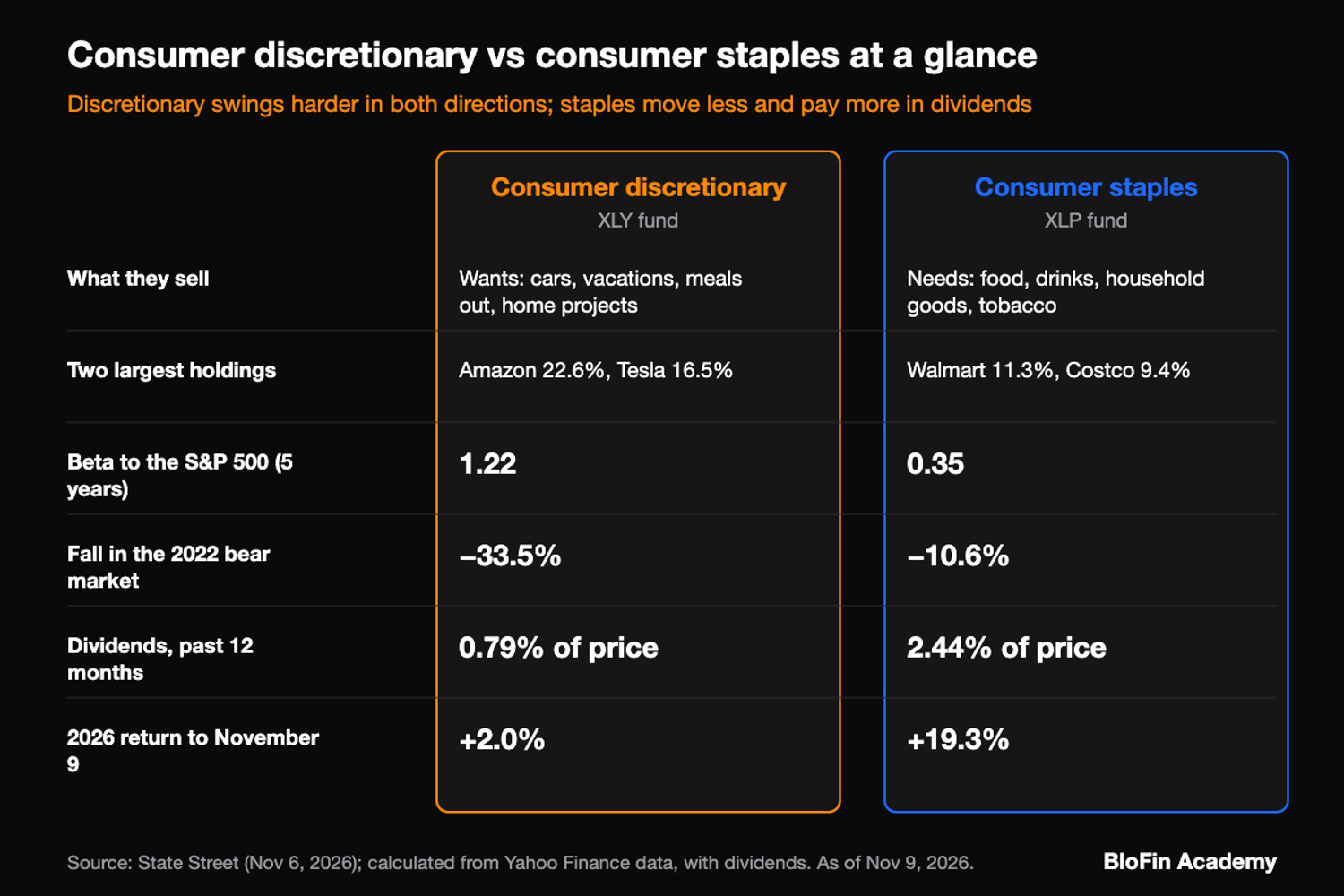
The two funds put numbers on that difference. Beta measures how much a stock tends to move when the market moves. A beta of 1.22 means XLY has moved about 1.22% for every 1% move in SPY, an S&P 500 fund, over the past five years of daily prices. XLP's beta was 0.35. Volatility, the size of typical price swings, was 24.2% a year for XLY and 14.0% for XLP, against 17.3% for SPY (source: calculated from Yahoo Finance data).
Measure | Consumer discretionary (XLY) | Consumer staples (XLP) |
|---|---|---|
Beta to SPY, five years to November 9, 2026 | 1.22 | 0.35 |
Volatility per year, same period | 24.2% | 14.0% |
Expected earnings growth per year, next 3 to 5 years | 19.31% | 8.34% |
Price-to-earnings ratio on forecast earnings for the coming year | 23.34 | 21.43 |
Dividends paid over the past 12 months, as a share of price | 0.79% | 2.44% |
Earnings, valuation and dividend figures are State Street's for November 6, 2026, and beta and volatility are calculated from Yahoo Finance data (source: State Street, XLY, State Street, XLP). The price-to-earnings ratio is the share price divided by a year's profit per share, so a higher figure means investors pay more for each dollar of profit. Investors are paying nearly as much for staples as for discretionary companies, even though analysts expect staples profits to grow at less than half the rate.
Is Costco consumer staples or discretionary?
Costco is a consumer staples stock, and it is the second-largest holding in XLP. Since March 2023, GICS has sorted retailers by what they mostly sell. One selling mostly food, household and personal care products goes into staples, while online retailers and marketplaces selling mostly discretionary goods stay in discretionary (source: MSCI and S&P Dow Jones Indices, GICS changes).
That rule explains some surprising neighbors. Walmart, Costco and Target are all XLP holdings, while Amazon is the largest holding in XLY. How Amazon and Walmart stock compare sets out how the two retailers make money. Coffee chains and restaurants such as Starbucks and McDonald's sit in discretionary, even though many people buy from them every day.
What moves consumer stocks?
Consumer stocks move with how much households are spending and how confident they feel about spending next. The figures traders watch most are retail sales, consumer sentiment surveys, the share of income people save, and the price of things that squeeze budgets, such as fuel and borrowing.
In 2026 those figures have pointed in different directions. US retail sales in September were 6.3% higher than a year earlier, or about 2.5% higher after adjusting for inflation, even though households told the University of Michigan they felt gloomier (source: FRED, consumer sentiment, FRED, retail sales, FRED, real retail sales, FRED, saving rate). These are the September readings next to a year earlier:
Measure | What it tells you | September 2025 | September 2026 |
|---|---|---|---|
Consumer sentiment, University of Michigan index | How confident households feel about money | 55.1 | 48.1 |
Retail sales in the month | What people spend in shops, restaurants and online | $700.9 billion | $745.0 billion |
Saving rate | The share of income households put aside | 5.1% | 3.8% |
In plain terms, people said they felt worse off and kept spending anyway, partly by saving less of what they earn. Sentiment has picked up a little since. The University of Michigan's preliminary November reading was 51.0, up from 48.0 in October and level with November 2025 (source: University of Michigan, Surveys of Consumers). Traders watch each new reading for signs of whether that spending can last.
Home Depot said in August that its second-quarter results beat its own expectations, with broad demand as customers kept taking on smaller projects. It also expected tariff refunds to partly offset unplanned fuel, energy and other costs (source: Home Depot, SEC filing). Interest rates matter too, since big purchases such as cars, kitchens and vacations are often paid for with loans or credit cards. Higher rates make that borrowing more expensive. The PCE report tracks what households spend each month, alongside the inflation measure the Federal Reserve prefers.
How do discretionary and staples stocks behave in a sell-off?
In four big US stock market falls since 2018, staples lost less than discretionary stocks, and in the three recoveries that followed, discretionary gained far more. These are the funds' returns with dividends over each fall and each recovery (source: calculated from Yahoo Finance data):
Period | What happened | XLY | XLP | SPY |
|---|---|---|---|---|
September 20 to December 24, 2018 | Late-2018 sell-off | −21.4% | −10.5% | −19.3% |
February 19 to March 23, 2020 | Covid crash | −33.5% | −24.2% | −33.7% |
March 23 to December 31, 2020 | Covid recovery | +84.8% | +41.8% | +69.8% |
January 3 to October 12, 2022 | 2022 bear market | −33.5% | −10.6% | −24.5% |
December 30, 2022 to December 29, 2023 | 2023 rebound | +39.6% | −0.8% | +26.2% |
February 19 to April 8, 2025 | Tariff sell-off | −21.8% | −5.9% | −18.8% |
April 8 to December 31, 2025 | Tariff recovery | +36.2% | +4.0% | +38.5% |
The Covid crash shows the limit of the defensive label. XLP still lost almost a quarter of its value in five weeks. A fast crash can still pull defensive shares a long way down. Staples protected you more in the slower fall of 2022, when XLP ended the calendar year down less than 1% against XLY's 36.3% loss (source: calculated from Yahoo Finance data).
The recoveries show the cost of that protection. Over the ten years from November 10, 2016, $10,000 in XLY grew to about $33,822 and $10,000 in XLP to about $23,507, with dividends reinvested. SPY turned $10,000 into $40,631 (source: calculated from Yahoo Finance data). Seven periods are a small sample, and the next fall may look different. Sector rotation tests whether defensive sectors hold up when tech falls.
Why have consumer staples beaten discretionary in 2026?
In 2026 staples have beaten discretionary partly because XLP's biggest holdings rose strongly while Tesla, XLY's second-largest holding, fell. To November 9, with dividends, Coca-Cola returned 40.0%, Costco 24.4%, Procter & Gamble 20.9% and Walmart 13.5%, and Target, a smaller XLP holding, 74.4% (source: calculated from Yahoo Finance data).
On the discretionary side, Tesla, about a sixth of XLY, fell 15.9%, Nike 35.8% and Booking Holdings 23.1%. Amazon returned 15.6%, which kept the fund from falling further (source: calculated from Yahoo Finance data). Because XLY leans so heavily on two companies, a bad year for Tesla can outweigh good news across dozens of smaller holdings. Say you hold $10,000 of XLY and use Tesla's November weight of about 16.5% as a rough guide. That slice is worth about $1,650, and a 15.9% fall on it costs about $262. That is 2.6% of the whole holding, more than the fund's entire 2.0% return for the year.
Both consumer groups have risen since early October, and staples kept their lead. From October 5 to November 9, XLY returned 9.6% and XLP 12.2%, while the technology fund XLK lost 15.0% and SPY 2.9%. Home Depot gained 25.7%, Lowe's 30.1% and McDonald's 20.8% in that time (source: calculated from Yahoo Finance data). Tech's fall is part of that story, and the Magnificent 7 stocks explains how much the largest tech names weigh on the S&P 500.
To follow the two sides of that gap, BloFin's KOUSDT Perpetual tracks Coca-Cola, the best performer among XLP's five largest holdings in 2026. Its TSLAUSDT Perpetual tracks Tesla, XLY's biggest drag.
How to read the discretionary-to-staples ratio
The discretionary-to-staples ratio is XLY's price divided by XLP's price, and traders use it as a quick gauge of risk appetite. StockCharts describes it as a go-to chart for that purpose (source: StockCharts). A rising line means investors are paying up for the riskier group, and a falling line means they prefer the safer one.
You can work it out yourself. On November 9, XLY closed at $121.01 and XLP at $90.89, so the ratio was 121.01 ÷ 90.89, or about 1.33. Adjusted for the 2-for-1 split XLY made on December 5, 2025, the ratio's highest close in ten years came on November 3, 2025, at about 1.60. It has fallen 16.8% since, which shows staples beating discretionary over the past year (source: calculated from Yahoo Finance data). Its lowest close in those ten years came on March 21, 2017, at about 0.78. Even after the fall, it sits well above where the decade began.
A change in the ratio translates directly into the gap between the two funds. If it rose from 1.33 to 1.40, XLY would have gained about 5% more than XLP over that time, whatever the market as a whole did. A falling ratio can mean discretionary is falling faster, or staples rising faster, so check both prices before you read anything into it.
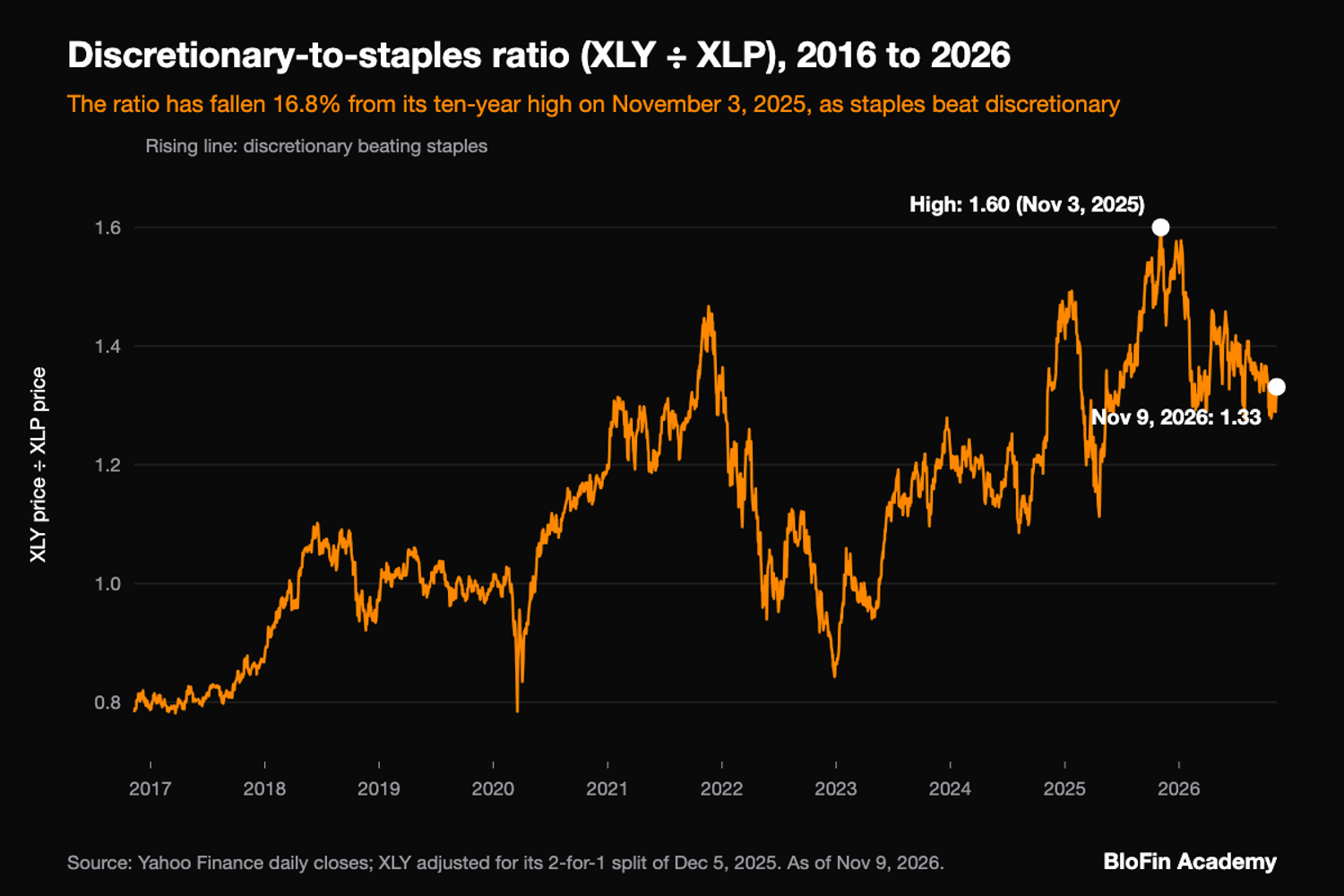
The ratio has limits. It compares two concentrated funds, so a move in Amazon or Tesla can push it around whatever the rest of the sector is doing. It also tells you what happened, never what will happen next. In 2022 it fell along with the whole market, and in 2026 it has fallen while SPY rose. The same signal has come with very different markets.
What to watch in Home Depot and Target earnings
Home Depot, a discretionary stock and XLY's third-largest holding, reports its third quarter on November 17, with a webcast at 9AM ET, or 2PM UTC (source: Home Depot). Target, an XLP holding, holds its third-quarter call at 8AM ET, or 1PM UTC, on November 18 (source: Target). Together they show how shoppers are treating both big projects and everyday baskets.
The two calls arrive about 23 hours apart, one from each fund. The figure to watch first is comparable sales, the change in sales at stores and websites open for at least a year. It strips out growth from new stores. Say you run a chain whose established stores sold $100 million last year and $102 million this year, while new openings lift total sales by 6%. Your comparable sales rose 2%, and that is the number analysts compare with their forecasts. In its second quarter, to August 2, Home Depot's sales rose 5.7% to $47.9 billion and its comparable sales rose 1.7%. It kept its forecast of flat to 2.0% comparable sales growth for the whole year (source: Home Depot, SEC filing). A cut to that forecast would point to a weaker shopper, and a raise to a stronger one.
Retail results can move the shares sharply in a single day, and the move depends on what investors expected as much as on the numbers. Home Depot had already gained 25.7% from October 5 to November 9 (source: calculated from Yahoo Finance data), so investors may already expect good results. Earnings season explained covers how to read a results day.
How to invest in consumer discretionary and staples stocks
You can hold consumer stocks in three main ways: buying shares in single companies through a broker, buying a sector fund, or trading a contract that follows the price. A fund spreads your money across the whole group, so a bad result at one company matters less.
Fund | What it holds | Holdings on November 6, 2026 | Annual fee | 2026 return to November 9 |
|---|---|---|---|---|
Consumer Discretionary Select Sector SPDR ETF (XLY) | S&P 500 discretionary companies, weighted by size | 47 | 0.08% | +2.0% |
Consumer Staples Select Sector SPDR ETF (XLP) | S&P 500 staples companies, weighted by size | 34 | 0.08% | +19.3% |
Fund details are State Street's, and returns include dividends (source: State Street, XLY, State Street, XLP, calculated from Yahoo Finance data). Both charge 0.08% a year, or $8 on every $10,000 invested. A standard S&P 500 fund already holds every company in both, so adding XLY or XLP raises your share of that sector rather than adding something new. Using the November 6 weights, each $1,000 in XLY puts about $226 into Amazon and $165 into Tesla, while each $1,000 in XLP puts about $113 into Walmart and $94 into Costco (source: calculated from State Street weights).
State Street publishes the full list of holdings for both funds every day, so you can check what each one holds (source: State Street, XLY, State Street, XLP).
To buy single shares instead, you open an account with a stock broker, search for the ticker and place an order. Measures such as beta, expected earnings growth and dividend payout are a starting point for comparing one company with its sector.
How to trade consumer stocks on BloFin
BloFin lists USDT perpetuals on Amazon, Tesla, McDonald's, Nike and Carvana, all XLY holdings, and on Coca-Cola and Costco from XLP, each with leverage of up to 20x. It has no contract on Walmart, Home Depot, Procter & Gamble or Target, or on the XLY and XLP funds.
Each of these contracts tracks the stock's price and never expires. Because you own a contract rather than shares, you receive no dividends and have no vote. That matters more for a dividend payer such as Coca-Cola than for Amazon. Long and short traders also swap a regular payment called funding, which BloFin currently settles every eight hours, so it can cost or pay you for as long as the position stays open. Outside regular weekday trading hours, and on weekends and market holidays, trading may be limited to reduce-only orders, which means you can close or shrink a position but not open or add to one (source: BloFin, stock futures trading hours).
Leverage lets you hold a position larger than the money you put up, which is called margin, and it makes a calm stock risky. Say you open a 1,000 USDT long on the KOUSDT Perpetual at 5x, which ties up 200 USDT of margin. At about $96, Coca-Cola's November 9 close, that comes to about 104 contracts of 0.1 share each. If Coca-Cola repeats its 8.5% fall from February 27 to April 22, 2026, you lose about 85 USDT before fees and funding, or over 40% of your margin (source: calculated from Yahoo Finance data). How to trade Tesla with leverage runs the same sums on one of the most volatile consumer stocks.
A discretionary stock can do far worse. McDonald's fell 32.3% from February 27 to October 7, 2026, so a 5x long on isolated margin would have been liquidated before the price had fallen 20% (source: calculated from Yahoo Finance data). Setting a stop-loss on BloFin exits the trade at a price you choose beforehand, and how leverage and liquidation work explains what happens when the margin is used up.
How to open a consumer stock perpetual on BloFin
Step 1: Create your BloFin account and send USDT to it. A deposit lands in your Funding Account, so move the USDT to your Futures Account with Transfer, found under Assets.

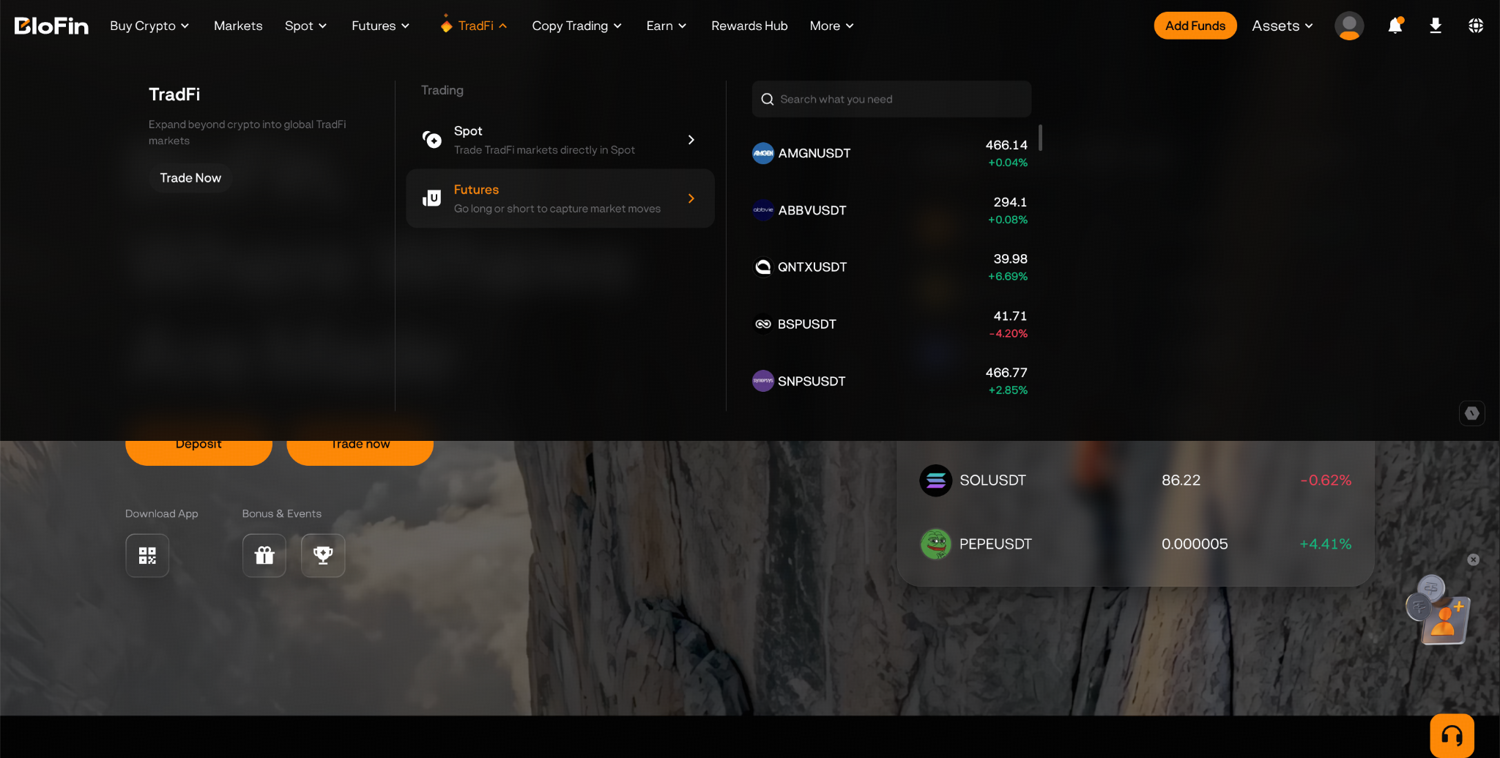
Step 2: Hover your cursor over the TradFi tab and select Futures.
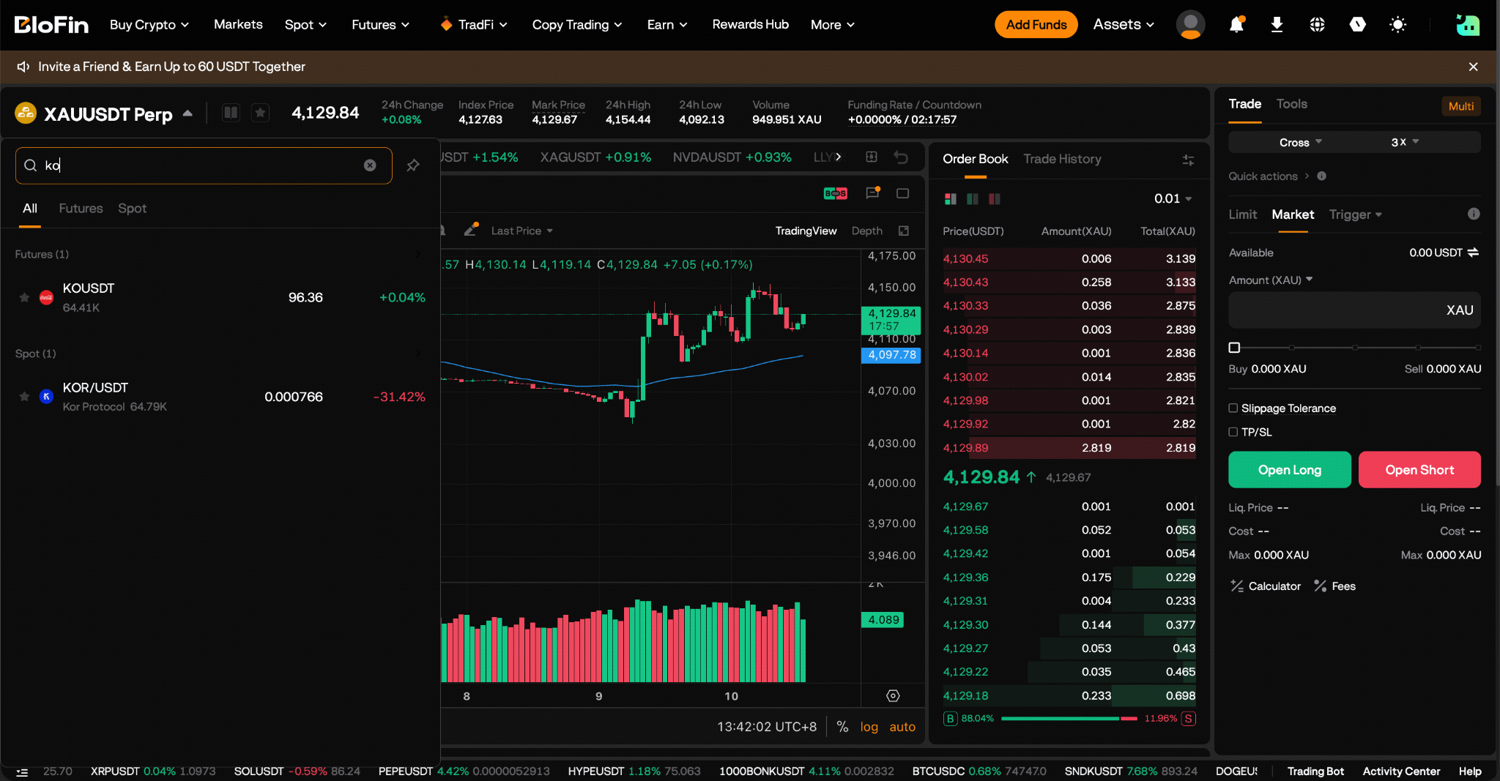
Step 3: Click on the trading pair at the top left corner and search for the stock, such as KO or MCD.
Step 4: On the order panel, click the margin mode button, shown as Cross by default, to choose your margin mode, and click the leverage button beside it to set your leverage. Cross lets a losing position draw on the rest of your futures balance, while Isolated limits the loss to the margin you assign. Then choose Limit, which fills only at your price or better, or Market, which fills right away at the best price available, and enter your amount.
Step 5: Tick TP/SL and enter a stop-loss price. Before you click Buy to go long or Sell to go short, check Liq. Price and Cost. Your first trade on BloFin walks through the order screen in more detail. Your open trade then shows under Positions, and closing a trade on BloFin shows how to exit.
Looking to trade consumer stocks? To get started, you'll need to first create a BloFin account, fund your account with cryptocurrency, and navigate to the AMZNUSDT Perpetual, TSLAUSDT Perpetual, MCDUSDT Perpetual, NKEUSDT Perpetual, CVNAUSDT Perpetual, KOUSDT Perpetual or COSTUSDT Perpetual page.

Frequently asked questions
Is consumer discretionary a good investment?
It may suit someone who wants more exposure to consumer spending and can sit through large falls. Discretionary stocks tend to gain most when the economy grows, and they fall hardest when shoppers cut back. XLY lost 36.3% in 2022 and gained almost 40% in 2023, with dividends, so its good years and bad years are both large (source: calculated from Yahoo Finance data). Because Amazon and Tesla make up almost two-fifths of the fund, buying it is largely a view on those two companies. As with any investment, only commit what you can afford to lose.
Are consumer staples stocks recession-proof?
Consumer staples stocks tend to fall less than the market, but they still fall. XLP lost 24.2% in the Covid crash of February and March 2020, against about a third for an S&P 500 fund, and about a tenth in the late-2018 sell-off (source: calculated from Yahoo Finance data). Their sales hold up better than most in a downturn, but their share prices still drop when investors sell in a panic.
Do consumer staples pay higher dividends than consumer discretionary?
Usually, yes. Over the 12 months to November 6, 2026, XLP paid out 2.44% of its price in dividends, about three times XLY's 0.79% (source: State Street, XLP, State Street, XLY). Part of the gap sits at the top of XLY: Amazon and Tesla pay no dividend, so almost two-fifths of the fund earns nothing in payouts.
Do consumer stocks move with bitcoin?
Only loosely. Over the three years to November 6, 2026, the correlation between weekly returns of XLY and bitcoin was 0.27, and for XLP it was −0.10. A correlation of 1 would mean they moved in lockstep, 0 would mean no link, and a negative figure means they tended to move in opposite directions (source: calculated from Yahoo Finance data). An S&P 500 fund scored 0.24, so discretionary stocks track bitcoin about as closely as the market does.
Is consumer cyclical the same as consumer discretionary?
Broadly, yes. Some data providers use the words cyclical and defensive as sector names, and Yahoo Finance's consumer cyclical and consumer defensive sectors cover broadly the same companies as consumer discretionary and consumer staples (source: Yahoo Finance, consumer cyclical, Yahoo Finance, consumer defensive). Cyclical describes how discretionary sales rise and fall with the economy, and defensive describes how staples sales hold steadier in a downturn.
Researched and written by the BloFin Academy editorial team with AI-assisted drafting. All facts independently verified. Sources include Yahoo Finance, State Street, the St. Louis Fed (FRED), the University of Michigan, MSCI and S&P Dow Jones Indices, a Home Depot SEC filing, Home Depot and Target investor relations, CNBC, StockCharts and BloFin, current as of November 10, 2026.
Nothing in this article constitutes financial advice, and nothing in it is a recommendation to buy, sell or hold any stock, ETF or crypto asset. Consumer staples are called defensive, but XLP still lost 24.2% in the 2020 crash, and a discretionary fund leaning on Amazon and Tesla can swing much further. Past sector returns, betas and correlations do not predict future ones. Stock perpetuals pay no dividends and carry funding costs, trading may be limited to reduce-only orders outside regular market hours, and even a 5x position on a steady staple can lose most of its margin or be liquidated. BloFin services are not available in restricted locations, including the United States. Past performance does not indicate future results. Do your own research and consider your risk tolerance before you trade on BloFin.