
People keep filling prescriptions, seeing doctors and paying insurance premiums whether the economy is booming or slowing. That steady demand is why investors treat healthcare companies as a shelter when markets turn rough. The week of the US midterm elections in November 2026 put that reputation on show. On November 4, the day after the vote, the main US healthcare fund rose 3.1% to the highest close in its history. The next day an AI sell-off took the S&P 500 down 4.4%, its worst day since April 2025. The healthcare fund fell 2.5% and the technology fund 8.0% (source: calculated from Yahoo Finance data, AP via BNN Bloomberg).
Politics now sits close to the center of the story. CNBC reported that the healthcare fund jumped 3% the day after Election Day, and that the outlook for the sector is less certain once a Democratic Congress takes over (source: CNBC). This year to November 9, that fund has returned 23.2% with dividends, about double the S&P 500 fund's 11.2% (source: calculated from Yahoo Finance data). Two years earlier the picture was the reverse, and healthcare spent 2023 and 2024 trailing the S&P 500 by a wide margin.
Knowing what sits inside the sector, and what makes each part of it rise or fall, explains both of those stretches. A drugmaker, a health insurer and a maker of surgical robots all count as healthcare stocks, but they answer to different news, from trial results to government payment rates.
BloFin lists USDT-settled perpetual contracts on six of the 60 companies in the main healthcare fund. They are the LLYUSDT Perpetual on Eli Lilly, the ABBVUSDT Perpetual on AbbVie, the MRKUSDT Perpetual on Merck, the UNHUSDT Perpetual on UnitedHealth, the AMGNUSDT Perpetual on Amgen and the MRNAUSDT Perpetual on Moderna.
What are healthcare stocks?
Healthcare stocks are shares in companies that make medicines, run hospitals and health insurance plans, build medical devices, or supply the labs and software behind them. In the US the group is one of the 11 sectors of the S&P 500, and it includes Eli Lilly, Johnson & Johnson, UnitedHealth and Abbott Laboratories among its largest names.
The sectors come from a system called the Global Industry Classification Standard (GICS), which MSCI and S&P Dow Jones Indices developed to sort companies by their main business (source: MSCI, GICS). The State Street Health Care Select Sector SPDR ETF, ticker XLV, is an exchange-traded fund (ETF) that holds the healthcare companies in the S&P 500. It splits them into six industries: pharmaceuticals, biotechnology, healthcare providers and services, healthcare equipment and supplies, life sciences tools and services, and healthcare technology (source: State Street, XLV).
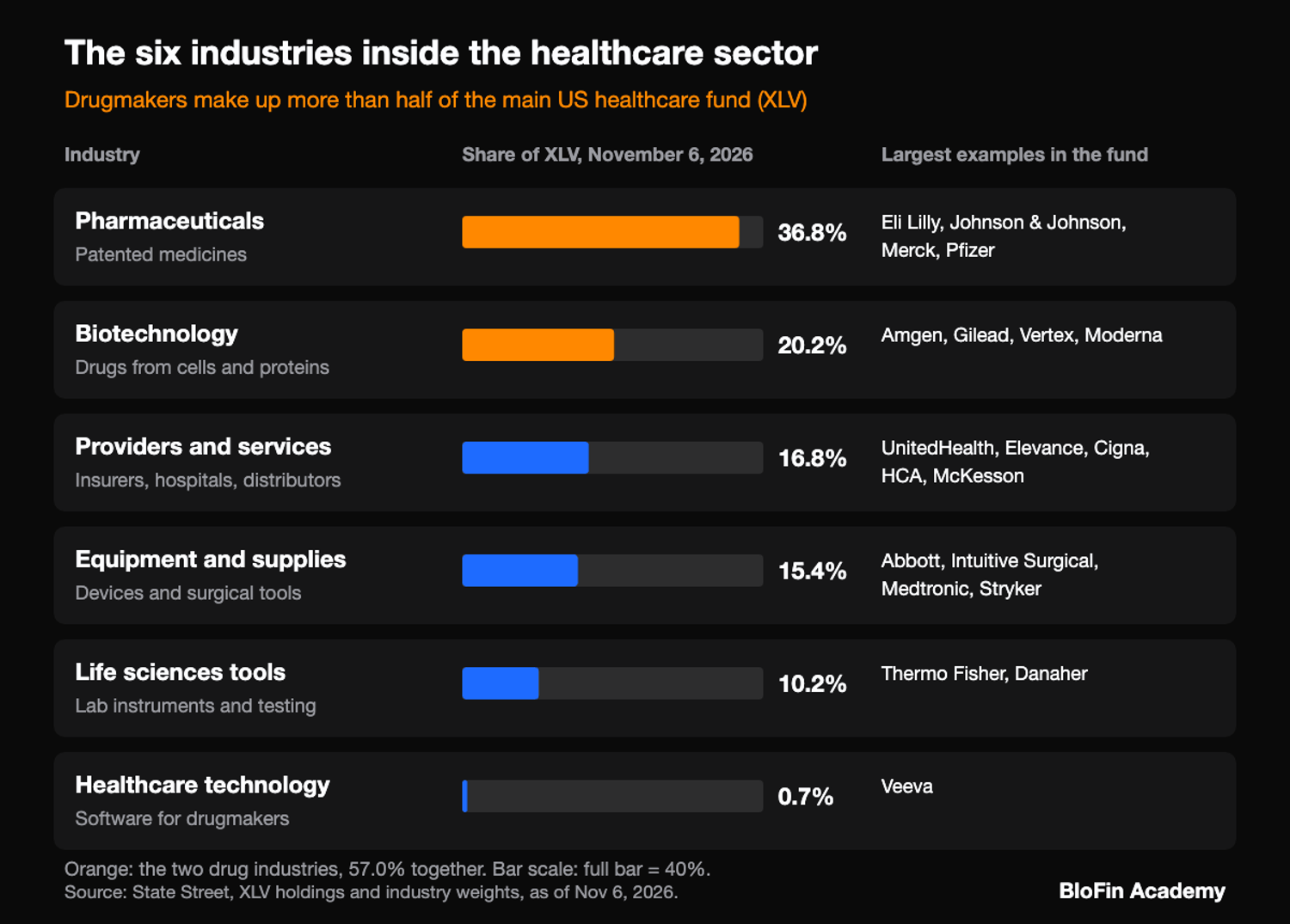
Pharmaceutical companies such as Lilly, Johnson & Johnson, Merck and Pfizer made up 36.82% of XLV on November 6, and they earn most of their money from patented medicines. Biotechnology companies such as Amgen, Gilead, Vertex and Moderna made up 20.18%. They build drugs from living cells and proteins, and the smaller ones often depend on a single product still in trials. Providers and services, at 16.81%, covers the health insurers UnitedHealth, Elevance and Cigna, the hospital group HCA and drug distributors such as McKesson. Equipment and supplies, at 15.35%, covers Abbott, Intuitive Surgical, Medtronic, Stryker and Boston Scientific. Life sciences tools, at 10.17%, covers Thermo Fisher and Danaher, which sell lab instruments and testing gear to drugmakers and hospitals, and healthcare technology makes up the last 0.68% (source: State Street, XLV).
A single doctor's visit shows how these industries connect. Say you see your doctor, who orders a blood test and prescribes a weight-loss drug. The clinic may sit inside an insurer's network, and the test runs on equipment from a tools company. The prescription is made by a drugmaker and shipped by a distributor, and your insurer pays most of the bill. Each of those companies is a healthcare stock, yet their profits depend on different things. The drugmaker needs its patent, the insurer needs its members' care to cost less than their premiums, and the distributor needs volume through its warehouses.
What are the largest healthcare stocks?
The largest healthcare stocks in the US are Eli Lilly, Johnson & Johnson, AbbVie, Merck and UnitedHealth. XLV weights its holdings by company size, so on November 6 Lilly alone made up 16.17% of the fund. The ten largest companies together made up 60.43% of a fund holding 60 stocks (source: State Street, XLV).
Company | Share of XLV on November 6, 2026 | Return in 2026 to November 9, with dividends |
|---|---|---|
Eli Lilly | 16.17% | 32.0% |
Johnson & Johnson | 9.93% | 38.5% |
AbbVie | 7.68% | 32.2% |
Merck | 5.40% | 44.2% |
UnitedHealth | 5.28% | 22.8% |
Thermo Fisher Scientific | 3.83% | 24.9% |
Amgen | 3.71% | 45.0% |
Gilead Sciences | 3.09% | 40.4% |
Abbott Laboratories | 2.84% | −9.6% |
Pfizer | 2.50% | 25.3% |
(source: State Street, XLV, calculated from Yahoo Finance data)
That much weight in one company means XLV moves a lot with Lilly. Multiply the 16.17% weight by the 32.0% gain and you get about 5.2 percentage points, so roughly a fifth of the fund's 23.2% return in 2026 came from one stock. The sum is approximate because the weight shifted during the year as the share price rose, but the point holds: buying XLV is partly a bet on weight-loss and diabetes drugs. Third-quarter revenue at Lilly rose 39% to $24.4 billion, driven mainly by its diabetes drug Mounjaro and its weight-loss drug Zepbound. The company also raised its 2026 revenue forecast to between $91.0 billion and $92.0 billion (source: Eli Lilly, SEC filing).
Size also changes how a company behaves. Johnson & Johnson sells medicines and surgical devices across the world, so one failed trial barely dents it. Moderna, at 1.41% of XLV on November 6, can double or halve on a single result. A list of the largest names tells you who drives the fund. It tells you little about which healthcare stock suits you, because the largest companies have little in common beyond the sector label. The Magnificent 7 stocks show the same concentration at a larger scale, where seven companies carry a big share of the whole S&P 500.
To follow the fund's largest holding directly, BloFin's LLYUSDT Perpetual tracks Eli Lilly, and its UNHUSDT Perpetual tracks UnitedHealth, the largest insurer in XLV.
Why are healthcare stocks called defensive?
Healthcare stocks are called defensive because demand for medicines, treatment and insurance holds up when the economy slows, so their prices follow the market less closely. Over the five years to November 9, 2026, XLV's beta was 0.53: for each 1% move in the S&P 500, it tended to move about 0.5% (source: calculated from Yahoo Finance data).
Beta shows how much of the market's move a stock or fund tends to follow. A beta of 1 means it moves in step, above 1 means it tends to move further than the market and below 1 means it follows less of the move. Over the same five years the technology fund XLK had a beta of 1.39 and the consumer staples fund XLP 0.35. Volatility measures how widely a price swings from day to day, quoted as a yearly figure, and it shows a smaller gap. XLV's was about 15.4%, against 17.3% for an S&P 500 fund and 26.5% for XLK (source: calculated from Yahoo Finance data). Healthcare's own daily swings are nearly as large as the market's; what is smaller is how much of the market's move it follows.
The reason is simple. A family that loses income cuts back on holidays and new cars long before it stops buying insulin or skips cancer treatment. Much of the bill is also paid by insurers and government programs such as Medicare, which keep paying through a recession. A drugmaker's sales of an approved medicine can grow for years until its patent runs out. Consumer staples are defensive for a similar reason, since people keep buying food and soap in a downturn, and the two sectors often lead together when investors grow nervous.
The label also has a cost. Over the ten years from November 10, 2016, $10,000 in XLV grew to about $31,112 with dividends reinvested, while $10,000 in an S&P 500 fund grew to about $40,631 (source: calculated from Yahoo Finance data). A smaller fall in bad years usually comes with a smaller gain in good ones, so a defensive sector tends to lag a strong bull market.
How did healthcare stocks do in past sell-offs?
Healthcare stocks fell less than the market in each of the four big sell-offs since 2018, but they still fell, and XLV lost 27.9% in the Covid crash of 2020. On November 5, 2026, it fell 2.5% while the S&P 500 fund lost 4.4% (source: calculated from Yahoo Finance data).
Sell-off | S&P 500 fund (SPY) | Healthcare fund (XLV) | Technology fund (XLK) |
|---|---|---|---|
Late-2018 sell-off, September 20 to December 24, 2018 | −19.3% | −13.9% | −22.7% |
Covid crash, February 19 to March 23, 2020 | −33.7% | −27.9% | −31.2% |
2022 bear market, January 3 to October 12, 2022 | −24.5% | −11.6% | −33.1% |
Tariff sell-off, February 19 to April 8, 2025 | −18.8% | −8.8% | −25.7% |
AI sell-off, November 5, 2026 (one day) | −4.4% | −2.5% | −8.0% |
Returns include dividends (source: calculated from Yahoo Finance data). Each multi-week period runs from the S&P 500 fund's closing peak to its closing low.
The Covid crash is the warning in that record. When investors sold almost everything at once in March 2020, healthcare fell nearly as far as the market. Defensive stocks protected far better in the slower sell-off of 2022. Rising interest rates hit fast-growing tech companies hardest that year, and healthcare lost less than half as much as the S&P 500 fund.
Single stocks inside the sector did not always follow the fund. Lilly rose 20.7% in the 2022 bear market but fell 16.2% in the 2025 tariff sell-off, almost twice XLV's drop. UnitedHealth fell 35.9% in the Covid crash and then gained 8.7% in the 2025 sell-off (source: calculated from Yahoo Finance data). Four sell-offs are a small sample, and the next one may look different.
The years after a fall show the other side. In 2023 and 2024 together, XLV returned 4.6% with dividends while the S&P 500 fund returned 57.6% (source: calculated from Yahoo Finance data), as investors piled into AI companies. Holding the defensive sector through a bull market can mean watching most of the gains happen elsewhere.
Why single healthcare stocks can still crash
A defensive sector can hold stocks that swing as hard as tech stocks, because the fund's calm comes from spreading money across 60 businesses. In the year to November 9, 2026, XLV's volatility, a yearly measure of how widely a price swings, was about 17.0%, against 35.4% for Lilly and about 195% for Moderna (source: calculated from Yahoo Finance data).
UnitedHealth is the clearest recent example. The largest US health insurer fell 62.0% between November 11, 2024 and August 1, 2025, from $625.25 to $237.77 a share (source: calculated from Yahoo Finance data). It has since recovered by about 67%, to $397.62 on November 9, 2026 (source: calculated from Yahoo Finance data). In the third quarter of 2026 its medical cost ratio, the share of premiums spent on members' care, improved to 88.4%, and it raised its full-year profit forecast (source: UnitedHealth, SEC filing).
The gap between winners and losers inside the sector is wide in 2026. To November 9, Moderna has returned 812.2%, Merck 44.2% and Amgen 45.0%, while Abbott lost 9.6%, Intuitive Surgical 18.7% and Boston Scientific 53.8% (source: calculated from Yahoo Finance data). In October, Boston Scientific cut its forecast for the third time in the year. A cyberattack had shut down its ordering, manufacturing and shipping for a time, costing about $150 million in sales. It now expects revenue to grow 4.25% in 2026, down from an earlier 5.5% to 6.5% (source: MedTech Dive).
Say you had split $1,000 equally between Boston Scientific and Moderna at the start of 2026. The $500 in Boston Scientific would be worth about $231, and the $500 in Moderna about $4,561, a spread no fund holder ever sees. Nobody can tell in advance which stocks will end up at either extreme. That is why a fund is the usual way to own the sector, and why the defensive label describes the group far better than any one company in it.
What moves healthcare stocks?
Healthcare stocks move on four kinds of news: drug trial results and patents, government payment rates, the politics of drug prices, and quarterly earnings. Each hits a different part of the sector, so a day that lifts insurers can leave drugmakers flat.
Kind of news | Part of the sector it hits first | Example from 2026 |
|---|---|---|
Government payment rate | Health insurers | 2027 Medicare Advantage proposal, January 27 |
Drug trial result | Biotech and drugmakers | Moderna and Merck melanoma vaccine, August 19 |
Quarterly earnings | The reporting company | Lilly third-quarter results, October 29 |
Election and drug-price politics | Insurers and drugmakers | Midterm results, November 4 |
The size of a move depends on how much of a company's future rides on the news. A trial result can decide whether a drug ever reaches patients, so a biotech company with one main product can double or lose most of its value in a day. The same news barely moves a drugmaker selling dozens of approved medicines. Payment rates matter most to insurers, because Medicare Advantage is a core source of profit for the big health insurers (source: Axios). Politics works more slowly, through the odds of a future rule, and earnings move each stock on how its results compare with what investors expected. Most days, several of these forces pull on different parts of the sector at once, which is part of why the fund as a whole moves less than its members. Before you buy or trade a single healthcare stock, it helps to know which of the four it depends on most. Find out, too, when its next big date falls: a trial result, a payment-rate notice or an earnings report.
Drug trials and patents
Human trials of a new drug typically run in three phases, from small early studies to phase 3 studies of 300 to 3,000 patients that test whether it works (source: US Food and Drug Administration). Phase 3, the largest, often decides whether years of research pay off. On August 19, 2026, Moderna and Merck reported a phase 3 result for their personalized cancer vaccine, given with the Merck immunotherapy drug Keytruda. In a trial of more than 1,100 patients, it cut the return of melanoma, a skin cancer (source: Forbes). Moderna closed 177.0% higher that day (source: calculated from Yahoo Finance data), from $62.96 to $174.38, and Merck rose 12.6%. Patents work in the other direction. When a best-selling drug's patent expires, cheaper copies called generics can enter the market, and the original maker's sales from that drug usually fall fast.
Government payment rates
The US government is one of the biggest payers in healthcare, through Medicare, mainly for people aged 65 and over, and Medicaid for people on low incomes. Many seniors buy private Medicare Advantage plans, which the government pays insurers to run, so the yearly payment rate goes straight to insurers' profits. On January 27, 2026, the government proposed raising those payments by an average of 0.09% for 2027, after a rise of more than 5% for 2026. Health insurers' shares dropped sharply (source: Axios). UnitedHealth closed down 19.6% and Humana 21.1% that day (source: calculated from Yahoo Finance data). For UnitedHealth, the fall was made worse by disappointing fourth-quarter revenue and a weak 2026 outlook from the company itself (source: Axios).
Drug prices and politics
Drug prices are a political issue in the US, and elections change the odds of new limits on what drugmakers can charge. Democrats are set to take control of Congress after the November 3 midterm elections, and a Mizuho analyst told CNBC that the change may make it harder for healthcare stocks to keep rising (source: CNBC). The first reaction was mixed by industry: on November 4, Elevance rose 4.9%, Cigna 3.4%, Merck 3.9% and Johnson & Johnson 3.8% (source: calculated from Yahoo Finance data). A new law takes months or years, so a share price reacts to how likely a rule now looks, well before anything changes.
Earnings
Every three months each company reports its sales and profits, and the share price moves on how those compare with what investors expected. Shares in Lilly rose 6.6% on October 29, the day it reported its 39% jump in third-quarter revenue and raised its revenue forecast (source: calculated from Yahoo Finance data, Eli Lilly, SEC filing). For insurers the number to watch is the medical cost ratio, and for drugmakers it is sales of their biggest drugs. Earnings season explains how the reports work and why a strong quarter can still send a stock lower.
Why have healthcare stocks led in 2026?
Healthcare stocks have led in 2026 because their biggest companies delivered strong results while investors moved money out of AI stocks. From October 5 to November 9, XLV returned 12.5% while XLK lost 15.0% and the S&P 500 fund 2.9%. In the year to date, XLV's 23.2% is ahead of XLK's 19.1% (source: calculated from Yahoo Finance data).
Say you had put $10,000 into XLV and $10,000 into XLK on October 5. By November 9 the healthcare fund would be worth about $11,250 and the tech fund about $8,500, a gap of $2,750 in five weeks (source: calculated from Yahoo Finance data).
Three things came together. The weight-loss drug boom kept lifting Lilly, the fund's largest holding. UnitedHealth showed that its costs were back under control. And the Moderna and Merck vaccine result sent Moderna up 177% in a single day. Over the same stretch, tech stocks fell on worries that the AI data-center boom could slow now that borrowing money has become so expensive (source: AP via BNN Bloomberg). Many investors moved toward businesses whose sales depend less on AI.
That last move is called sector rotation, the movement of money from one part of the market to another as investors change their view of what comes next. Healthcare also started from a low base, since it had trailed the S&P 500 by a wide margin in 2023 and 2024. A low starting point helps a rebound, but it says nothing about where the rebound stops.
The election week added one more test. Healthcare rose with the rest of the market on November 4 and fell less than it on November 5, which is what a defensive sector is expected to do. What Congress actually does on drug prices and insurance will take longer to show, and the stocks will move on each step.
How to invest in healthcare stocks
The simplest way to invest in healthcare stocks is a sector fund such as XLV, which holds 60 companies for a yearly fee of 0.08% (source: State Street, XLV). You can also buy a biotech fund, which swings harder, or pick single companies, any one of which can crash on its own news.
Biotech funds show how much the choice of fund matters. Over the five years to November 9, 2026, the iShares Biotechnology ETF (IBB) returned 43.0% with dividends and the SPDR S&P Biotech ETF (XBI) 22.8%, against 53.4% for XLV. Their volatility ran at 22.6% and 32.7% a year, against XLV's 15.4% (source: calculated from Yahoo Finance data). Biotech has done better in 2026, with IBB up 30.2% and XBI 28.8%, but over five years those funds carried more risk for less return.
Single stocks need more work. Say you split $1,000 between Lilly and UnitedHealth at the end of 2024. By November 9, 2026, with dividends, the $500 in Lilly would be worth about $926. The $500 in UnitedHealth more than halved by August 2025 and, after its recovery, would be worth about $411 (source: calculated from Yahoo Finance data). The same sector and the same starting date gave opposite results, so the outcome depended almost entirely on which company you picked. Before buying a single healthcare stock, find out which of its products bring in most of the money and when their patents expire. It also helps to know how much of its revenue depends on government programs.
Healthcare also sits beside other parts of the market you may already hold. An S&P 500 fund already holds every company in XLV, so buying both adds to a position you have. Bank stocks and consumer stocks respond to interest rates and spending, while healthcare responds more to trials and policy, which is why investors often hold it alongside them.
How to trade healthcare stocks on BloFin
BloFin lists USDT perpetuals on Eli Lilly, AbbVie, Merck, UnitedHealth, Amgen and Moderna, each with leverage of up to 20x and a contract size of 0.01 share. Those six companies made up 39.65% of XLV on November 6 (source: State Street, XLV).
BloFin has no contract on Johnson & Johnson, the fund's second-largest holding, on Pfizer or Abbott, or on the XLV fund. A fund holder is spread across 60 companies, while a perpetual holder is tied to one, so each contract carries that company's own trial, policy and earnings risk.
Each perpetual tracks its company's share price and has no expiry date. You hold a contract and own no shares, so you get no votes or dividends, which matters for dividend payers such as AbbVie and Merck. Funding, a regular payment between traders who are long and short, is paid at set intervals, so it costs or pays you for as long as you hold. Outside regular weekday trading hours, and on weekends and market holidays, trading may be limited to reduce-only orders, which means you can reduce or close a position but cannot open a new one or add to it (source: BloFin, stock futures trading hours).
Leverage lets you hold a position larger than the money you put up, which is called margin, and on a healthcare stock it turns news risk into liquidation risk. Say you open a 1,000 USDT long on the UNHUSDT Perpetual at 5x, which ties up 200 USDT of margin. At about $398, UnitedHealth's November 9 close, that comes to about 251 contracts of 0.01 share each. If the stock repeats its 19.6% fall of January 27, 2026, you lose about 196 USDT before fees and funding, almost all of your margin (source: calculated from Yahoo Finance data). On isolated margin the position would most likely be liquidated before the loss got that far, because liquidation happens while some margin is still left.
Moderna shows the risk in the other direction. It moved more than 10% in a single day 16 times in the year to November 9. Even at 2x on the MRNAUSDT Perpetual, each of those days moved your margin by more than 20%. A short position held through August 19, when the price nearly tripled, would have been wiped out (source: calculated from Yahoo Finance data). A stop-loss on BloFin closes the position at a price you set in advance, though a stock that gaps past your stop fills at the next available price.
How to open a healthcare stock perpetual on BloFin
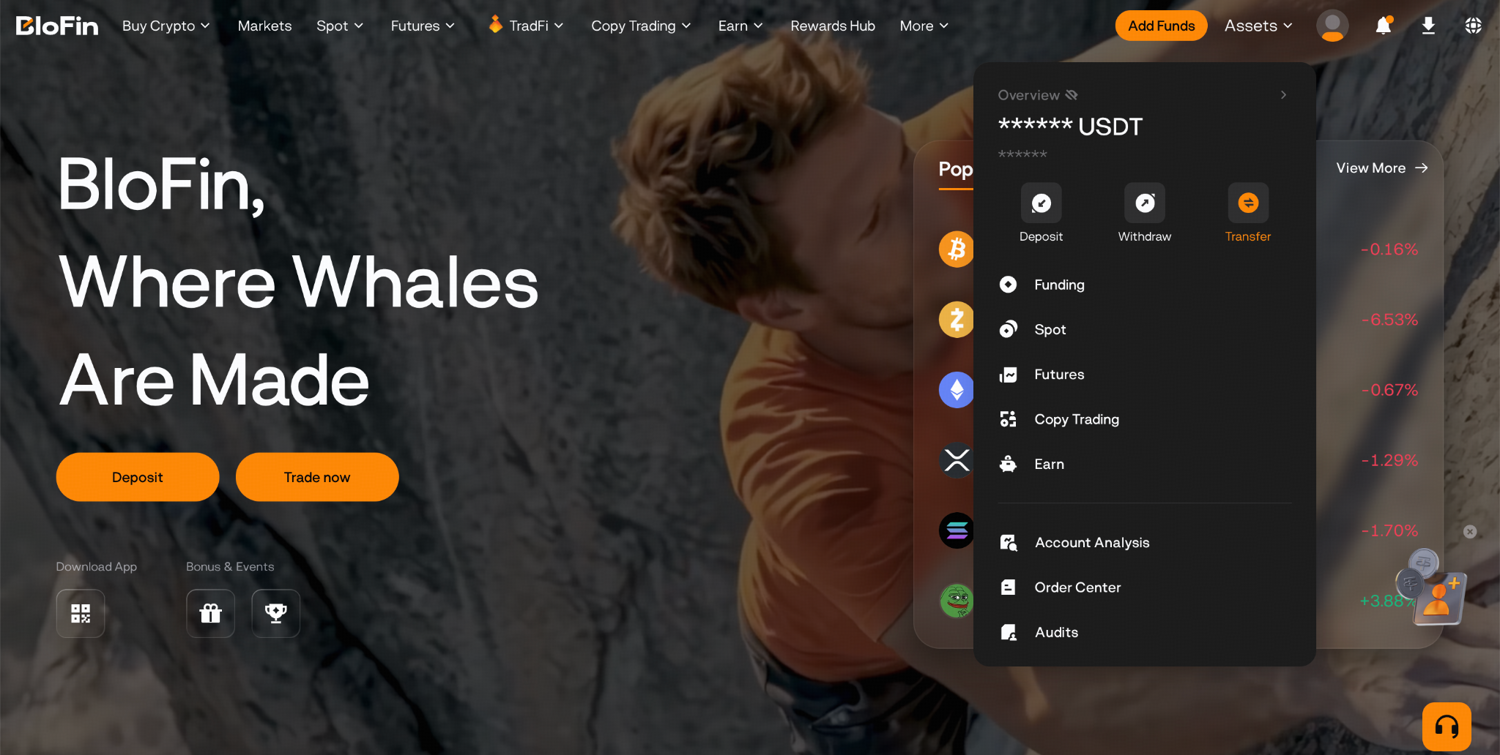
Step 1: Create your BloFin account and send USDT to it. A deposit lands in your Funding Account, so move the USDT to your Futures Account with Transfer, found under Assets.
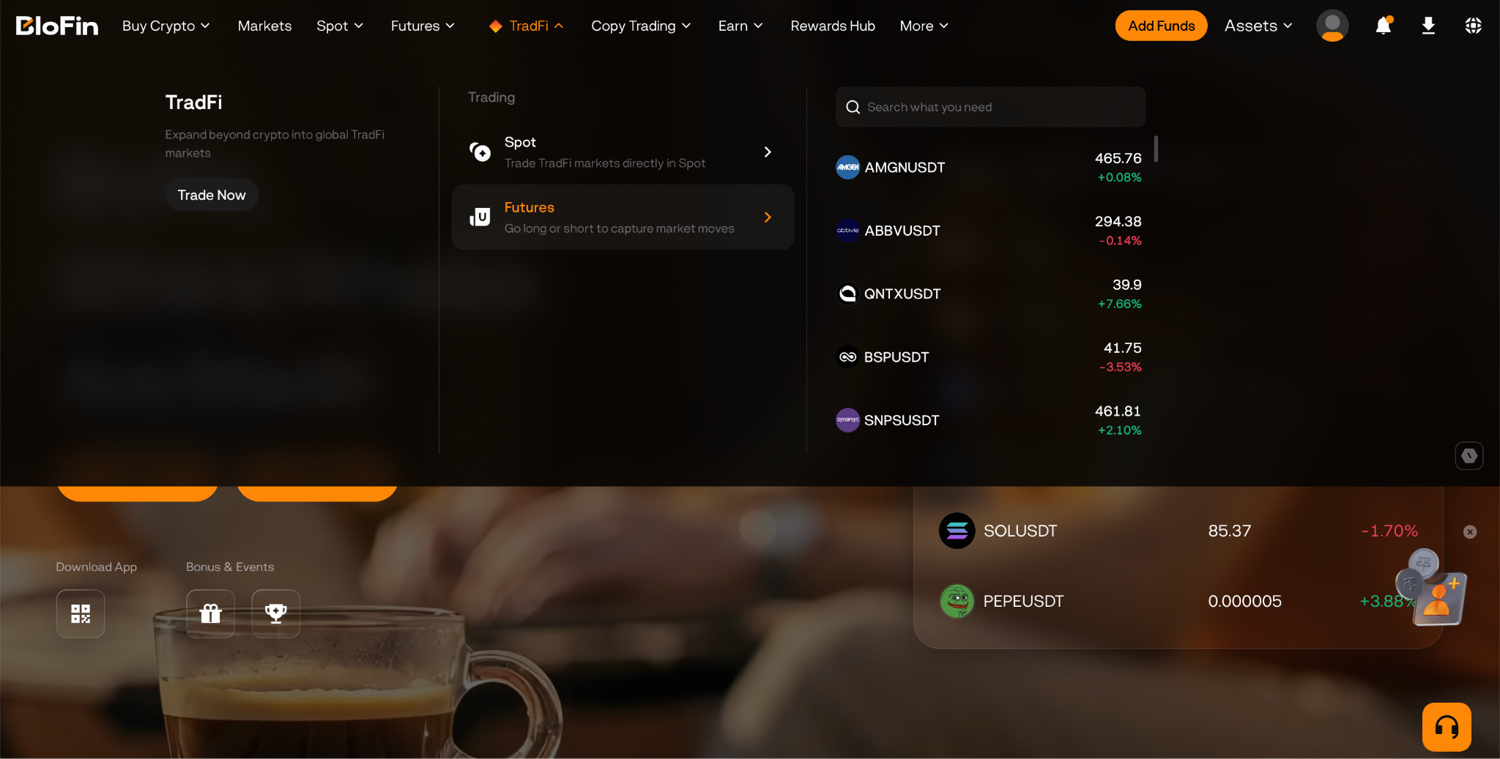
Step 2: Hover your cursor over the TradFi tab and select Futures.
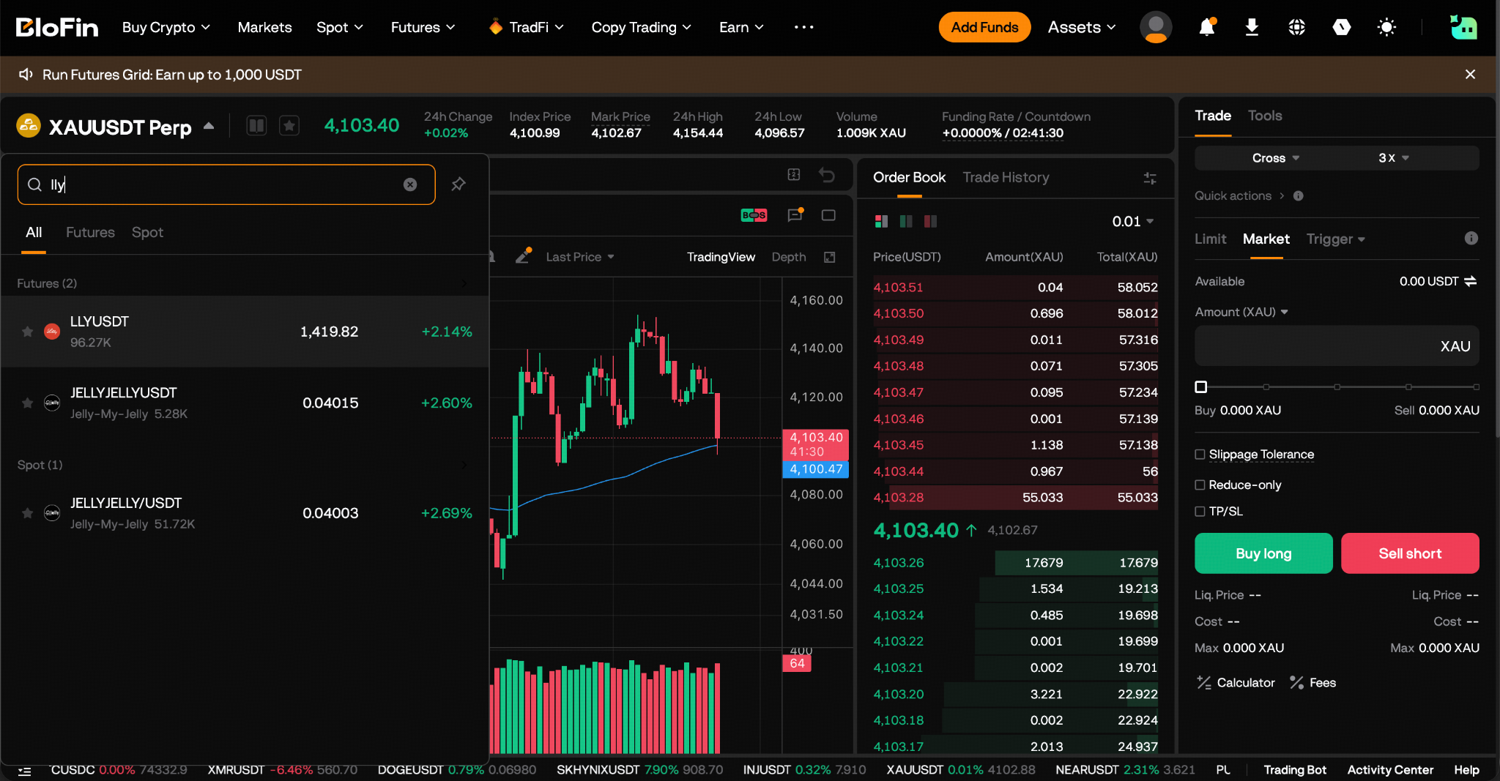
Step 3: Click on the trading pair at the top left corner and search for the stock, such as LLY or UNH.
Step 4: On the order panel, click the margin mode button, shown as Cross by default, to choose your margin mode, and click the leverage button beside it to set your leverage. Cross lets a losing position draw on the rest of your futures balance, while Isolated limits the loss to the margin you assign. Then choose Limit, which fills only at your price or better, or Market, which fills right away at the best price available, and enter your amount.
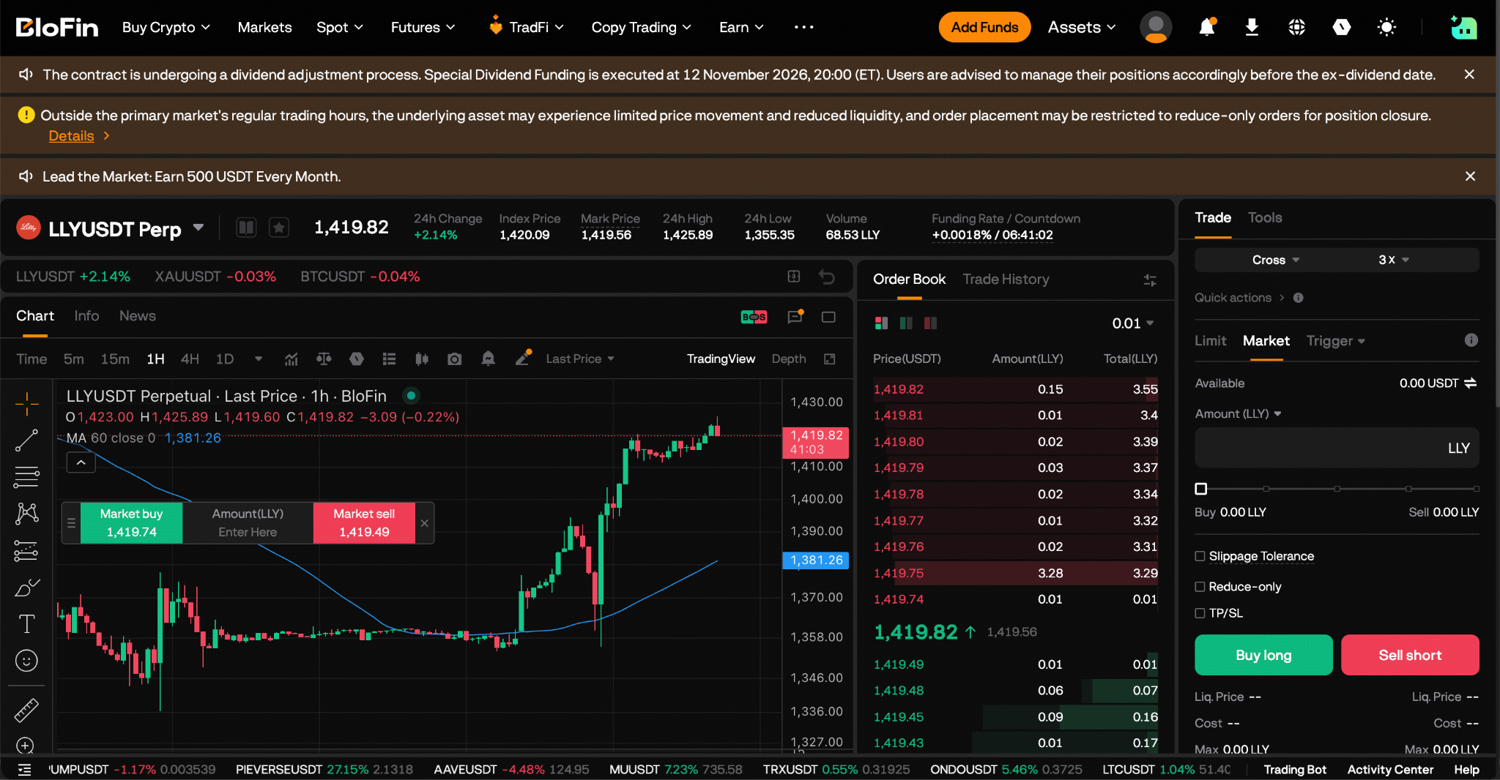
Step 5: Tick TP/SL and enter a stop-loss price. Before you click Buy to go long or Sell to go short, check Liq. Price and Cost. Your first trade on BloFin walks through the order screen in more detail. Your open trade then shows under Positions, and closing a trade on BloFin shows how to exit.
Looking to trade healthcare stocks? To get started, you'll need to first create a BloFin account, fund your account with cryptocurrency, and navigate to the LLYUSDT Perpetual, ABBVUSDT Perpetual, MRKUSDT Perpetual, UNHUSDT Perpetual, AMGNUSDT Perpetual or MRNAUSDT Perpetual page.

Frequently asked questions
Are healthcare stocks a good investment right now?
That depends on what you need them to do. XLV has returned 23.2% in 2026 to November 9 and reached a record close on November 4. Across 2023 and 2024, though, it returned 4.6% while an S&P 500 fund returned 57.6% (source: calculated from Yahoo Finance data). Healthcare tends to hold up in sell-offs and lag in strong bull markets, so it suits an investor who wants smaller swings more than one chasing the biggest gains. Whatever you choose, only invest money you can afford to lose.
Are healthcare stocks recession-proof?
No stock is recession-proof, and healthcare companies differ in how well they hold up. In the late-2018 sell-off Eli Lilly rose 1.1% while UnitedHealth fell 12.3%, and in the 2020 crash Lilly fell 15.5% and Johnson & Johnson 24.9% (source: calculated from Yahoo Finance data). Sales of medicines and insurance hold up when jobs are lost, but a share price can still fall when investors sell everything at once.
Do healthcare stocks pay dividends?
Many large healthcare companies pay dividends, and XLV paid out 1.38% of its price over the 12 months to November 6, 2026, more than an S&P 500 fund's 1.0% (source: State Street, XLV, calculated from Yahoo Finance data). The payouts vary widely. The last four quarterly payments came to about 5.9% of the share price at Pfizer, 2.4% at AbbVie and 1.9% at Johnson & Johnson. Lilly paid about 0.5%, because its dividend is small next to its share price.
Do healthcare stocks move with bitcoin?
Hardly at all. Over the three years to November 6, 2026, the correlation between weekly returns of XLV and bitcoin was 0.01, so close to zero that bitcoin's weekly moves said nothing about where the fund went. An S&P 500 fund scored 0.24 and Moderna 0.31 (source: calculated from Yahoo Finance data). For a crypto trader, healthcare is one of the few parts of the stock market whose weekly moves have had almost nothing to do with bitcoin's.
What is the difference between pharma and biotech stocks?
Pharmaceutical companies are usually large firms selling many approved medicines, while biotech companies build drugs from living cells and proteins and are often smaller, with fewer products and more riding on trials. That difference shows up in the funds: over five years to November 9, 2026, the biotech fund XBI was about twice as volatile as XLV (source: calculated from Yahoo Finance data). Some large biotech companies, such as Amgen and Gilead, now behave much like big drugmakers.
Researched and written by the BloFin Academy editorial team with AI-assisted drafting. All facts independently verified. Sources include Yahoo Finance, State Street, MSCI, Eli Lilly and UnitedHealth SEC filings, CNBC, the Associated Press, Axios, Forbes, MedTech Dive, the US Food and Drug Administration and BloFin, current as of November 10, 2026.
Nothing in this article constitutes financial advice, and nothing in it is a recommendation to buy, sell or hold any stock, ETF or crypto asset. Healthcare is called defensive, but XLV still lost 27.9% in the 2020 crash, and single healthcare stocks can halve or triple on one trial result, one payment-rate decision or one quarter's costs. Past sector returns, betas and correlations do not predict future ones. Stock perpetuals pay no dividends and carry funding costs, trading may be limited to reduce-only orders outside regular market hours, and a leveraged position on a healthcare stock can be liquidated in a single day of news. BloFin services are not available in restricted locations, including the United States. Past performance does not indicate future results. Do your own research and consider your risk tolerance before you trade on BloFin.